Basic Ethical Principles in
Experimental Research
Prepared by:
Orlando A. Pistan, MAEd-GC
Psychology Instructor
Basic Ethical Principles in
Experimental Research
The American
Psychological
Association have issued
ethical guidelines for
researchers involving
human participants and
animal subjects.
Human Participants
Responsibility.
The researcher should be responsible for protecting the rights
of human participants.
Establish objectives.
The researcher must establish the objectives of the research
and reach an agreement with participants prior to their
participation. Both participants and researcher must clarify the
obligations and responsibilities of each.
Human Participants
Informed consent.
Full awareness must be given to the participants regarding
the purpose of the experiment and must not use concealment
or deception.
Respect freedom.
The researcher must respect the individual’s freedom to
decline participation or withdraw from the experiment at
anytime.
Human Participants
Protection from harm.
Researchers must assist participants from physical and
mental discomfort and any changes that may arise from the
study.
Confidentiality.
Results and findings must be maintained to protect indue
invasion of privacy.
Animal Participants
Moral and Legal standard.
Researchers must abide to established laws and ordinances
and guidelines for the care and handling of animals.
Students are encouraged to select animals that are small
and manageable.
Animal Participants
The presence of qualified supervisors should be ensured so
that the students are trained in the care and handling of
animals.
The basic daily needs of each animal shall be of prime
concern. There must be special arrangement made during
weekends, holidays and vacation to protect animals from
sources of disturbance or harm.
Animal Participants
When the research experiment has been completed, the
supervisor is responsible for proper disposition of the
animals.
No student shall inflict pain, severe deprivation, or high
distress to the animals. All projects must be conducted in
accordance with American Psychological Association (APA)
principles for the care and use of animals.
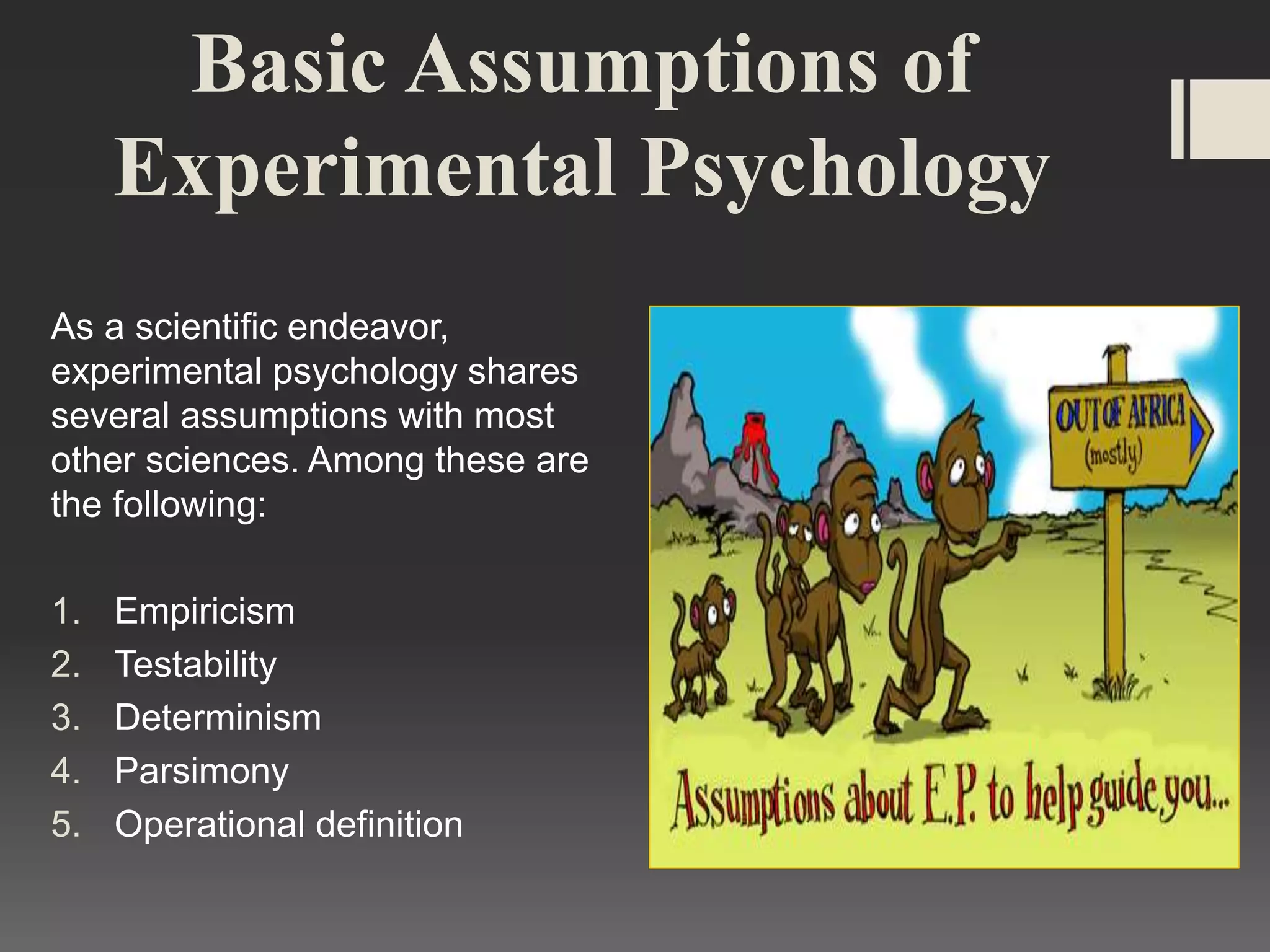
Basic Assumptions of
Experimental Psychology
As a scientific endeavor,
experimental psychology shares
several assumptions with most
other sciences. Among these are
the following:
1. Empiricism
2. Testability
3. Determinism
4. Parsimony
5. Operational definition
Empiricism
Perhaps the most basic
assumption of psychological
science is that factual
statements about the world
must ultimately be based on
observations of the world.
This notion
of empiricism requires that
hypotheses and theories be
tested against observations
of the natural world rather
than on a prior reasoning,
intuition, or revelation.
Testability
Closely related to empiricism is the
idea that, to be useful, a scientific
law or theory must be testable with
available research methods. If a
theory cannot be tested in any
conceivable way then many
scientists consider the theory to be
meaningless. Testability
implies falsifiability, which is the
idea that some set of observations
could prove the theory to be
incorrect.
Testability has been emphasized in
psychology because influential or
well-known theories like those of
Freud have been difficult to test.
Determinism
Experimental psychologists, like
most scientists, accept the notion
of determinism.
This is the assumption that any
state of an object or event is
determined by prior states. In other
words, behavioral or mental
phenomena are typically stated in
terms of cause and effect. If a
phenomenon is sufficiently general
and widely confirmed, it may be
called a "law"; psychological
theories serve to organize and
integrate laws.
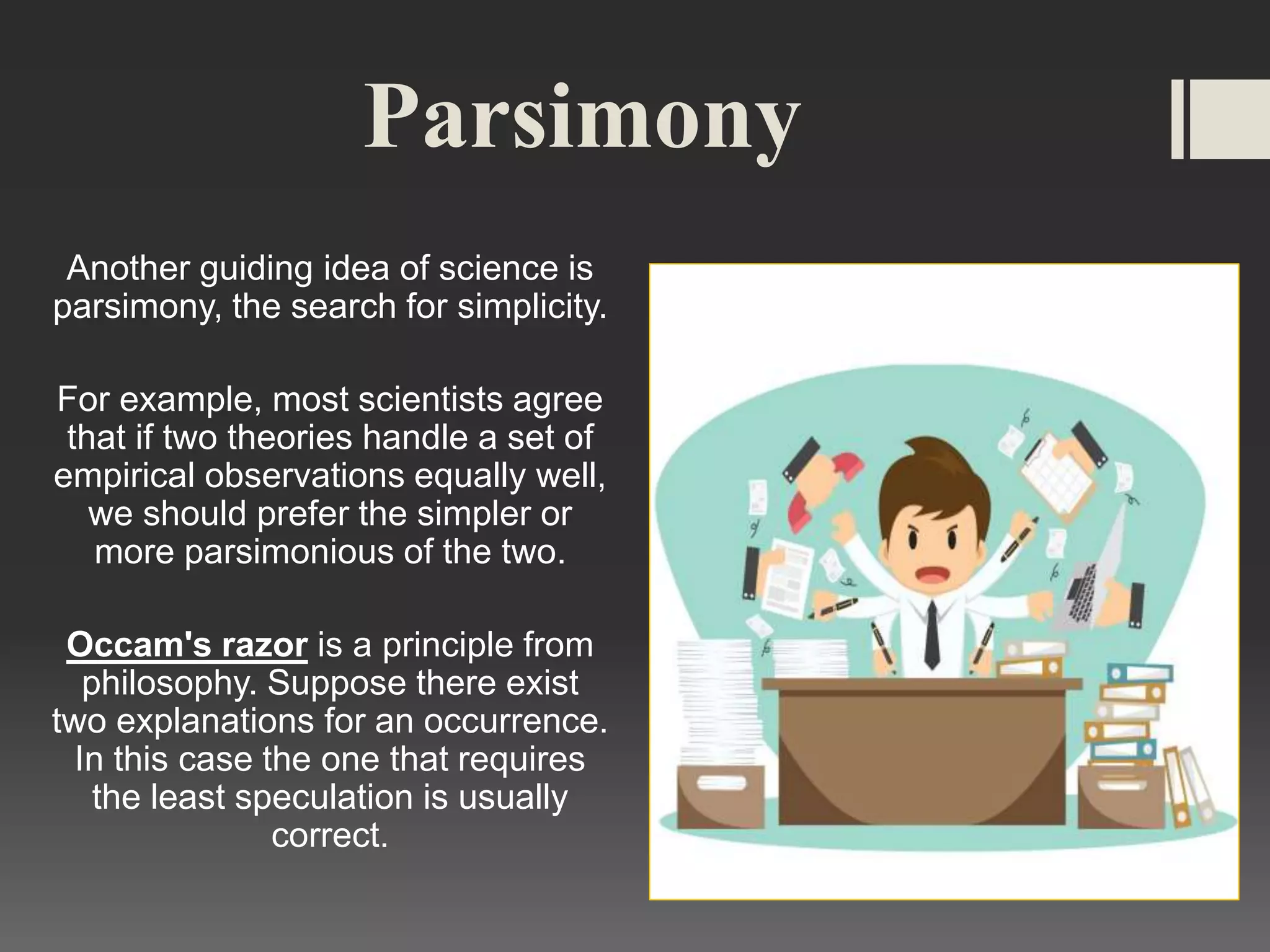
Parsimony
Another guiding idea of science is
parsimony, the search for simplicity.
For example, most scientists agree
that if two theories handle a set of
empirical observations equally well,
we should prefer the simpler or
more parsimonious of the two.
Occam's razor is a principle from
philosophy. Suppose there exist
two explanations for an occurrence.
In this case the one that requires
the least speculation is usually
correct.
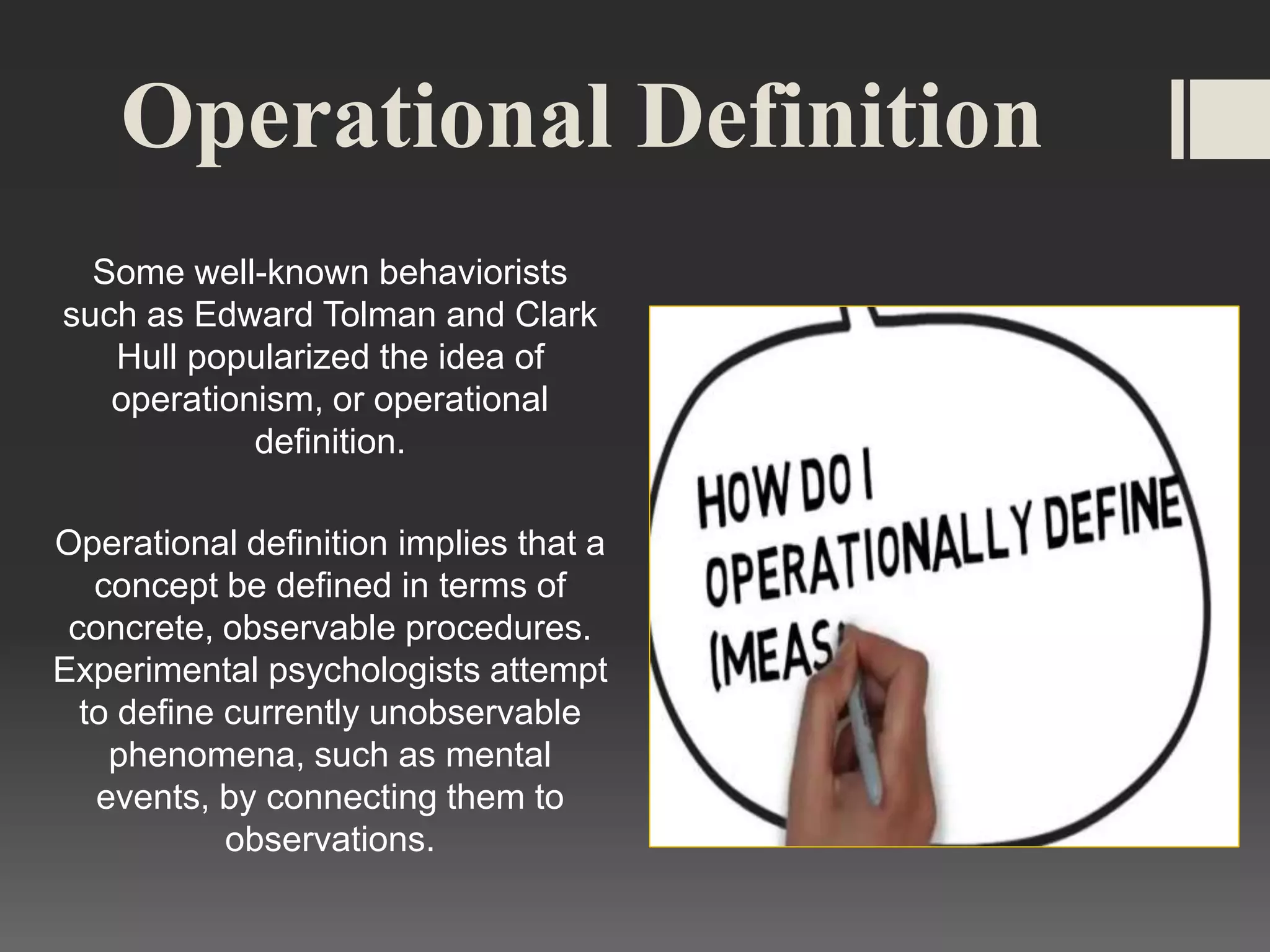
Operational Definition
Some well-known behaviorists
such as Edward Tolman and Clark
Hull popularized the idea of
operationism, or operational
definition.
Operational definition implies that a
concept be defined in terms of
concrete, observable procedures.
Experimental psychologists attempt
to define currently unobservable
phenomena, such as mental
events, by connecting them to
observations.
Ethical Principles and Basic
Assumptions in Experimental Research
Thank you for paying
attention.

Ethical Principles and Basic Assumptions in Experimental Research

  • 1.
    Basic Ethical Principlesin Experimental Research Prepared by: Orlando A. Pistan, MAEd-GC Psychology Instructor
  • 2.
    Basic Ethical Principlesin Experimental Research The American Psychological Association have issued ethical guidelines for researchers involving human participants and animal subjects.
  • 3.
    Human Participants Responsibility. The researchershould be responsible for protecting the rights of human participants. Establish objectives. The researcher must establish the objectives of the research and reach an agreement with participants prior to their participation. Both participants and researcher must clarify the obligations and responsibilities of each.
  • 4.
    Human Participants Informed consent. Fullawareness must be given to the participants regarding the purpose of the experiment and must not use concealment or deception. Respect freedom. The researcher must respect the individual’s freedom to decline participation or withdraw from the experiment at anytime.
  • 5.
    Human Participants Protection fromharm. Researchers must assist participants from physical and mental discomfort and any changes that may arise from the study. Confidentiality. Results and findings must be maintained to protect indue invasion of privacy.
  • 6.
    Animal Participants Moral andLegal standard. Researchers must abide to established laws and ordinances and guidelines for the care and handling of animals. Students are encouraged to select animals that are small and manageable.
  • 7.
    Animal Participants The presenceof qualified supervisors should be ensured so that the students are trained in the care and handling of animals. The basic daily needs of each animal shall be of prime concern. There must be special arrangement made during weekends, holidays and vacation to protect animals from sources of disturbance or harm.
  • 8.
    Animal Participants When theresearch experiment has been completed, the supervisor is responsible for proper disposition of the animals. No student shall inflict pain, severe deprivation, or high distress to the animals. All projects must be conducted in accordance with American Psychological Association (APA) principles for the care and use of animals.
  • 9.
    Basic Assumptions of ExperimentalPsychology As a scientific endeavor, experimental psychology shares several assumptions with most other sciences. Among these are the following: 1. Empiricism 2. Testability 3. Determinism 4. Parsimony 5. Operational definition
  • 10.
    Empiricism Perhaps the mostbasic assumption of psychological science is that factual statements about the world must ultimately be based on observations of the world. This notion of empiricism requires that hypotheses and theories be tested against observations of the natural world rather than on a prior reasoning, intuition, or revelation.
  • 11.
    Testability Closely related toempiricism is the idea that, to be useful, a scientific law or theory must be testable with available research methods. If a theory cannot be tested in any conceivable way then many scientists consider the theory to be meaningless. Testability implies falsifiability, which is the idea that some set of observations could prove the theory to be incorrect. Testability has been emphasized in psychology because influential or well-known theories like those of Freud have been difficult to test.
  • 12.
    Determinism Experimental psychologists, like mostscientists, accept the notion of determinism. This is the assumption that any state of an object or event is determined by prior states. In other words, behavioral or mental phenomena are typically stated in terms of cause and effect. If a phenomenon is sufficiently general and widely confirmed, it may be called a "law"; psychological theories serve to organize and integrate laws.
  • 13.
    Parsimony Another guiding ideaof science is parsimony, the search for simplicity. For example, most scientists agree that if two theories handle a set of empirical observations equally well, we should prefer the simpler or more parsimonious of the two. Occam's razor is a principle from philosophy. Suppose there exist two explanations for an occurrence. In this case the one that requires the least speculation is usually correct.
  • 14.
    Operational Definition Some well-knownbehaviorists such as Edward Tolman and Clark Hull popularized the idea of operationism, or operational definition. Operational definition implies that a concept be defined in terms of concrete, observable procedures. Experimental psychologists attempt to define currently unobservable phenomena, such as mental events, by connecting them to observations.
  • 15.
    Ethical Principles andBasic Assumptions in Experimental Research Thank you for paying attention.