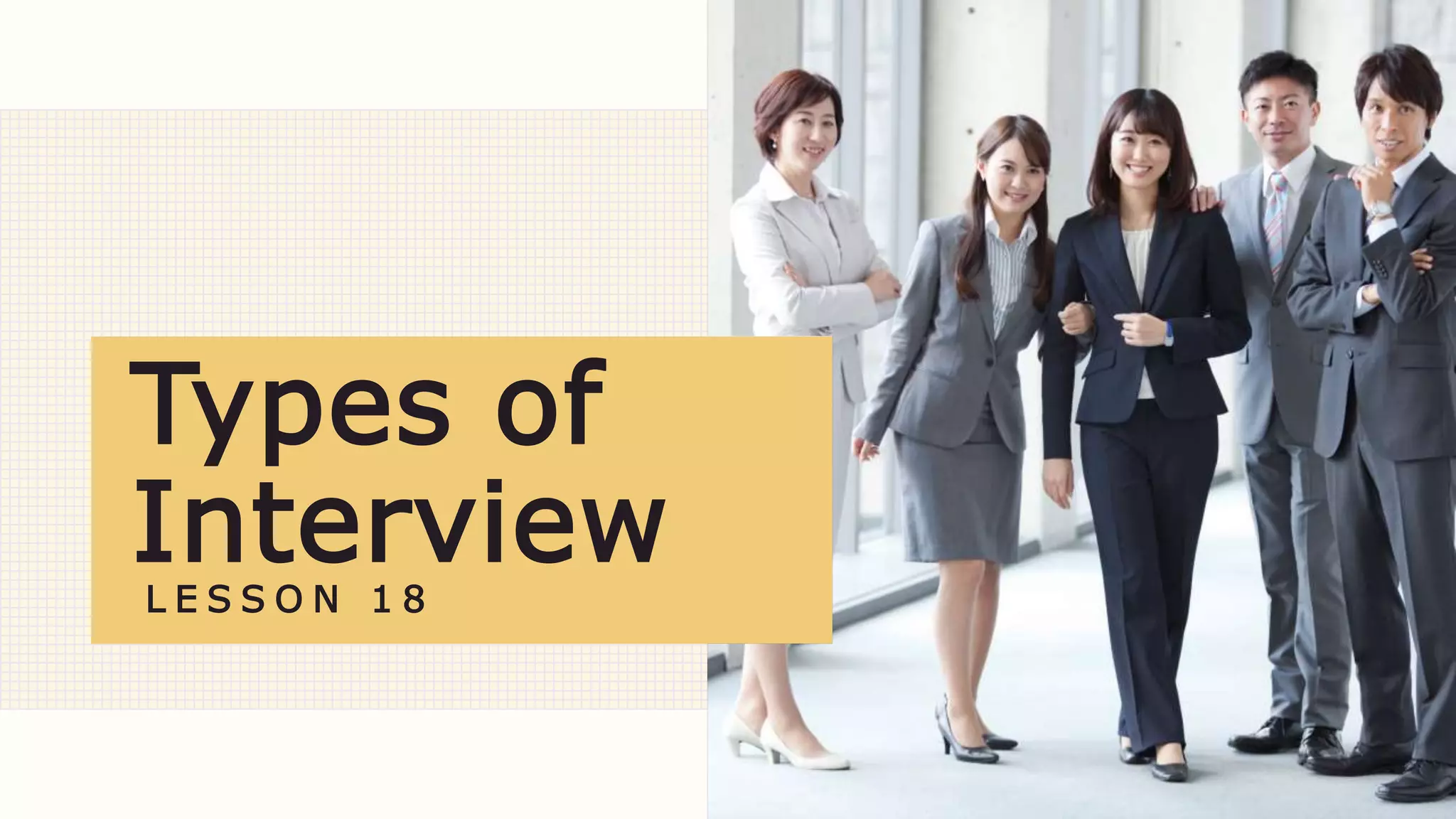
Types of
Interview
L E S S O N 1 8
What is an Interview?
An interview is a structured conversation where
one participant asks questions, and the other provides
answers.
In common parlance, the word "interview" refers
to a one-on-one conversation between an interviewer
and an interviewee.
Types of Interview
Informal Interview
Formal Interview
Planned Interview
Patterned Interview
Non-Directive
Interview
Depth Interview
Stress Interview
Group Interview
Panel Interview
Nine types of interview:
1. INFORMAL INTERVIEW
An informal interview could happen in any place at
any time.
Some inquiries, such as name, place of birth, prior
work experience, etc., may be asked by the
employer or a manager in the personnel
department.
When the labor market is tight and you really need
people, it is not planned and used frequently.
An applicant may be brought by a friend or family
of the employer to the manager's or employer's
home for this form of interview.
2. FORMAL INTERVIEW
 With the use of well-crafted questions, the
employment officer conducted this in a more
official setting at the employment office.
 The employment office specifies the interview's
time and location.
3. PLANNED INTERVIEW
 This official interview has been meticulously
prepared.
 The interviewer has a strategy in place for how
much time will be spent with each candidate, what
information will be requested, what information
will be provided, how the interview will be
conducted, and other factors.
 He has some latitude in how he uses the strategy.
4. PATTERNED INTERVIEW
 This interview was likewise arranged, but it was
done so with more correctness, precision, and
exactitude. The questions and locations are
meticulously planned out.
 One after another, the interviewer asks the
questions from the list.
5. NON-DIRECTIVE INTERVIEW
 This is done to allow the interviewee to express
himself freely.
 When the applicant is silent, the interviewer gently
prods while paying close attention and being
patient.
 The goal is to completely remove the interviewer's
questions from the candidate's ability to "sell"
himself.
6. DEPTH INTERVIEW
 This is intended to analyze the applicant’s
background and way of thinking in-depth and to
cover a specific topic of particular interest to the
candidate in great detail.
 According to the underlying hypothesis, if an
applicant is deemed competent in his or her field
of expertise, there is a considerable likelihood that,
if offered a position, he or she would be really
interested in it.
STRESS INTERVIEW
 By placing him under stress and pressure, this is
intended to examine the candidate's behavior and
demeanor.
 This is a very helpful way to gauge how people
behave under unfavorable and challenging
circumstances.
GROUP INTERVIEW
 The purpose of this is to see how the candidates
respond to and contrast one another. It is possible
to gather every applicant in the office for an
interview.
 As an alternative, the candidates might be given a
topic for debate and watched to see who will take
the initiative, how they will interact with one
another, how they will each offer their ideas, and
how they will respond to one another's arguments.
PANEL INTERVIEW
 Members of the selection committee or the
interview panel carry out this task.
 Usually, this is done for management and
supervisory jobs.
 It combines the panelists’ pooled wisdom and
judgment. The panel may want the candidate to
meet with them one-on-one for a lengthy
interview.
 Most businesses are forbidden by
federal and state regulations from
discriminating in any step of the
recruiting process, including
reviewing applications, conducting
interviews, and administering tests
to candidates.
 Employers are not permitted to
inquire about protected
characteristics like race or disability
during the interview process or to
use such traits as a criterion for
hiring.
Discrimination in Job
Interviews
Which
Characteristics
are Protected?
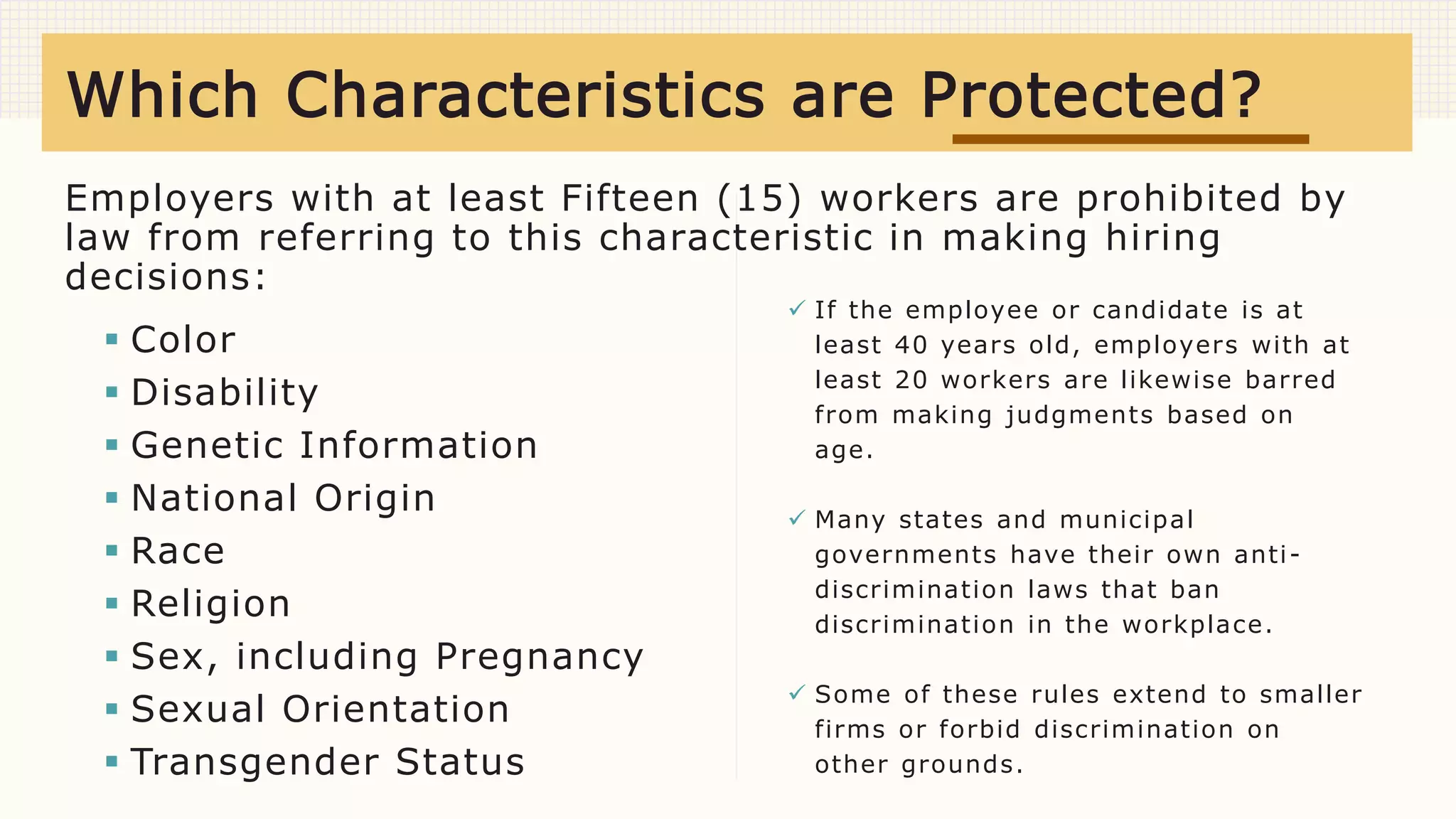
Employers with at least Fifteen (15) workers are prohibited by
law from referring to this characteristic in making hiring
decisions:
 Color
 Disability
 Genetic Information
 National Origin
 Race
 Religion
 Sex, including Pregnancy
 Sexual Orientation
 Transgender Status
 If the employee or candidate is at
least 40 years old, employers with at
least 20 workers are likewise barred
from making judgments based on
age.
 Many states and municipal
governments have their own anti-
discrimination laws that ban
discrimination in the workplace.
 Some of these rules extend to smaller
firms or forbid discrimination on
other grounds.
Which Characteristics are Protected?
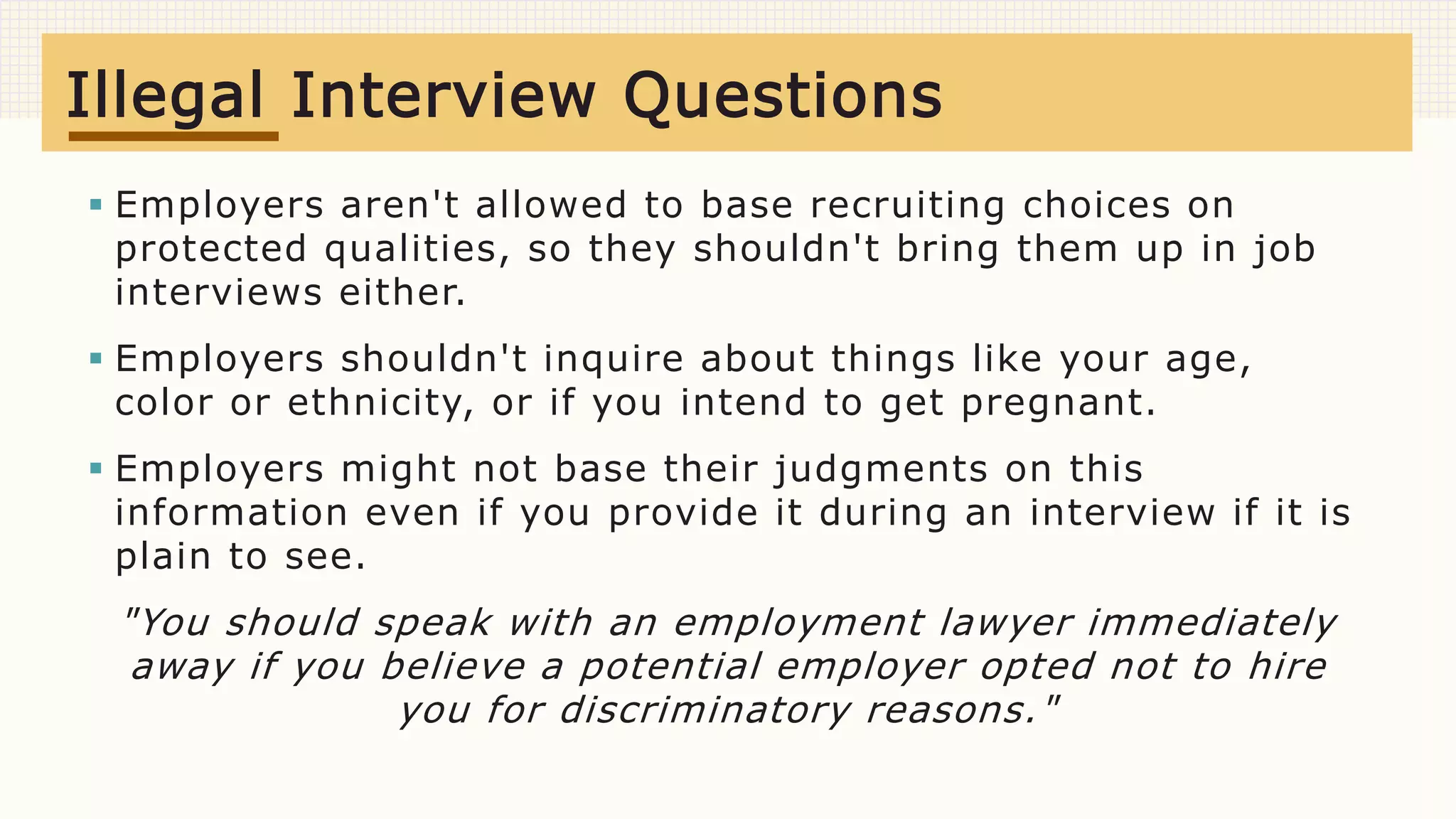
Illegal
I N T E R V I E W Q U E S T I O N S
 Employers aren't allowed to base recruiting choices on
protected qualities, so they shouldn't bring them up in job
interviews either.
 Employers shouldn't inquire about things like your age,
color or ethnicity, or if you intend to get pregnant.
 Employers might not base their judgments on this
information even if you provide it during an interview if it is
plain to see.
"You should speak with an employment lawyer immediately
away if you believe a potential employer opted not to hire
you for discriminatory reasons."
Illegal Interview Questions
 Employers are not permitted to inquire about your
disability during an interview.
 The interviewer may inquire about your requirement for a
reasonable accommodation to carry out the essential
functions of the position if you disclose your impairment to
them during the interview or if your disability is obviously
present.
 Employers must treat all candidates equally in this regard;
regard; it is not permitted to ask these questions of only
only those who clearly have a disability.
Reasonable Accommodation for a Disability
 You'll need to make a decision right away
about how to respond if a potential employer
asks you discriminatory questions during an
interview.
 You should see an employment lawyer
straight away if you believe that a prospective
employer's decision to reject your application
was motivated by discrimination.
 It is challenging also to prove that you are
being discriminated. Without hard ground for
your claim, the employer could easily reason
out why you were not considered.
 In that case, you have to examine if your
claim may be worth pursuing, or it may be
better to go on with your employment hunt,
according to an attorney.
It can be worthwhile to
speak with an employment
attorney to learn more about
your legal alternatives if you
were the target of discrimination
during a job interview.
There's virtually nothing
to lose because many attorneys
give consultations without cost.
If You’re Facing Discrimination
Contact an Attorney
GUIDELINES IN
CONDUCTING
INTERVIEWS
GUIDELINES IN CONDUCTING INTERVIEWS
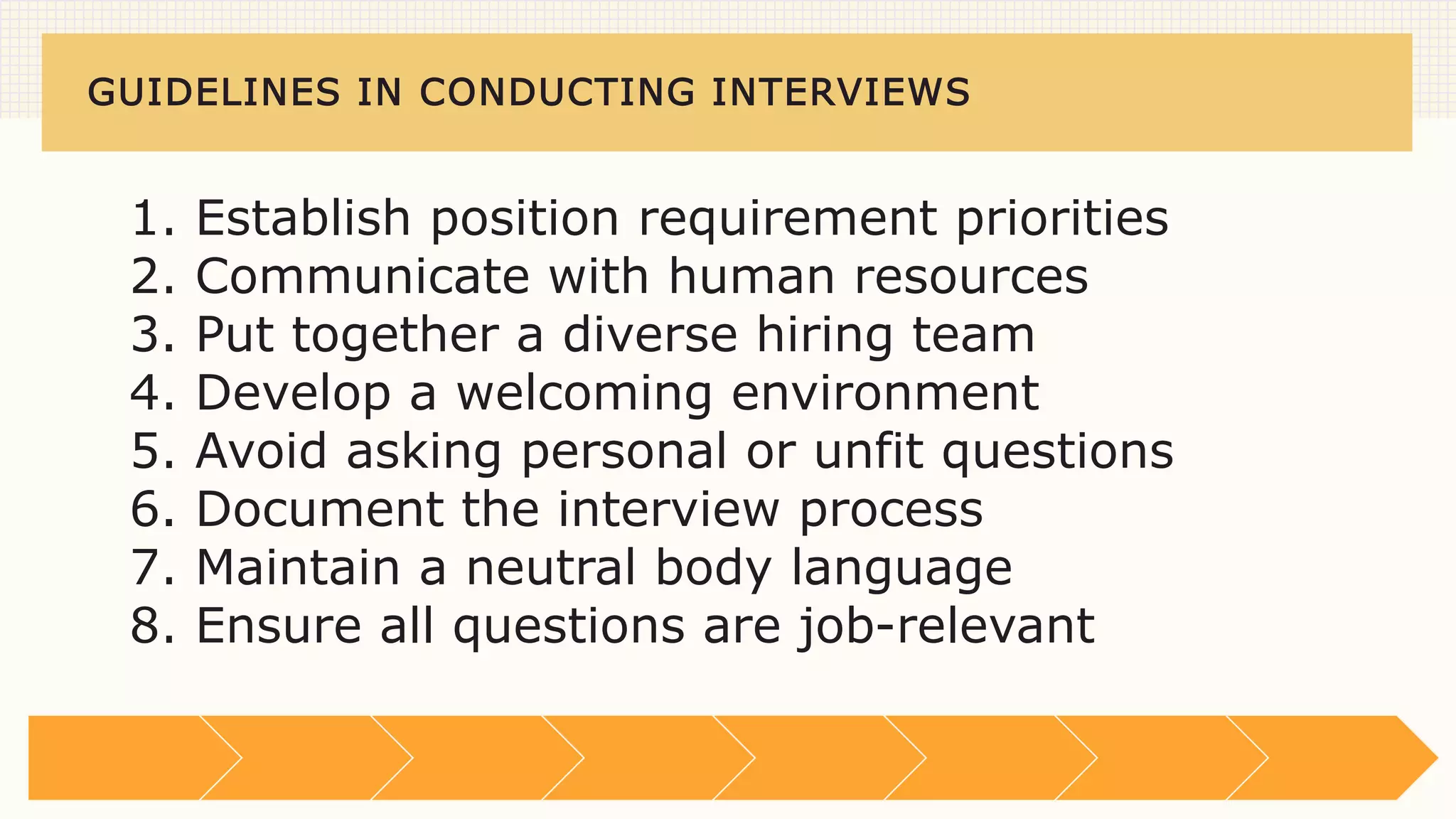
1. Establish position requirement priorities
2. Communicate with human resources
3. Put together a diverse hiring team
4. Develop a welcoming environment
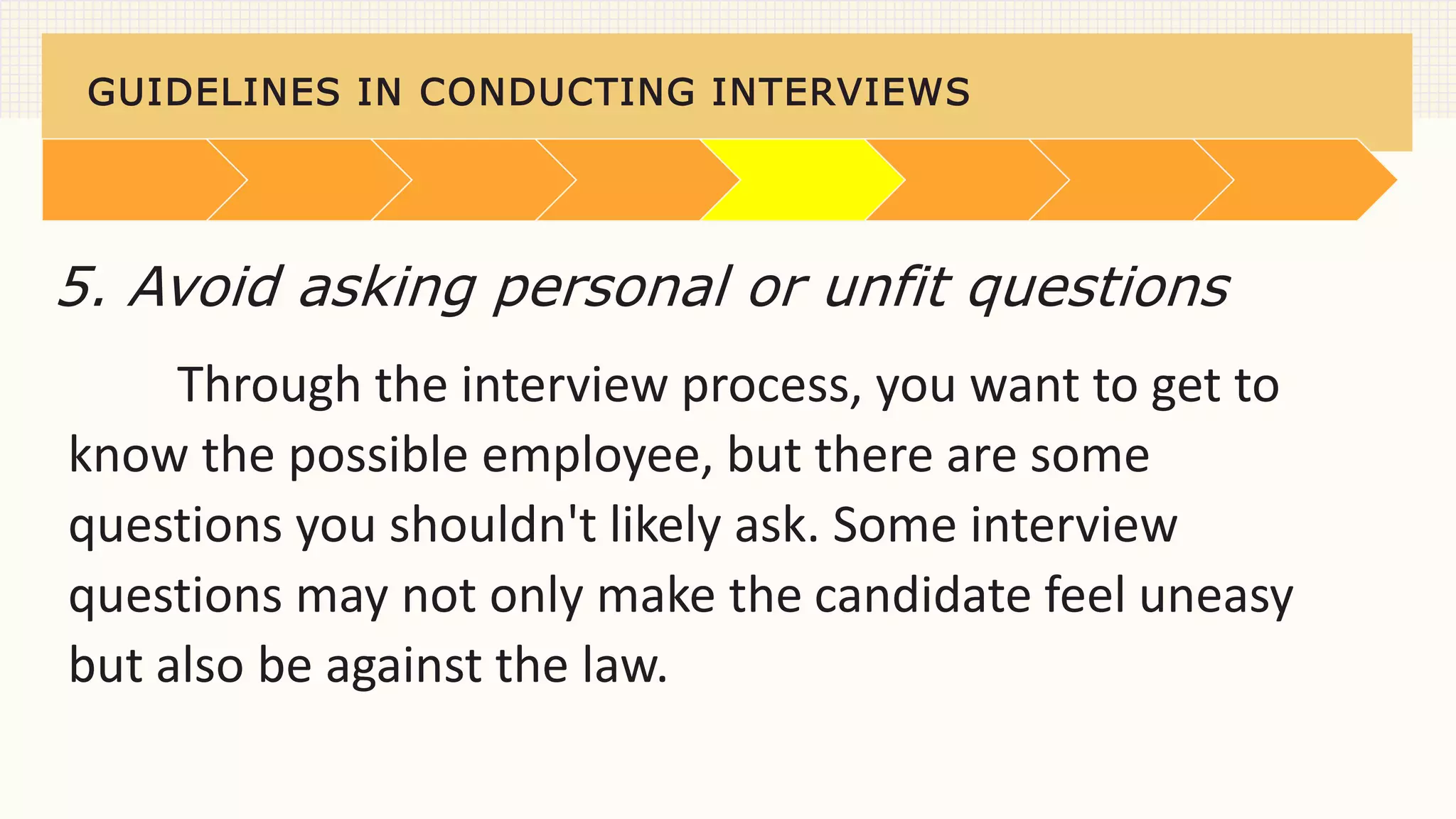
5. Avoid asking personal or unfit questions
6. Document the interview process
7. Maintain a neutral body language
8. Ensure all questions are job-relevant
GUIDELINES IN CONDUCTING INTERVIEWS
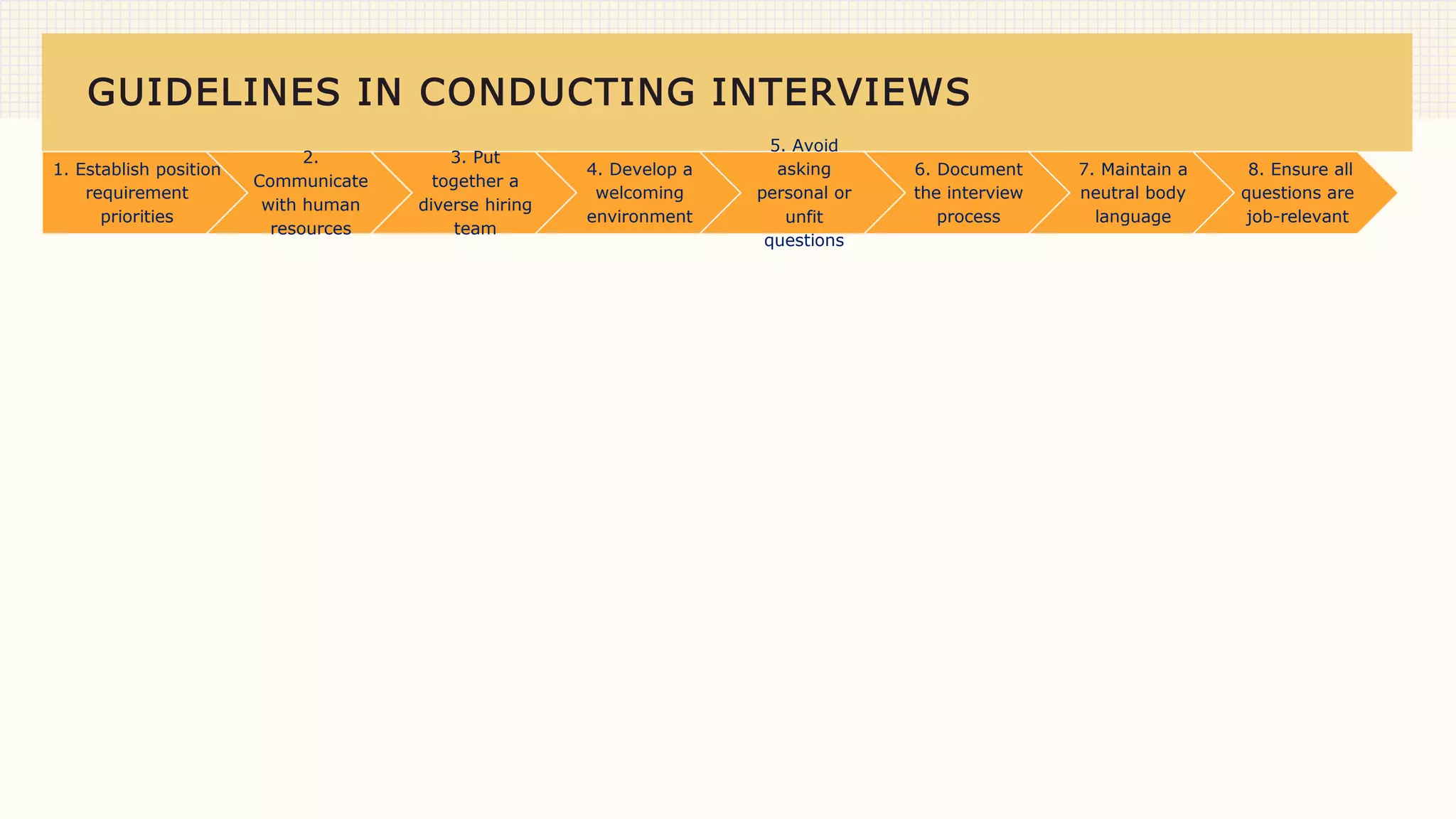
1. Establish position
requirement
priorities
2.
Communicate
with human
resources
3. Put
together a
diverse hiring
team
4. Develop a
welcoming
environment
5. Avoid
asking
personal or
unfit
questions
6. Document
the interview
process
7. Maintain a
neutral body
language
8. Ensure all
questions are
job-relevant
GUIDELINES IN CONDUCTING INTERVIEWS
 Determine the prerequisites you have for the position you are
recruiting for before you conduct interviews.
 Prioritize the needs that are absolutely required and identify which are
desirable once you have determined the position requirements.
 It's crucial to maintain flexibility during the recruiting process since the
ideal applicant cannot satisfy all the prerequisites but yet be the
greatest fit for the job.
1. Establish position requirement priorities
GUIDELINES IN CONDUCTING INTERVIEWS
 Professionals in human resources are very helpful when vetting and
interviewing potential employees.
 Consider scheduling a meeting with a human resources person after
you've created your interview materials so they can look through the
materials and offer comments.
 Before you start the interview, a member of the human resources staff
might be able to let you know whether any of your questions might be
illegal.
2. Communicate with human resources
GUIDELINES IN CONDUCTING INTERVIEWS
 Having a diverse hiring staff may help ensure fair evaluation of
candidates during interviews and increase their comfort level.
 You want to make sure that everyone who is participating thinks
that the recruiting process is fair, that they are welcomed, and that
their needs are being met.
 Consider putting together a recruiting committee that includes
competent, diverse members of your staff to conduct interviews
and make judgments.
3. Put together a diverse hiring team
GUIDELINES IN CONDUCTING INTERVIEWS
 If you create a friendly, distraction-free environment for
your interview, it will be more likely to be successful.
 The applicant should sense that you and your staff are
paying close attention to them.
 Think about choosing a space with few windows that
face inward and a door that you can close during the
interview.
 Make sure the candidate is comfortable before starting
the interview by asking questions rather than doing
other business activities.
4. Develop a welcoming environment
GUIDELINES IN CONDUCTING INTERVIEWS
Through the interview process, you want to get to
know the possible employee, but there are some
questions you shouldn't likely ask. Some interview
questions may not only make the candidate feel uneasy
but also be against the law.
5. Avoid asking personal or unfit questions
GUIDELINES IN CONDUCTING INTERVIEWS
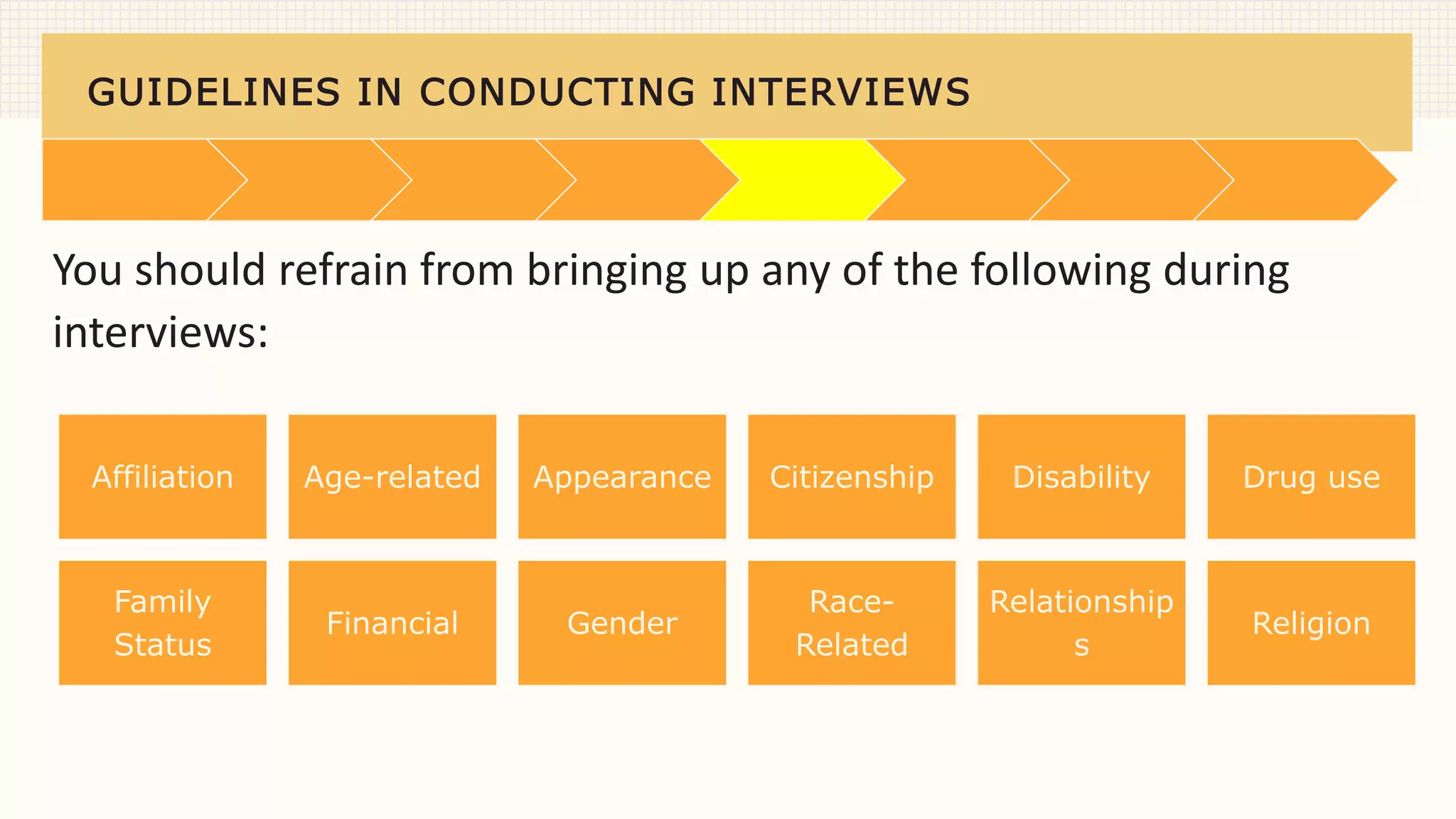
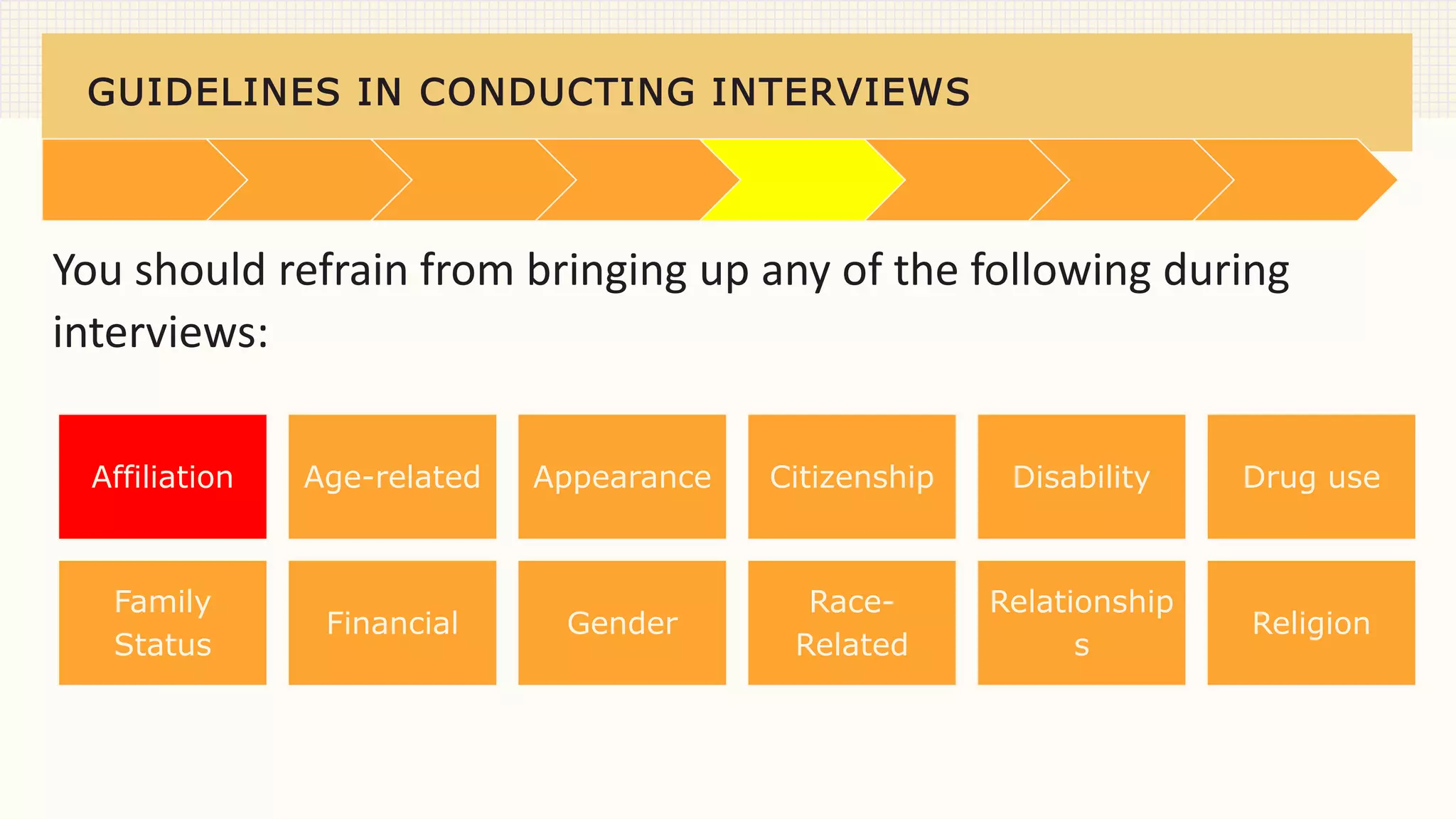
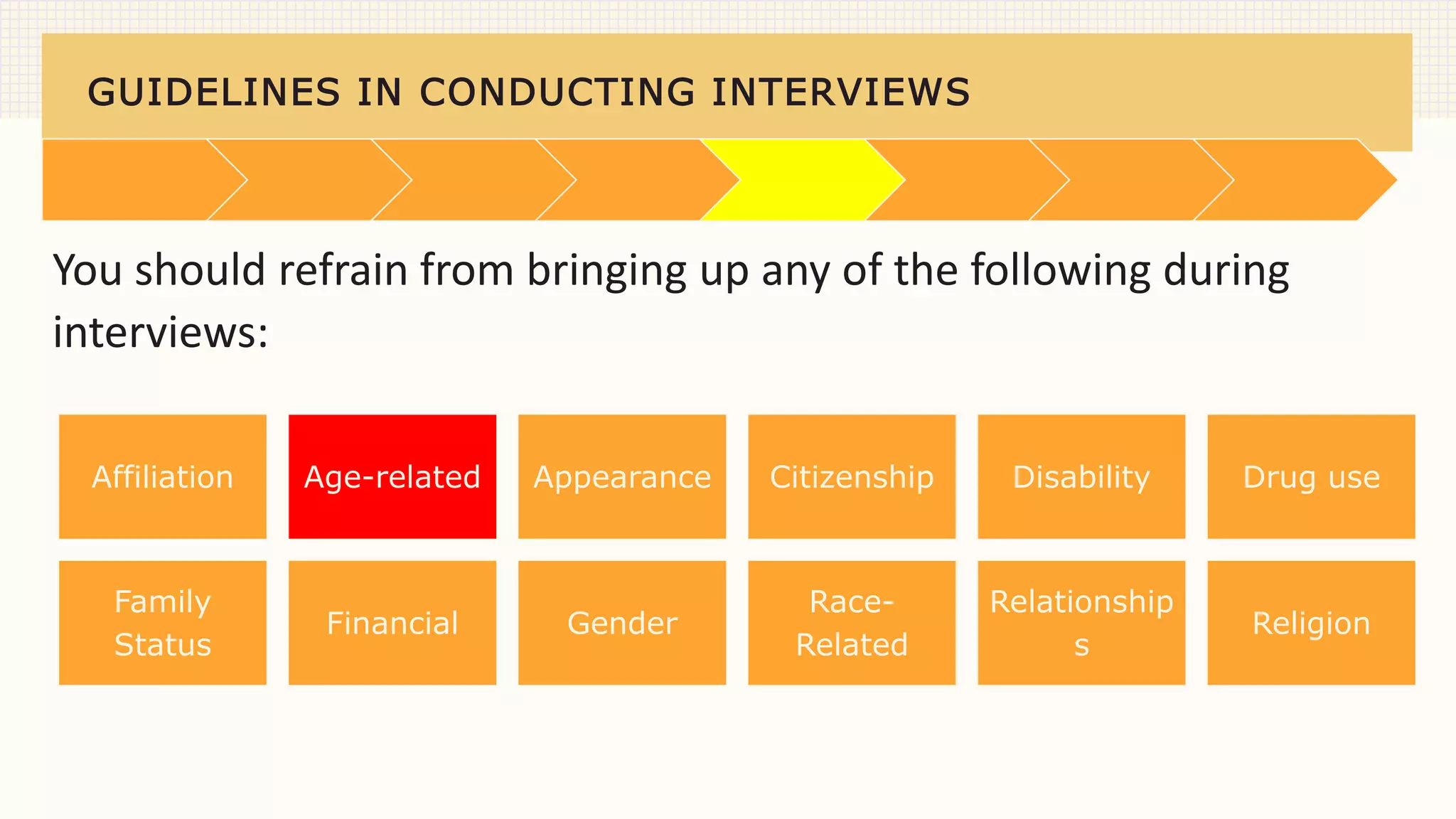
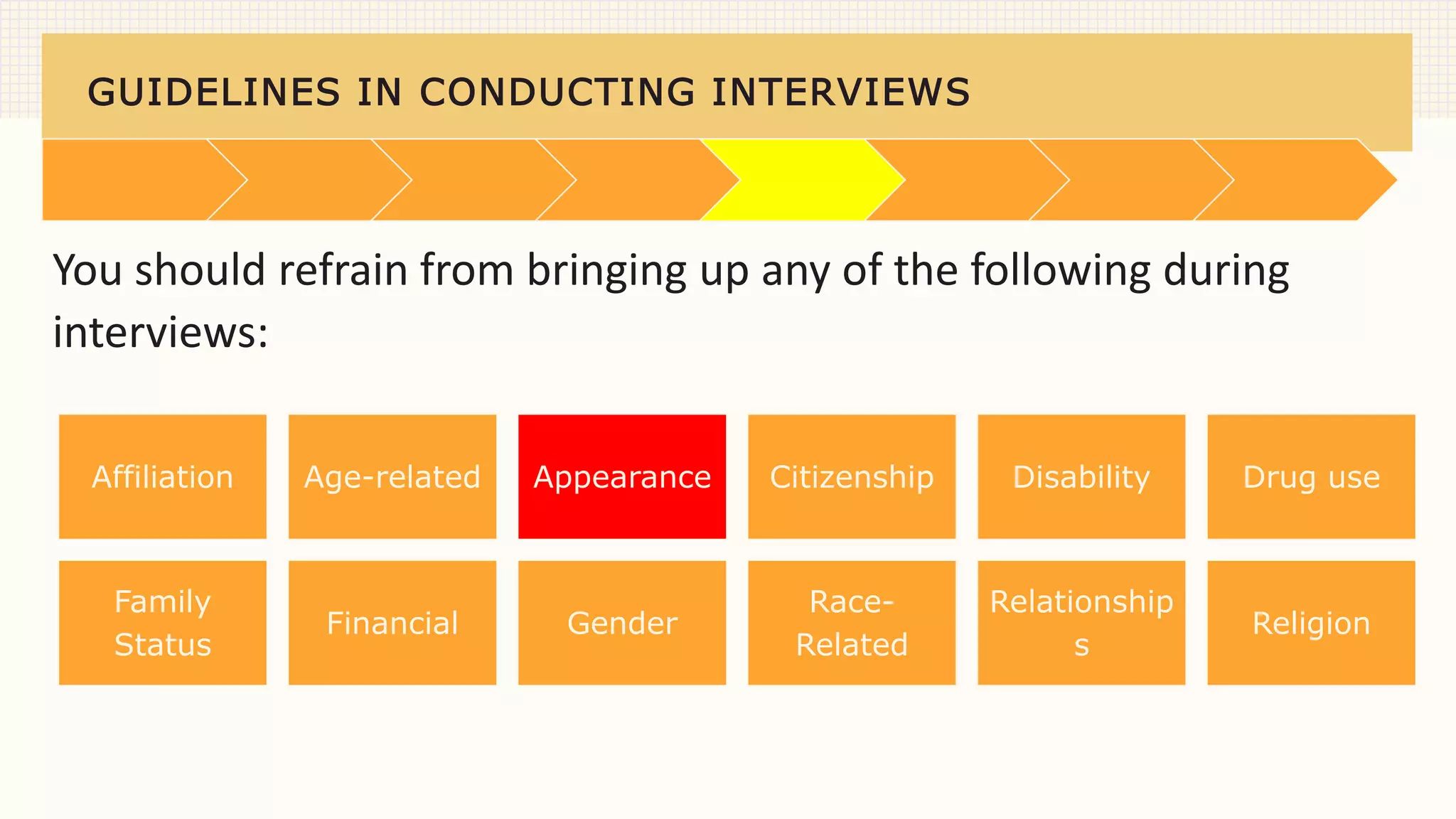
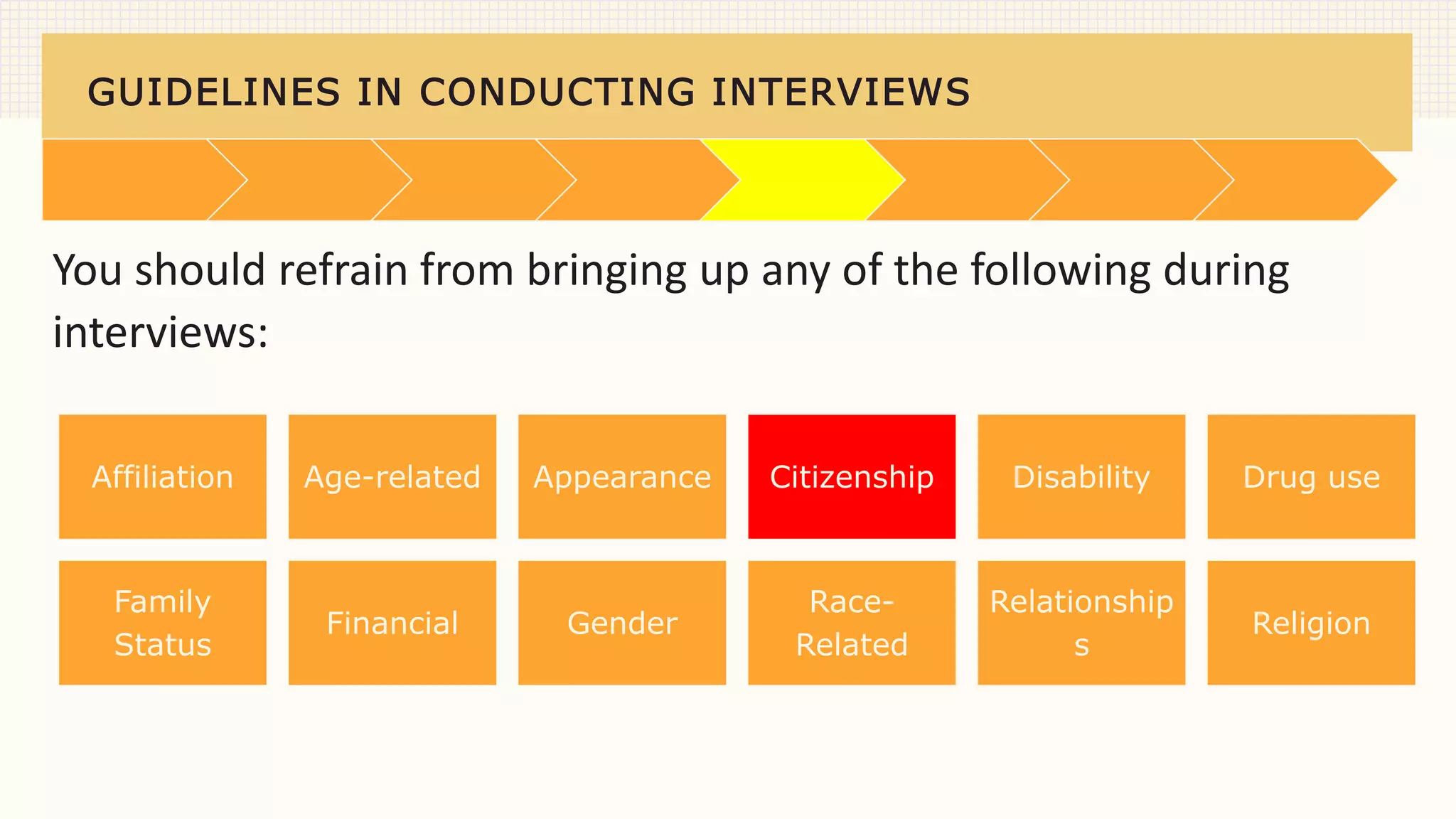
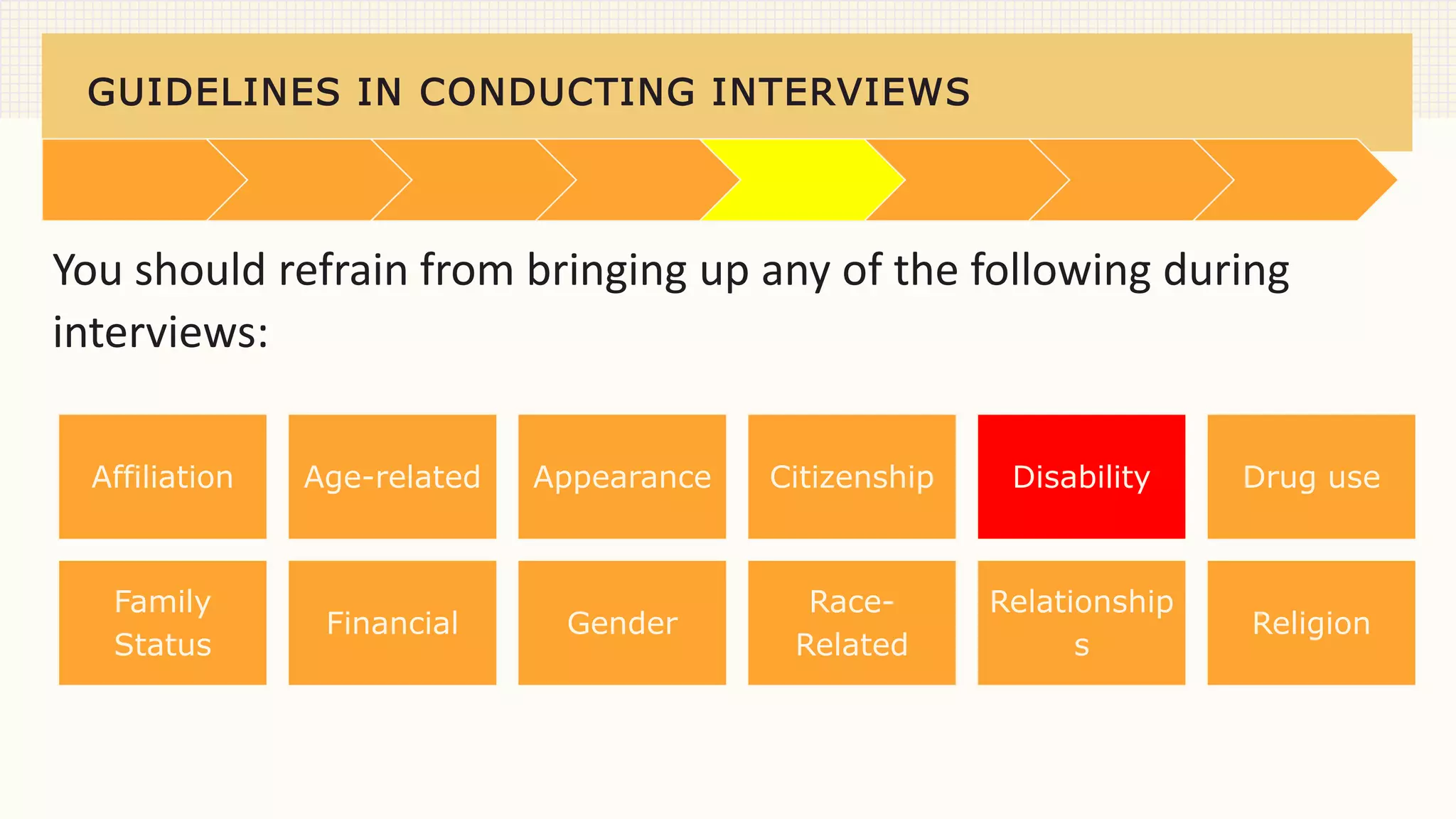
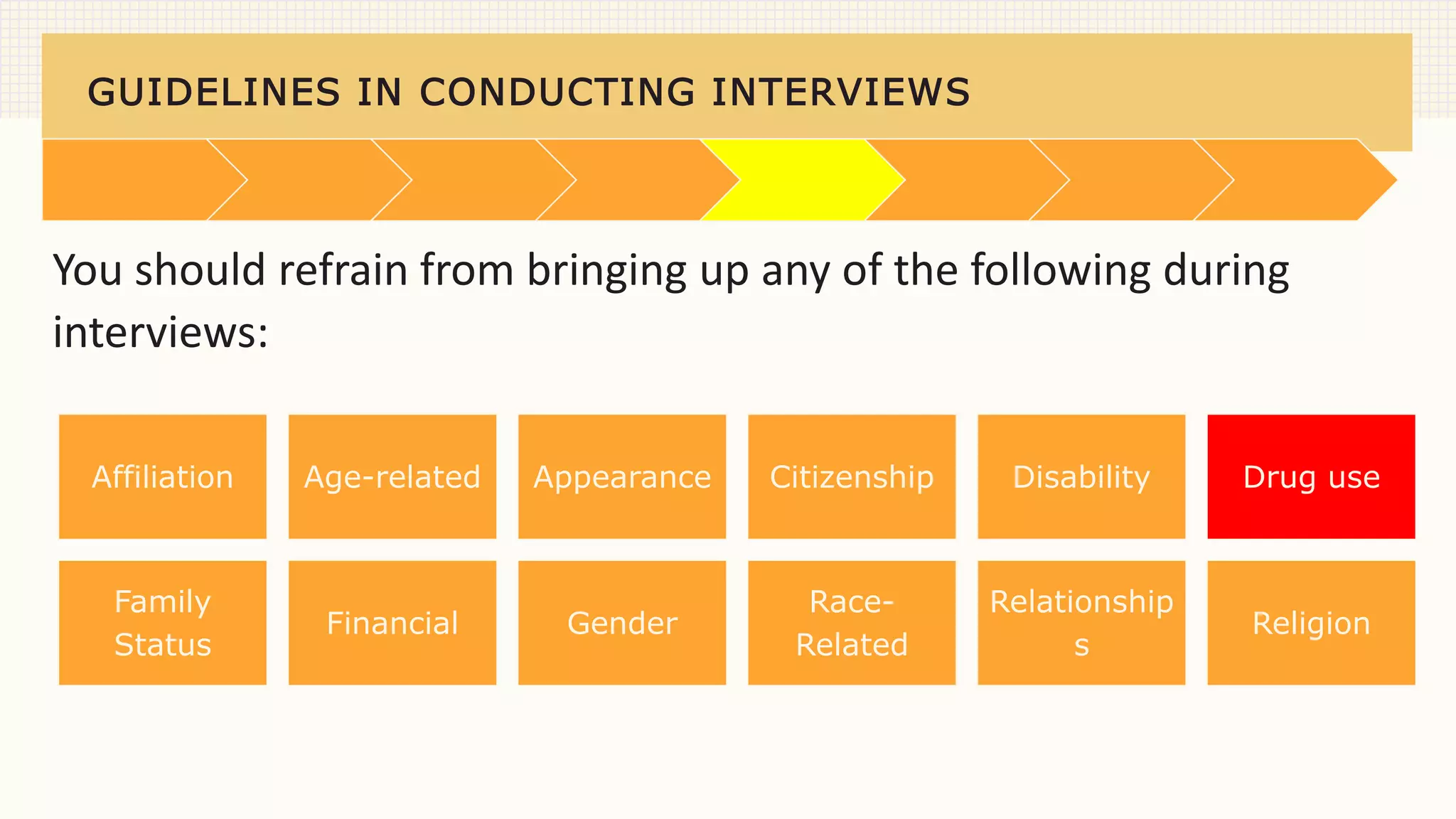
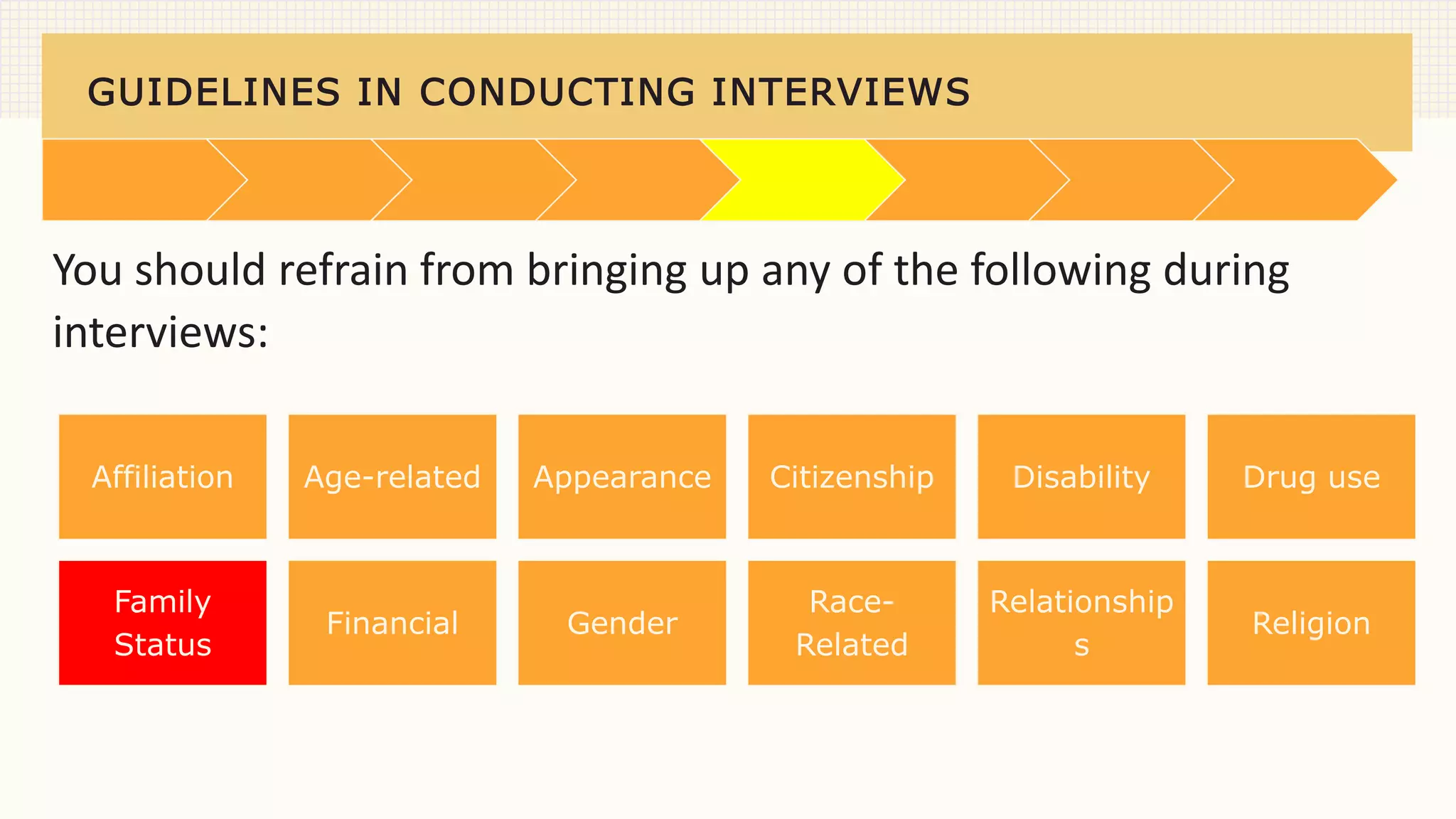
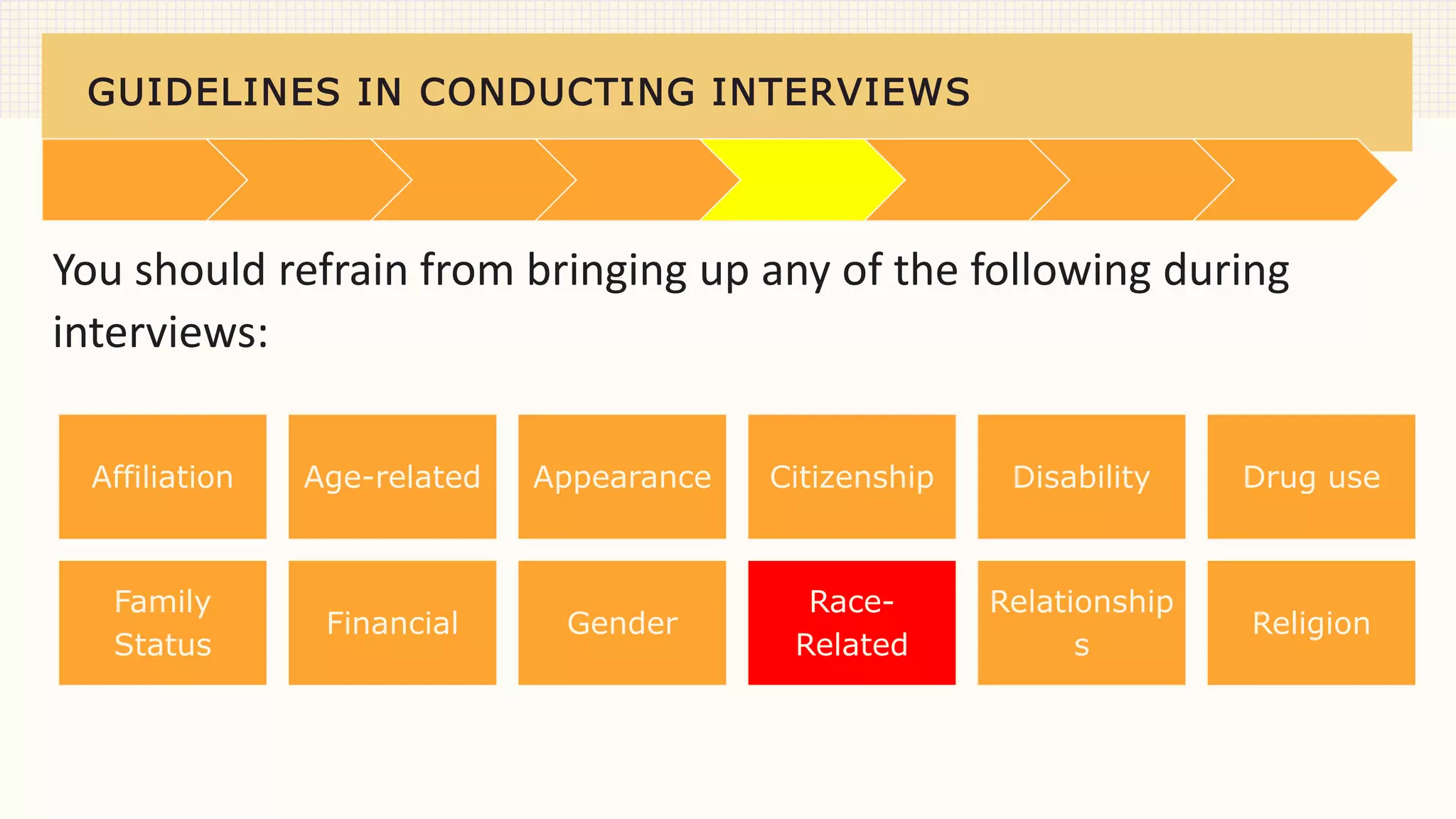
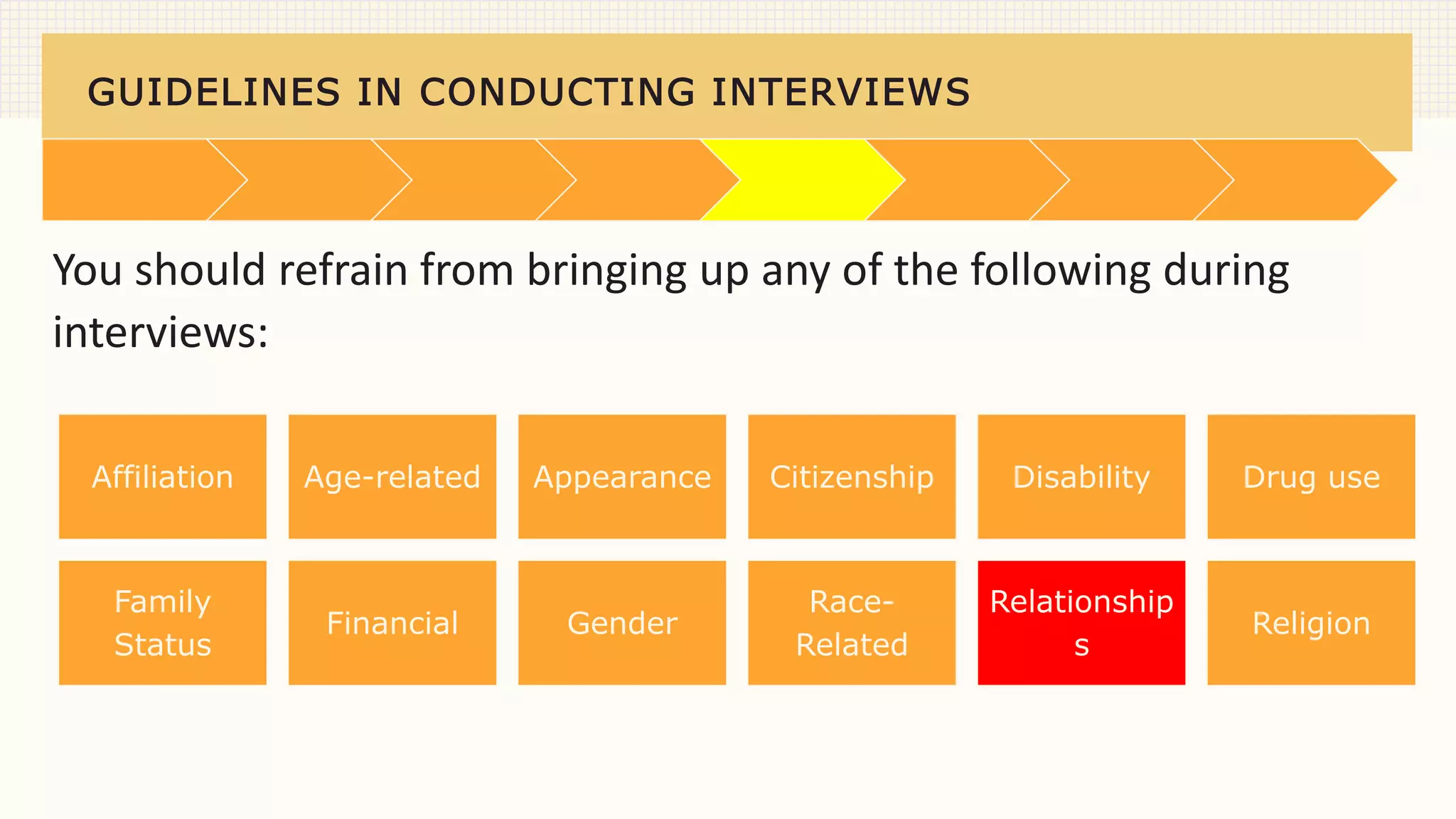
You should refrain from bringing up any of the following during
interviews:
Affiliation Age-related Appearance Citizenship Disability Drug use
Family
Status
Financial Gender
Race-
Related
Relationship
s
Religion
GUIDELINES IN CONDUCTING INTERVIEWS
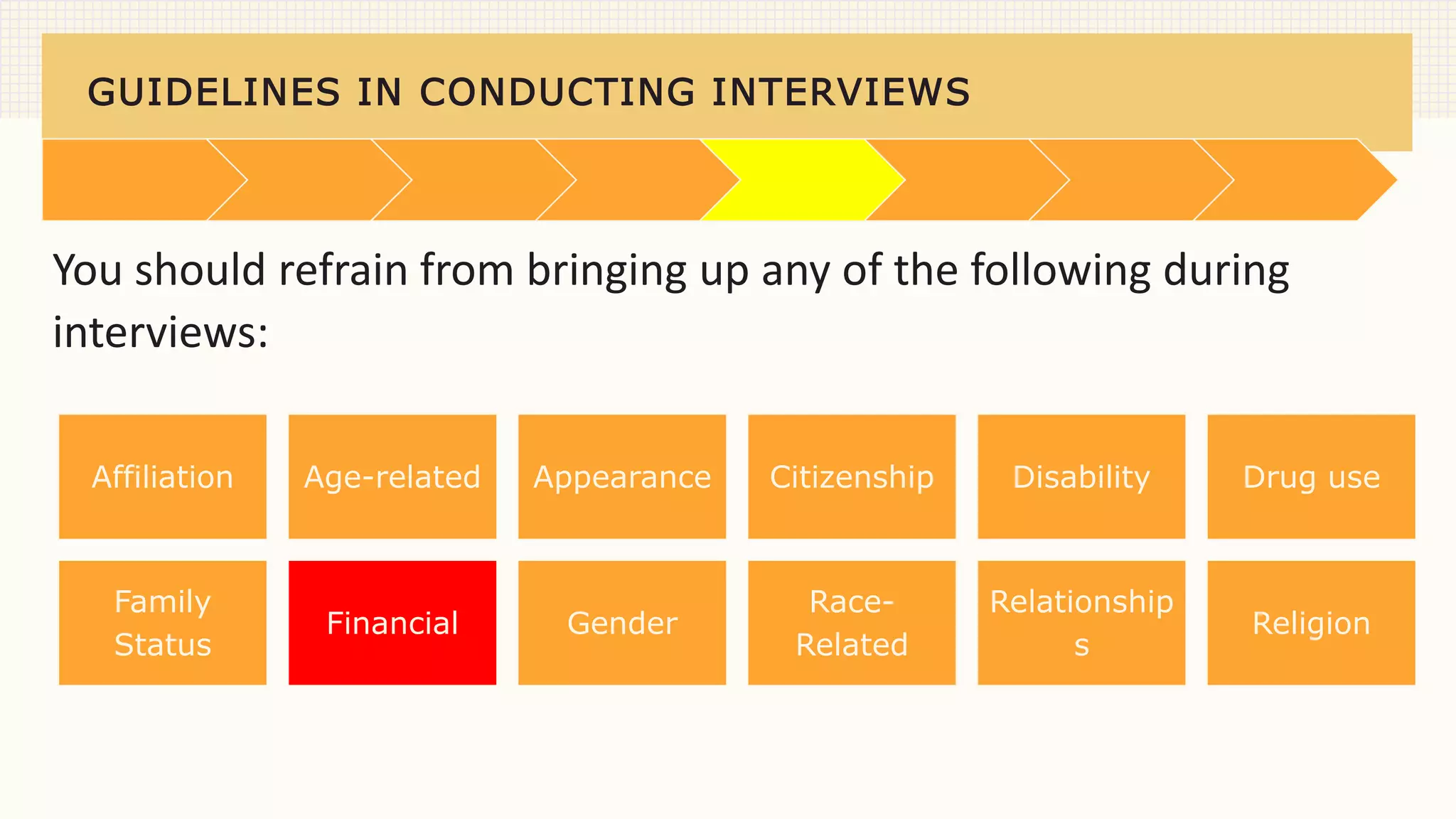
You should refrain from bringing up any of the following during
interviews:
Affiliation Age-related Appearance Citizenship Disability Drug use
Family
Status
Financial Gender
Race-
Related
Relationship
s
Religion
GUIDELINES IN CONDUCTING INTERVIEWS
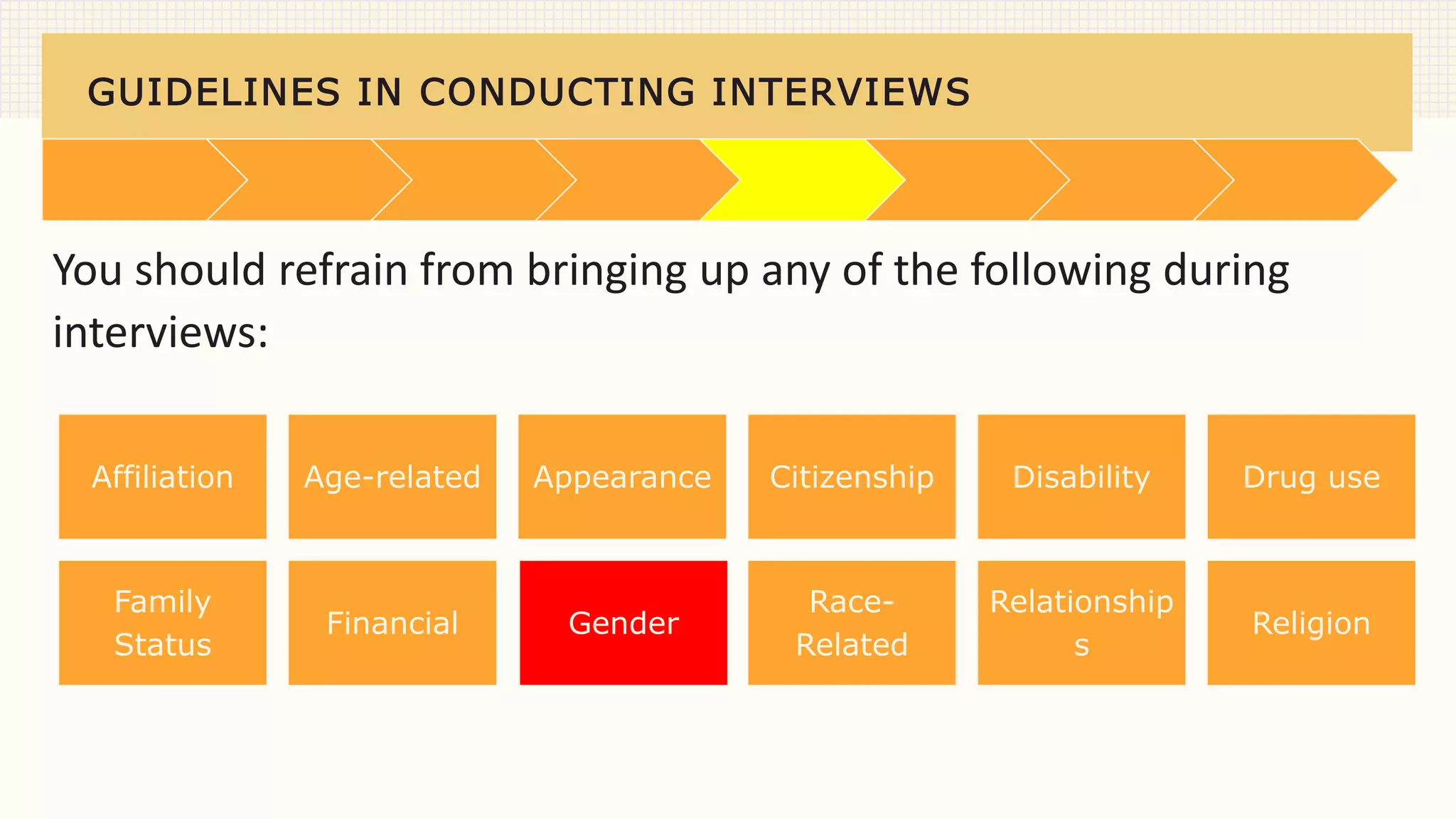
You should refrain from bringing up any of the following during
interviews:
Affiliation Age-related Appearance Citizenship Disability Drug use
Family
Status
Financial Gender
Race-
Related
Relationship
s
Religion
GUIDELINES IN CONDUCTING INTERVIEWS
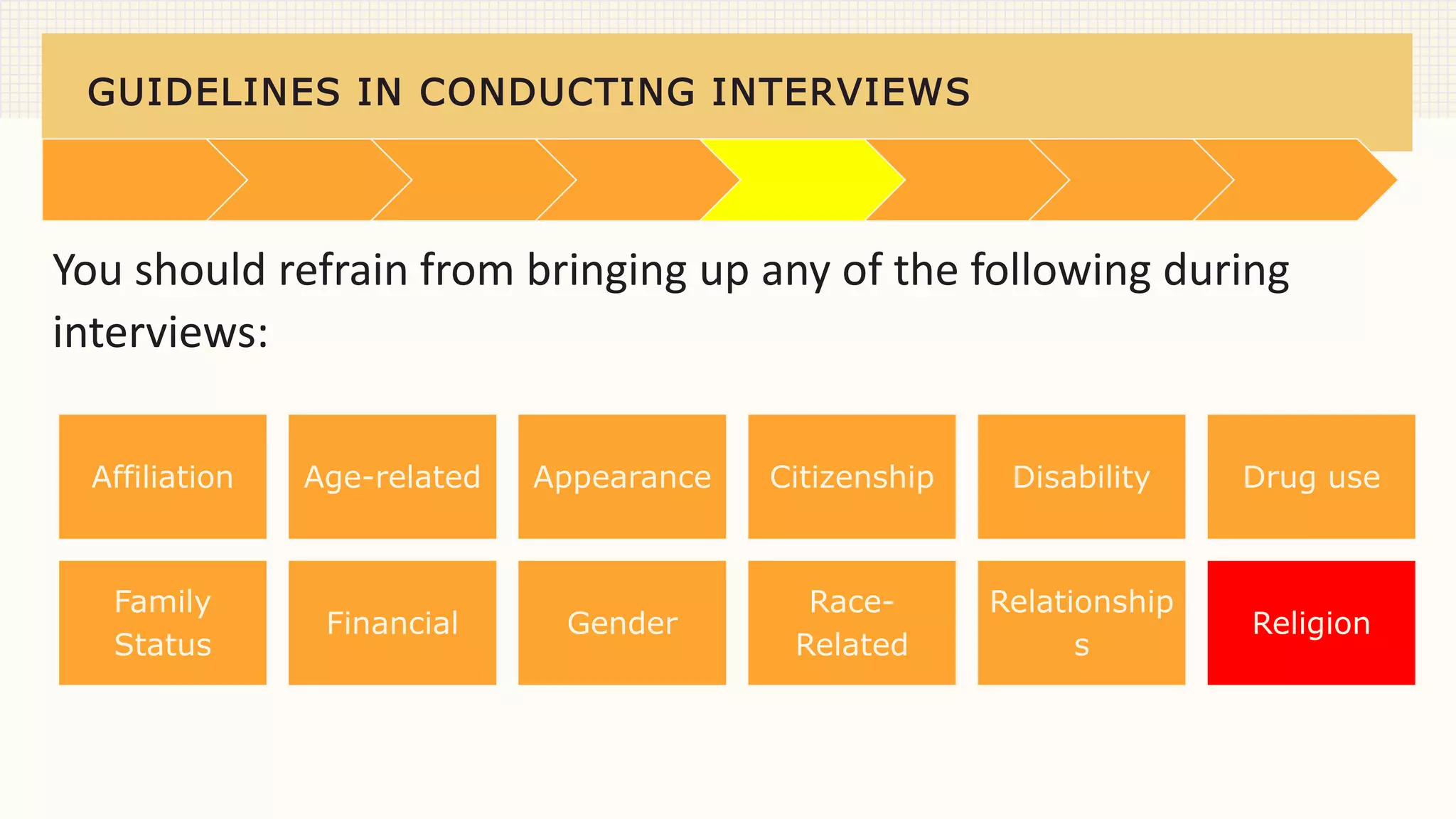
You should refrain from bringing up any of the following during
interviews:
Affiliation Age-related Appearance Citizenship Disability Drug use
Family
Status
Financial Gender
Race-
Related
Relationship
s
Religion
GUIDELINES IN CONDUCTING INTERVIEWS
You should refrain from bringing up any of the following during
interviews:
Affiliation Age-related Appearance Citizenship Disability Drug use
Family
Status
Financial Gender
Race-
Related
Relationship
s
Religion
GUIDELINES IN CONDUCTING INTERVIEWS
You should refrain from bringing up any of the following during
interviews:
Affiliation Age-related Appearance Citizenship Disability Drug use
Family
Status
Financial Gender
Race-
Related
Relationship
s
Religion
GUIDELINES IN CONDUCTING INTERVIEWS
You should refrain from bringing up any of the following during
interviews:
Affiliation Age-related Appearance Citizenship Disability Drug use
Family
Status
Financial Gender
Race-
Related
Relationship
s
Religion
GUIDELINES IN CONDUCTING INTERVIEWS
You should refrain from bringing up any of the following during
interviews:
Affiliation Age-related Appearance Citizenship Disability Drug use
Family
Status
Financial Gender
Race-
Related
Relationship
s
Religion
GUIDELINES IN CONDUCTING INTERVIEWS
You should refrain from bringing up any of the following during
interviews:
Affiliation Age-related Appearance Citizenship Disability Drug use
Family
Status
Financial Gender
Race-
Related
Relationship
s
Religion
GUIDELINES IN CONDUCTING INTERVIEWS
You should refrain from bringing up any of the following during
interviews:
Affiliation Age-related Appearance Citizenship Disability Drug use
Family
Status
Financial Gender
Race-
Related
Relationship
s
Religion
GUIDELINES IN CONDUCTING INTERVIEWS
You should refrain from bringing up any of the following during
interviews:
Affiliation Age-related Appearance Citizenship Disability Drug use
Family
Status
Financial Gender
Race-
Related
Relationship
s
Religion
GUIDELINES IN CONDUCTING INTERVIEWS
You should refrain from bringing up any of the following during
interviews:
Affiliation Age-related Appearance Citizenship Disability Drug use
Family
Status
Financial Gender
Race-
Related
Relationship
s
Religion
GUIDELINES IN CONDUCTING INTERVIEWS
You should refrain from bringing up any of the following during
interviews:
Affiliation Age-related Appearance Citizenship Disability Drug use
Family
Status
Financial Gender
Race-
Related
Relationship
s
Religion
GUIDELINES IN CONDUCTING INTERVIEWS
 To safeguard yourself, your recruiting team, and the business you
work for, documentation is crucial.
 To guarantee you have complete documentation of each encounter,
think about utilizing a tape or video recorder to capture each
interview. Make careful to let the candidate know you're recording
the interview if you decide to do so.
 Take notes throughout the meeting as well. Even though it may be
helpful to record the meeting on video or audio, taking notes will
allow you to capture your ideas as they occur.
 When evaluating the applicant's details throughout the recruiting
process, you may then refer to them.
6. Document the interview process
GUIDELINES IN CONDUCTING INTERVIEWS
 You can be impressed or taken aback by a candidate's comments
during an interview.
 In these circumstances, it's critical to maintain neutral body
language, restrain your facial expressions, and refrain from
making unexpected movements. For instance, if a candidate says
something that makes you believe they'd be a great pick and you
want to remember it, don't write it down hastily.
 By doing this, you can keep your body language neutral and make
sure the prospect is at ease.
7. Maintain a neutral body language
GUIDELINES IN CONDUCTING INTERVIEWS
 Making sure that the interview questions are applicable to the
position being filled is one of the most crucial interview standards
to adhere to while creating your interview materials.
 Avoid asking inappropriate or personal inquiries and make sure
the questions you do ask are about the work.
 This not only shields you and your recruiting team from unethical
behavior, but it may also speed up the interview process and
make everyone more at ease.
 Keep your attention on the crucial facets of the position if you
want to conduct yourself properly.
8. Ensure all questions are job-relevant
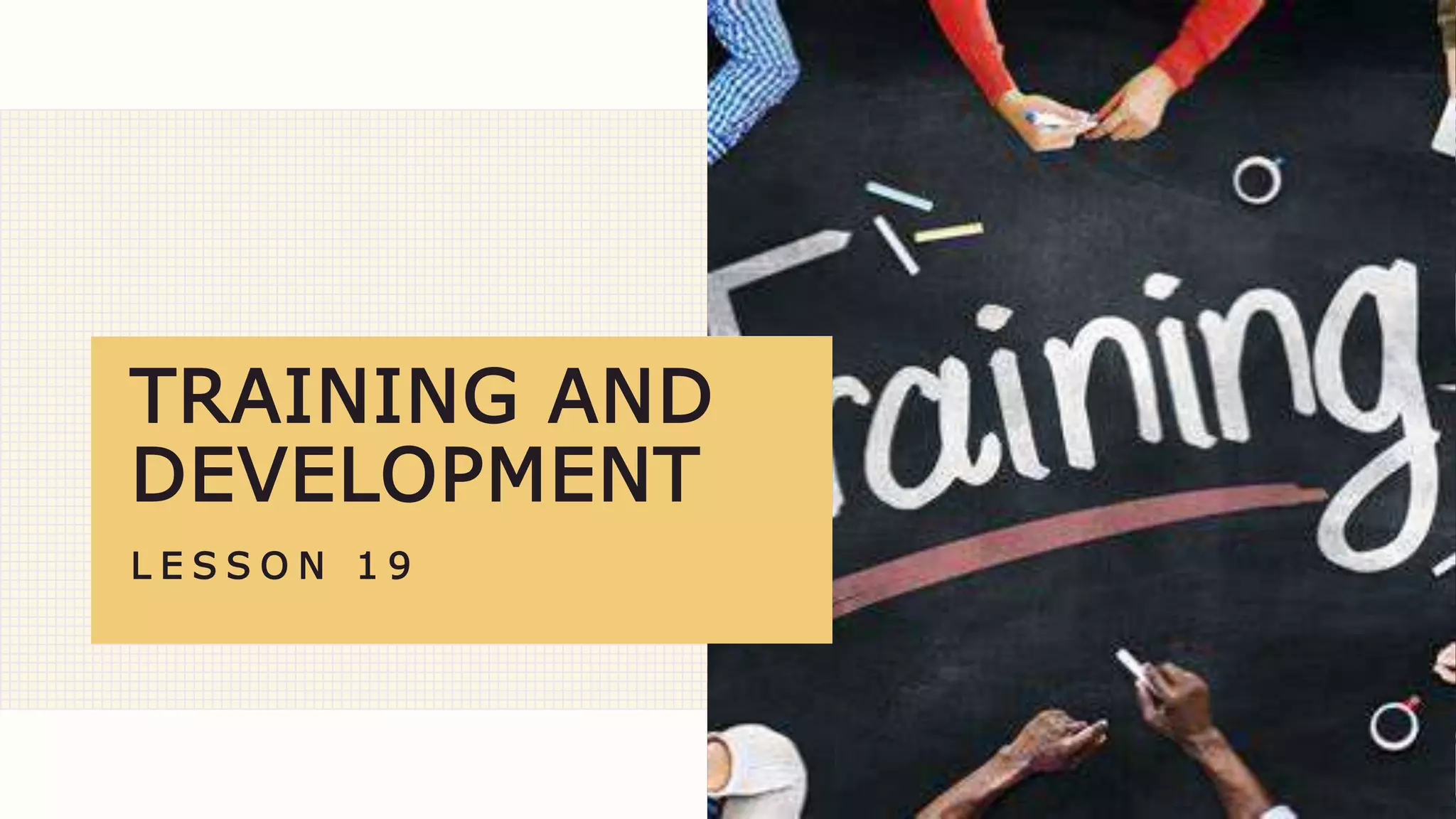
TRAINING AND
DEVELOPMENT
L E S S O N 1 9
TRAINING AND DEVELOPMENT
One of the most crucial aspects of human
resource management in any firm is training
and development.
The goal of this training is to improve
employees' abilities, behaviors, and expertise
by exposing them to new working methods.
TRAINING AND DEVELOPMENT
One of the most crucial aspects of human
resource management in any firm is training
and development.
The goal of this training is to improve
employees' abilities, behaviors, and expertise
by exposing them to new working methods.
TRAINING AND DEVELOPMENT
Definition:
A system utilized by a company to enhance the abilities and
productivity of its employees is known as employee training and
development (ETD) in human resource management.
It is a teaching tool that contains data and guidelines for honing
already acquired abilities and introducing fresh ideas and information to
boost worker productivity.
A successful training and development plan built on an analysis of
the training needs aids the business in raising the productivity and skill
levels of its workforce.
TRAINING AND DEVELOPMENT
Meaning:
Training is a process for improving an employee's capabilities,
knowledge, and skills. To guarantee that the employee can successfully
complete the responsibilities allocated to them and contribute to the
success of the business, job-related training is frequently given to them.
On the other hand, the development program frequently serves as
training for the work of the future. The development of human resources
offers employees a learning opportunity to improve their job capacities
and prepare for upcoming problems.
Training and Development Definition by the
Eminent Authors
Armstrong
“Training is the formal and systematic modification of behavior
through learning which occurs as a result of education,
instruction, development and planned experience. Development
is improving individual performance in their present Roles and
preparing them for greater responsibilities in the future”.
Here are the definitions provided by the knowledgeable and distinguished authors:
Training and Development Definition by the
Eminent Authors
Katz & Kahn
“Training and development is described as a maintenance subsystem,
intended to improve organizational efficiency by increasing routinization
and predictability of behavior.”
Kllatt, Murdick & Schuster
“Training is a systematic way of altering behavior to prepare an employee
for a job or to employee for improving the conceptual, decision-making,
and interpersonal skills in complex, in structured situation”
Here are the definitions provided by the knowledgeable and distinguished authors:
Training and Development Definition by the
Eminent Authors
Lussier
“Training is a process of acquiring the skills necessary to perform a
job and development is the ability to perform both present and
future jobs”.
McLagan
“Training and development focuses on identifying, assuring and
helping develop, through planned learning, the key competencies
that enable individuals to perform current or future jobs”.
Here are the definitions provided by the knowledgeable and distinguished authors:
Training and Development Definition by the
Eminent Authors
Kirkpatrick
“Training refers to the teaching of specific knowledge and skills
required on the individual’s present job. The term development
refers to the growth of the individual and preparations for higher-
level jobs”.
Kleiman
“Training and development are planned learning experiences that
teach workers how to perform their current or future jobs
effectively.”
Here are the definitions provided by the knowledgeable and distinguished authors:
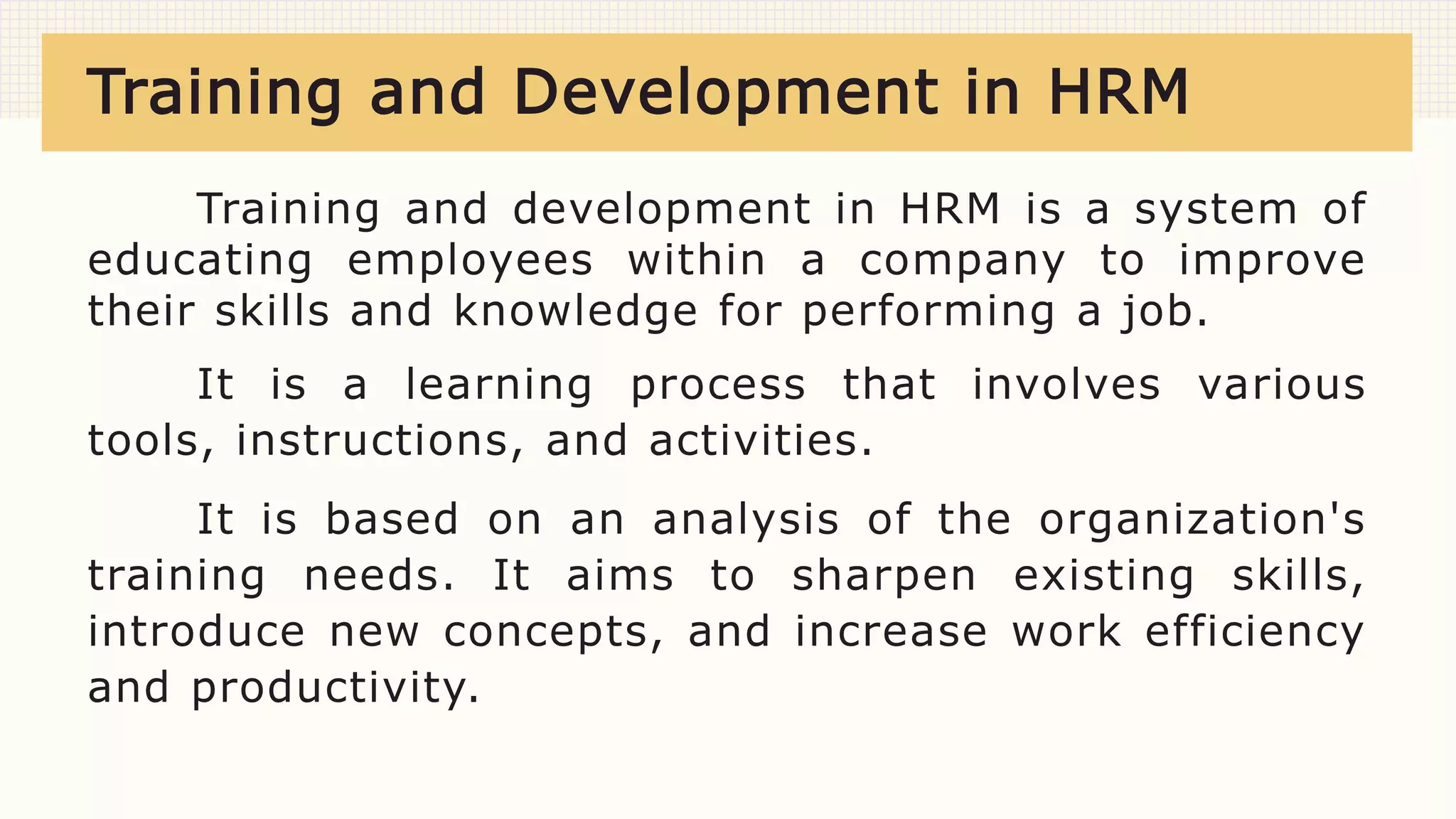
Training and Development in HRM
Training and development in HRM is a system of
educating employees within a company to improve
their skills and knowledge for performing a job.
It is a learning process that involves various
tools, instructions, and activities.
It is based on an analysis of the organization's
training needs. It aims to sharpen existing skills,
introduce new concepts, and increase work efficiency
and productivity.
Thank you!
EDWIN ADORACION JR.

Types of Interview.pptx

  • 1.
  • 2.
    What is anInterview? An interview is a structured conversation where one participant asks questions, and the other provides answers. In common parlance, the word "interview" refers to a one-on-one conversation between an interviewer and an interviewee.
  • 3.
    Types of Interview InformalInterview Formal Interview Planned Interview Patterned Interview Non-Directive Interview Depth Interview Stress Interview Group Interview Panel Interview Nine types of interview:
  • 4.
    1. INFORMAL INTERVIEW Aninformal interview could happen in any place at any time. Some inquiries, such as name, place of birth, prior work experience, etc., may be asked by the employer or a manager in the personnel department. When the labor market is tight and you really need people, it is not planned and used frequently. An applicant may be brought by a friend or family of the employer to the manager's or employer's home for this form of interview.
  • 5.
    2. FORMAL INTERVIEW With the use of well-crafted questions, the employment officer conducted this in a more official setting at the employment office.  The employment office specifies the interview's time and location.
  • 6.
    3. PLANNED INTERVIEW This official interview has been meticulously prepared.  The interviewer has a strategy in place for how much time will be spent with each candidate, what information will be requested, what information will be provided, how the interview will be conducted, and other factors.  He has some latitude in how he uses the strategy.
  • 7.
    4. PATTERNED INTERVIEW This interview was likewise arranged, but it was done so with more correctness, precision, and exactitude. The questions and locations are meticulously planned out.  One after another, the interviewer asks the questions from the list.
  • 8.
    5. NON-DIRECTIVE INTERVIEW This is done to allow the interviewee to express himself freely.  When the applicant is silent, the interviewer gently prods while paying close attention and being patient.  The goal is to completely remove the interviewer's questions from the candidate's ability to "sell" himself.
  • 9.
    6. DEPTH INTERVIEW This is intended to analyze the applicant’s background and way of thinking in-depth and to cover a specific topic of particular interest to the candidate in great detail.  According to the underlying hypothesis, if an applicant is deemed competent in his or her field of expertise, there is a considerable likelihood that, if offered a position, he or she would be really interested in it.
  • 10.
    STRESS INTERVIEW  Byplacing him under stress and pressure, this is intended to examine the candidate's behavior and demeanor.  This is a very helpful way to gauge how people behave under unfavorable and challenging circumstances.
  • 11.
    GROUP INTERVIEW  Thepurpose of this is to see how the candidates respond to and contrast one another. It is possible to gather every applicant in the office for an interview.  As an alternative, the candidates might be given a topic for debate and watched to see who will take the initiative, how they will interact with one another, how they will each offer their ideas, and how they will respond to one another's arguments.
  • 12.
    PANEL INTERVIEW  Membersof the selection committee or the interview panel carry out this task.  Usually, this is done for management and supervisory jobs.  It combines the panelists’ pooled wisdom and judgment. The panel may want the candidate to meet with them one-on-one for a lengthy interview.
  • 13.
     Most businessesare forbidden by federal and state regulations from discriminating in any step of the recruiting process, including reviewing applications, conducting interviews, and administering tests to candidates.  Employers are not permitted to inquire about protected characteristics like race or disability during the interview process or to use such traits as a criterion for hiring. Discrimination in Job Interviews
  • 14.
  • 15.
    Employers with atleast Fifteen (15) workers are prohibited by law from referring to this characteristic in making hiring decisions:  Color  Disability  Genetic Information  National Origin  Race  Religion  Sex, including Pregnancy  Sexual Orientation  Transgender Status  If the employee or candidate is at least 40 years old, employers with at least 20 workers are likewise barred from making judgments based on age.  Many states and municipal governments have their own anti- discrimination laws that ban discrimination in the workplace.  Some of these rules extend to smaller firms or forbid discrimination on other grounds. Which Characteristics are Protected?
  • 16.
    Illegal I N TE R V I E W Q U E S T I O N S
  • 17.
     Employers aren'tallowed to base recruiting choices on protected qualities, so they shouldn't bring them up in job interviews either.  Employers shouldn't inquire about things like your age, color or ethnicity, or if you intend to get pregnant.  Employers might not base their judgments on this information even if you provide it during an interview if it is plain to see. "You should speak with an employment lawyer immediately away if you believe a potential employer opted not to hire you for discriminatory reasons." Illegal Interview Questions
  • 18.
     Employers arenot permitted to inquire about your disability during an interview.  The interviewer may inquire about your requirement for a reasonable accommodation to carry out the essential functions of the position if you disclose your impairment to them during the interview or if your disability is obviously present.  Employers must treat all candidates equally in this regard; regard; it is not permitted to ask these questions of only only those who clearly have a disability. Reasonable Accommodation for a Disability
  • 19.
     You'll needto make a decision right away about how to respond if a potential employer asks you discriminatory questions during an interview.  You should see an employment lawyer straight away if you believe that a prospective employer's decision to reject your application was motivated by discrimination.  It is challenging also to prove that you are being discriminated. Without hard ground for your claim, the employer could easily reason out why you were not considered.  In that case, you have to examine if your claim may be worth pursuing, or it may be better to go on with your employment hunt, according to an attorney. It can be worthwhile to speak with an employment attorney to learn more about your legal alternatives if you were the target of discrimination during a job interview. There's virtually nothing to lose because many attorneys give consultations without cost. If You’re Facing Discrimination Contact an Attorney
  • 20.
  • 21.
    GUIDELINES IN CONDUCTINGINTERVIEWS 1. Establish position requirement priorities 2. Communicate with human resources 3. Put together a diverse hiring team 4. Develop a welcoming environment 5. Avoid asking personal or unfit questions 6. Document the interview process 7. Maintain a neutral body language 8. Ensure all questions are job-relevant
  • 22.
    GUIDELINES IN CONDUCTINGINTERVIEWS 1. Establish position requirement priorities 2. Communicate with human resources 3. Put together a diverse hiring team 4. Develop a welcoming environment 5. Avoid asking personal or unfit questions 6. Document the interview process 7. Maintain a neutral body language 8. Ensure all questions are job-relevant
  • 23.
    GUIDELINES IN CONDUCTINGINTERVIEWS  Determine the prerequisites you have for the position you are recruiting for before you conduct interviews.  Prioritize the needs that are absolutely required and identify which are desirable once you have determined the position requirements.  It's crucial to maintain flexibility during the recruiting process since the ideal applicant cannot satisfy all the prerequisites but yet be the greatest fit for the job. 1. Establish position requirement priorities
  • 24.
    GUIDELINES IN CONDUCTINGINTERVIEWS  Professionals in human resources are very helpful when vetting and interviewing potential employees.  Consider scheduling a meeting with a human resources person after you've created your interview materials so they can look through the materials and offer comments.  Before you start the interview, a member of the human resources staff might be able to let you know whether any of your questions might be illegal. 2. Communicate with human resources
  • 25.
    GUIDELINES IN CONDUCTINGINTERVIEWS  Having a diverse hiring staff may help ensure fair evaluation of candidates during interviews and increase their comfort level.  You want to make sure that everyone who is participating thinks that the recruiting process is fair, that they are welcomed, and that their needs are being met.  Consider putting together a recruiting committee that includes competent, diverse members of your staff to conduct interviews and make judgments. 3. Put together a diverse hiring team
  • 26.
    GUIDELINES IN CONDUCTINGINTERVIEWS  If you create a friendly, distraction-free environment for your interview, it will be more likely to be successful.  The applicant should sense that you and your staff are paying close attention to them.  Think about choosing a space with few windows that face inward and a door that you can close during the interview.  Make sure the candidate is comfortable before starting the interview by asking questions rather than doing other business activities. 4. Develop a welcoming environment
  • 27.
    GUIDELINES IN CONDUCTINGINTERVIEWS Through the interview process, you want to get to know the possible employee, but there are some questions you shouldn't likely ask. Some interview questions may not only make the candidate feel uneasy but also be against the law. 5. Avoid asking personal or unfit questions
  • 28.
    GUIDELINES IN CONDUCTINGINTERVIEWS You should refrain from bringing up any of the following during interviews: Affiliation Age-related Appearance Citizenship Disability Drug use Family Status Financial Gender Race- Related Relationship s Religion
  • 29.
    GUIDELINES IN CONDUCTINGINTERVIEWS You should refrain from bringing up any of the following during interviews: Affiliation Age-related Appearance Citizenship Disability Drug use Family Status Financial Gender Race- Related Relationship s Religion
  • 30.
    GUIDELINES IN CONDUCTINGINTERVIEWS You should refrain from bringing up any of the following during interviews: Affiliation Age-related Appearance Citizenship Disability Drug use Family Status Financial Gender Race- Related Relationship s Religion
  • 31.
    GUIDELINES IN CONDUCTINGINTERVIEWS You should refrain from bringing up any of the following during interviews: Affiliation Age-related Appearance Citizenship Disability Drug use Family Status Financial Gender Race- Related Relationship s Religion
  • 32.
    GUIDELINES IN CONDUCTINGINTERVIEWS You should refrain from bringing up any of the following during interviews: Affiliation Age-related Appearance Citizenship Disability Drug use Family Status Financial Gender Race- Related Relationship s Religion
  • 33.
    GUIDELINES IN CONDUCTINGINTERVIEWS You should refrain from bringing up any of the following during interviews: Affiliation Age-related Appearance Citizenship Disability Drug use Family Status Financial Gender Race- Related Relationship s Religion
  • 34.
    GUIDELINES IN CONDUCTINGINTERVIEWS You should refrain from bringing up any of the following during interviews: Affiliation Age-related Appearance Citizenship Disability Drug use Family Status Financial Gender Race- Related Relationship s Religion
  • 35.
    GUIDELINES IN CONDUCTINGINTERVIEWS You should refrain from bringing up any of the following during interviews: Affiliation Age-related Appearance Citizenship Disability Drug use Family Status Financial Gender Race- Related Relationship s Religion
  • 36.
    GUIDELINES IN CONDUCTINGINTERVIEWS You should refrain from bringing up any of the following during interviews: Affiliation Age-related Appearance Citizenship Disability Drug use Family Status Financial Gender Race- Related Relationship s Religion
  • 37.
    GUIDELINES IN CONDUCTINGINTERVIEWS You should refrain from bringing up any of the following during interviews: Affiliation Age-related Appearance Citizenship Disability Drug use Family Status Financial Gender Race- Related Relationship s Religion
  • 38.
    GUIDELINES IN CONDUCTINGINTERVIEWS You should refrain from bringing up any of the following during interviews: Affiliation Age-related Appearance Citizenship Disability Drug use Family Status Financial Gender Race- Related Relationship s Religion
  • 39.
    GUIDELINES IN CONDUCTINGINTERVIEWS You should refrain from bringing up any of the following during interviews: Affiliation Age-related Appearance Citizenship Disability Drug use Family Status Financial Gender Race- Related Relationship s Religion
  • 40.
    GUIDELINES IN CONDUCTINGINTERVIEWS You should refrain from bringing up any of the following during interviews: Affiliation Age-related Appearance Citizenship Disability Drug use Family Status Financial Gender Race- Related Relationship s Religion
  • 41.
    GUIDELINES IN CONDUCTINGINTERVIEWS  To safeguard yourself, your recruiting team, and the business you work for, documentation is crucial.  To guarantee you have complete documentation of each encounter, think about utilizing a tape or video recorder to capture each interview. Make careful to let the candidate know you're recording the interview if you decide to do so.  Take notes throughout the meeting as well. Even though it may be helpful to record the meeting on video or audio, taking notes will allow you to capture your ideas as they occur.  When evaluating the applicant's details throughout the recruiting process, you may then refer to them. 6. Document the interview process
  • 42.
    GUIDELINES IN CONDUCTINGINTERVIEWS  You can be impressed or taken aback by a candidate's comments during an interview.  In these circumstances, it's critical to maintain neutral body language, restrain your facial expressions, and refrain from making unexpected movements. For instance, if a candidate says something that makes you believe they'd be a great pick and you want to remember it, don't write it down hastily.  By doing this, you can keep your body language neutral and make sure the prospect is at ease. 7. Maintain a neutral body language
  • 43.
    GUIDELINES IN CONDUCTINGINTERVIEWS  Making sure that the interview questions are applicable to the position being filled is one of the most crucial interview standards to adhere to while creating your interview materials.  Avoid asking inappropriate or personal inquiries and make sure the questions you do ask are about the work.  This not only shields you and your recruiting team from unethical behavior, but it may also speed up the interview process and make everyone more at ease.  Keep your attention on the crucial facets of the position if you want to conduct yourself properly. 8. Ensure all questions are job-relevant
  • 44.
  • 45.
    TRAINING AND DEVELOPMENT Oneof the most crucial aspects of human resource management in any firm is training and development. The goal of this training is to improve employees' abilities, behaviors, and expertise by exposing them to new working methods.
  • 46.
    TRAINING AND DEVELOPMENT Oneof the most crucial aspects of human resource management in any firm is training and development. The goal of this training is to improve employees' abilities, behaviors, and expertise by exposing them to new working methods.
  • 47.
    TRAINING AND DEVELOPMENT Definition: Asystem utilized by a company to enhance the abilities and productivity of its employees is known as employee training and development (ETD) in human resource management. It is a teaching tool that contains data and guidelines for honing already acquired abilities and introducing fresh ideas and information to boost worker productivity. A successful training and development plan built on an analysis of the training needs aids the business in raising the productivity and skill levels of its workforce.
  • 48.
    TRAINING AND DEVELOPMENT Meaning: Trainingis a process for improving an employee's capabilities, knowledge, and skills. To guarantee that the employee can successfully complete the responsibilities allocated to them and contribute to the success of the business, job-related training is frequently given to them. On the other hand, the development program frequently serves as training for the work of the future. The development of human resources offers employees a learning opportunity to improve their job capacities and prepare for upcoming problems.
  • 49.
    Training and DevelopmentDefinition by the Eminent Authors Armstrong “Training is the formal and systematic modification of behavior through learning which occurs as a result of education, instruction, development and planned experience. Development is improving individual performance in their present Roles and preparing them for greater responsibilities in the future”. Here are the definitions provided by the knowledgeable and distinguished authors:
  • 50.
    Training and DevelopmentDefinition by the Eminent Authors Katz & Kahn “Training and development is described as a maintenance subsystem, intended to improve organizational efficiency by increasing routinization and predictability of behavior.” Kllatt, Murdick & Schuster “Training is a systematic way of altering behavior to prepare an employee for a job or to employee for improving the conceptual, decision-making, and interpersonal skills in complex, in structured situation” Here are the definitions provided by the knowledgeable and distinguished authors:
  • 51.
    Training and DevelopmentDefinition by the Eminent Authors Lussier “Training is a process of acquiring the skills necessary to perform a job and development is the ability to perform both present and future jobs”. McLagan “Training and development focuses on identifying, assuring and helping develop, through planned learning, the key competencies that enable individuals to perform current or future jobs”. Here are the definitions provided by the knowledgeable and distinguished authors:
  • 52.
    Training and DevelopmentDefinition by the Eminent Authors Kirkpatrick “Training refers to the teaching of specific knowledge and skills required on the individual’s present job. The term development refers to the growth of the individual and preparations for higher- level jobs”. Kleiman “Training and development are planned learning experiences that teach workers how to perform their current or future jobs effectively.” Here are the definitions provided by the knowledgeable and distinguished authors:
  • 53.
    Training and Developmentin HRM Training and development in HRM is a system of educating employees within a company to improve their skills and knowledge for performing a job. It is a learning process that involves various tools, instructions, and activities. It is based on an analysis of the organization's training needs. It aims to sharpen existing skills, introduce new concepts, and increase work efficiency and productivity.
  • 54.

Editor's Notes

  • #18 Employers aren't allowed to base recruiting choices on protected qualities, so they shouldn't bring them up in job interviews either. Employers shouldn't inquire about things like your age, color or ethnicity, or if you intend to get pregnant. Employers might not base their judgments on this information even if you provide it during an interview if it is plain to see. For instance, the interviewer may not take into account the fact that your last name is Persian and that you were born in Iran when making a hiring decision if you correct the interviewer's pronunciation error. "You should speak with an employment lawyer immediately away if you believe a potential employer opted not to hire you for discriminatory reasons."
  • #19 Employers are not permitted to inquire about your disability during an interview. However, as long as they do so for all candidates, an employer is allowed to explain how the recruiting process works and inquire whether you'll need a reasonable accommodation to participate. The interviewer may inquire about your requirement for a reasonable accommodation to carry out the essential functions of the position if you disclose your impairment to them during the interview or if your disability is obviously present. Employers must treat all candidates equally in this regard; it is not permitted to ask these questions of only those who clearly have a disability. Additionally, if you are qualified for the position, with or without a reasonable accommodation, an employer may not base a hiring decision on your impairment.
  • #24 Determine the prerequisites you have for the position you are recruiting for before you conduct interviews. Prioritize the needs that are absolutely required and identify which are desirable once you have determined the position requirements. It's crucial to maintain flexibility during the recruiting process since the ideal applicant cannot satisfy all the prerequisites but yet be the greatest fit for the job.
  • #25 Determine the prerequisites you have for the position you are recruiting for before you conduct interviews. Prioritize the needs that are absolutely required and identify which are desirable once you have determined the position requirements. It's crucial to maintain flexibility during the recruiting process since the ideal applicant cannot satisfy all the prerequisites but yet be the greatest fit for the job.
  • #26 Determine the prerequisites you have for the position you are recruiting for before you conduct interviews. Prioritize the needs that are absolutely required and identify which are desirable once you have determined the position requirements. It's crucial to maintain flexibility during the recruiting process since the ideal applicant cannot satisfy all the prerequisites but yet be the greatest fit for the job.
  • #30 Affiliation: Instead than focusing on their membership or affiliation in organizations or unions, inquire simply about the relevant professional associations.