
Cracking an InterviewCracking an Interview
Rohan Fernandez
Srinivas School of Engineering
I have got to attend
a job interview
next week. How
can I prepare
myself?
I have never been to
an interview before.
What is it all about?
How can I let them
know I could
actually do the job
well?
What will they ask
me? How do I
answer?
What do I need to
take with me? Someone HELP me!
Who can help me? I
have no idea what to
say or what to do?
How do I dress? Do
I have to purchase a
new suit for the
interview?
How can I do well if I
know nothing about
it?
What can I ask them
about?
Where exactly is this street?
Where exactly is this building?
How do I get there?
What about the traffic jams?
Will I be delayed?
What time must I leave?
Which floor?
Which office?
Which room?
If I drive there,
where will I park
the car?
Will there be
parking space?NOTE THE
DATE of the
interview
DAY of the interview
TIME of the interview
PLACE of the
interview
AIMS OF THE INTERVIEWAIMS OF THE INTERVIEW
To Elicit Information
To assess the suitability of a person to the
job/position
To assess the job / position / Company by
the interviewee
INTERVIEW IS NOT A ONE WAY
PROCESS:
The interviewer is assessing the Interviewee
for the suitability of the job or position
The interviewee is assessing whether the
job is suitable to him with all related perks
Therefore, it is a two way process of
communication.
VERBAL INTERVIEW:VERBAL INTERVIEW:
Family background
Communication Skill
General aptitude
Knowledge on subject
Personality
Potential to handle the job/to grow
Remuneration package
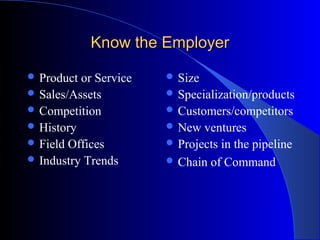
Know the EmployerKnow the Employer
 Product or Service
 Sales/Assets
 Competition
 History
 Field Offices
 Industry Trends
 Size
 Specialization/products
 Customers/competitors
 New ventures
 Projects in the pipeline
 Chain of Command
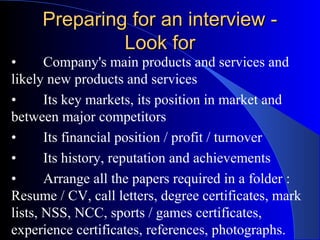
Preparing for an interview -Preparing for an interview -
Look forLook for
• Company's main products and services and
likely new products and services
• Its key markets, its position in market and
between major competitors
• Its financial position / profit / turnover
• Its history, reputation and achievements
• Arrange all the papers required in a folder :
Resume / CV, call letters, degree certificates, mark
lists, NSS, NCC, sports / games certificates,
experience certificates, references, photographs.
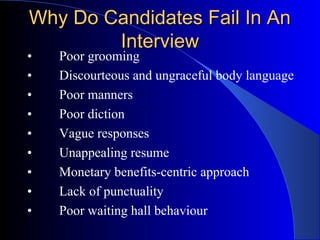
Why Do Candidates Fail In AnWhy Do Candidates Fail In An
InterviewInterview
• Poor grooming
• Discourteous and ungraceful body language
• Poor manners
• Poor diction
• Vague responses
• Unappealing resume
• Monetary benefits-centric approach
• Lack of punctuality
• Poor waiting hall behaviour
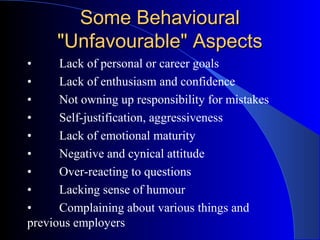
Some BehaviouralSome Behavioural
"Unfavourable" Aspects"Unfavourable" Aspects
• Lack of personal or career goals
• Lack of enthusiasm and confidence
• Not owning up responsibility for mistakes
• Self-justification, aggressiveness
• Lack of emotional maturity
• Negative and cynical attitude
• Over-reacting to questions
• Lacking sense of humour
• Complaining about various things and
previous employers
Resources forResources for
Researching theResearching the
EmployerEmployer
 Official website of the company
 Newspapers/Magazines
 Advertisements
 Annual Reports
 Ex-employees
 Present employees
 Direct contact
 Trade publications & journals
Know YourselfKnow Yourself
Why do you want to work for the firm?
What can you do for the company?
Your accomplishments/experience
Your strengths/weaknesses
Your initiative, goals and attitudes
Your responses should be unique and
specific
The Previous DayThe Previous Day
• Confirm the venue of the interview,
distance, and mode of transport
• Locate the venue earlier
• Relax, have good sleep, visualise and
pray
The Interview DayThe Interview Day
• Reach the venue at least 30 minutes
ahead of the interview
• Get familiar with the ambience
• Don't carry too much baggage
• Report to the authority concerned
Waiting Hall BehaviourWaiting Hall Behaviour
• Maintain Decorum
• Mingle with others politely
• Avoid smoking, chewing, flirting,
gossiping, defamatory comments
• Greet others present
• Switch off the mobile
• Relax and visualise
• Don’t listen to your iPod, play video
games, make cell phone calls, etc. while
waiting to be interviewed..
What to Bring to the InterviewWhat to Bring to the Interview
 Portfolio
 Copies of your resume
 List of Professional
References
 College transcripts
 Filled out application
 Two quality pens
 Notepad
 Comb or brush
 Breath mints
 Always carry a
handkerchief
 Keep your teeth clean.
You don’t want to put
off your interview when
you speak.
 Don’t eat smelly food
like onion, garlic,
pickles etc.
Men's Interview AttireMen's Interview Attire
• Suit (solid color - navy
or dark grey)
• Long sleeve shirt
(white or coordinated
with the suit)
• Clean shaven
• Belt
• Tie (pattern should be
simple)
• Dark socks,
conservative leather
shoes (well polished)
• Neat, professional
hairstyle
• Limit the aftershave
• Neatly trimmed nails
• Portfolio file with
documents properly
organized
Women's Interview Attire:Women's Interview Attire:
• Suit (navy, black or
dark grey)
• The suit skirt should be
long enough so you can
sit down comfortably
• Coordinated blouse
• Conservative shoes
• Limited jewelry (no
dangling earrings or
arms full of bracelets
• Professional hairstyle
• Light make-up and
perfume
• Neatly manicured clean
nails
• Portfolio file with
documents properly
organized
Interview Attire Tips:Interview Attire Tips:
• Before you even think about going on an
interview, make sure you have appropriate
interview attire and everything fits correctly.
• Get your clothes ready the night before, so you
don't have to spend time getting them ready on
the day of the interview.
• If your clothes are dry clean only, take them to
the cleaners after an interview, so they are ready
for next time.
• Bring a breath mint and use it before you enter
the building.
Ten TipsTen Tips
 Arrive on time
 Introduce yourself in a
courteous manner
 Read company
literature while you
wait
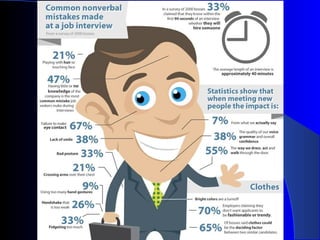
 Use body language to
show interest
 Listen
 Smile, nod, give
nonverbal feedback
 Ask about the next
step in the process
 Thank the interviewer
 Obtain a business card
 Write a thank-you
letter to anyone you
have spoken to
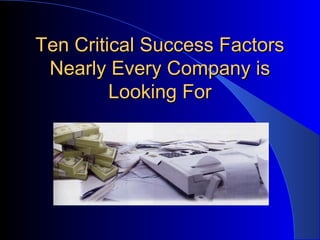
Ten Critical Success FactorsTen Critical Success Factors
Nearly Every Company isNearly Every Company is
Looking ForLooking For
1) Positive attitude towards work
2) Proficiency in field of study
3) Communication skills (oral and written)
4) Interpersonal skills
5) Confidence
6) Critical thinking and problem solving
skills
7) Flexibility
8) Self-motivation
9) Leadership
10) Teamwork
While Entering the InterviewWhile Entering the Interview
HallHall
• Enter confidently, not arrogantly
• Shut the door gently
• Smile and greet the interviewers
• Shake hands only if they offer their hand
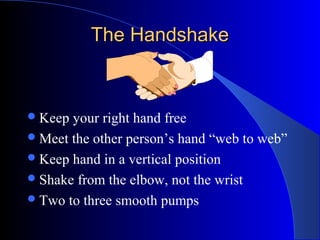
The HandshakeThe Handshake
Keep your right hand free
Meet the other person’s hand “web to web”
Keep hand in a vertical position
Shake from the elbow, not the wrist
Two to three smooth pumps
During The InterviewDuring The Interview
• Maintain eye contact
• Be attentive, listen carefully, and lean
forward
• Don't lean on the table, and don't slouch
• Don't toss your files across
• Hand over your file-right side facing them
• Don't laugh or giggle but smile gently
• Be polite. use the words "Please" and "thank
you"
• Don't argue but can orally acknowledge
Sit relaxed and in up right position without
crossing your legs
Beware of your forced habits - Breaking
knuckles/Shaking your legs/Squeezing your
palms/Wiping your face etc.,
Be bold and confident
Anticipate the type of questions
Be polite and ask for queries in case of doubt
while answering the questions
High light your strengths whenever a chance is
given to you or create a chance to highlight your
strengths
Try to draw attention of the interviewer on
specific subject you know well and try to take an
opportunity to express them well
Mind your body language
Do not get frustrated or loose temper for some
irritant questions posed
Do not have the negative feeling if you do not
answer some questions
Do not try to bluff or cover your wrong answers
If you do not know the answer say I am sorry/ I
am afraid I cannot answer the question etc.,
If you cannot understand the question ask politely
to repeat the question
Do not try to argue with the interviewer
As far as your credentials are concerned take a
chance to show/exhibit them - by doing so you
will be drawing their attention towards the subject
you know well
Do not try to blow your own Trumpet - You
might get caught or it gives an impression that
you are a self centered person
Face the interviewer while answering. Answer to
the person who posed you the questions
Have a good eye contact with the panel members of the
interview
Wait for a question to be completed . Do not be hasty
in answering even when you know the answer well
Some times using pen and scribbling pad will help you
in expressing things better and it also helps you in
relaxing
Do not give excuses of health for not answering
Do not take shelter under or blame the college or
organization or lecturers for not answering some
questions
Be clear in what you say - Do not mumble
Respond to questions and back up your statements
about yourself with specific examples whenever
possible.
Ask for clarification if you don’t understand a
question; and be thorough in your responses while
being concise in your wording.
Use good grammar and good diction. Say “yes”, not
“yeah.” Don’t fill pauses with “um,” uh” or “ah”.
Don’t punctuate sentences with “you know”, “like”,
“see” or “okay”.
Treat the interview seriously and show interest in the
employer and the opportunity presented and respond
to questions in a positive manner.
Watch the tone of your voice. While it might be trendy
among your friends to “up speak” (end sentence with a
higher tone of voice so that sentences sound like
questions), this habit will kill your credibility during
the interview.
Answer the question and use professional experiences
or descriptive information to demonstrate how you
would react or respond to a situation.
Make sure answers have a definite flow. In the
beginning state major points you want to make; in the
middle expand upon those points or ideas, and in the
end reinforce your key points and end on a positive
note.
Do not try to take sympathy by expressing your
family problems / financial problems to the
interviewer
At the end of interview, if you have still doubts on
anything, ask for clarification from the interviewer
Do not plead or beg for the job
Do not accept or ask for whatever job the Company
will offer (Say like, not related to your aptitude)
Do not walk out of the interview in a huff. Wait until
the interview is completed
After completing the interview, do not forget to wish
or say thanks before you go out
Typical Structure of anTypical Structure of an
InterviewInterview
Small talk
“Tell me about yourself!”
Discussion of your background and how it
relates to the position
Your opportunity to ask questions
Conclusion
Five Tough InterviewFive Tough Interview
QuestionsQuestions
The tell-all question: “Tell me about
yourself.”
The surprise question: “What’s your
passion?”
Strengths and weaknesses questions
Questions about the future: “What are your
long-term goals?”
Scenario questions: “What if…?”
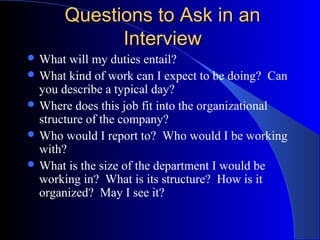
Questions to Ask in anQuestions to Ask in an
InterviewInterview
 What will my duties entail?
 What kind of work can I expect to be doing? Can
you describe a typical day?
 Where does this job fit into the organizational
structure of the company?
 Who would I report to? Who would I be working
with?
 What is the size of the department I would be
working in? What is its structure? How is it
organized? May I see it?
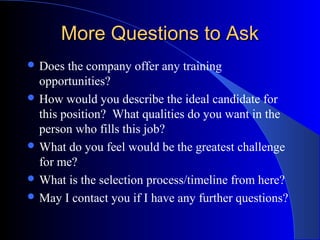
More Questions to AskMore Questions to Ask
 Does the company offer any training
opportunities?
 How would you describe the ideal candidate for
this position? What qualities do you want in the
person who fills this job?
 What do you feel would be the greatest challenge
for me?
 What is the selection process/timeline from here?
 May I contact you if I have any further questions?
Practice, Practice, Practice!Practice, Practice, Practice!
Mock interview
Scour the Internet for questions etc.
UNDERSTANDING THEUNDERSTANDING THE
PROCESS OF NEGOTIATIONPROCESS OF NEGOTIATION
What It Is Not
– saying “I want more money”
What It Is
– Meeting and discussing a subject
– Mutual agreement of issues
UNDERSTANDING THEUNDERSTANDING THE
PROCESSPROCESS
When does negotiation begin
– Telling about yourself
– With the initial interview
Don’t reveal your salary requirements too
early in the negotiation process.
UNDERSTANDING THEUNDERSTANDING THE
PROCESSPROCESS
Evaluation
– Answer these questions:
What is the Salary range?
What is the lowest salary that I will consider?
What makes me worth a higher salary?
UNDERSTANDING THE PROCESSUNDERSTANDING THE PROCESS
Where To Get Salary Information
– National Association of Colleges and
Employers
– Career Resource Center
– Libraries
– Trade associations and trade publications
– Internet
– People working in the industry
UNDERSTANDING THE PROCESSUNDERSTANDING THE PROCESS
Some Employer Objections To Your
Request For More Money
– You don’t have enough experience
– Other employees aren’t making more
– The budget won’t permit
– That’s what we are paying new hires
UNDERSTANDING THE PROCESSUNDERSTANDING THE PROCESS
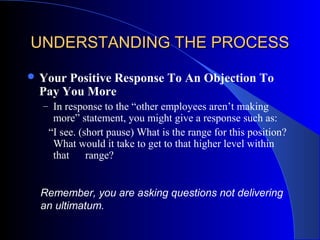
 Your Positive Response To An Objection To
Pay You More
– In response to the “other employees aren’t making
more” statement, you might give a response such as:
“I see. (short pause) What is the range for this position?
What would it take to get to that higher level within
that range?
Remember, you are asking questions not delivering
an ultimatum.
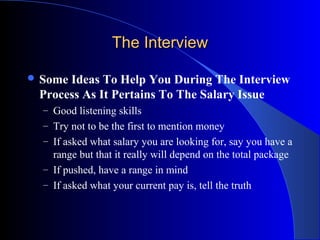
The InterviewThe Interview
 Some Ideas To Help You During The Interview
Process As It Pertains To The Salary Issue
– Good listening skills
– Try not to be the first to mention money
– If asked what salary you are looking for, say you have a
range but that it really will depend on the total package
– If pushed, have a range in mind
– If asked what your current pay is, tell the truth
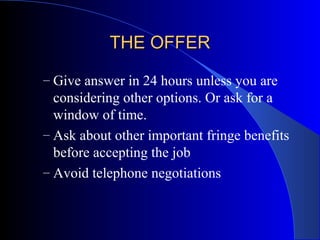
THE OFFERTHE OFFER
– Give answer in 24 hours unless you are
considering other options. Or ask for a
window of time.
– Ask about other important fringe benefits
before accepting the job
– Avoid telephone negotiations
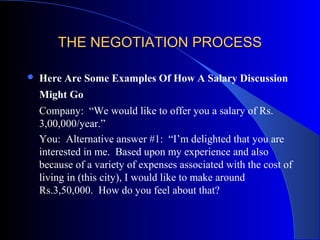
THE NEGOTIATION PROCESSTHE NEGOTIATION PROCESS
 Here Are Some Examples Of How A Salary Discussion
Might Go
Company: “We would like to offer you a salary of Rs.
3,00,000/year.”
You: Alternative answer #1: “I’m delighted that you are
interested in me. Based upon my experience and also
because of a variety of expenses associated with the cost of
living in (this city), I would like to make around
Rs.3,50,000. How do you feel about that?
THE NEGOTIATION PROCESSTHE NEGOTIATION PROCESS
Alternative answer #2: “I like the opportunity, and I know
that I could contribute, but I have several other
opportunities that are in the Rs.3,50,000 range. Is there a
way we could work this out?”
Alternative answer #3: “I’ve completed a very valuable
education and anticipated Rs.3,50,000 as a minimum. Is
there a way we can work that out? I love the opportunity
and would like to work here if I can get that amount. What
do you think?”
THE NEGOTIATION PROCESSTHE NEGOTIATION PROCESS
– Ask if you can get periodic reviews to let your
future employer know that you are concerned
with providing the highest level of service.
– Before asking for more money, mention
positive statement that reflects your skills and
why you are qualified for the job.
Every Interview is a
new opportunity
Credential questionsCredential questions
 "How long were you at . . . "
 "What did you learn in that
class?"
 objective measurements
on your background.
Experience questionsExperience questions
 What were your responsibilities in that
position?
 What is the most rewarding thing in
your job?
 Subjectively evaluate your
background.
Opinion questionsOpinion questions
 "What would you do in this
situation?“
 "What are your strengths and
weaknesses?"
 Subjectively analyze your
response in a series of scenarios.
Behavioral questionsBehavioral questions
 "Can you give me a specific example
of how you did that?“
 "What were the steps you followed
to accomplish that task?"
 Anticipate future responses based
upon past behaviors.
Top Interview QuestionsTop Interview Questions
Introduce yourself
What are your key strengths?
What are your weaknesses?
What kind of a person you are?
What subjects have you studied?
What are your career goals?
Why did you choose this company?
What are your accomplishments?
What is your percentage of marks?
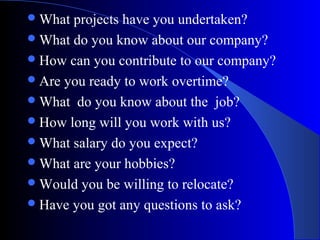
What projects have you undertaken?
What do you know about our company?
How can you contribute to our company?
Are you ready to work overtime?
What do you know about the job?
How long will you work with us?
What salary do you expect?
What are your hobbies?
Would you be willing to relocate?
Have you got any questions to ask?

Cracking an interview

  • 1.
    Cracking an InterviewCrackingan Interview Rohan Fernandez Srinivas School of Engineering
  • 2.
    I have gotto attend a job interview next week. How can I prepare myself? I have never been to an interview before. What is it all about? How can I let them know I could actually do the job well? What will they ask me? How do I answer? What do I need to take with me? Someone HELP me! Who can help me? I have no idea what to say or what to do? How do I dress? Do I have to purchase a new suit for the interview? How can I do well if I know nothing about it? What can I ask them about?
  • 3.
    Where exactly isthis street? Where exactly is this building? How do I get there? What about the traffic jams? Will I be delayed? What time must I leave? Which floor? Which office? Which room? If I drive there, where will I park the car? Will there be parking space?NOTE THE DATE of the interview DAY of the interview TIME of the interview PLACE of the interview
  • 5.
    AIMS OF THEINTERVIEWAIMS OF THE INTERVIEW To Elicit Information To assess the suitability of a person to the job/position To assess the job / position / Company by the interviewee
  • 6.
    INTERVIEW IS NOTA ONE WAY PROCESS: The interviewer is assessing the Interviewee for the suitability of the job or position The interviewee is assessing whether the job is suitable to him with all related perks Therefore, it is a two way process of communication.
  • 7.
    VERBAL INTERVIEW:VERBAL INTERVIEW: Familybackground Communication Skill General aptitude Knowledge on subject Personality Potential to handle the job/to grow Remuneration package
  • 8.
    Know the EmployerKnowthe Employer  Product or Service  Sales/Assets  Competition  History  Field Offices  Industry Trends  Size  Specialization/products  Customers/competitors  New ventures  Projects in the pipeline  Chain of Command
  • 9.
    Preparing for aninterview -Preparing for an interview - Look forLook for • Company's main products and services and likely new products and services • Its key markets, its position in market and between major competitors • Its financial position / profit / turnover • Its history, reputation and achievements • Arrange all the papers required in a folder : Resume / CV, call letters, degree certificates, mark lists, NSS, NCC, sports / games certificates, experience certificates, references, photographs.
  • 10.
    Why Do CandidatesFail In AnWhy Do Candidates Fail In An InterviewInterview • Poor grooming • Discourteous and ungraceful body language • Poor manners • Poor diction • Vague responses • Unappealing resume • Monetary benefits-centric approach • Lack of punctuality • Poor waiting hall behaviour
  • 11.
    Some BehaviouralSome Behavioural "Unfavourable"Aspects"Unfavourable" Aspects • Lack of personal or career goals • Lack of enthusiasm and confidence • Not owning up responsibility for mistakes • Self-justification, aggressiveness • Lack of emotional maturity • Negative and cynical attitude • Over-reacting to questions • Lacking sense of humour • Complaining about various things and previous employers
  • 12.
    Resources forResources for ResearchingtheResearching the EmployerEmployer  Official website of the company  Newspapers/Magazines  Advertisements  Annual Reports  Ex-employees  Present employees  Direct contact  Trade publications & journals
  • 13.
    Know YourselfKnow Yourself Whydo you want to work for the firm? What can you do for the company? Your accomplishments/experience Your strengths/weaknesses Your initiative, goals and attitudes Your responses should be unique and specific
  • 14.
    The Previous DayThePrevious Day • Confirm the venue of the interview, distance, and mode of transport • Locate the venue earlier • Relax, have good sleep, visualise and pray
  • 15.
    The Interview DayTheInterview Day • Reach the venue at least 30 minutes ahead of the interview • Get familiar with the ambience • Don't carry too much baggage • Report to the authority concerned
  • 16.
    Waiting Hall BehaviourWaitingHall Behaviour • Maintain Decorum • Mingle with others politely • Avoid smoking, chewing, flirting, gossiping, defamatory comments • Greet others present • Switch off the mobile • Relax and visualise • Don’t listen to your iPod, play video games, make cell phone calls, etc. while waiting to be interviewed..
  • 17.
    What to Bringto the InterviewWhat to Bring to the Interview  Portfolio  Copies of your resume  List of Professional References  College transcripts  Filled out application  Two quality pens  Notepad  Comb or brush  Breath mints  Always carry a handkerchief  Keep your teeth clean. You don’t want to put off your interview when you speak.  Don’t eat smelly food like onion, garlic, pickles etc.
  • 18.
    Men's Interview AttireMen'sInterview Attire • Suit (solid color - navy or dark grey) • Long sleeve shirt (white or coordinated with the suit) • Clean shaven • Belt • Tie (pattern should be simple) • Dark socks, conservative leather shoes (well polished) • Neat, professional hairstyle • Limit the aftershave • Neatly trimmed nails • Portfolio file with documents properly organized
  • 19.
    Women's Interview Attire:Women'sInterview Attire: • Suit (navy, black or dark grey) • The suit skirt should be long enough so you can sit down comfortably • Coordinated blouse • Conservative shoes • Limited jewelry (no dangling earrings or arms full of bracelets • Professional hairstyle • Light make-up and perfume • Neatly manicured clean nails • Portfolio file with documents properly organized
  • 20.
    Interview Attire Tips:InterviewAttire Tips: • Before you even think about going on an interview, make sure you have appropriate interview attire and everything fits correctly. • Get your clothes ready the night before, so you don't have to spend time getting them ready on the day of the interview. • If your clothes are dry clean only, take them to the cleaners after an interview, so they are ready for next time. • Bring a breath mint and use it before you enter the building.
  • 21.
    Ten TipsTen Tips Arrive on time  Introduce yourself in a courteous manner  Read company literature while you wait  Use body language to show interest  Listen  Smile, nod, give nonverbal feedback  Ask about the next step in the process  Thank the interviewer  Obtain a business card  Write a thank-you letter to anyone you have spoken to
  • 22.
    Ten Critical SuccessFactorsTen Critical Success Factors Nearly Every Company isNearly Every Company is Looking ForLooking For
  • 23.
    1) Positive attitudetowards work 2) Proficiency in field of study 3) Communication skills (oral and written) 4) Interpersonal skills 5) Confidence 6) Critical thinking and problem solving skills 7) Flexibility 8) Self-motivation 9) Leadership 10) Teamwork
  • 24.
    While Entering theInterviewWhile Entering the Interview HallHall • Enter confidently, not arrogantly • Shut the door gently • Smile and greet the interviewers • Shake hands only if they offer their hand
  • 25.
    The HandshakeThe Handshake Keepyour right hand free Meet the other person’s hand “web to web” Keep hand in a vertical position Shake from the elbow, not the wrist Two to three smooth pumps
  • 26.
    During The InterviewDuringThe Interview • Maintain eye contact • Be attentive, listen carefully, and lean forward • Don't lean on the table, and don't slouch • Don't toss your files across • Hand over your file-right side facing them • Don't laugh or giggle but smile gently • Be polite. use the words "Please" and "thank you" • Don't argue but can orally acknowledge
  • 27.
    Sit relaxed andin up right position without crossing your legs Beware of your forced habits - Breaking knuckles/Shaking your legs/Squeezing your palms/Wiping your face etc., Be bold and confident Anticipate the type of questions Be polite and ask for queries in case of doubt while answering the questions High light your strengths whenever a chance is given to you or create a chance to highlight your strengths
  • 28.
    Try to drawattention of the interviewer on specific subject you know well and try to take an opportunity to express them well Mind your body language Do not get frustrated or loose temper for some irritant questions posed Do not have the negative feeling if you do not answer some questions Do not try to bluff or cover your wrong answers If you do not know the answer say I am sorry/ I am afraid I cannot answer the question etc.,
  • 29.
    If you cannotunderstand the question ask politely to repeat the question Do not try to argue with the interviewer As far as your credentials are concerned take a chance to show/exhibit them - by doing so you will be drawing their attention towards the subject you know well Do not try to blow your own Trumpet - You might get caught or it gives an impression that you are a self centered person Face the interviewer while answering. Answer to the person who posed you the questions
  • 30.
    Have a goodeye contact with the panel members of the interview Wait for a question to be completed . Do not be hasty in answering even when you know the answer well Some times using pen and scribbling pad will help you in expressing things better and it also helps you in relaxing Do not give excuses of health for not answering Do not take shelter under or blame the college or organization or lecturers for not answering some questions Be clear in what you say - Do not mumble
  • 31.
    Respond to questionsand back up your statements about yourself with specific examples whenever possible. Ask for clarification if you don’t understand a question; and be thorough in your responses while being concise in your wording. Use good grammar and good diction. Say “yes”, not “yeah.” Don’t fill pauses with “um,” uh” or “ah”. Don’t punctuate sentences with “you know”, “like”, “see” or “okay”. Treat the interview seriously and show interest in the employer and the opportunity presented and respond to questions in a positive manner.
  • 32.
    Watch the toneof your voice. While it might be trendy among your friends to “up speak” (end sentence with a higher tone of voice so that sentences sound like questions), this habit will kill your credibility during the interview. Answer the question and use professional experiences or descriptive information to demonstrate how you would react or respond to a situation. Make sure answers have a definite flow. In the beginning state major points you want to make; in the middle expand upon those points or ideas, and in the end reinforce your key points and end on a positive note.
  • 33.
    Do not tryto take sympathy by expressing your family problems / financial problems to the interviewer At the end of interview, if you have still doubts on anything, ask for clarification from the interviewer Do not plead or beg for the job Do not accept or ask for whatever job the Company will offer (Say like, not related to your aptitude) Do not walk out of the interview in a huff. Wait until the interview is completed After completing the interview, do not forget to wish or say thanks before you go out
  • 34.
    Typical Structure ofanTypical Structure of an InterviewInterview Small talk “Tell me about yourself!” Discussion of your background and how it relates to the position Your opportunity to ask questions Conclusion
  • 35.
    Five Tough InterviewFiveTough Interview QuestionsQuestions The tell-all question: “Tell me about yourself.” The surprise question: “What’s your passion?” Strengths and weaknesses questions Questions about the future: “What are your long-term goals?” Scenario questions: “What if…?”
  • 36.
    Questions to Askin anQuestions to Ask in an InterviewInterview  What will my duties entail?  What kind of work can I expect to be doing? Can you describe a typical day?  Where does this job fit into the organizational structure of the company?  Who would I report to? Who would I be working with?  What is the size of the department I would be working in? What is its structure? How is it organized? May I see it?
  • 37.
    More Questions toAskMore Questions to Ask  Does the company offer any training opportunities?  How would you describe the ideal candidate for this position? What qualities do you want in the person who fills this job?  What do you feel would be the greatest challenge for me?  What is the selection process/timeline from here?  May I contact you if I have any further questions?
  • 38.
    Practice, Practice, Practice!Practice,Practice, Practice! Mock interview Scour the Internet for questions etc.
  • 39.
    UNDERSTANDING THEUNDERSTANDING THE PROCESSOF NEGOTIATIONPROCESS OF NEGOTIATION What It Is Not – saying “I want more money” What It Is – Meeting and discussing a subject – Mutual agreement of issues
  • 40.
    UNDERSTANDING THEUNDERSTANDING THE PROCESSPROCESS Whendoes negotiation begin – Telling about yourself – With the initial interview Don’t reveal your salary requirements too early in the negotiation process.
  • 41.
    UNDERSTANDING THEUNDERSTANDING THE PROCESSPROCESS Evaluation –Answer these questions: What is the Salary range? What is the lowest salary that I will consider? What makes me worth a higher salary?
  • 42.
    UNDERSTANDING THE PROCESSUNDERSTANDINGTHE PROCESS Where To Get Salary Information – National Association of Colleges and Employers – Career Resource Center – Libraries – Trade associations and trade publications – Internet – People working in the industry
  • 43.
    UNDERSTANDING THE PROCESSUNDERSTANDINGTHE PROCESS Some Employer Objections To Your Request For More Money – You don’t have enough experience – Other employees aren’t making more – The budget won’t permit – That’s what we are paying new hires
  • 44.
    UNDERSTANDING THE PROCESSUNDERSTANDINGTHE PROCESS  Your Positive Response To An Objection To Pay You More – In response to the “other employees aren’t making more” statement, you might give a response such as: “I see. (short pause) What is the range for this position? What would it take to get to that higher level within that range? Remember, you are asking questions not delivering an ultimatum.
  • 45.
    The InterviewThe Interview Some Ideas To Help You During The Interview Process As It Pertains To The Salary Issue – Good listening skills – Try not to be the first to mention money – If asked what salary you are looking for, say you have a range but that it really will depend on the total package – If pushed, have a range in mind – If asked what your current pay is, tell the truth
  • 46.
    THE OFFERTHE OFFER –Give answer in 24 hours unless you are considering other options. Or ask for a window of time. – Ask about other important fringe benefits before accepting the job – Avoid telephone negotiations
  • 47.
    THE NEGOTIATION PROCESSTHENEGOTIATION PROCESS  Here Are Some Examples Of How A Salary Discussion Might Go Company: “We would like to offer you a salary of Rs. 3,00,000/year.” You: Alternative answer #1: “I’m delighted that you are interested in me. Based upon my experience and also because of a variety of expenses associated with the cost of living in (this city), I would like to make around Rs.3,50,000. How do you feel about that?
  • 48.
    THE NEGOTIATION PROCESSTHENEGOTIATION PROCESS Alternative answer #2: “I like the opportunity, and I know that I could contribute, but I have several other opportunities that are in the Rs.3,50,000 range. Is there a way we could work this out?” Alternative answer #3: “I’ve completed a very valuable education and anticipated Rs.3,50,000 as a minimum. Is there a way we can work that out? I love the opportunity and would like to work here if I can get that amount. What do you think?”
  • 49.
    THE NEGOTIATION PROCESSTHENEGOTIATION PROCESS – Ask if you can get periodic reviews to let your future employer know that you are concerned with providing the highest level of service. – Before asking for more money, mention positive statement that reflects your skills and why you are qualified for the job.
  • 51.
    Every Interview isa new opportunity
  • 52.
    Credential questionsCredential questions "How long were you at . . . "  "What did you learn in that class?"  objective measurements on your background.
  • 53.
    Experience questionsExperience questions What were your responsibilities in that position?  What is the most rewarding thing in your job?  Subjectively evaluate your background.
  • 54.
    Opinion questionsOpinion questions "What would you do in this situation?“  "What are your strengths and weaknesses?"  Subjectively analyze your response in a series of scenarios.
  • 55.
    Behavioral questionsBehavioral questions "Can you give me a specific example of how you did that?“  "What were the steps you followed to accomplish that task?"  Anticipate future responses based upon past behaviors.
  • 56.
    Top Interview QuestionsTopInterview Questions Introduce yourself What are your key strengths? What are your weaknesses? What kind of a person you are? What subjects have you studied? What are your career goals? Why did you choose this company? What are your accomplishments? What is your percentage of marks?
  • 57.
    What projects haveyou undertaken? What do you know about our company? How can you contribute to our company? Are you ready to work overtime? What do you know about the job? How long will you work with us? What salary do you expect? What are your hobbies? Would you be willing to relocate? Have you got any questions to ask?