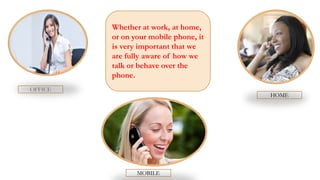
Whether at work, at home,
or on your mobile phone, it
is very important that we
are fully aware of how we
talk or behave over the
phone.
OFFICE

HOME

MOBILE
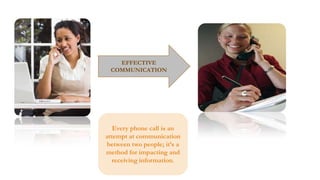
EFFECTIVE
COMMUNICATION

Every phone call is an
attempt at communication
between two people; it’s a
method for impacting and
receiving information.
SENDER TO RECEIVER
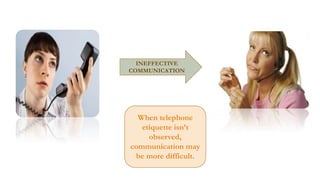
INEFFECTIVE
COMMUNICATION

When telephone
etiquette isn’t
observed,
communication may
be more difficult.
 OBJECTIVEVE
AT THE END OF THE TRAINING, STAFF WILL BE ABLE TO;
•
•
•
•
•
•

Use effective call greetings as a caller and a receiver.
Project the company in a positive manner.
Practice good telephone techniques and telephone manners.
Use appropriate language during telephone conversations.
Speak with an effective telephone voice.
Use an effective approach to handle special telephone tasks like call
transfers, taking messages, call holds, interruptions, and unintentional
disconnects.
• Manage difficult calls.
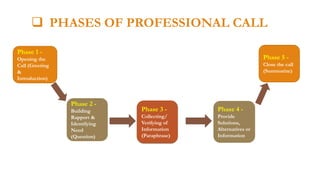
 PHASES OF PROFESSIONAL CALL
Phase 1 -

Phase 5 -

Opening the
Call (Greeting
&
Introduction)

Close the call
(Summarize)

Phase 2 Building
Rapport &
Identifying
Need
(Question)

Phase 3 -

Phase 4 -

Collecting/
Verifying of
Information
(Paraphrase)

Provide
Solutions,
Alternatives or
Information
 PHONE CALL IMPRESSION

 PHONE IMPRESSION

The person on call forms a mental PICTURE of you.

P – PITCH
I – INFLECTION
C – COURTESY
T – TONE
U - UNDERSTANDING
R – RATE
E - ENUNCIATION
 ENDING A CALL

DIFFERENT PHONE CALL
SITUATIONS
 ANSWERING CALLS CALLS
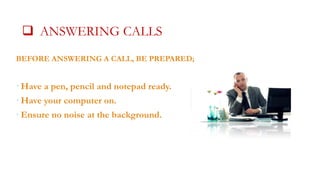
BEFORE ANSWERING A CALL, BE PREPARED;

• Have a pen, pencil and notepad ready.
• Have your computer on.

• Ensure no noise at the background.
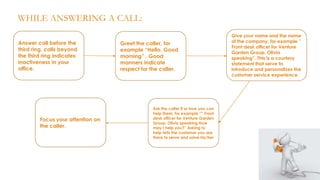
WHILE ANSWERING A CALL:
Answer call before the
third ring, calls beyond
the third ring indicates
inactiveness in your
office.

Focus your attention on
the caller.

Greet the caller, for
example “Hello, Good
morning” . Good
manners indicate
respect for the caller.

Ask the caller if or how you can
help them, for example “” Front
desk officer for Venture Garden
Group, Olivia speaking How
may I help you?” Asking to
help tells the customer you are
there to serve and solve his/her

Give your name and the name
of the company, for example ”
Front desk officer for Venture
Garden Group, Olivia
speaking”. This is a courtesy
statement that serve to
introduce and personalizes the
customer service experience.
 PLACING CALLS CALLS
BEFORE PLACING A CALL, BE PREPARED;
•
•
•

Know the name of the person you want to reach and how to
pronounce it.
Know what you need to say before placing the call will make your call
brief and effective.
Verify the phone number before calling.
 PLACING CALLS

IN PLACING THE CALL:

•
•
•
•
•

State your name along with the name of the person you are calling.
Example: “Hello, my name is Olivia from Venture Garden Group.
May I please speak with Mrs. Jane Ojo?”
Ask the caller if it is convenient to talk.
State your business as politely and clear as possible.
Use the clients name during the conversation.
Insist on calling back if the connection is faulty.
 ENDING CALLS CALLS
When the conversation is complete, do the following;

• Make sure that the caller has no more queries or message.
• Use “Goodbye, thank you for calling” to end the
conversation.
• Make sure the caller drops down the receiver before you.
This prevents the feeling that you may have cut them off
intentionally.
 TRANSFERRING CALLSALLS

 TRANSFER CA

TRANSFER CALLS ONLY IF YOU ARE UNABLE TO HELP THE CALLER OR IF THE
CALL IS MEANT FOR YOU FOR SOMEONE ELSE:

•
•
•
•
•
•
•

Ask permission to transfer calls and explain the reason for the transfer.
Let the caller know the name and department you are transferring the call to.
Be sure you are transferring the caller to the proper person or department.
If the caller complains about being transferred, suggest having the call returned instead.
Give the new party any helpful information before completing the transfer.
Never transfer a caller more than two times.
Know the transfer instructions for the telephone system so that you do not cut off your
caller!
 PLACING A CALL ON HOLD
•
•
•
•
•
•
•
•

Make sure its for a good reason.
Ask permission before placing a caller on hold.
Return to the line periodically.
Ask callers if they want to continue holding.
Indicate how long the delay could be.
Offer to call the person back if the wait will be long.
Never leave a customer on hold for longer than one minute.
Be courteous, respectful and professional.
 ANSWERING MULTIPLE CALLSALLS
• Place the first call on hold.
• Answer the next call.
• Complete the second call only if it can be
handled quickly.
• Return to the initial call promptly.
• Provide quality service that meets or exceeds
the customer’s expectations.
 CUTTING CALLSALLS

 CUTTING CALLS SHORT

•

Give a short, sincere explanation for ending the telephone
conversation.
For example, “I’m sorry to cut this short, but I have a visitor
waiting to see me.”

•

Make plans to get back with the caller if necessary.
Example: “We have a staff meeting in two minutes. May I call you
back?”
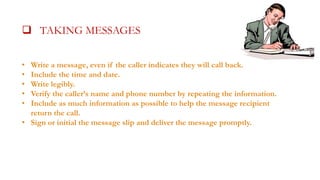
 TAKING MESSAGESALLS

 TAKING MESSAGES

•
•
•
•
•

Write a message, even if the caller indicates they will call back.
Include the time and date.
Write legibly.
Verify the caller’s name and phone number by repeating the information.
Include as much information as possible to help the message recipient
return the call.
• Sign or initial the message slip and deliver the message promptly.
 SOMEONE CALLS YOU BY MISTAKE
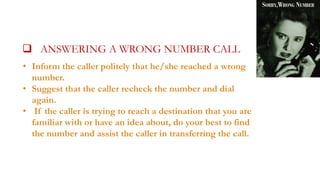
 ANSWERING A WRONG NUMBER CALLALLS
• Inform the caller politely that he/she reached a wrong
number.
• Suggest that the caller recheck the number and dial
again.
• If the caller is trying to reach a destination that you are
familiar with or have an idea about, do your best to find
the number and assist the caller in transferring the call.
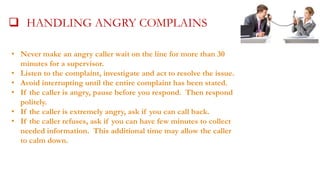
 HANDLING ANGRY COMPLAINS
•

 make an angry callerCOMPLAINTS AND30
HANDLING wait on the line for more than ANGRY
Never
minutesCALLERS
for a supervisor.

• Listen to the complaint, investigate and act to resolve the issue.
• Avoid interrupting until the entire complaint has been stated.
• If the caller is angry, pause before you respond. Then respond
politely.
• If the caller is extremely angry, ask if you can call back.
• If the caller refuses, ask if you can have few minutes to collect
needed information. This additional time may allow the caller
to calm down.
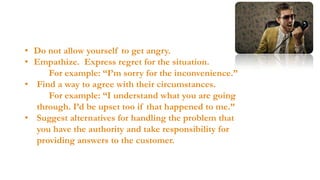
 HANDLING COMPLAINTS AND ANGRY
CALLERS
• Do not allow yourself to get angry.
Continued…
• Empathize. Express regret for the situation.
For example: “I’m sorry for the inconvenience.”
• Find a way to agree with their circumstances.
For example: “I understand what you are going
through. I’d be upset too if that happened to me.”
• Suggest alternatives for handling the problem that
you have the authority and take responsibility for
providing answers to the customer.
PHONE ETIQUETTE TIPS
 8 TELEPHONE ETIQUETTES
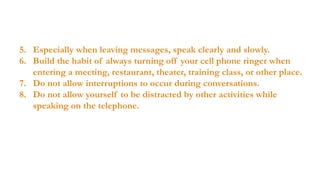
1. Think through exactly what you plan to say and
discuss BEFORE you place a call.
2. Always identify yourself at the beginning of all calls.
3. Always speak into the telephone receiver with an even
and low tone of voice, high pitch will sound like
shouting.
4. Be sensitive to the tone of your voice
5. Especially when leaving messages, speak clearly and slowly.
6. Build the habit of always turning off your cell phone ringer when
entering a meeting, restaurant, theater, training class, or other place.
7. Do not allow interruptions to occur during conversations.
8. Do not allow yourself to be distracted by other activities while
speaking on the telephone.
 GENERAL PHONE ETIQUETTE TIPS
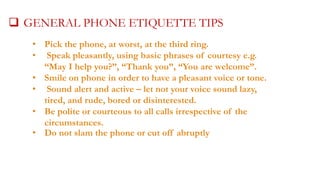
• Pick the phone, at worst, at the third ring.
• Speak pleasantly, using basic phrases of courtesy e.g.
“May I help you?”, “Thank you”, “You are welcome”.
• Smile on phone in order to have a pleasant voice or tone.
• Sound alert and active – let not your voice sound lazy,
tired, and rude, bored or disinterested.
• Be polite or courteous to all calls irrespective of the
circumstances.
• Do not slam the phone or cut off abruptly
• Avoid slangs
• Don’t eat, sip a drink, and chew gum while on phone.
• Listen very attentively.
• When transferring calls, whether in coming or out
going, introduce both party to each other.
• Don’t keep the caller on hold for more than sixty
seconds without communicating your effort.
• When ending your call ensure there are no unfinished
business.
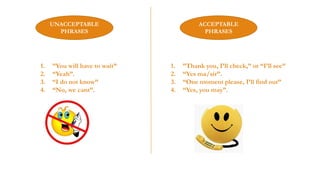
UNACCEPTABLE
PHRASES

1.
2.
3.
4.

”You will have to wait”
“Yeah”.
“I do not know”
“No, we cant”.

ACCEPTABLE
PHRASES

1.
2.
3.
4.

”Thank you, I’ll check,” or “I’ll see”
“Yes ma/sir”.
“One moment please, I’ll find out”
“Yes, you may”.
HAPPY
CALLING

Telephone etiquette1

  • 2.
    Whether at work,at home, or on your mobile phone, it is very important that we are fully aware of how we talk or behave over the phone. OFFICE HOME MOBILE
  • 3.
    EFFECTIVE COMMUNICATION Every phone callis an attempt at communication between two people; it’s a method for impacting and receiving information.
  • 4.
    SENDER TO RECEIVER INEFFECTIVE COMMUNICATION Whentelephone etiquette isn’t observed, communication may be more difficult.
  • 5.
     OBJECTIVEVE AT THEEND OF THE TRAINING, STAFF WILL BE ABLE TO; • • • • • • Use effective call greetings as a caller and a receiver. Project the company in a positive manner. Practice good telephone techniques and telephone manners. Use appropriate language during telephone conversations. Speak with an effective telephone voice. Use an effective approach to handle special telephone tasks like call transfers, taking messages, call holds, interruptions, and unintentional disconnects. • Manage difficult calls.
  • 6.
     PHASES OFPROFESSIONAL CALL Phase 1 - Phase 5 - Opening the Call (Greeting & Introduction) Close the call (Summarize) Phase 2 Building Rapport & Identifying Need (Question) Phase 3 - Phase 4 - Collecting/ Verifying of Information (Paraphrase) Provide Solutions, Alternatives or Information
  • 7.
     PHONE CALLIMPRESSION  PHONE IMPRESSION The person on call forms a mental PICTURE of you. P – PITCH I – INFLECTION C – COURTESY T – TONE U - UNDERSTANDING R – RATE E - ENUNCIATION
  • 8.
     ENDING ACALL DIFFERENT PHONE CALL SITUATIONS
  • 9.
     ANSWERING CALLSCALLS BEFORE ANSWERING A CALL, BE PREPARED; • Have a pen, pencil and notepad ready. • Have your computer on. • Ensure no noise at the background.
  • 10.
    WHILE ANSWERING ACALL: Answer call before the third ring, calls beyond the third ring indicates inactiveness in your office. Focus your attention on the caller. Greet the caller, for example “Hello, Good morning” . Good manners indicate respect for the caller. Ask the caller if or how you can help them, for example “” Front desk officer for Venture Garden Group, Olivia speaking How may I help you?” Asking to help tells the customer you are there to serve and solve his/her Give your name and the name of the company, for example ” Front desk officer for Venture Garden Group, Olivia speaking”. This is a courtesy statement that serve to introduce and personalizes the customer service experience.
  • 11.
     PLACING CALLSCALLS BEFORE PLACING A CALL, BE PREPARED; • • • Know the name of the person you want to reach and how to pronounce it. Know what you need to say before placing the call will make your call brief and effective. Verify the phone number before calling.
  • 12.
     PLACING CALLS INPLACING THE CALL: • • • • • State your name along with the name of the person you are calling. Example: “Hello, my name is Olivia from Venture Garden Group. May I please speak with Mrs. Jane Ojo?” Ask the caller if it is convenient to talk. State your business as politely and clear as possible. Use the clients name during the conversation. Insist on calling back if the connection is faulty.
  • 13.
     ENDING CALLSCALLS When the conversation is complete, do the following; • Make sure that the caller has no more queries or message. • Use “Goodbye, thank you for calling” to end the conversation. • Make sure the caller drops down the receiver before you. This prevents the feeling that you may have cut them off intentionally.
  • 14.
     TRANSFERRING CALLSALLS TRANSFER CA TRANSFER CALLS ONLY IF YOU ARE UNABLE TO HELP THE CALLER OR IF THE CALL IS MEANT FOR YOU FOR SOMEONE ELSE: • • • • • • • Ask permission to transfer calls and explain the reason for the transfer. Let the caller know the name and department you are transferring the call to. Be sure you are transferring the caller to the proper person or department. If the caller complains about being transferred, suggest having the call returned instead. Give the new party any helpful information before completing the transfer. Never transfer a caller more than two times. Know the transfer instructions for the telephone system so that you do not cut off your caller!
  • 15.
     PLACING ACALL ON HOLD • • • • • • • • Make sure its for a good reason. Ask permission before placing a caller on hold. Return to the line periodically. Ask callers if they want to continue holding. Indicate how long the delay could be. Offer to call the person back if the wait will be long. Never leave a customer on hold for longer than one minute. Be courteous, respectful and professional.
  • 16.
     ANSWERING MULTIPLECALLSALLS • Place the first call on hold. • Answer the next call. • Complete the second call only if it can be handled quickly. • Return to the initial call promptly. • Provide quality service that meets or exceeds the customer’s expectations.
  • 17.
     CUTTING CALLSALLS CUTTING CALLS SHORT • Give a short, sincere explanation for ending the telephone conversation. For example, “I’m sorry to cut this short, but I have a visitor waiting to see me.” • Make plans to get back with the caller if necessary. Example: “We have a staff meeting in two minutes. May I call you back?”
  • 18.
     TAKING MESSAGESALLS TAKING MESSAGES • • • • • Write a message, even if the caller indicates they will call back. Include the time and date. Write legibly. Verify the caller’s name and phone number by repeating the information. Include as much information as possible to help the message recipient return the call. • Sign or initial the message slip and deliver the message promptly.
  • 19.
     SOMEONE CALLSYOU BY MISTAKE  ANSWERING A WRONG NUMBER CALLALLS • Inform the caller politely that he/she reached a wrong number. • Suggest that the caller recheck the number and dial again. • If the caller is trying to reach a destination that you are familiar with or have an idea about, do your best to find the number and assist the caller in transferring the call.
  • 20.
     HANDLING ANGRYCOMPLAINS •  make an angry callerCOMPLAINTS AND30 HANDLING wait on the line for more than ANGRY Never minutesCALLERS for a supervisor. • Listen to the complaint, investigate and act to resolve the issue. • Avoid interrupting until the entire complaint has been stated. • If the caller is angry, pause before you respond. Then respond politely. • If the caller is extremely angry, ask if you can call back. • If the caller refuses, ask if you can have few minutes to collect needed information. This additional time may allow the caller to calm down.
  • 21.
     HANDLING COMPLAINTSAND ANGRY CALLERS • Do not allow yourself to get angry. Continued… • Empathize. Express regret for the situation. For example: “I’m sorry for the inconvenience.” • Find a way to agree with their circumstances. For example: “I understand what you are going through. I’d be upset too if that happened to me.” • Suggest alternatives for handling the problem that you have the authority and take responsibility for providing answers to the customer.
  • 22.
  • 23.
     8 TELEPHONEETIQUETTES 1. Think through exactly what you plan to say and discuss BEFORE you place a call. 2. Always identify yourself at the beginning of all calls. 3. Always speak into the telephone receiver with an even and low tone of voice, high pitch will sound like shouting. 4. Be sensitive to the tone of your voice
  • 24.
    5. Especially whenleaving messages, speak clearly and slowly. 6. Build the habit of always turning off your cell phone ringer when entering a meeting, restaurant, theater, training class, or other place. 7. Do not allow interruptions to occur during conversations. 8. Do not allow yourself to be distracted by other activities while speaking on the telephone.
  • 25.
     GENERAL PHONEETIQUETTE TIPS • Pick the phone, at worst, at the third ring. • Speak pleasantly, using basic phrases of courtesy e.g. “May I help you?”, “Thank you”, “You are welcome”. • Smile on phone in order to have a pleasant voice or tone. • Sound alert and active – let not your voice sound lazy, tired, and rude, bored or disinterested. • Be polite or courteous to all calls irrespective of the circumstances. • Do not slam the phone or cut off abruptly
  • 26.
    • Avoid slangs •Don’t eat, sip a drink, and chew gum while on phone. • Listen very attentively. • When transferring calls, whether in coming or out going, introduce both party to each other. • Don’t keep the caller on hold for more than sixty seconds without communicating your effort. • When ending your call ensure there are no unfinished business.
  • 27.
    UNACCEPTABLE PHRASES 1. 2. 3. 4. ”You will haveto wait” “Yeah”. “I do not know” “No, we cant”. ACCEPTABLE PHRASES 1. 2. 3. 4. ”Thank you, I’ll check,” or “I’ll see” “Yes ma/sir”. “One moment please, I’ll find out” “Yes, you may”.
  • 28.