CHEMICAL KINETICS: definition
 Branch of chemistry which deals with the rate of chemical
reactions. the factors affecting the rate of reactions and the
mechanism of the reaction is called chemical kinetics.
Chemical Reactions on the Basis of
Rate of Reaction
1. Fast reactions :-Chemical reaction which get completed in
10- 16 to 10-14 second ,are known as fast reaction. Example.
ionic reactions
2. Slow reactions:- Chemical reactions which completes in a
long time from some minutes to some years are called slow
reactions. e.g., rusting of iron
transformation of diamond etc.
3. Moderately slow reactions:- Chemical reactions which
are intermediate between slow and fast reactions are called
moderately slow reactions. Example , Inversion of sugar
,hydrolysis of starch
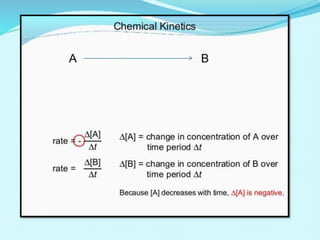
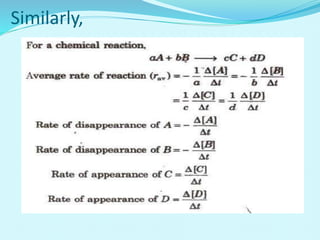
Average rate of reaction
 The change in the concentration of any of the reactant or
product per unit time over a specified interval of time is
called average rate of reaction .
Similarly,
Instantaneous rate of reaction
 The change in the concentration of any of the reactant
or product at a particular instant of time is called
instantaneous rate of the given reaction at that instant
of time .
Factors Affecting the Rate of
Reaction
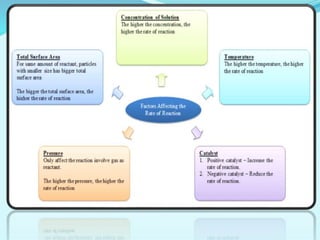
 Nature of the reactant :- the rate of the chemical reaction is
influenced by the nature of reactant . The ionic reaction are
quiet fast whereas the reaction involving the covalent
compound are slower .
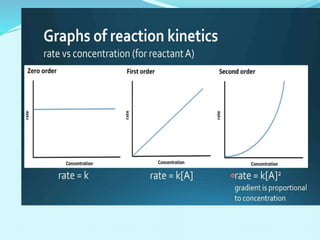
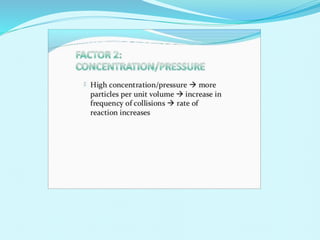
 Concentration on reactant :- The rate of reaction increases
on increasing the concentration of the reactant .
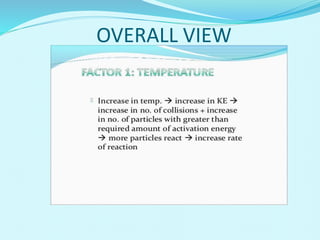
 Temperature:-temp increases reaction rate increases.
 Surface Area of the Reactants:- Increase in the surface area
provide more opportunity for the reaction to come in contact
or collide resuting in increased reaction rate
Rate law
 The expression which describe the reaction rate in
term of molar concentration of the reactant as
determined experimentally is called rate law.
The rate constant of the reaction is equal to the rate of
reaction when the concentration of each of the
reactant is unity .
ORDER OF THE REACTION
 Sum of the power of concentration.
Rate=k [A]m [B]n
• The order of such a reaction is (m + n).
• Order of reaction:- positive, negative, zero and fractional.
• Example:
H 2 + I2 2 HI
reaction order= 1+1= 2
• Reaction order is determined by experiment.
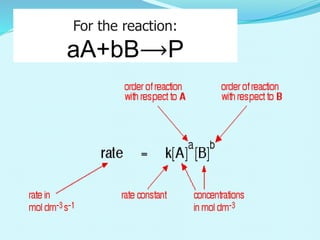
For the reaction:
aA+bB⟶P
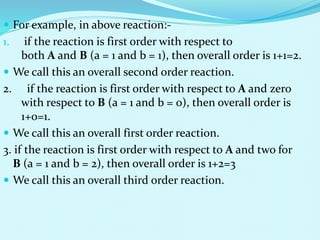
 For example, in above reaction:-
1. if the reaction is first order with respect to
both A and B (a = 1 and b = 1), then overall order is 1+1=2.
 We call this an overall second order reaction.
2. if the reaction is first order with respect to A and zero
with respect to B (a = 1 and b = 0), then overall order is
1+0=1.
 We call this an overall first order reaction.
3. if the reaction is first order with respect to A and two for
B (a = 1 and b = 2), then overall order is 1+2=3
 We call this an overall third order reaction.
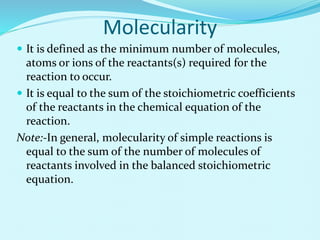
Molecularity
 It is defined as the minimum number of molecules,
atoms or ions of the reactants(s) required for the
reaction to occur.
 It is equal to the sum of the stoichiometric coefficients
of the reactants in the chemical equation of the
reaction.
Note:-In general, molecularity of simple reactions is
equal to the sum of the number of molecules of
reactants involved in the balanced stoichiometric
equation.
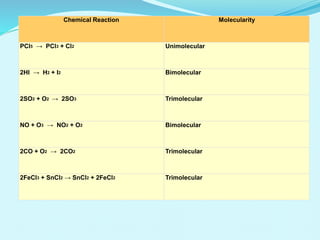
Chemical Reaction Molecularity
PCl5 → PCl3 + Cl2 Unimolecular
2HI → H2 + I2 Bimolecular
2SO2 + O2 → 2SO3 Trimolecular
NO + O3 → NO2 + O2 Bimolecular
2CO + O2 → 2CO2 Trimolecular
2FeCl3 + SnCl2 → SnCl2 + 2FeCl2 Trimolecular
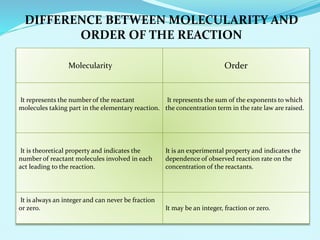
Molecularity Order
It represents the number of the reactant
molecules taking part in the elementary reaction.
It represents the sum of the exponents to which
the concentration term in the rate law are raised.
It is theoretical property and indicates the
number of reactant molecules involved in each
act leading to the reaction.
It is an experimental property and indicates the
dependence of observed reaction rate on the
concentration of the reactants.
It is always an integer and can never be fraction
or zero. It may be an integer, fraction or zero.
DIFFERENCE BETWEEN MOLECULARITY AND
ORDER OF THE REACTION
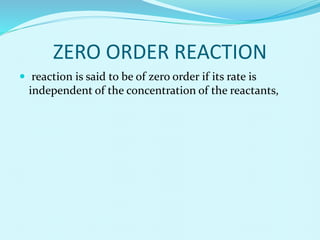
ZERO ORDER REACTION
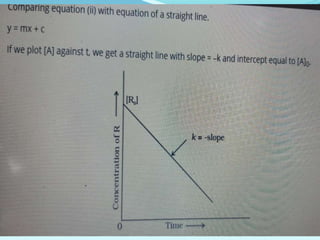
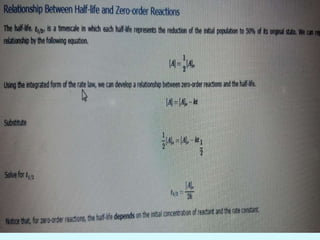
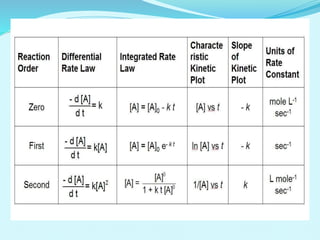
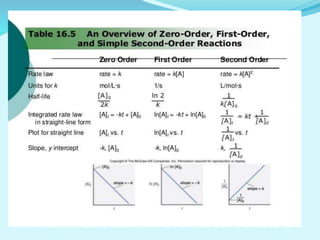
 reaction is said to be of zero order if its rate is
independent of the concentration of the reactants,
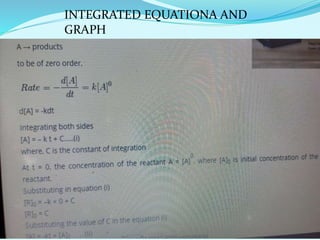
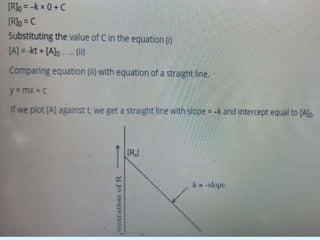
INTEGRATED EQUATIONA AND
GRAPH
• Reaction is said to be first order if its rate is determined by the change of one
concentration term only.
FIRST ORDER REACTION
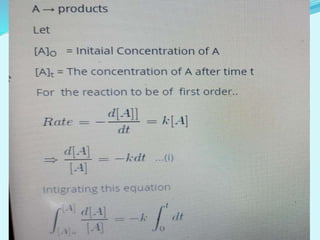
Consider the reaction, A → products
Let [A]O = Initial Concentration of A, [A]T = The concentration of A after time t
For the reaction to be of first order..
The differential equation describing first-order kinetics is given below:
Rate=−d[A]/dt=k[A]……………………………………………….(1)
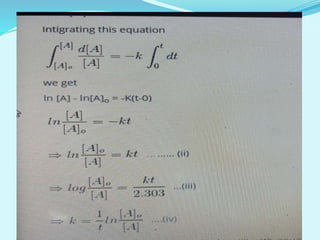
For a first-order reaction,
the rate constant can be mathematically expressed as follows:
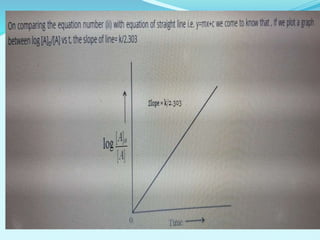
k=2.303tlog[A]0/[A]
From the definition of reaction half-life, at t = t1/2, [A] = [A]0/2.
Substituting these values in the expression for the first-order
rate constant, the following equation is obtained:
k=2.303t1/2log[A0]/([A]0/2)
Rearranging the expression to find the value of t1/2:
t1/2=2.303klog(2)=0.693k
Thus, the half-life of a first-order reaction is given by 0.693/k.
HALF LIFE TIME OF FIRST ORDER
REACTION
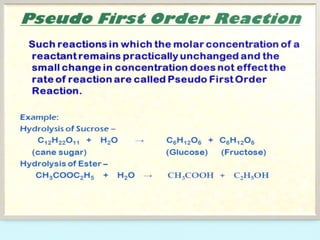
Examples: a. Hydrolysis of an ester:
CH3COOC2H5 + H2O(Large excess) → CH3COOH + C2H5OH
The rate law for the reaction can be written as Rate
=K[CH3COOC2H5][H2O]
--Since water is present in large excess, its concentration remains
practically constant during the course of the reaction. Thus
above rate law can be written as Rate = K’[CH3COOC2H5] .
The reaction is actually second order but in practice it
follows first- order kinetics. Thus, it is a pseudo-first order
reaction.
TEMPERATURE AND RATE OF
REACTION
 The rate constant is nearly doubled for a chemical
reaction with a rise in temperature by 10°.
 Until 1889, there was no fixed way to physically
measure the temperature dependence of the rate of
a chemical reaction. In 1889, Svante Arrhenius give an
equation called Arrhenius equation.
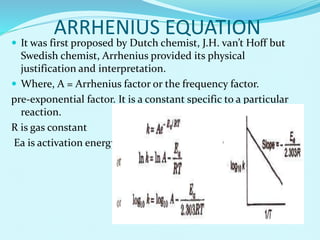
ARRHENIUS EQUATION
 It was first proposed by Dutch chemist, J.H. van’t Hoff but
Swedish chemist, Arrhenius provided its physical
justification and interpretation.
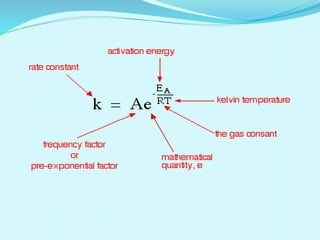
 Where, A = Arrhenius factor or the frequency factor.
pre-exponential factor. It is a constant specific to a particular
reaction.
R is gas constant
Ea is activation energy
EXPLANATION OF ARREHENIUS
EQUATION
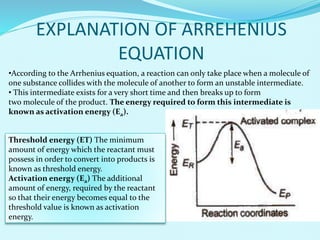
•According to the Arrhenius equation, a reaction can only take place when a molecule of
one substance collides with the molecule of another to form an unstable intermediate.
• This intermediate exists for a very short time and then breaks up to form
two molecule of the product. The energy required to form this intermediate is
known as activation energy (Ea).
Threshold energy (ET) The minimum
amount of energy which the reactant must
possess in order to convert into products is
known as threshold energy.
Activation energy (Ea) The additional
amount of energy, required by the reactant
so that their energy becomes equal to the
threshold value is known as activation
energy.
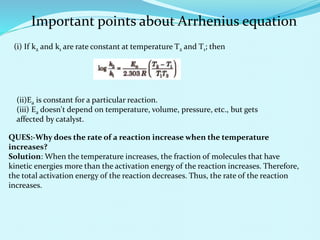
(i) If k2 and k1 are rate constant at temperature T2 and T1; then
Important points about Arrhenius equation
(ii)Ea is constant for a particular reaction.
(iii) Ea doesn't depend on temperature, volume, pressure, etc., but gets
affected by catalyst.
QUES:-Why does the rate of a reaction increase when the temperature
increases?
Solution: When the temperature increases, the fraction of molecules that have
kinetic energies more than the activation energy of the reaction increases. Therefore,
the total activation energy of the reaction decreases. Thus, the rate of the reaction
increases.
EFFECT OF CATALYST ON
ACTIVATION ENERGY
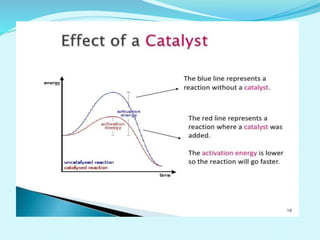
 A catalyst provides an alternative route for the reaction
with a lower activation energy.
 The action of the catalyst can be explained by
intermediate complex theory.
 According to this theory, a catalyst participates in a
chemical reaction by forming temporary bonds with
the reactants resulting in an intermediate complex.
This has a transitory existence and decomposes to
yield products and the catalyst.
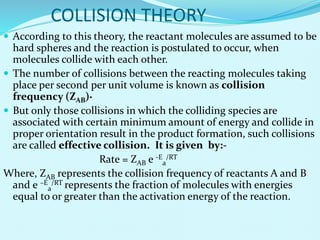
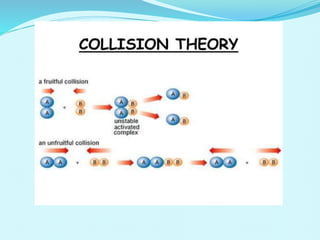
COLLISION THEORY
 According to this theory, the reactant molecules are assumed to be
hard spheres and the reaction is postulated to occur, when
molecules collide with each other.
 The number of collisions between the reacting molecules taking
place per second per unit volume is known as collision
frequency (ZAB)·
 But only those collisions in which the colliding species are
associated with certain minimum amount of energy and collide in
proper orientation result in the product formation, such collisions
are called effective collision. It is given by:-
Rate = ZAB e -E
a
/RT
Where, ZAB represents the collision frequency of reactants A and B
and e –E
a
/RT represents the fraction of molecules with energies
equal to or greater than the activation energy of the reaction.
OVERALL VIEW
ASSIGNMENT WORK
 Q.1 what is the difference between order and
molecularity.
 Q.2 What is the unit of rate constant of second order
reaction.
 Q.3 what is Arrehenious equation.
 Q.4 Define:- collision theory and arrehenious factor.
 Q.5 write the integrated equation of first order
reaction.
 Q.6 how is temperature depends upon rate of reaction.
class 12 chemicalkinetics.pptx

class 12 chemicalkinetics.pptx

  • 2.
    CHEMICAL KINETICS: definition Branch of chemistry which deals with the rate of chemical reactions. the factors affecting the rate of reactions and the mechanism of the reaction is called chemical kinetics.
  • 3.
    Chemical Reactions onthe Basis of Rate of Reaction 1. Fast reactions :-Chemical reaction which get completed in 10- 16 to 10-14 second ,are known as fast reaction. Example. ionic reactions 2. Slow reactions:- Chemical reactions which completes in a long time from some minutes to some years are called slow reactions. e.g., rusting of iron transformation of diamond etc. 3. Moderately slow reactions:- Chemical reactions which are intermediate between slow and fast reactions are called moderately slow reactions. Example , Inversion of sugar ,hydrolysis of starch
  • 4.
    Average rate ofreaction  The change in the concentration of any of the reactant or product per unit time over a specified interval of time is called average rate of reaction .
  • 6.
  • 7.
    Instantaneous rate ofreaction  The change in the concentration of any of the reactant or product at a particular instant of time is called instantaneous rate of the given reaction at that instant of time .
  • 8.
    Factors Affecting theRate of Reaction  Nature of the reactant :- the rate of the chemical reaction is influenced by the nature of reactant . The ionic reaction are quiet fast whereas the reaction involving the covalent compound are slower .  Concentration on reactant :- The rate of reaction increases on increasing the concentration of the reactant .  Temperature:-temp increases reaction rate increases.  Surface Area of the Reactants:- Increase in the surface area provide more opportunity for the reaction to come in contact or collide resuting in increased reaction rate
  • 10.
    Rate law  Theexpression which describe the reaction rate in term of molar concentration of the reactant as determined experimentally is called rate law.
  • 11.
    The rate constantof the reaction is equal to the rate of reaction when the concentration of each of the reactant is unity .
  • 12.
    ORDER OF THEREACTION  Sum of the power of concentration. Rate=k [A]m [B]n • The order of such a reaction is (m + n). • Order of reaction:- positive, negative, zero and fractional. • Example: H 2 + I2 2 HI reaction order= 1+1= 2 • Reaction order is determined by experiment.
  • 13.
  • 14.
     For example,in above reaction:- 1. if the reaction is first order with respect to both A and B (a = 1 and b = 1), then overall order is 1+1=2.  We call this an overall second order reaction. 2. if the reaction is first order with respect to A and zero with respect to B (a = 1 and b = 0), then overall order is 1+0=1.  We call this an overall first order reaction. 3. if the reaction is first order with respect to A and two for B (a = 1 and b = 2), then overall order is 1+2=3  We call this an overall third order reaction.
  • 15.
    Molecularity  It isdefined as the minimum number of molecules, atoms or ions of the reactants(s) required for the reaction to occur.  It is equal to the sum of the stoichiometric coefficients of the reactants in the chemical equation of the reaction. Note:-In general, molecularity of simple reactions is equal to the sum of the number of molecules of reactants involved in the balanced stoichiometric equation.
  • 16.
    Chemical Reaction Molecularity PCl5→ PCl3 + Cl2 Unimolecular 2HI → H2 + I2 Bimolecular 2SO2 + O2 → 2SO3 Trimolecular NO + O3 → NO2 + O2 Bimolecular 2CO + O2 → 2CO2 Trimolecular 2FeCl3 + SnCl2 → SnCl2 + 2FeCl2 Trimolecular
  • 18.
    Molecularity Order It representsthe number of the reactant molecules taking part in the elementary reaction. It represents the sum of the exponents to which the concentration term in the rate law are raised. It is theoretical property and indicates the number of reactant molecules involved in each act leading to the reaction. It is an experimental property and indicates the dependence of observed reaction rate on the concentration of the reactants. It is always an integer and can never be fraction or zero. It may be an integer, fraction or zero. DIFFERENCE BETWEEN MOLECULARITY AND ORDER OF THE REACTION
  • 19.
    ZERO ORDER REACTION reaction is said to be of zero order if its rate is independent of the concentration of the reactants,
  • 20.
  • 24.
    • Reaction issaid to be first order if its rate is determined by the change of one concentration term only. FIRST ORDER REACTION Consider the reaction, A → products Let [A]O = Initial Concentration of A, [A]T = The concentration of A after time t For the reaction to be of first order.. The differential equation describing first-order kinetics is given below: Rate=−d[A]/dt=k[A]……………………………………………….(1)
  • 28.
    For a first-orderreaction, the rate constant can be mathematically expressed as follows: k=2.303tlog[A]0/[A] From the definition of reaction half-life, at t = t1/2, [A] = [A]0/2. Substituting these values in the expression for the first-order rate constant, the following equation is obtained: k=2.303t1/2log[A0]/([A]0/2) Rearranging the expression to find the value of t1/2: t1/2=2.303klog(2)=0.693k Thus, the half-life of a first-order reaction is given by 0.693/k. HALF LIFE TIME OF FIRST ORDER REACTION
  • 30.
    Examples: a. Hydrolysisof an ester: CH3COOC2H5 + H2O(Large excess) → CH3COOH + C2H5OH The rate law for the reaction can be written as Rate =K[CH3COOC2H5][H2O] --Since water is present in large excess, its concentration remains practically constant during the course of the reaction. Thus above rate law can be written as Rate = K’[CH3COOC2H5] . The reaction is actually second order but in practice it follows first- order kinetics. Thus, it is a pseudo-first order reaction.
  • 34.
    TEMPERATURE AND RATEOF REACTION  The rate constant is nearly doubled for a chemical reaction with a rise in temperature by 10°.  Until 1889, there was no fixed way to physically measure the temperature dependence of the rate of a chemical reaction. In 1889, Svante Arrhenius give an equation called Arrhenius equation.
  • 35.
    ARRHENIUS EQUATION  Itwas first proposed by Dutch chemist, J.H. van’t Hoff but Swedish chemist, Arrhenius provided its physical justification and interpretation.  Where, A = Arrhenius factor or the frequency factor. pre-exponential factor. It is a constant specific to a particular reaction. R is gas constant Ea is activation energy
  • 37.
    EXPLANATION OF ARREHENIUS EQUATION •Accordingto the Arrhenius equation, a reaction can only take place when a molecule of one substance collides with the molecule of another to form an unstable intermediate. • This intermediate exists for a very short time and then breaks up to form two molecule of the product. The energy required to form this intermediate is known as activation energy (Ea). Threshold energy (ET) The minimum amount of energy which the reactant must possess in order to convert into products is known as threshold energy. Activation energy (Ea) The additional amount of energy, required by the reactant so that their energy becomes equal to the threshold value is known as activation energy.
  • 38.
    (i) If k2and k1 are rate constant at temperature T2 and T1; then Important points about Arrhenius equation (ii)Ea is constant for a particular reaction. (iii) Ea doesn't depend on temperature, volume, pressure, etc., but gets affected by catalyst. QUES:-Why does the rate of a reaction increase when the temperature increases? Solution: When the temperature increases, the fraction of molecules that have kinetic energies more than the activation energy of the reaction increases. Therefore, the total activation energy of the reaction decreases. Thus, the rate of the reaction increases.
  • 39.
    EFFECT OF CATALYSTON ACTIVATION ENERGY  A catalyst provides an alternative route for the reaction with a lower activation energy.  The action of the catalyst can be explained by intermediate complex theory.  According to this theory, a catalyst participates in a chemical reaction by forming temporary bonds with the reactants resulting in an intermediate complex. This has a transitory existence and decomposes to yield products and the catalyst.
  • 41.
    COLLISION THEORY  Accordingto this theory, the reactant molecules are assumed to be hard spheres and the reaction is postulated to occur, when molecules collide with each other.  The number of collisions between the reacting molecules taking place per second per unit volume is known as collision frequency (ZAB)·  But only those collisions in which the colliding species are associated with certain minimum amount of energy and collide in proper orientation result in the product formation, such collisions are called effective collision. It is given by:- Rate = ZAB e -E a /RT Where, ZAB represents the collision frequency of reactants A and B and e –E a /RT represents the fraction of molecules with energies equal to or greater than the activation energy of the reaction.
  • 43.
  • 46.
    ASSIGNMENT WORK  Q.1what is the difference between order and molecularity.  Q.2 What is the unit of rate constant of second order reaction.  Q.3 what is Arrehenious equation.  Q.4 Define:- collision theory and arrehenious factor.  Q.5 write the integrated equation of first order reaction.  Q.6 how is temperature depends upon rate of reaction.