UNIT 2 CHAPTER 5
    Attitudes and Emotions


1
Interpreting Events and Experiences


    Your experience is what happens to you and
    what happens in the world around you.
2
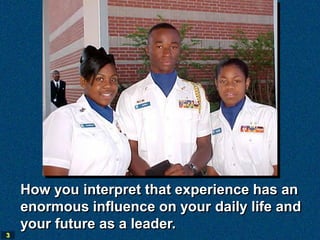
How you interpret that experience has an
    enormous influence on your daily life and
    your future as a leader.
3
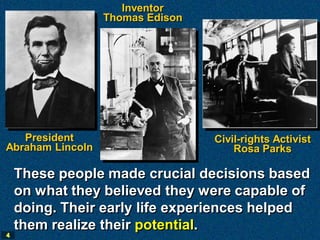
Inventor
                  Thomas Edison


   President                      Civil-rights Activist
Abraham Lincoln                       Rosa Parks

    These people made crucial decisions based
    on what they believed they were capable of
    doing. Their early life experiences helped
    them realize their potential.
4
Potential

    What an individual is capable of
    doing or becoming


5
Senator
                   John McCain


                                    Actress
      General                     Meryl Streep
    Colin Powell

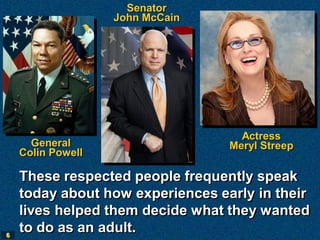
    These respected people frequently speak
    today about how experiences early in their
    lives helped them decide what they wanted
6
    to do as an adult.
Senator
                   John McCain


                                   Actress
      General                    Meryl Streep
    Colin Powell


     That’s not to say people who achieve
     greatness never make mistakes—they’ll
     admit they’ve made plenty!
7
Senator
                   John McCain


                                      Actress
      General                       Meryl Streep
    Colin Powell

    They became the result of their potential.
    As one old saying puts it, “As the twig is
    bent, so grows the tree.”
8
What is experience?

    A. Events that happen to you and in
       the world around you
    B. Reasons why you become fully
       developed and reach your potential
    C. Responses you have to your
       thoughts and the actions of other
       people
    D. Interpretations you give to your
       relationship with others
9
What is experience?

 A. Events that happen to you and in
    the world around you
 B. Reasons why you become fully
    developed and reach your potential
 C. Responses you have to your
    thoughts and the actions of other
    people
 D. Interpretations you give to your
    relationship with others
10
Many respected people have revealed
 how youthful experiences _______.

 A. made them believe they could
    accomplish anything
 B. convinced them that the world
    presented too many obstacles
 C. helped them determine their adult
    goals
 D. helped them avoid making mistakes
    as an adult
11
Many respected people have revealed
 how youthful experiences _______.

 A. made them believe they could
    accomplish anything
 B. convinced them that the world
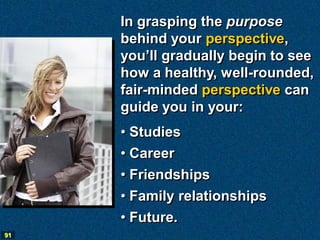
    presented too many obstacles
 C. helped them determine their adult
    goals
 D. helped them avoid making mistakes
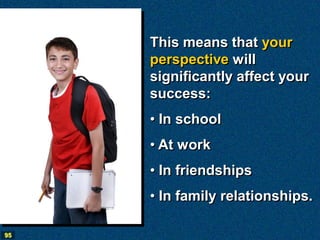
    as an adult
12
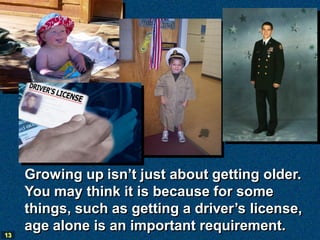
Growing up isn’t just about getting older.
     You may think it is because for some
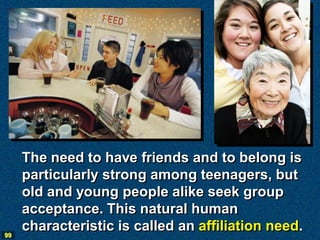
     things, such as getting a driver’s license,
13
     age alone is an important requirement.
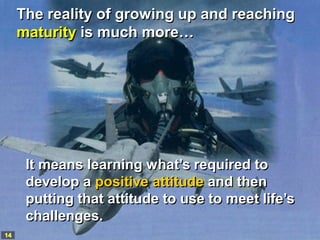
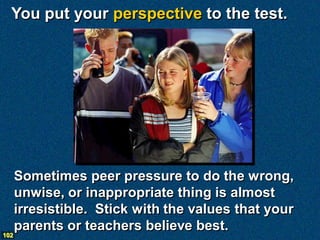
The reality of growing up and reaching
     maturity is much more…


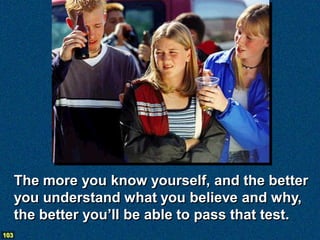
      It means learning what’s required to
      develop a positive attitude and then
      putting that attitude to use to meet life’s
      challenges.
14
Maturity

     The state of being fully grown or
     developed


15
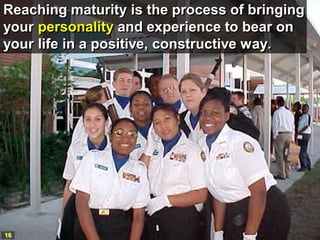
Reaching maturity is the process of bringing
your personality and experience to bear on
your life in a positive, constructive way.


16
Personality

     What an individual is inside and
     what he or she shows to others;
     it includes actions, opinions,
     beliefs, biases, desires, and
     ambitions.


17
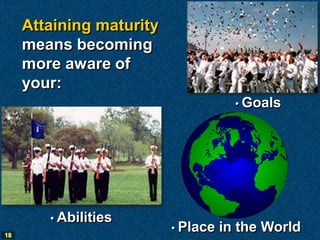
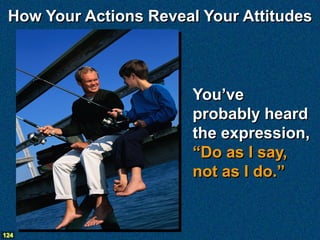
Attaining maturity
     means becoming
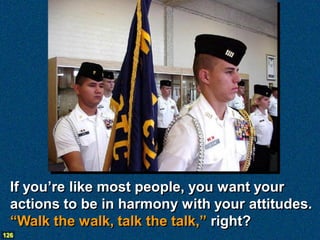
     more aware of
     your:
                                      • Goals


        • Abilities
                          • Place   in the World
18
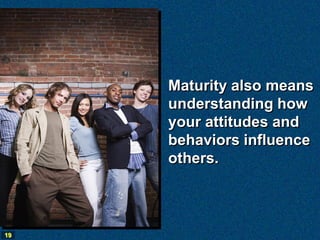
Maturity also means
     understanding how
     your attitudes and
     behaviors influence
     others.


19
Growing up involves developing a
 _______ and then using it to meet
 life’s challenges.

 A. life’s goal
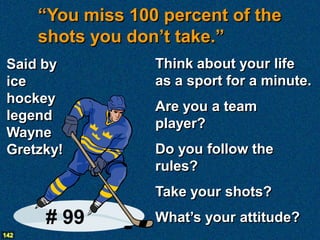
 B. positive attitude
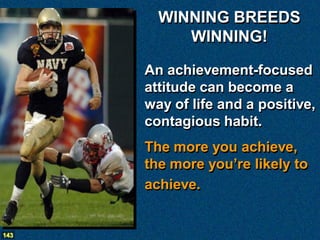
 C. satisfying career
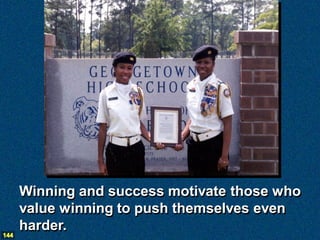
 D. strong will


20
Growing up involves developing a
 _______ and then using it to meet
 life’s challenges.

 A. life’s goal
 B. positive attitude
 C. satisfying career
 D. strong will


21
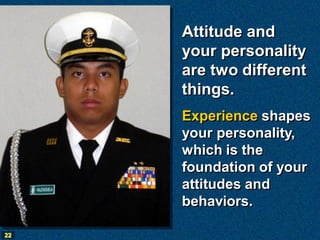
Attitude and
     your personality
     are two different
     things.
     Experience shapes
     your personality,
     which is the
     foundation of your
     attitudes and
     behaviors.

22
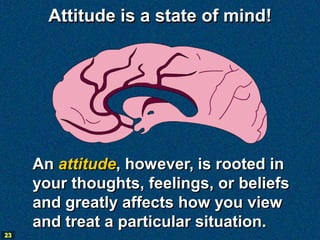
Attitude is a state of mind!


     An attitude, however, is rooted in
     your thoughts, feelings, or beliefs
     and greatly affects how you view
     and treat a particular situation.
23
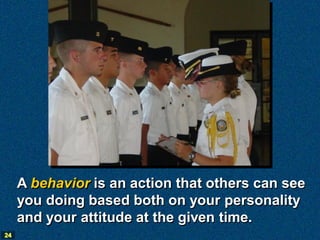
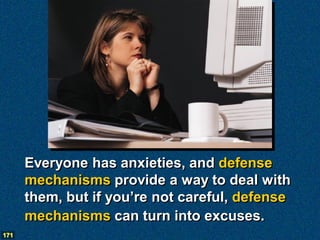
A behavior is an action that others can see
     you doing based both on your personality
     and your attitude at the given time.
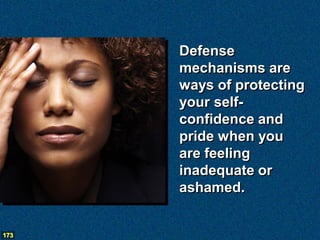
24
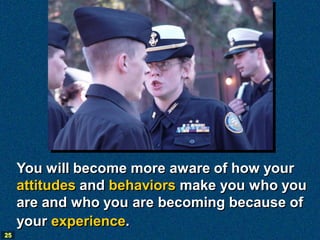
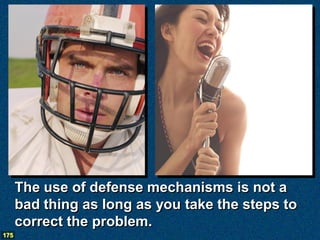
You will become more aware of how your
     attitudes and behaviors make you who you
     are and who you are becoming because of
     your experience.
25
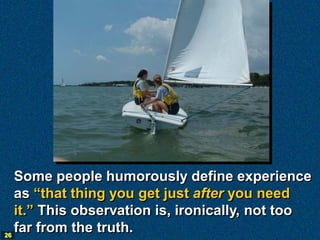
Some people humorously define experience
   as “that thing you get just after you need
   it.” This observation is, ironically, not too
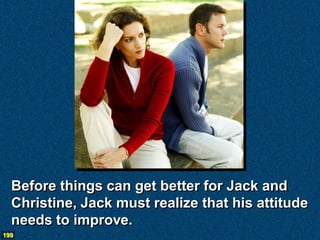
26
   far from the truth.
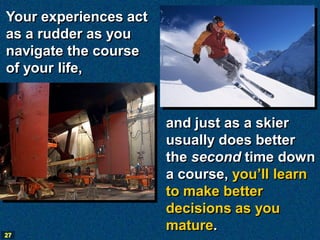
Your experiences act
as a rudder as you
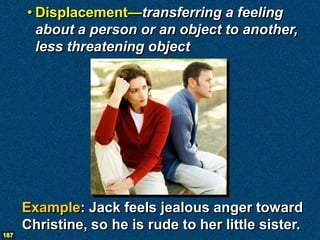
navigate the course
of your life,


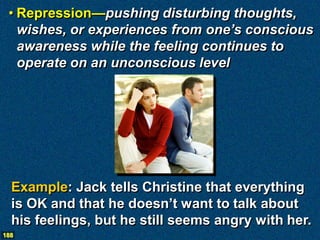
                       and just as a skier
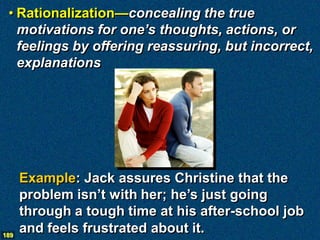
                       usually does better
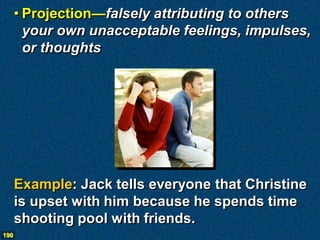
                       the second time down
                       a course, you’ll learn
                       to make better
                       decisions as you
                       mature.
27
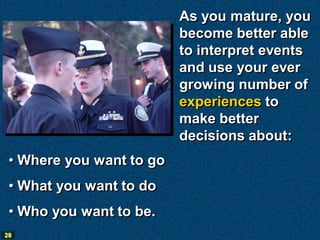
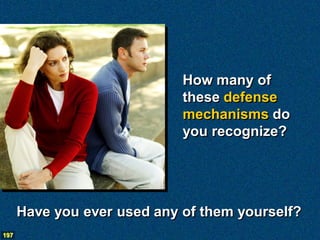
As you mature, you
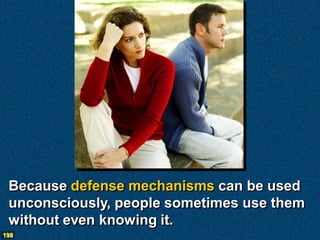
                          become better able
                          to interpret events
                          and use your ever
                          growing number of
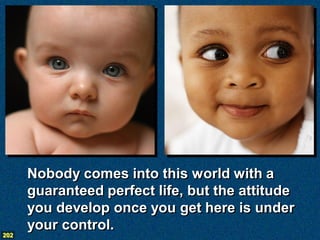
                          experiences to
                          make better
                          decisions about:
 • Where you want to go
 • What you want to do
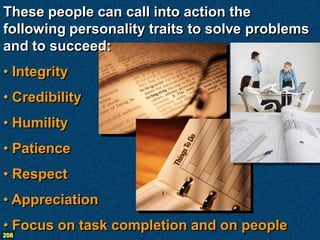
 • Who you want to be.
28
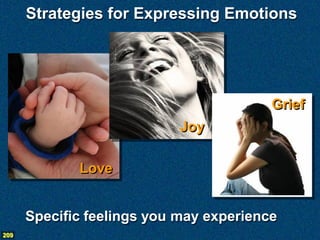
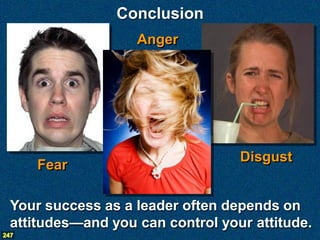
True or False: Attitude and personality
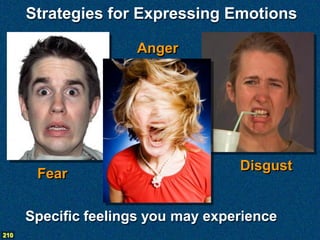
 are the same thing.


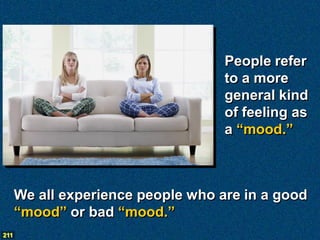
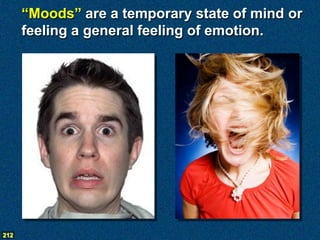
29
True or False: Attitude and personality
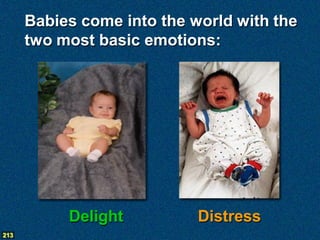
 are the same thing.

 False


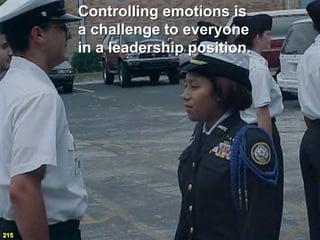
30
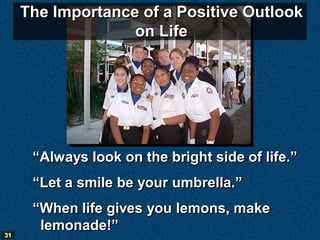
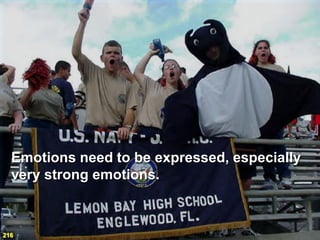
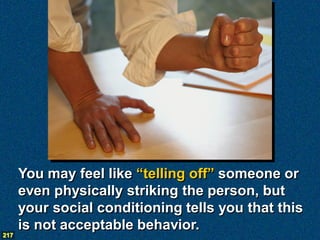
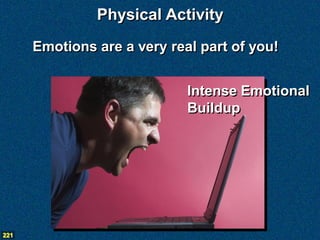
The Importance of a Positive Outlook
                   on Life


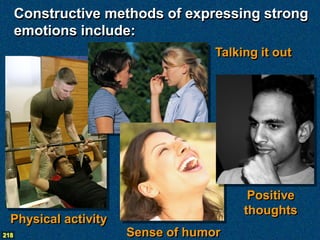
      “Always look on the bright side of life.”
      “Let a smile be your umbrella.”
      “When life gives you lemons, make
       lemonade!”
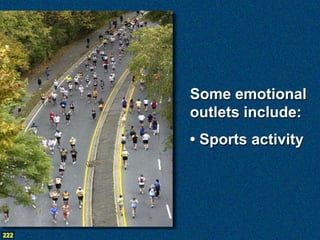
31
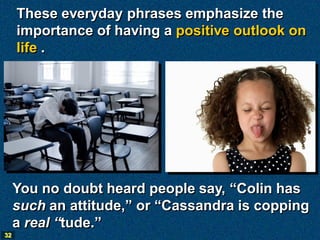
These everyday phrases emphasize the
     importance of having a positive outlook on
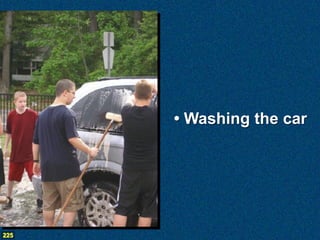
     life .


     You no doubt heard people say, “Colin has
     such an attitude,” or “Cassandra is copping
     a real “tude.”
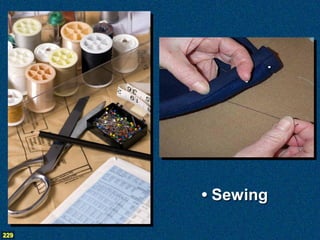
32
Those observations reflect negatively on
     Colin and Cassandra. Why?


 How would their ongoing bad attitudes affect
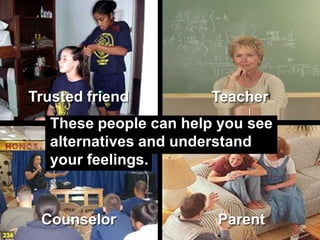
 your friendship with Colin or Cassandra? ”
33
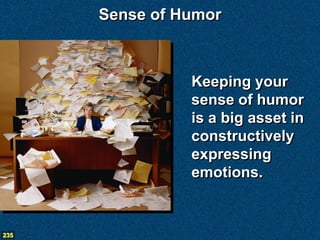
Your Attitude is a Compass


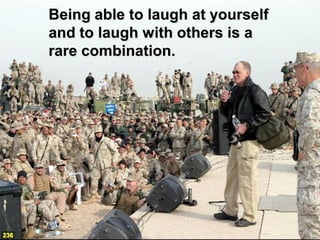
 Remember, your attitude is rooted in your
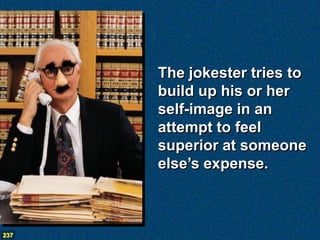
 thoughts, feelings, and beliefs and is your
 “slant” or “angle” on life.
34
This “slant” determines your outlook and
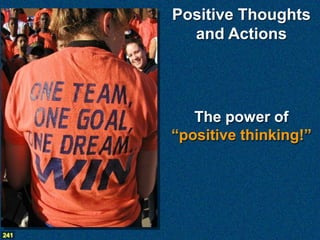
     approach to life and like a compass—you
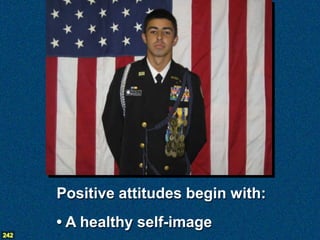
     go in the direction the needle points.
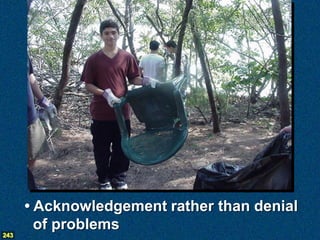
35
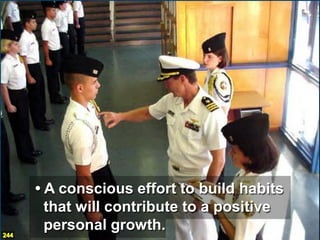
Your attitude is largely under your control.
     Attitude is not something you are born with.


36
Some experts say that
                      you can “program”
                      your attitude as you do
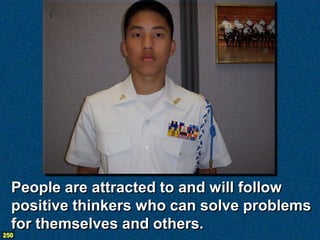
                      a computer, by
                      repeatedly thinking and
                      saying positive things
                      about yourself and
                      others.

     You can change your attitude and mood
     simply by changing how you think and
     talk.
37
Your attitude follows your behavior. If
     you do positive things, you’ll slowly
     develop a more positive attitude.
38
A person’s _______ is his/her “slant”
 or “angle” on life.

 A. attitude
 B. personality
 C. behavior
 D. experience


39
A person’s _______ is his/her “slant”
 or “angle” on life.

 A. attitude
 B. personality
 C. behavior
 D. experience


40
Which one of these behaviors is NOT
 a method of changing an attitude?

 A. Thinking positive things about
    yourself
 B. Saying positive things about others
 C. Doing positive things
 D. Wishing positive things would
    happen


41
Which one of these behaviors is NOT
 a method of changing an attitude?

 A. Thinking positive things about
    yourself
 B. Saying positive things about others
 C. Doing positive things
 D. Wishing positive things would
    happen


42
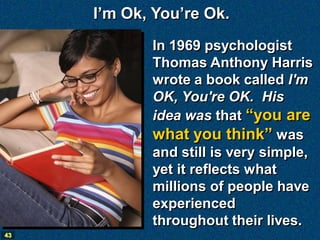
I’m Ok, You’re Ok.
            In 1969 psychologist
            Thomas Anthony Harris
            wrote a book called I'm
            OK, You're OK. His
            idea was that “you are
            what you think” was
            and still is very simple,
            yet it reflects what
            millions of people have
            experienced
            throughout their lives.
43
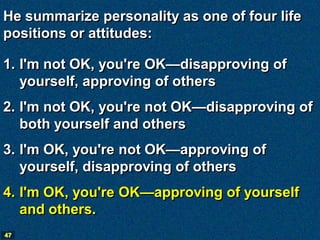
He summarize personality as one of four life
positions or attitudes:

1. I'm not OK, you're OK—disapproving of
   yourself, approving of others


44
He summarize personality as one of four life
positions or attitudes:

1. I'm not OK, you're OK—disapproving of
   yourself, approving of others
2. I'm not OK, you're not OK—disapproving of
   both yourself and others


45
He summarize personality as one of four life
positions or attitudes:

1. I'm not OK, you're OK—disapproving of
   yourself, approving of others
2. I'm not OK, you're not OK—disapproving of
   both yourself and others
3. I'm OK, you're not OK—approving of
   yourself, disapproving of others


46
He summarize personality as one of four life
positions or attitudes:

1. I'm not OK, you're OK—disapproving of
   yourself, approving of others
2. I'm not OK, you're not OK—disapproving of
   both yourself and others
3. I'm OK, you're not OK—approving of
   yourself, disapproving of others
4. I'm OK, you're OK—approving of yourself
   and others.
47
What thoughts describe the “I’m not
 OK, you’re not OK” attitude?

 A. Disapproval of yourself, approval of
    others
 B. Disapproval of both yourself and
    others
 C. Approval of both yourself and
    others
 D. Approval of yourself, disapproval of
    others
48
What thoughts describe the “I’m not
 OK, you’re not OK” attitude?

 A. Disapproval of yourself, approval of
    others
 B. Disapproval of both yourself and
    others
 C. Approval of both yourself and
    others
 D. Approval of yourself, disapproval of
    others
49
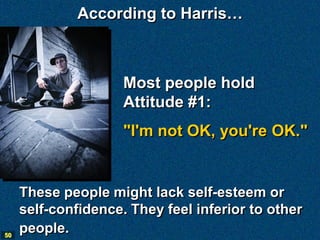
According to Harris…


                     Most people hold
                     Attitude #1:
                     "I'm not OK, you're OK."


     These people might lack self-esteem or
     self-confidence. They feel inferior to other
50
     people.
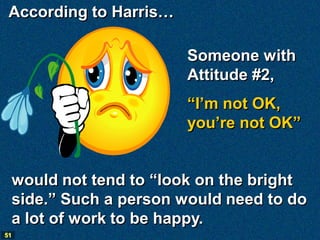
According to Harris…

                           Someone with
                           Attitude #2,
                           “I’m not OK,
                           you’re not OK”


     would not tend to “look on the bright
     side.” Such a person would need to do
     a lot of work to be happy.
51
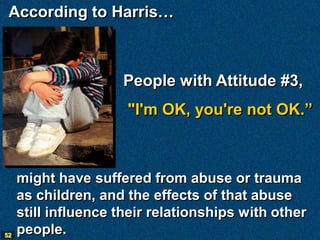
According to Harris…


                     People with Attitude #3,
                      "I'm OK, you're not OK.”


     might have suffered from abuse or trauma
     as children, and the effects of that abuse
     still influence their relationships with other
52
     people.
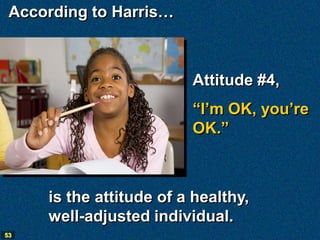
According to Harris…


                         Attitude #4,
                         “I’m OK, you’re
                         OK.”


     is the attitude of a healthy,
     well-adjusted individual.
53
According to Thomas Anthony Harris,
 which attitude would belong to people
 who lack self-esteem or self-confidence?

 A. Approval of both themselves and
    others
 B. Approval of themselves, disapproval
    of others
 C. Disapproval of both themselves and
    others
 D. Disapproval of themselves, approval
    of others
54
According to Thomas Anthony Harris,
 which attitude would belong to people
 who lack self-esteem or self-confidence?

 A. Approval of both themselves and
    others
 B. Approval of themselves, disapproval
    of others
 C. Disapproval of both themselves and
    others
 D. Disapproval of themselves, approval
    of others
55
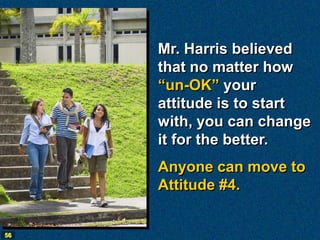
Mr. Harris believed
     that no matter how
     “un-OK” your
     attitude is to start
     with, you can change
     it for the better.
     Anyone can move to
     Attitude #4.


56
True or False: According to Thomas
 Anthony Harris, with effort everyone
 can achieve an attitude of “I’m OK,
 you’re OK.”


57
True or False: According to Thomas
 Anthony Harris, with effort everyone
 can achieve an attitude of “I’m OK,
 you’re OK.”

 True


58
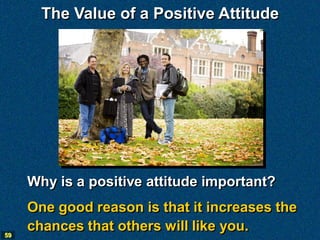
The Value of a Positive Attitude


     Why is a positive attitude important?
     One good reason is that it increases the
59
     chances that others will like you.
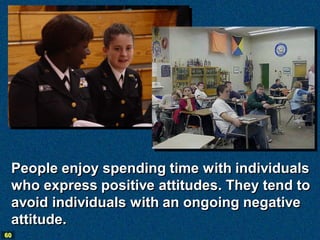
People enjoy spending time with individuals
 who express positive attitudes. They tend to
 avoid individuals with an ongoing negative
 attitude.
60
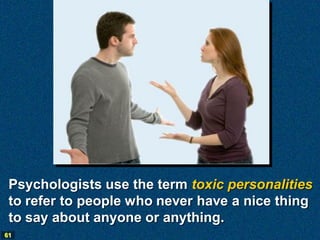
Psychologists use the term toxic personalities
 to refer to people who never have a nice thing
 to say about anyone or anything.
61
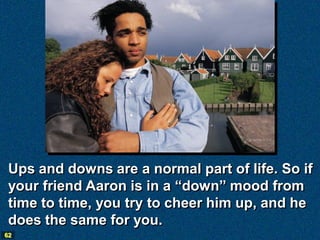
Ups and downs are a normal part of life. So if
 your friend Aaron is in a “down” mood from
 time to time, you try to cheer him up, and he
 does the same for you.
62
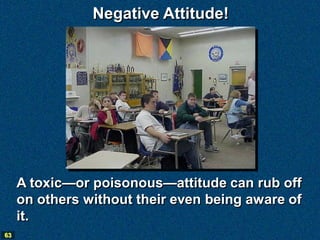
Negative Attitude!


     A toxic—or poisonous—attitude can rub off
     on others without their even being aware of
     it.
63
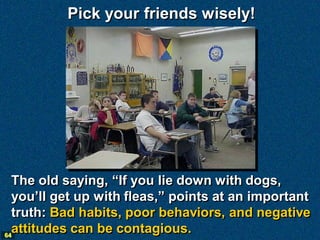
Pick your friends wisely!


  The old saying, “If you lie down with dogs,
  you’ll get up with fleas,” points at an important
  truth: Bad habits, poor behaviors, and negative
64
  attitudes can be contagious.
Which of the following statements is NOT
 true regarding attitudes?

 A. Someone with a toxic personality has
    occasional negative moods.
 B. Spending time with negative people can
    affect your own attitude for the worse.
 C. People tend to avoid people with
    negative attitudes.
 D. Having a positive attitude makes it more
    likely that people will want to be around
    you.
65
Which of the following statements is NOT
 true regarding attitudes?

 A. Someone with a toxic personality has
    occasional negative moods.
 B. Spending time with negative people can
    affect your own attitude for the worse.
 C. People tend to avoid people with
    negative attitudes.
 D. Having a positive attitude makes it more
    likely that people will want to be around
    you.
66
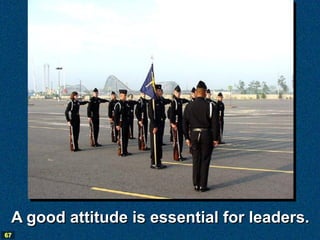
A good attitude is essential for leaders.
67
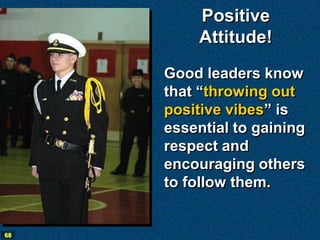
Positive
         Attitude!
     Good leaders know
     that “throwing out
     positive vibes” is
     essential to gaining
     respect and
     encouraging others
     to follow them.


68
The saying, “If you lie down with
 dogs, you’ll get up with fleas,” is
 warning people to _______.

 A. stay active and avoid laziness
 B. choose their friends wisely
 C. keep motivated and goal-oriented
 D. make sure their attitude stays
    positive


69
The saying, “If you lie down with
 dogs, you’ll get up with fleas,” is
 warning people to _______.

 A. stay active and avoid laziness
 B. choose their friends wisely
 C. keep motivated and goal-oriented
 D. make sure their attitude stays
    positive


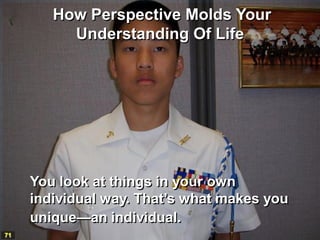
70
How Perspective Molds Your
          Understanding Of Life


     You look at things in your own
     individual way. That’s what makes you
     unique—an individual.
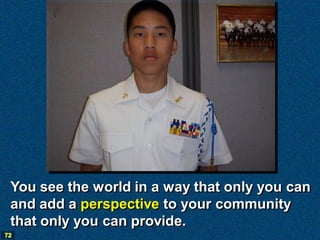
71
You see the world in a way that only you can
 and add a perspective to your community
 that only you can provide.
72
Perspective

     An individual’s way of seeing the
     world


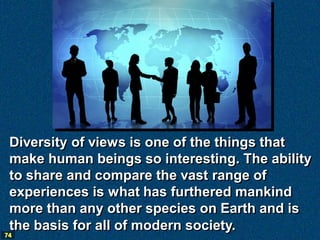
73
Diversity of views is one of the things that
 make human beings so interesting. The ability
 to share and compare the vast range of
 experiences is what has furthered mankind
 more than any other species on Earth and is
 the basis for all of modern society.
74
Your perspective is your “take” on
     the world—your worldview.
75
Your perspective includes your insight into
     people, things, and events, driving the way
     you interpret your life experiences.
76
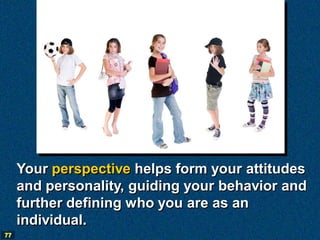
Your perspective helps form your attitudes
     and personality, guiding your behavior and
     further defining who you are as an
     individual.
77
What term is used to refer to each
 individual’s unique view of the world?

 A. Attitude
 B. Personality
 C. Opinion
 D. Perspective


78
What term is used to refer to each
 individual’s unique view of the world?

 A. Attitude
 B. Personality
 C. Opinion
 D. Perspective


79
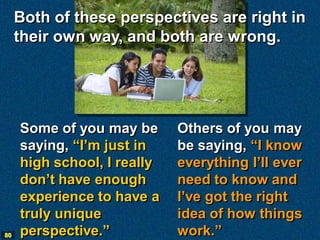
Both of these perspectives are right in
     their own way, and both are wrong.


     Some of you may be      Others of you may
     saying, “I’m just in    be saying, “I know
     high school, I really   everything I’ll ever
     don’t have enough       need to know and
     experience to have a    I’ve got the right
     truly unique            idea of how things
80   perspective.”           work.”
As a student you are in a lively and
     interesting world of discovery that you
     largely determine for yourself, so you
     really do know how things work for you.
81
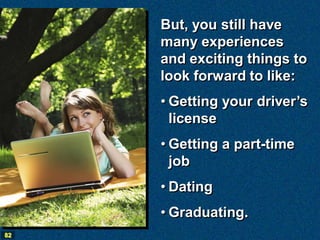
But, you still have
     many experiences
     and exciting things to
     look forward to like:
     • Getting your driver’s
       license
     • Getting a part-time
       job
     • Dating
     • Graduating.
82
On the longer-term
     perspective, you may
     look forward to:
     • going to college
     • getting a job
     • marrying
     • raising a family.

83
In thefar distant future, you may be
     looking to retire to a home on the beach
     or a cabin in the woods somewhere.
84
Maturity will broaden your views on the
     world, or another way of saying it is that
     life is like climbing a mountain: the higher
     you get, the farther you can see.
85
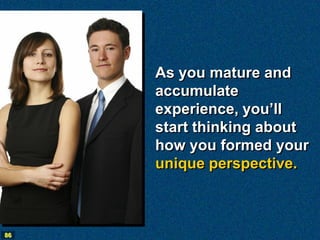
As you mature and
     accumulate
     experience, you’ll
     start thinking about
     how you formed your
     unique perspective.


86
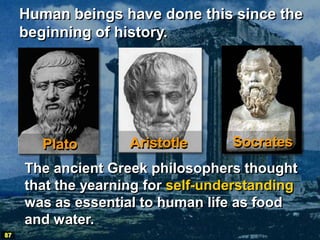
Human beings have done this since the
     beginning of history.


        Plato       Aristotle      Socrates
     The ancient Greek philosophers thought
     that the yearning for self-understanding
     was as essential to human life as food
     and water.
87
What did the ancient Greek philosophers
 believe about human beings and perspective?

 A. The happiest people spend the least
    amount of time in philosophical musings.
 B. People have a greater need to understand
    other people than to understand
    themselves.
 C. People are reluctant to consider their
    negative traits and shortcomings.
 D. All people have a longing and a need to
    understand themselves.

88
What did the ancient Greek philosophers
 believe about human beings and perspective?

 A. The happiest people spend the least
    amount of time in philosophical musings.
 B. People have a greater need to understand
    other people than to understand
    themselves.
 C. People are reluctant to consider their
    negative traits and shortcomings.
 D. All people have a longing and a need to
    understand themselves.

89
It’s natural for you to want to understand
     why you are thinking and doing certain
     things at your age.
90
In grasping the purpose
     behind your perspective,
     you’ll gradually begin to see
     how a healthy, well-rounded,
     fair-minded perspective can
     guide you in your:
     • Studies
     • Career
     • Friendships
     • Family relationships
     • Future.
91
Right now, your
                       perspective may be
                       based largely on the
                       influence of your:
                       • Peers
                       • Parents
                       • Guardians
                       • Friends
                       • Teachers
 These influences give you a good foundation
 for growth.
92
Your friends and
     family “support
     your worldview,”
     but questioning
     assumptions is also
     important.
     Both are the sign of
     a growing, dynamic
     perspective.

93
How Perspective Molds Your Purposes,
       Passions, And Practices


     Your perspective drives the purposes you
     strive toward; your passions, or the things
     you feel strongly about, and the practices
94   you follow in your life.
This means that your
     perspective will
     significantly affect your
     success:
     • In school
     • At work
     • In friendships
     • In family relationships.

95
True or False: Perspective has a
 significant effect on a person’s
 success in school, at work, and with
 friends and family.


96
True or False: Perspective has a
 significant effect on a person’s
 success in school, at work, and with
 friends and family.

 True


97
By nature,
                                 human
                                 beings are
                                 social
                                 creatures.


     People want to belong to a group or an
     organization. They want to have friends—
     sometimes desperately so.
98
The need to have friends and to belong is
     particularly strong among teenagers, but
     old and young people alike seek group
     acceptance. This natural human
99
     characteristic is called an affiliation need.
Affiliation Need

      A desire to be and feel a part of
      a group


100
When you are young, the desire for
      affiliation can sometimes lead to actions or
      behaviors that run counter to the influence
      of your family and teachers.
101
You put your perspective to the test.


      Sometimes peer pressure to do the wrong,
      unwise, or inappropriate thing is almost
      irresistible. Stick with the values that your
      parents or teachers believe best.
102
The more you know yourself, and the better
      you understand what you believe and why,
      the better you’ll be able to pass that test.
103
What is desired in affiliation need?

  A. To have children
  B. To be successful at work
  C. To be part of a group
  D. To be loved and supported by
     family


104
What is desired in affiliation need?

  A. To have children
  B. To be successful at work
  C. To be part of a group
  D. To be loved and supported by
     family


105
In what age group can the need for
  affiliation most often lead people to
  inappropriate, wrong, or unwise
  behavior?

  A. Children
  B. Teenagers
  C. Middle aged
  D. Elderly


106
In what age group can the need for
  affiliation most often lead people to
  inappropriate, wrong, or unwise
  behavior?

  A. Children
  B. Teenagers
  C. Middle aged
  D. Elderly


107
Cultivating a Healthy Perspective


                     People’s beliefs and
                     desires help shape
                     their perspectives.
                     A belief is a strong and
                     deeply held idea that
                     forms the basis for
                     much of your thinking.


108
Cultivating A Healthy Perspective


                        A belief can be:
                        • Religious
                        • Social
                        • Political
                        • Personal.

109
A desire is something
      you deeply want and is
      frequently part of your
      emotional and
      psychological
      motivation.


110
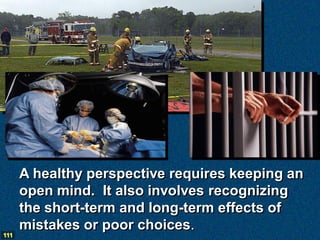
A healthy perspective requires keeping an
      open mind. It also involves recognizing
      the short-term and long-term effects of
      mistakes or poor choices.
111
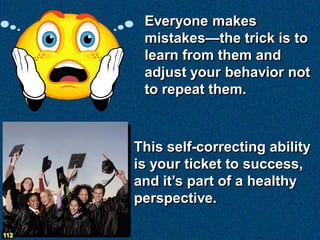
Everyone makes
       mistakes—the trick is to
       learn from them and
       adjust your behavior not
       to repeat them.


      This self-correcting ability
      is your ticket to success,
      and it’s part of a healthy
      perspective.

112
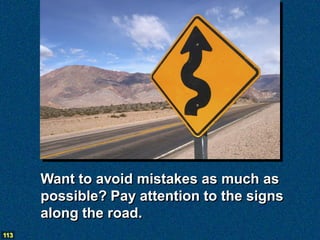
Want to avoid mistakes as much as
      possible? Pay attention to the signs
      along the road.
113
Beliefs are strong and deeply held
  _______ that shape your thinking.

  A. desires
  B. values
  C. emotions
  D. ideas


114
Beliefs are strong and deeply held
  _______ that shape your thinking.

  A. desires
  B. values
  C. emotions
  D. ideas


115
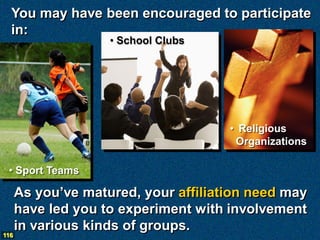
You may have been encouraged to participate
  in:
                    • School Clubs


                                      • Religious
                                       Organizations

 • Sport Teams

      As you’ve matured, your affiliation need may
      have led you to experiment with involvement
      in various kinds of groups.
116
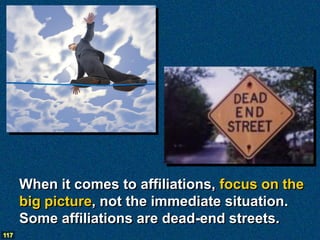
When it comes to affiliations, focus on the
      big picture, not the immediate situation.
      Some affiliations are dead-end streets.
117
Affiliations like:
      • internet chat rooms
      • cliques
      • gangs
      • secret clubs
      are not a good
      breeding ground for
      developing a mature,
      positive perspective.

118
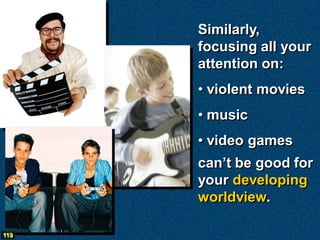
Similarly,
      focusing all your
      attention on:
      • violent movies
      • music
      • video games
      can’t be good for
      your developing
      worldview.

119
In the 1985 movie Witness, one character
      says, “What you take into your hands, you
      take into your heart.”

                            This points to a
                            direct relationship
                            between your
                            experience—what
                            you see, hear,
                            touch, taste, say,
                            and do—and your
                            ever-widening
                            perspective on life.
120
Everyone has heroes in their life!

      Parent                           Coach


                        Teacher


      Your heroes set goals, got excited about
      them, and then worked to achieve them.
               You can do that, too!
121
Which of these is NOT a poor choice
  for an affiliation or pastime that will
  help you develop a mature, positive
  perspective?

  A. Internet chat rooms and adult
     websites
  B. Violent movies, music, and video
     games
  C. School club, sports team, and
     religious youth organization
  D. Gangs, cliques, and secret clubs
122
Which of these is NOT a poor choice
  for an affiliation or pastime that will
  help you develop a mature, positive
  perspective?

  A. Internet chat rooms and adult
     websites
  B. Violent movies, music, and video
     games
  C. School club, sports team, and
     religious youth organization
  D. Gangs, cliques, and secret clubs
123
How Your Actions Reveal Your Attitudes


                        You’ve
                        probably heard
                        the expression,
                        “Do as I say,
                        not as I do.”


124
This points out the close—and at times
  contradictory—relationship between
  your attitudes:
                        • perspectives,
                       • purposes
                       • beliefs
                       and your actions:
                       • practices
                       • behaviors.
125
If you’re like most people, you want your
  actions to be in harmony with your attitudes.
  “Walk the walk, talk the talk,” right?
126
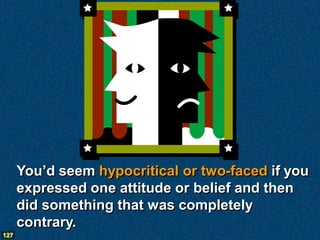
You’d seem hypocritical or two-faced if you
      expressed one attitude or belief and then
      did something that was completely
      contrary.
127
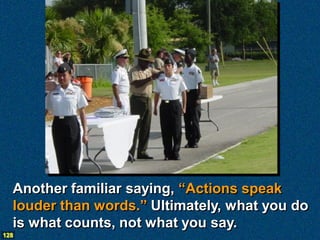
Another familiar saying, “Actions speak
  louder than words.” Ultimately, what you do
  is what counts, not what you say.
128
Your actions set your goals in motion and
      help you achieve what you want to
      achieve.
129
The desire to achieve shows itself in:
Making           Getting               Being Part
Friends           Good                 of A Family
                 Grades


  Making a                 Making        Winning
   Team                     Band         Awards
    All these things may be part of how you define
    success. You direct your actions to achieving
130
    these goals.
The expression “Do as I say, not as I
  do” demonstrates what conflict?

  A. Between parents and children
  B. Between attitudes and actions
  C. Between right and wrong
  D. Between maturity and immaturity


131
The expression “Do as I say, not as I
  do” demonstrates what conflict?

  A. Between parents and children
  B. Between attitudes and actions
  C. Between right and wrong
  D. Between maturity and immaturity


132
True or False: What people say is
  more powerful than how they act.


133
True or False: What people say is
  more powerful than how they act.

  False


134
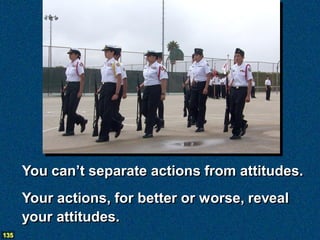
You can’t separate actions from attitudes.
      Your actions, for better or worse, reveal
      your attitudes.
135
Showing up late
      for:
      • school
      • practice
      • work
      sends a message
      about your
      attitude.
136
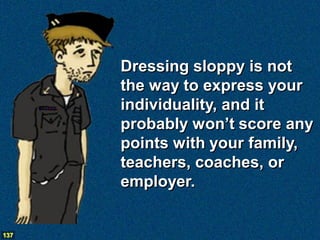
Dressing sloppy is not
      the way to express your
      individuality, and it
      probably won’t score any
      points with your family,
      teachers, coaches, or
      employer.


137
See if you can tell what each of the
  following actions might say about the
  person’s attitude:
  • Chewing and snapping gum during a
    lecture
  • Conversing above a whisper during a
    movie
  • Failing to use “Mr.,” “Mrs.,” “Ms.,” “Sir,”
    or “Ma’am” in talking with adults
  • Not using a turn signal when driving

138
• Never saying “Please” and “Thank you” in
   normal conversation
 • Avoiding eye contact with others
 • Putting your feet up on furniture
 • Losing something that you’ve borrowed
   from a friend
 • Ignoring personal hygiene with hair, teeth,
   bathing, and clothing

139
Actions cannot be separated from
  _______.

  A. desires
  B. values
  C. goals
  D. attitudes


140
Actions cannot be separated from
  _______.

  A. desires
  B. values
  C. goals
  D. attitudes


141
“You miss 100 percent of the
      shots you don’t take.”
 Said by           Think about your life
 ice               as a sport for a minute.
 hockey
                   Are you a team
 legend
                   player?
 Wayne
 Gretzky!          Do you follow the
                   rules?
                   Take your shots?
      # 99         What’s your attitude?
142
WINNING BREEDS
           WINNING!

      An achievement-focused
      attitude can become a
      way of life and a positive,
      contagious habit.
      The more you achieve,
      the more you’re likely to
      achieve.


143
Winning and success motivate those who
      value winning to push themselves even
      harder.
144
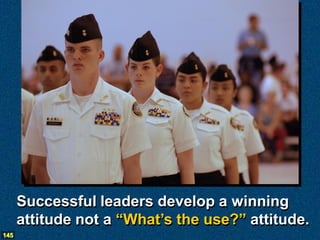
Successful leaders develop a winning
      attitude not a “What’s the use?” attitude.
145
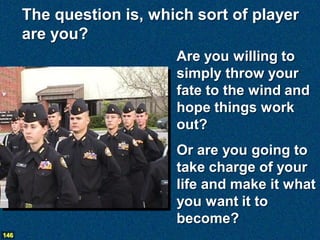
The question is, which sort of player
      are you?
                          Are you willing to
                          simply throw your
                          fate to the wind and
                          hope things work
                          out?
                          Or are you going to
                          take charge of your
                          life and make it what
                          you want it to
                          become?
146
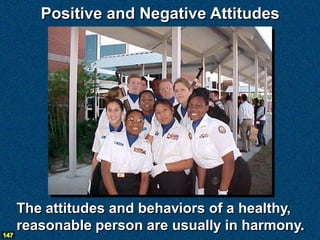
Positive and Negative Attitudes


      The attitudes and behaviors of a healthy,
      reasonable person are usually in harmony.
147
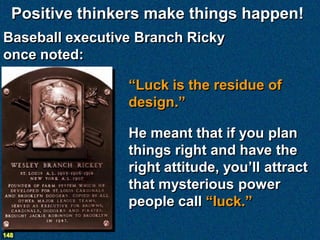
Positive thinkers make things happen!
Baseball executive Branch Ricky
once noted:

                 “Luck is the residue of
                 design.”

                 He meant that if you plan
                 things right and have the
                 right attitude, you’ll attract
                 that mysterious power
                 people call “luck.”

148
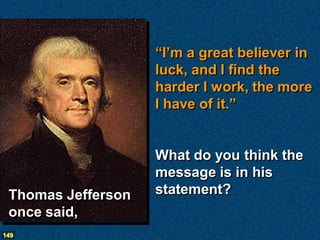
“I’m a great believer in
                    luck, and I find the
                    harder I work, the more
                    I have of it.”


                    What do you think the
                    message is in his
 Thomas Jefferson   statement?
 once said,
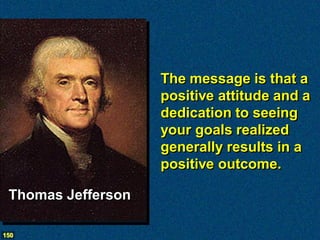
149
The message is that a
                    positive attitude and a
                    dedication to seeing
                    your goals realized
                    generally results in a
                    positive outcome.

 Thomas Jefferson

150
Which of these attitudes are you least
  likely revealing when you ignore
  personal hygiene issues like bathing and
  having clean clothes, hair, and teeth?

  A. That you do not have any self-respect
  B. That you do not care about offending
     other people
  C. That you have pride and make the
     effort to be presentable
  D. That you do not seek the approval of
     other people
151
Which of these attitudes are you least
  likely revealing when you ignore
  personal hygiene issues like bathing and
  having clean clothes, hair, and teeth?

  A. That you do not have any self-respect
  B. That you do not care about offending
     other people
  C. That you have pride and make the
     effort to be presentable
  D. That you do not seek the approval of
     other people
152
With the proper planning and a
  positive attitude, you will find that
  _______ comes your way and that it is
  not a random, mysterious thing after
  all.

  A. luck
  B. happiness
  C. success
  D. wealth

153
With the proper planning and a
  positive attitude, you will find that
  _______ comes your way and that it is
  not a random, mysterious thing after
  all.

  A. luck
  B. happiness
  C. success
  D. wealth

154
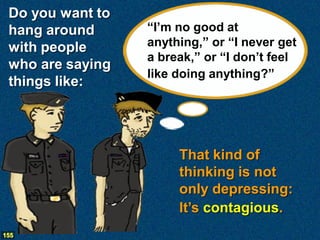
Do you want to
 hang around      “I’m no good at
 with people      anything,” or “I never get
                  a break,” or “I don’t feel
 who are saying
                  like doing anything?”
 things like:


                       That kind of
                       thinking is not
                       only depressing:
                       It’s contagious.
155
Contagious

      Tending to spread from person
      to person


156
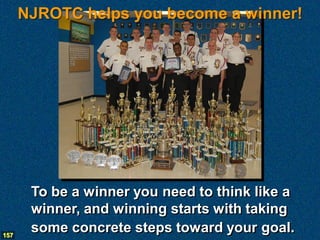
NJROTC helps you become a winner!


       To be a winner you need to think like a
       winner, and winning starts with taking
157
       some concrete steps toward your goal.
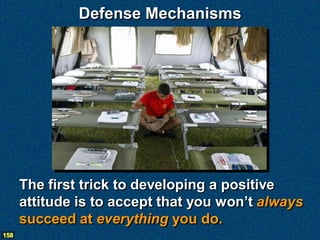
Defense Mechanisms


      The first trick to developing a positive
      attitude is to accept that you won’t always
      succeed at everything you do.
158
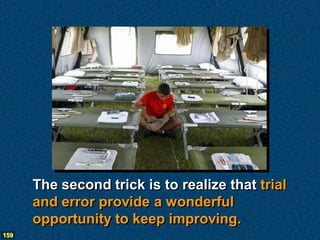
The second trick is to realize that trial
      and error provide a wonderful
      opportunity to keep improving.
159
True or False: Being around people
  who whine and complain will most
  likely make you feel like a winner.


160
True or False: Being around people
  who whine and complain will most
  likely make you feel like a winner.

  False


161
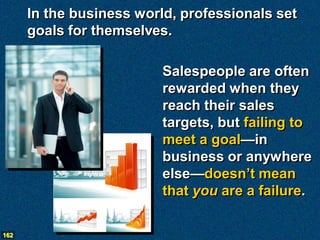
In the business world, professionals set
      goals for themselves.

                          Salespeople are often
                          rewarded when they
                          reach their sales
                          targets, but failing to
                          meet a goal—in
                          business or anywhere
                          else—doesn’t mean
                          that you are a failure.

162
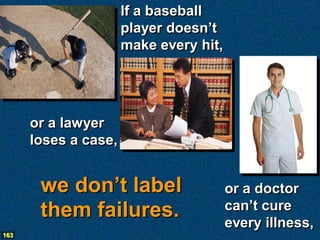
If a baseball
                      player doesn’t
                      make every hit,


      or a lawyer
      loses a case,


       we don’t label                   or a doctor
       them failures.                   can’t cure
                                        every illness,
163
People talk about the “practice” of law and
  medicine because those professionals are
  constantly improving their art.
164
Architect     Pilot


 Of course, some professions have a zero
 tolerance for failure—and it’s a good thing
 they do. You don’t want them to make any big
 mistakes. But even pilots are not always on
 schedule, and architects do not win every
 contract.
165
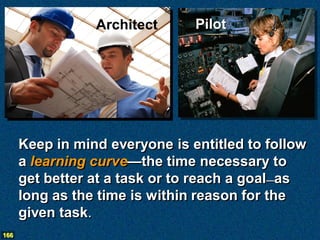
Architect      Pilot


      Keep in mind everyone is entitled to follow
      a learning curve—the time necessary to
      get better at a task or to reach a goal—as
      long as the time is within reason for the
      given task.
166
What is a learning curve?

  A. Chart that managers use to plot
     progress toward a goal
  B. Time needed to perfect a task or
     reach a goal
  C. Checkpoints for new employees
     during their probationary period
  D. Graph that documents how the
     quality of an employee’s work
     reaches a peak and then declines
167
     over time
What is a learning curve?

  A. Chart that managers use to plot
     progress toward a goal
  B. Time needed to perfect a task or
     reach a goal
  C. Checkpoints for new employees
     during their probationary period
  D. Graph that documents how the
     quality of an employee’s work
     reaches a peak and then declines
168
     over time
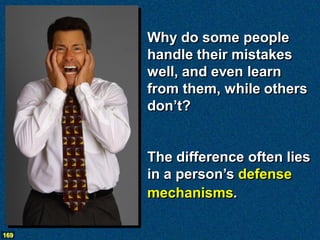
Why do some people
      handle their mistakes
      well, and even learn
      from them, while others
      don’t?


      The difference often lies
      in a person’s defense
      mechanisms.

169
Defense mechanisms

      Behaviors people use to deal
      with anxiety, stress, or pressure


170
Everyone has anxieties, and defense
      mechanisms provide a way to deal with
      them, but if you’re not careful, defense
      mechanisms can turn into excuses.
171
USS San Francisco
     SSN-711

 People use defense mechanisms without
 realizing it to try and convince others and
 themselves that someone else is to blame for
 a mistake, or that a controllable situation was
 entirely outside of their ability to handle.
172
Defense
      mechanisms are
      ways of protecting
      your self-
      confidence and
      pride when you
      are feeling
      inadequate or
      ashamed.


173
You probably don’t respect the athlete, or
  singer who constantly makes excuses for
  his or her shortfalls.
174
The use of defense mechanisms is not a
      bad thing as long as you take the steps to
      correct the problem.
175
The danger of
      defense
      mechanisms is
      failing to take
      responsibility for
      your actions or
      inactions.


176
This is the hallmark
      of an immature
      personality and of
      someone who still
      has some growing
      up to do, no matter
      what his or her age.


177
What are people trying to protect
  when they use defense mechanisms?

  A. Their pride and self-confidence
  B. Their inabilities and inadequacies
  C. The feelings of their families,
     friends, and co-workers
  D. The identity of the other people
     responsible for the situation or
     mistake

178
What are people trying to protect
  when they use defense mechanisms?

  A. Their pride and self-confidence
  B. Their inabilities and inadequacies
  C. The feelings of their families,
     friends, and co-workers
  D. The identity of the other people
     responsible for the situation or
     mistake

179
What is the danger of constantly using
  defense mechanisms?

  A. People find themselves being given
     more and more responsibility.
  B. People begin to see themselves as
     too perfect and incapable of error.
  C. People keep those around them from
     seeing the situation clearly enough
     to help improve it.
  D. People fail to take responsibility for
180
     their actions and remain immature.
What is the danger of constantly using
  defense mechanisms?

  A. People find themselves being given
     more and more responsibility.
  B. People begin to see themselves as
     too perfect and incapable of error.
  C. People keep those around them from
     seeing the situation clearly enough
     to help improve it.
  D. People fail to take responsibility for
181
     their actions and remain immature.
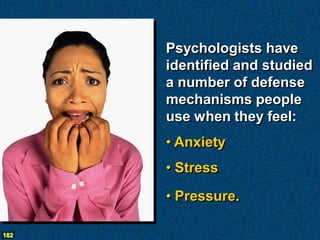
Psychologists have
      identified and studied
      a number of defense
      mechanisms people
      use when they feel:
      • Anxiety
      • Stress
      • Pressure.

182
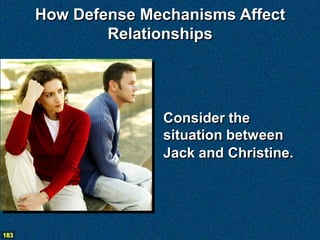
How Defense Mechanisms Affect
              Relationships


                    Consider the
                    situation between
                    Jack and Christine.


183
Jack and Christine have been dating
      steadily for about a year, but they have
      a problem: Jack gets jealous any time
184
      Christine even talks to another boy.
He suspects she’s not really happy in
      their relationship and watches her every
      move. Christine keeps telling Jack that
      he’s imagining things.
185
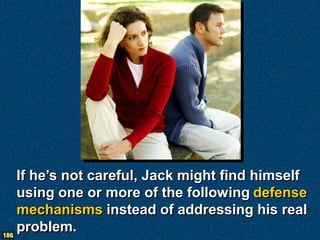
If he’s not careful, Jack might find himself
    using one or more of the following defense
    mechanisms instead of addressing his real
186
    problem.
• Displacement—transferring a feeling
        about a person or an object to another,
        less threatening object


      Example: Jack feels jealous anger toward
      Christine, so he is rude to her little sister.
187
• Repression—pushing disturbing thoughts,
   wishes, or experiences from one’s conscious
   awareness while the feeling continues to
   operate on an unconscious level


  Example: Jack tells Christine that everything
  is OK and that he doesn’t want to talk about
  his feelings, but he still seems angry with her.
188
• Rationalization—concealing the true
   motivations for one’s thoughts, actions, or
   feelings by offering reassuring, but incorrect,
   explanations


      Example: Jack assures Christine that the
      problem isn’t with her; he’s just going
      through a tough time at his after-school job
189
      and feels frustrated about it.
• Projection—falsely attributing to others
        your own unacceptable feelings, impulses,
        or thoughts


      Example: Jack tells everyone that Christine
      is upset with him because he spends time
      shooting pool with friends.
190
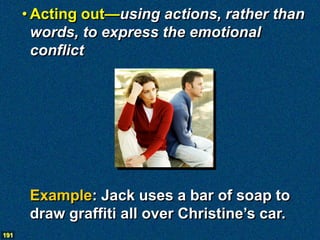
• Acting out—using actions, rather than
        words, to express the emotional
        conflict


       Example: Jack uses a bar of soap to
       draw graffiti all over Christine’s car.
191
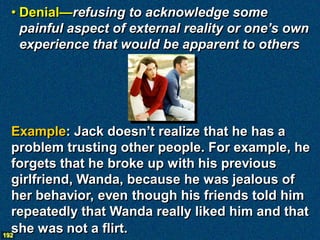
• Denial—refusing to acknowledge some
   painful aspect of external reality or one’s own
   experience that would be apparent to others


  Example: Jack doesn’t realize that he has a
  problem trusting other people. For example, he
  forgets that he broke up with his previous
  girlfriend, Wanda, because he was jealous of
  her behavior, even though his friends told him
  repeatedly that Wanda really liked him and that
  she was not a flirt.
192
What term is used to refer to the
  transference of a feeling about a
  person or an object to another, less
  threatening object?

  A. Repression
  B. Rationalization
  C. Displacement
  D. Projection


193
What term is used to refer to the
  transference of a feeling about a
  person or an object to another, less
  threatening object?

  A. Repression
  B. Rationalization
  C. Displacement
  D. Projection


194
If someone refuses to recognize some
  painful aspect of reality or his/her own
  experience that other people would
  clearly see, he/she is _______.

  A. acting out
  B. in repression
  C. rationalizing
  D. in denial


195
If someone refuses to recognize some
  painful aspect of reality or his/her own
  experience that other people would
  clearly see, he/she is _______.

  A. acting out
  B. in repression
  C. rationalizing
  D. in denial


196
How many of
                             these defense
                             mechanisms do
                             you recognize?


      Have you ever used any of them yourself?
197
Because defense mechanisms can be used
 unconsciously, people sometimes use them
 without even knowing it.
198
Before things can get better for Jack and
  Christine, Jack must realize that his attitude
  needs to improve.
199
Mature people don’t fall back on defense
      mechanisms—mainly because they don’t
      need them.
200
You will not
                                  always be
                                  successful.


      Many times, you simply have to “grin and
      bear it,” but growing up and developing a
      positive, productive attitude requires a
      willingness to keep working to solve an
      issue rather than dodge it.
201
Nobody comes into this world with a
      guaranteed perfect life, but the attitude
      you develop once you get here is under
      your control.
202
A positive attitude
      can make it easier to
      handle life’s troubles.


203
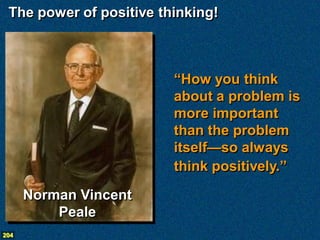
The power of positive thinking!


                         “How you think
                         about a problem is
                         more important
                         than the problem
                         itself—so always
                         think positively.”

      Norman Vincent
          Peale
204
How do mature people deal with their
 problems?

  A. They use defense mechanisms most of
     the time like anybody else.
  B. They confront their problems in an
     attempt to solve them.
  C. They wait them out, knowing that the
     passage of time will help them see
     solutions more clearly.
  D. They do not fear addressing problems
     because they know they will always be
205
     successful.
How do mature people deal with their
 problems?

  A. They use defense mechanisms most of
     the time like anybody else.
  B. They confront their problems in an
     attempt to solve them.
  C. They wait them out, knowing that the
     passage of time will help them see
     solutions more clearly.
  D. They do not fear addressing problems
     because they know they will always be
206
     successful.
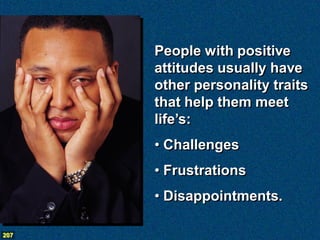
People with positive
      attitudes usually have
      other personality traits
      that help them meet
      life’s:
      • Challenges
      • Frustrations
      • Disappointments.

207
These people can call into action the
following personality traits to solve problems
and to succeed:
• Integrity
• Credibility
• Humility
• Patience
• Respect
• Appreciation
• Focus on task completion and on people
208
Strategies for Expressing Emotions


                                         Grief
                            Joy

             Love


      Specific feelings you may experience
209
Strategies for Expressing Emotions

                     Anger


                                    Disgust
       Fear

      Specific feelings you may experience
210
People refer
                                    to a more
                                    general kind
                                    of feeling as
                                    a “mood.”


      We all experience people who are in a good
      “mood” or bad “mood.”
211
“Moods” are a temporary state of mind or
      feeling a general feeling of emotion.


212
Babies come into the world with the
      two most basic emotions:


           Delight          Distress
213
As you grow older, emotions
      become a very real part of you.
214
Controlling emotions is
      a challenge to everyone
      in a leadership position.


215
Emotions need to be expressed, especially
  very strong emotions.


216
You may feel like “telling off” someone or
      even physically striking the person, but
      your social conditioning tells you that this
      is not acceptable behavior.
217
Constructive methods of expressing strong
      emotions include:
                                   Talking it out


                                         Positive
                                        thoughts
  Physical activity
218                   Sense of humor
Spontaneous feelings that people
  have are called _______.

  A. moods
  B. attitudes
  C. emotions
  D. outlooks


219
Spontaneous feelings that people
  have are called _______.

  A. moods
  B. attitudes
  C. emotions
  D. outlooks


220
Physical Activity
      Emotions are a very real part of you!


                             Intense Emotional
                             Buildup


221
Some emotional
      outlets include:
      • Sports activity


222
• Creative projects
223
• Cleaning a house
224
• Washing the car


225
• Mowing the lawn
226
• Hunting or fishing
227
• Painting
228
• Sewing

229
• Woodworking.

230
Which of these is NOT a
  recommended physical activity to help
  deal with emotions constructively?

  A. Washing the car
  B. Mowing the lawn
  C. Playing video games
  D. Cleaning house


231
Which of these is NOT a
  recommended physical activity to help
  deal with emotions constructively?

  A. Washing the car
  B. Mowing the lawn
  C. Playing video games
  D. Cleaning house


232
Trusted friend          Teacher
                 Talking it out


       Counselor                  Parent
233
Trusted friend          Teacher
         These people can help you see
         alternatives and understand
         your feelings.


       Counselor              Parent
234
Sense of Humor


                Keeping your
                sense of humor
                is a big asset in
                constructively
                expressing
                emotions.


235
Being able to laugh at yourself
      and to laugh with others is a
      rare combination.


236
The jokester tries to
      build up his or her
      self-image in an
      attempt to feel
      superior at someone
      else’s expense.


237
A constructive sense
      of humor is not:
      • Cutting
      • Sarcastic
      • Hostile.
238
People using humor constructively
  focus the humor on _______, and it is
  not hostile, cutting, or sarcastic.

  A. their emotion
  B. people close to them
  C. strangers
  D. themselves


239
People using humor constructively
  focus the humor on _______, and it is
  not hostile, cutting, or sarcastic.

  A. their emotion
  B. people close to them
  C. strangers
  D. themselves


240
Positive Thoughts
        and Actions


         The power of
      “positive thinking!”


241
Positive attitudes begin with:
      • A healthy self-image
242
• Acknowledgement rather than denial
        of problems
243
• A conscious effort to build habits
        that will contribute to a positive
244
        personal growth.
Which of the following is NOT part of the
  process of establishing a positive
  attitude?

  A. Facing rather than ignoring problems
  B. Repeating to yourself and your
     friends that you are going to become
     a positive thinker
  C. Making a conscious effort to build
     habits for personal growth
  D. Trying to keep a healthy self-image
245
Which of the following is NOT part of the
  process of establishing a positive
  attitude?

  A. Facing rather than ignoring problems
  B. Repeating to yourself and your
     friends that you are going to become
     a positive thinker
  C. Making a conscious effort to build
     habits for personal growth
  D. Trying to keep a healthy self-image
246
Conclusion
                    Anger


                                   Disgust
      Fear

  Your success as a leader often depends on
  attitudes—and you can control your attitude.
247
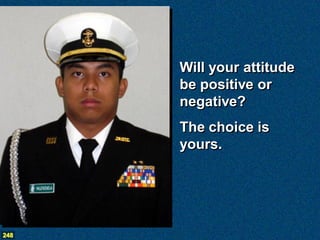
Will your attitude
      be positive or
      negative?
      The choice is
      yours.


248
Family member          Employee


         A positive attitude will make
         you a happier and more
         successful:


249
         Student               Citizen
CONCLUSION


  People are attracted to and will follow
  positive thinkers who can solve problems
  for themselves and others.
250
A positive attitude
  can be the leader’s
  key to success.


251
What term refers to something
      that can be but has not yet been
      developed?

      A. Maturity
      B. Affiliation
      C. Perspective
      D. Potential


252
What term refers to something
      that can be but has not yet been
      developed?

      A. Maturity
      B. Affiliation
      C. Perspective
      D. Potential


253
What term is used to refer to the
      state of being fully grown or
      developed?

      A. Maturity
      B. Potential
      C. Affiliation
      D. Perspective


254
What term is used to refer to the
      state of being fully grown or
      developed?

      A. Maturity
      B. Potential
      C. Affiliation
      D. Perspective


255
What term is used to refer to
      what a person is inside as well
      as what he/she shows to others,
      and is comprised of such things
      as actions, opinions, and
      beliefs?

      A. Affiliation
      B. Personality
      C. Perspective
      D. Potential
256
What term is used to refer to
      what a person is inside as well
      as what he/she shows to others,
      and is comprised of such things
      as actions, opinions, and
      beliefs?

      A. Affiliation
      B. Personality
      C. Perspective
      D. Potential
257
A person’s _______ is rooted in
      his/her thoughts, feelings, and
      beliefs, and largely determines
      how a person responds to a
      particular situation.

      A. experience
      B. personality
      C. attitude
      D. behavior

258
A person’s _______ is rooted in
      his/her thoughts, feelings, and
      beliefs, and largely determines
      how a person responds to a
      particular situation.

      A. experience
      B. personality
      C. attitude
      D. behavior

259
Someone’s way of seeing the
      world is his/her _______.

      A. personality
      B. potential
      C. perspective
      D. affiliation


260
Someone’s way of seeing the
      world is his/her _______.

      A. personality
      B. potential
      C. perspective
      D. affiliation


261
A human being’s natural desire
      to feel like he/she is part of a
      group is known as _______.

      A. a defense mechanism
      B. gregariousness
      C. herd mentality
      D. affiliation need


262
A human being’s natural desire
      to feel like he/she is part of a
      group is known as _______.

      A. a defense mechanism
      B. gregariousness
      C. herd mentality
      D. affiliation need


263
What term is used to refer to
      behaviors that people use to deal
      with anxieties and stress?

      A. Defense mechanisms
      B. Affiliation needs
      C. Displacements
      D. Projections


264
What term is used to refer to
      behaviors that people use to deal
      with anxieties and stress?

      A. Defense mechanisms
      B. Affiliation needs
      C. Displacements
      D. Projections


265
What term is used to refer to
      taking out impulses on or
      transferring feelings about a
      person or thing to a less
      threatening, more acceptable
      object?

      A. Rationalization
      B. Projection
      C. Displacement
      D. Repression
266
What term is used to refer to
      taking out impulses on or
      transferring feelings about a
      person or thing to a less
      threatening, more acceptable
      object?

      A. Rationalization
      B. Projection
      C. Displacement
      D. Repression
267
What term is used to refer to a
      refusal to acknowledge the
      existence of a problem or a
      painful reality?

      A. Repression
      B. Acting out
      C. Displacement
      D. Denial


268
What term is used to refer to a
      refusal to acknowledge the
      existence of a problem or a
      painful reality?

      A. Repression
      B. Acting out
      C. Displacement
      D. Denial


269
A defense mechanism in which
      someone pushes disturbing
      thoughts from his/her conscious
      mind while the feelings continue
      at the subconscious level is
      known as _______.

      A. denial
      B. repression
      C. displacement
      D. rationalization
270
A defense mechanism in which
      someone pushes disturbing
      thoughts from his/her conscious
      mind while the feelings continue
      at the subconscious level is
      known as _______.

      A. denial
      B. repression
      C. displacement
      D. rationalization
271
What term is used to refer to the
      concealing of true motivations
      for one’s thoughts or actions by
      explaining them in a more
      reassuring way?

      A. Rationalization
      B. Displacement
      C. Repression
      D. Denial

272
What term is used to refer to the
      concealing of true motivations
      for one’s thoughts or actions by
      explaining them in a more
      reassuring way?

      A. Rationalization
      B. Displacement
      C. Repression
      D. Denial

273
What term is used to refer to
      falsely attributing one’s own
      unacceptable feelings or
      impulses to another?

      A. Displacement
      B. Denial
      C. Projection
      D. Rationalization


274
What term is used to refer to
      falsely attributing one’s own
      unacceptable feelings or
      impulses to another?

      A. Displacement
      B. Denial
      C. Projection
      D. Rationalization


275
While emotions are
      spontaneous feelings, _______
      are a more a temporary state of
      mind or general feeling of some
      emotion.

      A. personalities
      B. affiliations
      C. perspectives
      D. moods

276
While emotions are
      spontaneous feelings, _______
      are a more a temporary state of
      mind or general feeling of some
      emotion.

      A. personalities
      B. affiliations
      C. perspectives
      D. moods

277
Because expressing strong emotions is
      important, people should deal with
      them in constructive ways, such as
      having a sense of humor, engaging in
      physical activity, and _______.

      A. spending a lot of time alone thinking
         about the emotions
      B. releasing the pent-up emotions by
         “telling off” someone
      C. talking with someone they trust to
         “get it off” their chest
      D. sleeping and resting more than usual
278
Because expressing strong emotions is
      important, people should deal with
      them in constructive ways, such as
      having a sense of humor, engaging in
      physical activity, and _______.

      A. spending a lot of time alone thinking
         about the emotions
      B. releasing the pent-up emotions by
         “telling off” someone
      C. talking with someone they trust to
         “get it off” their chest
      D. sleeping and resting more than usual
279
What was the theme of Thomas
      Anthony Harris’ 1969 book I’m
      OK, You’re OK?

      A. Each person has a distinct
         personality.
      B. People should be accepted for
         who they are.
      C. All people are inherently
         good.
      D. People can change their
280
         attitude for the better.
What was the theme of Thomas
      Anthony Harris’ 1969 book I’m
      OK, You’re OK?

      A. Each person has a distinct
         personality.
      B. People should be accepted for
         who they are.
      C. All people are inherently
         good.
      D. People can change their
281
         attitude for the better.
According to Thomas Anthony
      Harris’ 1969 book, which of
      these attitudes reflects the
      approval both of oneself and of
      others that a healthy, well-
      adjusted person feels?

      A. I’m not OK, you’re OK.
      B. I’m OK, you’re not OK.
      C. I’m OK, you’re OK.
      D. I’m not OK, you’re not OK.
282
According to Thomas Anthony
      Harris’ 1969 book, which of
      these attitudes reflects the
      approval both of oneself and of
      others that a healthy, well-
      adjusted person feels?

      A. I’m not OK, you’re OK.
      B. I’m OK, you’re not OK.
      C. I’m OK, you’re OK.
      D. I’m not OK, you’re not OK.
283
Which of these statements about
      perspectives is accurate?

      A. People’s attitudes and personalities are
         formed separately from their
         perspectives.
      B. People want to explore the purpose
         behind their perspectives as they grow
         older.
      C. By the teenage years, people’s
         perspectives are fully formed with little
         or no change to be expected.
      D. Perspectives grow narrower over time,
         much like climbing down from a
284
         mountain.
Which of these statements about
      perspectives is accurate?

      A. People’s attitudes and personalities are
         formed separately from their
         perspectives.
      B. People want to explore the purpose
         behind their perspectives as they grow
         older.
      C. By the teenage years, people’s
         perspectives are fully formed with little
         or no change to be expected.
      D. Perspectives grow narrower over time,
         much like climbing down from a
285
         mountain.
When young people must decide
      between going along with the group
      and behaving in accordance with
      their values, their _______ are tested.

      A. behavior and belonging in a group
      B. parents’ influences and lessons
      C. personality and attitude
      D. self-knowledge and perspective


286
When young people must decide
      between going along with the group
      and behaving in accordance with
      their values, their _______ are tested.

      A. behavior and belonging in a group
      B. parents’ influences and lessons
      C. personality and attitude
      D. self-knowledge and perspective


287
Which of these statements about desire is
      NOT accurate?

      A. The mistakes people make in dealing
         with desires fortunately always have
         only short-term effects.
      B. Desires often are sources of
         psychological and emotional motivation.
      C. In the process of fulfilling desires,
         people often make mistakes and poor
         choices.
      D. Dealing wisely with desires requires a
         perspective that allows people to see
         things as they really are.
288
Which of these statements about desire is
      NOT accurate?

      A. The mistakes people make in dealing
         with desires fortunately always have
         only short-term effects.
      B. Desires often are sources of
         psychological and emotional motivation.
      C. In the process of fulfilling desires,
         people often make mistakes and poor
         choices.
      D. Dealing wisely with desires requires a
         perspective that allows people to see
         things as they really are.
289
Desires are things you want
      either for yourself or those you
      care for, while beliefs are strong
      and deeply held _______ that
      shape your thinking.

      A. emotions
      B. values
      C. ideas
      D. perceptions

290
Desires are things you want
      either for yourself or those you
      care for, while beliefs are strong
      and deeply held _______ that
      shape your thinking.

      A. emotions
      B. values
      C. ideas
      D. perceptions

291
To learn from a mistake, a
      healthy, well-adjusted person
      will adjust his/her behavior and
      _______.

      A. attribute it to chance and bad
         luck
      B. determine not to repeat it
      C. hope it will not happen again
      D. pinpoint who should share
         the blame
292
To learn from a mistake, a
      healthy, well-adjusted person
      will adjust his/her behavior and
      _______.

      A. attribute it to chance and bad
         luck
      B. determine not to repeat it
      C. hope it will not happen again
      D. pinpoint who should share
         the blame
293
Actions reveal a person’s
      _______ and cannot be
      separated from them.

      A. desires
      B. goals
      C. values
      D. attitudes


294
Actions reveal a person’s
      _______ and cannot be
      separated from them.

      A. desires
      B. goals
      C. values
      D. attitudes


295
With proper planning and a
      positive attitude, _______ will
      come your way, as in Thomas
      Jefferson’s statement, the
      harder he worked, the more of it
      he had.

      A. success
      B. wealth
      C. luck
      D. happiness
296
With proper planning and a
      positive attitude, _______ will
      come your way, as in Thomas
      Jefferson’s statement, the
      harder he worked, the more of it
      he had.

      A. success
      B. wealth
      C. luck
      D. happiness
297
What is a learning curve?

      A. Time needed to perfect a task or
         reach a goal
      B. Graph showing how the quality
         of an employee’s work reaches a
         peak and then declines over time
      C. Checkpoints for new employees
         during their probationary period
      D. Chart that managers use to plot
         progress toward a goal

298
What is a learning curve?

      A. Time needed to perfect a task or
         reach a goal
      B. Graph showing how the quality
         of an employee’s work reaches a
         peak and then declines over time
      C. Checkpoints for new employees
         during their probationary period
      D. Chart that managers use to plot
         progress toward a goal

299
What is the greatest danger of the
      constant use of defense mechanisms?

      A. People begin to see themselves as
         too perfect and incapable of error.
      B. People find themselves being given
         more and more responsibility and
         are not able to handle it.
      C. People fail to take responsibility for
         their actions and remain immature.
      D. People prevent co-workers and
         friends from seeing a situation
         clearly enough to improve it.
300
What is the greatest danger of the
      constant use of defense mechanisms?

      A. People begin to see themselves as
         too perfect and incapable of error.
      B. People find themselves being given
         more and more responsibility and
         are not able to handle it.
      C. People fail to take responsibility for
         their actions and remain immature.
      D. People prevent co-workers and
         friends from seeing a situation
         clearly enough to improve it.
301
In support of the power of
      positive thinking, Norman
      Vincent Peale wrote, “How you
      _______ is more important than
      the problem itself.”

      A. face a problem
      B. deal with a problem
      C. solve a problem
      D. think about a problem

302
In support of the power of
      positive thinking, Norman
      Vincent Peale wrote, “How you
      _______ is more important than
      the problem itself.”

      A. face a problem
      B. deal with a problem
      C. solve a problem
      D. think about a problem

303
The way that people _______
      their experiences is very
      influential on their lives and
      their ability to lead.

      A. interpret
      B. remember
      C. show
      D. discuss


304
The way that people _______
      their experiences is very
      influential on their lives and
      their ability to lead.

      A. interpret
      B. remember
      C. show
      D. discuss


305
In the process of maturing, a
      person develops a _______ and
      then uses it to meet life’s
      challenges.

      A. strong will
      B. positive attitude
      C. fulfilling career
      D. life goal


306
In the process of maturing, a
      person develops a _______ and
      then uses it to meet life’s
      challenges.

      A. strong will
      B. positive attitude
      C. fulfilling career
      D. life goal


307
What happens to a person’s decision-
      making skills as he/she matures?

      A. They improve with the growing
         ability to interpret events and use
         experiences.
      B. They continue to be inconsistent as
         difficulties arise throughout life.
      C. They reach a plateau where making
         the right decision becomes almost
         automatic.
      D. They slowly deteriorate as life
         becomes inevitably more
308      complicated.
What happens to a person’s decision-
      making skills as he/she matures?

      A. They improve with the growing
         ability to interpret events and use
         experiences.
      B. They continue to be inconsistent as
         difficulties arise throughout life.
      C. They reach a plateau where making
         the right decision becomes almost
         automatic.
      D. They slowly deteriorate as life
         becomes inevitably more
309      complicated.
Which one of these behaviors is
      NOT considered a method of
      changing an attitude?

      A. Thinking positive things
         about yourself
      B. Saying positive things about
         others
      C. Wishing positive things
         would happen
      D. Doing positive things
310
Which one of these behaviors is
      NOT considered a method of
      changing an attitude?

      A. Thinking positive things
         about yourself
      B. Saying positive things about
         others
      C. Wishing positive things
         would happen
      D. Doing positive things
311

NS1 2.5 Attitudes And Emotions

  • 1.
    UNIT 2 CHAPTER5 Attitudes and Emotions 1
  • 2.
    Interpreting Events andExperiences Your experience is what happens to you and what happens in the world around you. 2
  • 3.
    How you interpretthat experience has an enormous influence on your daily life and your future as a leader. 3
  • 4.
    Inventor Thomas Edison President Civil-rights Activist Abraham Lincoln Rosa Parks These people made crucial decisions based on what they believed they were capable of doing. Their early life experiences helped them realize their potential. 4
  • 5.
    Potential What an individual is capable of doing or becoming 5
  • 6.
    Senator John McCain Actress General Meryl Streep Colin Powell These respected people frequently speak today about how experiences early in their lives helped them decide what they wanted 6 to do as an adult.
  • 7.
    Senator John McCain Actress General Meryl Streep Colin Powell That’s not to say people who achieve greatness never make mistakes—they’ll admit they’ve made plenty! 7
  • 8.
    Senator John McCain Actress General Meryl Streep Colin Powell They became the result of their potential. As one old saying puts it, “As the twig is bent, so grows the tree.” 8
  • 9.
    What is experience? A. Events that happen to you and in the world around you B. Reasons why you become fully developed and reach your potential C. Responses you have to your thoughts and the actions of other people D. Interpretations you give to your relationship with others 9
  • 10.
    What is experience? A. Events that happen to you and in the world around you B. Reasons why you become fully developed and reach your potential C. Responses you have to your thoughts and the actions of other people D. Interpretations you give to your relationship with others 10
  • 11.
    Many respected peoplehave revealed how youthful experiences _______. A. made them believe they could accomplish anything B. convinced them that the world presented too many obstacles C. helped them determine their adult goals D. helped them avoid making mistakes as an adult 11
  • 12.
    Many respected peoplehave revealed how youthful experiences _______. A. made them believe they could accomplish anything B. convinced them that the world presented too many obstacles C. helped them determine their adult goals D. helped them avoid making mistakes as an adult 12
  • 13.
    Growing up isn’tjust about getting older. You may think it is because for some things, such as getting a driver’s license, 13 age alone is an important requirement.
  • 14.
    The reality ofgrowing up and reaching maturity is much more… It means learning what’s required to develop a positive attitude and then putting that attitude to use to meet life’s challenges. 14
  • 15.
    Maturity The state of being fully grown or developed 15
  • 16.
    Reaching maturity isthe process of bringing your personality and experience to bear on your life in a positive, constructive way. 16
  • 17.
    Personality What an individual is inside and what he or she shows to others; it includes actions, opinions, beliefs, biases, desires, and ambitions. 17
  • 18.
    Attaining maturity means becoming more aware of your: • Goals • Abilities • Place in the World 18
  • 19.
    Maturity also means understanding how your attitudes and behaviors influence others. 19
  • 20.
    Growing up involvesdeveloping a _______ and then using it to meet life’s challenges. A. life’s goal B. positive attitude C. satisfying career D. strong will 20
  • 21.
    Growing up involvesdeveloping a _______ and then using it to meet life’s challenges. A. life’s goal B. positive attitude C. satisfying career D. strong will 21
  • 22.
    Attitude and your personality are two different things. Experience shapes your personality, which is the foundation of your attitudes and behaviors. 22
  • 23.
    Attitude is astate of mind! An attitude, however, is rooted in your thoughts, feelings, or beliefs and greatly affects how you view and treat a particular situation. 23
  • 24.
    A behavior isan action that others can see you doing based both on your personality and your attitude at the given time. 24
  • 25.
    You will becomemore aware of how your attitudes and behaviors make you who you are and who you are becoming because of your experience. 25
  • 26.
    Some people humorouslydefine experience as “that thing you get just after you need it.” This observation is, ironically, not too 26 far from the truth.
  • 27.
    Your experiences act asa rudder as you navigate the course of your life, and just as a skier usually does better the second time down a course, you’ll learn to make better decisions as you mature. 27
  • 28.
    As you mature,you become better able to interpret events and use your ever growing number of experiences to make better decisions about: • Where you want to go • What you want to do • Who you want to be. 28
  • 29.
    True or False:Attitude and personality are the same thing. 29
  • 30.
    True or False:Attitude and personality are the same thing. False 30
  • 31.
    The Importance ofa Positive Outlook on Life “Always look on the bright side of life.” “Let a smile be your umbrella.” “When life gives you lemons, make lemonade!” 31
  • 32.
    These everyday phrasesemphasize the importance of having a positive outlook on life . You no doubt heard people say, “Colin has such an attitude,” or “Cassandra is copping a real “tude.” 32
  • 33.
    Those observations reflectnegatively on Colin and Cassandra. Why? How would their ongoing bad attitudes affect your friendship with Colin or Cassandra? ” 33
  • 34.
    Your Attitude isa Compass Remember, your attitude is rooted in your thoughts, feelings, and beliefs and is your “slant” or “angle” on life. 34
  • 35.
    This “slant” determinesyour outlook and approach to life and like a compass—you go in the direction the needle points. 35
  • 36.
    Your attitude islargely under your control. Attitude is not something you are born with. 36
  • 37.
    Some experts saythat you can “program” your attitude as you do a computer, by repeatedly thinking and saying positive things about yourself and others. You can change your attitude and mood simply by changing how you think and talk. 37
  • 38.
    Your attitude followsyour behavior. If you do positive things, you’ll slowly develop a more positive attitude. 38
  • 39.
    A person’s _______is his/her “slant” or “angle” on life. A. attitude B. personality C. behavior D. experience 39
  • 40.
    A person’s _______is his/her “slant” or “angle” on life. A. attitude B. personality C. behavior D. experience 40
  • 41.
    Which one ofthese behaviors is NOT a method of changing an attitude? A. Thinking positive things about yourself B. Saying positive things about others C. Doing positive things D. Wishing positive things would happen 41
  • 42.
    Which one ofthese behaviors is NOT a method of changing an attitude? A. Thinking positive things about yourself B. Saying positive things about others C. Doing positive things D. Wishing positive things would happen 42
  • 43.
    I’m Ok, You’reOk. In 1969 psychologist Thomas Anthony Harris wrote a book called I'm OK, You're OK. His idea was that “you are what you think” was and still is very simple, yet it reflects what millions of people have experienced throughout their lives. 43
  • 44.
    He summarize personalityas one of four life positions or attitudes: 1. I'm not OK, you're OK—disapproving of yourself, approving of others 44
  • 45.
    He summarize personalityas one of four life positions or attitudes: 1. I'm not OK, you're OK—disapproving of yourself, approving of others 2. I'm not OK, you're not OK—disapproving of both yourself and others 45
  • 46.
    He summarize personalityas one of four life positions or attitudes: 1. I'm not OK, you're OK—disapproving of yourself, approving of others 2. I'm not OK, you're not OK—disapproving of both yourself and others 3. I'm OK, you're not OK—approving of yourself, disapproving of others 46
  • 47.
    He summarize personalityas one of four life positions or attitudes: 1. I'm not OK, you're OK—disapproving of yourself, approving of others 2. I'm not OK, you're not OK—disapproving of both yourself and others 3. I'm OK, you're not OK—approving of yourself, disapproving of others 4. I'm OK, you're OK—approving of yourself and others. 47
  • 48.
    What thoughts describethe “I’m not OK, you’re not OK” attitude? A. Disapproval of yourself, approval of others B. Disapproval of both yourself and others C. Approval of both yourself and others D. Approval of yourself, disapproval of others 48
  • 49.
    What thoughts describethe “I’m not OK, you’re not OK” attitude? A. Disapproval of yourself, approval of others B. Disapproval of both yourself and others C. Approval of both yourself and others D. Approval of yourself, disapproval of others 49
  • 50.
    According to Harris… Most people hold Attitude #1: "I'm not OK, you're OK." These people might lack self-esteem or self-confidence. They feel inferior to other 50 people.
  • 51.
    According to Harris… Someone with Attitude #2, “I’m not OK, you’re not OK” would not tend to “look on the bright side.” Such a person would need to do a lot of work to be happy. 51
  • 52.
    According to Harris… People with Attitude #3, "I'm OK, you're not OK.” might have suffered from abuse or trauma as children, and the effects of that abuse still influence their relationships with other 52 people.
  • 53.
    According to Harris… Attitude #4, “I’m OK, you’re OK.” is the attitude of a healthy, well-adjusted individual. 53
  • 54.
    According to ThomasAnthony Harris, which attitude would belong to people who lack self-esteem or self-confidence? A. Approval of both themselves and others B. Approval of themselves, disapproval of others C. Disapproval of both themselves and others D. Disapproval of themselves, approval of others 54
  • 55.
    According to ThomasAnthony Harris, which attitude would belong to people who lack self-esteem or self-confidence? A. Approval of both themselves and others B. Approval of themselves, disapproval of others C. Disapproval of both themselves and others D. Disapproval of themselves, approval of others 55
  • 56.
    Mr. Harris believed that no matter how “un-OK” your attitude is to start with, you can change it for the better. Anyone can move to Attitude #4. 56
  • 57.
    True or False:According to Thomas Anthony Harris, with effort everyone can achieve an attitude of “I’m OK, you’re OK.” 57
  • 58.
    True or False:According to Thomas Anthony Harris, with effort everyone can achieve an attitude of “I’m OK, you’re OK.” True 58
  • 59.
    The Value ofa Positive Attitude Why is a positive attitude important? One good reason is that it increases the 59 chances that others will like you.
  • 60.
    People enjoy spendingtime with individuals who express positive attitudes. They tend to avoid individuals with an ongoing negative attitude. 60
  • 61.
    Psychologists use theterm toxic personalities to refer to people who never have a nice thing to say about anyone or anything. 61
  • 62.
    Ups and downsare a normal part of life. So if your friend Aaron is in a “down” mood from time to time, you try to cheer him up, and he does the same for you. 62
  • 63.
    Negative Attitude! A toxic—or poisonous—attitude can rub off on others without their even being aware of it. 63
  • 64.
    Pick your friendswisely! The old saying, “If you lie down with dogs, you’ll get up with fleas,” points at an important truth: Bad habits, poor behaviors, and negative 64 attitudes can be contagious.
  • 65.
    Which of thefollowing statements is NOT true regarding attitudes? A. Someone with a toxic personality has occasional negative moods. B. Spending time with negative people can affect your own attitude for the worse. C. People tend to avoid people with negative attitudes. D. Having a positive attitude makes it more likely that people will want to be around you. 65
  • 66.
    Which of thefollowing statements is NOT true regarding attitudes? A. Someone with a toxic personality has occasional negative moods. B. Spending time with negative people can affect your own attitude for the worse. C. People tend to avoid people with negative attitudes. D. Having a positive attitude makes it more likely that people will want to be around you. 66
  • 67.
    A good attitudeis essential for leaders. 67
  • 68.
    Positive Attitude! Good leaders know that “throwing out positive vibes” is essential to gaining respect and encouraging others to follow them. 68
  • 69.
    The saying, “Ifyou lie down with dogs, you’ll get up with fleas,” is warning people to _______. A. stay active and avoid laziness B. choose their friends wisely C. keep motivated and goal-oriented D. make sure their attitude stays positive 69
  • 70.
    The saying, “Ifyou lie down with dogs, you’ll get up with fleas,” is warning people to _______. A. stay active and avoid laziness B. choose their friends wisely C. keep motivated and goal-oriented D. make sure their attitude stays positive 70
  • 71.
    How Perspective MoldsYour Understanding Of Life You look at things in your own individual way. That’s what makes you unique—an individual. 71
  • 72.
    You see theworld in a way that only you can and add a perspective to your community that only you can provide. 72
  • 73.
    Perspective An individual’s way of seeing the world 73
  • 74.
    Diversity of viewsis one of the things that make human beings so interesting. The ability to share and compare the vast range of experiences is what has furthered mankind more than any other species on Earth and is the basis for all of modern society. 74
  • 75.
    Your perspective isyour “take” on the world—your worldview. 75
  • 76.
    Your perspective includesyour insight into people, things, and events, driving the way you interpret your life experiences. 76
  • 77.
    Your perspective helpsform your attitudes and personality, guiding your behavior and further defining who you are as an individual. 77
  • 78.
    What term isused to refer to each individual’s unique view of the world? A. Attitude B. Personality C. Opinion D. Perspective 78
  • 79.
    What term isused to refer to each individual’s unique view of the world? A. Attitude B. Personality C. Opinion D. Perspective 79
  • 80.
    Both of theseperspectives are right in their own way, and both are wrong. Some of you may be Others of you may saying, “I’m just in be saying, “I know high school, I really everything I’ll ever don’t have enough need to know and experience to have a I’ve got the right truly unique idea of how things 80 perspective.” work.”
  • 81.
    As a studentyou are in a lively and interesting world of discovery that you largely determine for yourself, so you really do know how things work for you. 81
  • 82.
    But, you stillhave many experiences and exciting things to look forward to like: • Getting your driver’s license • Getting a part-time job • Dating • Graduating. 82
  • 83.
    On the longer-term perspective, you may look forward to: • going to college • getting a job • marrying • raising a family. 83
  • 84.
    In thefar distantfuture, you may be looking to retire to a home on the beach or a cabin in the woods somewhere. 84
  • 85.
    Maturity will broadenyour views on the world, or another way of saying it is that life is like climbing a mountain: the higher you get, the farther you can see. 85
  • 86.
    As you matureand accumulate experience, you’ll start thinking about how you formed your unique perspective. 86
  • 87.
    Human beings havedone this since the beginning of history. Plato Aristotle Socrates The ancient Greek philosophers thought that the yearning for self-understanding was as essential to human life as food and water. 87
  • 88.
    What did theancient Greek philosophers believe about human beings and perspective? A. The happiest people spend the least amount of time in philosophical musings. B. People have a greater need to understand other people than to understand themselves. C. People are reluctant to consider their negative traits and shortcomings. D. All people have a longing and a need to understand themselves. 88
  • 89.
    What did theancient Greek philosophers believe about human beings and perspective? A. The happiest people spend the least amount of time in philosophical musings. B. People have a greater need to understand other people than to understand themselves. C. People are reluctant to consider their negative traits and shortcomings. D. All people have a longing and a need to understand themselves. 89
  • 90.
    It’s natural foryou to want to understand why you are thinking and doing certain things at your age. 90
  • 91.
    In grasping thepurpose behind your perspective, you’ll gradually begin to see how a healthy, well-rounded, fair-minded perspective can guide you in your: • Studies • Career • Friendships • Family relationships • Future. 91
  • 92.
    Right now, your perspective may be based largely on the influence of your: • Peers • Parents • Guardians • Friends • Teachers These influences give you a good foundation for growth. 92
  • 93.
    Your friends and family “support your worldview,” but questioning assumptions is also important. Both are the sign of a growing, dynamic perspective. 93
  • 94.
    How Perspective MoldsYour Purposes, Passions, And Practices Your perspective drives the purposes you strive toward; your passions, or the things you feel strongly about, and the practices 94 you follow in your life.
  • 95.
    This means thatyour perspective will significantly affect your success: • In school • At work • In friendships • In family relationships. 95
  • 96.
    True or False:Perspective has a significant effect on a person’s success in school, at work, and with friends and family. 96
  • 97.
    True or False:Perspective has a significant effect on a person’s success in school, at work, and with friends and family. True 97
  • 98.
    By nature, human beings are social creatures. People want to belong to a group or an organization. They want to have friends— sometimes desperately so. 98
  • 99.
    The need tohave friends and to belong is particularly strong among teenagers, but old and young people alike seek group acceptance. This natural human 99 characteristic is called an affiliation need.
  • 100.
    Affiliation Need A desire to be and feel a part of a group 100
  • 101.
    When you areyoung, the desire for affiliation can sometimes lead to actions or behaviors that run counter to the influence of your family and teachers. 101
  • 102.
    You put yourperspective to the test. Sometimes peer pressure to do the wrong, unwise, or inappropriate thing is almost irresistible. Stick with the values that your parents or teachers believe best. 102
  • 103.
    The more youknow yourself, and the better you understand what you believe and why, the better you’ll be able to pass that test. 103
  • 104.
    What is desiredin affiliation need? A. To have children B. To be successful at work C. To be part of a group D. To be loved and supported by family 104
  • 105.
    What is desiredin affiliation need? A. To have children B. To be successful at work C. To be part of a group D. To be loved and supported by family 105
  • 106.
    In what agegroup can the need for affiliation most often lead people to inappropriate, wrong, or unwise behavior? A. Children B. Teenagers C. Middle aged D. Elderly 106
  • 107.
    In what agegroup can the need for affiliation most often lead people to inappropriate, wrong, or unwise behavior? A. Children B. Teenagers C. Middle aged D. Elderly 107
  • 108.
    Cultivating a HealthyPerspective People’s beliefs and desires help shape their perspectives. A belief is a strong and deeply held idea that forms the basis for much of your thinking. 108
  • 109.
    Cultivating A HealthyPerspective A belief can be: • Religious • Social • Political • Personal. 109
  • 110.
    A desire issomething you deeply want and is frequently part of your emotional and psychological motivation. 110
  • 111.
    A healthy perspectiverequires keeping an open mind. It also involves recognizing the short-term and long-term effects of mistakes or poor choices. 111
  • 112.
    Everyone makes mistakes—the trick is to learn from them and adjust your behavior not to repeat them. This self-correcting ability is your ticket to success, and it’s part of a healthy perspective. 112
  • 113.
    Want to avoidmistakes as much as possible? Pay attention to the signs along the road. 113
  • 114.
    Beliefs are strongand deeply held _______ that shape your thinking. A. desires B. values C. emotions D. ideas 114
  • 115.
    Beliefs are strongand deeply held _______ that shape your thinking. A. desires B. values C. emotions D. ideas 115
  • 116.
    You may havebeen encouraged to participate in: • School Clubs • Religious Organizations • Sport Teams As you’ve matured, your affiliation need may have led you to experiment with involvement in various kinds of groups. 116
  • 117.
    When it comesto affiliations, focus on the big picture, not the immediate situation. Some affiliations are dead-end streets. 117
  • 118.
    Affiliations like: • internet chat rooms • cliques • gangs • secret clubs are not a good breeding ground for developing a mature, positive perspective. 118
  • 119.
    Similarly, focusing all your attention on: • violent movies • music • video games can’t be good for your developing worldview. 119
  • 120.
    In the 1985movie Witness, one character says, “What you take into your hands, you take into your heart.” This points to a direct relationship between your experience—what you see, hear, touch, taste, say, and do—and your ever-widening perspective on life. 120
  • 121.
    Everyone has heroesin their life! Parent Coach Teacher Your heroes set goals, got excited about them, and then worked to achieve them. You can do that, too! 121
  • 122.
    Which of theseis NOT a poor choice for an affiliation or pastime that will help you develop a mature, positive perspective? A. Internet chat rooms and adult websites B. Violent movies, music, and video games C. School club, sports team, and religious youth organization D. Gangs, cliques, and secret clubs 122
  • 123.
    Which of theseis NOT a poor choice for an affiliation or pastime that will help you develop a mature, positive perspective? A. Internet chat rooms and adult websites B. Violent movies, music, and video games C. School club, sports team, and religious youth organization D. Gangs, cliques, and secret clubs 123
  • 124.
    How Your ActionsReveal Your Attitudes You’ve probably heard the expression, “Do as I say, not as I do.” 124
  • 125.
    This points outthe close—and at times contradictory—relationship between your attitudes: • perspectives, • purposes • beliefs and your actions: • practices • behaviors. 125
  • 126.
    If you’re likemost people, you want your actions to be in harmony with your attitudes. “Walk the walk, talk the talk,” right? 126
  • 127.
    You’d seem hypocriticalor two-faced if you expressed one attitude or belief and then did something that was completely contrary. 127
  • 128.
    Another familiar saying,“Actions speak louder than words.” Ultimately, what you do is what counts, not what you say. 128
  • 129.
    Your actions setyour goals in motion and help you achieve what you want to achieve. 129
  • 130.
    The desire toachieve shows itself in: Making Getting Being Part Friends Good of A Family Grades Making a Making Winning Team Band Awards All these things may be part of how you define success. You direct your actions to achieving 130 these goals.
  • 131.
    The expression “Doas I say, not as I do” demonstrates what conflict? A. Between parents and children B. Between attitudes and actions C. Between right and wrong D. Between maturity and immaturity 131
  • 132.
    The expression “Doas I say, not as I do” demonstrates what conflict? A. Between parents and children B. Between attitudes and actions C. Between right and wrong D. Between maturity and immaturity 132
  • 133.
    True or False:What people say is more powerful than how they act. 133
  • 134.
    True or False:What people say is more powerful than how they act. False 134
  • 135.
    You can’t separateactions from attitudes. Your actions, for better or worse, reveal your attitudes. 135
  • 136.
    Showing up late for: • school • practice • work sends a message about your attitude. 136
  • 137.
    Dressing sloppy isnot the way to express your individuality, and it probably won’t score any points with your family, teachers, coaches, or employer. 137
  • 138.
    See if youcan tell what each of the following actions might say about the person’s attitude: • Chewing and snapping gum during a lecture • Conversing above a whisper during a movie • Failing to use “Mr.,” “Mrs.,” “Ms.,” “Sir,” or “Ma’am” in talking with adults • Not using a turn signal when driving 138
  • 139.
    • Never saying“Please” and “Thank you” in normal conversation • Avoiding eye contact with others • Putting your feet up on furniture • Losing something that you’ve borrowed from a friend • Ignoring personal hygiene with hair, teeth, bathing, and clothing 139
  • 140.
    Actions cannot beseparated from _______. A. desires B. values C. goals D. attitudes 140
  • 141.
    Actions cannot beseparated from _______. A. desires B. values C. goals D. attitudes 141
  • 142.
    “You miss 100percent of the shots you don’t take.” Said by Think about your life ice as a sport for a minute. hockey Are you a team legend player? Wayne Gretzky! Do you follow the rules? Take your shots? # 99 What’s your attitude? 142
  • 143.
    WINNING BREEDS WINNING! An achievement-focused attitude can become a way of life and a positive, contagious habit. The more you achieve, the more you’re likely to achieve. 143
  • 144.
    Winning and successmotivate those who value winning to push themselves even harder. 144
  • 145.
    Successful leaders developa winning attitude not a “What’s the use?” attitude. 145
  • 146.
    The question is,which sort of player are you? Are you willing to simply throw your fate to the wind and hope things work out? Or are you going to take charge of your life and make it what you want it to become? 146
  • 147.
    Positive and NegativeAttitudes The attitudes and behaviors of a healthy, reasonable person are usually in harmony. 147
  • 148.
    Positive thinkers makethings happen! Baseball executive Branch Ricky once noted: “Luck is the residue of design.” He meant that if you plan things right and have the right attitude, you’ll attract that mysterious power people call “luck.” 148
  • 149.
    “I’m a greatbeliever in luck, and I find the harder I work, the more I have of it.” What do you think the message is in his Thomas Jefferson statement? once said, 149
  • 150.
    The message isthat a positive attitude and a dedication to seeing your goals realized generally results in a positive outcome. Thomas Jefferson 150
  • 151.
    Which of theseattitudes are you least likely revealing when you ignore personal hygiene issues like bathing and having clean clothes, hair, and teeth? A. That you do not have any self-respect B. That you do not care about offending other people C. That you have pride and make the effort to be presentable D. That you do not seek the approval of other people 151
  • 152.
    Which of theseattitudes are you least likely revealing when you ignore personal hygiene issues like bathing and having clean clothes, hair, and teeth? A. That you do not have any self-respect B. That you do not care about offending other people C. That you have pride and make the effort to be presentable D. That you do not seek the approval of other people 152
  • 153.
    With the properplanning and a positive attitude, you will find that _______ comes your way and that it is not a random, mysterious thing after all. A. luck B. happiness C. success D. wealth 153
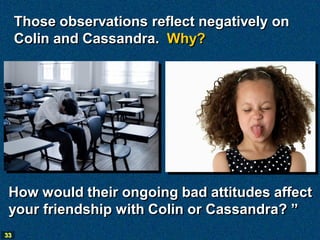
  • 154.
    With the properplanning and a positive attitude, you will find that _______ comes your way and that it is not a random, mysterious thing after all. A. luck B. happiness C. success D. wealth 154
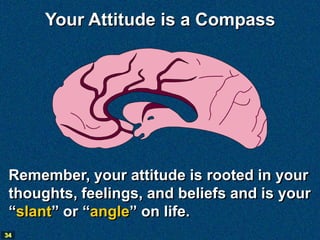
  • 155.
    Do you wantto hang around “I’m no good at with people anything,” or “I never get a break,” or “I don’t feel who are saying like doing anything?” things like: That kind of thinking is not only depressing: It’s contagious. 155
  • 156.
    Contagious Tending to spread from person to person 156
  • 157.
    NJROTC helps youbecome a winner! To be a winner you need to think like a winner, and winning starts with taking 157 some concrete steps toward your goal.
  • 158.
    Defense Mechanisms The first trick to developing a positive attitude is to accept that you won’t always succeed at everything you do. 158
  • 159.
    The second trickis to realize that trial and error provide a wonderful opportunity to keep improving. 159
  • 160.
    True or False:Being around people who whine and complain will most likely make you feel like a winner. 160
  • 161.
    True or False:Being around people who whine and complain will most likely make you feel like a winner. False 161
  • 162.
    In the businessworld, professionals set goals for themselves. Salespeople are often rewarded when they reach their sales targets, but failing to meet a goal—in business or anywhere else—doesn’t mean that you are a failure. 162
  • 163.
    If a baseball player doesn’t make every hit, or a lawyer loses a case, we don’t label or a doctor them failures. can’t cure every illness, 163
  • 164.
    People talk aboutthe “practice” of law and medicine because those professionals are constantly improving their art. 164
  • 165.
    Architect Pilot Of course, some professions have a zero tolerance for failure—and it’s a good thing they do. You don’t want them to make any big mistakes. But even pilots are not always on schedule, and architects do not win every contract. 165
  • 166.
    Architect Pilot Keep in mind everyone is entitled to follow a learning curve—the time necessary to get better at a task or to reach a goal—as long as the time is within reason for the given task. 166
  • 167.
    What is alearning curve? A. Chart that managers use to plot progress toward a goal B. Time needed to perfect a task or reach a goal C. Checkpoints for new employees during their probationary period D. Graph that documents how the quality of an employee’s work reaches a peak and then declines 167 over time
  • 168.
    What is alearning curve? A. Chart that managers use to plot progress toward a goal B. Time needed to perfect a task or reach a goal C. Checkpoints for new employees during their probationary period D. Graph that documents how the quality of an employee’s work reaches a peak and then declines 168 over time
  • 169.
    Why do somepeople handle their mistakes well, and even learn from them, while others don’t? The difference often lies in a person’s defense mechanisms. 169
  • 170.
    Defense mechanisms Behaviors people use to deal with anxiety, stress, or pressure 170
  • 171.
    Everyone has anxieties,and defense mechanisms provide a way to deal with them, but if you’re not careful, defense mechanisms can turn into excuses. 171
  • 172.
    USS San Francisco SSN-711 People use defense mechanisms without realizing it to try and convince others and themselves that someone else is to blame for a mistake, or that a controllable situation was entirely outside of their ability to handle. 172
  • 173.
    Defense mechanisms are ways of protecting your self- confidence and pride when you are feeling inadequate or ashamed. 173
  • 174.
    You probably don’trespect the athlete, or singer who constantly makes excuses for his or her shortfalls. 174
  • 175.
    The use ofdefense mechanisms is not a bad thing as long as you take the steps to correct the problem. 175
  • 176.
    The danger of defense mechanisms is failing to take responsibility for your actions or inactions. 176
  • 177.
    This is thehallmark of an immature personality and of someone who still has some growing up to do, no matter what his or her age. 177
  • 178.
    What are peopletrying to protect when they use defense mechanisms? A. Their pride and self-confidence B. Their inabilities and inadequacies C. The feelings of their families, friends, and co-workers D. The identity of the other people responsible for the situation or mistake 178
  • 179.
    What are peopletrying to protect when they use defense mechanisms? A. Their pride and self-confidence B. Their inabilities and inadequacies C. The feelings of their families, friends, and co-workers D. The identity of the other people responsible for the situation or mistake 179
  • 180.
    What is thedanger of constantly using defense mechanisms? A. People find themselves being given more and more responsibility. B. People begin to see themselves as too perfect and incapable of error. C. People keep those around them from seeing the situation clearly enough to help improve it. D. People fail to take responsibility for 180 their actions and remain immature.
  • 181.
    What is thedanger of constantly using defense mechanisms? A. People find themselves being given more and more responsibility. B. People begin to see themselves as too perfect and incapable of error. C. People keep those around them from seeing the situation clearly enough to help improve it. D. People fail to take responsibility for 181 their actions and remain immature.
  • 182.
    Psychologists have identified and studied a number of defense mechanisms people use when they feel: • Anxiety • Stress • Pressure. 182
  • 183.
    How Defense MechanismsAffect Relationships Consider the situation between Jack and Christine. 183
  • 184.
    Jack and Christinehave been dating steadily for about a year, but they have a problem: Jack gets jealous any time 184 Christine even talks to another boy.
  • 185.
    He suspects she’snot really happy in their relationship and watches her every move. Christine keeps telling Jack that he’s imagining things. 185
  • 186.
    If he’s notcareful, Jack might find himself using one or more of the following defense mechanisms instead of addressing his real 186 problem.
  • 187.
    • Displacement—transferring afeeling about a person or an object to another, less threatening object Example: Jack feels jealous anger toward Christine, so he is rude to her little sister. 187
  • 188.
    • Repression—pushing disturbingthoughts, wishes, or experiences from one’s conscious awareness while the feeling continues to operate on an unconscious level Example: Jack tells Christine that everything is OK and that he doesn’t want to talk about his feelings, but he still seems angry with her. 188
  • 189.
    • Rationalization—concealing thetrue motivations for one’s thoughts, actions, or feelings by offering reassuring, but incorrect, explanations Example: Jack assures Christine that the problem isn’t with her; he’s just going through a tough time at his after-school job 189 and feels frustrated about it.
  • 190.
    • Projection—falsely attributingto others your own unacceptable feelings, impulses, or thoughts Example: Jack tells everyone that Christine is upset with him because he spends time shooting pool with friends. 190
  • 191.
    • Acting out—usingactions, rather than words, to express the emotional conflict Example: Jack uses a bar of soap to draw graffiti all over Christine’s car. 191
  • 192.
    • Denial—refusing toacknowledge some painful aspect of external reality or one’s own experience that would be apparent to others Example: Jack doesn’t realize that he has a problem trusting other people. For example, he forgets that he broke up with his previous girlfriend, Wanda, because he was jealous of her behavior, even though his friends told him repeatedly that Wanda really liked him and that she was not a flirt. 192
  • 193.
    What term isused to refer to the transference of a feeling about a person or an object to another, less threatening object? A. Repression B. Rationalization C. Displacement D. Projection 193
  • 194.
    What term isused to refer to the transference of a feeling about a person or an object to another, less threatening object? A. Repression B. Rationalization C. Displacement D. Projection 194
  • 195.
    If someone refusesto recognize some painful aspect of reality or his/her own experience that other people would clearly see, he/she is _______. A. acting out B. in repression C. rationalizing D. in denial 195
  • 196.
    If someone refusesto recognize some painful aspect of reality or his/her own experience that other people would clearly see, he/she is _______. A. acting out B. in repression C. rationalizing D. in denial 196
  • 197.
    How many of these defense mechanisms do you recognize? Have you ever used any of them yourself? 197
  • 198.
    Because defense mechanismscan be used unconsciously, people sometimes use them without even knowing it. 198
  • 199.
    Before things canget better for Jack and Christine, Jack must realize that his attitude needs to improve. 199
  • 200.
    Mature people don’tfall back on defense mechanisms—mainly because they don’t need them. 200
  • 201.
    You will not always be successful. Many times, you simply have to “grin and bear it,” but growing up and developing a positive, productive attitude requires a willingness to keep working to solve an issue rather than dodge it. 201
  • 202.
    Nobody comes intothis world with a guaranteed perfect life, but the attitude you develop once you get here is under your control. 202
  • 203.
    A positive attitude can make it easier to handle life’s troubles. 203
  • 204.
    The power ofpositive thinking! “How you think about a problem is more important than the problem itself—so always think positively.” Norman Vincent Peale 204
  • 205.
    How do maturepeople deal with their problems? A. They use defense mechanisms most of the time like anybody else. B. They confront their problems in an attempt to solve them. C. They wait them out, knowing that the passage of time will help them see solutions more clearly. D. They do not fear addressing problems because they know they will always be 205 successful.
  • 206.
    How do maturepeople deal with their problems? A. They use defense mechanisms most of the time like anybody else. B. They confront their problems in an attempt to solve them. C. They wait them out, knowing that the passage of time will help them see solutions more clearly. D. They do not fear addressing problems because they know they will always be 206 successful.
  • 207.
    People with positive attitudes usually have other personality traits that help them meet life’s: • Challenges • Frustrations • Disappointments. 207
  • 208.
    These people cancall into action the following personality traits to solve problems and to succeed: • Integrity • Credibility • Humility • Patience • Respect • Appreciation • Focus on task completion and on people 208
  • 209.
    Strategies for ExpressingEmotions Grief Joy Love Specific feelings you may experience 209
  • 210.
    Strategies for ExpressingEmotions Anger Disgust Fear Specific feelings you may experience 210
  • 211.
    People refer to a more general kind of feeling as a “mood.” We all experience people who are in a good “mood” or bad “mood.” 211
  • 212.
    “Moods” are atemporary state of mind or feeling a general feeling of emotion. 212
  • 213.
    Babies come intothe world with the two most basic emotions: Delight Distress 213
  • 214.
    As you growolder, emotions become a very real part of you. 214
  • 215.
    Controlling emotions is a challenge to everyone in a leadership position. 215
  • 216.
    Emotions need tobe expressed, especially very strong emotions. 216
  • 217.
    You may feellike “telling off” someone or even physically striking the person, but your social conditioning tells you that this is not acceptable behavior. 217
  • 218.
    Constructive methods ofexpressing strong emotions include: Talking it out Positive thoughts Physical activity 218 Sense of humor
  • 219.
    Spontaneous feelings thatpeople have are called _______. A. moods B. attitudes C. emotions D. outlooks 219
  • 220.
    Spontaneous feelings thatpeople have are called _______. A. moods B. attitudes C. emotions D. outlooks 220
  • 221.
    Physical Activity Emotions are a very real part of you! Intense Emotional Buildup 221
  • 222.
    Some emotional outlets include: • Sports activity 222
  • 223.
  • 224.
    • Cleaning ahouse 224
  • 225.
  • 226.
  • 227.
    • Hunting orfishing 227
  • 228.
  • 229.
  • 230.
  • 231.
    Which of theseis NOT a recommended physical activity to help deal with emotions constructively? A. Washing the car B. Mowing the lawn C. Playing video games D. Cleaning house 231
  • 232.
    Which of theseis NOT a recommended physical activity to help deal with emotions constructively? A. Washing the car B. Mowing the lawn C. Playing video games D. Cleaning house 232
  • 233.
    Trusted friend Teacher Talking it out Counselor Parent 233
  • 234.
    Trusted friend Teacher These people can help you see alternatives and understand your feelings. Counselor Parent 234
  • 235.
    Sense of Humor Keeping your sense of humor is a big asset in constructively expressing emotions. 235
  • 236.
    Being able tolaugh at yourself and to laugh with others is a rare combination. 236
  • 237.
    The jokester triesto build up his or her self-image in an attempt to feel superior at someone else’s expense. 237
  • 238.
    A constructive sense of humor is not: • Cutting • Sarcastic • Hostile. 238
  • 239.
    People using humorconstructively focus the humor on _______, and it is not hostile, cutting, or sarcastic. A. their emotion B. people close to them C. strangers D. themselves 239
  • 240.
    People using humorconstructively focus the humor on _______, and it is not hostile, cutting, or sarcastic. A. their emotion B. people close to them C. strangers D. themselves 240
  • 241.
    Positive Thoughts and Actions The power of “positive thinking!” 241
  • 242.
    Positive attitudes beginwith: • A healthy self-image 242
  • 243.
    • Acknowledgement ratherthan denial of problems 243
  • 244.
    • A consciouseffort to build habits that will contribute to a positive 244 personal growth.
  • 245.
    Which of thefollowing is NOT part of the process of establishing a positive attitude? A. Facing rather than ignoring problems B. Repeating to yourself and your friends that you are going to become a positive thinker C. Making a conscious effort to build habits for personal growth D. Trying to keep a healthy self-image 245
  • 246.
    Which of thefollowing is NOT part of the process of establishing a positive attitude? A. Facing rather than ignoring problems B. Repeating to yourself and your friends that you are going to become a positive thinker C. Making a conscious effort to build habits for personal growth D. Trying to keep a healthy self-image 246
  • 247.
    Conclusion Anger Disgust Fear Your success as a leader often depends on attitudes—and you can control your attitude. 247
  • 248.
    Will your attitude be positive or negative? The choice is yours. 248
  • 249.
    Family member Employee A positive attitude will make you a happier and more successful: 249 Student Citizen
  • 250.
    CONCLUSION Peopleare attracted to and will follow positive thinkers who can solve problems for themselves and others. 250
  • 251.
    A positive attitude can be the leader’s key to success. 251
  • 252.
    What term refersto something that can be but has not yet been developed? A. Maturity B. Affiliation C. Perspective D. Potential 252
  • 253.
    What term refersto something that can be but has not yet been developed? A. Maturity B. Affiliation C. Perspective D. Potential 253
  • 254.
    What term isused to refer to the state of being fully grown or developed? A. Maturity B. Potential C. Affiliation D. Perspective 254
  • 255.
    What term isused to refer to the state of being fully grown or developed? A. Maturity B. Potential C. Affiliation D. Perspective 255
  • 256.
    What term isused to refer to what a person is inside as well as what he/she shows to others, and is comprised of such things as actions, opinions, and beliefs? A. Affiliation B. Personality C. Perspective D. Potential 256
  • 257.
    What term isused to refer to what a person is inside as well as what he/she shows to others, and is comprised of such things as actions, opinions, and beliefs? A. Affiliation B. Personality C. Perspective D. Potential 257
  • 258.
    A person’s _______is rooted in his/her thoughts, feelings, and beliefs, and largely determines how a person responds to a particular situation. A. experience B. personality C. attitude D. behavior 258
  • 259.
    A person’s _______is rooted in his/her thoughts, feelings, and beliefs, and largely determines how a person responds to a particular situation. A. experience B. personality C. attitude D. behavior 259
  • 260.
    Someone’s way ofseeing the world is his/her _______. A. personality B. potential C. perspective D. affiliation 260
  • 261.
    Someone’s way ofseeing the world is his/her _______. A. personality B. potential C. perspective D. affiliation 261
  • 262.
    A human being’snatural desire to feel like he/she is part of a group is known as _______. A. a defense mechanism B. gregariousness C. herd mentality D. affiliation need 262
  • 263.
    A human being’snatural desire to feel like he/she is part of a group is known as _______. A. a defense mechanism B. gregariousness C. herd mentality D. affiliation need 263
  • 264.
    What term isused to refer to behaviors that people use to deal with anxieties and stress? A. Defense mechanisms B. Affiliation needs C. Displacements D. Projections 264
  • 265.
    What term isused to refer to behaviors that people use to deal with anxieties and stress? A. Defense mechanisms B. Affiliation needs C. Displacements D. Projections 265
  • 266.
    What term isused to refer to taking out impulses on or transferring feelings about a person or thing to a less threatening, more acceptable object? A. Rationalization B. Projection C. Displacement D. Repression 266
  • 267.
    What term isused to refer to taking out impulses on or transferring feelings about a person or thing to a less threatening, more acceptable object? A. Rationalization B. Projection C. Displacement D. Repression 267
  • 268.
    What term isused to refer to a refusal to acknowledge the existence of a problem or a painful reality? A. Repression B. Acting out C. Displacement D. Denial 268
  • 269.
    What term isused to refer to a refusal to acknowledge the existence of a problem or a painful reality? A. Repression B. Acting out C. Displacement D. Denial 269
  • 270.
    A defense mechanismin which someone pushes disturbing thoughts from his/her conscious mind while the feelings continue at the subconscious level is known as _______. A. denial B. repression C. displacement D. rationalization 270
  • 271.
    A defense mechanismin which someone pushes disturbing thoughts from his/her conscious mind while the feelings continue at the subconscious level is known as _______. A. denial B. repression C. displacement D. rationalization 271
  • 272.
    What term isused to refer to the concealing of true motivations for one’s thoughts or actions by explaining them in a more reassuring way? A. Rationalization B. Displacement C. Repression D. Denial 272
  • 273.
    What term isused to refer to the concealing of true motivations for one’s thoughts or actions by explaining them in a more reassuring way? A. Rationalization B. Displacement C. Repression D. Denial 273
  • 274.
    What term isused to refer to falsely attributing one’s own unacceptable feelings or impulses to another? A. Displacement B. Denial C. Projection D. Rationalization 274
  • 275.
    What term isused to refer to falsely attributing one’s own unacceptable feelings or impulses to another? A. Displacement B. Denial C. Projection D. Rationalization 275
  • 276.
    While emotions are spontaneous feelings, _______ are a more a temporary state of mind or general feeling of some emotion. A. personalities B. affiliations C. perspectives D. moods 276
  • 277.
    While emotions are spontaneous feelings, _______ are a more a temporary state of mind or general feeling of some emotion. A. personalities B. affiliations C. perspectives D. moods 277
  • 278.
    Because expressing strongemotions is important, people should deal with them in constructive ways, such as having a sense of humor, engaging in physical activity, and _______. A. spending a lot of time alone thinking about the emotions B. releasing the pent-up emotions by “telling off” someone C. talking with someone they trust to “get it off” their chest D. sleeping and resting more than usual 278
  • 279.
    Because expressing strongemotions is important, people should deal with them in constructive ways, such as having a sense of humor, engaging in physical activity, and _______. A. spending a lot of time alone thinking about the emotions B. releasing the pent-up emotions by “telling off” someone C. talking with someone they trust to “get it off” their chest D. sleeping and resting more than usual 279
  • 280.
    What was thetheme of Thomas Anthony Harris’ 1969 book I’m OK, You’re OK? A. Each person has a distinct personality. B. People should be accepted for who they are. C. All people are inherently good. D. People can change their 280 attitude for the better.
  • 281.
    What was thetheme of Thomas Anthony Harris’ 1969 book I’m OK, You’re OK? A. Each person has a distinct personality. B. People should be accepted for who they are. C. All people are inherently good. D. People can change their 281 attitude for the better.
  • 282.
    According to ThomasAnthony Harris’ 1969 book, which of these attitudes reflects the approval both of oneself and of others that a healthy, well- adjusted person feels? A. I’m not OK, you’re OK. B. I’m OK, you’re not OK. C. I’m OK, you’re OK. D. I’m not OK, you’re not OK. 282
  • 283.
    According to ThomasAnthony Harris’ 1969 book, which of these attitudes reflects the approval both of oneself and of others that a healthy, well- adjusted person feels? A. I’m not OK, you’re OK. B. I’m OK, you’re not OK. C. I’m OK, you’re OK. D. I’m not OK, you’re not OK. 283
  • 284.
    Which of thesestatements about perspectives is accurate? A. People’s attitudes and personalities are formed separately from their perspectives. B. People want to explore the purpose behind their perspectives as they grow older. C. By the teenage years, people’s perspectives are fully formed with little or no change to be expected. D. Perspectives grow narrower over time, much like climbing down from a 284 mountain.
  • 285.
    Which of thesestatements about perspectives is accurate? A. People’s attitudes and personalities are formed separately from their perspectives. B. People want to explore the purpose behind their perspectives as they grow older. C. By the teenage years, people’s perspectives are fully formed with little or no change to be expected. D. Perspectives grow narrower over time, much like climbing down from a 285 mountain.
  • 286.
    When young peoplemust decide between going along with the group and behaving in accordance with their values, their _______ are tested. A. behavior and belonging in a group B. parents’ influences and lessons C. personality and attitude D. self-knowledge and perspective 286
  • 287.
    When young peoplemust decide between going along with the group and behaving in accordance with their values, their _______ are tested. A. behavior and belonging in a group B. parents’ influences and lessons C. personality and attitude D. self-knowledge and perspective 287
  • 288.
    Which of thesestatements about desire is NOT accurate? A. The mistakes people make in dealing with desires fortunately always have only short-term effects. B. Desires often are sources of psychological and emotional motivation. C. In the process of fulfilling desires, people often make mistakes and poor choices. D. Dealing wisely with desires requires a perspective that allows people to see things as they really are. 288
  • 289.
    Which of thesestatements about desire is NOT accurate? A. The mistakes people make in dealing with desires fortunately always have only short-term effects. B. Desires often are sources of psychological and emotional motivation. C. In the process of fulfilling desires, people often make mistakes and poor choices. D. Dealing wisely with desires requires a perspective that allows people to see things as they really are. 289
  • 290.
    Desires are thingsyou want either for yourself or those you care for, while beliefs are strong and deeply held _______ that shape your thinking. A. emotions B. values C. ideas D. perceptions 290
  • 291.
    Desires are thingsyou want either for yourself or those you care for, while beliefs are strong and deeply held _______ that shape your thinking. A. emotions B. values C. ideas D. perceptions 291
  • 292.
    To learn froma mistake, a healthy, well-adjusted person will adjust his/her behavior and _______. A. attribute it to chance and bad luck B. determine not to repeat it C. hope it will not happen again D. pinpoint who should share the blame 292
  • 293.
    To learn froma mistake, a healthy, well-adjusted person will adjust his/her behavior and _______. A. attribute it to chance and bad luck B. determine not to repeat it C. hope it will not happen again D. pinpoint who should share the blame 293
  • 294.
    Actions reveal aperson’s _______ and cannot be separated from them. A. desires B. goals C. values D. attitudes 294
  • 295.
    Actions reveal aperson’s _______ and cannot be separated from them. A. desires B. goals C. values D. attitudes 295
  • 296.
    With proper planningand a positive attitude, _______ will come your way, as in Thomas Jefferson’s statement, the harder he worked, the more of it he had. A. success B. wealth C. luck D. happiness 296
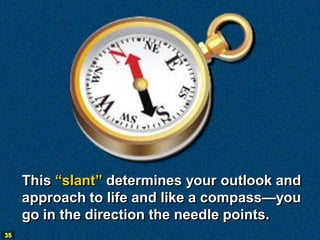
  • 297.
    With proper planningand a positive attitude, _______ will come your way, as in Thomas Jefferson’s statement, the harder he worked, the more of it he had. A. success B. wealth C. luck D. happiness 297
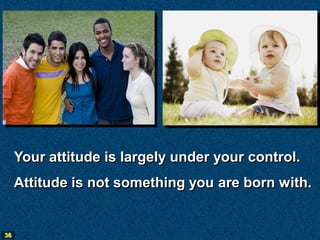
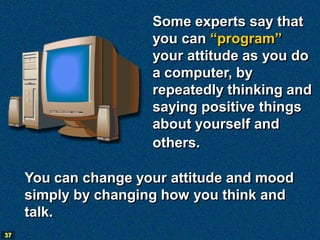
  • 298.
    What is alearning curve? A. Time needed to perfect a task or reach a goal B. Graph showing how the quality of an employee’s work reaches a peak and then declines over time C. Checkpoints for new employees during their probationary period D. Chart that managers use to plot progress toward a goal 298
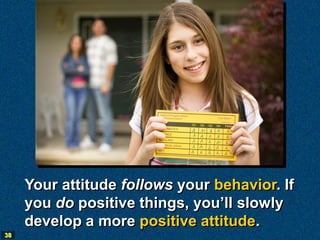
  • 299.
    What is alearning curve? A. Time needed to perfect a task or reach a goal B. Graph showing how the quality of an employee’s work reaches a peak and then declines over time C. Checkpoints for new employees during their probationary period D. Chart that managers use to plot progress toward a goal 299
  • 300.
    What is thegreatest danger of the constant use of defense mechanisms? A. People begin to see themselves as too perfect and incapable of error. B. People find themselves being given more and more responsibility and are not able to handle it. C. People fail to take responsibility for their actions and remain immature. D. People prevent co-workers and friends from seeing a situation clearly enough to improve it. 300
  • 301.
    What is thegreatest danger of the constant use of defense mechanisms? A. People begin to see themselves as too perfect and incapable of error. B. People find themselves being given more and more responsibility and are not able to handle it. C. People fail to take responsibility for their actions and remain immature. D. People prevent co-workers and friends from seeing a situation clearly enough to improve it. 301
  • 302.
    In support ofthe power of positive thinking, Norman Vincent Peale wrote, “How you _______ is more important than the problem itself.” A. face a problem B. deal with a problem C. solve a problem D. think about a problem 302
  • 303.
    In support ofthe power of positive thinking, Norman Vincent Peale wrote, “How you _______ is more important than the problem itself.” A. face a problem B. deal with a problem C. solve a problem D. think about a problem 303
  • 304.
    The way thatpeople _______ their experiences is very influential on their lives and their ability to lead. A. interpret B. remember C. show D. discuss 304
  • 305.
    The way thatpeople _______ their experiences is very influential on their lives and their ability to lead. A. interpret B. remember C. show D. discuss 305
  • 306.
    In the processof maturing, a person develops a _______ and then uses it to meet life’s challenges. A. strong will B. positive attitude C. fulfilling career D. life goal 306
  • 307.
    In the processof maturing, a person develops a _______ and then uses it to meet life’s challenges. A. strong will B. positive attitude C. fulfilling career D. life goal 307
  • 308.
    What happens toa person’s decision- making skills as he/she matures? A. They improve with the growing ability to interpret events and use experiences. B. They continue to be inconsistent as difficulties arise throughout life. C. They reach a plateau where making the right decision becomes almost automatic. D. They slowly deteriorate as life becomes inevitably more 308 complicated.
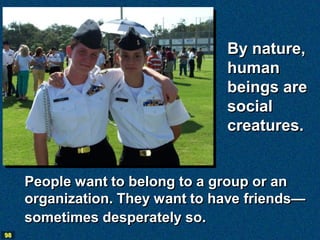
  • 309.
    What happens toa person’s decision- making skills as he/she matures? A. They improve with the growing ability to interpret events and use experiences. B. They continue to be inconsistent as difficulties arise throughout life. C. They reach a plateau where making the right decision becomes almost automatic. D. They slowly deteriorate as life becomes inevitably more 309 complicated.
  • 310.
    Which one ofthese behaviors is NOT considered a method of changing an attitude? A. Thinking positive things about yourself B. Saying positive things about others C. Wishing positive things would happen D. Doing positive things 310
  • 311.
    Which one ofthese behaviors is NOT considered a method of changing an attitude? A. Thinking positive things about yourself B. Saying positive things about others C. Wishing positive things would happen D. Doing positive things 311