Emotions
And
Moods
IMAGINE LIFE WITHOUT
• Happiness
• Fear
• Sadness
• Surprise
• Disgust
WHAT ARE EMOTIONS?
What is Emotion?
Origin- Latin word
emovere = move out, remove, agitate
- Any strong kind of feeling is Emotion
- Internal conscious states that we infer in
ourselves and others.
 Happy
 Sad
 Angry
 Frightened
 Sneaky
 Surprised
 Shy
 Upset
 Cheeky
 Sleepy
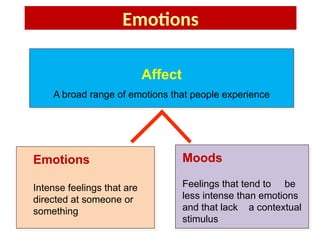
Moods
Feelings that tend to be
less intense than emotions
and that lack a contextual
stimulus
Emotions
Intense feelings that are
directed at someone or
something
Affect
A broad range of emotions that people experience
Emotions
EMOTIONS INCLUDE THREE COMPONENTS
• Conscious experience (feelings)
• Expressions which can be seen by others
• Actions of the body ('physiological arousal’)
Types of Emotions
Dimensions of Emotion
• VARIETY OF EMOTIONS:
– Positive Emotions
– Negative Emotions
Positive Emotion
• Positive emotions that lead one to feel good
about one’s self will lead to an emotionally
happy and satisfied result.
Positive emotions are-
• Hopeful
• Confident
• Peaceful
Negative Emotion
• Negative emotions sap your energy and
undermine your effectiveness. In the negative
emotional state, you find the lack of desire to
do anything.
Emotional Labor
• Employees can display organizationally-desired
emotions by acting out the emotion.
• emotional labor A situation in which an
employee expresses organizationally desired
emotions during interpersonal transactions
at work.
EMOTIONAL DISSONANCE
• Inconsistencies between the emotions people feel
and the emotions they project.
• The true challenge arises when employees have to
project one emotion while feeling another.
• This disparity is emotional dissonance, and it can
take a heavy toll. Bottled-up feelings of frustration,
anger, and resentment can eventually lead to
emotional exhaustion and burnout
FELT EMOTIONS VS DISPLAYED EMOTIONS
Emotional labor creates dilemmas for employees.
There are people with whom you have to work that you just plain
don’t like.
• Felt emotions - are an individual’s actual emotions
• Displayed emotions - are those that are organizationally- required
and considered appropriate
• Such acting can take two forms
– Surface acting
• involves "painting on" affective displays, or faking;
• Surface acting involves an employee's presenting emotions on
his or her "surface" without actually feeling them.
• The employee in this case puts on a facade as if the
emotions are felt, like a "personal".
– Deep acting
• wherein they modify their inner feelings to match the
emotion expressions the organization requires.
Facial Expressions Convey Emotions
Factors Affecting Emotions
•PERSONALITY
•CULTUR
E
•WEATHE
R
•GENDER
•ENVIRONMENTAL
•MARITAL RELATION
STRESS
AGE
GENDER
ENVIROMENTAL
•ORGANIZATIONAL
•SOCIAL
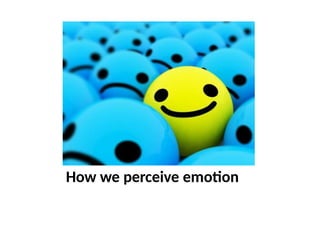
How we perceive emotion
•Body posture
•Speech Patterns
•Gestures
Emotional Intelligence
• Emotional intelligence (EI) is the ability to
identify, assess, and control the emotions of
oneself, of others, and of groups.
Four Components of Emotional
Intelligence
• There are four fundamental aspects of
EI
– Self-Awareness,
– Self-Management,
– Social Awareness,
– Relationship Management.
Components of EI
• Self-awareness – The ability to recognize your
own emotions and how they affect your
thoughts and behavior, know your strengths
and weaknesses, and have self-confidence.
• Self-management – The ability to control
impulsive feelings and behaviors, manage
your emotions in healthy ways, take
initiative, follow through on
commitments, and adapt to changing
circumstances.
Components of EI
• Social awareness – The ability to understand the
emotions, needs, and concerns of other
people, pick up on emotional cues, feel
comfortable socially, and recognize the power
dynamics in a group or organization.
• Relationship management – The ability to
develop and maintain good
relationships, communicate clearly, inspire and
influence others, work well in a team, and
manage conflict.
Situation 2
Situation 3
Emotional Intelligence
EMOTIONAL SKILL MANAGER SHOULD LEARN
 Emotional competency
 Emotional maturity
 Emotional sensitivity
Emotions in the work place result in a series of problems
that managers find themselves faced with in their workplace.
Personal issues:-
Employees react to one another because of personal
traits that they either like or dislike in their peers and this can
cause some serious problems in the smooth execution of work.
Workplace Antics:-
Bullying or ganging up in office environments are as real
as the grapevine.
Management must be aware that there are peer pressures
and groups that form based on interests and other
circumstances.
Employee Orientation:-
New employees can face a stiff battle to be accepted by
existing employees and this can lead to complications since
the new recruit has been taken on to execute a specific role
within the business and the longer the candidate takes to be
accepted, the greater the losses felt by the company and the
more the inefficiency.
Gender harassment:-
particularly towards women is a common occurrence in the
workplace and regulations govern any such harassment very
stringently. However, a lot of cases don't get reported simply
because the subjected women are ambiguous about what
defines harassment.
Stress:-
Stress is one of the more discussed affects that influence
the emotional well being of individuals in every sphere of their
lives.
Advantages of EI
• Greater productivity
• Improved job performance
• Fewer grievances
• Better conflict resolution
• Increased creativity and innovation
• Better teamwork
• High motivation
• Better employee retention
What have we learned?
Thank U…….

Emotions and Moods.pptx, complete topic

  • 1.
  • 2.
    IMAGINE LIFE WITHOUT •Happiness • Fear • Sadness • Surprise • Disgust
  • 3.
  • 4.
    What is Emotion? Origin-Latin word emovere = move out, remove, agitate - Any strong kind of feeling is Emotion - Internal conscious states that we infer in ourselves and others.
  • 5.
     Happy  Sad Angry  Frightened  Sneaky  Surprised  Shy  Upset  Cheeky  Sleepy
  • 7.
    Moods Feelings that tendto be less intense than emotions and that lack a contextual stimulus Emotions Intense feelings that are directed at someone or something Affect A broad range of emotions that people experience Emotions
  • 8.
    EMOTIONS INCLUDE THREECOMPONENTS • Conscious experience (feelings) • Expressions which can be seen by others • Actions of the body ('physiological arousal’)
  • 9.
  • 10.
    Dimensions of Emotion •VARIETY OF EMOTIONS: – Positive Emotions – Negative Emotions
  • 11.
    Positive Emotion • Positiveemotions that lead one to feel good about one’s self will lead to an emotionally happy and satisfied result. Positive emotions are- • Hopeful • Confident • Peaceful
  • 12.
    Negative Emotion • Negativeemotions sap your energy and undermine your effectiveness. In the negative emotional state, you find the lack of desire to do anything.
  • 13.
    Emotional Labor • Employeescan display organizationally-desired emotions by acting out the emotion. • emotional labor A situation in which an employee expresses organizationally desired emotions during interpersonal transactions at work.
  • 14.
    EMOTIONAL DISSONANCE • Inconsistenciesbetween the emotions people feel and the emotions they project. • The true challenge arises when employees have to project one emotion while feeling another. • This disparity is emotional dissonance, and it can take a heavy toll. Bottled-up feelings of frustration, anger, and resentment can eventually lead to emotional exhaustion and burnout
  • 15.
    FELT EMOTIONS VSDISPLAYED EMOTIONS Emotional labor creates dilemmas for employees. There are people with whom you have to work that you just plain don’t like. • Felt emotions - are an individual’s actual emotions • Displayed emotions - are those that are organizationally- required and considered appropriate
  • 16.
    • Such actingcan take two forms – Surface acting • involves "painting on" affective displays, or faking; • Surface acting involves an employee's presenting emotions on his or her "surface" without actually feeling them. • The employee in this case puts on a facade as if the emotions are felt, like a "personal". – Deep acting • wherein they modify their inner feelings to match the emotion expressions the organization requires.
  • 17.
  • 18.
  • 19.
  • 20.
  • 21.
  • 22.
  • 23.
  • 24.
  • 25.
  • 26.
  • 28.
  • 29.
    How we perceiveemotion •Body posture •Speech Patterns •Gestures
  • 30.
    Emotional Intelligence • Emotionalintelligence (EI) is the ability to identify, assess, and control the emotions of oneself, of others, and of groups.
  • 32.
    Four Components ofEmotional Intelligence • There are four fundamental aspects of EI – Self-Awareness, – Self-Management, – Social Awareness, – Relationship Management.
  • 33.
    Components of EI •Self-awareness – The ability to recognize your own emotions and how they affect your thoughts and behavior, know your strengths and weaknesses, and have self-confidence. • Self-management – The ability to control impulsive feelings and behaviors, manage your emotions in healthy ways, take initiative, follow through on commitments, and adapt to changing circumstances.
  • 34.
    Components of EI •Social awareness – The ability to understand the emotions, needs, and concerns of other people, pick up on emotional cues, feel comfortable socially, and recognize the power dynamics in a group or organization. • Relationship management – The ability to develop and maintain good relationships, communicate clearly, inspire and influence others, work well in a team, and manage conflict.
  • 39.
  • 42.
  • 45.
    Emotional Intelligence EMOTIONAL SKILLMANAGER SHOULD LEARN  Emotional competency  Emotional maturity  Emotional sensitivity
  • 51.
    Emotions in thework place result in a series of problems that managers find themselves faced with in their workplace. Personal issues:- Employees react to one another because of personal traits that they either like or dislike in their peers and this can cause some serious problems in the smooth execution of work. Workplace Antics:- Bullying or ganging up in office environments are as real as the grapevine.
  • 52.
    Management must beaware that there are peer pressures and groups that form based on interests and other circumstances. Employee Orientation:- New employees can face a stiff battle to be accepted by existing employees and this can lead to complications since the new recruit has been taken on to execute a specific role within the business and the longer the candidate takes to be accepted, the greater the losses felt by the company and the more the inefficiency.
  • 53.
    Gender harassment:- particularly towardswomen is a common occurrence in the workplace and regulations govern any such harassment very stringently. However, a lot of cases don't get reported simply because the subjected women are ambiguous about what defines harassment. Stress:- Stress is one of the more discussed affects that influence the emotional well being of individuals in every sphere of their lives.
  • 54.
    Advantages of EI •Greater productivity • Improved job performance • Fewer grievances • Better conflict resolution • Increased creativity and innovation • Better teamwork • High motivation • Better employee retention
  • 56.
    What have welearned?
  • 57.