EMOTIONAL LABOR
Bahadir Beadin
EMOTIONAL LABOR
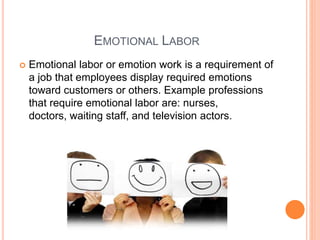
 Emotional labor or emotion work is a requirement of
a job that employees display required emotions
toward customers or others. Example professions
that require emotional labor are: nurses,
doctors, waiting staff, and television actors.
 Although emotional labor
may be helpful to the
organizational bottom-line,
there has been recent work
suggesting that managing
emotions for pay may be
detrimental to the employee.
HOCHSCHILD'S (1983) PERSPECTIVE
 Arlie Hochschild firs coined the term in her 1983
book, ‘The Menaged Heart’. The practice, however,
is ancient. Hochschild pointed out that people
control their emotions in personal adn worklife.
 Hochschild (1983) coined the term emotional labor
to refer to "the management of feeling to create a
publicly observable facial and bodily display" .
 In this perspective, the performance involves
impression management of service employees where
"actors may employ expressive devices" in order to
achieve this goal.
 Hochscbild's (1983) dramaturgical perspective
offered two main ways for actors to manage
emotions: through surface acting, where one
regulates the emotional expressions, and through
deep acting, where one consciously modifies feelings
in order to express the desired emotion.
FEELING RULES
 Each setting, each definition of the situation, will
require different kinds of emotional responses and
thus feeling management.
 Hochschild (1983) calls these scripts for emotions
feeling rules: “Feeling rules are what guide emotion
work by establishing the sense of entitlement or
obligation that governs emotional exchanges”.
These feeling rules are social norms that tell us
what to feel, when to feel, where to feel, how long
to feel, and how strong our emotions can be.
 How do can we know if a feeling rule is operating in
the situation?
 The answer is quite simple: if we are evaluating our
feelings or emotional state, then a feeling rule is
active. Some feeling rules are easy to recognize
because we’ve actually formalized them in some
fashion.
EMPLOYEE EMOTIONAL LABOR STRATEGY
 Research on the ways the two types of strategies
are viewed may offer predictions aboutpotential
links between employee labor strategies and
customer behavior.
 In surface acting, employeesare thought to regulate
their emotions in order to keep their jobs, not to
help the customer ororganization.
 With deep acting, they should be more likely to
make a purchase
Table show us employee acting with two types emotions
 In this study, we examine the influence of an
employee's strategy (deep or surface acting) on the
actualconsumer purchase decision, which leads to
the following two hypotheses:
 Hypothesis 1: Employee deep acting strategy will
be positively related to a customer's purchase
decision.
 Hypothesis 2: Employee surface acting strategy
will be negatively related to a customer's purchase
decision
EMOTIONAL LABOR AND JOB SATISFACTION
 Job satisfaction can be used as a measure of
employee well-being at work (Grandey, 2000).
Numerous studies have examined the relationship
between emotional labor and job satisfaction
(Abraham, 1999; Adelmann, 1995; Cote & Morgan,
2002; Grandey, 2003; Pugliesi, 1999; Seery &
Corrigall, 2009), a relationship originally suggested
by Hochschild herself. Many studies have found a
negative relationship between emotional labor and
job satisfaction. For example, Pugliesi found both
self and other focused emotional labor had a
negative impact on job satisfaction in a large
sample of employees working at a single university.
 When individuals employ emotional labor strategies
resulting in a net gain of resources (e.g., genuine
positive) positive outcomes are likely, while for strategies
resulting in a loss of resources (e.g., suppressing
negative) negative outcomes can occur. Based on
empirical findings and theory, the following hypotheses
were formed:
 H1: Genuine positive expression will be positively
related to job satisfaction; Genuine negative expression
will be negatively related to job satisfaction.
 H2: Faking positive expression will be negatively related
to job satisfaction; Faking negative expression will be
negatively related to job satisfaction.
 H3: Suppressing positive expression will be negatively
related to job satisfaction; Suppressing negative
expression will be negatively related to job satisfaction.
EMOTIONAL LABOR AND AFFECTIVE COMMITMENT
 Organizational commitment is an employee’s
psychological attachment to an organization (Meyer,
Allen, & Smith, 1993). Organizational commitment is
thought to have an affective component that is
logically linked to an individual’s emotional life at
work. They hypothesized surface acting would be
negatively related to affective commitment and that
what they called the “emotional enhancement”
component of emotional labor would be positively
related to affective commitment. While they did not
find a relationship between emotional enhancement
and organizational commitment, they did find a
significant negative relationship between surface
acting and affective commitment.
 Organizations fostering real positive expression from
employees help employees build emotional resources.
This increase in emotional resources is likely to impact
their psychological attachment to their organization,
particularly affective commitment. Consistent with the
findings of Seery and Corigall (2009), Abraham, and the
application of COR, the following hypotheses were
formulated:
 H1: Real positive expression will be directly and indirectly
positively related to affective commitment.
 H2: Job satisfaction will be positively related to affective
commitment.
 H3: Emotional exhaustion will be negatively related to
affective commitment.
EMOTIONAL LABOR IN AMERICAN PROFESSOR
 This study is unique in utilizing a representative sample of
American university and college professors. Results may
provide a baseline estimate of some types of emotional
labor and their effects on professors across the U.S.
 Procedure (Online Survey)
 An online survey of United States College and University
professors was conducted over a 3 month period. To
identify participants, we utilized an online directory of
public and private colleges and universities located in the
U.S. For each state, three private and three public
universities were randomly selected.
Note: GENPOS _ genuine positive expression, GENNEG _ genuine negative expression,
FAKPOS _ faking positive expression, FAKNEG _ faking negative expression, SUPPPOS _
suppressing positive expression, SUPNEG _ suppressing negative expression, EMOEXH _
emotional exhaustion, JOBSAT _ job satisfaction, AFFCOM _ affective commitment
 Participants
Of the 890 who initially agreed to participate, 598 usable
surveys were obtained. Ages ranged from 25 to 82 years old.
The sample consisted of 259 men (43.3%) and 335 women
(56.0%) and the remainder who did not indicate their gender.
 Result
The results show that genuine emotional expression,
particularly positive emotional expression, had the strongest
relationships with outcomes, with the exception of the
relationship between suppressing negative emotional
expression and emotional exhaustion. The findings indicate
that professors who express genuine positive emotions at
work tend to experience less emotional exhaustion, more job
satisfaction, and more affective commitment. Professors
expressing genuine negative emotions at work tend to
experience more emotional exhaustion, decreased job
satisfaction, and less affective commitment.
GENERAL OBSTACLES AND LIMITATIONS
 There are several limitations to the current study,
which also provides opportunities for future research.
The most obvious limitations are the language and
cultural barriers, the focus on mobile phone sales and
the employee-customer interaction, as well as the
preliminary research design. The language and
cultural challenges provide potential limitations both in
the initial translation and underlying assumptions well
as the potential generalizability of the study results.
CONCLUSION
 Emotional labor related to job satisfaction, emotional
exhaustion, and affective commitment for professors.
These results replicate previous findings, which found
significant relationships between emotional labor, job
satisfaction and emotional exhaustion across service-
oriented occupations. In edditionaly, the study expanded
on the prior research by examining the actual
purchasing decision, rather than attitudes, and by
providing a more integrated model that accounted for
both employee emotional labor strategies as well as
customers’ emotional experiences. Finally, consideration
of genuine emotion within the emotional labor construct
may add value in understanding and predicting work
outcomes.
THANK YOU

Emotional Labor

  • 1.
  • 2.
    EMOTIONAL LABOR  Emotionallabor or emotion work is a requirement of a job that employees display required emotions toward customers or others. Example professions that require emotional labor are: nurses, doctors, waiting staff, and television actors.
  • 3.
     Although emotionallabor may be helpful to the organizational bottom-line, there has been recent work suggesting that managing emotions for pay may be detrimental to the employee.
  • 4.
    HOCHSCHILD'S (1983) PERSPECTIVE Arlie Hochschild firs coined the term in her 1983 book, ‘The Menaged Heart’. The practice, however, is ancient. Hochschild pointed out that people control their emotions in personal adn worklife.  Hochschild (1983) coined the term emotional labor to refer to "the management of feeling to create a publicly observable facial and bodily display" .
  • 5.
     In thisperspective, the performance involves impression management of service employees where "actors may employ expressive devices" in order to achieve this goal.  Hochscbild's (1983) dramaturgical perspective offered two main ways for actors to manage emotions: through surface acting, where one regulates the emotional expressions, and through deep acting, where one consciously modifies feelings in order to express the desired emotion.
  • 6.
    FEELING RULES  Eachsetting, each definition of the situation, will require different kinds of emotional responses and thus feeling management.  Hochschild (1983) calls these scripts for emotions feeling rules: “Feeling rules are what guide emotion work by establishing the sense of entitlement or obligation that governs emotional exchanges”. These feeling rules are social norms that tell us what to feel, when to feel, where to feel, how long to feel, and how strong our emotions can be.
  • 7.
     How docan we know if a feeling rule is operating in the situation?  The answer is quite simple: if we are evaluating our feelings or emotional state, then a feeling rule is active. Some feeling rules are easy to recognize because we’ve actually formalized them in some fashion.
  • 8.
    EMPLOYEE EMOTIONAL LABORSTRATEGY  Research on the ways the two types of strategies are viewed may offer predictions aboutpotential links between employee labor strategies and customer behavior.  In surface acting, employeesare thought to regulate their emotions in order to keep their jobs, not to help the customer ororganization.
  • 9.
     With deepacting, they should be more likely to make a purchase Table show us employee acting with two types emotions
  • 10.
     In thisstudy, we examine the influence of an employee's strategy (deep or surface acting) on the actualconsumer purchase decision, which leads to the following two hypotheses:  Hypothesis 1: Employee deep acting strategy will be positively related to a customer's purchase decision.  Hypothesis 2: Employee surface acting strategy will be negatively related to a customer's purchase decision
  • 11.
    EMOTIONAL LABOR ANDJOB SATISFACTION  Job satisfaction can be used as a measure of employee well-being at work (Grandey, 2000). Numerous studies have examined the relationship between emotional labor and job satisfaction (Abraham, 1999; Adelmann, 1995; Cote & Morgan, 2002; Grandey, 2003; Pugliesi, 1999; Seery & Corrigall, 2009), a relationship originally suggested by Hochschild herself. Many studies have found a negative relationship between emotional labor and job satisfaction. For example, Pugliesi found both self and other focused emotional labor had a negative impact on job satisfaction in a large sample of employees working at a single university.
  • 12.
     When individualsemploy emotional labor strategies resulting in a net gain of resources (e.g., genuine positive) positive outcomes are likely, while for strategies resulting in a loss of resources (e.g., suppressing negative) negative outcomes can occur. Based on empirical findings and theory, the following hypotheses were formed:  H1: Genuine positive expression will be positively related to job satisfaction; Genuine negative expression will be negatively related to job satisfaction.  H2: Faking positive expression will be negatively related to job satisfaction; Faking negative expression will be negatively related to job satisfaction.  H3: Suppressing positive expression will be negatively related to job satisfaction; Suppressing negative expression will be negatively related to job satisfaction.
  • 13.
    EMOTIONAL LABOR ANDAFFECTIVE COMMITMENT  Organizational commitment is an employee’s psychological attachment to an organization (Meyer, Allen, & Smith, 1993). Organizational commitment is thought to have an affective component that is logically linked to an individual’s emotional life at work. They hypothesized surface acting would be negatively related to affective commitment and that what they called the “emotional enhancement” component of emotional labor would be positively related to affective commitment. While they did not find a relationship between emotional enhancement and organizational commitment, they did find a significant negative relationship between surface acting and affective commitment.
  • 14.
     Organizations fosteringreal positive expression from employees help employees build emotional resources. This increase in emotional resources is likely to impact their psychological attachment to their organization, particularly affective commitment. Consistent with the findings of Seery and Corigall (2009), Abraham, and the application of COR, the following hypotheses were formulated:  H1: Real positive expression will be directly and indirectly positively related to affective commitment.  H2: Job satisfaction will be positively related to affective commitment.  H3: Emotional exhaustion will be negatively related to affective commitment.
  • 15.
    EMOTIONAL LABOR INAMERICAN PROFESSOR  This study is unique in utilizing a representative sample of American university and college professors. Results may provide a baseline estimate of some types of emotional labor and their effects on professors across the U.S.  Procedure (Online Survey)  An online survey of United States College and University professors was conducted over a 3 month period. To identify participants, we utilized an online directory of public and private colleges and universities located in the U.S. For each state, three private and three public universities were randomly selected.
  • 16.
    Note: GENPOS _genuine positive expression, GENNEG _ genuine negative expression, FAKPOS _ faking positive expression, FAKNEG _ faking negative expression, SUPPPOS _ suppressing positive expression, SUPNEG _ suppressing negative expression, EMOEXH _ emotional exhaustion, JOBSAT _ job satisfaction, AFFCOM _ affective commitment
  • 17.
     Participants Of the890 who initially agreed to participate, 598 usable surveys were obtained. Ages ranged from 25 to 82 years old. The sample consisted of 259 men (43.3%) and 335 women (56.0%) and the remainder who did not indicate their gender.  Result The results show that genuine emotional expression, particularly positive emotional expression, had the strongest relationships with outcomes, with the exception of the relationship between suppressing negative emotional expression and emotional exhaustion. The findings indicate that professors who express genuine positive emotions at work tend to experience less emotional exhaustion, more job satisfaction, and more affective commitment. Professors expressing genuine negative emotions at work tend to experience more emotional exhaustion, decreased job satisfaction, and less affective commitment.
  • 18.
    GENERAL OBSTACLES ANDLIMITATIONS  There are several limitations to the current study, which also provides opportunities for future research. The most obvious limitations are the language and cultural barriers, the focus on mobile phone sales and the employee-customer interaction, as well as the preliminary research design. The language and cultural challenges provide potential limitations both in the initial translation and underlying assumptions well as the potential generalizability of the study results.
  • 19.
    CONCLUSION  Emotional laborrelated to job satisfaction, emotional exhaustion, and affective commitment for professors. These results replicate previous findings, which found significant relationships between emotional labor, job satisfaction and emotional exhaustion across service- oriented occupations. In edditionaly, the study expanded on the prior research by examining the actual purchasing decision, rather than attitudes, and by providing a more integrated model that accounted for both employee emotional labor strategies as well as customers’ emotional experiences. Finally, consideration of genuine emotion within the emotional labor construct may add value in understanding and predicting work outcomes.
  • 20.