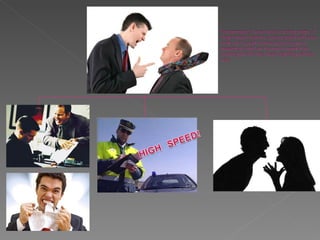
   Emotional intelligence (EI) refers to the
    ability to perceive, control and evaluate
    emotions. Some researchers suggest that
    emotional intelligence can be learned
    and strengthened, while others claim it is
    an inborn characteristic.
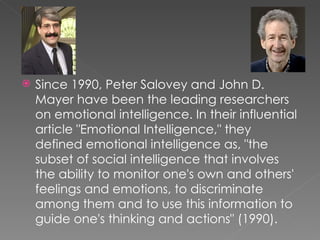
   Since 1990, Peter Salovey and John D.
    Mayer have been the leading researchers
    on emotional intelligence. In their influential
    article "Emotional Intelligence," they
    defined emotional intelligence as, "the
    subset of social intelligence that involves
    the ability to monitor one's own and others'
    feelings and emotions, to discriminate
    among them and to use this information to
    guide one's thinking and actions" (1990).
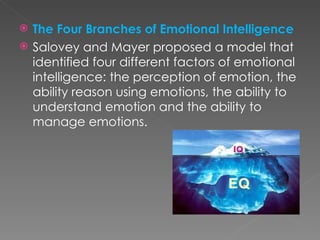
   The Four Branches of Emotional Intelligence
   Salovey and Mayer proposed a model that
    identified four different factors of emotional
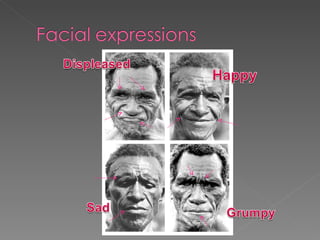
    intelligence: the perception of emotion, the
    ability reason using emotions, the ability to
    understand emotion and the ability to
    manage emotions.
   Reasoning With Emotions: The next step
    involves using emotions to develop thinking
    and cognitive activities. Emotions help
    prioritize what we pay attention and react
    to; we respond emotionally to things that
    catch our attention.
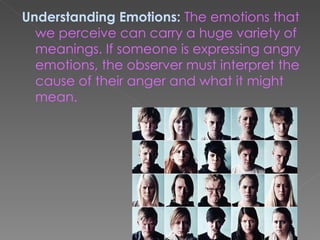
Understanding Emotions: The emotions that
  we perceive can carry a huge variety of
  meanings. If someone is expressing angry
  emotions, the observer must interpret the
  cause of their anger and what it might
  mean.
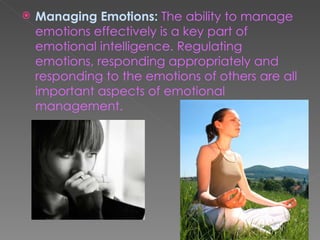
   Managing Emotions: The ability to manage
    emotions effectively is a key part of
    emotional intelligence. Regulating
    emotions, responding appropriately and
    responding to the emotions of others are all
    important aspects of emotional
    management.
   Sometimes there’s people who are rude to you, while you’re being nice. That
    dissapoints you, because you don’t understand their behavior. So, what
    should you do ?

   -You can try to understand him or her, and feel a bit of compasion. In these
    cases you keep being kind to that person, because you know he/she is like
    that, or that he/she has some problems which make him/her act in that way.
   -If you are one of those people who get upset inmediatly, you may not feel
    compasion and feel angry about it. In that case his/her answer could
    provoke a fight between you both, and start a really bad relationship. This
    reaction hasn’t got something positive and you may prompt your rage.

   This situation often appears in our lives, and people usually don’t use their
    emotional inteligence. To use it in this example would mean the first answer;
    to calw down yourself and to perceive the problem of the other person. If
    you don’t use it you’ll deteriorate the relationship between you two, and your
    soul, as in contact with the armony of the happiness.
Emotional intelligence

Emotional intelligence

  • 2.
    Emotional intelligence (EI) refers to the ability to perceive, control and evaluate emotions. Some researchers suggest that emotional intelligence can be learned and strengthened, while others claim it is an inborn characteristic.
  • 3.
    Since 1990, Peter Salovey and John D. Mayer have been the leading researchers on emotional intelligence. In their influential article "Emotional Intelligence," they defined emotional intelligence as, "the subset of social intelligence that involves the ability to monitor one's own and others' feelings and emotions, to discriminate among them and to use this information to guide one's thinking and actions" (1990).
  • 4.
    The Four Branches of Emotional Intelligence  Salovey and Mayer proposed a model that identified four different factors of emotional intelligence: the perception of emotion, the ability reason using emotions, the ability to understand emotion and the ability to manage emotions.
  • 8.
    Reasoning With Emotions: The next step involves using emotions to develop thinking and cognitive activities. Emotions help prioritize what we pay attention and react to; we respond emotionally to things that catch our attention.
  • 10.
    Understanding Emotions: The emotionsthat we perceive can carry a huge variety of meanings. If someone is expressing angry emotions, the observer must interpret the cause of their anger and what it might mean.
  • 12.
    Managing Emotions: The ability to manage emotions effectively is a key part of emotional intelligence. Regulating emotions, responding appropriately and responding to the emotions of others are all important aspects of emotional management.
  • 14.
    Sometimes there’s people who are rude to you, while you’re being nice. That dissapoints you, because you don’t understand their behavior. So, what should you do ?  -You can try to understand him or her, and feel a bit of compasion. In these cases you keep being kind to that person, because you know he/she is like that, or that he/she has some problems which make him/her act in that way.  -If you are one of those people who get upset inmediatly, you may not feel compasion and feel angry about it. In that case his/her answer could provoke a fight between you both, and start a really bad relationship. This reaction hasn’t got something positive and you may prompt your rage.  This situation often appears in our lives, and people usually don’t use their emotional inteligence. To use it in this example would mean the first answer; to calw down yourself and to perceive the problem of the other person. If you don’t use it you’ll deteriorate the relationship between you two, and your soul, as in contact with the armony of the happiness.