Understanding the Emotions of Our Selves and Others
EMOTIONAL INTELEGENCE (EI) is
an ability, skill, or in the case of the EI
model, a self-perceived ability to
identify, assess and control the
emotions of one’s self, of others and of
groups.
Darwin (1900’s)- Darwin placed importance on the
display of emotion on survival and adaptation.
Thorndike and the Testing Movement (1920)-
Thorndike coined the term social intelligence and
theorized that it was an equally important component
of overall IQ. Social Intelligence is “the ability to
understand men and women, boys and girls and to act
wisely in human relations”.
Thorndike and Stern (1937)- Attempted to measure
social intelligence by utilizing the George Washington
Social Intelligence Test which measured an
individual’s judgment in social situations and
relationship problems such as the recognition of a
speaker’s “mental state” and the ability to identify
emotional expression.
Salovey and Mayer (1990)- The Yale colleagues published
the seminal article “Emotional Intelligence” and identified
emotional intelligence as the ability to monitor one’s own
and other’s feelings and emotions, to discriminate among
them, and to use this information to guide one’s thinking
and action. Their model included a cognitive emphasis. It
focused on specific mental aptitudes for recognizing and
marshalling emotions (for example, knowing what
someone is feeling is a mental aptitude, whereas being
outgoing and warm is a behavior). A comprehensive EI
model must include some measure of “thinking about
feeling” rather than just regulating feeling.
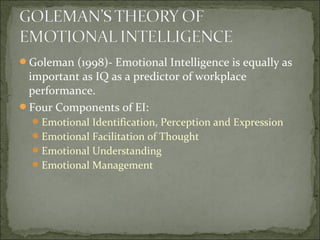
Goleman (1998)- Emotional Intelligence is equally as
important as IQ as a predictor of workplace
performance.
Four Components of EI:
Emotional Identification, Perception and Expression
Emotional Facilitation of Thought
Emotional Understanding
Emotional Management
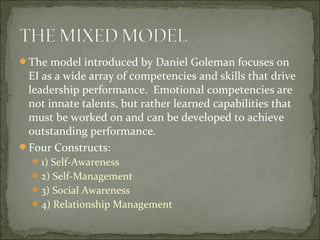
The model introduced by Daniel Goleman focuses on
EI as a wide array of competencies and skills that drive
leadership performance. Emotional competencies are
not innate talents, but rather learned capabilities that
must be worked on and can be developed to achieve
outstanding performance.
Four Constructs:
1) Self-Awareness
2) Self-Management
3) Social Awareness
4) Relationship Management
The ability to recognize your
own emotions, how they affect
your thoughts and behavior,
know your strengths and
weaknesses and have self-
confidence.
The ability to control impulsive
feelings, and behaviors, manage
your emotions in healthy ways,
take initiative, follow through
on commitments and adapt to
changing circumstances.
The ability to understand the
emotions, needs, and concerns of
other people, pick up on emotional
cues, feel comfortable socially and
recognize the power dynamics in a
group or organization.
The ability to develop and
maintain good relationships,
communicate clearly, inspire
and influence others, work well
in a team, and manage conflict.
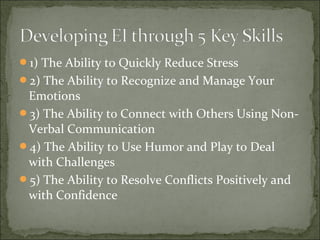
1) The Ability to Quickly Reduce Stress
2) The Ability to Recognize and Manage Your
Emotions
3) The Ability to Connect with Others Using Non-
Verbal Communication
4) The Ability to Use Humor and Play to Deal
with Challenges
5) The Ability to Resolve Conflicts Positively and
with Confidence
The first key skill of emotional intelligence is the
ability to quickly calm yourself down when you’re
feeling overwhelmed. Being able to manage stress in
the moment is the key to resilience. This emotional
intelligence skill helps you stay balanced, focused,
and in control-no matter what challenges you face
Realize When You Are Stressed
Identify Your Stress Response
Discover the Stress Busting Techniques that Work for
You
The second key of Emotional Intelligence is having a
moment-to-moment awareness of your emotions and
how they influence your thoughts and actions.
What kind of relationship do you have with your
emotions?
Do you experience feelings that flow?
Are your emotions accompanied by physical sensations
that you experience?
Do you experience discrete feelings and emotions?
Can you experience intense feelings?
Do you pay attention to your emotions?
We need to be aware of and in control of our non-
verbal cues. We also need to be able to accurately
read and respond to the non-verbal cues that other
people send us. Improving non-verbal
communication involves paying attention to:
Eye Contact
Facial Expression
Tone of Voice
Posture and Gesture
Touch
Timing and Pace
The ability to deal with challenges using humor
and play broadens our emotional intelligence and
helps us to do the following:
Take Hardships in Stride
Smooth Over Differences
Simultaneously Relax and Energize Ourselves
Become More Creative
The ability to manage conflicts in a positive, trust-
building way is the fifth key skill of emotional
intelligence. Successfully resolving differences is
supported by the previous four skills of emotional
intelligence. Once you know how to manage stress,
stay emotionally present and aware, communicate
nonverbally, and use humor and play, you’ll be better
equipped to handle emotionally charged situations
and catch and diffuse many issues before they
escalate.

Emotional intellegence

  • 1.
    Understanding the Emotionsof Our Selves and Others
  • 2.
    EMOTIONAL INTELEGENCE (EI)is an ability, skill, or in the case of the EI model, a self-perceived ability to identify, assess and control the emotions of one’s self, of others and of groups.
  • 3.
    Darwin (1900’s)- Darwinplaced importance on the display of emotion on survival and adaptation. Thorndike and the Testing Movement (1920)- Thorndike coined the term social intelligence and theorized that it was an equally important component of overall IQ. Social Intelligence is “the ability to understand men and women, boys and girls and to act wisely in human relations”.
  • 4.
    Thorndike and Stern(1937)- Attempted to measure social intelligence by utilizing the George Washington Social Intelligence Test which measured an individual’s judgment in social situations and relationship problems such as the recognition of a speaker’s “mental state” and the ability to identify emotional expression.
  • 5.
    Salovey and Mayer(1990)- The Yale colleagues published the seminal article “Emotional Intelligence” and identified emotional intelligence as the ability to monitor one’s own and other’s feelings and emotions, to discriminate among them, and to use this information to guide one’s thinking and action. Their model included a cognitive emphasis. It focused on specific mental aptitudes for recognizing and marshalling emotions (for example, knowing what someone is feeling is a mental aptitude, whereas being outgoing and warm is a behavior). A comprehensive EI model must include some measure of “thinking about feeling” rather than just regulating feeling.
  • 6.
    Goleman (1998)- EmotionalIntelligence is equally as important as IQ as a predictor of workplace performance. Four Components of EI: Emotional Identification, Perception and Expression Emotional Facilitation of Thought Emotional Understanding Emotional Management
  • 7.
    The model introducedby Daniel Goleman focuses on EI as a wide array of competencies and skills that drive leadership performance. Emotional competencies are not innate talents, but rather learned capabilities that must be worked on and can be developed to achieve outstanding performance. Four Constructs: 1) Self-Awareness 2) Self-Management 3) Social Awareness 4) Relationship Management
  • 8.
    The ability torecognize your own emotions, how they affect your thoughts and behavior, know your strengths and weaknesses and have self- confidence.
  • 9.
    The ability tocontrol impulsive feelings, and behaviors, manage your emotions in healthy ways, take initiative, follow through on commitments and adapt to changing circumstances.
  • 10.
    The ability tounderstand the emotions, needs, and concerns of other people, pick up on emotional cues, feel comfortable socially and recognize the power dynamics in a group or organization.
  • 11.
    The ability todevelop and maintain good relationships, communicate clearly, inspire and influence others, work well in a team, and manage conflict.
  • 12.
    1) The Abilityto Quickly Reduce Stress 2) The Ability to Recognize and Manage Your Emotions 3) The Ability to Connect with Others Using Non- Verbal Communication 4) The Ability to Use Humor and Play to Deal with Challenges 5) The Ability to Resolve Conflicts Positively and with Confidence
  • 13.
    The first keyskill of emotional intelligence is the ability to quickly calm yourself down when you’re feeling overwhelmed. Being able to manage stress in the moment is the key to resilience. This emotional intelligence skill helps you stay balanced, focused, and in control-no matter what challenges you face Realize When You Are Stressed Identify Your Stress Response Discover the Stress Busting Techniques that Work for You
  • 14.
    The second keyof Emotional Intelligence is having a moment-to-moment awareness of your emotions and how they influence your thoughts and actions. What kind of relationship do you have with your emotions? Do you experience feelings that flow? Are your emotions accompanied by physical sensations that you experience? Do you experience discrete feelings and emotions? Can you experience intense feelings? Do you pay attention to your emotions?
  • 15.
    We need tobe aware of and in control of our non- verbal cues. We also need to be able to accurately read and respond to the non-verbal cues that other people send us. Improving non-verbal communication involves paying attention to: Eye Contact Facial Expression Tone of Voice Posture and Gesture Touch Timing and Pace
  • 16.
    The ability todeal with challenges using humor and play broadens our emotional intelligence and helps us to do the following: Take Hardships in Stride Smooth Over Differences Simultaneously Relax and Energize Ourselves Become More Creative
  • 17.
    The ability tomanage conflicts in a positive, trust- building way is the fifth key skill of emotional intelligence. Successfully resolving differences is supported by the previous four skills of emotional intelligence. Once you know how to manage stress, stay emotionally present and aware, communicate nonverbally, and use humor and play, you’ll be better equipped to handle emotionally charged situations and catch and diffuse many issues before they escalate.

Editor's Notes

  • #7 Give Engineer example.