Public Speaking for
Technical Presentations
AWNM, Chapter 7: Empathy
Textbook Chapter 13: Listening
A Whole New Mind (AWNM)
http://www.onbeing.org/blog/an-empathy-video-that-asks-you-to-stand-in-someone-elsesshoes/5063

Empathy is the ability to imagine
yourself in someone else’s position
and to intuit what that person is
feeling.
It is the ability to stand in others’
shoes, to see with their eyes, and to
feel with their hearts.
Is it the same as Sympathy?
What is the difference?
A Whole New Mind (AWNM)
Men, Women, and Empathy
• Who’s more empathic?
• Tied to brain differences (Simon
Baron-Cohen).
• Systematizing: exactness, excellent
attention to local detail.
• Left Brain = Male Brain
• Empathizing: inexactness, attention
to the larger picture, context, with no
expectation of lawfulness.
• Right Brain = Female Brain
What to DO?
A Whole New Mind (AWNM)
Empathy Can Be Learned.
• Cognitive Empathy: perspectivetaking; concentrating on the situation
from their side
• Affective Empathy: Feel WITH them.
Work to imagine how they feel. This
comes through practice.
• What precedes most instances of
empathy is the DECISION to
empathize.
Chapter
4
Listening:
the process of receiving,
attending to, and
assigning meaning to
aural and visual stimuli
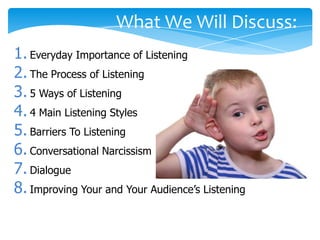
What We Will Discuss:
1. Everyday Importance of Listening
2. The Process of Listening
3. 5 Ways of Listening
4. 4 Main Listening Styles
5. Barriers To Listening
6. Conversational Narcissism
7. Dialogue
8. Improving Your and Your Audience’s Listening
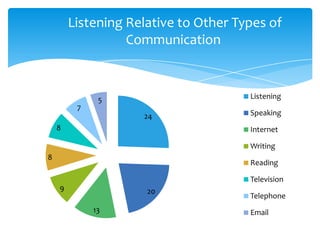
Listening Relative to Other Types of
Communication

7

Listening

5
24

8

Speaking
Internet
Writing

8

Reading
Television
9

20
13

Telephone
Email
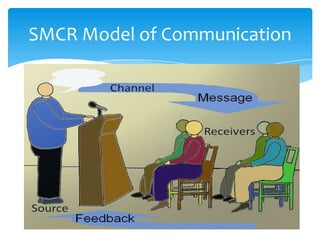
SMCR Model of Communication
Everyday Importance of Listening to . . .

How do you think Listening is
important in the following
contexts?

TedTalk:
http://www.youtube.com/watch?v=cSohjlYQI2A

College
Success in workforce
Interpersonal communication
Improving your public speaking
skills
The 4 “R”s of Listening

1. Receiving
Hearing with your
ears/reading/watching
2. Responding
Verbal and nonverbal cues
that we are attending
3. Recalling
What we take away
4. Rating
How we evaluate it
5 Ways of Listening
1.

Discriminative
•

2.

Comprehensive
•

3.

Give help to a person who needs
to talk through a concern

Critical
•

5.

Understand the message in order
to retain, recall & maybe use info
later on

Therapeutic
•

4.

Distinguish the auditory and
visual stimuli

Evaluate the merits of the
message

Appreciative
•

Obtain sensory stimuli or
enjoyment
11
4 Main Listening Styles
1.

People-oriented
•
•

2.

Action-oriented
•

3.

Like info that is
concise, succinct, free from
mistakes

Content-oriented
•

4.

High regard for other’s feelings
Seek to find common ground
with speaker

Prefer challenging and complex
messages

Time-oriented
•

Prefer brief listening encounters
12
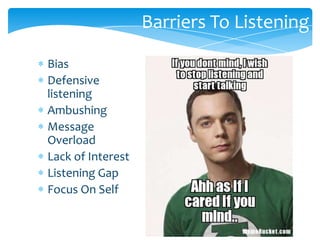
Barriers To Listening
Bias
Defensive
listening
Ambushing
Message
Overload
Lack of Interest
Listening Gap
Focus On Self
13
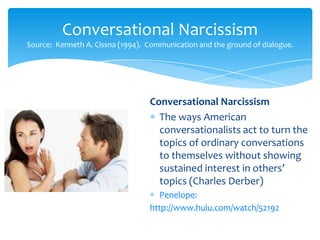
Conversational Narcissism
Source: Kenneth A. Cissna (1994). Communication and the ground of dialogue.

Conversational Narcissism
The ways American
conversationalists act to turn the
topics of ordinary conversations
to themselves without showing
sustained interest in others’
topics (Charles Derber)
Penelope:
http://www.hulu.com/watch/52192
Dialogue
Source: Kenneth A. Cissna (1994). Communication and the ground of dialogue.

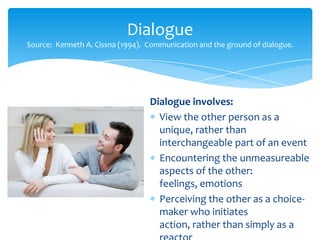
Dialogue involves:
View the other person as a
unique, rather than
interchangeable part of an event
Encountering the unmeasureable
aspects of the other:
feelings, emotions
Perceiving the other as a choicemaker who initiates
action, rather than simply as a
Improving Listening

Paraphrase Exercise: Should students and
teachers with concealed carry permits be
allowed to carry weapons at UCF?
1. Person # 1 gives their opinion.
2. Person #2 paraphrases #1 “So What You’re
Saying Is” then asks them “Did I get that
right?” Person #1 says yes or no. When they
say yes, Person #2 gives their opinion.
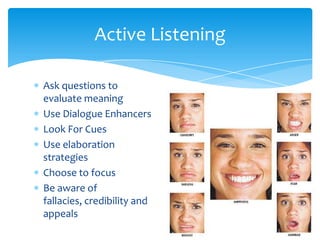
Active Listening
Ask questions to
evaluate meaning
Use Dialogue Enhancers
Look For Cues
Use elaboration
strategies
Choose to focus
Be aware of
fallacies, credibility and
appeals
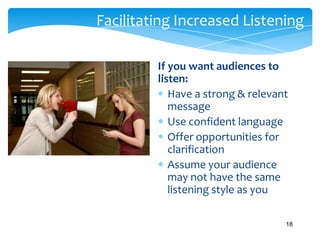
Facilitating Increased Listening
If you want audiences to
listen:
Have a strong & relevant
message
Use confident language
Offer opportunities for
clarification
Assume your audience
may not have the same
listening style as you
18
Summary
•Empathy
•Everyday Importance of Listening
•The Process of Listening
•Systems Model
•5 Ways of Listening
•4 Main Listening Styles
•Barriers To Listening
•Conversational Narcissism
•Dialogue
•Improving Your and Your Audience’s Listening
19
Empathy
http://www.onbeing.org/blog/an-empathy-video-thatasks-you-to-stand-in-someone-elses-shoes/5063
Listening Ted Talk
http://www.youtube.com/watch?
v=cSohjlYQI2A

Penelope:
http://vimeo.com/30933643

Listening and Empathy

  • 1.
    Public Speaking for TechnicalPresentations AWNM, Chapter 7: Empathy Textbook Chapter 13: Listening
  • 2.
    A Whole NewMind (AWNM) http://www.onbeing.org/blog/an-empathy-video-that-asks-you-to-stand-in-someone-elsesshoes/5063 Empathy is the ability to imagine yourself in someone else’s position and to intuit what that person is feeling. It is the ability to stand in others’ shoes, to see with their eyes, and to feel with their hearts. Is it the same as Sympathy? What is the difference?
  • 3.
    A Whole NewMind (AWNM) Men, Women, and Empathy • Who’s more empathic? • Tied to brain differences (Simon Baron-Cohen). • Systematizing: exactness, excellent attention to local detail. • Left Brain = Male Brain • Empathizing: inexactness, attention to the larger picture, context, with no expectation of lawfulness. • Right Brain = Female Brain What to DO?
  • 4.
    A Whole NewMind (AWNM) Empathy Can Be Learned. • Cognitive Empathy: perspectivetaking; concentrating on the situation from their side • Affective Empathy: Feel WITH them. Work to imagine how they feel. This comes through practice. • What precedes most instances of empathy is the DECISION to empathize.
  • 5.
    Chapter 4 Listening: the process ofreceiving, attending to, and assigning meaning to aural and visual stimuli
  • 6.
    What We WillDiscuss: 1. Everyday Importance of Listening 2. The Process of Listening 3. 5 Ways of Listening 4. 4 Main Listening Styles 5. Barriers To Listening 6. Conversational Narcissism 7. Dialogue 8. Improving Your and Your Audience’s Listening
  • 7.
    Listening Relative toOther Types of Communication 7 Listening 5 24 8 Speaking Internet Writing 8 Reading Television 9 20 13 Telephone Email
  • 8.
    SMCR Model ofCommunication
  • 9.
    Everyday Importance ofListening to . . . How do you think Listening is important in the following contexts? TedTalk: http://www.youtube.com/watch?v=cSohjlYQI2A College Success in workforce Interpersonal communication Improving your public speaking skills
  • 10.
    The 4 “R”sof Listening 1. Receiving Hearing with your ears/reading/watching 2. Responding Verbal and nonverbal cues that we are attending 3. Recalling What we take away 4. Rating How we evaluate it
  • 11.
    5 Ways ofListening 1. Discriminative • 2. Comprehensive • 3. Give help to a person who needs to talk through a concern Critical • 5. Understand the message in order to retain, recall & maybe use info later on Therapeutic • 4. Distinguish the auditory and visual stimuli Evaluate the merits of the message Appreciative • Obtain sensory stimuli or enjoyment 11
  • 12.
    4 Main ListeningStyles 1. People-oriented • • 2. Action-oriented • 3. Like info that is concise, succinct, free from mistakes Content-oriented • 4. High regard for other’s feelings Seek to find common ground with speaker Prefer challenging and complex messages Time-oriented • Prefer brief listening encounters 12
  • 13.
  • 14.
    Conversational Narcissism Source: KennethA. Cissna (1994). Communication and the ground of dialogue. Conversational Narcissism The ways American conversationalists act to turn the topics of ordinary conversations to themselves without showing sustained interest in others’ topics (Charles Derber) Penelope: http://www.hulu.com/watch/52192
  • 15.
    Dialogue Source: Kenneth A.Cissna (1994). Communication and the ground of dialogue. Dialogue involves: View the other person as a unique, rather than interchangeable part of an event Encountering the unmeasureable aspects of the other: feelings, emotions Perceiving the other as a choicemaker who initiates action, rather than simply as a
  • 16.
    Improving Listening Paraphrase Exercise:Should students and teachers with concealed carry permits be allowed to carry weapons at UCF? 1. Person # 1 gives their opinion. 2. Person #2 paraphrases #1 “So What You’re Saying Is” then asks them “Did I get that right?” Person #1 says yes or no. When they say yes, Person #2 gives their opinion.
  • 17.
    Active Listening Ask questionsto evaluate meaning Use Dialogue Enhancers Look For Cues Use elaboration strategies Choose to focus Be aware of fallacies, credibility and appeals
  • 18.
    Facilitating Increased Listening Ifyou want audiences to listen: Have a strong & relevant message Use confident language Offer opportunities for clarification Assume your audience may not have the same listening style as you 18
  • 19.
    Summary •Empathy •Everyday Importance ofListening •The Process of Listening •Systems Model •5 Ways of Listening •4 Main Listening Styles •Barriers To Listening •Conversational Narcissism •Dialogue •Improving Your and Your Audience’s Listening 19
  • 21.

Editor's Notes

  • #3 Video FIRSTEmpathy is the ability to imagine yourself in someone else’s position and to intuit what that person is feeling. It is the ability to stand in others’ shoes, to see with their eyes, and to feel with their hearts.Is it the same as Sympathy?What is the difference?Sympathy is feeling bad FOR someone else. Empathy is feeling WITH someone else, sensing what it would be like to BE that person.Contagious yawning is likely a primitive empathic mechanism. Contagious yawners score high on various tests that measure levels of Empathy. Some people are so in tune with what others are going through that they can’t help but mimic that behavior.
  • #4 A growing body of research has shown that women are generally better then men at reading facial expressions and at detecting lies. Girls are better at inferring what others are thinking and at divining emotions from the expression on someone’s face. Of course, this is a generalization, and as we learned in the Cultural Diversity section, you must pay attention to individual differences. Not all women have “female” brains, and not all men have “Male” brains. But in general, women are better at empathy.Both men and women report their friendships with women to be more intimate, enjoyable, and nurturing than their friendships with men. When seeking empathy and understanding, both men and women usually turn to women.This is all tied to brain differences. Baron describes autism as an “extreme” male brain.Systematizing: exactness, excellent attention to local detail, and an attraction to fixed rules independent of context. To systemize, you need detachment.Left Brain = Male BrainEmpathizing: inexactness (one can only ever approximate when one ascertains another’s mental state), attention to the larger picture, context (a person’s face, voice, action and history allow you to intuit their mental state), with no expectation of lawfulness (what made her happy yesterday may not make her happy tomorrow).What to DO? Some call it get in touch with the feminine side, but don’t reject the systematizing side of our brains. The Conceptual Age requires androgynous minds, so we should develop our abilities for BOTH.
  • #5 Cognitive Empathy: perspective-taking; concentrating on the situation from their sideAffective Empathy: Feel WITH them. Work to imagine how they feel. This comes through practice. You don’t have to be in their shoes, you can still feel with them even if you don’t share the experience.What precedes most instances of empathy is the DECISION to empathize.Develop your Emotional Intelligence. Described by Daniel Golman, this is social competence that recognizes others’ emotional states. Empathy tends to develop in people who have been through tough life experiences themselves. To develop your empathy, when you are with someone who is hurting, CHOOSE to empathize. First try to think through the situation as if you were them, considering all the ways it would affect you and the choices you’d have to make. Then BE with them and choose to TRY to feel what they feel. Start by using your imagination. As you practice the discipline of Empathy, you will grow in your Empathic ability. This will make you a better friend, a better spouse, a better employee, and an overall better person. Among other things, Daniel Pink recommends Volunteering. Seeing another human in distress, and thinking, “There but for the grace of God go I” – will hone your powers of empathy.
  • #15 We want you to avoid something called Conversational Narcissism. This is a common practice for many people and sometimes just knowing what it is can help you to avoid it.Conversational Narcissism is when you consider the person you’re talking to as a thing, not as a person. Reflects America’s culture of competitive individualismInflated self-importance results in a self-absorption and self-admiration that others often consider arrogant and that denies a need for other peopleUses shift responses: shift the attention and the topic to oneself. “You think your job is rough? Listen to what happened to me yesterday!”Tends to form short-term relationships lacking in commitment that are bland, superficial, and deeply unsatisfyingTendency for individuals to seek pre-dominant attention for themselves.
  • #16 And the opposite of this is something called dialogue. Many people use this term but do you really know what it means? Dialogue involves deeply listening to another person and collaborating with them in a genuine way through open conversation. To do this, you must respect and value the other person as a unique individual, and be present with them fully.Dialogue involves many things, one of them is, instead of shift responses, use support responses. Keep the attention and the topic focused on the other: “And then what happened?”
  • #18 Ask questions to evaluate meaning: pre-questions about what you want to learn in class that dayUse Dialogue Enhancers: uh-huh, and how did you feel about that?Look For Cues: nonverbalUse elaboration strategies: relate new knowledge in some meaningful way to existing knowledgeChoose to focus: put away technology. Thinking speed is 500 words per minute, speaking speed is 125 words per minute. Focus full attention on the speaker and the message, use extra thought energy to elaborate on the message.Be aware of fallacies, credibility and appeals: for persuasive speeches. Look for carefully considered, well-reasoned grounds, rather than peripheral factors or fallacious arguments. Like Sara taught us last week.Active listening is a precursor to critical thinking, you must listen actively before you can think critically.