By
Kashif Kashif
University of Bradford UK
Kashif.namal@gmail.com
Muhammad Yasir
Muhammad ejaz khan
University of Camerino Italy
 a strong feeling deriving from one's
circumstances, mood, or relationships with
others.
 Emotions are complex. According to some
theories, they are a state of feeling that
results in physical and psychological changes
that influence our behavior.
 Anticipatory emotion: Desire and Fear
 Outcome Emotion: Happiness, sadness,
regret, relief
 Basic Emotion
Emotions may be expressed by a person's
speech, facial and text based emotion
 People use text messages for communication
 Human recognize emotion easily but the
problem is for machine.
 Machine need accurate algorithm to
recognize emotion from text
 Text based recognitions also useful for
psychologist
 Hard Sensing: sensors provide the data
sources that may be relevant to emotion
recognition such as audio, gestures, eye
gazes and brain signals
 Soft Sensing: extract information from
software that already exists with the user and
analyzes it for the purpose of recognizing the
user’s emotions.
 Sentiment Analysis also called opinion mining
 Basic components of an opinion
◦ Opinion holder: A person or an organization that holds
an specific opinion on a particular object.
◦ Object: on which an opinion is expressed
◦ Opinion: a view, attitude, or appraisal on an object from
an opinion holder.
 Objectives of opinion mining: many ...
 We use consumer reviews of products to develop
the ideas. Need Advancement of system
 Sentence Level
 Document level
Human Computer Interaction
 Robot:
 Read code and exactly act like human
Individual consumers
Want to buy some thing, Review the website
Organization and business:
Opinion mining
 Strapparava et al. (2008) developed a system for
Semantic Analysis to identify emotions in text when no
affective words exist.
 Drawback.
 achieved a low accuracy because it is not context sensitive.
 Hancock et al. (2007)
 classify emotions as positive or negative. They found that
positive emotions are expressed in text by using more
exclamation marks and words, while negative emotions are
expressed using more affective words.
 Drawback
 this method is limited to positive/negative
 Ghazi et al. (2010)
 used hierarchical classification to classify the
six Ekman emotions.
 used multiple levels of hierarchy while
classifying emotions by first classifying
whether a sentence holds an emotion or not,
 classifying the emotion as either positive or
negative
 they achieved a better accuracy (+7%)
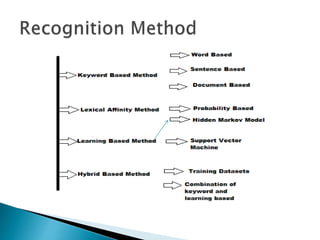
Simple and Easy method
Find Specific word in the
sentence
Work on Three dimension
Evaluation: this show how
much a word is closed to
happy or sad
Potency: show strong and weak intensity of word
Activity: show passive or active activity of the
sentence
 Ambiguity in keyword:
Meaning of same word could be different in
different places
 Sentence without keyword:
sentence which have no keyword, then how
you find the emotion
Negation Handling:
I like this dress ,
I don’t like this dress
Multiple opinion in one sentence
 Easy to use and straightforward method.
 An extension of keyword spotting technique;
 Assigns a probabilistic “affinity” for a
particular emotion to arbitrary words apart
from picking up emotional keywords.
 “I avoided an accident” or “I met my friend by
accident”.
 The word “accident” having been assigned a
high probability of indicating a negative
emotion.
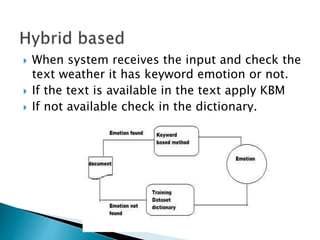
 When system receives the input and check the
text weather it has keyword emotion or not.
 If the text is available in the text apply KBM
 If not available check in the dictionary.
 Formulate the problem differently.
 The problem was to determine emotions from
input texts but now the problem is to classify
the input texts into different emotions.
 Try to detect emotions based on a previously
trained classifier.
 Support Vector Machine, Hidden Morkov
Model, KNN Algorithm etc
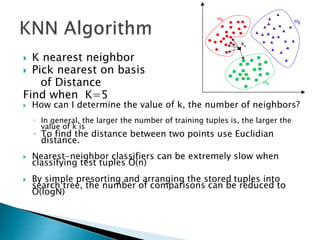
 K nearest neighbor
 Pick nearest on basis
of Distance
Find when K=5
 How can I determine the value of k, the number of neighbors?
◦ In general, the larger the number of training tuples is, the larger the
value of k is
◦ To find the distance between two points use Euclidian
distance.
 Nearest-neighbor classifiers can be extremely slow when
classifying test tuples O(n)
 By simple presorting and arranging the stored tuples into
search tree, the number of comparisons can be reduced to
O(logN)
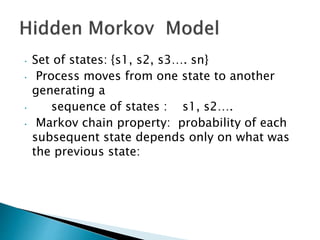
• Set of states: {s1, s2, s3…. sn}
• Process moves from one state to another
generating a
• sequence of states : s1, s2….
• Markov chain property: probability of each
subsequent state depends only on what was
the previous state:
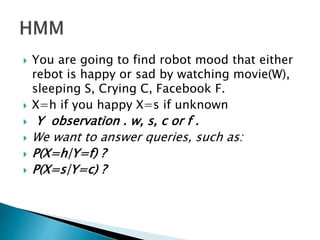
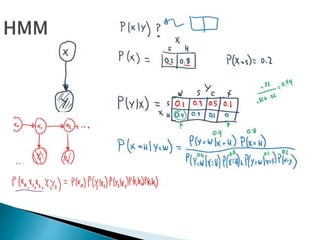
 You are going to find robot mood that either
rebot is happy or sad by watching movie(W),
sleeping S, Crying C, Facebook F.
 X=h if you happy X=s if unknown
 Y observation . w, s, c or f .
 We want to answer queries, such as:
 P(X=h|Y=f) ?
 P(X=s|Y=c) ?
 Conditional probability
 “Chance” of an event given that something
is true
 Notation:
◦ P(a/b)
◦ Probability of event a, given b is true

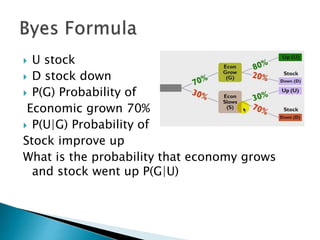
 U stock
 D stock down
 P(G) Probability of
Economic grown 70%
 P(U|G) Probability of
Stock improve up
What is the probability that economy grows
and stock went up P(G|U)
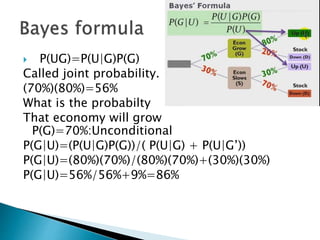
 P(UG)=P(U|G)P(G)
Called joint probability.
(70%)(80%)=56%
What is the probabilty
That economy will grow
P(G)=70%:Unconditional
P(G|U)=(P(U|G)P(G))/( P(U|G) + P(U|G’))
P(G|U)=(80%)(70%)/(80%)(70%)+(30%)(30%)
P(G|U)=56%/56%+9%=86%
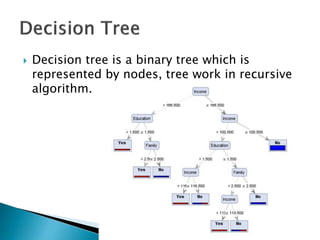
 Decision tree is a binary tree which is
represented by nodes, tree work in recursive
algorithm.
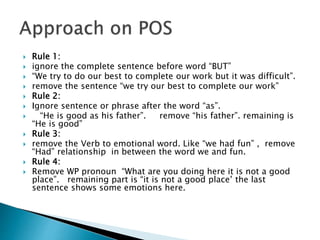
 Rule 1:
 ignore the complete sentence before word “BUT”
 “We try to do our best to complete our work but it was difficult”.
 remove the sentence “we try our best to complete our work”
 Rule 2:
 Ignore sentence or phrase after the word “as”.
 “He is good as his father”. remove “his father”. remaining is
“He is good”
 Rule 3:
 remove the Verb to emotional word. Like “we had fun” , remove
“Had” relationship in between the word we and fun.
 Rule 4:
 Remove WP pronoun “What are you doing here it is not a good
place”. remaining part is “it is not a good place’ the last
sentence shows some emotions here.
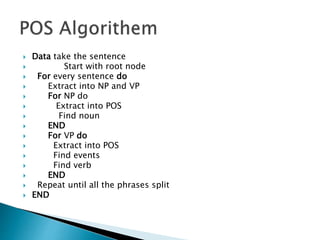
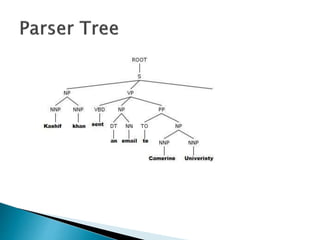
 Data take the sentence
 Start with root node
 For every sentence do
 Extract into NP and VP
 For NP do
 Extract into POS
 Find noun
 END
 For VP do
 Extract into POS
 Find events
 Find verb
 END
 Repeat until all the phrases split
 END
 the ability to search based on emotions
 the ability to study how emotional
expression changes over time
 Different algorithm used to find the solution
for detection
 In Future, This system should also detect not
only the existence of keywords, but also their
linguistic information to detect emotions
more accurately
 Kashif khan
 Beng Software Engineering. University of
Bradford UK
 Master Computer Science. University of
Camerino Italy
 Kashif.namal@gmail.com

Emotion Detection in text

  • 1.
    By Kashif Kashif University ofBradford UK Kashif.namal@gmail.com Muhammad Yasir Muhammad ejaz khan University of Camerino Italy
  • 2.
     a strongfeeling deriving from one's circumstances, mood, or relationships with others.  Emotions are complex. According to some theories, they are a state of feeling that results in physical and psychological changes that influence our behavior.
  • 3.
     Anticipatory emotion:Desire and Fear  Outcome Emotion: Happiness, sadness, regret, relief  Basic Emotion
  • 4.
    Emotions may beexpressed by a person's speech, facial and text based emotion  People use text messages for communication  Human recognize emotion easily but the problem is for machine.  Machine need accurate algorithm to recognize emotion from text  Text based recognitions also useful for psychologist
  • 5.
     Hard Sensing:sensors provide the data sources that may be relevant to emotion recognition such as audio, gestures, eye gazes and brain signals  Soft Sensing: extract information from software that already exists with the user and analyzes it for the purpose of recognizing the user’s emotions.
  • 6.
     Sentiment Analysisalso called opinion mining  Basic components of an opinion ◦ Opinion holder: A person or an organization that holds an specific opinion on a particular object. ◦ Object: on which an opinion is expressed ◦ Opinion: a view, attitude, or appraisal on an object from an opinion holder.  Objectives of opinion mining: many ...  We use consumer reviews of products to develop the ideas. Need Advancement of system  Sentence Level  Document level
  • 7.
    Human Computer Interaction Robot:  Read code and exactly act like human Individual consumers Want to buy some thing, Review the website Organization and business: Opinion mining
  • 8.
     Strapparava etal. (2008) developed a system for Semantic Analysis to identify emotions in text when no affective words exist.  Drawback.  achieved a low accuracy because it is not context sensitive.  Hancock et al. (2007)  classify emotions as positive or negative. They found that positive emotions are expressed in text by using more exclamation marks and words, while negative emotions are expressed using more affective words.  Drawback  this method is limited to positive/negative
  • 9.
     Ghazi etal. (2010)  used hierarchical classification to classify the six Ekman emotions.  used multiple levels of hierarchy while classifying emotions by first classifying whether a sentence holds an emotion or not,  classifying the emotion as either positive or negative  they achieved a better accuracy (+7%)
  • 11.
    Simple and Easymethod Find Specific word in the sentence Work on Three dimension Evaluation: this show how much a word is closed to happy or sad Potency: show strong and weak intensity of word Activity: show passive or active activity of the sentence
  • 12.
     Ambiguity inkeyword: Meaning of same word could be different in different places  Sentence without keyword: sentence which have no keyword, then how you find the emotion Negation Handling: I like this dress , I don’t like this dress Multiple opinion in one sentence
  • 13.
     Easy touse and straightforward method.  An extension of keyword spotting technique;  Assigns a probabilistic “affinity” for a particular emotion to arbitrary words apart from picking up emotional keywords.  “I avoided an accident” or “I met my friend by accident”.  The word “accident” having been assigned a high probability of indicating a negative emotion.
  • 14.
     When systemreceives the input and check the text weather it has keyword emotion or not.  If the text is available in the text apply KBM  If not available check in the dictionary.
  • 15.
     Formulate theproblem differently.  The problem was to determine emotions from input texts but now the problem is to classify the input texts into different emotions.  Try to detect emotions based on a previously trained classifier.  Support Vector Machine, Hidden Morkov Model, KNN Algorithm etc
  • 16.
     K nearestneighbor  Pick nearest on basis of Distance Find when K=5  How can I determine the value of k, the number of neighbors? ◦ In general, the larger the number of training tuples is, the larger the value of k is ◦ To find the distance between two points use Euclidian distance.  Nearest-neighbor classifiers can be extremely slow when classifying test tuples O(n)  By simple presorting and arranging the stored tuples into search tree, the number of comparisons can be reduced to O(logN)
  • 17.
    • Set ofstates: {s1, s2, s3…. sn} • Process moves from one state to another generating a • sequence of states : s1, s2…. • Markov chain property: probability of each subsequent state depends only on what was the previous state:
  • 18.
     You aregoing to find robot mood that either rebot is happy or sad by watching movie(W), sleeping S, Crying C, Facebook F.  X=h if you happy X=s if unknown  Y observation . w, s, c or f .  We want to answer queries, such as:  P(X=h|Y=f) ?  P(X=s|Y=c) ?
  • 20.
     Conditional probability “Chance” of an event given that something is true  Notation: ◦ P(a/b) ◦ Probability of event a, given b is true 
  • 21.
     U stock D stock down  P(G) Probability of Economic grown 70%  P(U|G) Probability of Stock improve up What is the probability that economy grows and stock went up P(G|U)
  • 22.
     P(UG)=P(U|G)P(G) Called jointprobability. (70%)(80%)=56% What is the probabilty That economy will grow P(G)=70%:Unconditional P(G|U)=(P(U|G)P(G))/( P(U|G) + P(U|G’)) P(G|U)=(80%)(70%)/(80%)(70%)+(30%)(30%) P(G|U)=56%/56%+9%=86%
  • 23.
     Decision treeis a binary tree which is represented by nodes, tree work in recursive algorithm.
  • 24.
     Rule 1: ignore the complete sentence before word “BUT”  “We try to do our best to complete our work but it was difficult”.  remove the sentence “we try our best to complete our work”  Rule 2:  Ignore sentence or phrase after the word “as”.  “He is good as his father”. remove “his father”. remaining is “He is good”  Rule 3:  remove the Verb to emotional word. Like “we had fun” , remove “Had” relationship in between the word we and fun.  Rule 4:  Remove WP pronoun “What are you doing here it is not a good place”. remaining part is “it is not a good place’ the last sentence shows some emotions here.
  • 25.
     Data takethe sentence  Start with root node  For every sentence do  Extract into NP and VP  For NP do  Extract into POS  Find noun  END  For VP do  Extract into POS  Find events  Find verb  END  Repeat until all the phrases split  END
  • 27.
     the abilityto search based on emotions  the ability to study how emotional expression changes over time  Different algorithm used to find the solution for detection  In Future, This system should also detect not only the existence of keywords, but also their linguistic information to detect emotions more accurately
  • 28.
     Kashif khan Beng Software Engineering. University of Bradford UK  Master Computer Science. University of Camerino Italy  Kashif.namal@gmail.com