MusicMood 
Machine Learning in Automatic Music Mood Prediction 
Based on Song Lyrics 
Sebastian Raschka 
December 10, 2014
Music Mood Prediction 
• We like to listen to music [1][2] 
• Digital music libraries are growing 
• Recommendation system for happy music 
(clinics, restaurants ...) & genre selection 
[1] Thomas Schaefer, Peter Sedlmeier, Christine Sta ̈dtler, and David Huron. The psychological functions of music listening. Frontiers in psychology, 4, 2013. 
[2] Daniel Vaestfjaell. Emotion induction through music: A review of the musical mood induction procedure. Musicae Scientiae, 5(1 suppl):173–211, 2002.
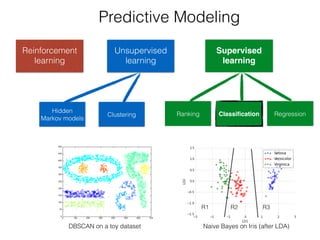
Predictive Modeling 
Unsupervised 
learning 
Supervised 
learning 
Clustering Classification Regression 
Reinforcement 
learning 
Hidden Ranking 
Markov models 
DBSCAN on a toy dataset Naive Bayes on Iris (after LDA)
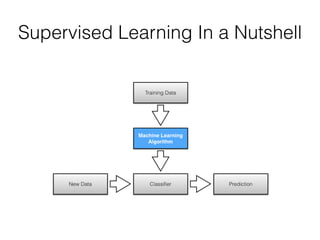
Supervised Learning In a Nutshell
Feature Extraction 
Feature Selection 
Normalization 
Dimensionality Reduction 
Raw Data Collection 
Pre-processing 
Sampling 
Supervised Learning 
- A Quick Overview 
Pre-processing Test Dataset 
New Data 
Training Dataset 
Training Learning 
Algorithms 
Post-Processing 
Cross Validation 
Final Classification/ 
Regression Model 
Refinement 
Prediction 
Split 
Supervised 
Learning 
Sebastian Raschka 2014 
Missing Data 
Prediction-error Metrics 
Model Selection 
Hyperparameter 
optimization 
This work is licensed under a Creative Commons Attribution 4.0 International License.
MusicMood - The Plan
The Dataset 
http://labrosa.ee.columbia.edu/millionsong/
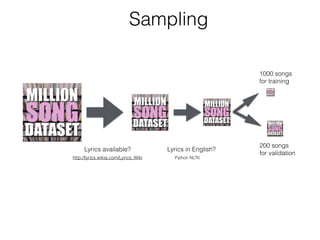
Sampling 
Lyrics available? Lyrics in English? 
1000 songs 
for training 
200 songs 
for validation 
http://lyrics.wikia.com/Lyrics_Wiki Python NLTK
Mood Labels 
Downloading mood labels from Last.fm 
Manual labeling based on lyrics and listening 
sad if ... 
• Dark topic (killing, war, complaints about politics, ...) 
• Artist in sorrow (lost love, ...)
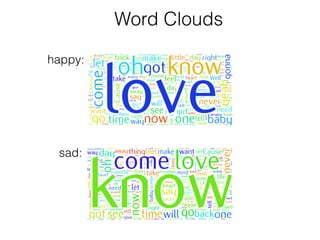
Word Clouds 
happy: 
sad:
A Short Introduction to 
Naive Bayes Classification
Naive Bayes - Why? 
• Small sample size, can outperform the more powerful 
alternatives [1] 
• "Eager learner" (on-line learning vs. batch learning) 
• Fast for classification and re-training 
• Success in Spam Filtering [2] 
• High accuracy for predicting positive and negative classes in 
a sentiment analysis of Twitter data [3] 
[1] Pedro Domingos and Michael Pazzani. On the optimality of the simple bayesian classifier under zero-one loss. Machine learning, 
29(2-3):103–130, 1997. 
[2] Mehran Sahami, Susan Dumais, David Heckerman, and Eric Horvitz. A bayesian approach to filtering junk e-mail. In Learning for 
Text Categorization: Papers from the 1998 workshop, volume 62, pages 98–105, 1998. 
[3] Alec Go, Richa Bhayani, and Lei Huang. Twitter sentiment classification using distant supervision. CS224N Project Report, Stanford, 
pages 1–12, 2009.
Bayes Classifiers 
It’s All About Posterior Probabilities 
objective function: maximize the posterior probability
The Prior Probability 
Maximum Likelihood Estimate (MLE)
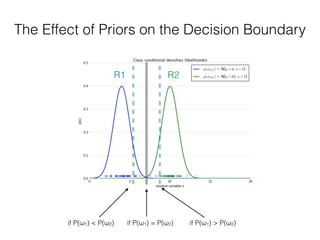
The Effect of Priors on the Decision Boundary
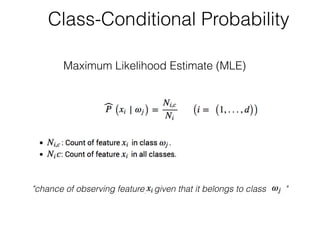
Class-Conditional Probability 
Maximum Likelihood Estimate (MLE) 
"chance of observing feature given that it belongs to class " "
Evidence 
just a normalization factor, 
can be omitted in decision rule:
Naive Bayes Models 
Gaussian Naive Bayes 
for continuous variables
Naive Bayes Models 
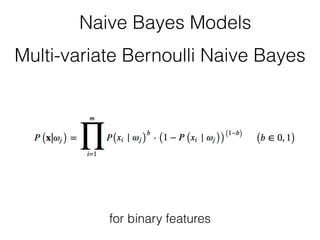
Multi-variate Bernoulli Naive Bayes 
for binary features
Naive Bayes Models 
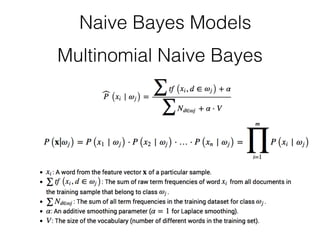
Multinomial Naive Bayes
Naive Bayes and 
Text Classification
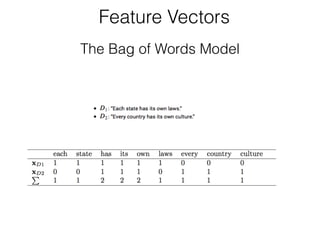
Feature Vectors 
The Bag of Words Model
Tokenization and N-grams 
“a swimmer likes swimming thus he swims”
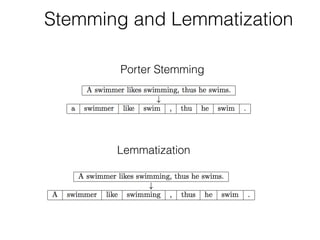
Stemming and Lemmatization 
Porter Stemming 
Lemmatization
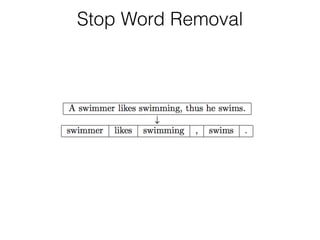
Stop Word Removal
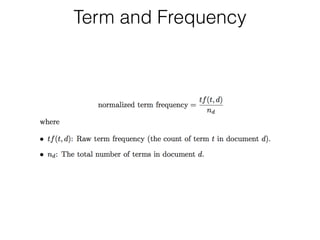
Term and Frequency
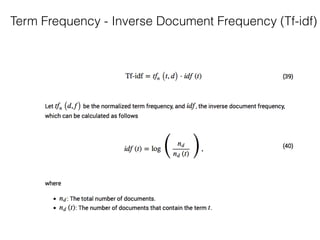
Term Frequency - Inverse Document Frequency (Tf-idf)
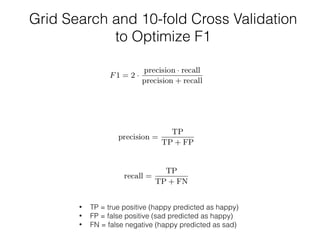
Grid Search and 10-fold Cross Validation 
to Optimize F1 
• TP = true positive (happy predicted as happy) 
• FP = false positive (sad predicted as happy) 
• FN = false negative (happy predicted as sad)
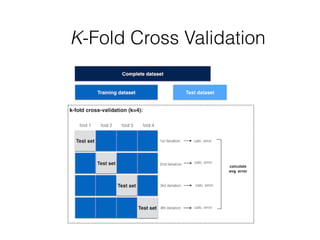
K-Fold Cross Validation
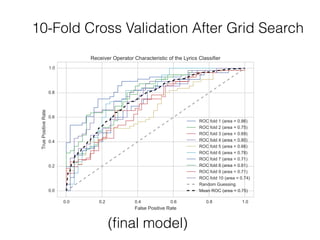
10-Fold Cross Validation After Grid Search 
(final model)
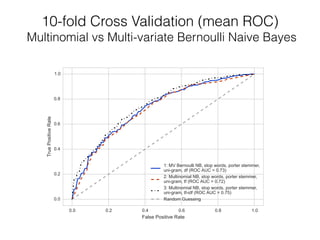
10-fold Cross Validation (mean ROC) 
Multinomial vs Multi-variate Bernoulli Naive Bayes
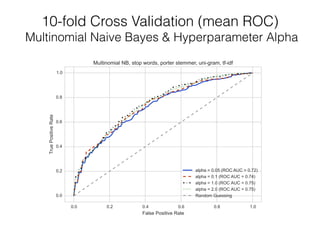
10-fold Cross Validation (mean ROC) 
Multinomial Naive Bayes & Hyperparameter Alpha
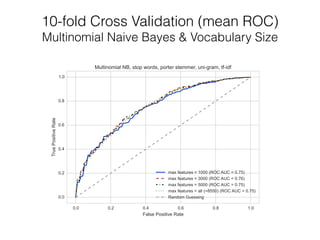
10-fold Cross Validation (mean ROC) 
Multinomial Naive Bayes & Vocabulary Size
10-fold Cross Validation (mean ROC) 
Multinomial Naive Bayes & Document Frequency Cut-off
10-fold Cross Validation (mean ROC) 
Multinomial Naive Bayes & N-gram Sequence Length
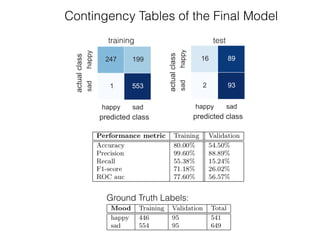
Contingency Tables of the Final Model 
training test
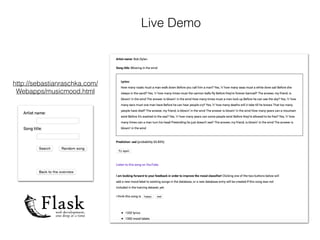
Live Demo 
http://sebastianraschka.com/ 
Webapps/musicmood.html
Future Plans 
• Growing a list of mood labels (majority rule). 
• Performance comparisons of different machine learning algorithms. 
• Genre prediction and selection based on sound.
Thank you!

MusicMood - Machine Learning in Automatic Music Mood Prediction Based on Song Lyrics

  • 1.
    MusicMood Machine Learningin Automatic Music Mood Prediction Based on Song Lyrics Sebastian Raschka December 10, 2014
  • 2.
    Music Mood Prediction • We like to listen to music [1][2] • Digital music libraries are growing • Recommendation system for happy music (clinics, restaurants ...) & genre selection [1] Thomas Schaefer, Peter Sedlmeier, Christine Sta ̈dtler, and David Huron. The psychological functions of music listening. Frontiers in psychology, 4, 2013. [2] Daniel Vaestfjaell. Emotion induction through music: A review of the musical mood induction procedure. Musicae Scientiae, 5(1 suppl):173–211, 2002.
  • 3.
    Predictive Modeling Unsupervised learning Supervised learning Clustering Classification Regression Reinforcement learning Hidden Ranking Markov models DBSCAN on a toy dataset Naive Bayes on Iris (after LDA)
  • 4.
  • 5.
    Feature Extraction FeatureSelection Normalization Dimensionality Reduction Raw Data Collection Pre-processing Sampling Supervised Learning - A Quick Overview Pre-processing Test Dataset New Data Training Dataset Training Learning Algorithms Post-Processing Cross Validation Final Classification/ Regression Model Refinement Prediction Split Supervised Learning Sebastian Raschka 2014 Missing Data Prediction-error Metrics Model Selection Hyperparameter optimization This work is licensed under a Creative Commons Attribution 4.0 International License.
  • 6.
  • 7.
  • 8.
    Sampling Lyrics available?Lyrics in English? 1000 songs for training 200 songs for validation http://lyrics.wikia.com/Lyrics_Wiki Python NLTK
  • 9.
    Mood Labels Downloadingmood labels from Last.fm Manual labeling based on lyrics and listening sad if ... • Dark topic (killing, war, complaints about politics, ...) • Artist in sorrow (lost love, ...)
  • 11.
  • 12.
    A Short Introductionto Naive Bayes Classification
  • 13.
    Naive Bayes -Why? • Small sample size, can outperform the more powerful alternatives [1] • "Eager learner" (on-line learning vs. batch learning) • Fast for classification and re-training • Success in Spam Filtering [2] • High accuracy for predicting positive and negative classes in a sentiment analysis of Twitter data [3] [1] Pedro Domingos and Michael Pazzani. On the optimality of the simple bayesian classifier under zero-one loss. Machine learning, 29(2-3):103–130, 1997. [2] Mehran Sahami, Susan Dumais, David Heckerman, and Eric Horvitz. A bayesian approach to filtering junk e-mail. In Learning for Text Categorization: Papers from the 1998 workshop, volume 62, pages 98–105, 1998. [3] Alec Go, Richa Bhayani, and Lei Huang. Twitter sentiment classification using distant supervision. CS224N Project Report, Stanford, pages 1–12, 2009.
  • 14.
    Bayes Classifiers It’sAll About Posterior Probabilities objective function: maximize the posterior probability
  • 15.
    The Prior Probability Maximum Likelihood Estimate (MLE)
  • 16.
    The Effect ofPriors on the Decision Boundary
  • 17.
    Class-Conditional Probability MaximumLikelihood Estimate (MLE) "chance of observing feature given that it belongs to class " "
  • 18.
    Evidence just anormalization factor, can be omitted in decision rule:
  • 19.
    Naive Bayes Models Gaussian Naive Bayes for continuous variables
  • 20.
    Naive Bayes Models Multi-variate Bernoulli Naive Bayes for binary features
  • 21.
    Naive Bayes Models Multinomial Naive Bayes
  • 22.
    Naive Bayes and Text Classification
  • 23.
    Feature Vectors TheBag of Words Model
  • 24.
    Tokenization and N-grams “a swimmer likes swimming thus he swims”
  • 25.
    Stemming and Lemmatization Porter Stemming Lemmatization
  • 26.
  • 27.
  • 28.
    Term Frequency -Inverse Document Frequency (Tf-idf)
  • 29.
    Grid Search and10-fold Cross Validation to Optimize F1 • TP = true positive (happy predicted as happy) • FP = false positive (sad predicted as happy) • FN = false negative (happy predicted as sad)
  • 30.
  • 31.
    10-Fold Cross ValidationAfter Grid Search (final model)
  • 32.
    10-fold Cross Validation(mean ROC) Multinomial vs Multi-variate Bernoulli Naive Bayes
  • 33.
    10-fold Cross Validation(mean ROC) Multinomial Naive Bayes & Hyperparameter Alpha
  • 34.
    10-fold Cross Validation(mean ROC) Multinomial Naive Bayes & Vocabulary Size
  • 35.
    10-fold Cross Validation(mean ROC) Multinomial Naive Bayes & Document Frequency Cut-off
  • 36.
    10-fold Cross Validation(mean ROC) Multinomial Naive Bayes & N-gram Sequence Length
  • 37.
    Contingency Tables ofthe Final Model training test
  • 38.
  • 39.
    Future Plans •Growing a list of mood labels (majority rule). • Performance comparisons of different machine learning algorithms. • Genre prediction and selection based on sound.
  • 40.