ELECTRONICS
             L.C.TECHNOLOGY


07/07/09      ................ L.C.TECHNOLOGIES ................   1
BASIC ELECTRONICS


07/07/09       ................ L.C.TECHNOLOGIES ................   2
Basic Electronics
           Things to be covered:
           • What is electricity
           • Voltage, Current, Resistance
           • Ohm’s Law
           • Capacitors, Inductors
           • Semiconductors
           • Mechanical Components
           • Digital Electronics


07/07/09                 ................ L.C.TECHNOLOGIES ................   3
OUTLINE
•   Basic Electronics and symbols
•   Measuring Equipment
•   Resistors
•   Capacitors
•   Diode
•   IC
•   Power Supply
•   Circuits
What is Electricity

• Everything is made of atoms
• There are 118 elements, an atom is a single part of an
  element
• Atom consists of electrons, protons, and neutrons


07/07/09             ................ L.C.TECHNOLOGIES ................   5
•   Electrons (- charge) are attracted to protons (+ charge), this holds
    the atom together
•   Some materials have strong attraction and refuse to loss electrons,
    these are called insulators (air, glass, rubber, most plastics)
•   Some materials have weak attractions and allow electrons to be lost,
    these are called conductors (copper, silver, gold, aluminum)
•   Electrons can be made to move from one atom to another, this is
    called a current of electricity.


07/07/09                  ................ L.C.TECHNOLOGIES ................   6
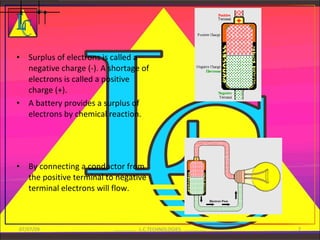
•   Surplus of electrons is called a
    negative charge (-). A shortage of
    electrons is called a positive
    charge (+).
•   A battery provides a surplus of
    electrons by chemical reaction.


•   By connecting a conductor from
    the positive terminal to negative
    terminal electrons will flow.


07/07/09                    ................ L.C.TECHNOLOGIES ................   7
Basic Symbols in Electronics


07/07/09    ................ L.C.TECHNOLOGIES ................   8
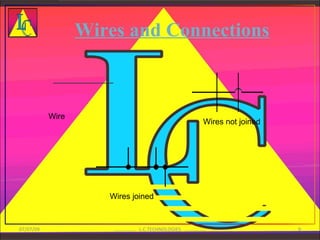
Wires and Connections


           Wire
                                                                      Wires not joined


                     Wires joined


07/07/09              ................ L.C.TECHNOLOGIES ................                 9
Power Supplies


              Cell                                                          Battery


           AC supply
                                                                        DC supply
                                        Ground


            Fuse
                                                                            Transformer


07/07/09               ................ L.C.TECHNOLOGIES ................                 10
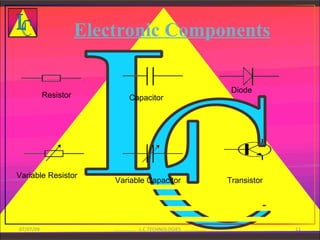
Electronic Components

                                                                                Diode
           Resistor               Capacitor


Variable Resistor
                          Variable Capacitor                                   Transistor


07/07/09                  ................ L.C.TECHNOLOGIES ................                11
Amplifier                Ariel                                   On/Off switch


    Microphone                                                           2-way switch
                               Earphone


07/07/09           ................ L.C.TECHNOLOGIES ................                   12
Measurement


  Voltmeter                                                        Ohmmeter


                     Galvanometer


 Ammeter
                                                                   Oscilloscope


07/07/09      ................ L.C.TECHNOLOGIES ................                  13
Voltage
•   A battery positive terminal (+) and a negative terminal (-). The
    difference in charge between each terminal is the potential energy the
    battery can provide. This is labeled in units of volts.

Water Analogy


07/07/09                  ................ L.C.TECHNOLOGIES ................   14
Voltage Sources:


07/07/09              ................ L.C.TECHNOLOGIES ................   15
• Voltage is like differential pressure,
                          always measure between two points.


                        • Measure voltage between two points
                          or across a component in a circuit.

                        • When measuring DC voltage make
                          sure polarity of meter is correct,
                          positive (+) red, negative (-) black.


07/07/09   ................ L.C.TECHNOLOGIES ................      16
Ground


07/07/09   ................ L.C.TECHNOLOGIES ................   17
Exercise
• Measure DC voltage from power supply using multimeter
• Measure DC voltage from power supply using oscilloscope
• Measure DC voltage from battery using multimeter

• Measure AC voltage from wall outlet using a multimeter
• Measure AC voltage from wall outlet using an oscilloscope


                                                              Effective or Root Mean Square Voltage
                                                                   (Measured with multimeter)

                                                                          ERMS=0.707xEA
           E


07/07/09                     ................ L.C.TECHNOLOGIES ................                       18
Current


 •   Uniform flow of electrons thru a circuit is called current.


                                               WILL USE CONVENTIONAL FLOW NOTATION ON ALL
                                               SCHEMATICS
07/07/09                       ................ L.C.TECHNOLOGIES ................           19
• To measure current, must break circuit and install meter in line.

      • Measurement is imperfect because of voltage drop created by meter.

07/07/09                   ................ L.C.TECHNOLOGIES ................   20
Connecting Meters


                                                                        Voltmeter
           Ammeter

07/07/09               ................ L.C.TECHNOLOGIES ................           21
Resistance


    •      All materials have a resistance that is dependent on cross-
           sectional area, material type and temperature.
    •      A resistor dissipates power in the form of heat
07/07/09                       ................ L.C.TECHNOLOGIES ................   22
Various resistors types


07/07/09    ................ L.C.TECHNOLOGIES ................   23
When measuring resistance, remove
           component from the circuit.


07/07/09                    ................ L.C.TECHNOLOGIES ................   24
Resistor Color Code


07/07/09    ................ L.C.TECHNOLOGIES ................   25
Exercise

           • Determine the resistance of various resistors of unknown value
             using the resistor color code

           • Using the multimeter, compare the specified resistance and
             measured resistance

           • Using the multimeter to examine the characteristics of various
             potentiometers


07/07/09                      ................ L.C.TECHNOLOGIES ................   26
Ohm’s Law


07/07/09   ................ L.C.TECHNOLOGIES ................   27
Prototyping Board


                                                     Example of how components are
                                                     Inserted in the protoboard


07/07/09     ................ L.C.TECHNOLOGIES ................                  28
Exercise

     • Calculate the total current and voltage drop across each resistor shown in Figure 1

     • Build the circuit in Figure 1 on the prototype board

     • Measure the total circuit current and voltage drops across each resistor and compare
       the calculated and measured values


07/07/09                         ................ L.C.TECHNOLOGIES ................           29
Capacitance
                A capacitor is used to store charge for a short amount of time


                                                                                     Capacitor

      Battery


                                Unit = Farad

                                Pico Farad - pF = 10-12F
                                Micro Farad - uF = 10-6F
07/07/09                        ................ L.C.TECHNOLOGIES ................               30
07/07/09   ................ L.C.TECHNOLOGIES ................   31
Capacitor Charging


07/07/09    ................ L.C.TECHNOLOGIES ................   32
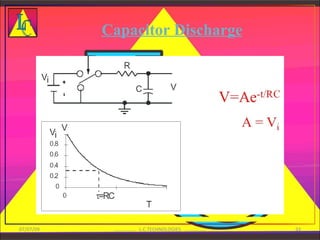
Capacitor Discharge


07/07/09    ................ L.C.TECHNOLOGIES ................   33
Inductance


07/07/09   ................ L.C.TECHNOLOGIES ................   34
07/07/09   ................ L.C.TECHNOLOGIES ................   35
Gates
•   NOT Gate
•   AND Gate
•   OR Gate
•   XOR Gate
•   NAND Gate
•   NOR Gate
•   XNOR Gate
NOT Gate

               A   B

A   B
               1   0

               0   1
AND Gate

             A     B   Q

A            0     0   0
    Q

             1     0   0
B

             0     1   0
             1     1   1
OR Gate

             A    B   Q

A   Q
             0    0   0

B
             1    0   1
             0    1   1
             1    1   1
XOR Gate
          A    B   Q

          0    0   0
A   Q     1    0   1
B
          0    1   1

          1    1   0
NAND Gate

          A     B   Q
A
    Q     0     0   1

B
          1     0   1
          0     1   1
          1     1   0
NOR Gate

           A   B   Q
           0   0   1
A   Q
           1   0   0
B
           0   1   0
           1   1   0
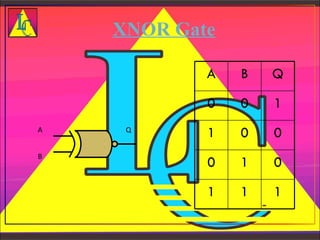
XNOR Gate

            A   B   Q

            0   0   1
A    Q
            1   0   0
B
            0   1   0

            1   1   1
44

Basic Electronics2003

  • 1.
    ELECTRONICS L.C.TECHNOLOGY 07/07/09 ................ L.C.TECHNOLOGIES ................ 1
  • 2.
    BASIC ELECTRONICS 07/07/09 ................ L.C.TECHNOLOGIES ................ 2
  • 3.
    Basic Electronics Things to be covered: • What is electricity • Voltage, Current, Resistance • Ohm’s Law • Capacitors, Inductors • Semiconductors • Mechanical Components • Digital Electronics 07/07/09 ................ L.C.TECHNOLOGIES ................ 3
  • 4.
    OUTLINE • Basic Electronics and symbols • Measuring Equipment • Resistors • Capacitors • Diode • IC • Power Supply • Circuits
  • 5.
    What is Electricity •Everything is made of atoms • There are 118 elements, an atom is a single part of an element • Atom consists of electrons, protons, and neutrons 07/07/09 ................ L.C.TECHNOLOGIES ................ 5
  • 6.
    Electrons (- charge) are attracted to protons (+ charge), this holds the atom together • Some materials have strong attraction and refuse to loss electrons, these are called insulators (air, glass, rubber, most plastics) • Some materials have weak attractions and allow electrons to be lost, these are called conductors (copper, silver, gold, aluminum) • Electrons can be made to move from one atom to another, this is called a current of electricity. 07/07/09 ................ L.C.TECHNOLOGIES ................ 6
  • 7.
    Surplus of electrons is called a negative charge (-). A shortage of electrons is called a positive charge (+). • A battery provides a surplus of electrons by chemical reaction. • By connecting a conductor from the positive terminal to negative terminal electrons will flow. 07/07/09 ................ L.C.TECHNOLOGIES ................ 7
  • 8.
    Basic Symbols inElectronics 07/07/09 ................ L.C.TECHNOLOGIES ................ 8
  • 9.
    Wires and Connections Wire Wires not joined Wires joined 07/07/09 ................ L.C.TECHNOLOGIES ................ 9
  • 10.
    Power Supplies Cell Battery AC supply DC supply Ground Fuse Transformer 07/07/09 ................ L.C.TECHNOLOGIES ................ 10
  • 11.
    Electronic Components Diode Resistor Capacitor Variable Resistor Variable Capacitor Transistor 07/07/09 ................ L.C.TECHNOLOGIES ................ 11
  • 12.
    Amplifier Ariel On/Off switch Microphone 2-way switch Earphone 07/07/09 ................ L.C.TECHNOLOGIES ................ 12
  • 13.
    Measurement Voltmeter Ohmmeter Galvanometer Ammeter Oscilloscope 07/07/09 ................ L.C.TECHNOLOGIES ................ 13
  • 14.
    Voltage • A battery positive terminal (+) and a negative terminal (-). The difference in charge between each terminal is the potential energy the battery can provide. This is labeled in units of volts. Water Analogy 07/07/09 ................ L.C.TECHNOLOGIES ................ 14
  • 15.
    Voltage Sources: 07/07/09 ................ L.C.TECHNOLOGIES ................ 15
  • 16.
    • Voltage islike differential pressure, always measure between two points. • Measure voltage between two points or across a component in a circuit. • When measuring DC voltage make sure polarity of meter is correct, positive (+) red, negative (-) black. 07/07/09 ................ L.C.TECHNOLOGIES ................ 16
  • 17.
    Ground 07/07/09 ................ L.C.TECHNOLOGIES ................ 17
  • 18.
    Exercise • Measure DCvoltage from power supply using multimeter • Measure DC voltage from power supply using oscilloscope • Measure DC voltage from battery using multimeter • Measure AC voltage from wall outlet using a multimeter • Measure AC voltage from wall outlet using an oscilloscope Effective or Root Mean Square Voltage (Measured with multimeter) ERMS=0.707xEA E 07/07/09 ................ L.C.TECHNOLOGIES ................ 18
  • 19.
    Current • Uniform flow of electrons thru a circuit is called current. WILL USE CONVENTIONAL FLOW NOTATION ON ALL SCHEMATICS 07/07/09 ................ L.C.TECHNOLOGIES ................ 19
  • 20.
    • To measurecurrent, must break circuit and install meter in line. • Measurement is imperfect because of voltage drop created by meter. 07/07/09 ................ L.C.TECHNOLOGIES ................ 20
  • 21.
    Connecting Meters Voltmeter Ammeter 07/07/09 ................ L.C.TECHNOLOGIES ................ 21
  • 22.
    Resistance • All materials have a resistance that is dependent on cross- sectional area, material type and temperature. • A resistor dissipates power in the form of heat 07/07/09 ................ L.C.TECHNOLOGIES ................ 22
  • 23.
    Various resistors types 07/07/09 ................ L.C.TECHNOLOGIES ................ 23
  • 24.
    When measuring resistance,remove component from the circuit. 07/07/09 ................ L.C.TECHNOLOGIES ................ 24
  • 25.
    Resistor Color Code 07/07/09 ................ L.C.TECHNOLOGIES ................ 25
  • 26.
    Exercise • Determine the resistance of various resistors of unknown value using the resistor color code • Using the multimeter, compare the specified resistance and measured resistance • Using the multimeter to examine the characteristics of various potentiometers 07/07/09 ................ L.C.TECHNOLOGIES ................ 26
  • 27.
    Ohm’s Law 07/07/09 ................ L.C.TECHNOLOGIES ................ 27
  • 28.
    Prototyping Board Example of how components are Inserted in the protoboard 07/07/09 ................ L.C.TECHNOLOGIES ................ 28
  • 29.
    Exercise • Calculate the total current and voltage drop across each resistor shown in Figure 1 • Build the circuit in Figure 1 on the prototype board • Measure the total circuit current and voltage drops across each resistor and compare the calculated and measured values 07/07/09 ................ L.C.TECHNOLOGIES ................ 29
  • 30.
    Capacitance A capacitor is used to store charge for a short amount of time Capacitor Battery Unit = Farad Pico Farad - pF = 10-12F Micro Farad - uF = 10-6F 07/07/09 ................ L.C.TECHNOLOGIES ................ 30
  • 31.
    07/07/09 ................ L.C.TECHNOLOGIES ................ 31
  • 32.
    Capacitor Charging 07/07/09 ................ L.C.TECHNOLOGIES ................ 32
  • 33.
    Capacitor Discharge 07/07/09 ................ L.C.TECHNOLOGIES ................ 33
  • 34.
    Inductance 07/07/09 ................ L.C.TECHNOLOGIES ................ 34
  • 35.
    07/07/09 ................ L.C.TECHNOLOGIES ................ 35
  • 36.
    Gates • NOT Gate • AND Gate • OR Gate • XOR Gate • NAND Gate • NOR Gate • XNOR Gate
  • 37.
    NOT Gate A B A B 1 0 0 1
  • 38.
    AND Gate A B Q A 0 0 0 Q 1 0 0 B 0 1 0 1 1 1
  • 39.
    OR Gate A B Q A Q 0 0 0 B 1 0 1 0 1 1 1 1 1
  • 40.
    XOR Gate A B Q 0 0 0 A Q 1 0 1 B 0 1 1 1 1 0
  • 41.
    NAND Gate A B Q A Q 0 0 1 B 1 0 1 0 1 1 1 1 0
  • 42.
    NOR Gate A B Q 0 0 1 A Q 1 0 0 B 0 1 0 1 1 0
  • 43.
    XNOR Gate A B Q 0 0 1 A Q 1 0 0 B 0 1 0 1 1 1
  • 44.