Unit 9  Measuring Instruments Objectives: Discuss the operation of a d’Arsonval meter movement. Connect a voltmeter to a circuit. Read an analog multimeter. Connect an ammeter. Measure resistance using an ohmmeter.
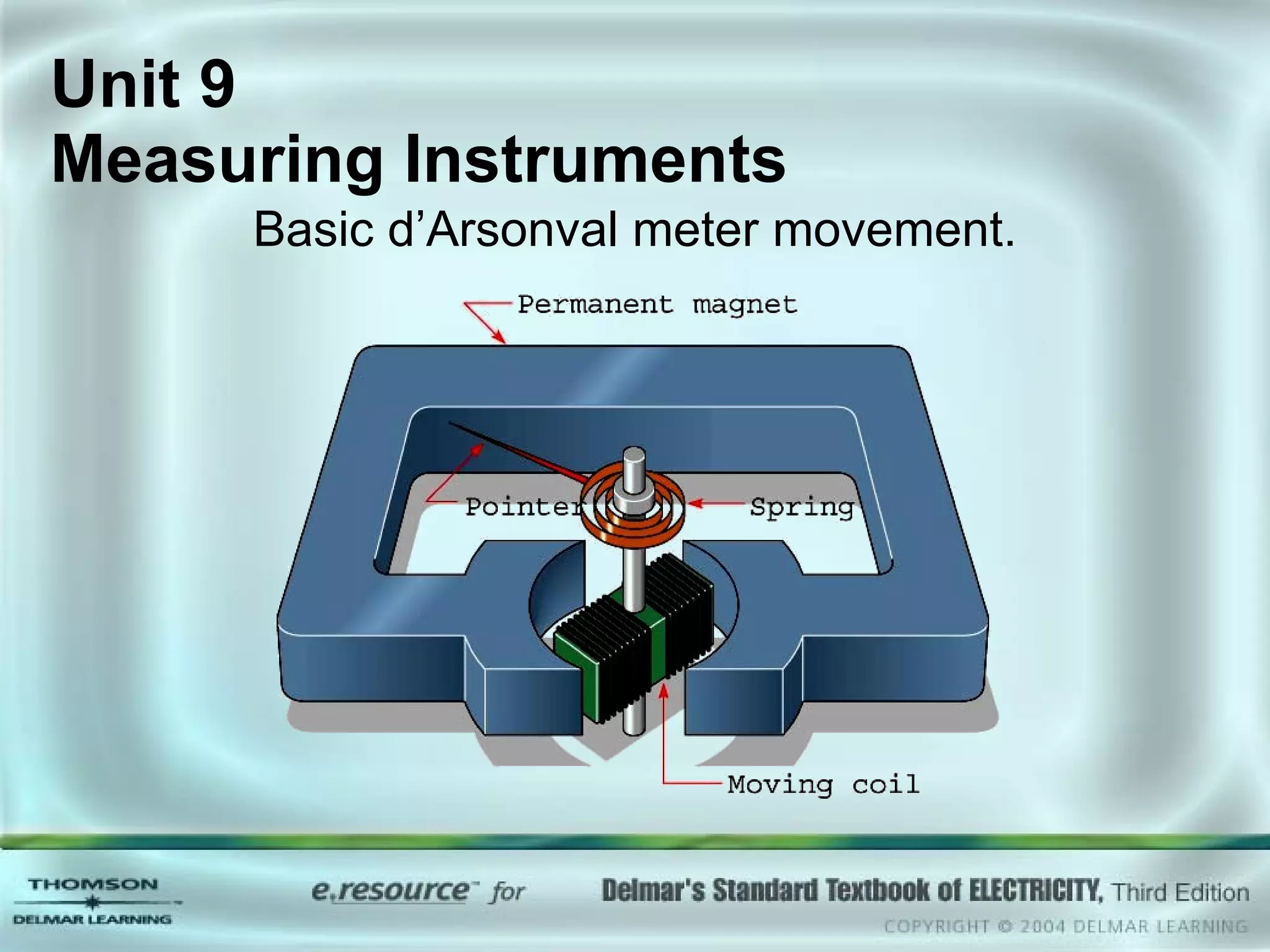
Unit 9  Measuring Instruments Analog meters  are characterized by the fact that they use a pointer and scale to indicate their value. One of the common types of meters uses the  d’Arsonval  type of meter movement. Analog meters use a moving coil placed between the poles of a magnet.
Basic d’Arsonval meter movement. Unit 9  Measuring Instruments
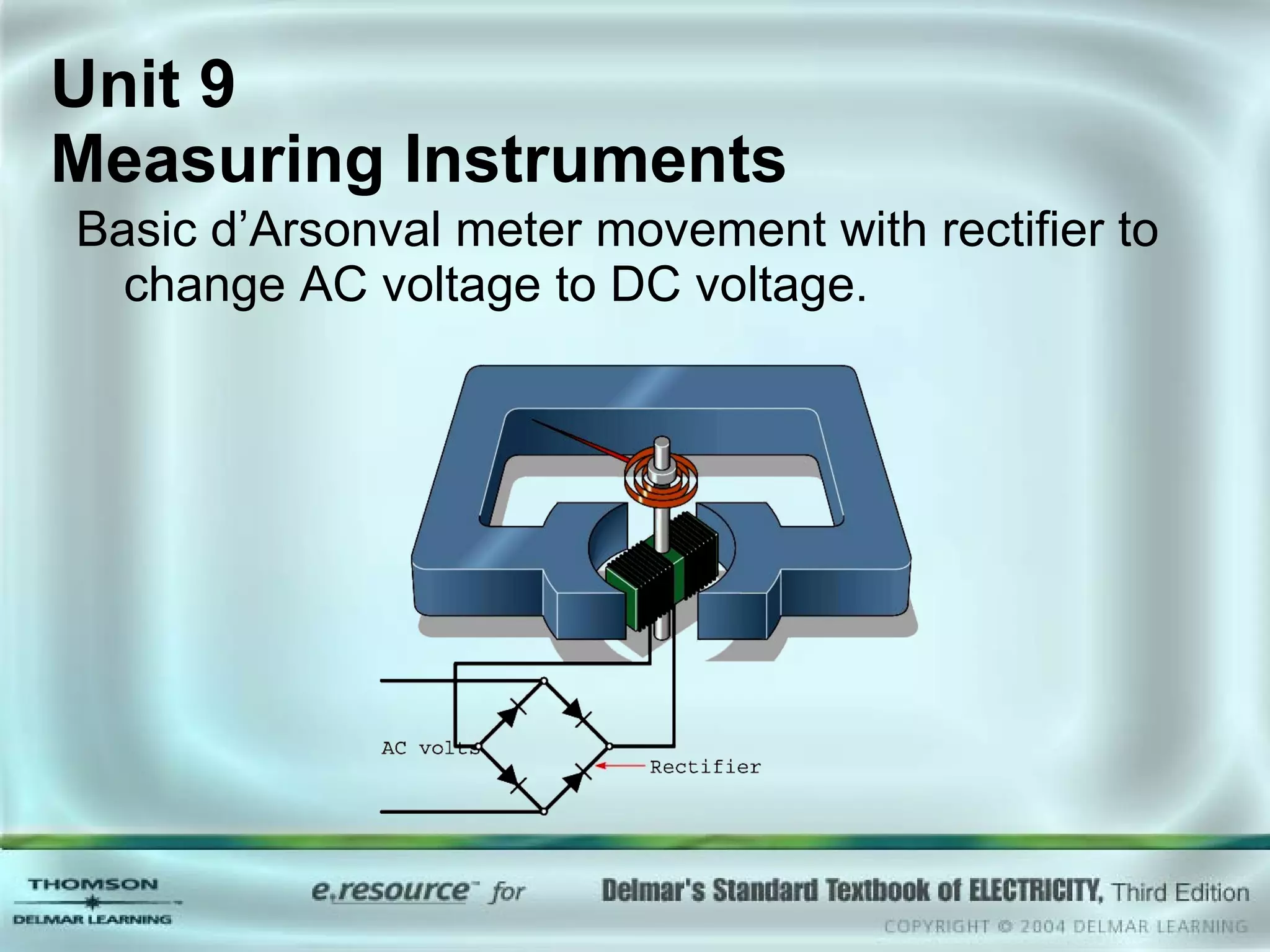
Basic d’Arsonval meter movement with rectifier to change AC voltage to DC voltage. Unit 9  Measuring Instruments
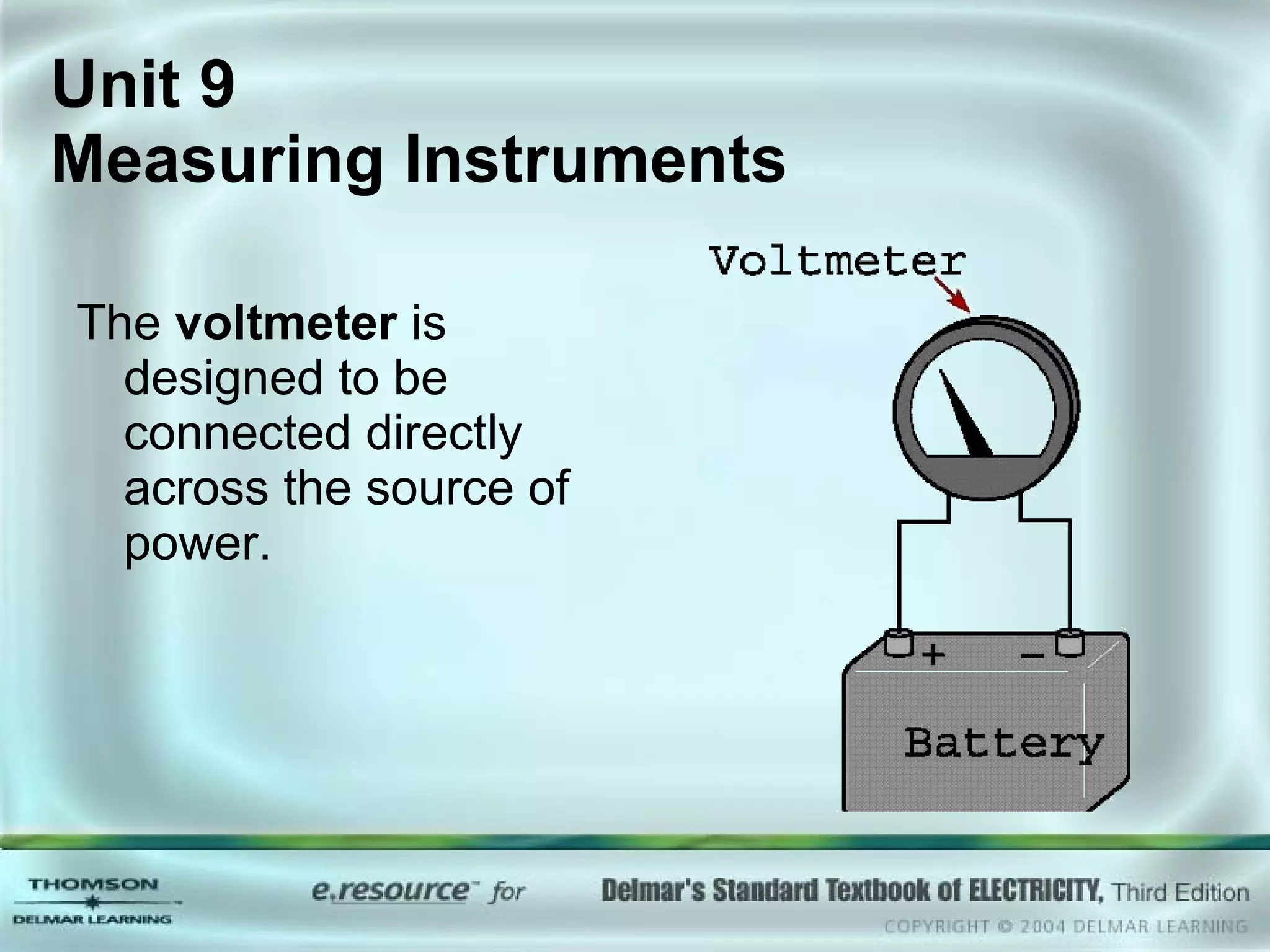
The  voltmeter  is designed to be connected directly across the source of power. Unit 9  Measuring Instruments
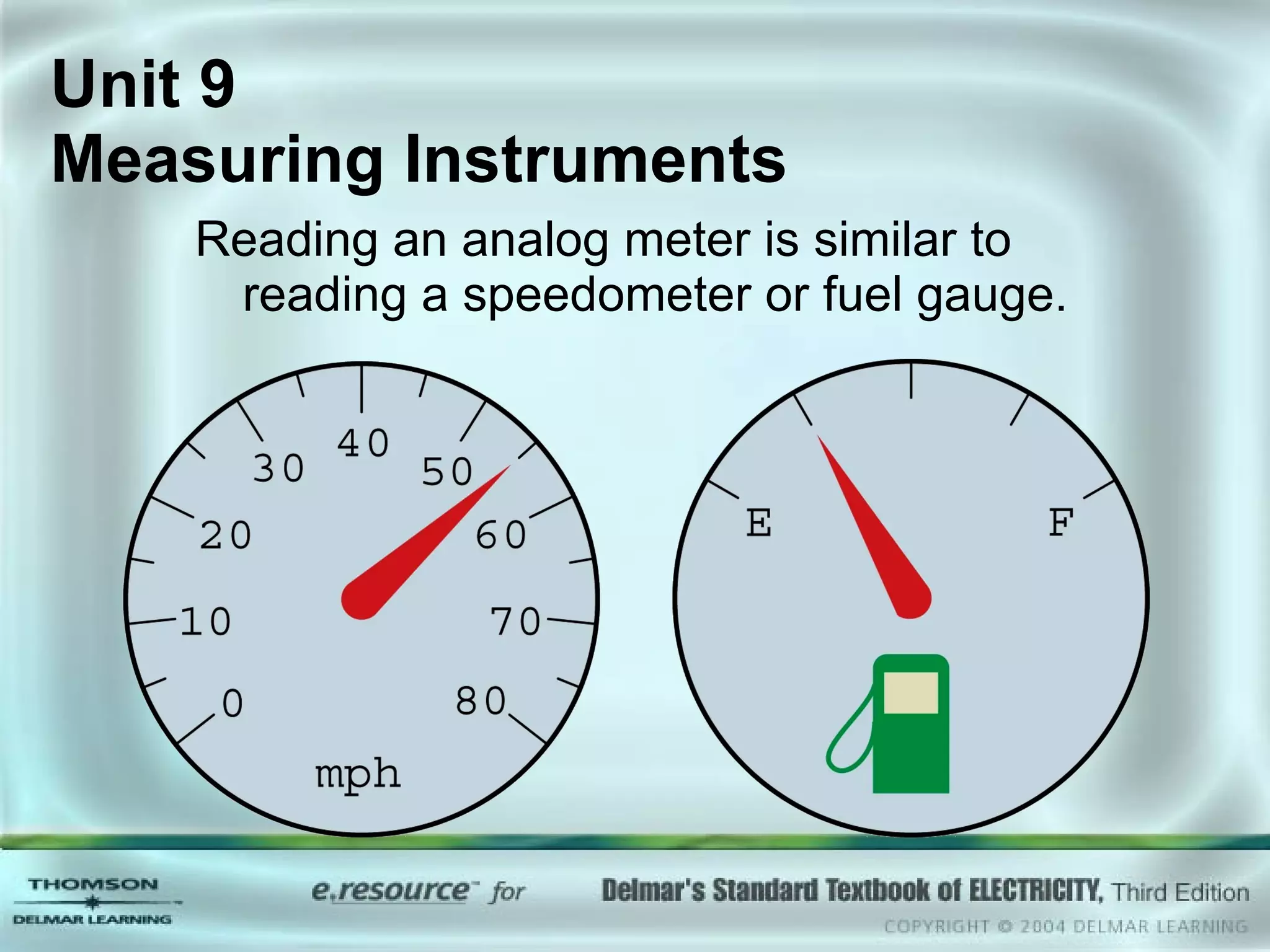
Reading an analog meter is similar to reading a speedometer or fuel gauge. Unit 9  Measuring Instruments
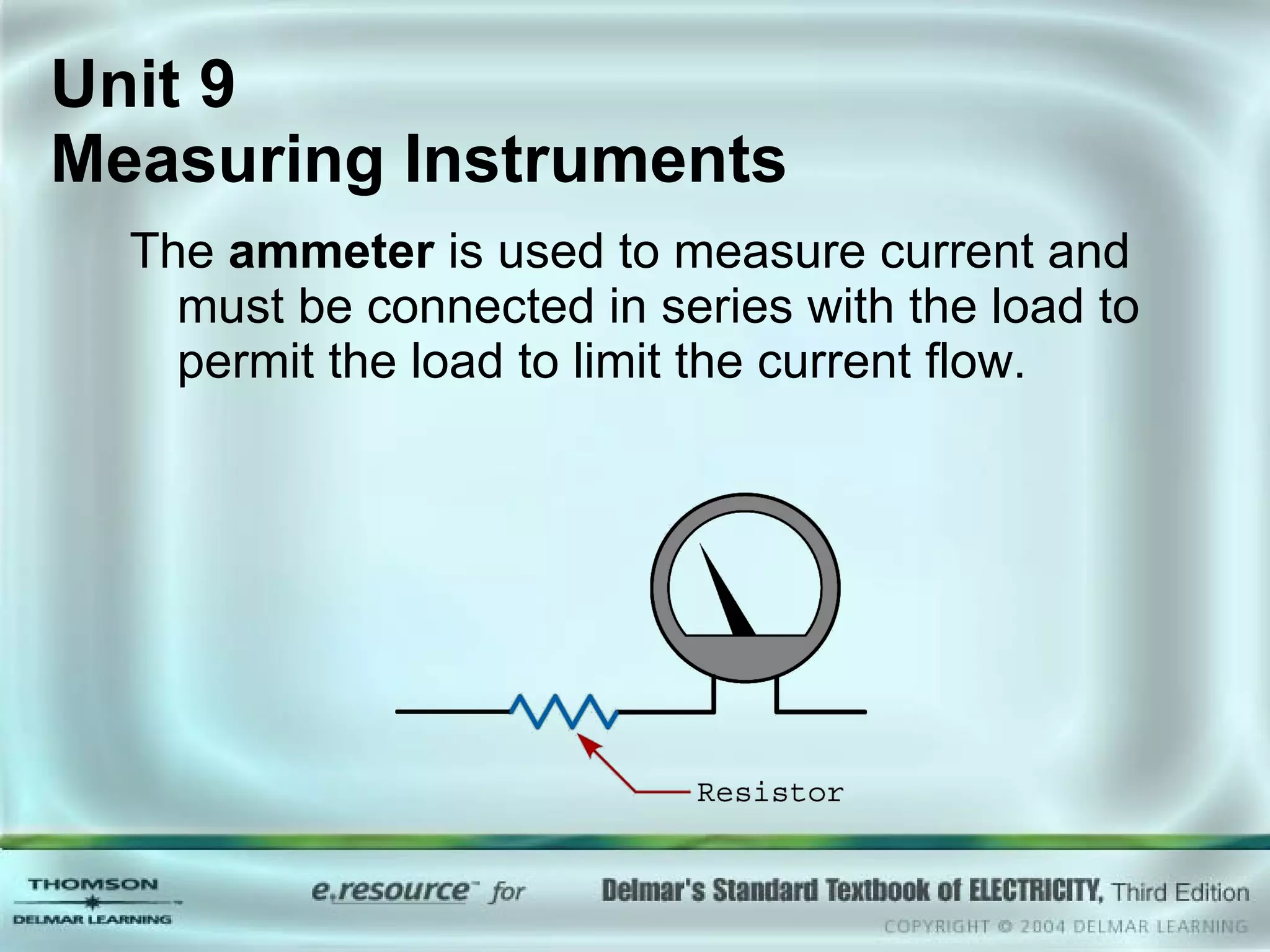
The  ammeter  is used to measure current and must be connected in series with the load to permit the load to limit the current flow. Unit 9  Measuring Instruments
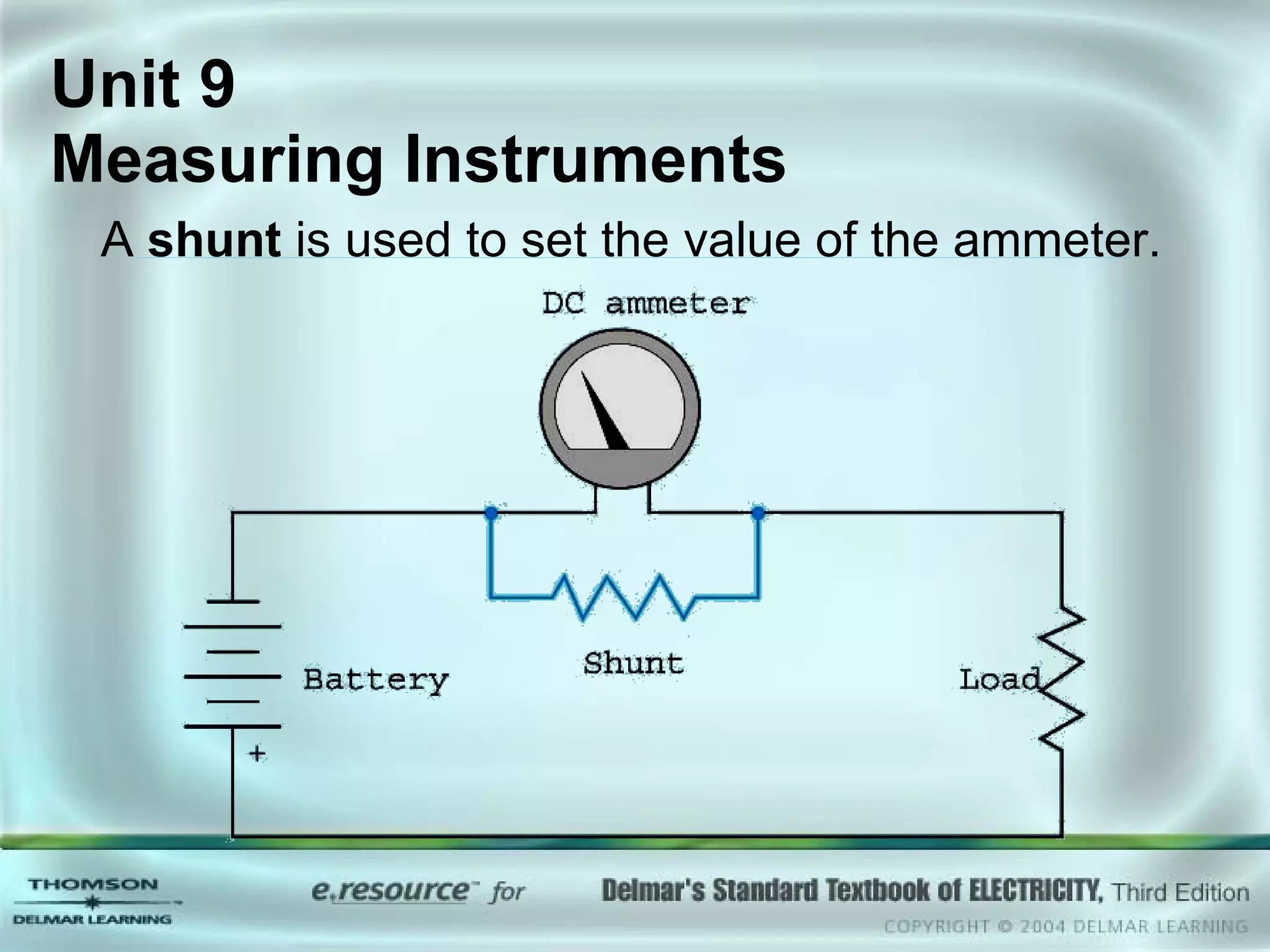
Unit 9  Measuring Instruments A  shunt  is used to set the value of the ammeter.
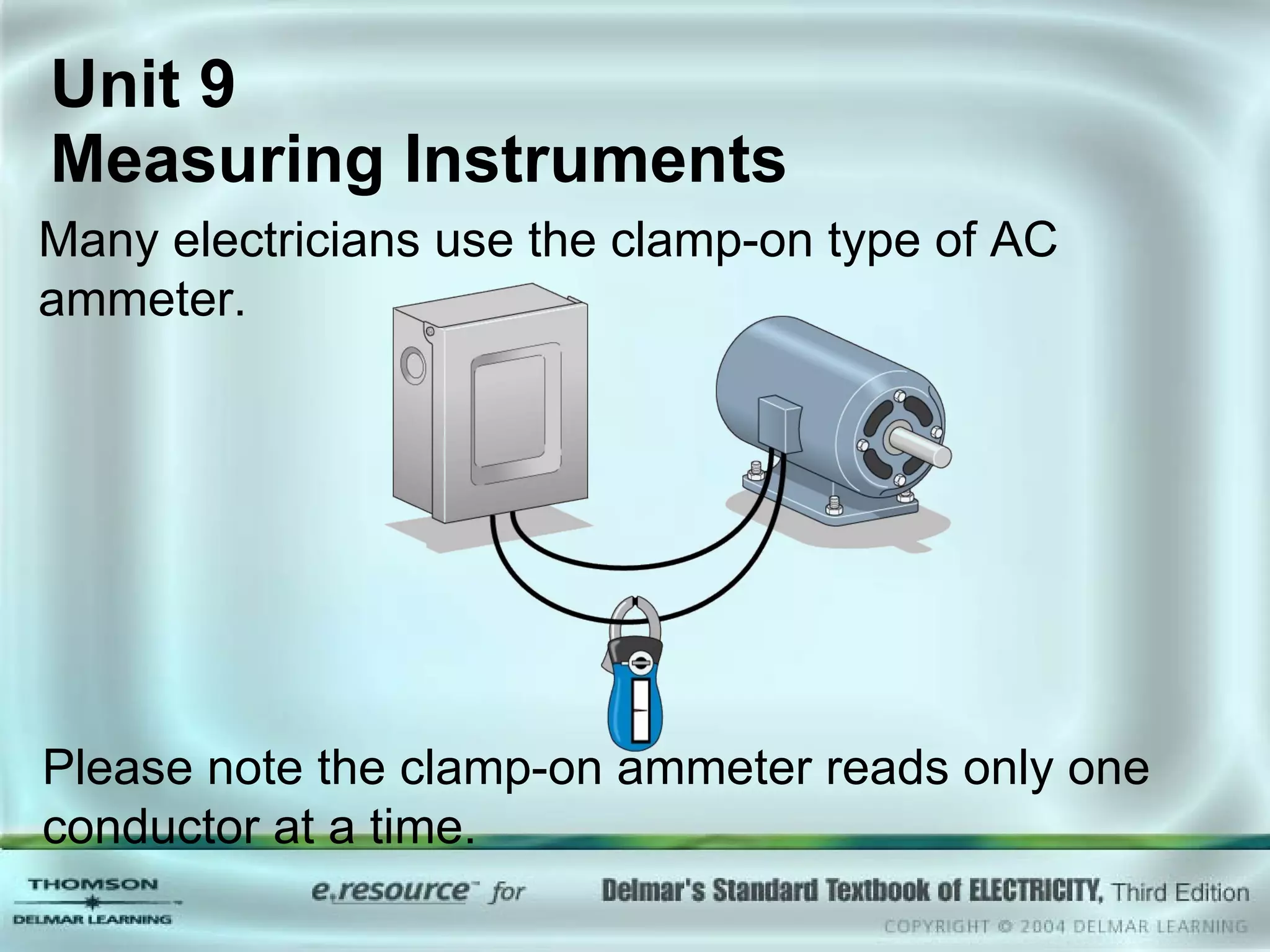
Unit 9  Measuring Instruments Many electricians use the clamp-on type of AC ammeter. Please note the clamp-on ammeter reads only one conductor at a time.
Unit 9  Measuring Instruments Ohmmeters The ohmmeter is used to measure resistance. There are two basic types: analog or digital. The common VOM (volt-ohm-milliammeter) contains an ohmmeter. An ohmmeter should always be readjusted to zero when the scale is changed.
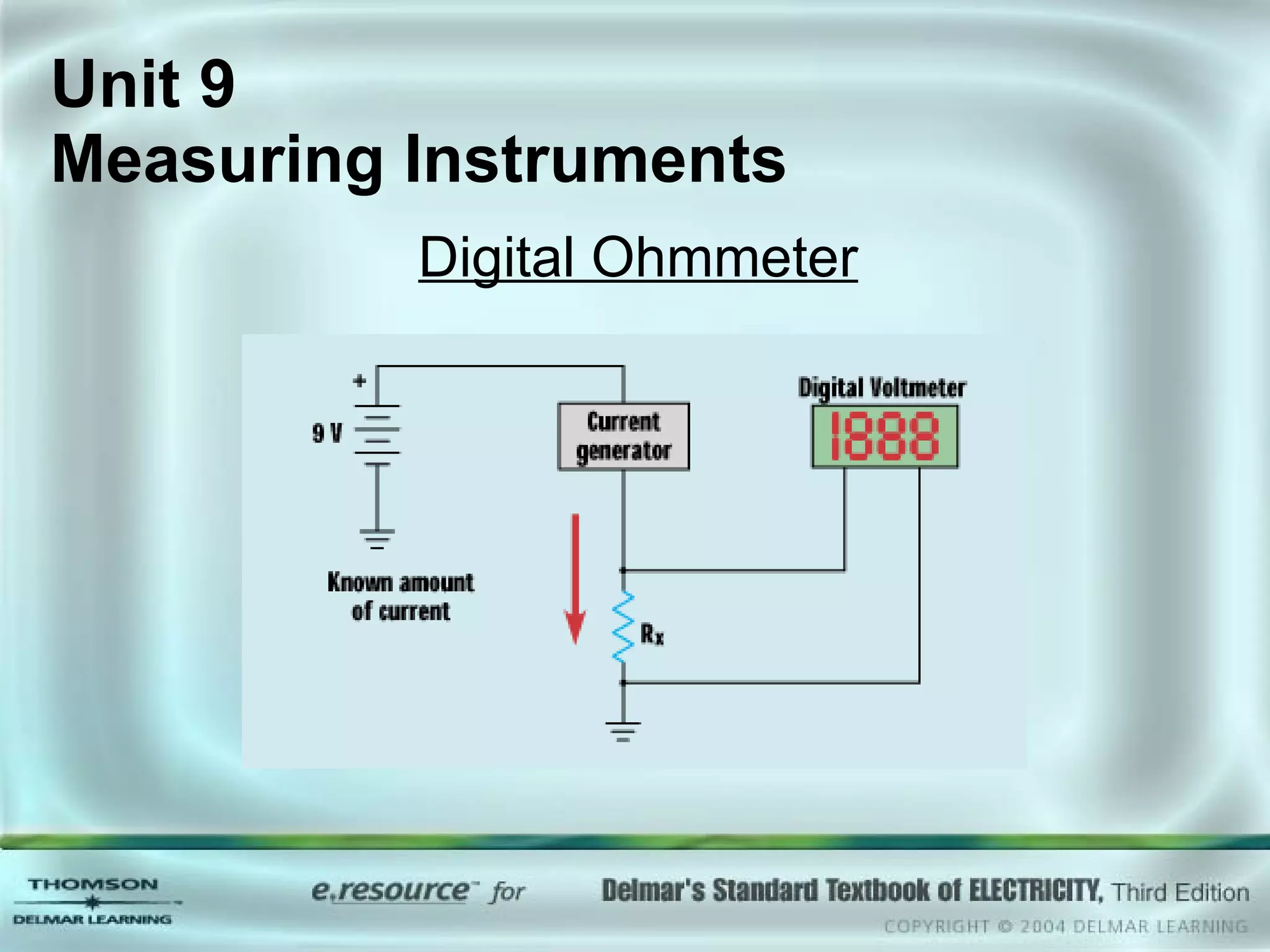
Unit 9  Measuring Instruments Digital Ohmmeters Digital ohmmeters display the resistance in figures instead of using a meter movement. They operate by measuring the voltage drop across a resistor. The ohmmeter, whether digital or analog, must never be connected to a circuit when the power is turned on!
Unit 9  Measuring Instruments Digital Ohmmeter
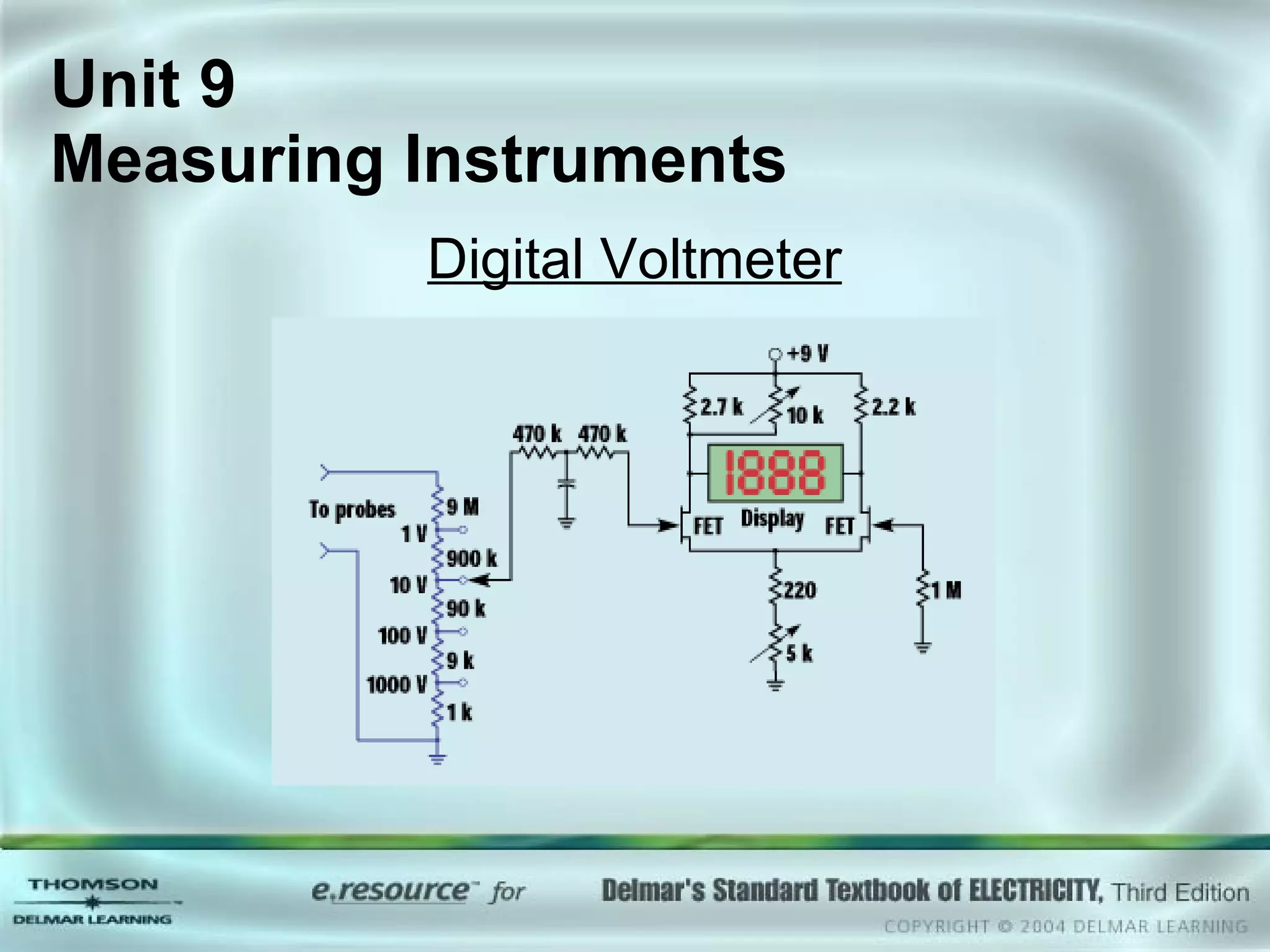
Unit 9  Measuring Instruments Digital Voltmeter
Unit 9  Measuring Instruments Low-impedance Voltage Tester The low-impedance voltage tester has a very large current draw compared to other types of voltmeters and should never be used to test low-power circuits.
Unit 9  Measuring Instruments Low-impedance Voltage Tester This tester has an impedance of 5000 Ω and can generally be used to measure voltages as high as 600 V.
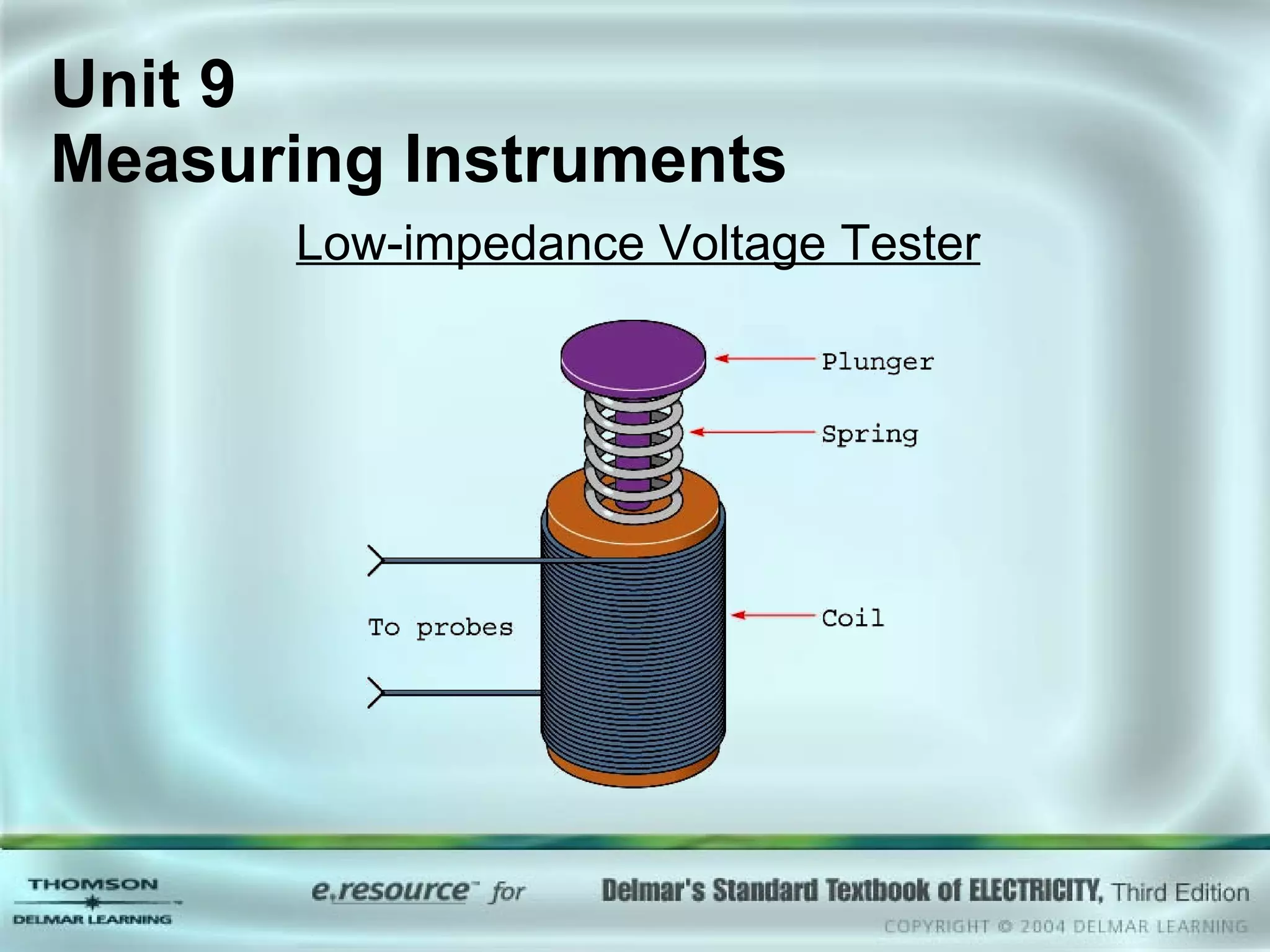
Unit 9  Measuring Instruments Low-impedance Voltage Tester This is also known as a solenoid type tester. This tester is not susceptible to giving the misleading voltage readings caused by high-impedance ground paths or feedback voltages.
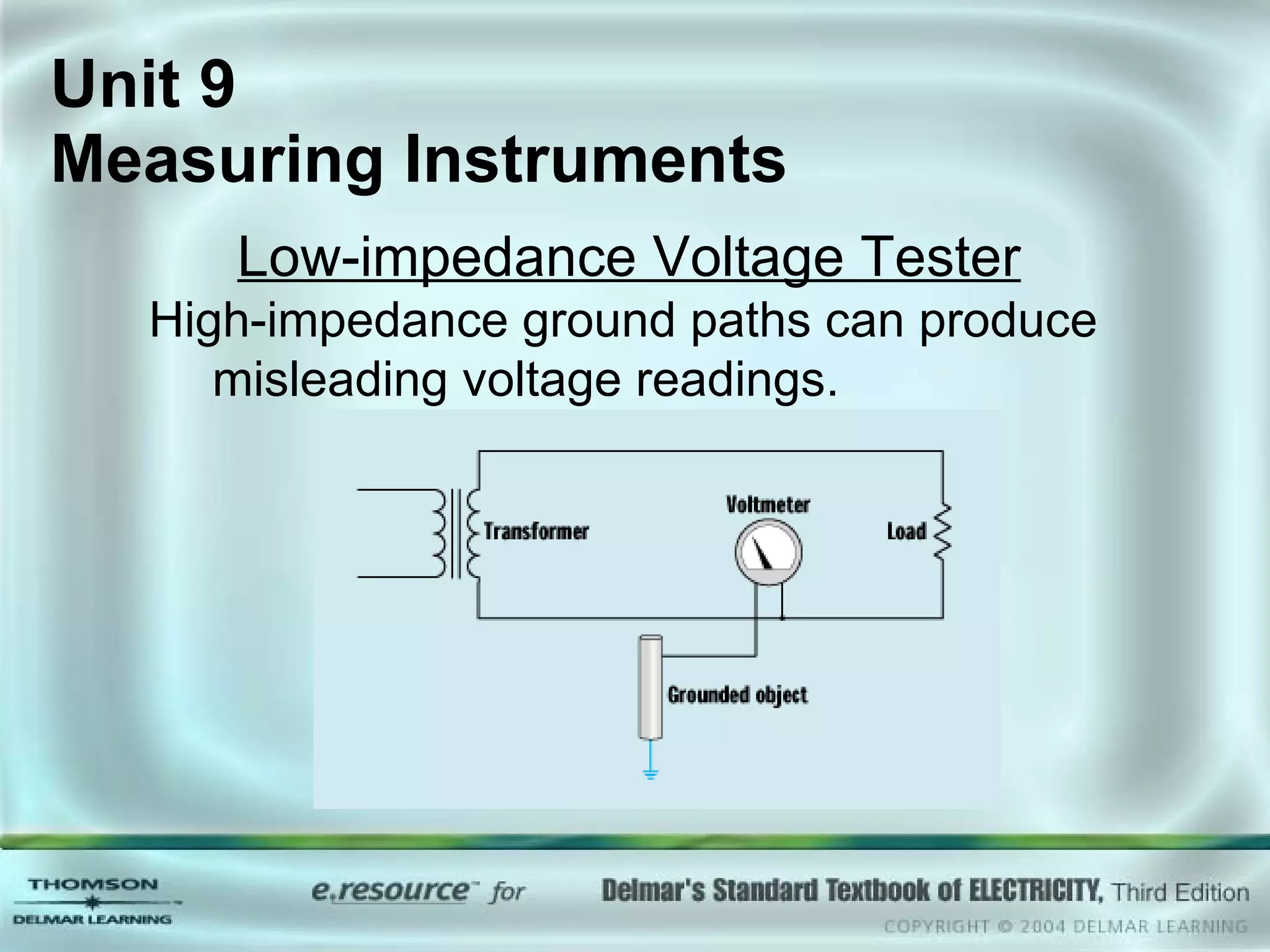
Unit 9  Measuring Instruments Low-impedance Voltage Tester High-impedance ground paths can produce misleading voltage readings.
Unit 9  Measuring Instruments Low-impedance Voltage Tester
Unit 9  Measuring Instruments Reading a Digital Meter Many digital meters are auto-ranging, which means that they select the range scale automatically. This type will display a notation beside the numerical digits to indicate the meter scale.
Unit 9  Measuring Instruments Review: The d’Arsonval movement is one of the common types of meters. The d’Arsonval movement operates only on DC currents or rectified AC current. Voltmeters have a high resistance and are designed to be connected directly across the power line.
Unit 9  Measuring Instruments Review: Ammeters have a low resistance and must be connected in series with a load. Shunts are used to change the value of DC ammeters. Clamp-on ammeters read only one conductor at a time.
Unit 9  Measuring Instruments Review: 7.  Ohmmeters are used to measure the resistance in a circuit. 8.  There are two basic types of Ohmmeters: analog and digital. 9.  Ohmmeters must never be connected to a circuit that has power applied to it.
Unit 9  Measuring Instruments Review: 10. Digital multimeters display their value in digits instead of using a meter movement. 11. Digital ohmmeters measure resistance by measuring the voltage drop across an unknown resistor when a known amount of current flows through it.
Unit 9  Measuring Instruments Review: 12. Low-impedance voltage testers (solenoid type) are not susceptible to indicating a negligible voltage caused by a high-impedance ground or feedback.

Unit 09

  • 1.
    Unit 9 Measuring Instruments Objectives: Discuss the operation of a d’Arsonval meter movement. Connect a voltmeter to a circuit. Read an analog multimeter. Connect an ammeter. Measure resistance using an ohmmeter.
  • 2.
    Unit 9 Measuring Instruments Analog meters are characterized by the fact that they use a pointer and scale to indicate their value. One of the common types of meters uses the d’Arsonval type of meter movement. Analog meters use a moving coil placed between the poles of a magnet.
  • 3.
    Basic d’Arsonval metermovement. Unit 9 Measuring Instruments
  • 4.
    Basic d’Arsonval metermovement with rectifier to change AC voltage to DC voltage. Unit 9 Measuring Instruments
  • 5.
    The voltmeter is designed to be connected directly across the source of power. Unit 9 Measuring Instruments
  • 6.
    Reading an analogmeter is similar to reading a speedometer or fuel gauge. Unit 9 Measuring Instruments
  • 7.
    The ammeter is used to measure current and must be connected in series with the load to permit the load to limit the current flow. Unit 9 Measuring Instruments
  • 8.
    Unit 9 Measuring Instruments A shunt is used to set the value of the ammeter.
  • 9.
    Unit 9 Measuring Instruments Many electricians use the clamp-on type of AC ammeter. Please note the clamp-on ammeter reads only one conductor at a time.
  • 10.
    Unit 9 Measuring Instruments Ohmmeters The ohmmeter is used to measure resistance. There are two basic types: analog or digital. The common VOM (volt-ohm-milliammeter) contains an ohmmeter. An ohmmeter should always be readjusted to zero when the scale is changed.
  • 11.
    Unit 9 Measuring Instruments Digital Ohmmeters Digital ohmmeters display the resistance in figures instead of using a meter movement. They operate by measuring the voltage drop across a resistor. The ohmmeter, whether digital or analog, must never be connected to a circuit when the power is turned on!
  • 12.
    Unit 9 Measuring Instruments Digital Ohmmeter
  • 13.
    Unit 9 Measuring Instruments Digital Voltmeter
  • 14.
    Unit 9 Measuring Instruments Low-impedance Voltage Tester The low-impedance voltage tester has a very large current draw compared to other types of voltmeters and should never be used to test low-power circuits.
  • 15.
    Unit 9 Measuring Instruments Low-impedance Voltage Tester This tester has an impedance of 5000 Ω and can generally be used to measure voltages as high as 600 V.
  • 16.
    Unit 9 Measuring Instruments Low-impedance Voltage Tester This is also known as a solenoid type tester. This tester is not susceptible to giving the misleading voltage readings caused by high-impedance ground paths or feedback voltages.
  • 17.
    Unit 9 Measuring Instruments Low-impedance Voltage Tester High-impedance ground paths can produce misleading voltage readings.
  • 18.
    Unit 9 Measuring Instruments Low-impedance Voltage Tester
  • 19.
    Unit 9 Measuring Instruments Reading a Digital Meter Many digital meters are auto-ranging, which means that they select the range scale automatically. This type will display a notation beside the numerical digits to indicate the meter scale.
  • 20.
    Unit 9 Measuring Instruments Review: The d’Arsonval movement is one of the common types of meters. The d’Arsonval movement operates only on DC currents or rectified AC current. Voltmeters have a high resistance and are designed to be connected directly across the power line.
  • 21.
    Unit 9 Measuring Instruments Review: Ammeters have a low resistance and must be connected in series with a load. Shunts are used to change the value of DC ammeters. Clamp-on ammeters read only one conductor at a time.
  • 22.
    Unit 9 Measuring Instruments Review: 7. Ohmmeters are used to measure the resistance in a circuit. 8. There are two basic types of Ohmmeters: analog and digital. 9. Ohmmeters must never be connected to a circuit that has power applied to it.
  • 23.
    Unit 9 Measuring Instruments Review: 10. Digital multimeters display their value in digits instead of using a meter movement. 11. Digital ohmmeters measure resistance by measuring the voltage drop across an unknown resistor when a known amount of current flows through it.
  • 24.
    Unit 9 Measuring Instruments Review: 12. Low-impedance voltage testers (solenoid type) are not susceptible to indicating a negligible voltage caused by a high-impedance ground or feedback.