

EXPERT SYSTEMS AND SOLUTIONS
     Email: expertsyssol@gmail.com
        expertsyssol@yahoo.com
          Cell: 9952749533
     www.researchprojects.info
    PAIYANOOR, OMR, CHENNAI
 Call For Research Projects          Final
 year students of B.E in EEE, ECE,
    EI, M.E (Power Systems), M.E
  (Applied Electronics), M.E (Power
              Electronics)
  Ph.D Electrical and Electronics.
Students can assemble their hardware in our
 Research labs. Experts will be guiding the
                 projects.
EI1361-MEASUREMENT
AND INSTRUMENTATION

        -C. KAMALA KANNAN
                 Lecturer/EEE
UNIT - 2
ELECTRICAL AND ELECTRONICS INSTRUMENTS
Principle and types of analog voltmeters
Principle and types of digital voltmeters
Principle and types of Multimeter
Single and three phase wattmeter
Single and three phase energy meters.
Magnetic measurements
Determination of B-H curve
Measurements of iron loss
Instrument transformers
Instruments for measurement of frequency and phase

                                                     3
Analog Instruments
 An analog device is one in which the
  output or display is a continuous function
  of time and bears a constant relation to its
  input.
Classification
 Classified based upon the quantity they measure
  (ammeter, voltmeter)
 Classified according to the current that can be
  measured by them.(DC,AC)
 Classified according to the effects used for
  working.
 Classified as Indicating, Recording, Integrating.
 Classified on the basis of method used for
  comparing the unknown quantity. (Direct /
  Comparison measurement )
Principle of operation
 Magnetic Effect.
 Thermal Effect.
 Electrostatic Effect
 Induction Effect.
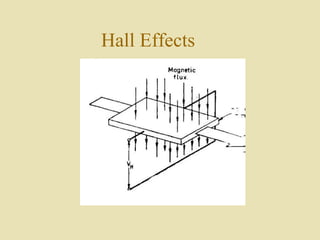
 Hall Effect.
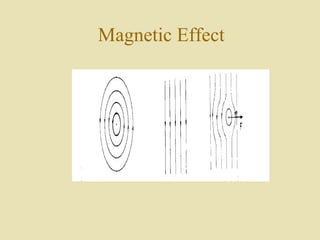
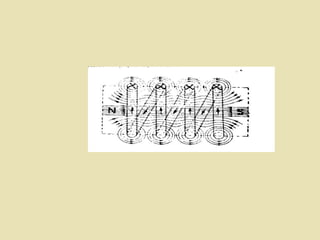
Magnetic Effect
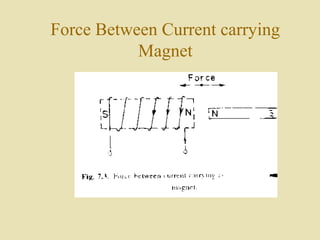
Force Between Current carrying
           Magnet
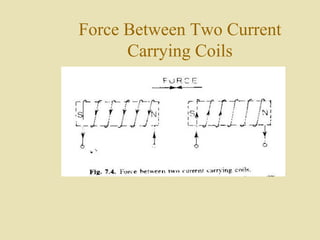
Force Between Two Current
      Carrying Coils
Hall Effects
Operating Forces
 Deflecting Force.
 Controlling Force.
 Damping Force.
Supporting the moving element
 Suspension
 Taut Suspension
 Pivot and jewel bearings.
Control Systems
 Gravity Control.
 Spring Control.
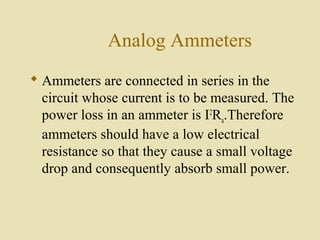
Analog Ammeters
 Ammeters are connected in series in the
  circuit whose current is to be measured. The
  power loss in an ammeter is I2Ra.Therefore
  ammeters should have a low electrical
  resistance so that they cause a small voltage
  drop and consequently absorb small power.
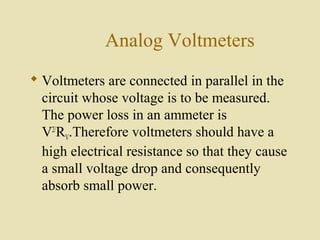
Analog Voltmeters
 Voltmeters are connected in parallel in the
  circuit whose voltage is to be measured.
  The power loss in an ammeter is
  V2/RV.Therefore voltmeters should have a
  high electrical resistance so that they cause
  a small voltage drop and consequently
  absorb small power.
Types of Instruments
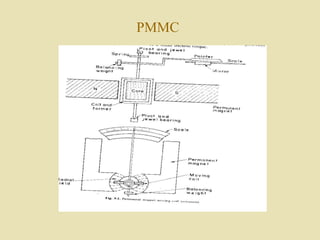
 Permanent magnet moving coil (PMMC).
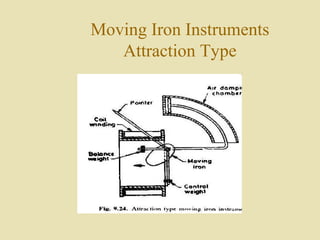
 Moving Iron
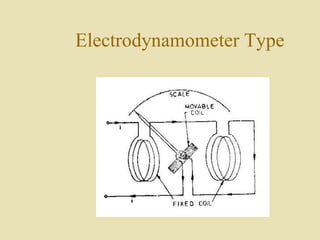
 Electro-dynamometer type.
 Hot wire type.
 Thermocouple type.
 Induction type.
 Electrostatic type.
 Rectifier type.
PMMC
Moving Iron Instruments
   Attraction Type
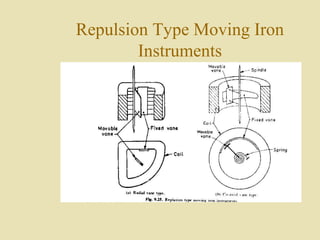
Repulsion Type Moving Iron
        Instruments
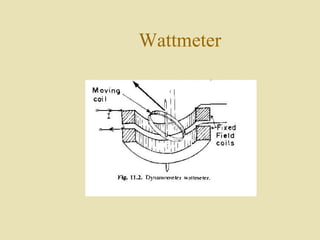
Electrodynamometer Type
Wattmeter
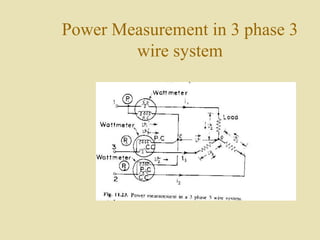
Power Measurement in 3 phase 3
        wire system
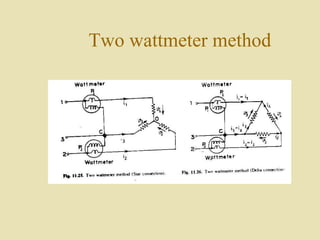
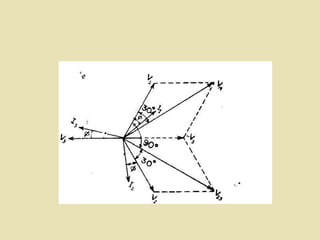
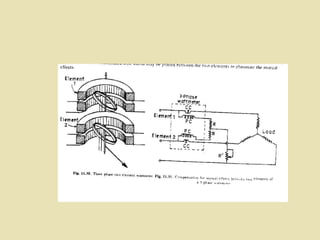
Two wattmeter method
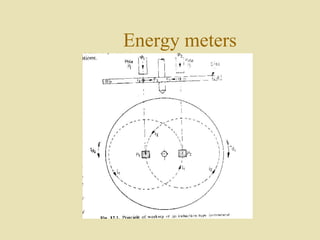
Energy meters
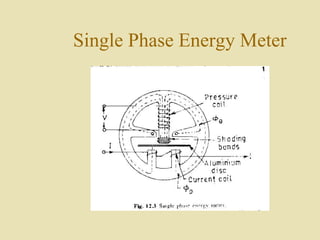
Single Phase Energy Meter
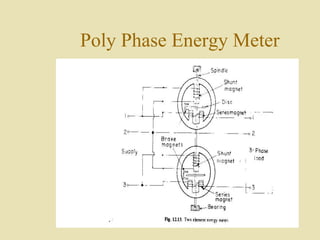
Poly Phase Energy Meter
THANK YOU

M.E projects call 9952749533

  • 1.
    EXPERT SYSTEMS ANDSOLUTIONS Email: expertsyssol@gmail.com expertsyssol@yahoo.com Cell: 9952749533 www.researchprojects.info PAIYANOOR, OMR, CHENNAI Call For Research Projects Final year students of B.E in EEE, ECE, EI, M.E (Power Systems), M.E (Applied Electronics), M.E (Power Electronics) Ph.D Electrical and Electronics. Students can assemble their hardware in our Research labs. Experts will be guiding the projects.
  • 2.
    EI1361-MEASUREMENT AND INSTRUMENTATION -C. KAMALA KANNAN Lecturer/EEE
  • 3.
    UNIT - 2 ELECTRICALAND ELECTRONICS INSTRUMENTS Principle and types of analog voltmeters Principle and types of digital voltmeters Principle and types of Multimeter Single and three phase wattmeter Single and three phase energy meters. Magnetic measurements Determination of B-H curve Measurements of iron loss Instrument transformers Instruments for measurement of frequency and phase 3
  • 4.
    Analog Instruments  Ananalog device is one in which the output or display is a continuous function of time and bears a constant relation to its input.
  • 5.
    Classification  Classified basedupon the quantity they measure (ammeter, voltmeter)  Classified according to the current that can be measured by them.(DC,AC)  Classified according to the effects used for working.  Classified as Indicating, Recording, Integrating.  Classified on the basis of method used for comparing the unknown quantity. (Direct / Comparison measurement )
  • 6.
    Principle of operation Magnetic Effect.  Thermal Effect.  Electrostatic Effect  Induction Effect.  Hall Effect.
  • 7.
  • 9.
    Force Between Currentcarrying Magnet
  • 10.
    Force Between TwoCurrent Carrying Coils
  • 11.
  • 12.
    Operating Forces  DeflectingForce.  Controlling Force.  Damping Force.
  • 13.
    Supporting the movingelement  Suspension  Taut Suspension  Pivot and jewel bearings.
  • 14.
    Control Systems  GravityControl.  Spring Control.
  • 15.
    Analog Ammeters  Ammetersare connected in series in the circuit whose current is to be measured. The power loss in an ammeter is I2Ra.Therefore ammeters should have a low electrical resistance so that they cause a small voltage drop and consequently absorb small power.
  • 16.
    Analog Voltmeters  Voltmetersare connected in parallel in the circuit whose voltage is to be measured. The power loss in an ammeter is V2/RV.Therefore voltmeters should have a high electrical resistance so that they cause a small voltage drop and consequently absorb small power.
  • 17.
    Types of Instruments Permanent magnet moving coil (PMMC).  Moving Iron  Electro-dynamometer type.  Hot wire type.  Thermocouple type.  Induction type.  Electrostatic type.  Rectifier type.
  • 18.
  • 19.
    Moving Iron Instruments Attraction Type
  • 20.
    Repulsion Type MovingIron Instruments
  • 21.
  • 22.
  • 23.
    Power Measurement in3 phase 3 wire system
  • 24.
  • 27.
  • 28.
  • 29.
  • 30.