Qualitative Research: Data Analysis and Interpretation Guess what? There are no formulae or steps for analysing and interpreting Qualitative Research data
However, here are some suggestions to use most of your data First,  data analysis  is our attempt to  summarize  collected data in a dependable and accurate manner Secondly,  data interpretation  is our attempt to find  meaning  in the data, or making sense of the data
When analysing and interpreting qualitative data:  Challenge yourself to explore  every possible angle and try to find patterns and seek out new understandings among the data
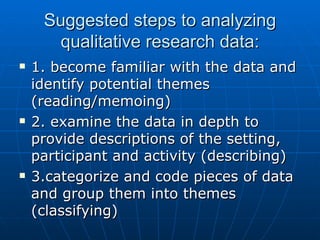
Suggested steps to analyzing qualitative research data: 1. become familiar with the data and identify potential themes (reading/memoing) 2. examine the data in depth to provide descriptions of the setting, participant and activity (describing) 3.categorize and code pieces of data  and group them into themes (classifying)
Remember it is your ability to: Think Imagine Create Intuit Analyze … that guides the data analysis
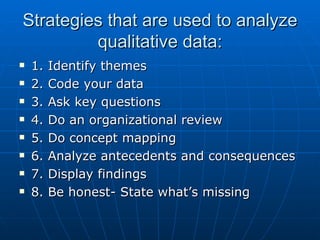
Strategies that are used to analyze qualitative data: 1. Identify themes 2. Code your data 3. Ask key questions 4. Do an organizational review 5. Do concept mapping 6. Analyze antecedents and consequences 7. Display findings 8. Be honest- State what’s missing
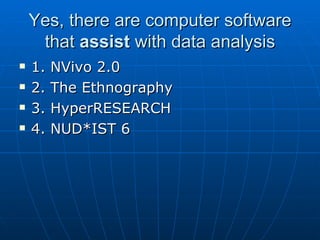
Yes, there are computer software that  assist  with data analysis 1. NVivo 2.0 2. The Ethnography 3. HyperRESEARCH 4. NUD*IST 6
These software  help -   they don’t do the work or replace your abilities To think Summarize Analyze Infer *Perhaps, they are most helpful in storing, helping you to manipulate and retrieving data
Strategies for Data Interpretation: 1. Extend the analysis- question your study 2.  Connect findings with personal experiences 3. Seek advice from “critical” friends 4. Contextualize findings in the literature
5. Turn to theory as a means to: link to broader issues, move away from a purely descriptive account, and providing a rational for your work 6. Know  when  to offer an interpretation from the data Note: it is rare for qualitative researchers to use all of their data for the task is to identify important themes or meanings, not necessarily including every theme
To ensure credibility ask: 1. Are the data based on observation or hearsay? 2. Is there corroboration by others for the observations? 3. Within what context was the observation made or reported?
4. How reliable were the people providing the data? 5. What motivations might have influenced a participant’s report? 6. What biases might have influenced how an observation was made or reported?
Lastly, as a qualitative researcher you should: Share your interpretations wisely Avoid being evangelical Provide a clear link between data collection, analysis, and interpretation

Emil Pulido on Qualitative Research: Analyzing Qualitative Data

  • 1.
    Qualitative Research: DataAnalysis and Interpretation Guess what? There are no formulae or steps for analysing and interpreting Qualitative Research data
  • 2.
    However, here aresome suggestions to use most of your data First, data analysis is our attempt to summarize collected data in a dependable and accurate manner Secondly, data interpretation is our attempt to find meaning in the data, or making sense of the data
  • 3.
    When analysing andinterpreting qualitative data: Challenge yourself to explore every possible angle and try to find patterns and seek out new understandings among the data
  • 4.
    Suggested steps toanalyzing qualitative research data: 1. become familiar with the data and identify potential themes (reading/memoing) 2. examine the data in depth to provide descriptions of the setting, participant and activity (describing) 3.categorize and code pieces of data and group them into themes (classifying)
  • 5.
    Remember it isyour ability to: Think Imagine Create Intuit Analyze … that guides the data analysis
  • 6.
    Strategies that areused to analyze qualitative data: 1. Identify themes 2. Code your data 3. Ask key questions 4. Do an organizational review 5. Do concept mapping 6. Analyze antecedents and consequences 7. Display findings 8. Be honest- State what’s missing
  • 7.
    Yes, there arecomputer software that assist with data analysis 1. NVivo 2.0 2. The Ethnography 3. HyperRESEARCH 4. NUD*IST 6
  • 8.
    These software help - they don’t do the work or replace your abilities To think Summarize Analyze Infer *Perhaps, they are most helpful in storing, helping you to manipulate and retrieving data
  • 9.
    Strategies for DataInterpretation: 1. Extend the analysis- question your study 2. Connect findings with personal experiences 3. Seek advice from “critical” friends 4. Contextualize findings in the literature
  • 10.
    5. Turn totheory as a means to: link to broader issues, move away from a purely descriptive account, and providing a rational for your work 6. Know when to offer an interpretation from the data Note: it is rare for qualitative researchers to use all of their data for the task is to identify important themes or meanings, not necessarily including every theme
  • 11.
    To ensure credibilityask: 1. Are the data based on observation or hearsay? 2. Is there corroboration by others for the observations? 3. Within what context was the observation made or reported?
  • 12.
    4. How reliablewere the people providing the data? 5. What motivations might have influenced a participant’s report? 6. What biases might have influenced how an observation was made or reported?
  • 13.
    Lastly, as aqualitative researcher you should: Share your interpretations wisely Avoid being evangelical Provide a clear link between data collection, analysis, and interpretation