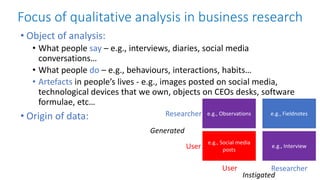
Focus of qualitative analysis in business research
• Object of analysis:
• What people say – e.g., interviews, diaries, social media
conversations…
• What people do – e.g., behaviours, interactions, habits…
• Artefacts in people’s lives - e.g., images posted on social media,
technological devices that we own, objects on CEOs desks, software
formulae, etc…
• Origin of data: e.g., Observations e.g., Fieldnotes
e.g., Social media
posts
e.g., Interview
Instigated
Generated
User Researcher
User
Researcher
Role of qualitative analysis in business research
• Benefits:
• Broad range of applications
• Richness of insight – may include quantification (e.g., wordclouds)
• Opportunity for holistic understanding of participants and their context
• Opportunities for triangulation
• Challenges:
• Volume of data to analyse => Is there such a thing as saturation?
• Variety of data to analyse => Varying levels of subjectivity in analysis
• No off-the-shelf procedure to analyse data=> depends on the specific
genre of qualitative research
Genres of qualitative research
• There are, broadly speaking, 5 different genres of qualitative
research (Sarker et al, 2018)
• Reflecting different view of:
• Data
• Role of theory in the study
• Requiring different approaches to analyzing the data
Genres of qualitative research
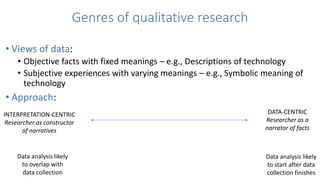
• Views of data:
• Objective facts with fixed meanings – e.g., Descriptions of technology
• Subjective experiences with varying meanings – e.g., Symbolic meaning of
technology
• Approach:
DATA-CENTRIC
Researcher as a
narrator of facts
INTERPRETATION-CENTRIC
Researcher as constructor
of narratives
Data analysis likely
to start after data
collection finishes
Data analysis likely
to overlap with
data collection
Genres of qualitative research
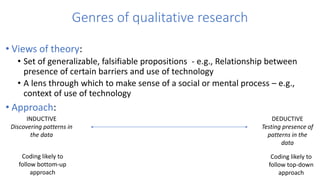
• Views of theory:
• Set of generalizable, falsifiable propositions - e.g., Relationship between
presence of certain barriers and use of technology
• A lens through which to make sense of a social or mental process – e.g.,
context of use of technology
• Approach:
DEDUCTIVE
Testing presence of
patterns in the
data
INDUCTIVE
Discovering patterns in
the data
Coding likely to
follow top-down
approach
Coding likely to
follow bottom-up
approach
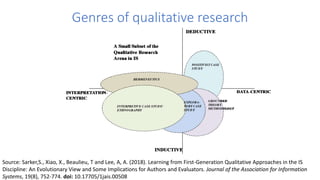
Genres of qualitative research
Source: Sarker,S., Xiao, X., Beaulieu, T and Lee, A, A. (2018). Learning from First-Generation Qualitative Approaches in the IS
Discipline: An Evolutionary View and Some Implications for Authors and Evaluators. Journal of the Association for Information
Systems, 19(8), 752-774. doi: 10.17705/1jais.00508
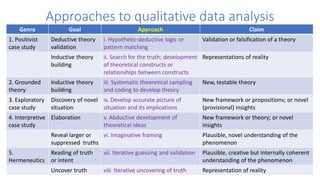
Approaches to data analysis
Genre Goal Approach Claim
1. Positivist
case study
Deductive theory
validation
i. Hypothetic-deductive logic or
pattern matching
Validation or falsification of a theory
Inductive theory
building
ii. Search for the truth; development
of theoretical constructs or
relationships between constructs
Representations of reality
2. Grounded
theory
Inductive theory
building
iii. Systematic theoretical sampling
and coding to develop theory
New, testable theory
3. Exploratory
case study
Discovery of novel
situation
iv. Develop accurate picture of
situation and its implications
New framework or propositions; or novel
(provisional) insights
4. Interpretive
case study
Elaboration v. Abductive development of
theoretical ideas
New framework or theory; or novel
insights
Reveal larger or
suppressed truths
vi. Imaginative framing Plausible, novel understanding of the
phenomenon
5.
Hermeneutics
Reading of truth
or intent
vii. Iterative guessing and validation Plausible, creative but internally coherent
understanding of the phenomenon
Uncover truth viii. Iterative uncovering of truth Representation of reality
Approaches to qualitative data analysis
Steps in qualitative research
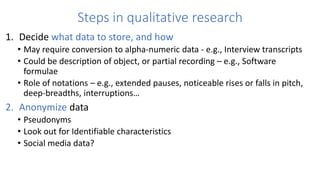
1. Decide what data to store, and how
• May require conversion to alpha-numeric data - e.g., Interview transcripts
• Could be description of object, or partial recording – e.g., Software
formulae
• Role of notations – e.g., extended pauses, noticeable rises or falls in pitch,
deep-breadths, interruptions…
2. Anonymize data
• Pseudonyms
• Look out for Identifiable characteristics
• Social media data?
Steps in qualitative research
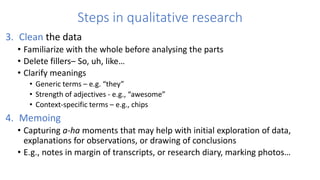
3. Clean the data
• Familiarize with the whole before analysing the parts
• Delete fillers– So, uh, like…
• Clarify meanings
• Generic terms – e.g. “they”
• Strength of adjectives - e.g., “awesome”
• Context-specific terms – e.g., chips
4. Memoing
• Capturing a-ha moments that may help with initial exploration of data,
explanations for observations, or drawing of conclusions
• E.g., notes in margin of transcripts, or research diary, marking photos…
Steps in qualitative research
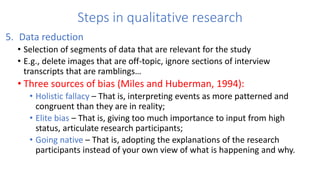
5. Data reduction
• Selection of segments of data that are relevant for the study
• E.g., delete images that are off-topic, ignore sections of interview
transcripts that are ramblings…
• Three sources of bias (Miles and Huberman, 1994):
• Holistic fallacy – That is, interpreting events as more patterned and
congruent than they are in reality;
• Elite bias – That is, giving too much importance to input from high
status, articulate research participants;
• Going native – That is, adopting the explanations of the research
participants instead of your own view of what is happening and why.
Steps in qualitative research
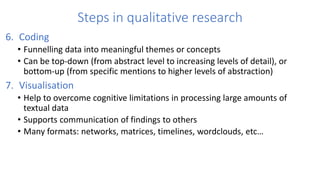
6. Coding
• Funnelling data into meaningful themes or concepts
• Can be top-down (from abstract level to increasing levels of detail), or
bottom-up (from specific mentions to higher levels of abstraction)
7. Visualisation
• Help to overcome cognitive limitations in processing large amounts of
textual data
• Supports communication of findings to others
• Many formats: networks, matrices, timelines, wordclouds, etc…
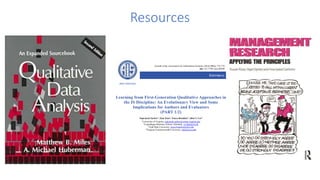
Resources
ISSN 1536-9323
Journal of the Association for Information Systems (2018) 19(8), 752-774
doi: 10.17705/1jais.00508
EDITORIAL
Learning from First-Generation Qualitative Approaches in
the IS Discipline: An Evolutionary View and Some
Implications for Authors and Evaluators
(PART 1/2)
Suprateek Sarker1
, Xiao Xiao2
, Tanya Beaulieu3
, Allen S. Lee4
1
University of Virginia, suprateek.sarker@comm.virginia.edu
2
Copenhagen Business School, Denmark, xx.digi@cbs.dk
3
Utah State University, tanya.beaulieu@usu.edu
4
Virginia Commonwealth University, aslee@vcu.edu
Abstract
Qualitative research in the information systems (IS) discipline has come a long way, from being
dismissed as “exploratory research” or “preresearch,” not worthy of being featured in “scientific”
and authoritative journals in the discipline, to a state where such research is seen as legitimate and
even welcome scholarship within much of the mainstream IS research community. Despite these
very positive developments in line with the value of pluralism that our discipline has embraced, and
the gradual inclusion of qualitative work in high-profile mainstream outlets, recent editorials have
expressed concerns regarding the research community’s lack of awareness about the diverse nature
of qualitative research and the apparent confusion regarding how these diverse approaches are
different. Such confusion has led to a mismatch between the methodology-related expectations of
evaluators and the methodological description provided by the authors (Conboy et al. 2012; Sarker
et al. 2013a). To help make sense of the situation, in this editorial, we offer a critical commentary
on the arena of qualitative research in the IS discipline. In viewing the adoption of qualitative
research in the IS discipline as an evolutionary process, by highlighting key differences among
various types of qualitative inquiry, and by drawing attention to lessons learned from the first-

MCB Qualitative Analysis Workshop

  • 2.
    Focus of qualitativeanalysis in business research • Object of analysis: • What people say – e.g., interviews, diaries, social media conversations… • What people do – e.g., behaviours, interactions, habits… • Artefacts in people’s lives - e.g., images posted on social media, technological devices that we own, objects on CEOs desks, software formulae, etc… • Origin of data: e.g., Observations e.g., Fieldnotes e.g., Social media posts e.g., Interview Instigated Generated User Researcher User Researcher
  • 3.
    Role of qualitativeanalysis in business research • Benefits: • Broad range of applications • Richness of insight – may include quantification (e.g., wordclouds) • Opportunity for holistic understanding of participants and their context • Opportunities for triangulation • Challenges: • Volume of data to analyse => Is there such a thing as saturation? • Variety of data to analyse => Varying levels of subjectivity in analysis • No off-the-shelf procedure to analyse data=> depends on the specific genre of qualitative research
  • 4.
    Genres of qualitativeresearch • There are, broadly speaking, 5 different genres of qualitative research (Sarker et al, 2018) • Reflecting different view of: • Data • Role of theory in the study • Requiring different approaches to analyzing the data
  • 5.
    Genres of qualitativeresearch • Views of data: • Objective facts with fixed meanings – e.g., Descriptions of technology • Subjective experiences with varying meanings – e.g., Symbolic meaning of technology • Approach: DATA-CENTRIC Researcher as a narrator of facts INTERPRETATION-CENTRIC Researcher as constructor of narratives Data analysis likely to start after data collection finishes Data analysis likely to overlap with data collection
  • 6.
    Genres of qualitativeresearch • Views of theory: • Set of generalizable, falsifiable propositions - e.g., Relationship between presence of certain barriers and use of technology • A lens through which to make sense of a social or mental process – e.g., context of use of technology • Approach: DEDUCTIVE Testing presence of patterns in the data INDUCTIVE Discovering patterns in the data Coding likely to follow top-down approach Coding likely to follow bottom-up approach
  • 7.
    Genres of qualitativeresearch Source: Sarker,S., Xiao, X., Beaulieu, T and Lee, A, A. (2018). Learning from First-Generation Qualitative Approaches in the IS Discipline: An Evolutionary View and Some Implications for Authors and Evaluators. Journal of the Association for Information Systems, 19(8), 752-774. doi: 10.17705/1jais.00508
  • 8.
    Approaches to dataanalysis Genre Goal Approach Claim 1. Positivist case study Deductive theory validation i. Hypothetic-deductive logic or pattern matching Validation or falsification of a theory Inductive theory building ii. Search for the truth; development of theoretical constructs or relationships between constructs Representations of reality 2. Grounded theory Inductive theory building iii. Systematic theoretical sampling and coding to develop theory New, testable theory 3. Exploratory case study Discovery of novel situation iv. Develop accurate picture of situation and its implications New framework or propositions; or novel (provisional) insights 4. Interpretive case study Elaboration v. Abductive development of theoretical ideas New framework or theory; or novel insights Reveal larger or suppressed truths vi. Imaginative framing Plausible, novel understanding of the phenomenon 5. Hermeneutics Reading of truth or intent vii. Iterative guessing and validation Plausible, creative but internally coherent understanding of the phenomenon Uncover truth viii. Iterative uncovering of truth Representation of reality Approaches to qualitative data analysis
  • 9.
    Steps in qualitativeresearch 1. Decide what data to store, and how • May require conversion to alpha-numeric data - e.g., Interview transcripts • Could be description of object, or partial recording – e.g., Software formulae • Role of notations – e.g., extended pauses, noticeable rises or falls in pitch, deep-breadths, interruptions… 2. Anonymize data • Pseudonyms • Look out for Identifiable characteristics • Social media data?
  • 10.
    Steps in qualitativeresearch 3. Clean the data • Familiarize with the whole before analysing the parts • Delete fillers– So, uh, like… • Clarify meanings • Generic terms – e.g. “they” • Strength of adjectives - e.g., “awesome” • Context-specific terms – e.g., chips 4. Memoing • Capturing a-ha moments that may help with initial exploration of data, explanations for observations, or drawing of conclusions • E.g., notes in margin of transcripts, or research diary, marking photos…
  • 11.
    Steps in qualitativeresearch 5. Data reduction • Selection of segments of data that are relevant for the study • E.g., delete images that are off-topic, ignore sections of interview transcripts that are ramblings… • Three sources of bias (Miles and Huberman, 1994): • Holistic fallacy – That is, interpreting events as more patterned and congruent than they are in reality; • Elite bias – That is, giving too much importance to input from high status, articulate research participants; • Going native – That is, adopting the explanations of the research participants instead of your own view of what is happening and why.
  • 12.
    Steps in qualitativeresearch 6. Coding • Funnelling data into meaningful themes or concepts • Can be top-down (from abstract level to increasing levels of detail), or bottom-up (from specific mentions to higher levels of abstraction) 7. Visualisation • Help to overcome cognitive limitations in processing large amounts of textual data • Supports communication of findings to others • Many formats: networks, matrices, timelines, wordclouds, etc…
  • 13.
    Resources ISSN 1536-9323 Journal ofthe Association for Information Systems (2018) 19(8), 752-774 doi: 10.17705/1jais.00508 EDITORIAL Learning from First-Generation Qualitative Approaches in the IS Discipline: An Evolutionary View and Some Implications for Authors and Evaluators (PART 1/2) Suprateek Sarker1 , Xiao Xiao2 , Tanya Beaulieu3 , Allen S. Lee4 1 University of Virginia, suprateek.sarker@comm.virginia.edu 2 Copenhagen Business School, Denmark, xx.digi@cbs.dk 3 Utah State University, tanya.beaulieu@usu.edu 4 Virginia Commonwealth University, aslee@vcu.edu Abstract Qualitative research in the information systems (IS) discipline has come a long way, from being dismissed as “exploratory research” or “preresearch,” not worthy of being featured in “scientific” and authoritative journals in the discipline, to a state where such research is seen as legitimate and even welcome scholarship within much of the mainstream IS research community. Despite these very positive developments in line with the value of pluralism that our discipline has embraced, and the gradual inclusion of qualitative work in high-profile mainstream outlets, recent editorials have expressed concerns regarding the research community’s lack of awareness about the diverse nature of qualitative research and the apparent confusion regarding how these diverse approaches are different. Such confusion has led to a mismatch between the methodology-related expectations of evaluators and the methodological description provided by the authors (Conboy et al. 2012; Sarker et al. 2013a). To help make sense of the situation, in this editorial, we offer a critical commentary on the arena of qualitative research in the IS discipline. In viewing the adoption of qualitative research in the IS discipline as an evolutionary process, by highlighting key differences among various types of qualitative inquiry, and by drawing attention to lessons learned from the first-