RESEARCH METHODS
WORKSHOP

DATA ANALYSIS:
HINTS AND TIPS


25th May 2011
Katrina Pritchard
DATA ANALYSIS HINTS AND TIPS

This presentation:


  Planning your approach to analysis

  Getting started with data analysis

  Specific hints and tips for analysing interviews

  Questions?
PLANNING YOUR APPROACH TO ANALYSIS
 What types of empirical research have been carried out in your area of
 interest?
    Does one type dominate? e.g. case studies? survey research?
    READ empirical papers and particularly note limitations and issues raised.
    Ensure you read BOTH quantitative and qualitative examples and get a
    sense of how these differ with respect to your topic.

 What techniques do YOU feel most comfortable using or have
 experience with?
 What is implied in the wording of your research question(s)?
    e.g. how vs. how many

 What actual data have you collected/are collecting?
    PRIMARY DATA and/or SECONDARY DATA
    QUANTITATIVE and/or QUALITATIVE DATA
PLANNING YOUR APPROACH TO ANALYSIS

 All research is underpinned by a set of assumptions about
 reality (ontological assumptions) and the way in which
 reality can be known (epistemological assumptions).

 Without going to far into the philosophical debate, you
 should at the very least ask yourself:
   What are my assumptions about the phenomena I am researching?
   (e.g. a fixed characteristic or contextually dependent?)
   What are my assumptions about the way in which I can best access
   these phenomena? (e.g. it is waiting to be measured or is
   constructed through the research?)
   What is my role as a researcher in respect to this process? (e.g. what
   impact to I have on these phenomena?)
PLANNING YOUR APPROACH TO ANALYSIS

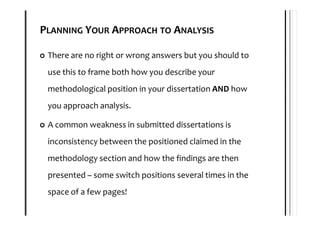
 There are no right or wrong answers but you should to
 use this to frame both how you describe your
 methodological position in your dissertation AND how
 you approach analysis.

 A common weakness in submitted dissertations is
 inconsistency between the positioned claimed in the
 methodology section and how the findings are then
 presented – some switch positions several times in the
 space of a few pages!
PLANNING YOUR APPROACH TO ANALYSIS
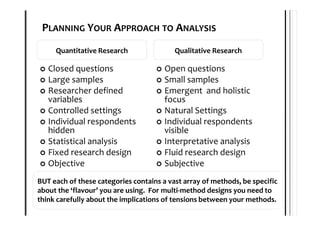
     Quantitative Research                Qualitative Research

   Closed questions                    Open questions
   Large samples                       Small samples
   Researcher defined                  Emergent and holistic
   variables                           focus
   Controlled settings                 Natural Settings
   Individual respondents              Individual respondents
   hidden                              visible
   Statistical analysis                Interpretative analysis
   Fixed research design               Fluid research design
   Objective                           Subjective
BUT each of these categories contains a vast array of methods, be specific
about the ‘flavour’ you are using. For multi-method designs you need to
think carefully about the implications of tensions between your methods.
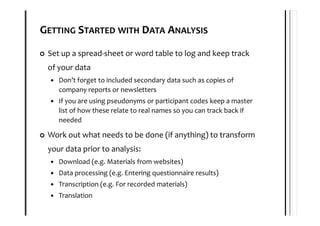
GETTING STARTED WITH DATA ANALYSIS
 Set up a spread-sheet or word table to log and keep track
 of your data
    Don’t forget to included secondary data such as copies of
    company reports or newsletters
    If you are using pseudonyms or participant codes keep a master
    list of how these relate to real names so you can track back if
    needed

 Work out what needs to be done (if anything) to transform
 your data prior to analysis:
    Download (e.g. Materials from websites)
    Data processing (e.g. Entering questionnaire results)
    Transcription (e.g. For recorded materials)
    Translation
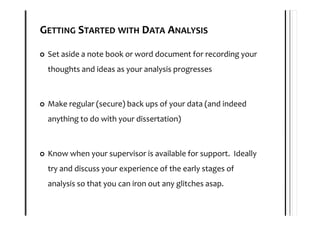
GETTING STARTED WITH DATA ANALYSIS

 Set aside a note book or word document for recording your
 thoughts and ideas as your analysis progresses


 Make regular (secure) back ups of your data (and indeed
 anything to do with your dissertation)


 Know when your supervisor is available for support. Ideally
 try and discuss your experience of the early stages of
 analysis so that you can iron out any glitches asap.
GETTING STARTED WITH DATA ANALYSIS
 Plan your overall approach but be prepared to play and test out
 ideas:
    Keep your research question(s) firmly in mind!
    Go back to the literature and/or organizational context to check the
    sense of your approach

 Work out the difference between DESCRIBING your data and
 ANALYSING it. A common weakness of submitted dissertations
 is the lack of actual analysis.
    For example: Seven people interviewed commented on the lack of
    managerial support for training but everyone else felt they could
    attend training when needed vs. There were conflicting views
    expressed with respect to opportunities for training. Those who
    commented on positive managerial support seem to suggest that
    this was.......
SPECIFIC HINTS AND TIPS FOR ANALYSING INTERVIEWS

 Analysing interviews means that you will need to:
    work with, and make sense of, large volumes of
    unstructured data

    go beyond description to generate insight

    weave a convincing story in respect to the research
    question posed

    critically appraise your own role in knowledge production
SPECIFIC HINTS AND TIPS FOR ANALYSING INTERVIEWS
 Most common method applied at MSc level is template/thematic
 analysis (see links posted on discussion board )
 Be careful of “coding fetishism” and remember that “coding is the
 first step to opening up meaning” not an end in itself
    Lyn Richards, Handling Qualitative Data: A Practical Guide 2005 – highly
    recommended, summary of notes posted on discussion board

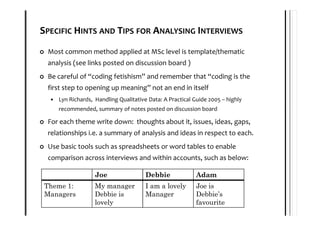
 For each theme write down: thoughts about it, issues, ideas, gaps,
 relationships i.e. a summary of analysis and ideas in respect to each.
 Use basic tools such as spreadsheets or word tables to enable
 comparison across interviews and within accounts, such as below:

                  Joe                 Debbie              Adam
 Theme 1:         My manager          I am a lovely       Joe is
 Managers         Debbie is           Manager             Debbie’s
                  lovely                                  favourite
SPECIFIC HINTS AND TIPS FOR ANALYSING INTERVIEWS

 You do not have to analyse everything – there will probably be
 too much data
 Avoid too much counting (three people said X vs. two people
 said Y) unless you are deliberately adopting an analytic approach
 of converting qualitative to quantitative data (usually done via
 content analysis)
 Think of interviews as a story told on a particular occasion rather
 than a list of facts. Often areas of confusion or contradiction can
 be analytically the most interesting so be very wary of classifying
 particular statements as ‘true’ or ‘false’
 Keep an eye on research ethics at all times (especially in terms of
 what you are revealing in your write up)
SPECIFIC HINTS AND TIPS FOR ANALYSING INTERVIEWS
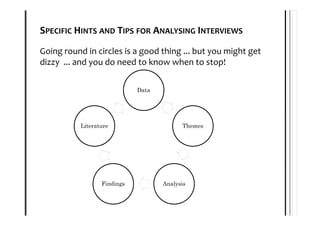
Going round in circles is a good thing ... but you might get
dizzy ... and you do need to know when to stop!

                             Data


           Literature                     Themes


                  Findings          Analysis
DATA ANALYSIS HINTS AND TIPS


 Planning your approach to analysis

 Getting Started with Data Analysis

 Specific Hints and Tips for analysing interviews

 Questions?
QUESTIONS?

Research methods workshop data analysis

  • 1.
    RESEARCH METHODS WORKSHOP DATA ANALYSIS: HINTSAND TIPS 25th May 2011 Katrina Pritchard
  • 2.
    DATA ANALYSIS HINTSAND TIPS This presentation: Planning your approach to analysis Getting started with data analysis Specific hints and tips for analysing interviews Questions?
  • 3.
    PLANNING YOUR APPROACHTO ANALYSIS What types of empirical research have been carried out in your area of interest? Does one type dominate? e.g. case studies? survey research? READ empirical papers and particularly note limitations and issues raised. Ensure you read BOTH quantitative and qualitative examples and get a sense of how these differ with respect to your topic. What techniques do YOU feel most comfortable using or have experience with? What is implied in the wording of your research question(s)? e.g. how vs. how many What actual data have you collected/are collecting? PRIMARY DATA and/or SECONDARY DATA QUANTITATIVE and/or QUALITATIVE DATA
  • 4.
    PLANNING YOUR APPROACHTO ANALYSIS All research is underpinned by a set of assumptions about reality (ontological assumptions) and the way in which reality can be known (epistemological assumptions). Without going to far into the philosophical debate, you should at the very least ask yourself: What are my assumptions about the phenomena I am researching? (e.g. a fixed characteristic or contextually dependent?) What are my assumptions about the way in which I can best access these phenomena? (e.g. it is waiting to be measured or is constructed through the research?) What is my role as a researcher in respect to this process? (e.g. what impact to I have on these phenomena?)
  • 5.
    PLANNING YOUR APPROACHTO ANALYSIS There are no right or wrong answers but you should to use this to frame both how you describe your methodological position in your dissertation AND how you approach analysis. A common weakness in submitted dissertations is inconsistency between the positioned claimed in the methodology section and how the findings are then presented – some switch positions several times in the space of a few pages!
  • 6.
    PLANNING YOUR APPROACHTO ANALYSIS Quantitative Research Qualitative Research Closed questions Open questions Large samples Small samples Researcher defined Emergent and holistic variables focus Controlled settings Natural Settings Individual respondents Individual respondents hidden visible Statistical analysis Interpretative analysis Fixed research design Fluid research design Objective Subjective BUT each of these categories contains a vast array of methods, be specific about the ‘flavour’ you are using. For multi-method designs you need to think carefully about the implications of tensions between your methods.
  • 7.
    GETTING STARTED WITHDATA ANALYSIS Set up a spread-sheet or word table to log and keep track of your data Don’t forget to included secondary data such as copies of company reports or newsletters If you are using pseudonyms or participant codes keep a master list of how these relate to real names so you can track back if needed Work out what needs to be done (if anything) to transform your data prior to analysis: Download (e.g. Materials from websites) Data processing (e.g. Entering questionnaire results) Transcription (e.g. For recorded materials) Translation
  • 8.
    GETTING STARTED WITHDATA ANALYSIS Set aside a note book or word document for recording your thoughts and ideas as your analysis progresses Make regular (secure) back ups of your data (and indeed anything to do with your dissertation) Know when your supervisor is available for support. Ideally try and discuss your experience of the early stages of analysis so that you can iron out any glitches asap.
  • 9.
    GETTING STARTED WITHDATA ANALYSIS Plan your overall approach but be prepared to play and test out ideas: Keep your research question(s) firmly in mind! Go back to the literature and/or organizational context to check the sense of your approach Work out the difference between DESCRIBING your data and ANALYSING it. A common weakness of submitted dissertations is the lack of actual analysis. For example: Seven people interviewed commented on the lack of managerial support for training but everyone else felt they could attend training when needed vs. There were conflicting views expressed with respect to opportunities for training. Those who commented on positive managerial support seem to suggest that this was.......
  • 10.
    SPECIFIC HINTS ANDTIPS FOR ANALYSING INTERVIEWS Analysing interviews means that you will need to: work with, and make sense of, large volumes of unstructured data go beyond description to generate insight weave a convincing story in respect to the research question posed critically appraise your own role in knowledge production
  • 11.
    SPECIFIC HINTS ANDTIPS FOR ANALYSING INTERVIEWS Most common method applied at MSc level is template/thematic analysis (see links posted on discussion board ) Be careful of “coding fetishism” and remember that “coding is the first step to opening up meaning” not an end in itself Lyn Richards, Handling Qualitative Data: A Practical Guide 2005 – highly recommended, summary of notes posted on discussion board For each theme write down: thoughts about it, issues, ideas, gaps, relationships i.e. a summary of analysis and ideas in respect to each. Use basic tools such as spreadsheets or word tables to enable comparison across interviews and within accounts, such as below: Joe Debbie Adam Theme 1: My manager I am a lovely Joe is Managers Debbie is Manager Debbie’s lovely favourite
  • 12.
    SPECIFIC HINTS ANDTIPS FOR ANALYSING INTERVIEWS You do not have to analyse everything – there will probably be too much data Avoid too much counting (three people said X vs. two people said Y) unless you are deliberately adopting an analytic approach of converting qualitative to quantitative data (usually done via content analysis) Think of interviews as a story told on a particular occasion rather than a list of facts. Often areas of confusion or contradiction can be analytically the most interesting so be very wary of classifying particular statements as ‘true’ or ‘false’ Keep an eye on research ethics at all times (especially in terms of what you are revealing in your write up)
  • 13.
    SPECIFIC HINTS ANDTIPS FOR ANALYSING INTERVIEWS Going round in circles is a good thing ... but you might get dizzy ... and you do need to know when to stop! Data Literature Themes Findings Analysis
  • 14.
    DATA ANALYSIS HINTSAND TIPS Planning your approach to analysis Getting Started with Data Analysis Specific Hints and Tips for analysing interviews Questions?
  • 15.