
Using Documentary Data Dr Kevin Morrell  www.kevinmorrell.org.uk
Session Overview What is ‘documentary data’? What are its advantages? What are the disadvantages? 2 approaches to analysing documentary data Example 1: content analysis of the questionnaire Example 2: narrative analysis of policy literature
Learning Objectives By the end of the session you will be familiar with some types of documents that can be used in organisational studies. You will be able to identify some of the advantages and disadvantages associated with using documentary data. You will have a basic understanding of two different approaches to analysing documents. You will be familiar with examples of: a content analysis and a narrative theory analysis. You will have tried analysing text using these two approaches.
What is documentary data?
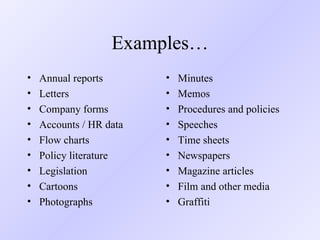
Examples… Annual reports Letters Company forms Accounts / HR data Flow charts Policy literature Legislation Cartoons Photographs Minutes Memos  Procedures and policies Speeches Time sheets Newspapers Magazine articles Film and other media Graffiti
Advantages   Disadvantages Unobtrusive and non-reactive (RWR:349) ‘ Given’ data Basis for triangulation Basis for comparison/contrast Encourage ingenuity Longitudinal aspect No influence on methods/methodology Difficult to identify author(s) Selection  Access/ethics considerations
Business historian or organizational theorist? Business historian:  an extensive trawl of a mass of documentation, less preoccupied with methodology Organizational theorist:  more intensive analysis with reference to a focused theme, topic or context, more concerned with methodological issues
2 approaches
Content analysis (from Robson RWR: 352-5) “ content analysis is  codified common sense  a refinement of ways that might be used by laypersons to describe and explain aspects of the world about them” (352)
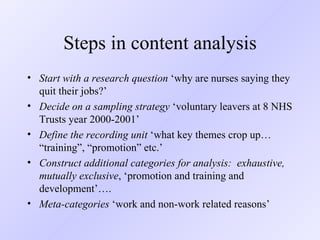
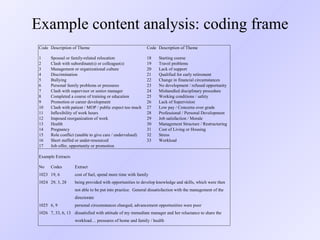
Steps in content analysis Start with a research question  ‘why are nurses saying they quit their jobs?’ Decide on a sampling strategy  ‘voluntary leavers at 8 NHS Trusts year 2000-2001’ Define the recording unit  ‘what key themes crop up… “training”, “promotion” etc.’ Construct additional categories for analysis:  exhaustive, mutually exclusive , ‘promotion and training and development’….  Meta-categories  ‘work and non-work related reasons’
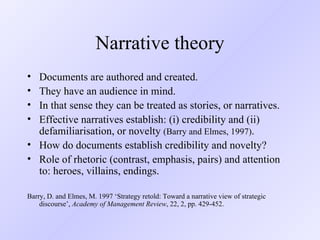
Narrative theory Documents are authored and created. They have an audience in mind. In that sense they can be treated as stories, or narratives. Effective narratives establish: (i) credibility and (ii) defamiliarisation, or novelty  (Barry and Elmes, 1997) . How do documents establish credibility and novelty? Role of rhetoric (contrast, emphasis, pairs) and attention to: heroes, villains, endings.  Barry, D. and Elmes, M. 1997 ‘Strategy retold: Toward a narrative view of strategic discourse’,  Academy of Management Review , 22, 2, pp. 429-452.
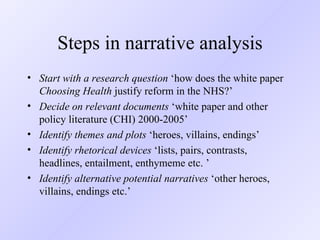
Steps in narrative analysis Start with a research question  ‘how does the white paper  Choosing Health  justify reform in the NHS?’ Decide on relevant documents  ‘white paper and other policy literature (CHI) 2000-2005’ Identify themes and plots  ‘heroes, villains, endings’ Identify rhetorical devices  ‘lists, pairs, contrasts, headlines, entailment, enthymeme etc. ’ Identify alternative potential narratives  ‘other heroes, villains, endings etc.’
2 examples
Example content analysis: coding frame
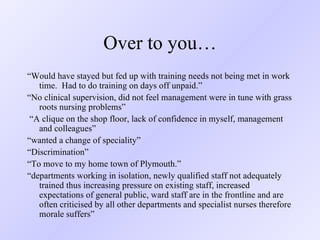
Over to you… “ Would have stayed but fed up with training needs not being met in work time.  Had to do training on days off unpaid.” “ No clinical supervision, did not feel management were in tune with grass roots nursing problems”  “ A clique on the shop floor, lack of confidence in myself, management and colleagues” “ wanted a change of speciality” “ Discrimination” “ To move to my home town of Plymouth.” “ departments working in isolation, newly qualified staff not adequately trained thus increasing pressure on existing staff, increased expectations of general public, ward staff are in the frontline and are often criticised by all other departments and specialist nurses therefore morale suffers”
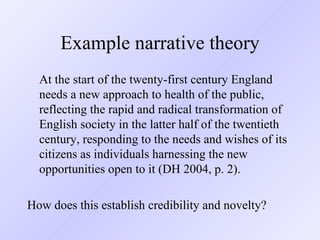
Example narrative theory At the start of the twenty-first century England needs a new approach to health of the public, reflecting the rapid and radical transformation of English society in the latter half of the twentieth century, responding to the needs and wishes of its citizens as individuals harnessing the new opportunities open to it (DH 2004, p. 2). How does this establish credibility and novelty?
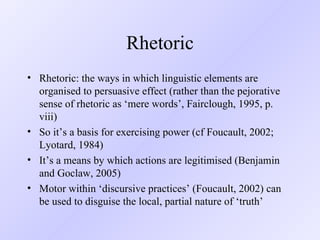
Rhetoric Rhetoric:  the ways in which linguistic elements are organised to persuasive effect (rather than the pejorative sense of rhetoric as ‘mere words’, Fairclough, 1995, p. viii) S o it’s a basis for exercising power (cf Foucault, 2002; Lyotard, 1984)  It’s a means by which actions are   legitimised (Benjamin and Goclaw, 2005 ) Motor within ‘discursive practices’ (Foucault, 2002) can be used to disguise the local, partial nature of ‘truth’
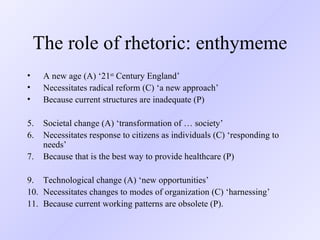
The role of rhetoric: enthymeme A new age (A) ‘21 st  Century England’ Necessitates radical reform (C) ‘a new approach’ Because current structures are inadequate (P)   Societal change (A) ‘transformation of … society’ Necessitates response to citizens as individuals (C) ‘responding to needs’ Because that is the best way to provide healthcare (P) Technological change (A) ‘new opportunities’ Necessitates changes to modes of organization (C) ‘harnessing’ Because current working patterns are obsolete (P).
Over to you… At the heart of “Building public value” is a vision of a BBC that maintains the ideals of its founders, but a BBC renewed to deliver those ideals in a digital world. That world contains the potential for limitless individual consumer choice. But it also contains the possibility of broadcasting reduced to just another commodity, with profitability the sole measure of worth. A renewed BBC, placing the public interest before all else, will counterbalance that market-driven drift towards programme-making as a commodity. Only a secure and adequately funded BBC can ensure that broadcasting retains its cultural (in the broadest sense) aspiration.
Worked example -  the 2006 Government white paper
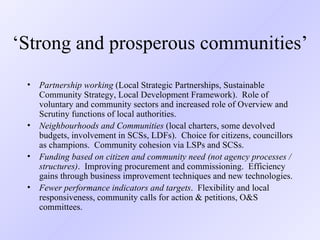
‘ Strong and prosperous communities’  Partnership working  (Local Strategic Partnerships, Sustainable Community Strategy, Local Development Framework).  Role of voluntary and community sectors and increased role of Overview and Scrutiny functions of local authorities. Neighbourhoods and Communities  (local charters, some devolved budgets, involvement in SCSs, LDFs).  Choice for citizens, councillors as champions.  Community cohesion via LSPs and SCSs. Funding based on citizen and community need (not agency processes / structures) .  Improving procurement and commissioning.  Efficiency gains through business improvement techniques and new technologies. Fewer performance indicators and targets .  Flexibility and local responsiveness, community calls for action & petitions, O&S committees.
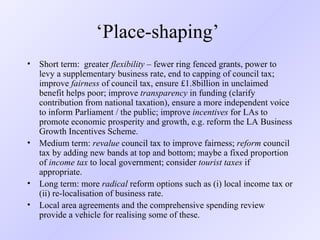
‘ Place-shaping’  Short term:  greater  flexibility  – fewer ring fenced grants, power to levy a supplementary business rate, end to capping of council tax; improve  fairness  of council tax, ensure £1.8billion in unclaimed benefit helps poor; improve  transparency  in funding (clarify contribution from national taxation), ensure a more independent voice to inform Parliament / the public; improve  incentives  for LAs to promote economic prosperity and growth, e.g. reform the LA Business Growth Incentives Scheme.  Medium term:  revalue  council tax to improve fairness;  reform  council tax by adding new bands at top and bottom; maybe a fixed proportion of  income tax  to local government; consider  tourist taxes  if appropriate. Long term: more  radical  reform options such as (i) local income tax or (ii) re-localisation of business rate. Local area agreements and the comprehensive spending review provide a vehicle for realising some of these.
The  Local Government and Public Involvement in Health Bill   (f ollowing the Local Government White Paper) Broader role of LAs Best Value regime and year on year efficiency targets New directive powers:  2-tier councils can be organised into single tier Wider more flexible approach to scrutiny (e.g. health, law and order,  environment, partnership arrangements – but no extra ‘teeth’) Integrated health care between LAs and Primary Care Trusts Partnership working with waste services Model code of conduct for councillors
New Labour Themes Public Bodies from service provider to commissioner Citizens to Consumers NPM  ‘managerialism rather than democracy’ (Lowndes review of 2nd WP in LGS)  Choice and voice Leaders as champions / emancipation rhetoric Does it reverse or reconfigure centre’s dominance Empty change narrative / telos
Some Broad Problems Tensions with public sector management - efficiency savings (Gershon), wage restraints, marketisation of services (privatisation) No mention of or consultation with Trade Unions, moves to mayoral systems opposed by UNISON Limited account of contestability (market based), other modes of competitiveness (peer review, benchmarking not mentioned) Boundary changes overlook problems with mergers elsewhere (police) Government’s negative response to ‘radical’ Lyons (buried on Budget day) Power inquiry ‘ Principles and ideas seem to have been replaced with managerialism and public relations.  It is as though Proctor and Gamble or Abbey National are running the country.’ Because of ‘overwhelmingly dominant’ position of central government. ‘ The history of the last 30 years is marked by a series of well-intentioned devolution initiatives, which have often evolved into subtle instruments of control’  (Lyons)
Narrative Theory Formalism - effective narratives have two features: (i) they establish credibility; and (ii) they create a sense of novelty or defamiliarization Policy documents are authored and devised with an audience in mind. They need to be both credible and novel in order to unite and mobilize different constituencies.  Practical advantages of a narrative approach:  access ready to hand notions associated with stories (heroines, villains etc)  call attention to rhetoric – how language is deployed as a resource links with literature on sense-making informs approach to interview research and reviewing
Enthymeme in the WP People no longer accept the ‘one size fits all’ service models of old.  They want choice over the services they receive. (A) changes in the provision of (consumer) goods and services ‘service models of old’ (C)  necessitates reform to provision of public goods and services ‘choice’ (P)  because these are consumed in the same way [challenging P > alternative accounts that reflect the unique status of public goods]  Councillors should be champions for their local community, able to speak out on all issues affecting their local area and able to sort out issues on the ground ... (A) power should be invested in local individuals ‘champions for their community’ (C) this will enable resolution of local problems ‘issues affecting their local area’ (P) because  local community and local councillor interests will coincide [challenging P > alternative accounts of local democracy, ‘bee in bonnet’ mode]
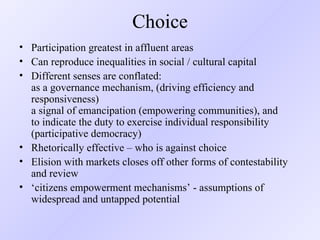
Choice Participation greatest in affluent areas Can reproduce inequalities in social / cultural capital Different senses are conflated:  as a governance mechanism, (driving efficiency and responsiveness)  a signal of emancipation (empowering communities), and  to indicate the duty to exercise individual responsibility (participative democracy) Rhetorically effective – who is against choice Elision with markets closes off other forms of contestability and review ‘ citizens empowerment mechanisms’ - assumptions of widespread and untapped potential
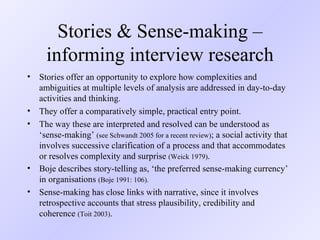
Stories & Sense-making – informing interview research Stories offer an opportunity to explore how complexities and ambiguities at multiple levels of analysis are addressed in day-to-day activities and thinking.  They offer a comparatively simple, practical entry point. The way these are interpreted and resolved can be understood as ‘sense-making’  (see Schwandt 2005 for a recent review) ; a social activity that involves successive clarification of a process and that accommodates or resolves complexity and surprise  (Weick 1979) .  Boje describes story-telling as, ‘the preferred sense-making currency’ in organisations  (Boje 1991: 106). Sense-making has close links with narrative, since it involves retrospective accounts that stress plausibility, credibility and coherence  (Toit 2003) .

Analysing Texts / Using Documents

  • 1.
    Using Documentary DataDr Kevin Morrell www.kevinmorrell.org.uk
  • 2.
    Session Overview Whatis ‘documentary data’? What are its advantages? What are the disadvantages? 2 approaches to analysing documentary data Example 1: content analysis of the questionnaire Example 2: narrative analysis of policy literature
  • 3.
    Learning Objectives Bythe end of the session you will be familiar with some types of documents that can be used in organisational studies. You will be able to identify some of the advantages and disadvantages associated with using documentary data. You will have a basic understanding of two different approaches to analysing documents. You will be familiar with examples of: a content analysis and a narrative theory analysis. You will have tried analysing text using these two approaches.
  • 4.
  • 5.
    Examples… Annual reportsLetters Company forms Accounts / HR data Flow charts Policy literature Legislation Cartoons Photographs Minutes Memos Procedures and policies Speeches Time sheets Newspapers Magazine articles Film and other media Graffiti
  • 6.
    Advantages Disadvantages Unobtrusive and non-reactive (RWR:349) ‘ Given’ data Basis for triangulation Basis for comparison/contrast Encourage ingenuity Longitudinal aspect No influence on methods/methodology Difficult to identify author(s) Selection Access/ethics considerations
  • 7.
    Business historian ororganizational theorist? Business historian: an extensive trawl of a mass of documentation, less preoccupied with methodology Organizational theorist: more intensive analysis with reference to a focused theme, topic or context, more concerned with methodological issues
  • 8.
  • 9.
    Content analysis (fromRobson RWR: 352-5) “ content analysis is codified common sense a refinement of ways that might be used by laypersons to describe and explain aspects of the world about them” (352)
  • 10.
    Steps in contentanalysis Start with a research question ‘why are nurses saying they quit their jobs?’ Decide on a sampling strategy ‘voluntary leavers at 8 NHS Trusts year 2000-2001’ Define the recording unit ‘what key themes crop up… “training”, “promotion” etc.’ Construct additional categories for analysis: exhaustive, mutually exclusive , ‘promotion and training and development’…. Meta-categories ‘work and non-work related reasons’
  • 11.
    Narrative theory Documentsare authored and created. They have an audience in mind. In that sense they can be treated as stories, or narratives. Effective narratives establish: (i) credibility and (ii) defamiliarisation, or novelty (Barry and Elmes, 1997) . How do documents establish credibility and novelty? Role of rhetoric (contrast, emphasis, pairs) and attention to: heroes, villains, endings. Barry, D. and Elmes, M. 1997 ‘Strategy retold: Toward a narrative view of strategic discourse’, Academy of Management Review , 22, 2, pp. 429-452.
  • 12.
    Steps in narrativeanalysis Start with a research question ‘how does the white paper Choosing Health justify reform in the NHS?’ Decide on relevant documents ‘white paper and other policy literature (CHI) 2000-2005’ Identify themes and plots ‘heroes, villains, endings’ Identify rhetorical devices ‘lists, pairs, contrasts, headlines, entailment, enthymeme etc. ’ Identify alternative potential narratives ‘other heroes, villains, endings etc.’
  • 13.
  • 14.
  • 15.
    Over to you…“ Would have stayed but fed up with training needs not being met in work time. Had to do training on days off unpaid.” “ No clinical supervision, did not feel management were in tune with grass roots nursing problems”  “ A clique on the shop floor, lack of confidence in myself, management and colleagues” “ wanted a change of speciality” “ Discrimination” “ To move to my home town of Plymouth.” “ departments working in isolation, newly qualified staff not adequately trained thus increasing pressure on existing staff, increased expectations of general public, ward staff are in the frontline and are often criticised by all other departments and specialist nurses therefore morale suffers”
  • 16.
    Example narrative theoryAt the start of the twenty-first century England needs a new approach to health of the public, reflecting the rapid and radical transformation of English society in the latter half of the twentieth century, responding to the needs and wishes of its citizens as individuals harnessing the new opportunities open to it (DH 2004, p. 2). How does this establish credibility and novelty?
  • 17.
    Rhetoric Rhetoric: the ways in which linguistic elements are organised to persuasive effect (rather than the pejorative sense of rhetoric as ‘mere words’, Fairclough, 1995, p. viii) S o it’s a basis for exercising power (cf Foucault, 2002; Lyotard, 1984) It’s a means by which actions are legitimised (Benjamin and Goclaw, 2005 ) Motor within ‘discursive practices’ (Foucault, 2002) can be used to disguise the local, partial nature of ‘truth’
  • 18.
    The role ofrhetoric: enthymeme A new age (A) ‘21 st Century England’ Necessitates radical reform (C) ‘a new approach’ Because current structures are inadequate (P)   Societal change (A) ‘transformation of … society’ Necessitates response to citizens as individuals (C) ‘responding to needs’ Because that is the best way to provide healthcare (P) Technological change (A) ‘new opportunities’ Necessitates changes to modes of organization (C) ‘harnessing’ Because current working patterns are obsolete (P).
  • 19.
    Over to you…At the heart of “Building public value” is a vision of a BBC that maintains the ideals of its founders, but a BBC renewed to deliver those ideals in a digital world. That world contains the potential for limitless individual consumer choice. But it also contains the possibility of broadcasting reduced to just another commodity, with profitability the sole measure of worth. A renewed BBC, placing the public interest before all else, will counterbalance that market-driven drift towards programme-making as a commodity. Only a secure and adequately funded BBC can ensure that broadcasting retains its cultural (in the broadest sense) aspiration.
  • 20.
    Worked example - the 2006 Government white paper
  • 21.
    ‘ Strong andprosperous communities’ Partnership working (Local Strategic Partnerships, Sustainable Community Strategy, Local Development Framework). Role of voluntary and community sectors and increased role of Overview and Scrutiny functions of local authorities. Neighbourhoods and Communities (local charters, some devolved budgets, involvement in SCSs, LDFs). Choice for citizens, councillors as champions. Community cohesion via LSPs and SCSs. Funding based on citizen and community need (not agency processes / structures) . Improving procurement and commissioning. Efficiency gains through business improvement techniques and new technologies. Fewer performance indicators and targets . Flexibility and local responsiveness, community calls for action & petitions, O&S committees.
  • 22.
    ‘ Place-shaping’ Short term: greater flexibility – fewer ring fenced grants, power to levy a supplementary business rate, end to capping of council tax; improve fairness of council tax, ensure £1.8billion in unclaimed benefit helps poor; improve transparency in funding (clarify contribution from national taxation), ensure a more independent voice to inform Parliament / the public; improve incentives for LAs to promote economic prosperity and growth, e.g. reform the LA Business Growth Incentives Scheme. Medium term: revalue council tax to improve fairness; reform council tax by adding new bands at top and bottom; maybe a fixed proportion of income tax to local government; consider tourist taxes if appropriate. Long term: more radical reform options such as (i) local income tax or (ii) re-localisation of business rate. Local area agreements and the comprehensive spending review provide a vehicle for realising some of these.
  • 23.
    The LocalGovernment and Public Involvement in Health Bill (f ollowing the Local Government White Paper) Broader role of LAs Best Value regime and year on year efficiency targets New directive powers: 2-tier councils can be organised into single tier Wider more flexible approach to scrutiny (e.g. health, law and order, environment, partnership arrangements – but no extra ‘teeth’) Integrated health care between LAs and Primary Care Trusts Partnership working with waste services Model code of conduct for councillors
  • 24.
    New Labour ThemesPublic Bodies from service provider to commissioner Citizens to Consumers NPM ‘managerialism rather than democracy’ (Lowndes review of 2nd WP in LGS) Choice and voice Leaders as champions / emancipation rhetoric Does it reverse or reconfigure centre’s dominance Empty change narrative / telos
  • 25.
    Some Broad ProblemsTensions with public sector management - efficiency savings (Gershon), wage restraints, marketisation of services (privatisation) No mention of or consultation with Trade Unions, moves to mayoral systems opposed by UNISON Limited account of contestability (market based), other modes of competitiveness (peer review, benchmarking not mentioned) Boundary changes overlook problems with mergers elsewhere (police) Government’s negative response to ‘radical’ Lyons (buried on Budget day) Power inquiry ‘ Principles and ideas seem to have been replaced with managerialism and public relations. It is as though Proctor and Gamble or Abbey National are running the country.’ Because of ‘overwhelmingly dominant’ position of central government. ‘ The history of the last 30 years is marked by a series of well-intentioned devolution initiatives, which have often evolved into subtle instruments of control’ (Lyons)
  • 26.
    Narrative Theory Formalism- effective narratives have two features: (i) they establish credibility; and (ii) they create a sense of novelty or defamiliarization Policy documents are authored and devised with an audience in mind. They need to be both credible and novel in order to unite and mobilize different constituencies. Practical advantages of a narrative approach: access ready to hand notions associated with stories (heroines, villains etc) call attention to rhetoric – how language is deployed as a resource links with literature on sense-making informs approach to interview research and reviewing
  • 27.
    Enthymeme in theWP People no longer accept the ‘one size fits all’ service models of old. They want choice over the services they receive. (A) changes in the provision of (consumer) goods and services ‘service models of old’ (C) necessitates reform to provision of public goods and services ‘choice’ (P) because these are consumed in the same way [challenging P > alternative accounts that reflect the unique status of public goods] Councillors should be champions for their local community, able to speak out on all issues affecting their local area and able to sort out issues on the ground ... (A) power should be invested in local individuals ‘champions for their community’ (C) this will enable resolution of local problems ‘issues affecting their local area’ (P) because local community and local councillor interests will coincide [challenging P > alternative accounts of local democracy, ‘bee in bonnet’ mode]
  • 28.
    Choice Participation greatestin affluent areas Can reproduce inequalities in social / cultural capital Different senses are conflated: as a governance mechanism, (driving efficiency and responsiveness) a signal of emancipation (empowering communities), and to indicate the duty to exercise individual responsibility (participative democracy) Rhetorically effective – who is against choice Elision with markets closes off other forms of contestability and review ‘ citizens empowerment mechanisms’ - assumptions of widespread and untapped potential
  • 29.
    Stories & Sense-making– informing interview research Stories offer an opportunity to explore how complexities and ambiguities at multiple levels of analysis are addressed in day-to-day activities and thinking. They offer a comparatively simple, practical entry point. The way these are interpreted and resolved can be understood as ‘sense-making’ (see Schwandt 2005 for a recent review) ; a social activity that involves successive clarification of a process and that accommodates or resolves complexity and surprise (Weick 1979) . Boje describes story-telling as, ‘the preferred sense-making currency’ in organisations (Boje 1991: 106). Sense-making has close links with narrative, since it involves retrospective accounts that stress plausibility, credibility and coherence (Toit 2003) .