Common Fallacies

  Dr. John Bradford
Common Mistakes in Social Research
1. Contamination
2. Fallacies of presumption
  –   Hasty Generalization
  –   False Dichotomy
  –   Spurious association
  –   ‘Post hoc’ fallacy
3. Fallacies of the wrong level
  –   Ecological Fallacy (group to individual)
  –   Reductionist Fallacy /Fallacy of Composition (individual to
      group)
4. ‘Ad Hoc’ Fallacies
I. Problem of Contamination
• Suppose that there is so much heat given off in the
  first test tube, Y₁ that it spreads and heats up Y₂ . This
  is contamination!
• The Error of Contamination occurs when the social
  researcher acts as if the influence of an independent
  variable is restricted solely to experimental group
  when in fact it is also influencing the ‘control group’.


                      Influencing the control   Y₂
      Y₁
I. Problem of Contamination
• One cannot assume that a change in an
  independent variable (X) affects the
  dependent variable (Y) only in those settings
  where the independent (X) variable is present
  or has changed.
• Why? Because people observe what happens
  elsewhere. The mere existence of some X in
  some setting, may affect Y in other settings
  where X isn’t present, or has changed.
I. Problem of Contamination
Example: Sweden v. Norway
• The effect of Norway’s entrance
  into World War II (X) on fertility
  rates in Norway (Y₁), using Sweden
  (Y₂) as a control.
• An invalid inference might be: “If
  Norway had not been invaded in
  1940, its fertility rates would have
  been like Sweden’s at that time”
I. Problem of Contamination
Example: Sweden v. Norway
• One problem (among many) is that
  Sweden is not a good ‘control’, even if it is
  exactly like Norway in all other
  conceivable characteristics, and even if it
  was an exact replica of Norway.
• Because Sweden was also affected by the
  Nazi invasion…
II. Fallacies of Presumption
1. Hasty generalization: making a general
   conclusion based on too little information
  – My former husband was a jerk…from that I learned
    that all men are jerks.
2. False Dichotomy (also called “False Bifurcation”,
   “Black and white fallacy;” “either/or fallacy”
   “False dilemma.” ): involves turning a complex
   issue into one that has only two choices that are
   opposite of one another
  – ‘You are either with or against us!’
II. Fallacies of Presumption
3. Fallacy of false cause (spurious association)
  – It says (wrongly) that if two things are associated,
    then one of them must be the cause of the other.
    If A and B are associated, then A must cause B.
  – Example: More and more young people are
    attending high schools and colleges today than
    ever before. Yet there is more and more juvenile
    delinquency among the young than every before.
    This makes it clear that these young people are
    being corrupted by their education.
II. Fallacies of Presumption
3. Fallacy of false cause (spurious association)
• ‘Post hoc’ fallacy: a more specific form of spurious
   association, which asserts that, if A occurs before
   B, then A is necessarily the cause of B.
  –   Derived from the Latin phrase,“Post hoc, ergo propter
      hoc” (Latin: After this, therefore because of this).
  –   Example 1: 98% of Heroin users started off with
      marijuana. Therefore, marijuana smoking causes people
      to go on to the hard stuff.
  –   Even more drank alcohol, and 100% drank water! Only
      about 1% of marijuana users end up using heroin.
II. Fallacies of Presumption
3. Fallacy of false cause (spurious association)
• ‘Post hoc’ fallacy:
• Example 2: Dr. Manfred Sakel discovered in 1927 that
   schizophrenia can be treated by administering overdoses
   of insulin, which produced convulsive shocks. Hundreds of
   psychiatrists drew a faulty conclusion and began to treat
   schizophrenia and other mental disorders by giving
   patients electric shocks without insulin. So, they skipped
   the insulin but went to shocks. At a psychiatric meeting
   some years later, Dr. Sakel sadly came forward to explain
   that electric shocks are actually harmful, while insulin
   treatment restores the patient’s hormonal balance. The
   doctors had confused the side effect with a cause.
III. Fallacies of the Wrong Level
• Ecological fallacy: studying something with
  the group as the unit of the analysis and
  making inferences about the individual
  – Group  Individual
• Reductionistic fallacy: studying something
  with the individual as the unit of analysis and
  making inferences about the group
  – Individual  Group
III. Fallacies of the Wrong Level
Ecological fallacy: (inferring lower from higher
  levels, or parts from wholes)
• Example 1: In the United States presidential
  elections of 2000, 2004, and 2008:
  i. Wealthier states tended to vote Democratic
  ii. Poorer states tended to vote Republican.
  iii. Yet wealthier voters tended to vote Republican
       and poorer voters tended to vote Democratic.
• The error would be to assume that, because
  wealthier states voted Democratic, wealthier
  voters also tended to vote Democratic.
III. Fallacies of the Wrong Level
Ecological fallacy: (inferring lower from higher
  levels, or parts from wholes)
• Example 2: In American cities, there is a strong
  relationship between illiteracy rate and
  proportion of people who are foreign born. Does
  this association hold for individuals? No, it could
  be that all the foreign born are highly
  literate, they just gravitate to urban areas where
  there are also lots of native born people who are
  illiterate.
III. Fallacies of the Wrong Level
Ecological fallacy: (inferring
  lower from higher levels, or
  parts from wholes)
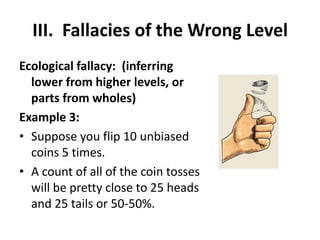
Example 3:
• Suppose you flip 10 unbiased
  coins 5 times.
• A count of all of the coin tosses
  will be pretty close to 25 heads
  and 25 tails or 50-50%.
III. Fallacies of the Wrong Level
Ecological fallacy: (inferring lower from
  higher levels, or parts from wholes)
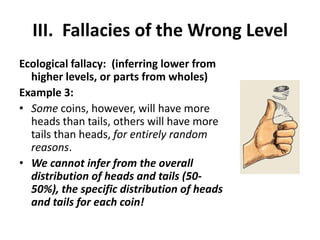
Example 3:
• Some coins, however, will have more
  heads than tails, others will have more
  tails than heads, for entirely random
  reasons.
• We cannot infer from the overall
  distribution of heads and tails (50-
  50%), the specific distribution of heads
  and tails for each coin!
III. Fallacies of the Wrong Level
Reductionist Fallacy (aka Fallacy of composition):
  (inferring higher levels from lower levels, or the
  whole from the parts):
• Example 1: ‘Paradox of Thrift.’ Saving is good for
  an individual, but not necessarily for the
  economy as a whole, because lack of spending in
  the aggregate can cause a recession.
• The error would be to assume that what
  individual interest necessarily coincides with
  collective or aggregate welfare.
III. Fallacies of the Wrong Level
Reductionist Fallacy (aka Fallacy of composition):
  (inferring higher levels from lower levels, or the
  whole from the parts):
• Example 2: ‘Dream Team’: Consider the study of
  basketball. Suppose you gather together the best
  players in the world. Does this mean that your
  team will naturally be the best? Not necessarily.
  (All these great players might have such great
  egos that they can’t manage to play together; a
  team of mediocre players might click so well that
  they are unbeatable as a team).
IV. Non Sequitur
• Non sequitur fallacy (non-SEK-wa-tuur): the
  term is Latin for “it does not follow.”
• In logic, the term is used to indicate a
  conclusion that can not be justified by the
  premises or evidence offered in an argument.
  In other words, the non sequitur fallacy occurs
  when an the conclusion does not follow from
  the premises.
IV. Non Sequitur
Argument A:
(1) Most poor people don’t commit crimes
(2) Some rich people commit crimes
• Therefore, there is no relation between poverty
   and crime!
Argument B:
1. Most people with bullet wounds don’t die.
2. Some people without bullet wounds do die.
• Therefore, bullet wounds are not a direct cause
   of death. ?????

1 29-13 common fallacies

  • 1.
    Common Fallacies Dr. John Bradford
  • 2.
    Common Mistakes inSocial Research 1. Contamination 2. Fallacies of presumption – Hasty Generalization – False Dichotomy – Spurious association – ‘Post hoc’ fallacy 3. Fallacies of the wrong level – Ecological Fallacy (group to individual) – Reductionist Fallacy /Fallacy of Composition (individual to group) 4. ‘Ad Hoc’ Fallacies
  • 3.
    I. Problem ofContamination • Suppose that there is so much heat given off in the first test tube, Y₁ that it spreads and heats up Y₂ . This is contamination! • The Error of Contamination occurs when the social researcher acts as if the influence of an independent variable is restricted solely to experimental group when in fact it is also influencing the ‘control group’. Influencing the control Y₂ Y₁
  • 4.
    I. Problem ofContamination • One cannot assume that a change in an independent variable (X) affects the dependent variable (Y) only in those settings where the independent (X) variable is present or has changed. • Why? Because people observe what happens elsewhere. The mere existence of some X in some setting, may affect Y in other settings where X isn’t present, or has changed.
  • 5.
    I. Problem ofContamination Example: Sweden v. Norway • The effect of Norway’s entrance into World War II (X) on fertility rates in Norway (Y₁), using Sweden (Y₂) as a control. • An invalid inference might be: “If Norway had not been invaded in 1940, its fertility rates would have been like Sweden’s at that time”
  • 6.
    I. Problem ofContamination Example: Sweden v. Norway • One problem (among many) is that Sweden is not a good ‘control’, even if it is exactly like Norway in all other conceivable characteristics, and even if it was an exact replica of Norway. • Because Sweden was also affected by the Nazi invasion…
  • 7.
    II. Fallacies ofPresumption 1. Hasty generalization: making a general conclusion based on too little information – My former husband was a jerk…from that I learned that all men are jerks. 2. False Dichotomy (also called “False Bifurcation”, “Black and white fallacy;” “either/or fallacy” “False dilemma.” ): involves turning a complex issue into one that has only two choices that are opposite of one another – ‘You are either with or against us!’
  • 8.
    II. Fallacies ofPresumption 3. Fallacy of false cause (spurious association) – It says (wrongly) that if two things are associated, then one of them must be the cause of the other. If A and B are associated, then A must cause B. – Example: More and more young people are attending high schools and colleges today than ever before. Yet there is more and more juvenile delinquency among the young than every before. This makes it clear that these young people are being corrupted by their education.
  • 9.
    II. Fallacies ofPresumption 3. Fallacy of false cause (spurious association) • ‘Post hoc’ fallacy: a more specific form of spurious association, which asserts that, if A occurs before B, then A is necessarily the cause of B. – Derived from the Latin phrase,“Post hoc, ergo propter hoc” (Latin: After this, therefore because of this). – Example 1: 98% of Heroin users started off with marijuana. Therefore, marijuana smoking causes people to go on to the hard stuff. – Even more drank alcohol, and 100% drank water! Only about 1% of marijuana users end up using heroin.
  • 10.
    II. Fallacies ofPresumption 3. Fallacy of false cause (spurious association) • ‘Post hoc’ fallacy: • Example 2: Dr. Manfred Sakel discovered in 1927 that schizophrenia can be treated by administering overdoses of insulin, which produced convulsive shocks. Hundreds of psychiatrists drew a faulty conclusion and began to treat schizophrenia and other mental disorders by giving patients electric shocks without insulin. So, they skipped the insulin but went to shocks. At a psychiatric meeting some years later, Dr. Sakel sadly came forward to explain that electric shocks are actually harmful, while insulin treatment restores the patient’s hormonal balance. The doctors had confused the side effect with a cause.
  • 11.
    III. Fallacies ofthe Wrong Level • Ecological fallacy: studying something with the group as the unit of the analysis and making inferences about the individual – Group  Individual • Reductionistic fallacy: studying something with the individual as the unit of analysis and making inferences about the group – Individual  Group
  • 12.
    III. Fallacies ofthe Wrong Level Ecological fallacy: (inferring lower from higher levels, or parts from wholes) • Example 1: In the United States presidential elections of 2000, 2004, and 2008: i. Wealthier states tended to vote Democratic ii. Poorer states tended to vote Republican. iii. Yet wealthier voters tended to vote Republican and poorer voters tended to vote Democratic. • The error would be to assume that, because wealthier states voted Democratic, wealthier voters also tended to vote Democratic.
  • 13.
    III. Fallacies ofthe Wrong Level Ecological fallacy: (inferring lower from higher levels, or parts from wholes) • Example 2: In American cities, there is a strong relationship between illiteracy rate and proportion of people who are foreign born. Does this association hold for individuals? No, it could be that all the foreign born are highly literate, they just gravitate to urban areas where there are also lots of native born people who are illiterate.
  • 14.
    III. Fallacies ofthe Wrong Level Ecological fallacy: (inferring lower from higher levels, or parts from wholes) Example 3: • Suppose you flip 10 unbiased coins 5 times. • A count of all of the coin tosses will be pretty close to 25 heads and 25 tails or 50-50%.
  • 15.
    III. Fallacies ofthe Wrong Level Ecological fallacy: (inferring lower from higher levels, or parts from wholes) Example 3: • Some coins, however, will have more heads than tails, others will have more tails than heads, for entirely random reasons. • We cannot infer from the overall distribution of heads and tails (50- 50%), the specific distribution of heads and tails for each coin!
  • 16.
    III. Fallacies ofthe Wrong Level Reductionist Fallacy (aka Fallacy of composition): (inferring higher levels from lower levels, or the whole from the parts): • Example 1: ‘Paradox of Thrift.’ Saving is good for an individual, but not necessarily for the economy as a whole, because lack of spending in the aggregate can cause a recession. • The error would be to assume that what individual interest necessarily coincides with collective or aggregate welfare.
  • 17.
    III. Fallacies ofthe Wrong Level Reductionist Fallacy (aka Fallacy of composition): (inferring higher levels from lower levels, or the whole from the parts): • Example 2: ‘Dream Team’: Consider the study of basketball. Suppose you gather together the best players in the world. Does this mean that your team will naturally be the best? Not necessarily. (All these great players might have such great egos that they can’t manage to play together; a team of mediocre players might click so well that they are unbeatable as a team).
  • 18.
    IV. Non Sequitur •Non sequitur fallacy (non-SEK-wa-tuur): the term is Latin for “it does not follow.” • In logic, the term is used to indicate a conclusion that can not be justified by the premises or evidence offered in an argument. In other words, the non sequitur fallacy occurs when an the conclusion does not follow from the premises.
  • 19.
    IV. Non Sequitur ArgumentA: (1) Most poor people don’t commit crimes (2) Some rich people commit crimes • Therefore, there is no relation between poverty and crime! Argument B: 1. Most people with bullet wounds don’t die. 2. Some people without bullet wounds do die. • Therefore, bullet wounds are not a direct cause of death. ?????

Editor's Notes

  • #4 One can observe that a certain difference exists and that it is caused by a certain condition, but one cannot infer from this difference what would have occurred had the test condition been absent. (Lieberson 1985: 55).
  • #5 See (Lieberson 1985: 56)
  • #6 See
  • #16 Sometimes what is most important is the overall distribution or pattern, and not the components that make up the pattern. Fundamental or basic driving forces tend to generate overall patterns, but leave undetermined its specific manifestation. For example, we know that in an educational setting, grades are a selection mechanism, and courses are geared towards generating certain overall outcomes, such as a grade distribution. Once we know that not everyone will make an A, by design, then we are less likely to attribute the overall distribution exclusively to the attributes (successes or failures) of the individual students.