Common Causal Fallacies
Errors in Cause/Effect Logic


                  Adapted from Julian C. Cole and Makoto Suzuki. 2003
1. Post Hoc Reasoning
When a person makes or accepts the reasoning to the
conclusion that event A is the cause of event B from no
proper reason but that event A preceded event B.

Example: Every time I take a shower, the telephone rings.
Therefore, since I’m dying to talk to somebody right now, I
should jump in the shower.

Problem: Just because an event happens before another
event, it may not be the cause.
2. Ignoring a Common Cause
The fallacy of ignoring a common cause is committed
when an event that is regularly connected with the event
under consideration is taken to be the cause of that event,
when in fact that event and the event under consideration
have a common cause.

Because people suffering from the fever of measles have
the red spots, we can conclude that the fever causes the
red spots.

Problem: Actually, the fever and the red spots are both
effects of a common cause, the measles virus.
3. Confusing Cause and Effect
 The fallacy of confusing cause and effect is committed when a
 mistake is made in judging the direction of a causal relation
 between two events
     Belief:           A⇒ B          Reality: B ⇒ A
 In general, causes precede their effects. So you can often avoid
 confusing cause and effect if you pay attention to the temporal
 ordering of the events.
 Example: Lung cancer patients often have a craving for
 cigarettes. So, lung cancer causes a craving for tobacco
 Problem: Smokers crave cigarettes, which can lead to lung
 cancer.
4. Oversimplified Cause
The fallacy of stating an oversimplified cause is committed
when a person arbitrarily selects just one element of a
multitude of possible causes for an effect.

Caution: If the person has a legitimate reason to emphasize
one element in particular, and does not exaggerate the role
of that one element, the person does not commit the fallacy
of oversimplified cause.

Example: The quality of education in our grade schools and
high schools has been declining for years. Clearly, our
teachers don’t care enough and just aren’t doing their jobs
these days.

Problem: While it may be true that some teachers may be a
problem, education is a complicated system of many factors.
5. The Genetic Fallacy
The genetic fallacy is committed when some factor concerning the
mere origin or cause of accepting a claim is confused with evidence for
(or against) the truth of that belief. The term “genetic” is derived from
the term “genesis”, which is synonymous with the term “origin”.

Example: A number of legislators are opposed to legalized abortion on
the grounds that women undergoing abortions may be damaged
psychologically. We can dismiss the truth of their claims, however, for
these legislators are Catholic, and everyone knows that the Catholic
Church is opposed to abortion.

Problem: The tenets of Catholicism are not evidence on the debate
about women experiencing psychological trauma from an abortion.
6. Slippery Slope
The fallacy of slippery slope is committed when the conclusion of an
argument rests upon an alleged chain reaction and there is not a
sufficient reason to think that the chain reaction will actually take place.
Mom: Those look like bags under your eyes. Are you getting enough sleep?

Jeff: I had a test and stayed up late studying.

Mom: You didn't take any drugs, did you?

Jeff: Just caffeine in my coffee, like I always do.

Mom: Jeff! You know what happens when people take drugs! Pretty soon the caffeine
won't be strong enough. Then you will take something stronger, maybe someone's diet
pill. Then, something even stronger. Eventually, you will be doing cocaine. Then you will
be a crack addict! So, don't drink that coffee.

Problem: There are many steps in between coffee and crack addiction.
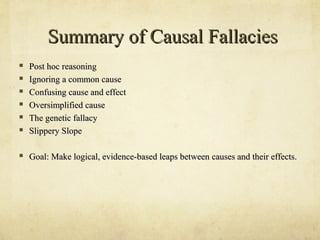
Summary of Causal Fallacies
   Post hoc reasoning
   Ignoring a common cause
   Confusing cause and effect
   Oversimplified cause
   The genetic fallacy
   Slippery Slope

   Goal: Make logical, evidence-based leaps between causes and their effects.

Fallacy Review

  • 1.
    Common Causal Fallacies Errorsin Cause/Effect Logic Adapted from Julian C. Cole and Makoto Suzuki. 2003
  • 2.
    1. Post HocReasoning When a person makes or accepts the reasoning to the conclusion that event A is the cause of event B from no proper reason but that event A preceded event B. Example: Every time I take a shower, the telephone rings. Therefore, since I’m dying to talk to somebody right now, I should jump in the shower. Problem: Just because an event happens before another event, it may not be the cause.
  • 3.
    2. Ignoring aCommon Cause The fallacy of ignoring a common cause is committed when an event that is regularly connected with the event under consideration is taken to be the cause of that event, when in fact that event and the event under consideration have a common cause. Because people suffering from the fever of measles have the red spots, we can conclude that the fever causes the red spots. Problem: Actually, the fever and the red spots are both effects of a common cause, the measles virus.
  • 4.
    3. Confusing Causeand Effect The fallacy of confusing cause and effect is committed when a mistake is made in judging the direction of a causal relation between two events Belief: A⇒ B Reality: B ⇒ A In general, causes precede their effects. So you can often avoid confusing cause and effect if you pay attention to the temporal ordering of the events. Example: Lung cancer patients often have a craving for cigarettes. So, lung cancer causes a craving for tobacco Problem: Smokers crave cigarettes, which can lead to lung cancer.
  • 5.
    4. Oversimplified Cause Thefallacy of stating an oversimplified cause is committed when a person arbitrarily selects just one element of a multitude of possible causes for an effect. Caution: If the person has a legitimate reason to emphasize one element in particular, and does not exaggerate the role of that one element, the person does not commit the fallacy of oversimplified cause. Example: The quality of education in our grade schools and high schools has been declining for years. Clearly, our teachers don’t care enough and just aren’t doing their jobs these days. Problem: While it may be true that some teachers may be a problem, education is a complicated system of many factors.
  • 6.
    5. The GeneticFallacy The genetic fallacy is committed when some factor concerning the mere origin or cause of accepting a claim is confused with evidence for (or against) the truth of that belief. The term “genetic” is derived from the term “genesis”, which is synonymous with the term “origin”. Example: A number of legislators are opposed to legalized abortion on the grounds that women undergoing abortions may be damaged psychologically. We can dismiss the truth of their claims, however, for these legislators are Catholic, and everyone knows that the Catholic Church is opposed to abortion. Problem: The tenets of Catholicism are not evidence on the debate about women experiencing psychological trauma from an abortion.
  • 7.
    6. Slippery Slope Thefallacy of slippery slope is committed when the conclusion of an argument rests upon an alleged chain reaction and there is not a sufficient reason to think that the chain reaction will actually take place. Mom: Those look like bags under your eyes. Are you getting enough sleep? Jeff: I had a test and stayed up late studying. Mom: You didn't take any drugs, did you? Jeff: Just caffeine in my coffee, like I always do. Mom: Jeff! You know what happens when people take drugs! Pretty soon the caffeine won't be strong enough. Then you will take something stronger, maybe someone's diet pill. Then, something even stronger. Eventually, you will be doing cocaine. Then you will be a crack addict! So, don't drink that coffee. Problem: There are many steps in between coffee and crack addiction.
  • 8.
    Summary of CausalFallacies  Post hoc reasoning  Ignoring a common cause  Confusing cause and effect  Oversimplified cause  The genetic fallacy  Slippery Slope  Goal: Make logical, evidence-based leaps between causes and their effects.