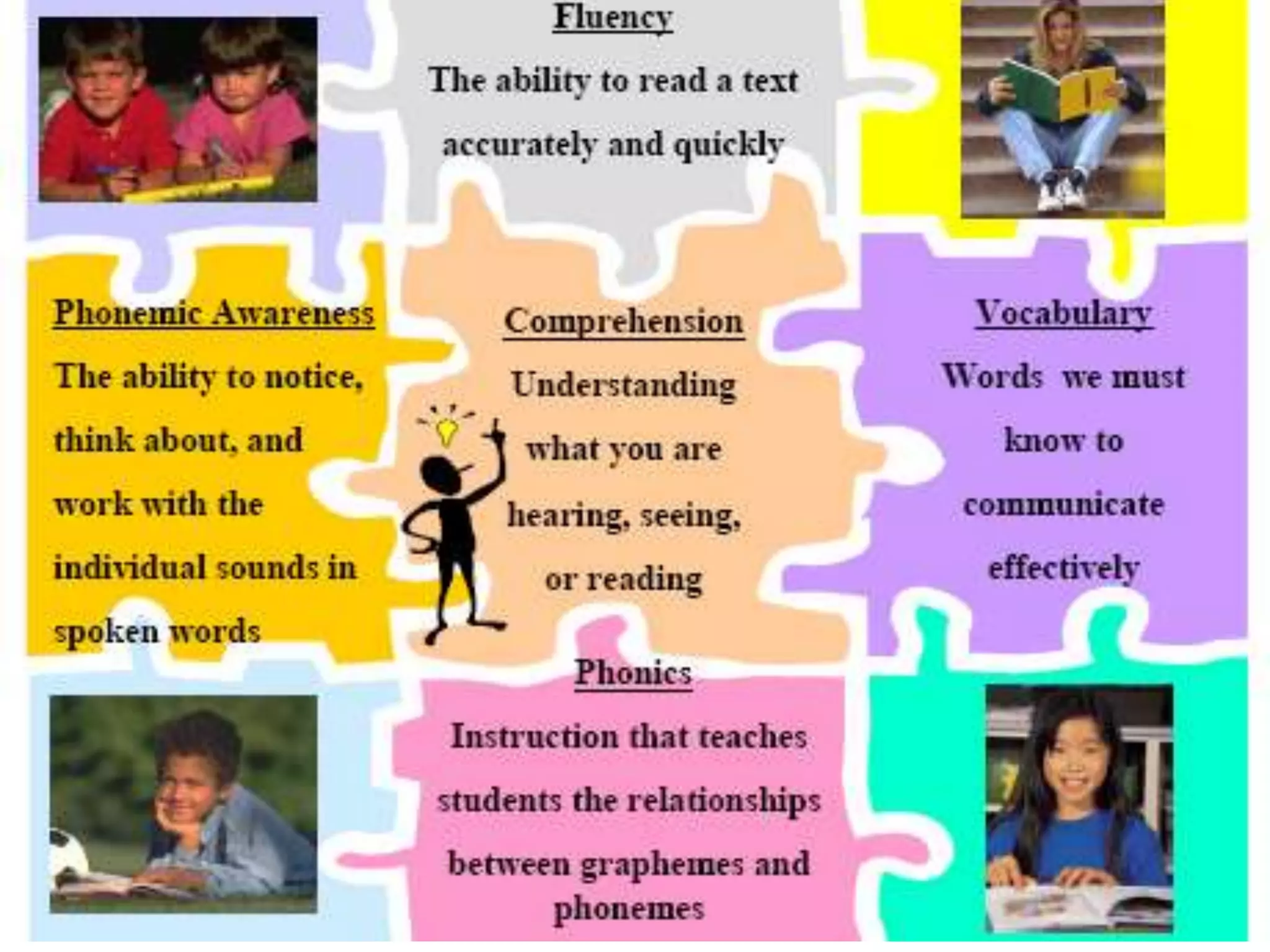
Reading ComprehensionSections I, II, III, IV of Paper 2Paper I 60 M.C. items1
2
How do you read?What strategies do you use?3
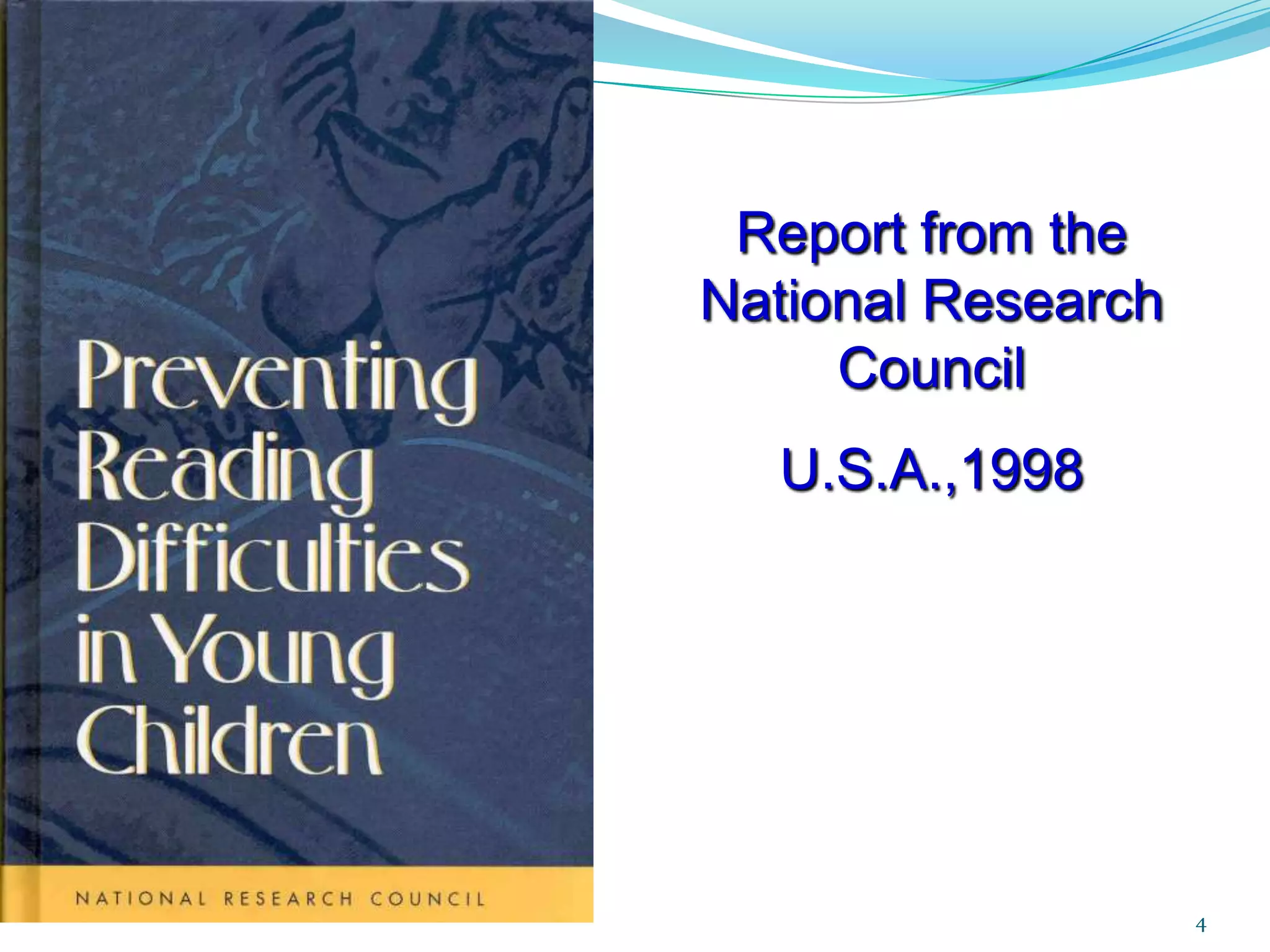
4Report from the National Research CouncilU.S.A.,1998
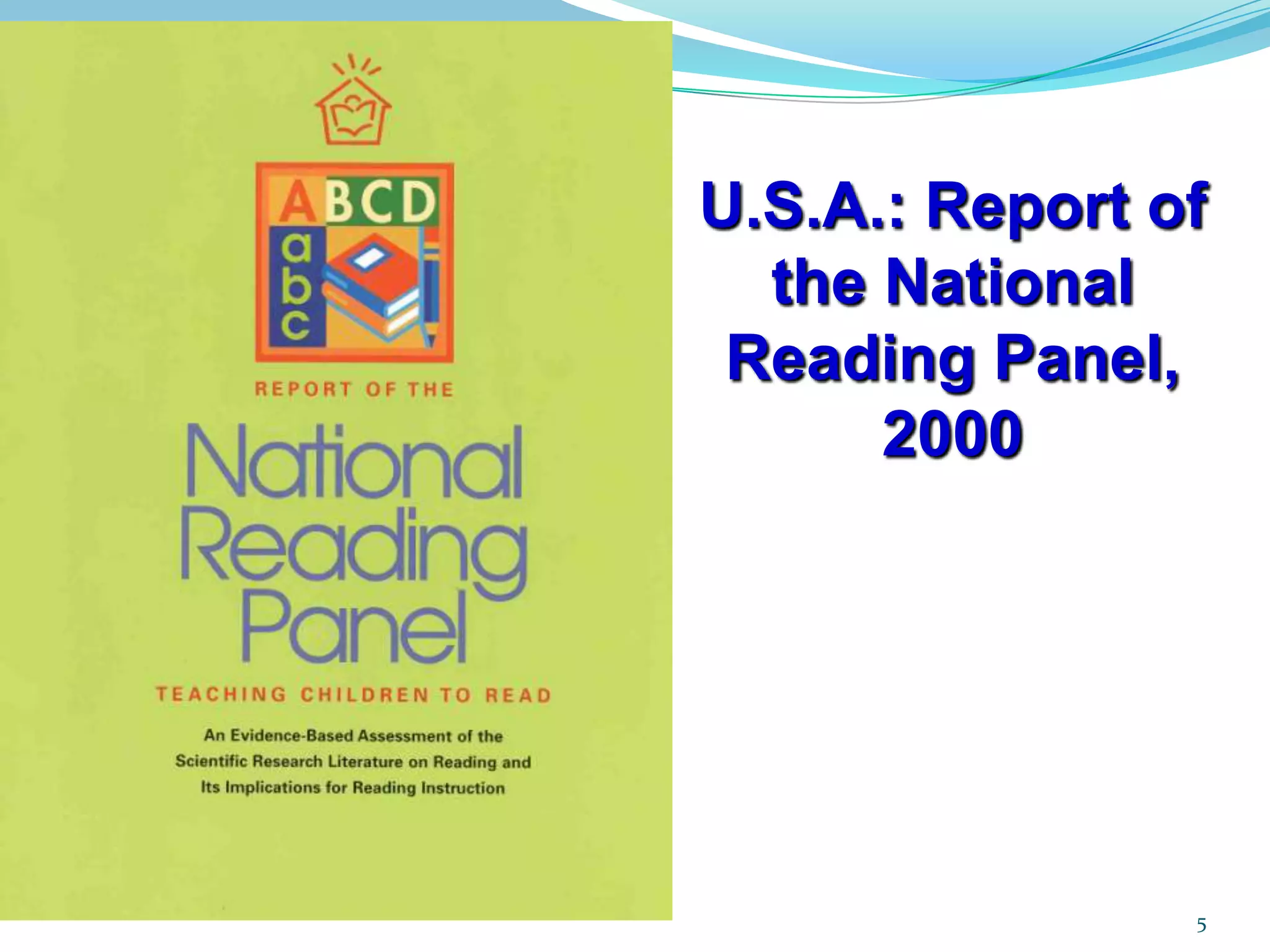
5U.S.A.: Report of the National Reading Panel, 2000
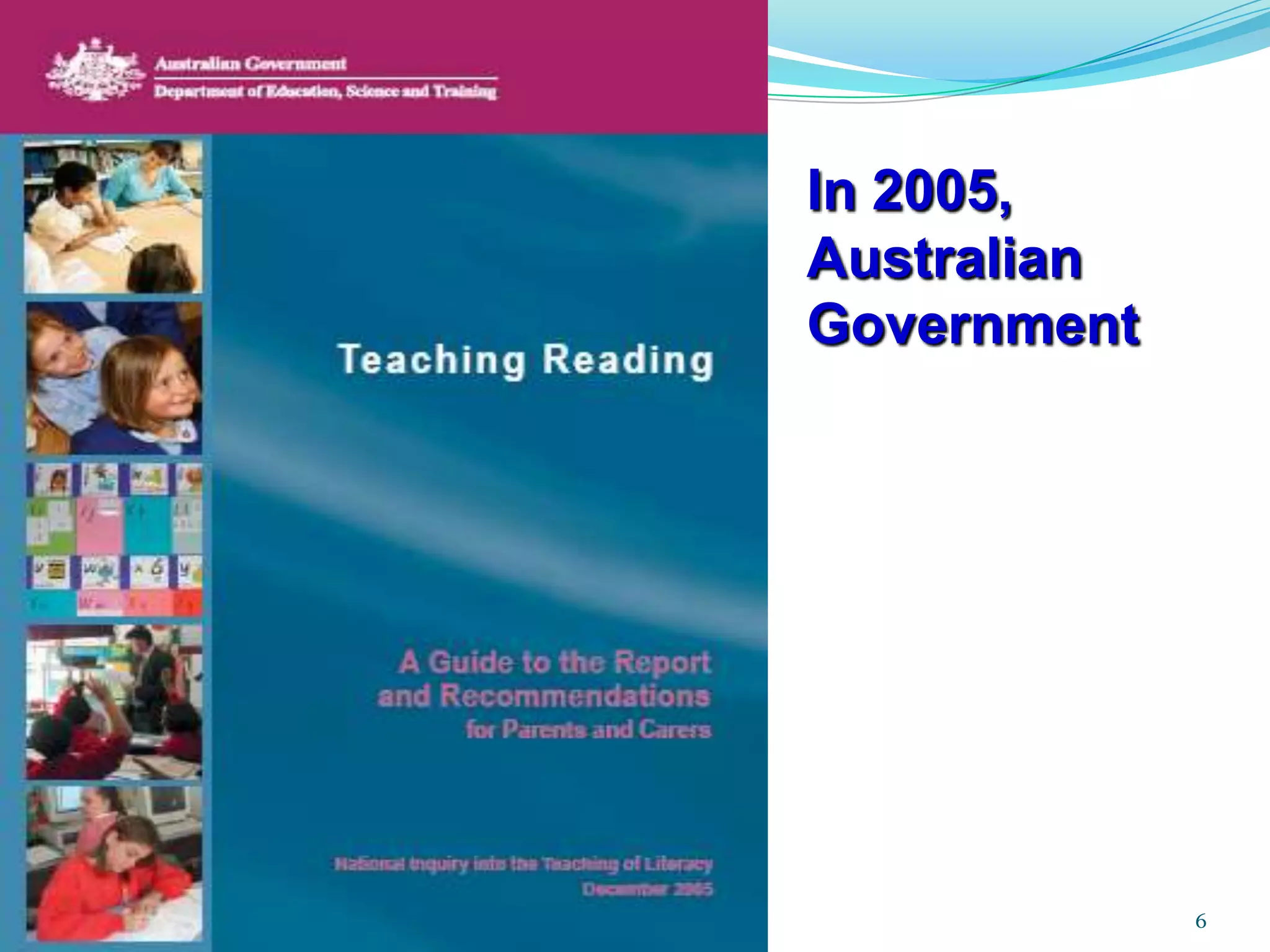
6In 2005, AustralianGovernment
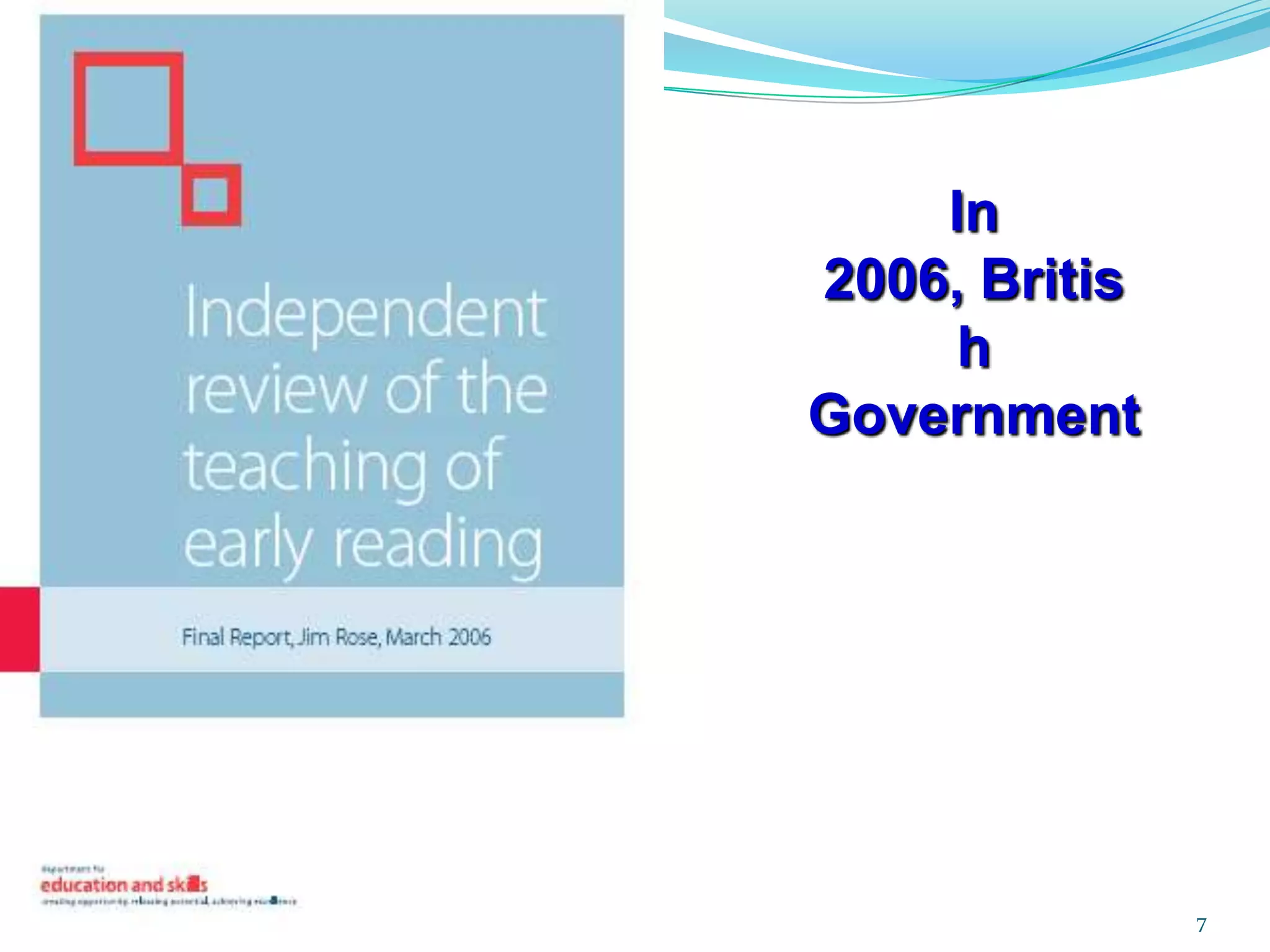
7In 2006, British Government
8So…why do our students need to read?
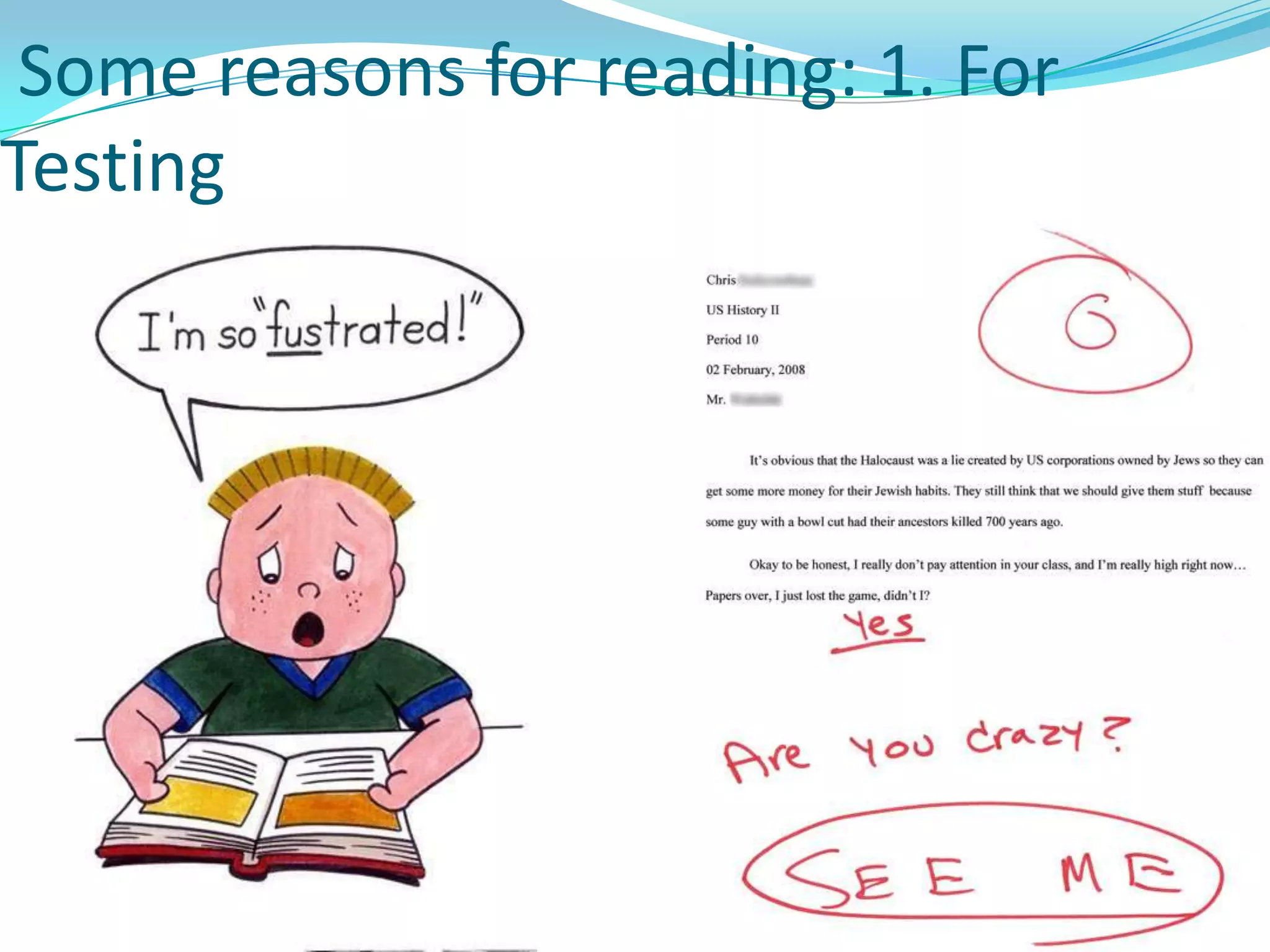
9 Some reasons for reading: 1. For Testing
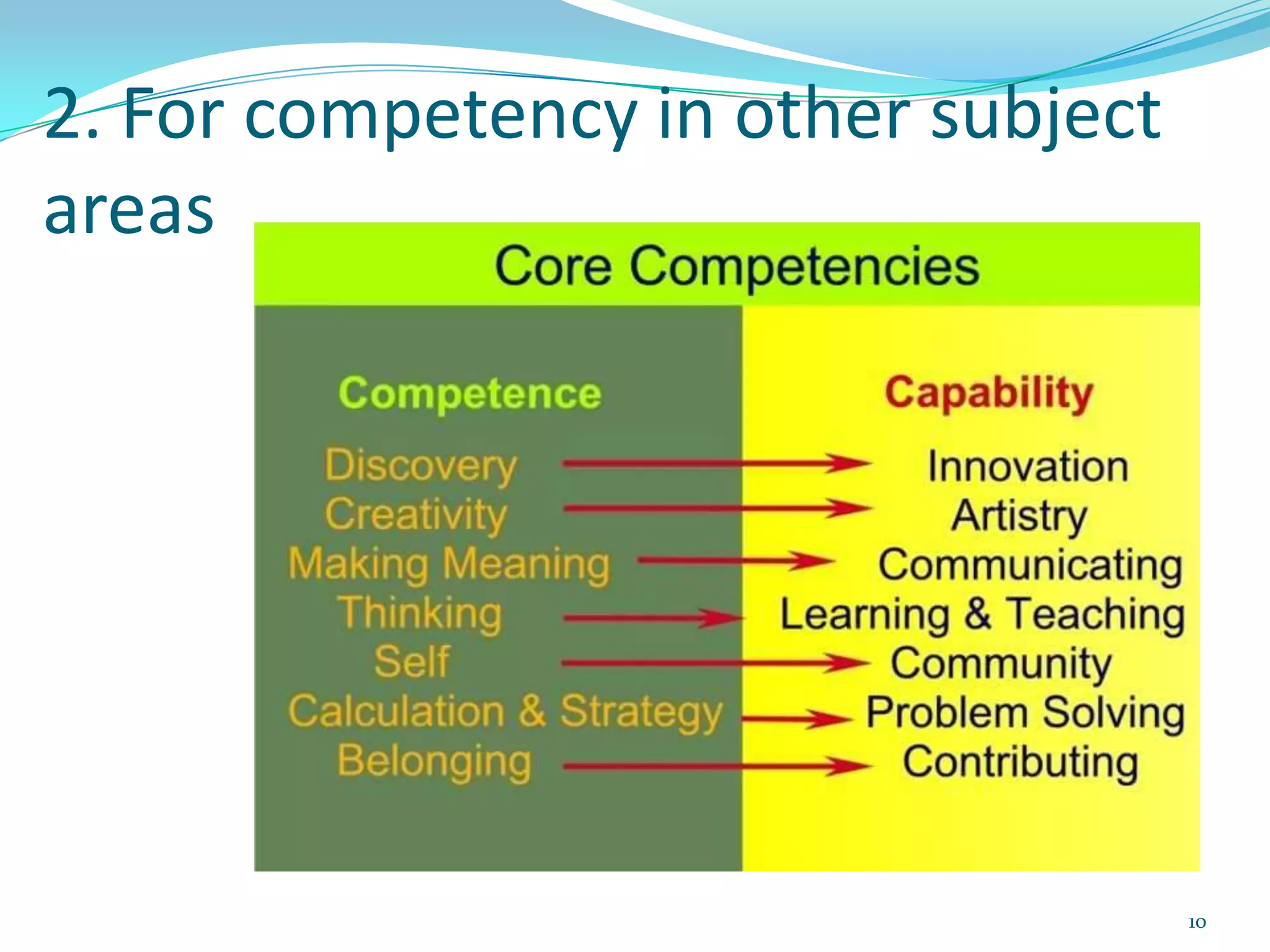
102. For competency in other subject areas
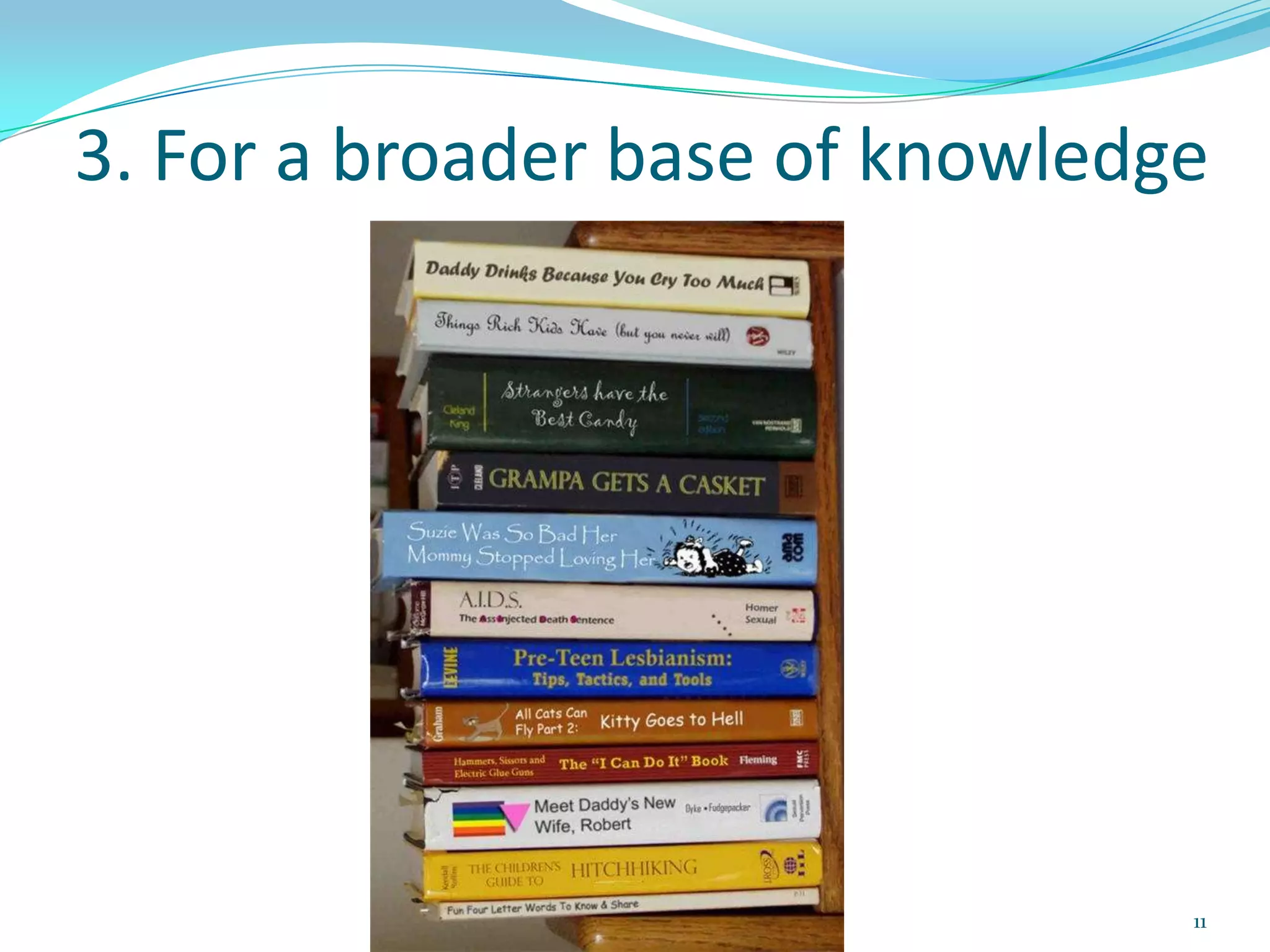
113. For a broader base of knowledge
124. For usefulness in a world replete with non-fiction literature
135. For creation of a deeper understanding of self and others
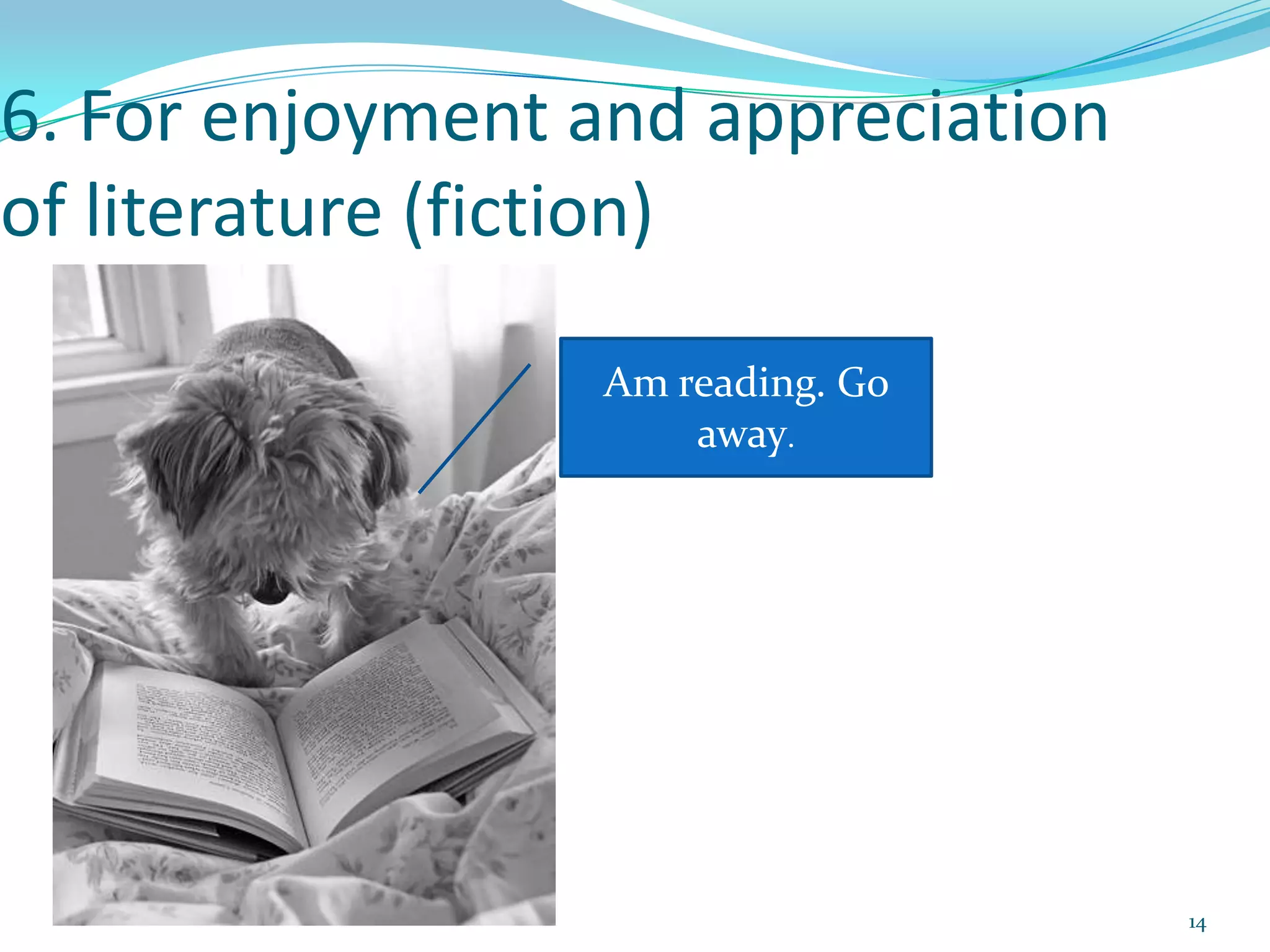
146. For enjoyment and appreciation of literature (fiction)Am reading. Go away.
Key Beliefs to Teaching Reading SuccessfullyTeachers, not programs or strategies, are the critical element in a student’s success. Teachers must understand a student’s particular issues and choose teaching strategies that will push students forward.The goal of reading is comprehension.15
Key beliefs to Teaching Reading (continued)3. Comprehension is a  complex, abstract activity. It can be taught. There are no “magically good” readers.4. No matter what level of students we teach, no matter how weak or how strong, it is our responsibility to teach them.16
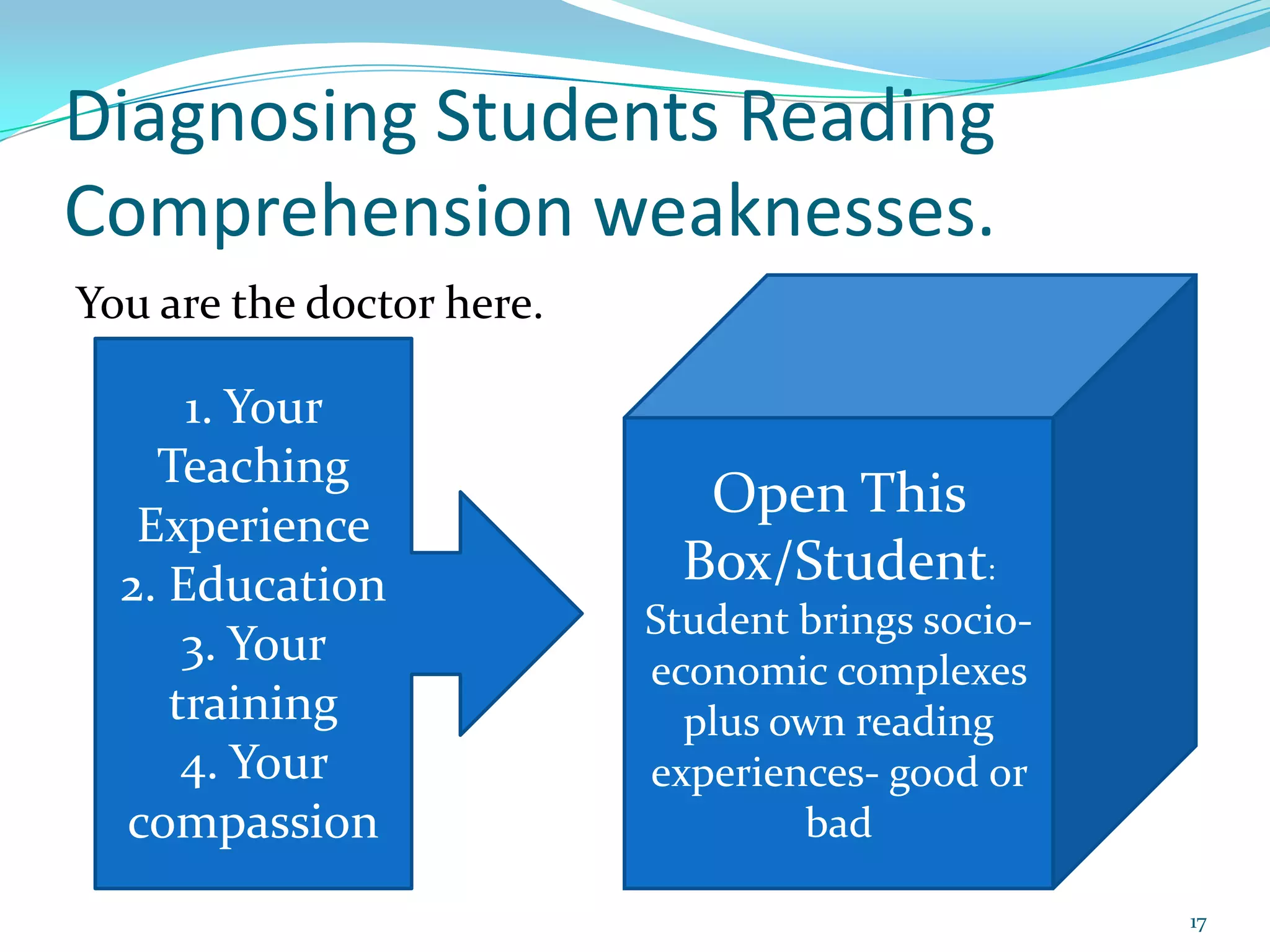
Diagnosing Students Reading Comprehension weaknesses. You are the doctor here.Open This Box/Student:Student brings socio-economic complexes plus own reading experiences- good or bad1. Your Teaching Experience2. Education3. Your training4. Your compassion17
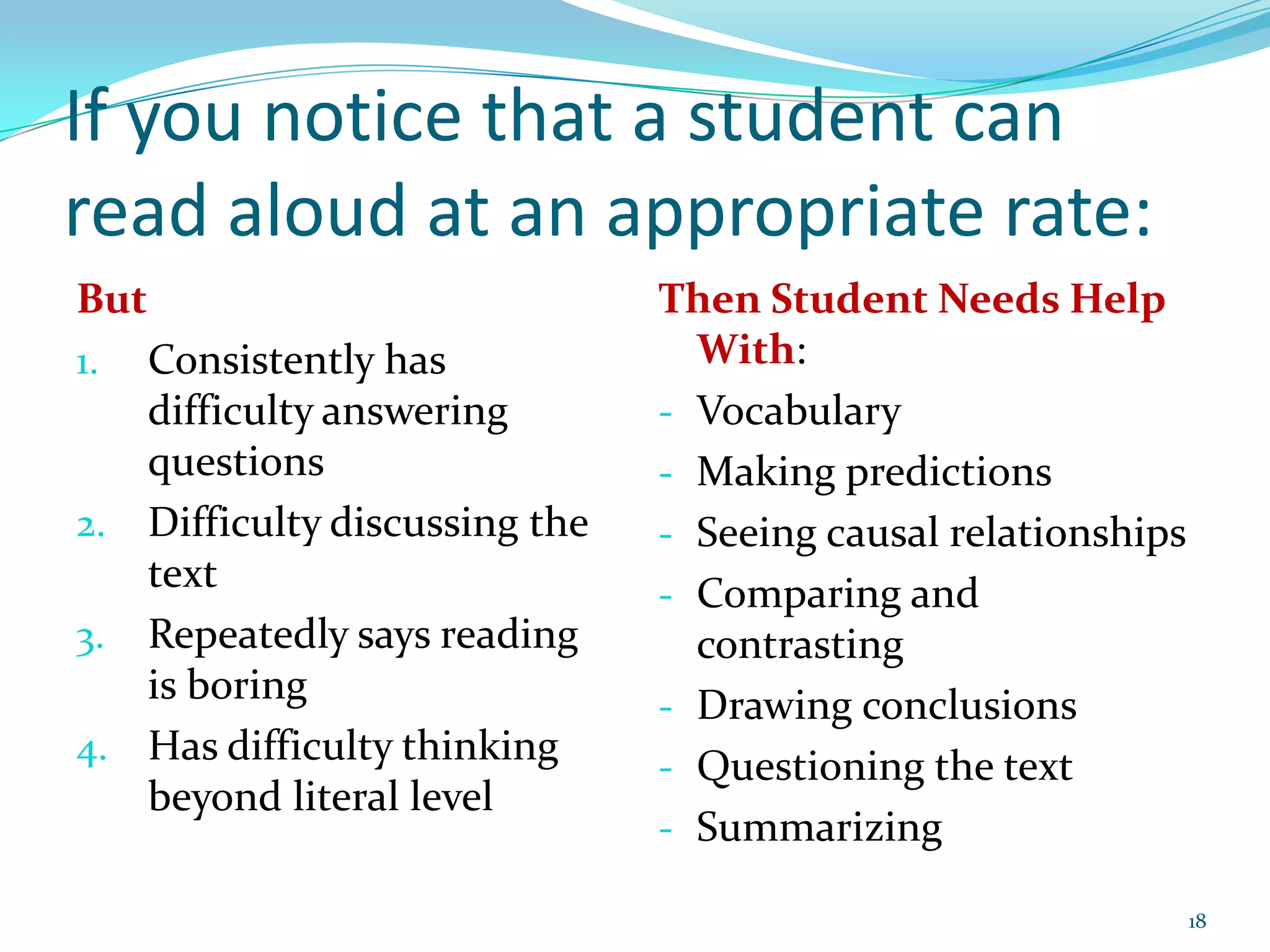
If you notice that a student can read aloud at an appropriate rate:ButConsistently has difficulty answering questionsDifficulty discussing the textRepeatedly says reading is boringHas difficulty thinking beyond literal levelThen Student Needs Help With:Vocabulary
Making predictions
Seeing causal relationships
Comparing and contrasting
Drawing conclusions
Questioning the text
Summarizing 18
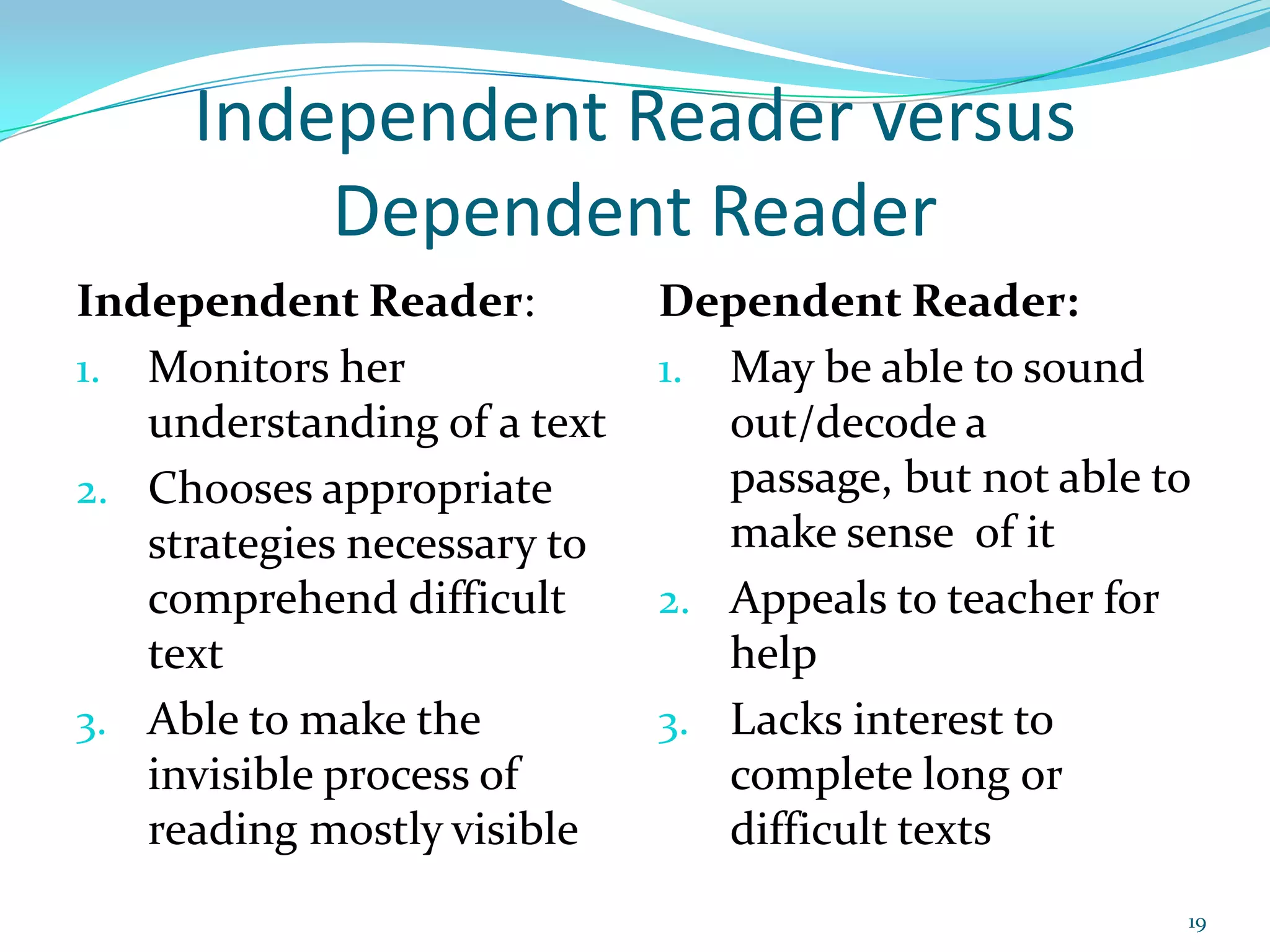
Independent Reader versus Dependent ReaderIndependent Reader:Monitors her understanding of a textChooses appropriate strategies necessary to comprehend difficult textAble to make the invisible process of reading mostly visibleDependent Reader:May be able to sound out/decode a passage, but not able to make sense  of itAppeals to teacher for helpLacks interest to complete long or difficult texts19
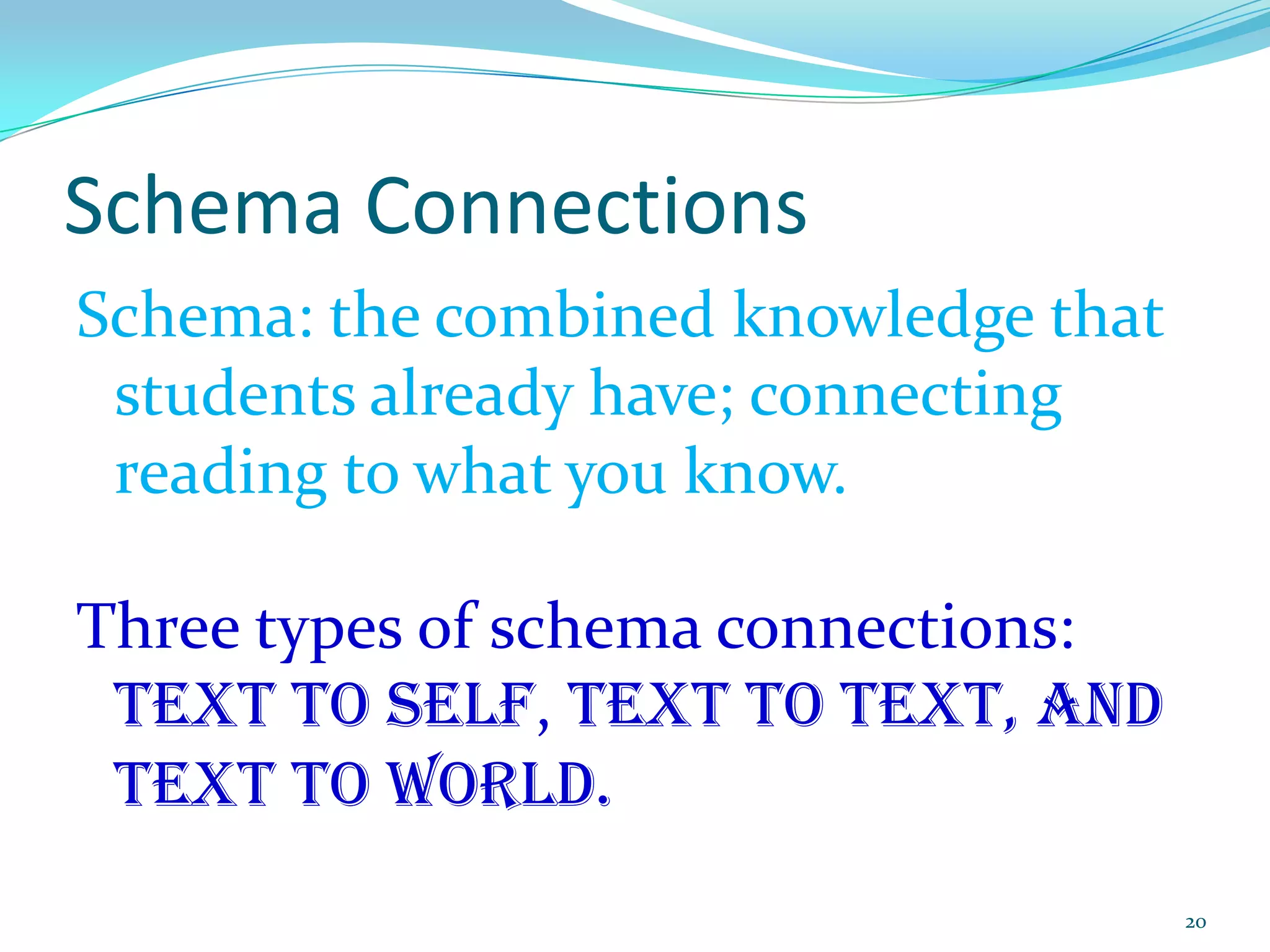
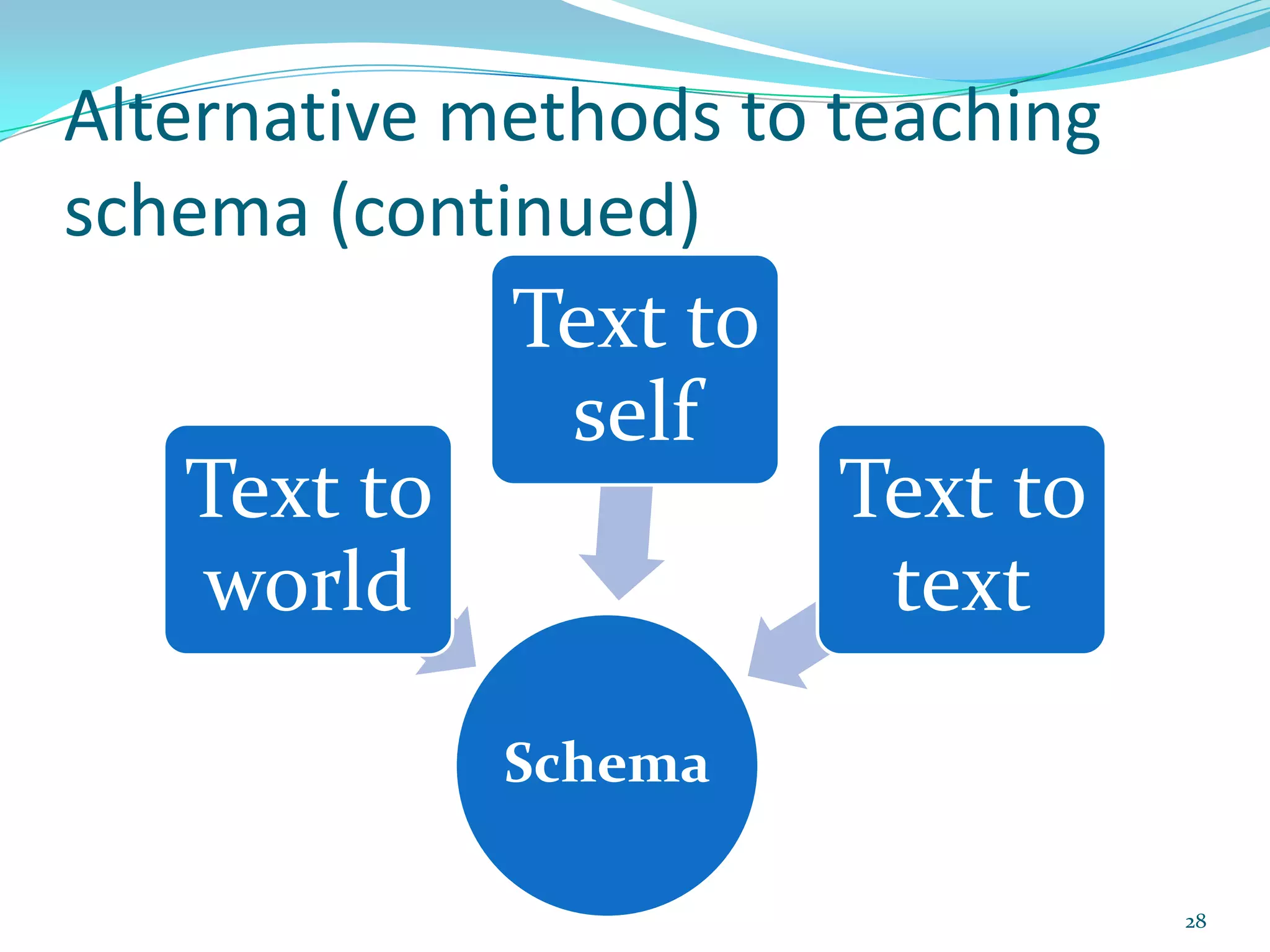
Schema ConnectionsSchema: the combined knowledge that students already have; connecting reading to what you know.Three types of schema connections: text to self, text to text, and text to world.20
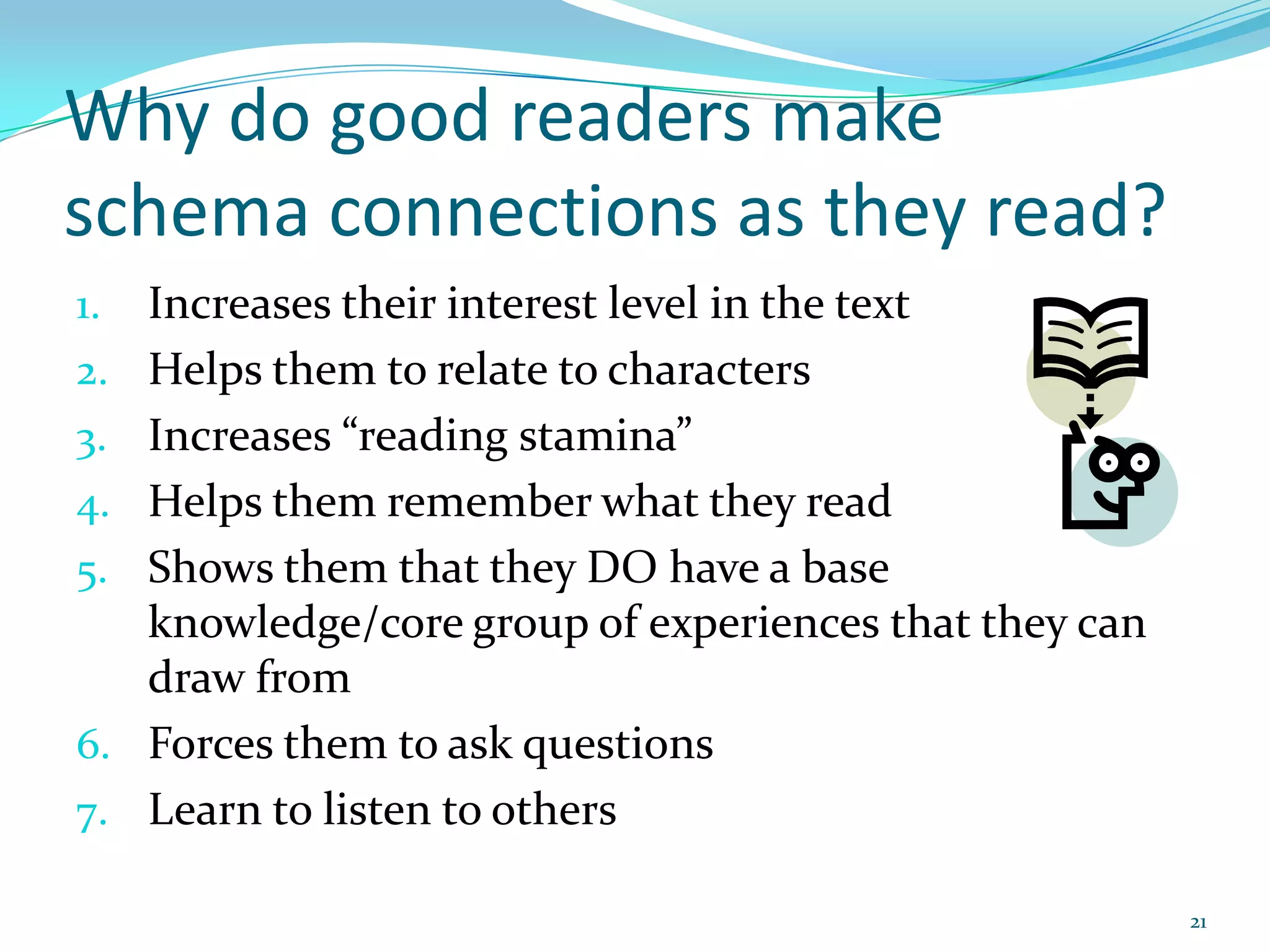
Why do good readers make schema connections as they read?Increases their interest level in the textHelps them to relate to charactersIncreases “reading stamina” Helps them remember what they readShows them that they DO have a base knowledge/core group of experiences that they can draw fromForces them to ask questionsLearn to listen to others21
Teach the students schema by:Explaining concept of schema to them, and the three types of schemaMake sure students understand the benefits of schema connections.3.  Model how I make schema connections. Use “think aloud” method.22
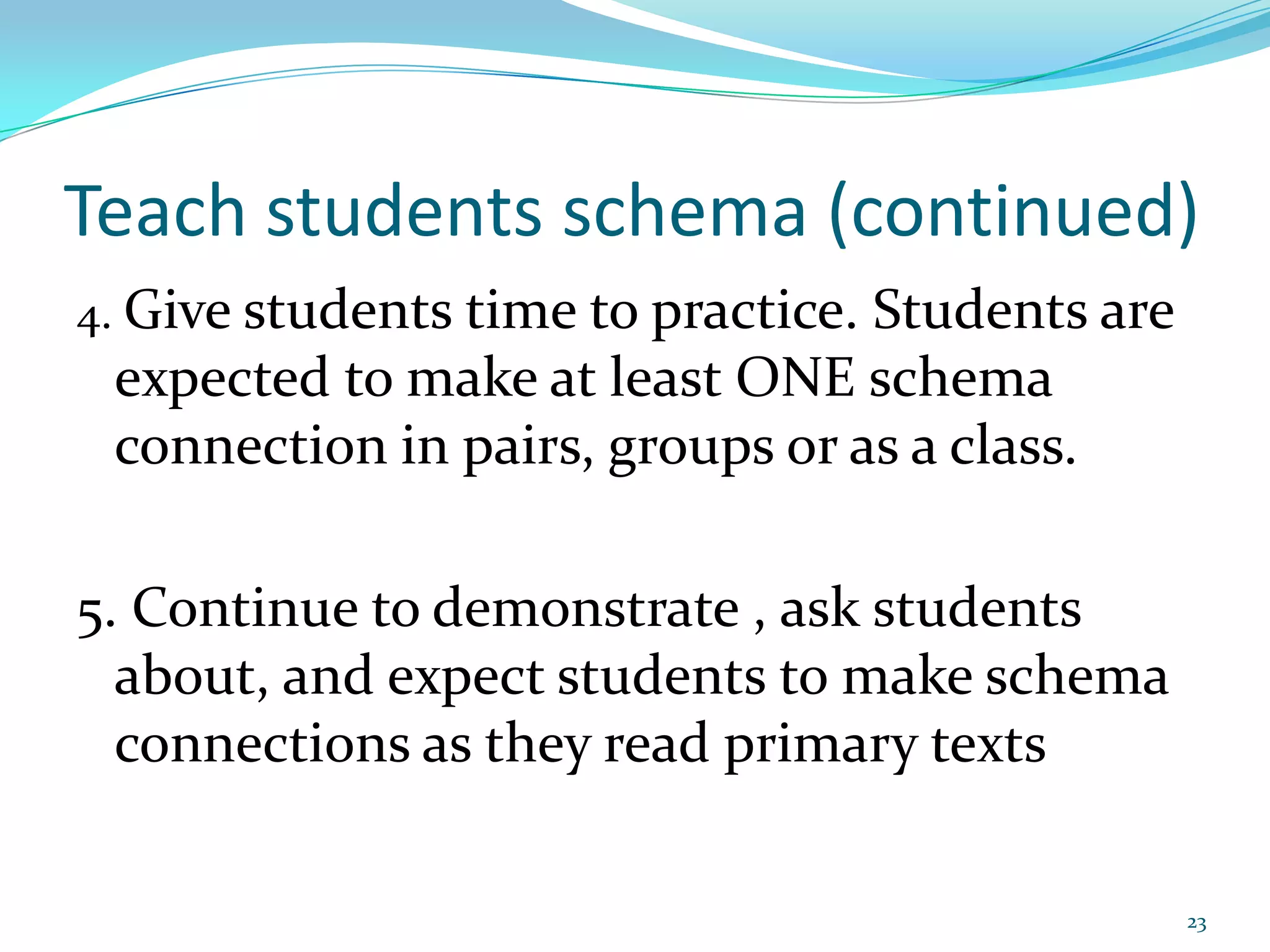
Teach students schema (continued)4. Give students time to practice. Students are expected to make at least ONE schema connection in pairs, groups or as a class.5. Continue to demonstrate , ask students about, and expect students to make schema connections as they read primary texts23
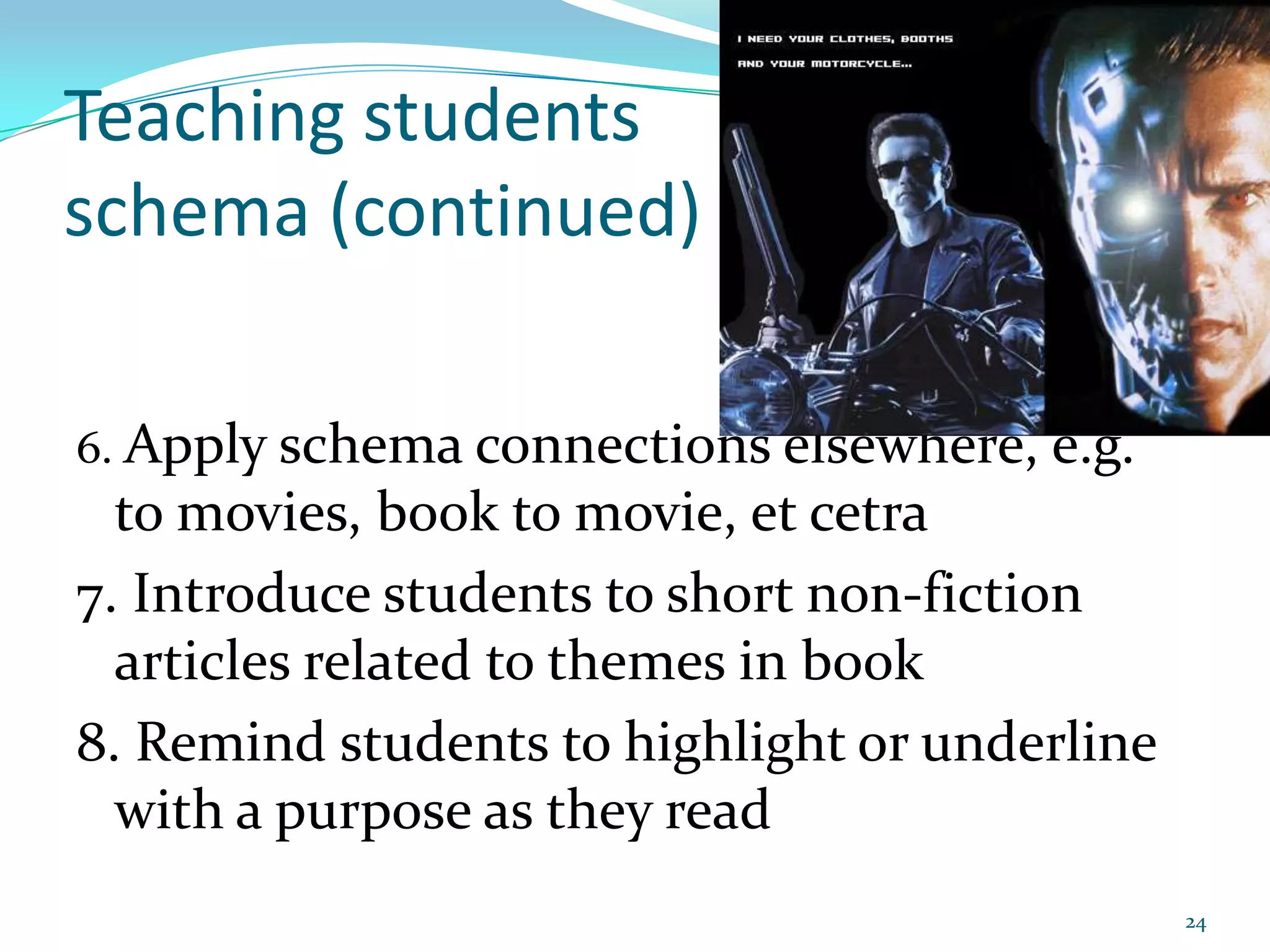
Teaching students schema (continued)6. Apply schema connections elsewhere, e.g. to movies, book to movie, et cetra7. Introduce students to short non-fiction articles related to themes in book8. Remind students to highlight or underline with a purpose as they read24
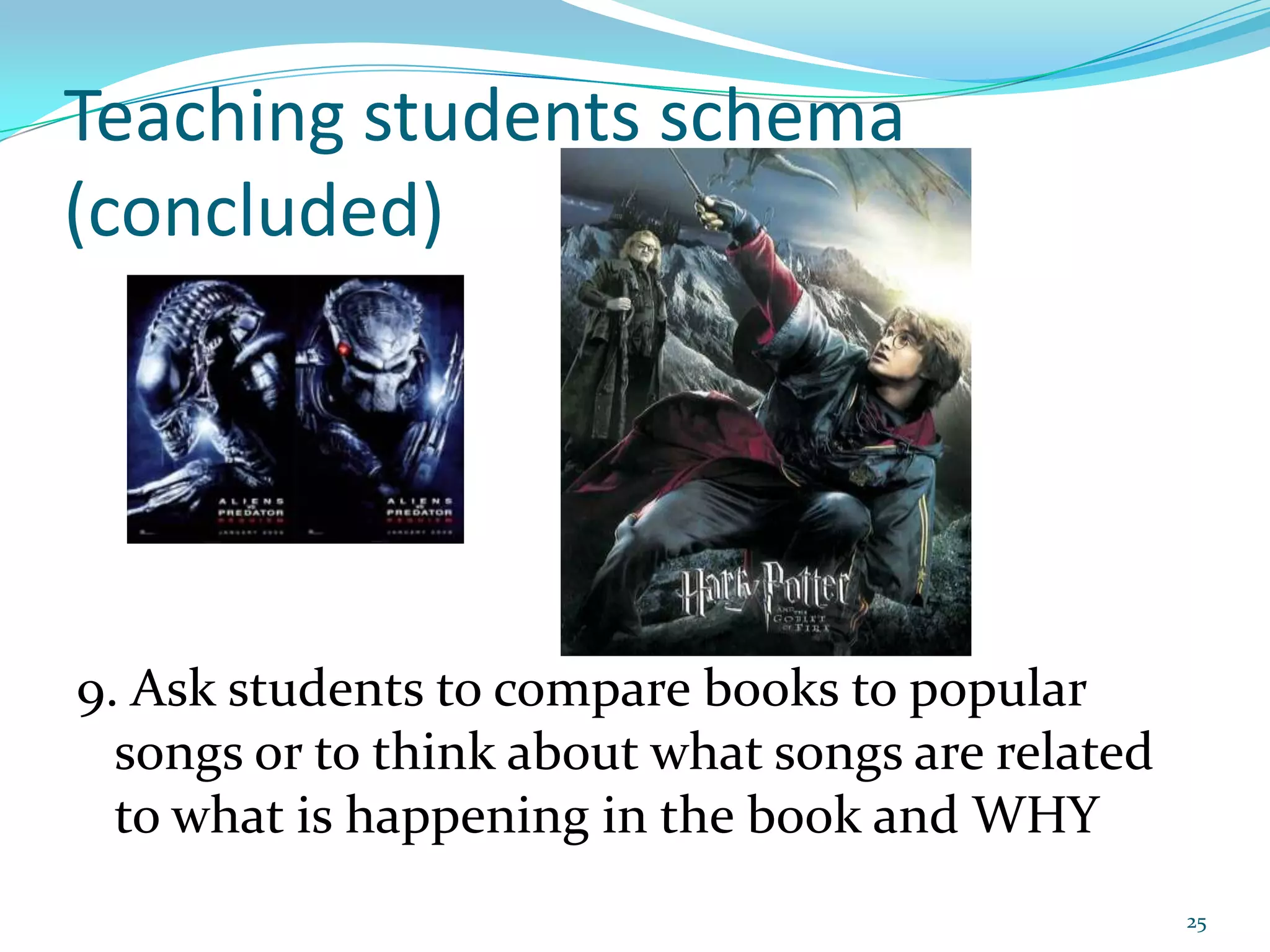
Teaching students schema (concluded)9. Ask students to compare books to popular songs or to think about what songs are related to what is happening in the book and WHY25
Alternative Methods for introducing SchemaAdopt mantra- “what does this remind me of?”Ask students to list everything they know about a given subject.26
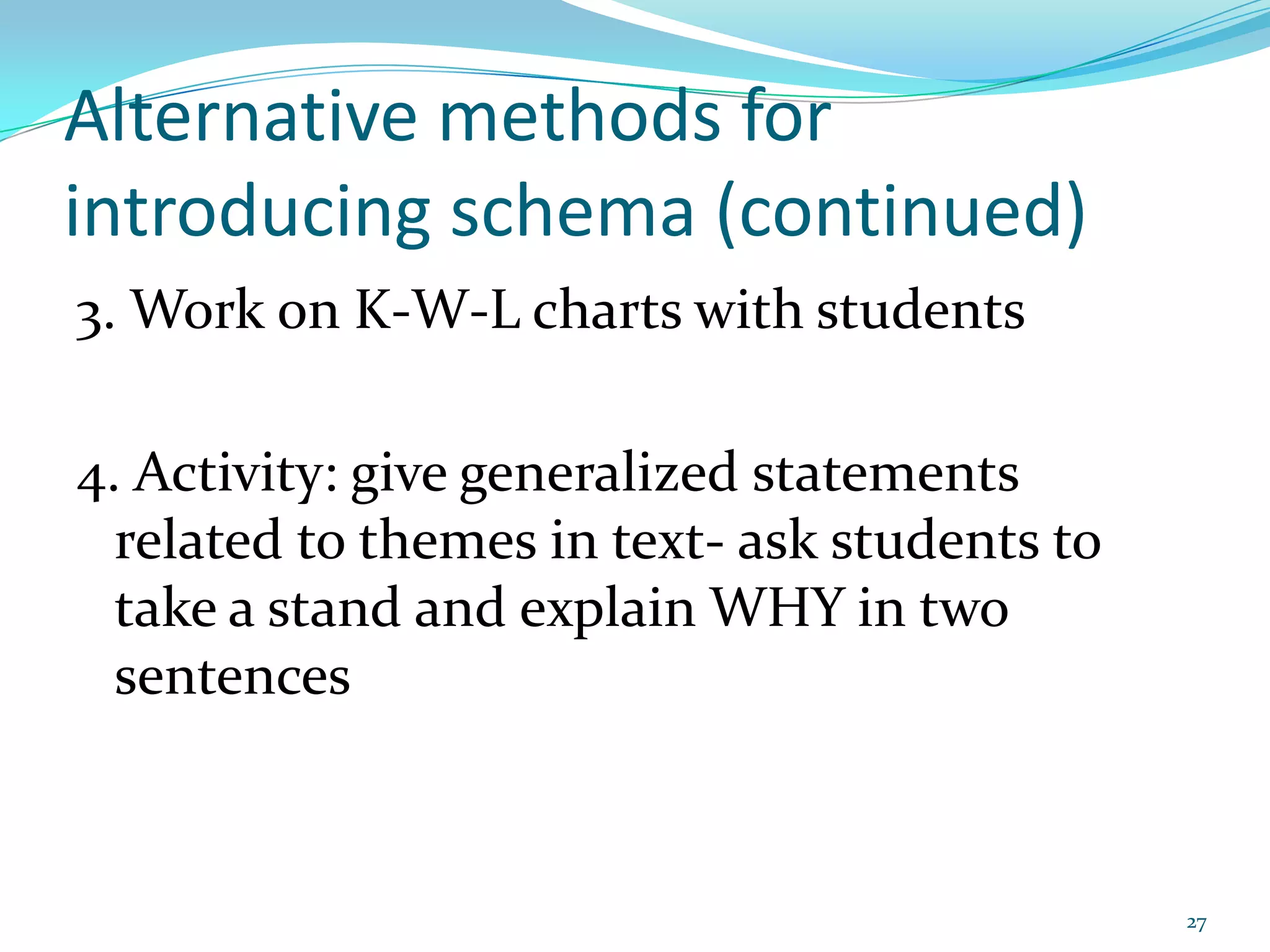
Alternative methods for introducing schema (continued)3. Work on K-W-L charts with students4. Activity: give generalized statements related to themes in text- ask students to take a stand and explain WHY in two sentences27
Alternative methods to teaching schema (continued)28
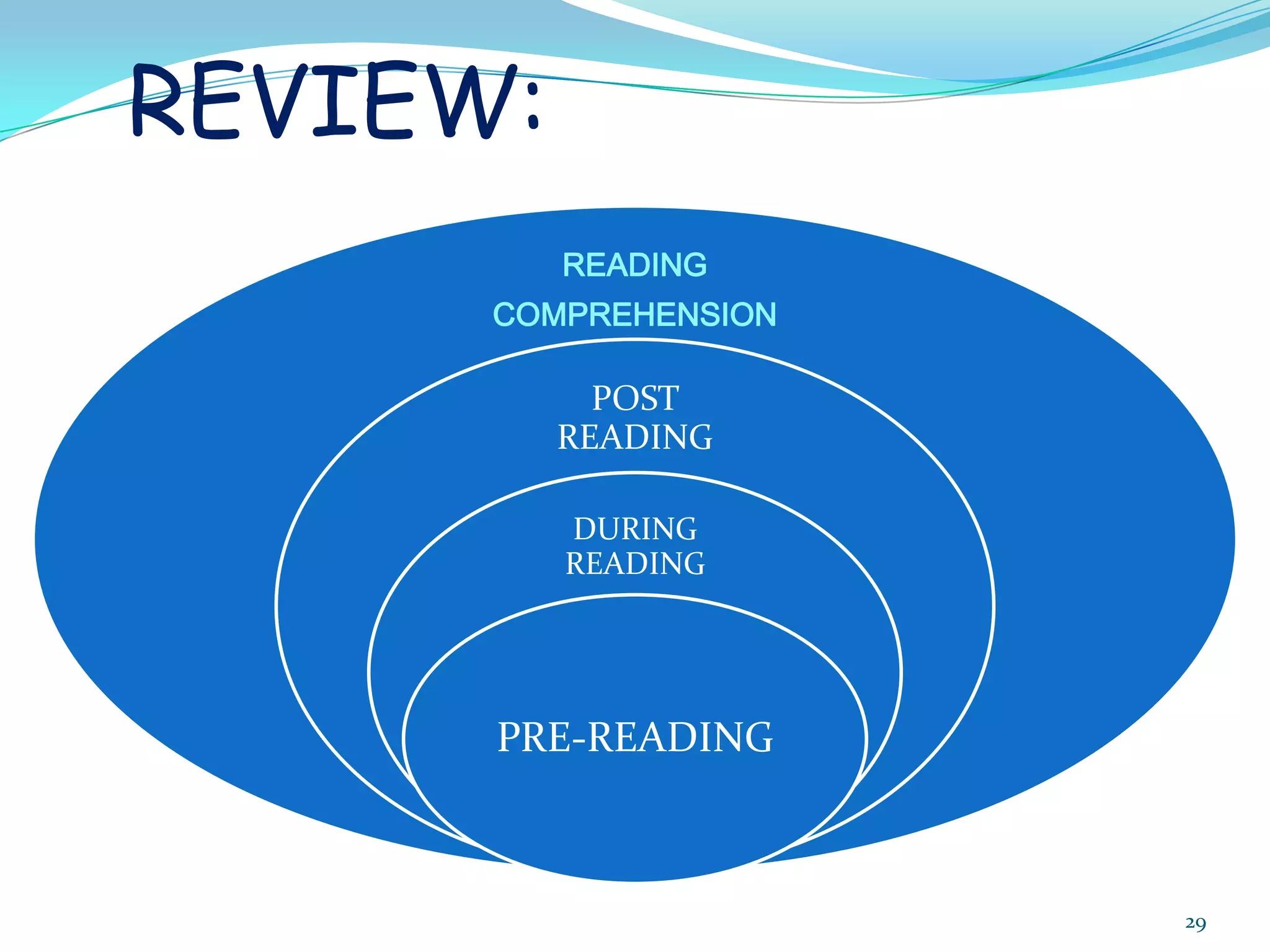
REVIEW:29

Emil pulidoOnReadingcomprehension

  • 1.
    Reading ComprehensionSections I,II, III, IV of Paper 2Paper I 60 M.C. items1
  • 2.
  • 3.
    How do youread?What strategies do you use?3
  • 4.
    4Report from theNational Research CouncilU.S.A.,1998
  • 5.
    5U.S.A.: Report ofthe National Reading Panel, 2000
  • 6.
  • 7.
  • 8.
    8So…why do ourstudents need to read?
  • 9.
    9 Some reasonsfor reading: 1. For Testing
  • 10.
    102. For competencyin other subject areas
  • 11.
    113. For abroader base of knowledge
  • 12.
    124. For usefulnessin a world replete with non-fiction literature
  • 13.
    135. For creationof a deeper understanding of self and others
  • 14.
    146. For enjoymentand appreciation of literature (fiction)Am reading. Go away.
  • 15.
    Key Beliefs toTeaching Reading SuccessfullyTeachers, not programs or strategies, are the critical element in a student’s success. Teachers must understand a student’s particular issues and choose teaching strategies that will push students forward.The goal of reading is comprehension.15
  • 16.
    Key beliefs toTeaching Reading (continued)3. Comprehension is a complex, abstract activity. It can be taught. There are no “magically good” readers.4. No matter what level of students we teach, no matter how weak or how strong, it is our responsibility to teach them.16
  • 17.
    Diagnosing Students ReadingComprehension weaknesses. You are the doctor here.Open This Box/Student:Student brings socio-economic complexes plus own reading experiences- good or bad1. Your Teaching Experience2. Education3. Your training4. Your compassion17
  • 18.
    If you noticethat a student can read aloud at an appropriate rate:ButConsistently has difficulty answering questionsDifficulty discussing the textRepeatedly says reading is boringHas difficulty thinking beyond literal levelThen Student Needs Help With:Vocabulary
  • 19.
  • 20.
  • 21.
  • 22.
  • 23.
  • 24.
  • 25.
    Independent Reader versusDependent ReaderIndependent Reader:Monitors her understanding of a textChooses appropriate strategies necessary to comprehend difficult textAble to make the invisible process of reading mostly visibleDependent Reader:May be able to sound out/decode a passage, but not able to make sense of itAppeals to teacher for helpLacks interest to complete long or difficult texts19
  • 26.
    Schema ConnectionsSchema: thecombined knowledge that students already have; connecting reading to what you know.Three types of schema connections: text to self, text to text, and text to world.20
  • 27.
    Why do goodreaders make schema connections as they read?Increases their interest level in the textHelps them to relate to charactersIncreases “reading stamina” Helps them remember what they readShows them that they DO have a base knowledge/core group of experiences that they can draw fromForces them to ask questionsLearn to listen to others21
  • 28.
    Teach the studentsschema by:Explaining concept of schema to them, and the three types of schemaMake sure students understand the benefits of schema connections.3. Model how I make schema connections. Use “think aloud” method.22
  • 29.
    Teach students schema(continued)4. Give students time to practice. Students are expected to make at least ONE schema connection in pairs, groups or as a class.5. Continue to demonstrate , ask students about, and expect students to make schema connections as they read primary texts23
  • 30.
    Teaching students schema(continued)6. Apply schema connections elsewhere, e.g. to movies, book to movie, et cetra7. Introduce students to short non-fiction articles related to themes in book8. Remind students to highlight or underline with a purpose as they read24
  • 31.
    Teaching students schema(concluded)9. Ask students to compare books to popular songs or to think about what songs are related to what is happening in the book and WHY25
  • 32.
    Alternative Methods forintroducing SchemaAdopt mantra- “what does this remind me of?”Ask students to list everything they know about a given subject.26
  • 33.
    Alternative methods forintroducing schema (continued)3. Work on K-W-L charts with students4. Activity: give generalized statements related to themes in text- ask students to take a stand and explain WHY in two sentences27
  • 34.
    Alternative methods toteaching schema (continued)28
  • 35.
  • 36.
  • 37.
  • 38.
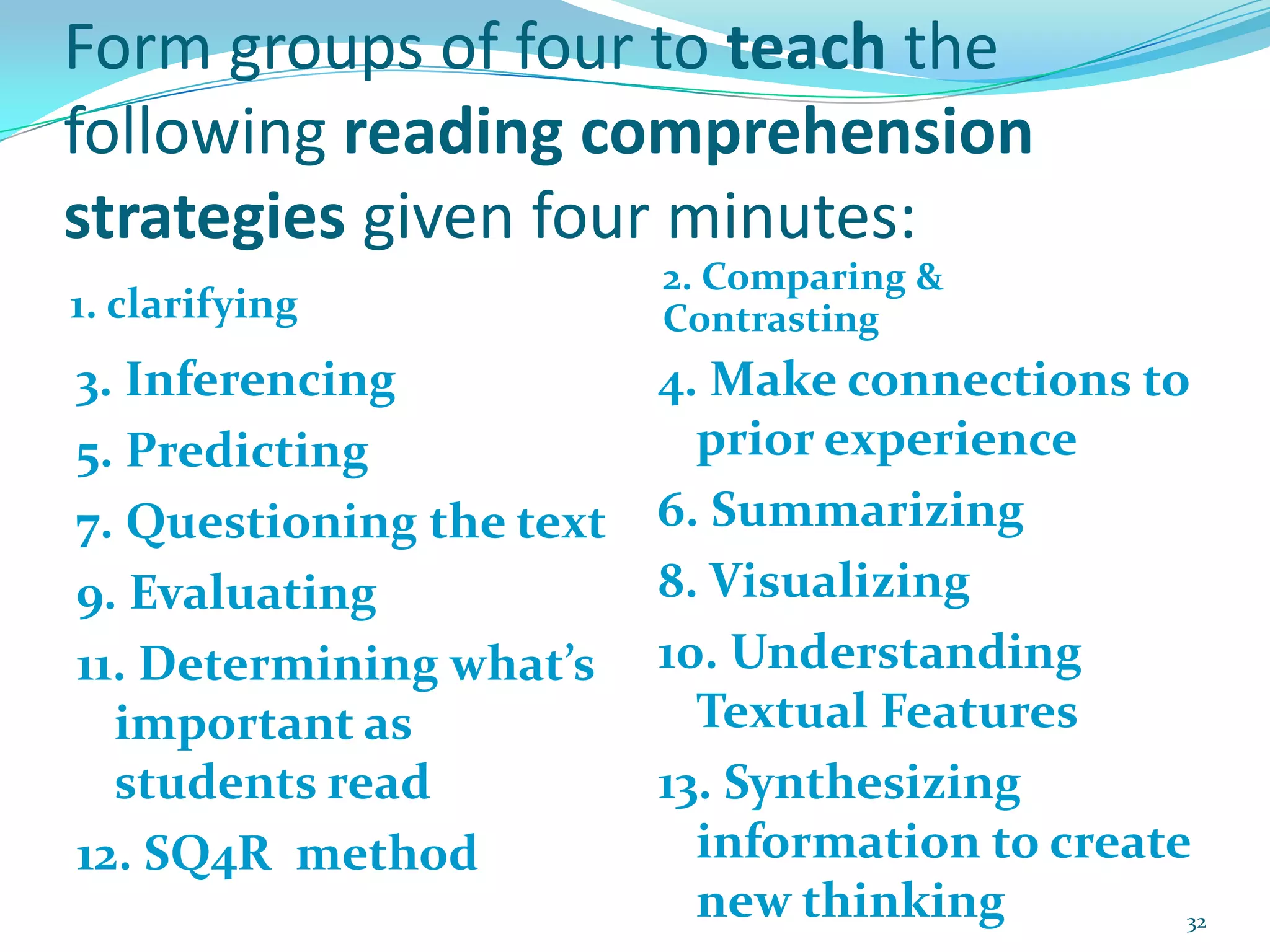
    Form groups offour to teach the following reading comprehension strategies given four minutes:1. clarifying2. Comparing & Contrasting3. Inferencing5. Predicting7. Questioning the text9. Evaluating11. Determining what’s important as students read12. SQ4R method4. Make connections to prior experience6. Summarizing8. Visualizing10. Understanding Textual Features13. Synthesizing information to create new thinking32
  • 39.
  • 40.
    Home Work forTuesday & Wednesday:Bring one innovative teaching method or technique you have created or used.Prepare for a debate on the following three propositions for Wednesday:34
  • 41.
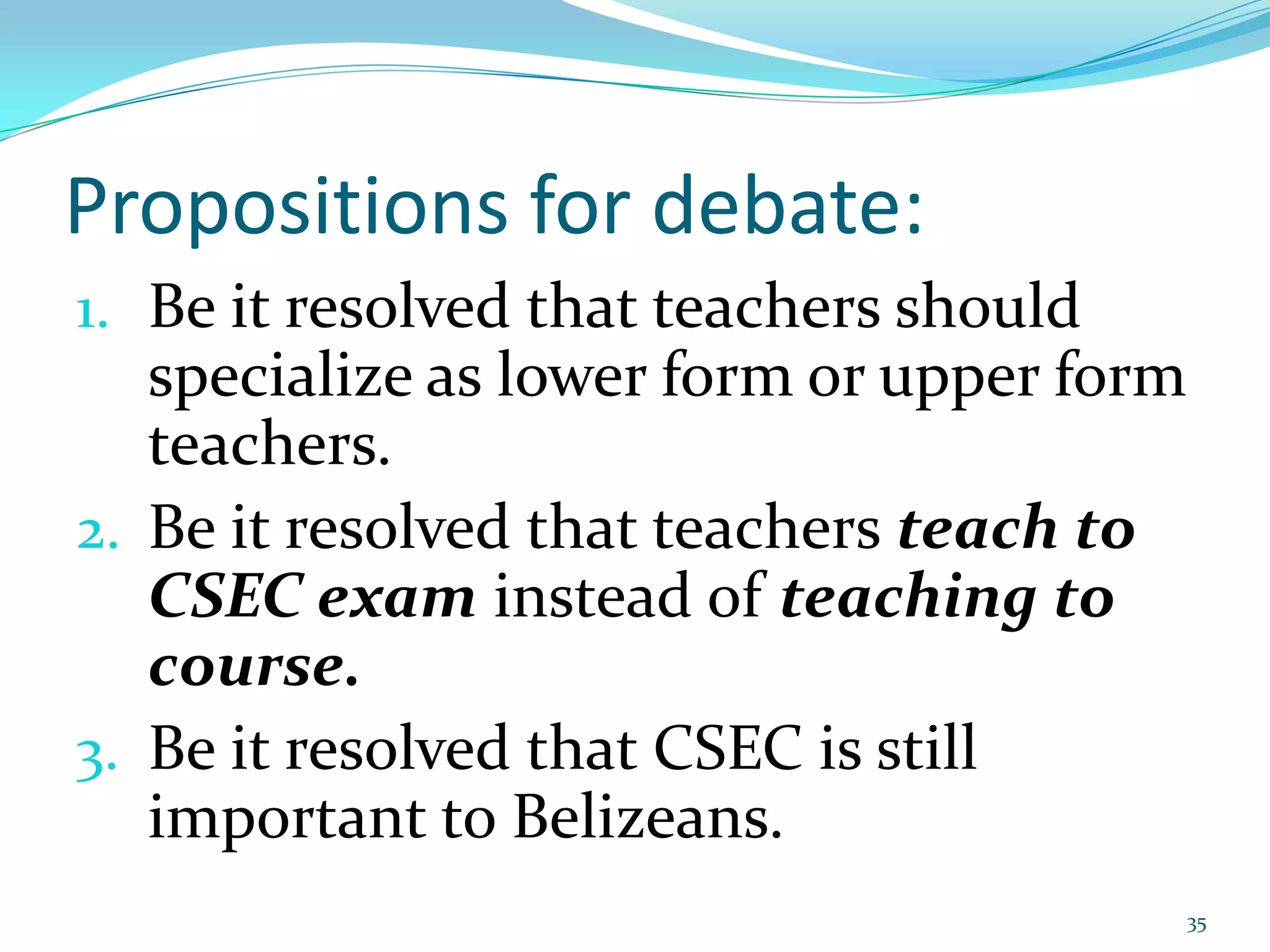
    Propositions for debate:Beit resolved that teachers should specialize as lower form orupper form teachers.Be it resolved that teachers teach to CSEC exam instead of teaching to course.Be it resolved that CSEC is still important to Belizeans.35

Editor's Notes

  • #4 Take five minutes to write down why you read and the strategies you use to read.
  • #10 Some times we can know when a student has failed a test even before he has taken the test.
  • #19 Student also needs help with 8. finding the main idea, 9. monitoring their own understanding
  • #20 Dependent Reader: 4. is not aware of the processes that should be going on in her head as she reads.