Brazil
© 2016 Emergo – Have comments or suggestions about the content of this table? Email us at marketing@emergogroup.com. Table updated 07/2016. EmergoGroup.com/brazil
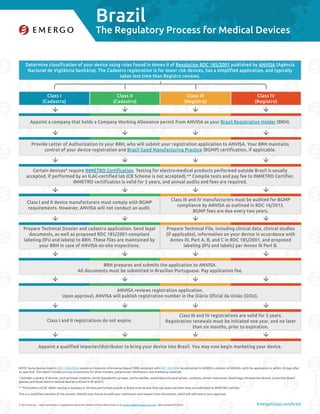
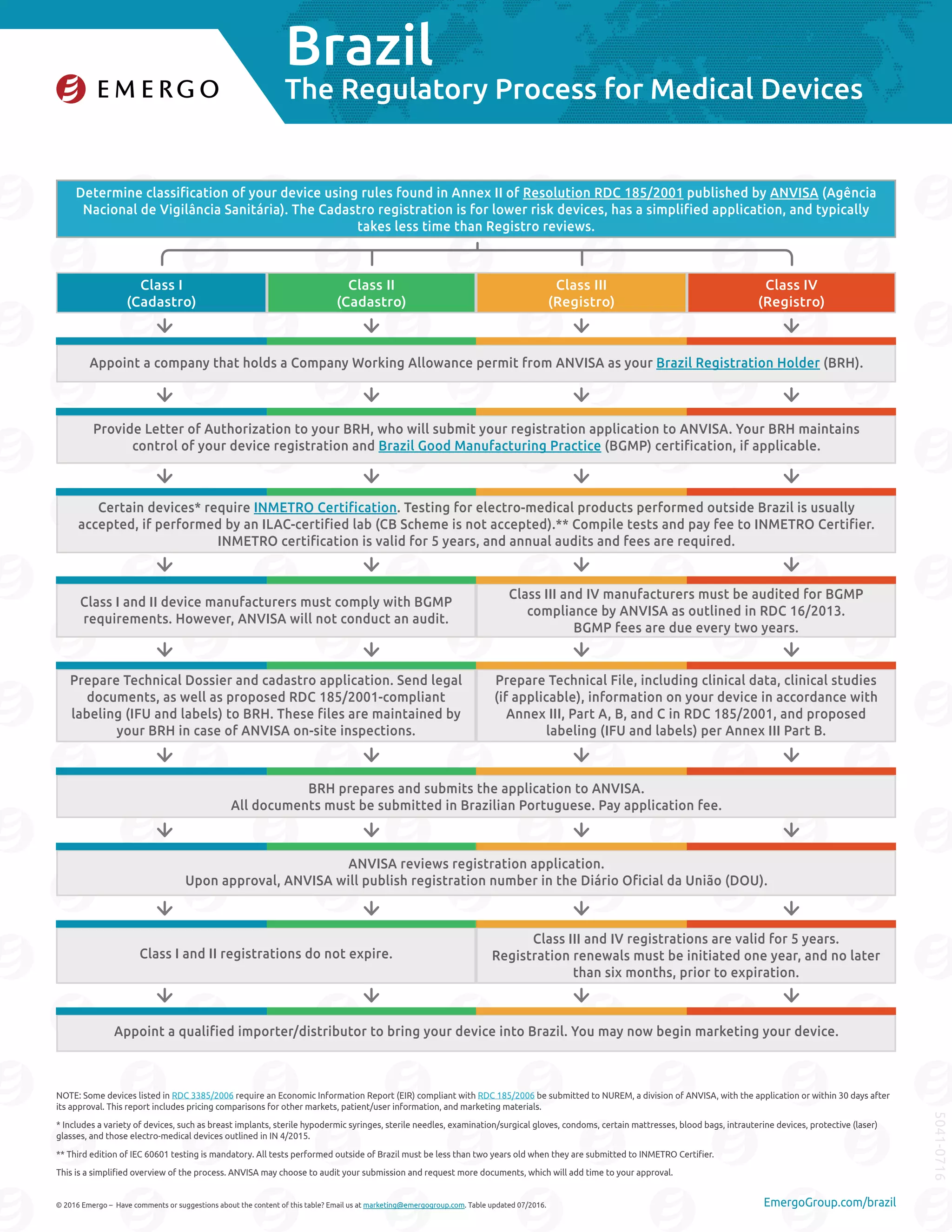
Determine classification of your device using rules found in Annex II of Resolution RDC 185/2001 published by ANVISA (Agência
Nacional de Vigilância Sanitária). The Cadastro registration is for lower risk devices, has a simplified application, and typically
takes less time than Registro reviews.
Appoint a company that holds a Company Working Allowance permit from ANVISA as your Brazil Registration Holder (BRH).
Provide Letter of Authorization to your BRH, who will submit your registration application to ANVISA. Your BRH maintains
control of your device registration and Brazil Good Manufacturing Practice (BGMP) certification, if applicable.
BRH prepares and submits the application to ANVISA.
All documents must be submitted in Brazilian Portuguese. Pay application fee.
Certain devices* require INMETRO Certification. Testing for electro-medical products performed outside Brazil is usually
accepted, if performed by an ILAC-certified lab (CB Scheme is not accepted).** Compile tests and pay fee to INMETRO Certifier.
INMETRO certification is valid for 5 years, and annual audits and fees are required.
ANVISA reviews registration application.
Upon approval, ANVISA will publish registration number in the Diário Oficial da União (DOU).
Appoint a qualified importer/distributor to bring your device into Brazil. You may now begin marketing your device.
Class III and IV manufacturers must be audited for BGMP
compliance by ANVISA as outlined in RDC 16/2013.
BGMP fees are due every two years.
Class I and II device manufacturers must comply with BGMP
requirements. However, ANVISA will not conduct an audit.
Prepare Technical File, including clinical data, clinical studies
(if applicable), information on your device in accordance with
Annex III, Part A, B, and C in RDC 185/2001, and proposed
labeling (IFU and labels) per Annex III Part B.
Prepare Technical Dossier and cadastro application. Send legal
documents, as well as proposed RDC 185/2001-compliant
labeling (IFU and labels) to BRH. These files are maintained by
your BRH in case of ANVISA on-site inspections.
Class III and IV registrations are valid for 5 years.
Registration renewals must be initiated one year, and no later
than six months, prior to expiration.
Class I and II registrations do not expire.
5041-0716
The Regulatory Process for Medical Devices
NOTE: Some devices listed in RDC 3385/2006 require an Economic Information Report (EIR) compliant with RDC 185/2006 be submitted to NUREM, a division of ANVISA, with the application or within 30 days after
its approval. This report includes pricing comparisons for other markets, patient/user information, and marketing materials.
* Includes a variety of devices, such as breast implants, sterile hypodermic syringes, sterile needles, examination/surgical gloves, condoms, certain mattresses, blood bags, intrauterine devices, protective (laser)
glasses, and those electro-medical devices outlined in IN 4/2015.
** Third edition of IEC 60601 testing is mandatory. All tests performed outside of Brazil must be less than two years old when they are submitted to INMETRO Certifier.
This is a simplified overview of the process. ANVISA may choose to audit your submission and request more documents, which will add time to your approval.
Class II
(Cadastro)
Class I
(Cadastro)
Class III
(Registro)
Class IV
(Registro)
Brazil
Notes
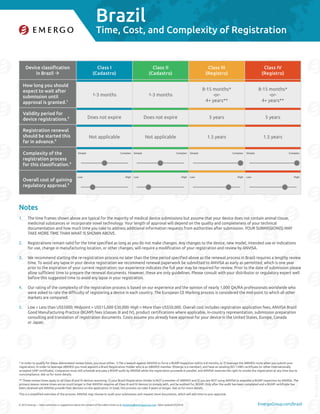
1.	 The time frames shown above are typical for the majority of medical device submissions but assume that your device does not contain animal tissue,
medicinal substances or incorporate novel technology. Your length of approval will depend on the quality and completeness of your technical
documentation and how much time you take to address additional information requests from authorities after submission. YOUR SUBMISSION(S) MAY
TAKE MORE TIME THAN WHAT IS SHOWN ABOVE.
2.	 Registrations remain valid for the time specified as long as you do not make changes. Any changes to the device, new model, intended use or indications
for use, change in manufacturing location, or other changes, will require a modification of your registration and review by ANVISA.
3.	 We recommend starting the re-registration process no later than the time period specified above as the renewal process in Brazil requires a lengthy review
time. To avoid any lapse in your device registration we recommend renewal paperwork be submitted to ANVISA as early as permitted, which is one year
prior to the expiration of your current registration; our experience indicates the full year may be required for review. Prior to the date of submission please
allow sufficient time to prepare the renewal documents. However, these are only guidelines. Please consult with your distributor or regulatory expert well
before this suggested time to avoid any lapse in your registration.
4.	 Our rating of the complexity of the registration process is based on our experience and the opinion of nearly 1,000 QA/RA professionals worldwide who
were asked to rate the difficulty of registering a device in each country. The European CE Marking process is considered the mid-point to which all other
markets are compared.
5.	 Low = Less than US$5000; Midpoint = US$15,000-$30,000: High = More than US$50,000. Overall cost includes registration application fees, ANVISA Brazil
Good Manufacturing Practice (BGMP) fees (classes III and IV), product certifications where applicable, in-country representation, submission preparation
consulting and translation of registration documents. Costs assume you already have approval for your device in the United States, Europe, Canada
or Japan.
EmergoGroup.com/brazil
5041-0716
© 2016 Emergo – Have comments or suggestions about the content of this table? Email us at marketing@emergogroup.com. Table updated 07/2016.
Time, Cost, and Complexity of Registration
* In order to qualify for these abbreviated review times, you must either: 1) file a lawsuit against ANVISA to force a BGMP inspection within 6-8 months, or 2) leverage the ABIMED route when you submit your
registration. In order to leverage ABIMED you must appoint a Brazil Registration Holder who is an ABIMED member (Emergo is a member), and have an existing ISO 13485 certificate (or other internationally
accepted GMP certificate). Companies must still schedule and pass a BGMP audit by ANVISA while the registration proceeds in parallel, and ANVISA reserves the right to revoke the registration at any time due to
noncompliance. Ask us for more details.
** These review times apply to all Class III and IV devices assuming: 1) your Brazil Registration Holder is NOT a member of ABIMED and 2) you are NOT suing ANVISA to expedite a BGMP inspection by ANVISA. The
primary reason review times are so much longer is that ANVISA requires all Class III and IV devices to comply with, and be audited for, BGMP. Only after the audit has been completed and a BGMP certificate has
been received will ANVISA provide their decision on the application. In total, this process can take 4 years or longer. Ask us for more details.
This is a simplified overview of the process. ANVISA may choose to audit your submission and request more documents, which will add time to your approval.
Device classification
in Brazil 
Class I
(Cadastro)
Class II
(Cadastro)
Class III
(Registro)
Class IV
(Registro)
How long you should
expect to wait after
submission until
approval is granted.1
1-3 months 1-3 months
8-15 months*
-or-
4+ years**
8-15 months*
-or-
4+ years**
Validity period for
device registrations.2 Does not expire Does not expire 5 years 5 years
Registration renewal
should be started this
far in advance.3
Not applicable Not applicable 1.5 years 1.5 years
Complexity of the
registration process
for this classification.4
Overall cost of gaining
regulatory approval.5
Simple Complex Simple Complex Simple Complex Simple Complex
Low High Low High Low High Low High

Brazil medical device registration and approval chart - EMERGO

  • 1.
    Brazil © 2016 Emergo– Have comments or suggestions about the content of this table? Email us at marketing@emergogroup.com. Table updated 07/2016. EmergoGroup.com/brazil Determine classification of your device using rules found in Annex II of Resolution RDC 185/2001 published by ANVISA (Agência Nacional de Vigilância Sanitária). The Cadastro registration is for lower risk devices, has a simplified application, and typically takes less time than Registro reviews. Appoint a company that holds a Company Working Allowance permit from ANVISA as your Brazil Registration Holder (BRH). Provide Letter of Authorization to your BRH, who will submit your registration application to ANVISA. Your BRH maintains control of your device registration and Brazil Good Manufacturing Practice (BGMP) certification, if applicable. BRH prepares and submits the application to ANVISA. All documents must be submitted in Brazilian Portuguese. Pay application fee. Certain devices* require INMETRO Certification. Testing for electro-medical products performed outside Brazil is usually accepted, if performed by an ILAC-certified lab (CB Scheme is not accepted).** Compile tests and pay fee to INMETRO Certifier. INMETRO certification is valid for 5 years, and annual audits and fees are required. ANVISA reviews registration application. Upon approval, ANVISA will publish registration number in the Diário Oficial da União (DOU). Appoint a qualified importer/distributor to bring your device into Brazil. You may now begin marketing your device. Class III and IV manufacturers must be audited for BGMP compliance by ANVISA as outlined in RDC 16/2013. BGMP fees are due every two years. Class I and II device manufacturers must comply with BGMP requirements. However, ANVISA will not conduct an audit. Prepare Technical File, including clinical data, clinical studies (if applicable), information on your device in accordance with Annex III, Part A, B, and C in RDC 185/2001, and proposed labeling (IFU and labels) per Annex III Part B. Prepare Technical Dossier and cadastro application. Send legal documents, as well as proposed RDC 185/2001-compliant labeling (IFU and labels) to BRH. These files are maintained by your BRH in case of ANVISA on-site inspections. Class III and IV registrations are valid for 5 years. Registration renewals must be initiated one year, and no later than six months, prior to expiration. Class I and II registrations do not expire. 5041-0716 The Regulatory Process for Medical Devices NOTE: Some devices listed in RDC 3385/2006 require an Economic Information Report (EIR) compliant with RDC 185/2006 be submitted to NUREM, a division of ANVISA, with the application or within 30 days after its approval. This report includes pricing comparisons for other markets, patient/user information, and marketing materials. * Includes a variety of devices, such as breast implants, sterile hypodermic syringes, sterile needles, examination/surgical gloves, condoms, certain mattresses, blood bags, intrauterine devices, protective (laser) glasses, and those electro-medical devices outlined in IN 4/2015. ** Third edition of IEC 60601 testing is mandatory. All tests performed outside of Brazil must be less than two years old when they are submitted to INMETRO Certifier. This is a simplified overview of the process. ANVISA may choose to audit your submission and request more documents, which will add time to your approval. Class II (Cadastro) Class I (Cadastro) Class III (Registro) Class IV (Registro)
  • 2.
    Brazil Notes 1. The timeframes shown above are typical for the majority of medical device submissions but assume that your device does not contain animal tissue, medicinal substances or incorporate novel technology. Your length of approval will depend on the quality and completeness of your technical documentation and how much time you take to address additional information requests from authorities after submission. YOUR SUBMISSION(S) MAY TAKE MORE TIME THAN WHAT IS SHOWN ABOVE. 2. Registrations remain valid for the time specified as long as you do not make changes. Any changes to the device, new model, intended use or indications for use, change in manufacturing location, or other changes, will require a modification of your registration and review by ANVISA. 3. We recommend starting the re-registration process no later than the time period specified above as the renewal process in Brazil requires a lengthy review time. To avoid any lapse in your device registration we recommend renewal paperwork be submitted to ANVISA as early as permitted, which is one year prior to the expiration of your current registration; our experience indicates the full year may be required for review. Prior to the date of submission please allow sufficient time to prepare the renewal documents. However, these are only guidelines. Please consult with your distributor or regulatory expert well before this suggested time to avoid any lapse in your registration. 4. Our rating of the complexity of the registration process is based on our experience and the opinion of nearly 1,000 QA/RA professionals worldwide who were asked to rate the difficulty of registering a device in each country. The European CE Marking process is considered the mid-point to which all other markets are compared. 5. Low = Less than US$5000; Midpoint = US$15,000-$30,000: High = More than US$50,000. Overall cost includes registration application fees, ANVISA Brazil Good Manufacturing Practice (BGMP) fees (classes III and IV), product certifications where applicable, in-country representation, submission preparation consulting and translation of registration documents. Costs assume you already have approval for your device in the United States, Europe, Canada or Japan. EmergoGroup.com/brazil 5041-0716 © 2016 Emergo – Have comments or suggestions about the content of this table? Email us at marketing@emergogroup.com. Table updated 07/2016. Time, Cost, and Complexity of Registration * In order to qualify for these abbreviated review times, you must either: 1) file a lawsuit against ANVISA to force a BGMP inspection within 6-8 months, or 2) leverage the ABIMED route when you submit your registration. In order to leverage ABIMED you must appoint a Brazil Registration Holder who is an ABIMED member (Emergo is a member), and have an existing ISO 13485 certificate (or other internationally accepted GMP certificate). Companies must still schedule and pass a BGMP audit by ANVISA while the registration proceeds in parallel, and ANVISA reserves the right to revoke the registration at any time due to noncompliance. Ask us for more details. ** These review times apply to all Class III and IV devices assuming: 1) your Brazil Registration Holder is NOT a member of ABIMED and 2) you are NOT suing ANVISA to expedite a BGMP inspection by ANVISA. The primary reason review times are so much longer is that ANVISA requires all Class III and IV devices to comply with, and be audited for, BGMP. Only after the audit has been completed and a BGMP certificate has been received will ANVISA provide their decision on the application. In total, this process can take 4 years or longer. Ask us for more details. This is a simplified overview of the process. ANVISA may choose to audit your submission and request more documents, which will add time to your approval. Device classification in Brazil  Class I (Cadastro) Class II (Cadastro) Class III (Registro) Class IV (Registro) How long you should expect to wait after submission until approval is granted.1 1-3 months 1-3 months 8-15 months* -or- 4+ years** 8-15 months* -or- 4+ years** Validity period for device registrations.2 Does not expire Does not expire 5 years 5 years Registration renewal should be started this far in advance.3 Not applicable Not applicable 1.5 years 1.5 years Complexity of the registration process for this classification.4 Overall cost of gaining regulatory approval.5 Simple Complex Simple Complex Simple Complex Simple Complex Low High Low High Low High Low High