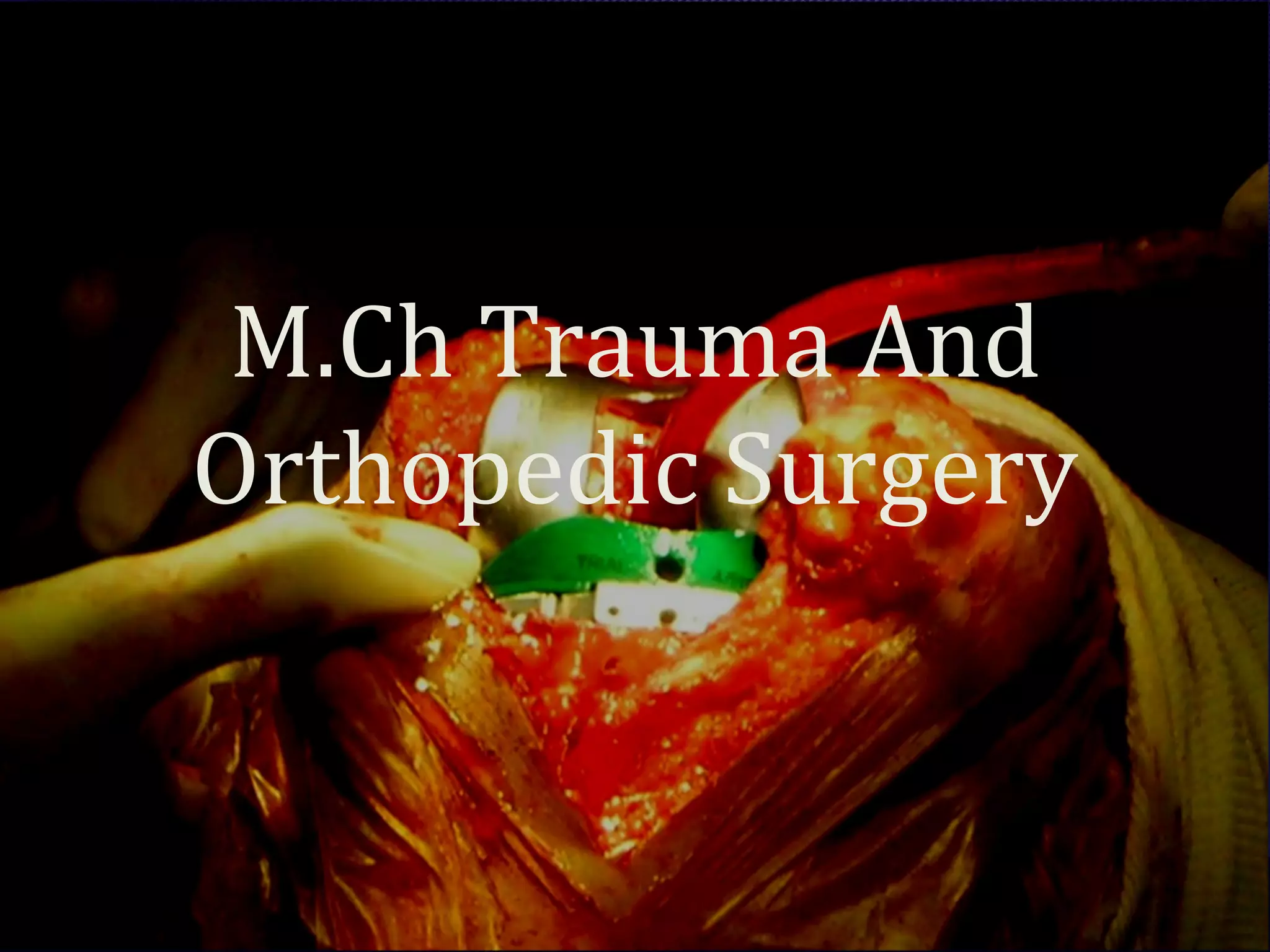
M.Ch Trauma And
Orthopedic Surgery
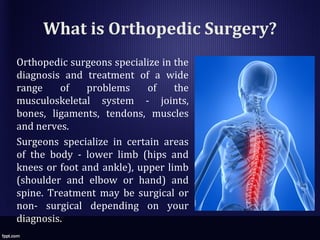
What is Orthopedic Surgery?
Orthopedic surgeons specialize in the
diagnosis and treatment of a wide
range of problems of the
musculoskeletal system - joints,
bones, ligaments, tendons, muscles
and nerves.
Surgeons specialize in certain areas
of the body - lower limb (hips and
knees or foot and ankle), upper limb
(shoulder and elbow or hand) and
spine. Treatment may be surgical or
non- surgical depending on your
diagnosis.
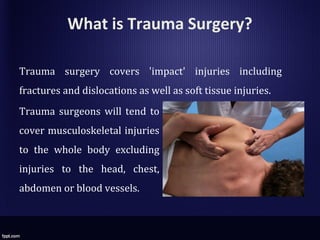
What is Trauma Surgery?
Trauma surgery covers 'impact' injuries including
fractures and dislocations as well as soft tissue injuries.
Trauma surgeons will tend to
cover musculoskeletal injuries
to the whole body excluding
injuries to the head, chest,
abdomen or blood vessels.
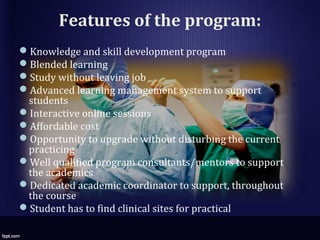
Features of the program:
Knowledge and skill development program
Blended learning
Study without leaving job
Advanced learning management system to support
students
Interactive online sessions
Affordable cost
Opportunity to upgrade without disturbing the current
practicing
Well qualified program consultants/mentors to support
the academics
Dedicated academic coordinator to support, throughout
the course
Student has to find clinical sites for practical
ACADEMIC PROGRAM
• The course is divided into 4 terms, each terms is of 4
months duration.
• Out of the 4 terms, the last 1 term is dedicated for research
and thesis writing
• Students are expected to accomplish 12 theory & clinical
modules and undergo clinical research course
ACADEMIC PROCESS
 After enrolling in the university, student will pursue his course from his
own place of residence and from the place where he is working
 Each student will have a Course Tutor who will provide online support
to the students throughout the course
 The student will identify a clinical mentor on his own. The clinical
mentor will assist the students to acquire clinical skills
 Students will submit periodical reports to the university PG
coordination office
 The students will also review the latest research articles in his subject
and publish it in international journals. These articles will be peer
reviewed before publication
 At the end of the course student will appear in clinical examination
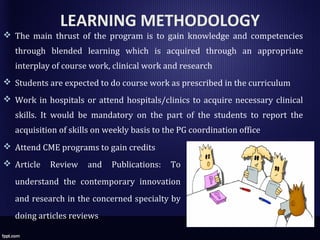
LEARNING METHODOLOGY
 The main thrust of the program is to gain knowledge and competencies
through blended learning which is acquired through an appropriate
interplay of course work, clinical work and research
 Students are expected to do course work as prescribed in the curriculum
 Work in hospitals or attend hospitals/clinics to acquire necessary clinical
skills. It would be mandatory on the part of the students to report the
acquisition of skills on weekly basis to the PG coordination office
 Attend CME programs to gain credits
 Article Review and Publications: To
understand the contemporary innovation
and research in the concerned specialty by
doing articles reviews
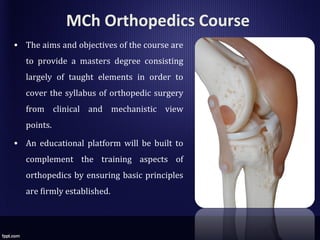
MCh Orthopedics Course
• The aims and objectives of the course are
to provide a masters degree consisting
largely of taught elements in order to
cover the syllabus of orthopedic surgery
from clinical and mechanistic view
points.
• An educational platform will be built to
complement the training aspects of
orthopedics by ensuring basic principles
are firmly established.
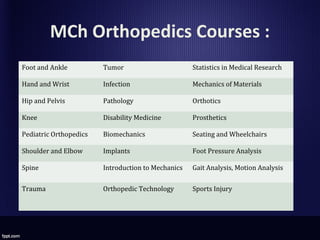
MCh Orthopedics Courses :
Foot and Ankle Tumor Statistics in Medical Research
Hand and Wrist Infection Mechanics of Materials
Hip and Pelvis Pathology Orthotics
Knee Disability Medicine Prosthetics
Pediatric Orthopedics Biomechanics Seating and Wheelchairs
Shoulder and Elbow Implants Foot Pressure Analysis
Spine Introduction to Mechanics Gait Analysis, Motion Analysis
Trauma Orthopedic Technology Sports Injury
The course aims to:
Enable you to develop an understanding of the principles and clinical
concepts underpinning practice in trauma & orthopedics.
Enable you to develop the skills and attitudes necessary to perform
evidence based trauma & orthopedic practice and research within
trauma & orthopedics
Foster a commitment to lifelong learning and an inquisitive approach
to clinical practice
A flexible approach to course delivery has been utilised, and for the
majority of modules you can choose to study by attending taught
sessions or by distance learning.
What you study
In Year 2 you undertake either an 80-credit dissertation which involves
planning, managing and writing up a small-scale research project, alongside
preparing the write-up for publication in a peer-reviewed journal; or you
undertake a 60-credit dissertation which involves planning, managing and
writing up the small-scale research project, plus a 20-credit option module.
In Year 1 of the program you study a
number of modules which develop your
understanding of the principles
underpinning clinical practice in trauma
and orthopedics and develop your skills in
evidence-based practice, research methods
and statistics.
Nature of the work
Trauma and orthopedic surgery deals primarily with injuries,
congenital and acquired disorders of the bones, and joints
and their associated soft tissues, including ligaments, nerves
and muscles.
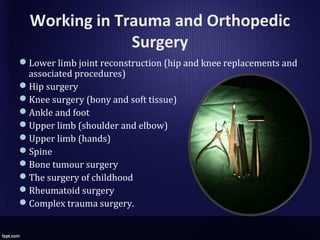
Working in Trauma and Orthopedic
Surgery
Lower limb joint reconstruction (hip and knee replacements and
associated procedures)
Hip surgery
Knee surgery (bony and soft tissue)
Ankle and foot
Upper limb (shoulder and elbow)
Upper limb (hands)
Spine
Bone tumour surgery
The surgery of childhood
Rheumatoid surgery
Complex trauma surgery.
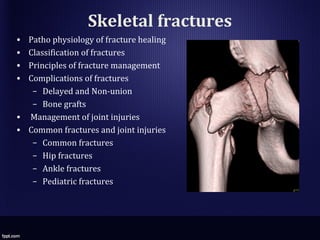
Skeletal fractures
• Patho physiology of fracture healing
• Classification of fractures
• Principles of fracture management
• Complications of fractures
– Delayed and Non-union
– Bone grafts
• Management of joint injuries
• Common fractures and joint injuries
– Common fractures
– Hip fractures
– Ankle fractures
– Pediatric fractures
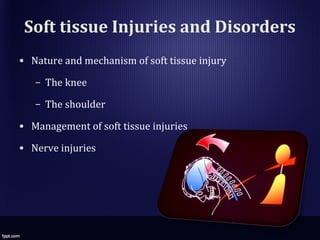
Soft tissue Injuries and Disorders
• Nature and mechanism of soft tissue injury
– The knee
– The shoulder
• Management of soft tissue injuries
• Nerve injuries
Common Disorders of the
Extremities
• Disorders of the upper limb
• Disorders of the hand
• Disorders of the lower limb
• Disorders of the foot
Degenerative and Rheumatoid
Arthritis
• Osteoarthritis and rheumatoid arthritis
• Osteoporosis
• Metabolic bone disease
• Paget's disease
• Surgical treatment of joint diseases
• Complications of joint replacement surgery
Infections of Bones and Joints
• Osteomyelitis
• Septic arthritis
• Other bone infections
Locomotor pain
 Low back pain and sciatica
 Spinal cord compression
 Scoliosis
 Pain in the neck and upper limb
 Thoracic outlet syndrome
Bone tumours and amputations
 Primary bone tumours
 Metastatic bone tumours
 Myeloma
 Amputations
General
 Imaging techniques
 Neuro physiological investigations
Orthopedic Trauma Common Injuries
What is a Fracture?
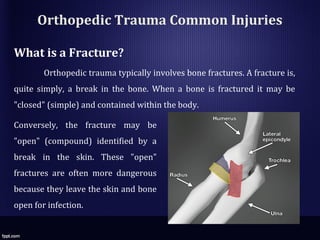
Orthopedic trauma typically involves bone fractures. A fracture is,
quite simply, a break in the bone. When a bone is fractured it may be
"closed" (simple) and contained within the body.
Conversely, the fracture may be
"open" (compound) identified by a
break in the skin. These "open"
fractures are often more dangerous
because they leave the skin and bone
open for infection.
Other types of Fractures Include:
• Transverse Fracture:
This type of fracture is at right angles to the long axis of the
bone.
• Greenstick Fracture:
A fracture on one side of the bone, causing a bend on the
injured side of the bone.
• Comminuted Fracture:
A fracture that results in three or more bone fragments.
What are the leading causes of fractures?
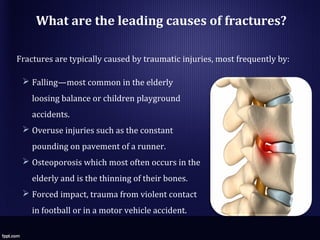
Fractures are typically caused by traumatic injuries, most frequently by:
 Falling—most common in the elderly
loosing balance or children playground
accidents.
 Overuse injuries such as the constant
pounding on pavement of a runner.
 Osteoporosis which most often occurs in the
elderly and is the thinning of their bones.
 Forced impact, trauma from violent contact
in football or in a motor vehicle accident.
Common Neck Injuries
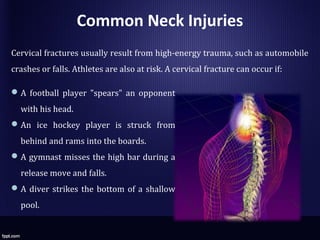
Cervical fractures usually result from high-energy trauma, such as automobile
crashes or falls. Athletes are also at risk. A cervical fracture can occur if:
A football player "spears" an opponent
with his head.
An ice hockey player is struck from
behind and rams into the boards.
A gymnast misses the high bar during a
release move and falls.
A diver strikes the bottom of a shallow
pool.
Common Spine Injuries
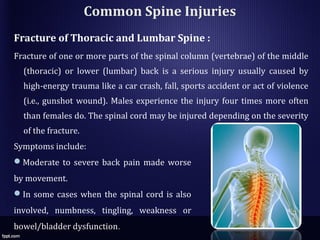
Fracture of Thoracic and Lumbar Spine :
Fracture of one or more parts of the spinal column (vertebrae) of the middle
(thoracic) or lower (lumbar) back is a serious injury usually caused by
high-energy trauma like a car crash, fall, sports accident or act of violence
(i.e., gunshot wound). Males experience the injury four times more often
than females do. The spinal cord may be injured depending on the severity
of the fracture.
Symptoms include:
Moderate to severe back pain made worse
by movement.
In some cases when the spinal cord is also
involved, numbness, tingling, weakness or
bowel/bladder dysfunction.
Common Shoulder Injuries
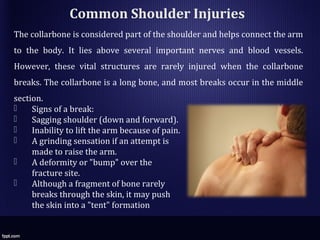
The collarbone is considered part of the shoulder and helps connect the arm
to the body. It lies above several important nerves and blood vessels.
However, these vital structures are rarely injured when the collarbone
breaks. The collarbone is a long bone, and most breaks occur in the middle
section.
 Signs of a break:
 Sagging shoulder (down and forward).
 Inability to lift the arm because of pain.
 A grinding sensation if an attempt is
made to raise the arm.
 A deformity or "bump" over the
fracture site.
 Although a fragment of bone rarely
breaks through the skin, it may push
the skin into a "tent" formation
Will a career in Orthopedic Surgery
suit me?
Orthopedics requires a combination of manual and spatial skills, knowledge,
an enquiring mind, and an ability to make sensible decisions. You have to be
both a manager and team player. Communication skills are also vital, both
with patients and colleagues.
With such a broad spread of sub-specialisation, there are branches of
orthopaedics to suit all people. Nevertheless, entry into higher training is
very competitive and the work can be physically demanding, requiring
considerable stamina. The main attraction is the satisfaction gained from
relieving pain, improving function and correcting deformity.
Orthopaedic training
• Ankle surgery
• Knee surgery
• Hip surgery
• Upper limb surgery
• Paediatric surgery
• Spinal surgery
• Sports injuries surgery
• Trauma surgery.
Life as a consultant in Trauma and
Orthopedic Surgery
A career as a consultant orthopedic surgeon is extremely
interesting, challenging, and rewarding. Most consultants
develop a subspecialty interest, while being fully trained in
the generality of trauma and orthopedic surgery.
As in other specialties, the roles and responsibilities consist
of direct clinical care and supporting professional activities.
Consultants are ultimately responsible for all patients under
their care and also for the supervision and leadership of their
team.
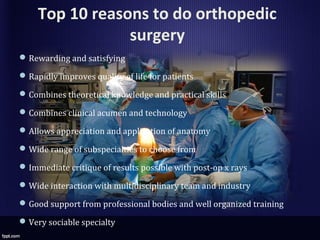
Top 10 reasons to do orthopedic
surgery
Rewarding and satisfying
Rapidly improves quality of life for patients
Combines theoretical knowledge and practical skills
Combines clinical acumen and technology
Allows appreciation and application of anatomy
Wide range of subspecialties to choose from
Immediate critique of results possible with post-op x rays
Wide interaction with multidisciplinary team and industry
Good support from professional bodies and well organized training
Very sociable specialty
ABOUT TEXILA AMERICAN
UNIVERSITY
Texila American University (TAU) is located in Guyana, the only English
speaking country in South America. TAU offers Health Science programs
with a high level of professionalism, exactness and problem solving skills,
upon which the foundations of specialist training and an independent
medical practice can be built, which facilitates further education and
development of their knowledge throughout their life.
The curriculum at the TAU is structured after the best U.S. medical schools.
The academic program is both accelerated and rigorous, with a focus on
preparing students for licensure in the United States, Caribbean and India.
TAU CREDENTIALS
Registered with National Accreditation council of
Guyana (which is governed by Ministry of Education).
Listed in WHO (World Health Organization)
Handbook.
Member of IADR (International Association
for Dental Research).
Member of GAME (Global Alliance for
Medical Education).
Member of AMEE (International
Association for Medical Education).
Contact Information
Texila American University
Critchlow, Woolford Avenue
Georgetown, Guyana, South America.
Telephone: (+592) 2318118
Fax: (+592) 2318111
E-mail: info@tauedu.org
Website: http://www.tauedu.org
Mch Program Offered by Texila American University

Mch Program Offered by Texila American University

  • 1.
  • 2.
    What is OrthopedicSurgery? Orthopedic surgeons specialize in the diagnosis and treatment of a wide range of problems of the musculoskeletal system - joints, bones, ligaments, tendons, muscles and nerves. Surgeons specialize in certain areas of the body - lower limb (hips and knees or foot and ankle), upper limb (shoulder and elbow or hand) and spine. Treatment may be surgical or non- surgical depending on your diagnosis.
  • 3.
    What is TraumaSurgery? Trauma surgery covers 'impact' injuries including fractures and dislocations as well as soft tissue injuries. Trauma surgeons will tend to cover musculoskeletal injuries to the whole body excluding injuries to the head, chest, abdomen or blood vessels.
  • 4.
    Features of theprogram: Knowledge and skill development program Blended learning Study without leaving job Advanced learning management system to support students Interactive online sessions Affordable cost Opportunity to upgrade without disturbing the current practicing Well qualified program consultants/mentors to support the academics Dedicated academic coordinator to support, throughout the course Student has to find clinical sites for practical
  • 5.
    ACADEMIC PROGRAM • Thecourse is divided into 4 terms, each terms is of 4 months duration. • Out of the 4 terms, the last 1 term is dedicated for research and thesis writing • Students are expected to accomplish 12 theory & clinical modules and undergo clinical research course
  • 6.
    ACADEMIC PROCESS  Afterenrolling in the university, student will pursue his course from his own place of residence and from the place where he is working  Each student will have a Course Tutor who will provide online support to the students throughout the course  The student will identify a clinical mentor on his own. The clinical mentor will assist the students to acquire clinical skills  Students will submit periodical reports to the university PG coordination office  The students will also review the latest research articles in his subject and publish it in international journals. These articles will be peer reviewed before publication  At the end of the course student will appear in clinical examination
  • 7.
    LEARNING METHODOLOGY  Themain thrust of the program is to gain knowledge and competencies through blended learning which is acquired through an appropriate interplay of course work, clinical work and research  Students are expected to do course work as prescribed in the curriculum  Work in hospitals or attend hospitals/clinics to acquire necessary clinical skills. It would be mandatory on the part of the students to report the acquisition of skills on weekly basis to the PG coordination office  Attend CME programs to gain credits  Article Review and Publications: To understand the contemporary innovation and research in the concerned specialty by doing articles reviews
  • 8.
    MCh Orthopedics Course •The aims and objectives of the course are to provide a masters degree consisting largely of taught elements in order to cover the syllabus of orthopedic surgery from clinical and mechanistic view points. • An educational platform will be built to complement the training aspects of orthopedics by ensuring basic principles are firmly established.
  • 9.
    MCh Orthopedics Courses: Foot and Ankle Tumor Statistics in Medical Research Hand and Wrist Infection Mechanics of Materials Hip and Pelvis Pathology Orthotics Knee Disability Medicine Prosthetics Pediatric Orthopedics Biomechanics Seating and Wheelchairs Shoulder and Elbow Implants Foot Pressure Analysis Spine Introduction to Mechanics Gait Analysis, Motion Analysis Trauma Orthopedic Technology Sports Injury
  • 10.
    The course aimsto: Enable you to develop an understanding of the principles and clinical concepts underpinning practice in trauma & orthopedics. Enable you to develop the skills and attitudes necessary to perform evidence based trauma & orthopedic practice and research within trauma & orthopedics Foster a commitment to lifelong learning and an inquisitive approach to clinical practice A flexible approach to course delivery has been utilised, and for the majority of modules you can choose to study by attending taught sessions or by distance learning.
  • 11.
    What you study InYear 2 you undertake either an 80-credit dissertation which involves planning, managing and writing up a small-scale research project, alongside preparing the write-up for publication in a peer-reviewed journal; or you undertake a 60-credit dissertation which involves planning, managing and writing up the small-scale research project, plus a 20-credit option module. In Year 1 of the program you study a number of modules which develop your understanding of the principles underpinning clinical practice in trauma and orthopedics and develop your skills in evidence-based practice, research methods and statistics.
  • 12.
    Nature of thework Trauma and orthopedic surgery deals primarily with injuries, congenital and acquired disorders of the bones, and joints and their associated soft tissues, including ligaments, nerves and muscles.
  • 13.
    Working in Traumaand Orthopedic Surgery Lower limb joint reconstruction (hip and knee replacements and associated procedures) Hip surgery Knee surgery (bony and soft tissue) Ankle and foot Upper limb (shoulder and elbow) Upper limb (hands) Spine Bone tumour surgery The surgery of childhood Rheumatoid surgery Complex trauma surgery.
  • 14.
    Skeletal fractures • Pathophysiology of fracture healing • Classification of fractures • Principles of fracture management • Complications of fractures – Delayed and Non-union – Bone grafts • Management of joint injuries • Common fractures and joint injuries – Common fractures – Hip fractures – Ankle fractures – Pediatric fractures
  • 15.
    Soft tissue Injuriesand Disorders • Nature and mechanism of soft tissue injury – The knee – The shoulder • Management of soft tissue injuries • Nerve injuries
  • 16.
    Common Disorders ofthe Extremities • Disorders of the upper limb • Disorders of the hand • Disorders of the lower limb • Disorders of the foot
  • 17.
    Degenerative and Rheumatoid Arthritis •Osteoarthritis and rheumatoid arthritis • Osteoporosis • Metabolic bone disease • Paget's disease • Surgical treatment of joint diseases • Complications of joint replacement surgery
  • 18.
    Infections of Bonesand Joints • Osteomyelitis • Septic arthritis • Other bone infections Locomotor pain  Low back pain and sciatica  Spinal cord compression  Scoliosis  Pain in the neck and upper limb  Thoracic outlet syndrome
  • 19.
    Bone tumours andamputations  Primary bone tumours  Metastatic bone tumours  Myeloma  Amputations General  Imaging techniques  Neuro physiological investigations
  • 20.
    Orthopedic Trauma CommonInjuries What is a Fracture? Orthopedic trauma typically involves bone fractures. A fracture is, quite simply, a break in the bone. When a bone is fractured it may be "closed" (simple) and contained within the body. Conversely, the fracture may be "open" (compound) identified by a break in the skin. These "open" fractures are often more dangerous because they leave the skin and bone open for infection.
  • 21.
    Other types ofFractures Include: • Transverse Fracture: This type of fracture is at right angles to the long axis of the bone. • Greenstick Fracture: A fracture on one side of the bone, causing a bend on the injured side of the bone. • Comminuted Fracture: A fracture that results in three or more bone fragments.
  • 22.
    What are theleading causes of fractures? Fractures are typically caused by traumatic injuries, most frequently by:  Falling—most common in the elderly loosing balance or children playground accidents.  Overuse injuries such as the constant pounding on pavement of a runner.  Osteoporosis which most often occurs in the elderly and is the thinning of their bones.  Forced impact, trauma from violent contact in football or in a motor vehicle accident.
  • 23.
    Common Neck Injuries Cervicalfractures usually result from high-energy trauma, such as automobile crashes or falls. Athletes are also at risk. A cervical fracture can occur if: A football player "spears" an opponent with his head. An ice hockey player is struck from behind and rams into the boards. A gymnast misses the high bar during a release move and falls. A diver strikes the bottom of a shallow pool.
  • 24.
    Common Spine Injuries Fractureof Thoracic and Lumbar Spine : Fracture of one or more parts of the spinal column (vertebrae) of the middle (thoracic) or lower (lumbar) back is a serious injury usually caused by high-energy trauma like a car crash, fall, sports accident or act of violence (i.e., gunshot wound). Males experience the injury four times more often than females do. The spinal cord may be injured depending on the severity of the fracture. Symptoms include: Moderate to severe back pain made worse by movement. In some cases when the spinal cord is also involved, numbness, tingling, weakness or bowel/bladder dysfunction.
  • 25.
    Common Shoulder Injuries Thecollarbone is considered part of the shoulder and helps connect the arm to the body. It lies above several important nerves and blood vessels. However, these vital structures are rarely injured when the collarbone breaks. The collarbone is a long bone, and most breaks occur in the middle section.  Signs of a break:  Sagging shoulder (down and forward).  Inability to lift the arm because of pain.  A grinding sensation if an attempt is made to raise the arm.  A deformity or "bump" over the fracture site.  Although a fragment of bone rarely breaks through the skin, it may push the skin into a "tent" formation
  • 26.
    Will a careerin Orthopedic Surgery suit me? Orthopedics requires a combination of manual and spatial skills, knowledge, an enquiring mind, and an ability to make sensible decisions. You have to be both a manager and team player. Communication skills are also vital, both with patients and colleagues. With such a broad spread of sub-specialisation, there are branches of orthopaedics to suit all people. Nevertheless, entry into higher training is very competitive and the work can be physically demanding, requiring considerable stamina. The main attraction is the satisfaction gained from relieving pain, improving function and correcting deformity.
  • 27.
    Orthopaedic training • Anklesurgery • Knee surgery • Hip surgery • Upper limb surgery • Paediatric surgery • Spinal surgery • Sports injuries surgery • Trauma surgery.
  • 28.
    Life as aconsultant in Trauma and Orthopedic Surgery A career as a consultant orthopedic surgeon is extremely interesting, challenging, and rewarding. Most consultants develop a subspecialty interest, while being fully trained in the generality of trauma and orthopedic surgery. As in other specialties, the roles and responsibilities consist of direct clinical care and supporting professional activities. Consultants are ultimately responsible for all patients under their care and also for the supervision and leadership of their team.
  • 29.
    Top 10 reasonsto do orthopedic surgery Rewarding and satisfying Rapidly improves quality of life for patients Combines theoretical knowledge and practical skills Combines clinical acumen and technology Allows appreciation and application of anatomy Wide range of subspecialties to choose from Immediate critique of results possible with post-op x rays Wide interaction with multidisciplinary team and industry Good support from professional bodies and well organized training Very sociable specialty
  • 30.
    ABOUT TEXILA AMERICAN UNIVERSITY TexilaAmerican University (TAU) is located in Guyana, the only English speaking country in South America. TAU offers Health Science programs with a high level of professionalism, exactness and problem solving skills, upon which the foundations of specialist training and an independent medical practice can be built, which facilitates further education and development of their knowledge throughout their life. The curriculum at the TAU is structured after the best U.S. medical schools. The academic program is both accelerated and rigorous, with a focus on preparing students for licensure in the United States, Caribbean and India.
  • 31.
    TAU CREDENTIALS Registered withNational Accreditation council of Guyana (which is governed by Ministry of Education). Listed in WHO (World Health Organization) Handbook. Member of IADR (International Association for Dental Research). Member of GAME (Global Alliance for Medical Education). Member of AMEE (International Association for Medical Education).
  • 32.
    Contact Information Texila AmericanUniversity Critchlow, Woolford Avenue Georgetown, Guyana, South America. Telephone: (+592) 2318118 Fax: (+592) 2318111 E-mail: info@tauedu.org Website: http://www.tauedu.org