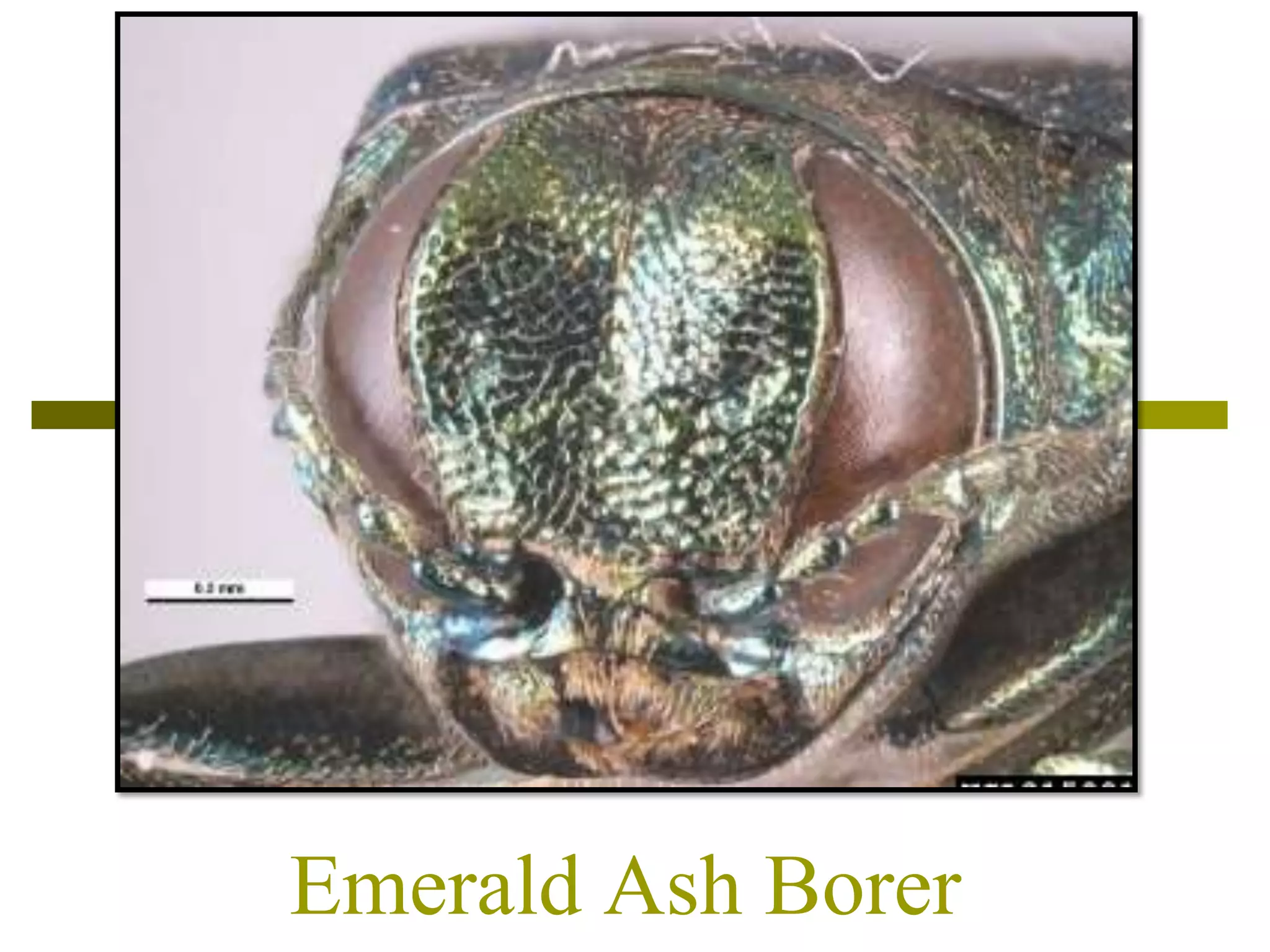

Emerald Ash Borer
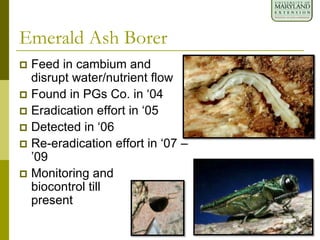
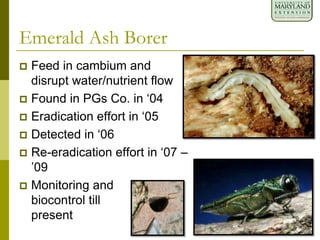
 Feed in cambium and
disrupt water/nutrient flow
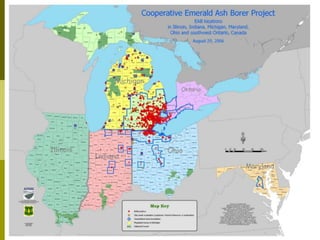
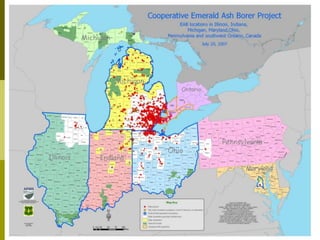
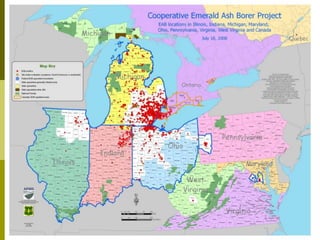
 Found in PGs Co. in ‘04
 Eradication effort in ‘05
 Detected in ‘06
 Re-eradication effort in ‘07 –
’09
 Monitoring and
biocontrol till
present
Emerald Ash Borer
Emerald Ash Borer
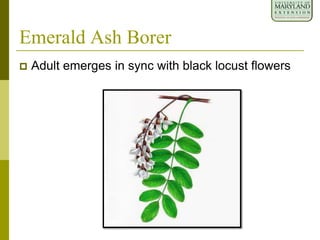
 Adult emerges in sync with black locust flowers
 Feed in cambium and
disrupt water/nutrient flow
 Found in PGs Co. in ‘04
 Eradication effort in ‘05
 Detected in ‘06
 Re-eradication effort in ‘07 –
’09
 Monitoring and
biocontrol till
present
Emerald Ash Borer
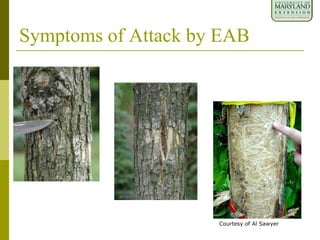
D-shaped exit holes
Bark splits
Serpentine galleries
Symptoms of Attack by EAB
Courtesy of Al Sawyer
David Roberts,
MSU
MI Dept of
Agriculture
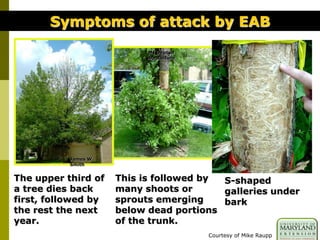
The upper third of
a tree dies back
first, followed by
the rest the next
year.
This is followed by
many shoots or
sprouts emerging
below dead portions
of the trunk.
S-shaped
galleries under
bark
Symptoms of attack by EAB
James W.
Smith
Courtesy of Mike Raupp
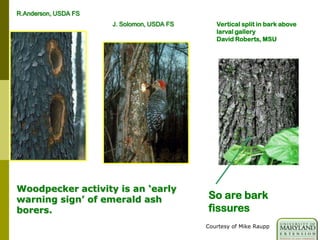
Woodpecker activity is an ‘early
warning sign’ of emerald ash
borers.
R.Anderson, USDA FS
J. Solomon, USDA FS
So are bark
fissures
Vertical split in bark above
larval gallery
David Roberts, MSU
Courtesy of Mike Raupp
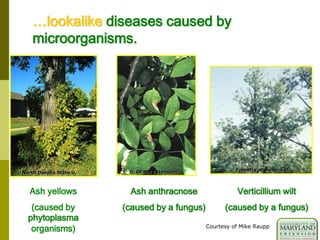
…lookalike diseases caused by
microorganisms.
Ash yellows
(caused by
phytoplasma
organisms)
Ash anthracnose
(caused by a fungus)
Verticillium wilt
(caused by a fungus)
North Dakota State U. U. Of MN Extension Forestry at Auburn U.
Courtesy of Mike Raupp
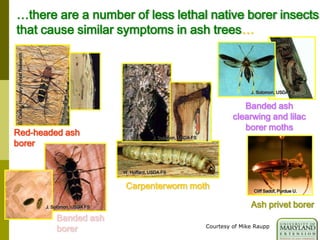
…there are a number of less lethal native borer insects
that cause similar symptoms in ash trees…
Banded ash
clearwing and lilac
borer moths
Banded ash
borer
J. Solomon, USDA FS
Red-headed ash
borer
G.Csoka,HungaryForestResearch
Carpenterworm moth
W. Hoffard, USDA FS
J. Solomon, USDA FS
J. Solomon, USDA FS
Cliff Sadof, Purdue U.
Ash privet borer
Courtesy of Mike Raupp
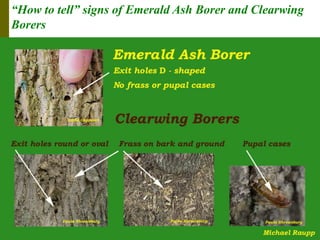
“How to tell” signs of Emerald Ash Borer and Clearwing
Borers
Emerald Ash Borer
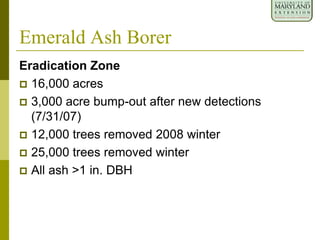
Eradication Zone
 16,000 acres
 3,000 acre bump-out after new detections
(7/31/07)
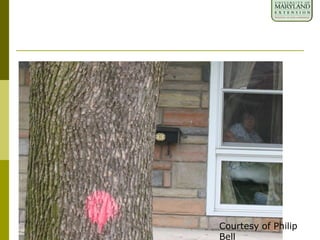
 12,000 trees removed 2008 winter
 25,000 trees removed winter
 All ash >1 in. DBH
Courtesy of Philip
Bell
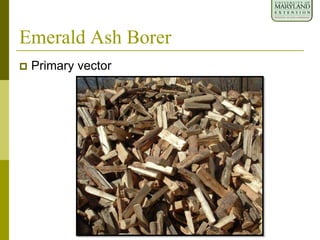
Emerald Ash Borer
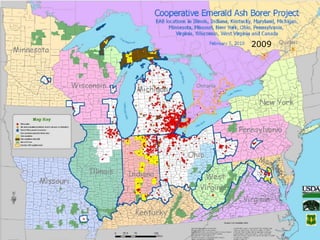
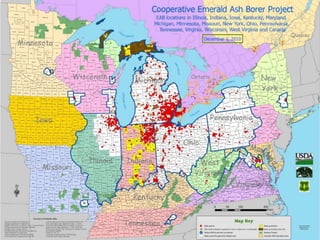
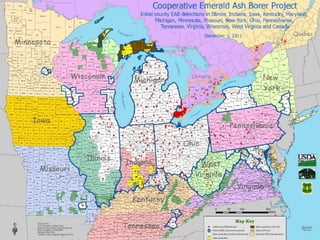
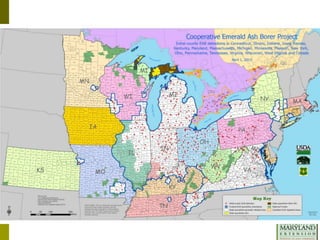
 Primary vector
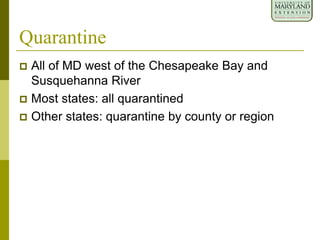
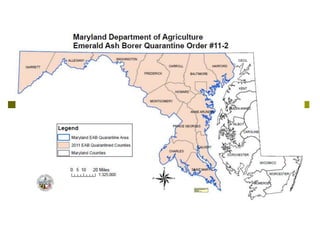
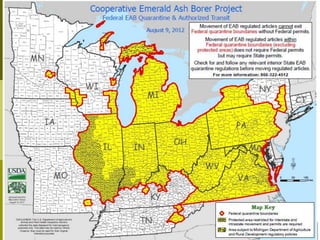
Quarantine
 All of MD west of the Chesapeake Bay and
Susquehanna River
 Most states: all quarantined
 Other states: quarantine by county or region
2009
December 15, 2011 APHIS, Pest Control, and the Wood Trade
Quarantine
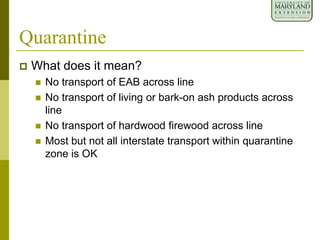
 What does it mean?
 No transport of EAB across line
 No transport of living or bark-on ash products across
line
 No transport of hardwood firewood across line
 Most but not all interstate transport within quarantine
zone is OK
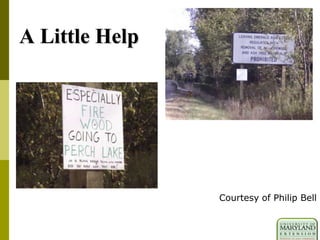
A Little Help
Courtesy of Philip Bell
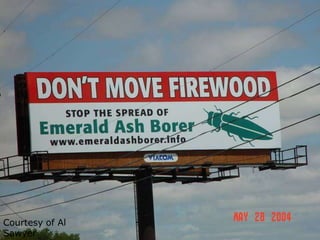
Courtesy of Al
Sawyer
Rate of Spread?
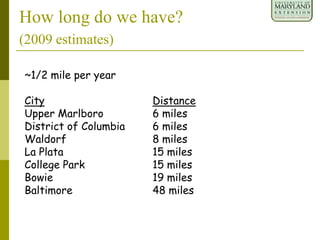
How long do we have?
(2009 estimates)
~1/2 mile per year
City Distance
Upper Marlboro 6 miles
District of Columbia 6 miles
Waldorf 8 miles
La Plata 15 miles
College Park 15 miles
Bowie 19 miles
Baltimore 48 miles
Arrival Date
2010
2010
2012
2021
2021
2025
2059
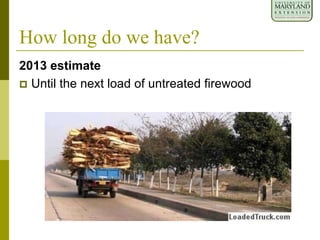
How long do we have?
2013 estimate
 Until the next load of untreated firewood
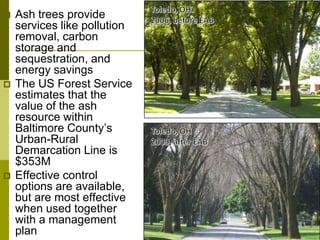
 Ash trees provide
services like pollution
removal, carbon
storage and
sequestration, and
energy savings
 The US Forest Service
estimates that the
value of the ash
resource within
Baltimore County’s
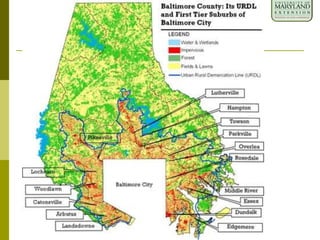
Urban-Rural
Demarcation Line is
$353M
 Effective control
options are available,
but are most effective
when used together
with a management
plan
Emerald Ash Borer
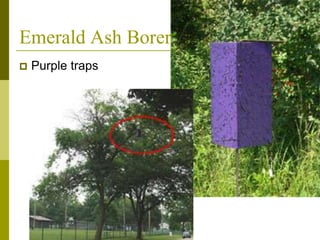
 Purple traps
Emerald Ash Borer
Control
 Imidacloprid
 May to early June
 Soil drench, 1 oz. per inch circumference
 Amount needed per in. DBH may increase with tree size
 Annual application
 1 year for protection on young trees (<6 in. DBH), 2 years
in older trees
 Available to homeowners
 Trunk injection also available
Emerald Ash Borer
Control
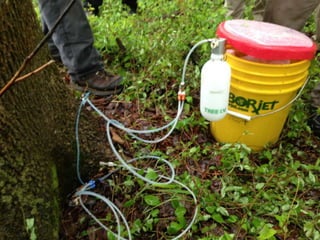
 Emamectin Benzoate (Tree-äge)
 Registered for EAB in all states where present
 Trunk injection (systemic)
 Used as preventive measure in valuable landscape
trees
 Has 2-3 year protection/application
 Studies show high efficacy
 Effectiveness lessened by low initial tree vigor
 Available to professionals only
Control
 Dinotefuran is registered for
 basal trunk bark: spray on lower trunk with garden
sprayer
 soil application
Remember…
 Always follow instructions on the label—it’s the
law!
Emerald Ash Borer
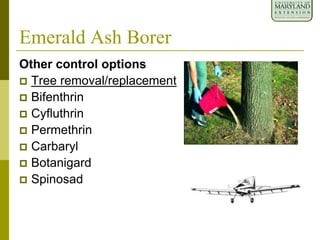
Other control options
 Tree removal/replacement
 Bifenthrin
 Cyfluthrin
 Permethrin
 Carbaryl
 Botanigard
 Spinosad
Compromise
 Maintain the benefits of large trees (>24 in.)
 Treat with emamectin benzoate (TREE-äge®) every 2
or 3 years
 Replace smaller trees with non-ash species
Key Points and Summary
 Insecticides can effectively protect ash trees from EAB
 Only treat a tree if EAB within 15 miles
 Trees with more than 50% canopy decline are unlikely to
recover even if treated
 Emamectin benzoate is the only product tested to date
that controls EAB for more than one year with a single
application; it also provided a higher level of control than
other products in side-by-side studies
Key Points and Summary
 XytectTM soil treatments are labeled for application at a
higher maximum rate than other imidacloprid
formulations: useful for large trees
 Treatment programs must comply with any label
restrictions on the amount of insecticide that can be
applied
Biocontrol Progress
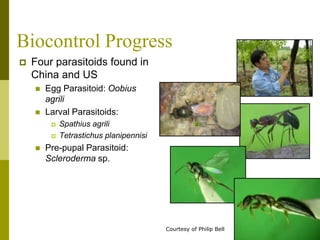
 Four parasitoids found in
China and US
 Egg Parasitoid: Oobius
agrili
 Larval Parasitoids:
 Spathius agrili
 Tetrastichus planipennisi
 Pre-pupal Parasitoid:
Scleroderma sp.
Courtesy of Philip Bell
Emerald Ash Borer
 Cost of infestation expected: $10-20 billion in
losses to urban forests over the next 10 years
 Urban density of ash trees
 Mean of cities in EAB range: 53/ha (131/ac)
 Baltimore: 244/ha (603/ac)
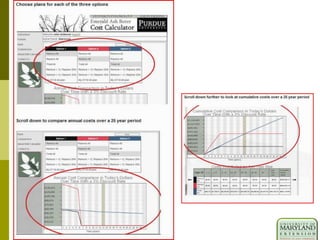
 Consider cost of live takedown v. dead
takedown
Emerald Ash Borer
Emerald Ash Borer
Outreach and education
 O'Malley declared May 18-24 Emerald Ash
Borer Awareness Week in Maryland
 2008 Summer-long campaign with the minor-
league Bowie Baysox
 Fact sheets, ID cards, HGIC hotline
 First responder training
 www.mda.state.md.us/plants-pests/eab
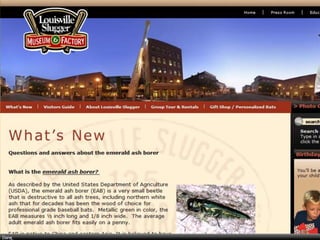
 http://www.emeraldashborer.info/
 County/municipal decision maker workshops
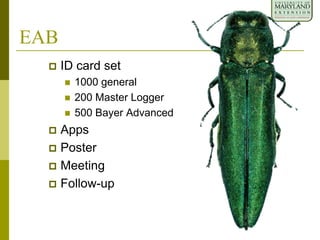
EAB
 ID card set
 1000 general
 200 Master Logger
 500 Bayer Advanced
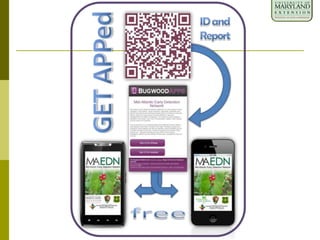
 Apps
 Poster
 Meeting
 Follow-up
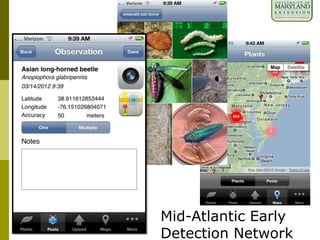
Mid-Atlantic Early
Detection Network
Coming Soon
 NIFA Regional IPM grant
 EDDSmaps
 Expansion of ID card set
 Boxwood blight
 Sudden oak death
 Sirex wood wasp
 Kudzu Bug

Emerald Ash Borer

  • 1.
  • 2.
     Feed incambium and disrupt water/nutrient flow  Found in PGs Co. in ‘04  Eradication effort in ‘05  Detected in ‘06  Re-eradication effort in ‘07 – ’09  Monitoring and biocontrol till present Emerald Ash Borer
  • 3.
    Emerald Ash Borer Adult emerges in sync with black locust flowers
  • 4.
     Feed incambium and disrupt water/nutrient flow  Found in PGs Co. in ‘04  Eradication effort in ‘05  Detected in ‘06  Re-eradication effort in ‘07 – ’09  Monitoring and biocontrol till present Emerald Ash Borer
  • 5.
    D-shaped exit holes Barksplits Serpentine galleries Symptoms of Attack by EAB Courtesy of Al Sawyer
  • 6.
    David Roberts, MSU MI Deptof Agriculture The upper third of a tree dies back first, followed by the rest the next year. This is followed by many shoots or sprouts emerging below dead portions of the trunk. S-shaped galleries under bark Symptoms of attack by EAB James W. Smith Courtesy of Mike Raupp
  • 7.
    Woodpecker activity isan ‘early warning sign’ of emerald ash borers. R.Anderson, USDA FS J. Solomon, USDA FS So are bark fissures Vertical split in bark above larval gallery David Roberts, MSU Courtesy of Mike Raupp
  • 8.
    …lookalike diseases causedby microorganisms. Ash yellows (caused by phytoplasma organisms) Ash anthracnose (caused by a fungus) Verticillium wilt (caused by a fungus) North Dakota State U. U. Of MN Extension Forestry at Auburn U. Courtesy of Mike Raupp
  • 9.
    …there are anumber of less lethal native borer insects that cause similar symptoms in ash trees… Banded ash clearwing and lilac borer moths Banded ash borer J. Solomon, USDA FS Red-headed ash borer G.Csoka,HungaryForestResearch Carpenterworm moth W. Hoffard, USDA FS J. Solomon, USDA FS J. Solomon, USDA FS Cliff Sadof, Purdue U. Ash privet borer Courtesy of Mike Raupp
  • 10.
    “How to tell”signs of Emerald Ash Borer and Clearwing Borers
  • 12.
    Emerald Ash Borer EradicationZone  16,000 acres  3,000 acre bump-out after new detections (7/31/07)  12,000 trees removed 2008 winter  25,000 trees removed winter  All ash >1 in. DBH
  • 13.
  • 14.
    Emerald Ash Borer Primary vector
  • 15.
    Quarantine  All ofMD west of the Chesapeake Bay and Susquehanna River  Most states: all quarantined  Other states: quarantine by county or region
  • 20.
  • 21.
    December 15, 2011APHIS, Pest Control, and the Wood Trade
  • 24.
    Quarantine  What doesit mean?  No transport of EAB across line  No transport of living or bark-on ash products across line  No transport of hardwood firewood across line  Most but not all interstate transport within quarantine zone is OK
  • 26.
    A Little Help Courtesyof Philip Bell
  • 27.
  • 28.
  • 29.
    How long dowe have? (2009 estimates) ~1/2 mile per year City Distance Upper Marlboro 6 miles District of Columbia 6 miles Waldorf 8 miles La Plata 15 miles College Park 15 miles Bowie 19 miles Baltimore 48 miles Arrival Date 2010 2010 2012 2021 2021 2025 2059
  • 30.
    How long dowe have? 2013 estimate  Until the next load of untreated firewood
  • 31.
     Ash treesprovide services like pollution removal, carbon storage and sequestration, and energy savings  The US Forest Service estimates that the value of the ash resource within Baltimore County’s Urban-Rural Demarcation Line is $353M  Effective control options are available, but are most effective when used together with a management plan
  • 33.
  • 34.
    Emerald Ash Borer Control Imidacloprid  May to early June  Soil drench, 1 oz. per inch circumference  Amount needed per in. DBH may increase with tree size  Annual application  1 year for protection on young trees (<6 in. DBH), 2 years in older trees  Available to homeowners  Trunk injection also available
  • 35.
    Emerald Ash Borer Control Emamectin Benzoate (Tree-äge)  Registered for EAB in all states where present  Trunk injection (systemic)  Used as preventive measure in valuable landscape trees  Has 2-3 year protection/application  Studies show high efficacy  Effectiveness lessened by low initial tree vigor  Available to professionals only
  • 37.
    Control  Dinotefuran isregistered for  basal trunk bark: spray on lower trunk with garden sprayer  soil application Remember…  Always follow instructions on the label—it’s the law!
  • 38.
    Emerald Ash Borer Othercontrol options  Tree removal/replacement  Bifenthrin  Cyfluthrin  Permethrin  Carbaryl  Botanigard  Spinosad
  • 39.
    Compromise  Maintain thebenefits of large trees (>24 in.)  Treat with emamectin benzoate (TREE-äge®) every 2 or 3 years  Replace smaller trees with non-ash species
  • 40.
    Key Points andSummary  Insecticides can effectively protect ash trees from EAB  Only treat a tree if EAB within 15 miles  Trees with more than 50% canopy decline are unlikely to recover even if treated  Emamectin benzoate is the only product tested to date that controls EAB for more than one year with a single application; it also provided a higher level of control than other products in side-by-side studies
  • 41.
    Key Points andSummary  XytectTM soil treatments are labeled for application at a higher maximum rate than other imidacloprid formulations: useful for large trees  Treatment programs must comply with any label restrictions on the amount of insecticide that can be applied
  • 43.
    Biocontrol Progress  Fourparasitoids found in China and US  Egg Parasitoid: Oobius agrili  Larval Parasitoids:  Spathius agrili  Tetrastichus planipennisi  Pre-pupal Parasitoid: Scleroderma sp. Courtesy of Philip Bell
  • 44.
    Emerald Ash Borer Cost of infestation expected: $10-20 billion in losses to urban forests over the next 10 years  Urban density of ash trees  Mean of cities in EAB range: 53/ha (131/ac)  Baltimore: 244/ha (603/ac)  Consider cost of live takedown v. dead takedown
  • 45.
  • 46.
    Emerald Ash Borer Outreachand education  O'Malley declared May 18-24 Emerald Ash Borer Awareness Week in Maryland  2008 Summer-long campaign with the minor- league Bowie Baysox  Fact sheets, ID cards, HGIC hotline  First responder training  www.mda.state.md.us/plants-pests/eab  http://www.emeraldashborer.info/  County/municipal decision maker workshops
  • 49.
    EAB  ID cardset  1000 general  200 Master Logger  500 Bayer Advanced  Apps  Poster  Meeting  Follow-up
  • 50.
  • 52.
    Coming Soon  NIFARegional IPM grant  EDDSmaps  Expansion of ID card set  Boxwood blight  Sudden oak death  Sirex wood wasp  Kudzu Bug