
www.ghi.coop/rainbarrels
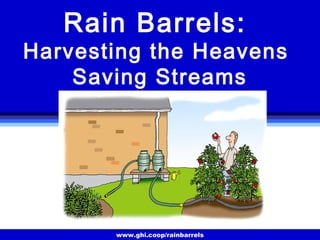
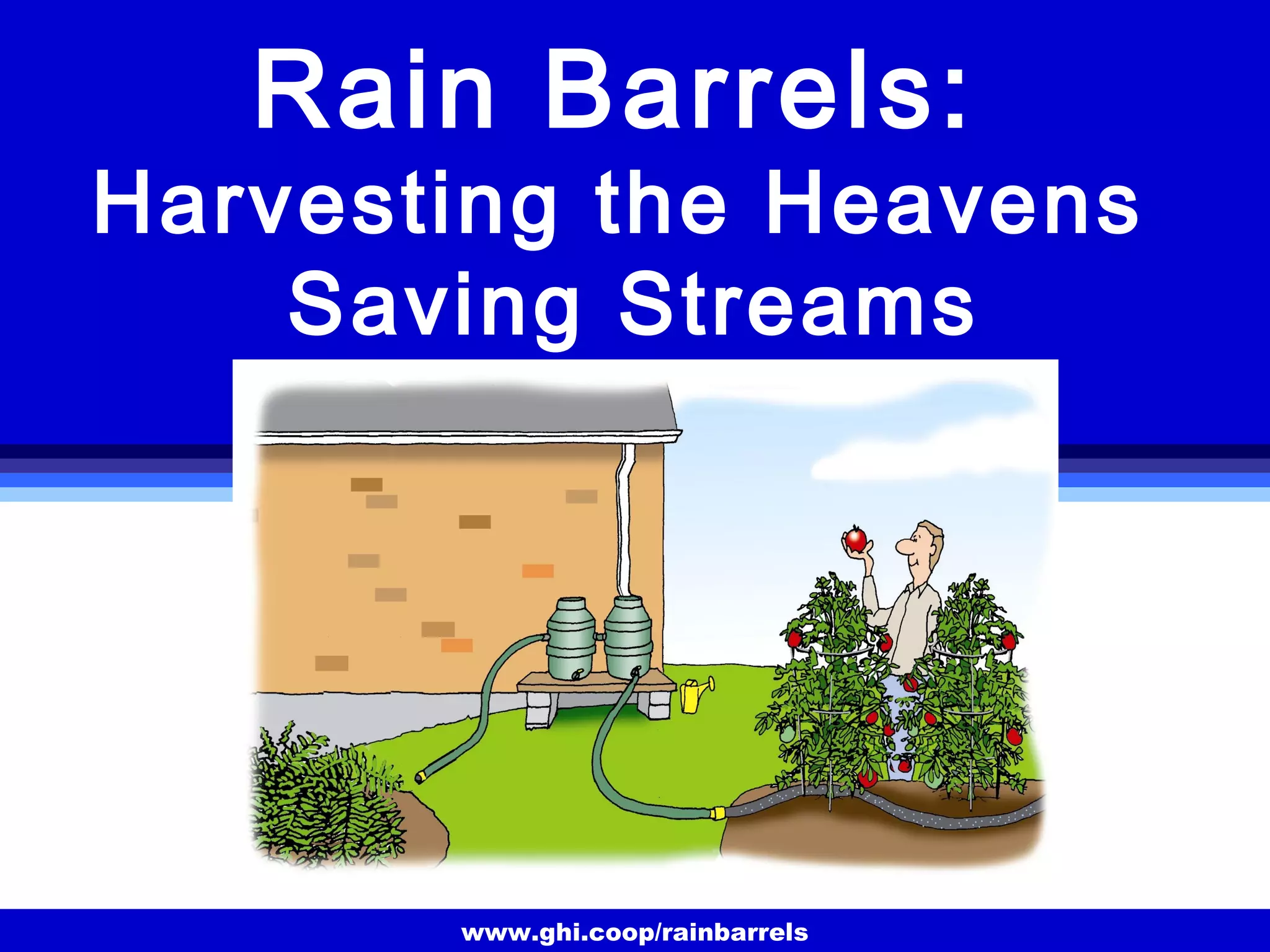
Rain Barrels:
Harvesting the Heavens
Saving Streams
www.ghi.coop/rainbarrels
A cooperative project of
Greenbelt Homes, Inc. and the City of Greenbelt
Woodlands Committee,
and Sustainable Design
and Practices Committee
Greenbelt Advisory
Committee on Environmental
Sustainability (Green ACES)
www.ghi.coop/rainbarrels
What you will learn
What are rain barrels
Why are they important
Where to order a barrel
How to install and maintain a
barrel
Other cool stream saving
practices
www.ghi.coop/rainbarrels
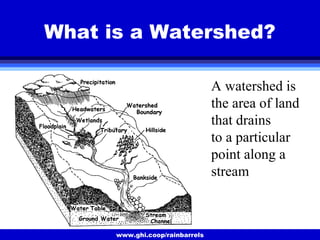
What is a Watershed?
A watershed is
the area of land
that drains
to a particular
point along a
stream
www.ghi.coop/rainbarrels
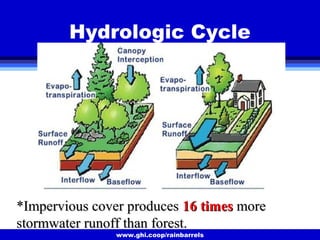
Hydrologic Cycle
*Impervious cover produces*Impervious cover produces 16 times16 times moremore
stormwater runoff than forest.stormwater runoff than forest.
www.ghi.coop/rainbarrels
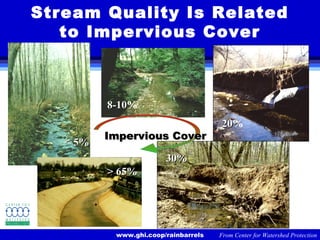
Stream Quality Is Related
to Impervious Cover
< 5%< 5%
Impervious CoverImpervious Cover
8-108-10%
2020%
30%30%
> 65%> 65%
From Center for Watershed Protection
www.ghi.coop/rainbarrels
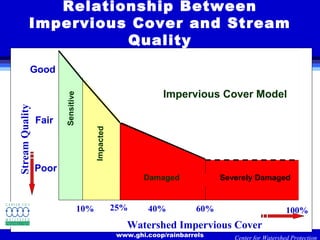
10% 40%25%
Good
Fair
Poor
Watershed Impervious Cover
StreamQuality
60% 100%
Sensitive
Impacted
Damaged
Impervious Cover Model
Severely Damaged
Center for Watershed Protection
Relationship Between
Impervious Cover and Stream
Quality
www.ghi.coop/rainbarrels
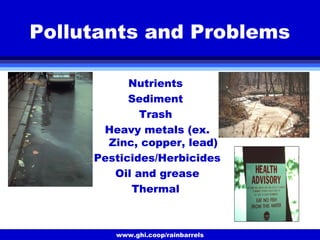
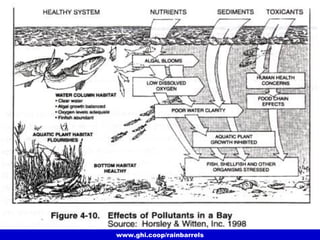
Pollutants and Problems
Nutrients
Sediment
Trash
Heavy metals (ex.
Zinc, copper, lead)
Pesticides/Herbicides
Oil and grease
Thermal
www.ghi.coop/rainbarrels
Pollutants Continued
www.ghi.coop/rainbarrels
Fresh Water At A Premium
Water Planet: 70% of Earth is water, but…
• Only 2.5% is freshwater.
• Much is not accessible. If all earth's water was a
5-litre container, available fresh water would not fill
a teaspoon!
Where we use it:
• Household use 10% - as much as 40% for outdoor
use
• Agriculture 70% - more than 50% of this is wasted.
• Industry 20%
By 2025, 2.8 Billion people on planet earth with face
water scarcity.
www.ghi.coop/rainbarrels
Rain Barrels to the Rescue
Why a rain barrel?
• Collect “free” rain water
• Water plants with non-chlorinated,
renewable supply
• Save money on water bills
• Reduce runoff to streams
• Save the planet!
www.ghi.coop/rainbarrels
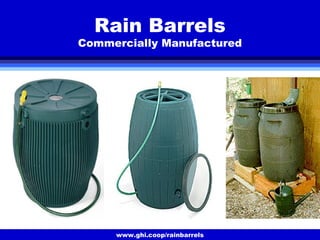
Rain Barrels
Commercially Manufactured
www.ghi.coop/rainbarrels
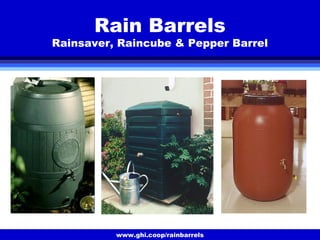
Rain Barrels
Rainsaver, Raincube & Pepper Barrel
www.ghi.coop/rainbarrels
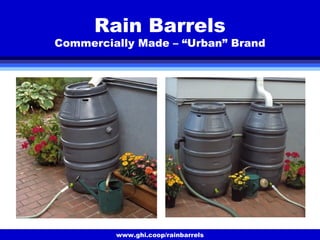
Rain Barrels
Commercially Made – “Urban” Brand
www.ghi.coop/rainbarrels
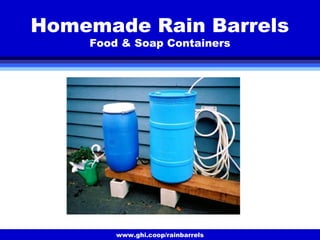
Homemade Rain Barrels
Food & Soap Containers
www.ghi.coop/rainbarrels
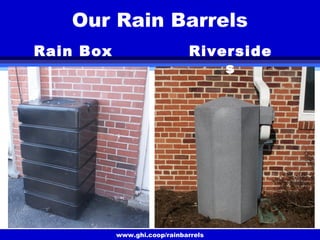
Our Rain Barrels
Rain Box Riverside
s
www.ghi.coop/rainbarrels
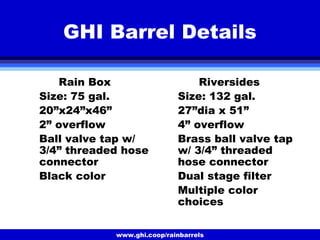
GHI Barrel Details
Rain Box
Size: 75 gal.
20”x24”x46”
2” overflow
Ball valve tap w/
3/4” threaded hose
connector
Black color
Riversides
Size: 132 gal.
27”dia x 51”
4” overflow
Brass ball valve tap
w/ 3/4” threaded
hose connector
Dual stage filter
Multiple color
choices
www.ghi.coop/rainbarrels
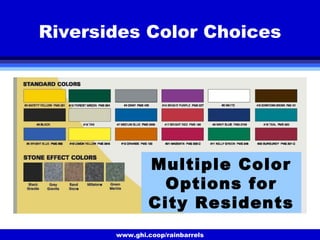
Riversides Color Choices
Multiple Color
Options for
City Residents
www.ghi.coop/rainbarrels
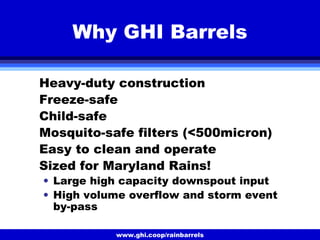
Why GHI Barrels
Heavy-duty construction
Freeze-safe
Child-safe
Mosquito-safe filters (<500micron)
Easy to clean and operate
Sized for Maryland Rains!
• Large high capacity downspout input
• High volume overflow and storm event
by-pass
www.ghi.coop/rainbarrels
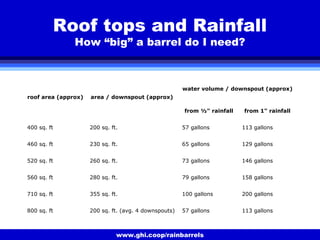
Roof tops and Rainfall
How “big” a barrel do I need?
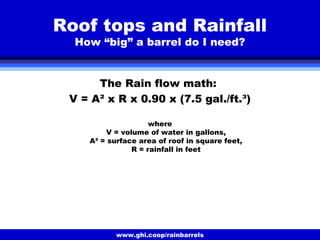
The Rain flow math:
V = A² x R x 0.90 x (7.5 gal./ft.³)
where
V = volume of water in gallons,
A² = surface area of roof in square feet,
R = rainfall in feet
www.ghi.coop/rainbarrels
Roof tops and Rainfall
How “big” a barrel do I need?
roof area (approx) area / downspout (approx)
water volume / downspout (approx)
from ½" rainfall from 1" rainfall
400 sq. ft 200 sq. ft. 57 gallons 113 gallons
460 sq. ft 230 sq. ft. 65 gallons 129 gallons
520 sq. ft 260 sq. ft. 73 gallons 146 gallons
560 sq. ft 280 sq. ft. 79 gallons 158 gallons
710 sq. ft 355 sq. ft. 100 gallons 200 gallons
800 sq. ft 200 sq. ft. (avg. 4 downspouts) 57 gallons 113 gallons
www.ghi.coop/rainbarrels
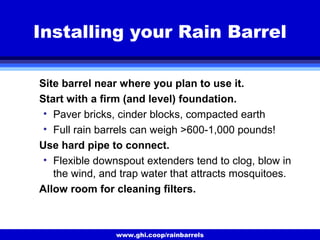
Installing your Rain Barrel
Site barrel near where you plan to use it.
Start with a firm (and level) foundation.
• Paver bricks, cinder blocks, compacted earth
• Full rain barrels can weigh >600-1,000 pounds!
Use hard pipe to connect.
• Flexible downspout extenders tend to clog, blow in
the wind, and trap water that attracts mosquitoes.
Allow room for cleaning filters.
www.ghi.coop/rainbarrels
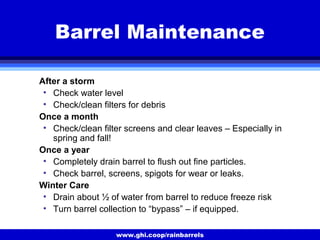
Barrel Maintenance
After a storm
• Check water level
• Check/clean filters for debris
Once a month
• Check/clean filter screens and clear leaves – Especially in
spring and fall!
Once a year
• Completely drain barrel to flush out fine particles.
• Check barrel, screens, spigots for wear or leaks.
Winter Care
• Drain about ½ of water from barrel to reduce freeze risk
• Turn barrel collection to “bypass” – if equipped.
www.ghi.coop/rainbarrels
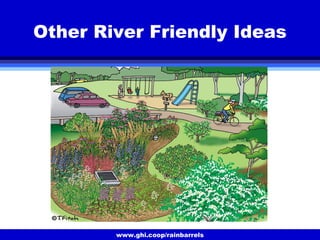
Other River Friendly Ideas
www.ghi.coop/rainbarrels
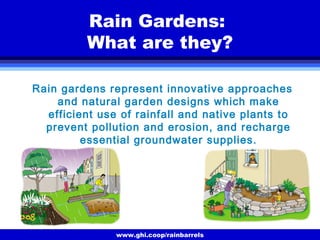
Rain Gardens:
What are they?
Rain gardens represent innovative approaches
and natural garden designs which make
efficient use of rainfall and native plants to
prevent pollution and erosion, and recharge
essential groundwater supplies.
www.ghi.coop/rainbarrels
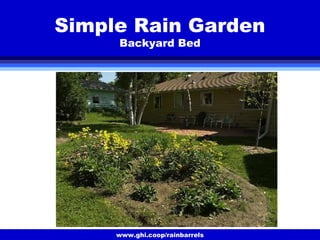
Simple Rain Garden
Backyard Bed
www.ghi.coop/rainbarrels
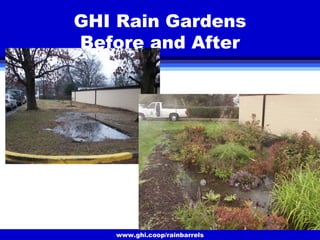
GHI Rain Gardens
Before and After
www.ghi.coop/rainbarrels
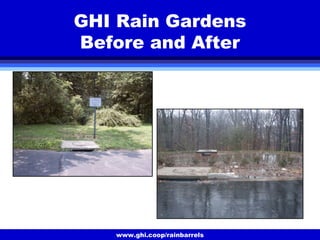
GHI Rain Gardens
Before and After
www.ghi.coop/rainbarrels
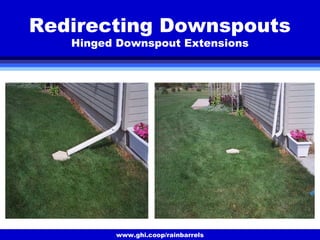
Redirecting Downspouts
Hinged Downspout Extensions
www.ghi.coop/rainbarrels
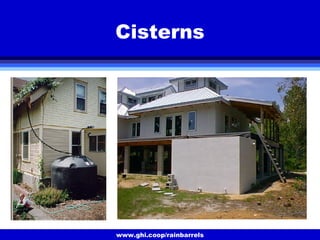
Cisterns
www.ghi.coop/rainbarrels
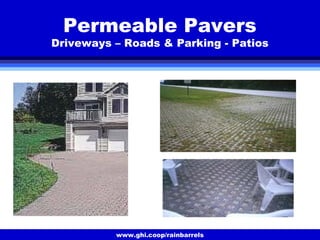
Permeable Pavers
Driveways – Roads & Parking - Patios
www.ghi.coop/rainbarrels
Next Steps
Take a rainy day walk
• Look for areas where water ponds.
• Watch how water flows across
your yard, neighborhood.
• Check out drainage channels and
local streams during a storm.
Order your rain barrel!
www.ghi.coop/rainbarrels
For More Information:
Matt Berres
Director, Operations
Greenbelt Homes Inc.
mberres@ghi.coop
www.ghi.coop/content/rain-barrels
www.ghi.coop/content/rain-gardens
www.rainscapes.org
www.riversides.org/
www.epa.gov/owow/
Other Good Websites

Rain Barrels: Harvesting the Heavens Saving Streams

Editor's Notes

  • #15 Rain Barrels are systems designed to capture and store rainwater coming off a roof, usually attached to a downspout. They consist of a storage container (usually plastic), a system for diverting downspout water into the barrel, and an overflow that returns to the downspout or diverts water safely away from the house to percolate into the soil.They should also have the following: Durable, rot resistant construction. Opaque containers to discourage bacteria/algae growth. Kid, pet, and pest-proof openings. Valves for hose attachment. Screens and/or filters to keep debris out of the barrel. Rain caught (gallons) = (inches of rain) x .6* x (portion of building footprint) For example, if your home&amp;apos;s footprint is 1,400 ft2, and you want to know the amount of water that comes from a 1/4&amp;quot; (.25&amp;quot;) rain event, you would solve the following: Rain caught (gallons) = (.25) x (.6) x (1,400), or 210 gallons. However, storage is limited to the capacity of your system. Added capacity helps your system weather the dry spells. Capacity and cost are directly related: decide how much you want to spend for savings. *One inch of rain falling on a square foot of surface yields approximately .6 gallons of water.