Coalition for Urban Ash Tree Conservation
                                      - Emerald Ash Borer Management Statement -
                                                www.emeraldashborer.info/files/conserve_ash.pdf
                                                             signed 06 Jan 2011


We the undersigned strongly endorse ash tree conservation as a fundamental component of integrated programs to
manage emerald ash borer (EAB) in residential and municipal landscapes. Cost-effective, environmentally sound EAB
treatment protocols are now available that can preserve ash trees through peak EAB outbreaks with healthy canopy
intact. Used in association with tree inventories and strategic removal / replacement of unhealthy ash, tree conservation
will help retain maximum integrity and value of urban forests. This integrated approach to urban EAB management is
supported by university scientists with expertise in EAB management, commercial arborists, municipal foresters, public
works officials, and non-governmental organizations (NGOs).


Emerald ash borer has killed millions of ash trees since its
discovery in 2002 and the number of dead ash is increasing
rapidly. Ash species are abundant in planted and natural
areas of urban forests, representing 10 - 40% of the canopy
cover in many communities.

Ash trees provide substantial economic and ecosystem
benefits to taxpayers, ranging from increased property
value, to storm water mitigation, to decreased energy
demands (http://www.coloradotrees.org/benefits.htm).

Consequently, widespread ash mortality in urban forests
and residential landscapes is having devastating economic
and environmental impacts. Indeed, EAB is predicted to
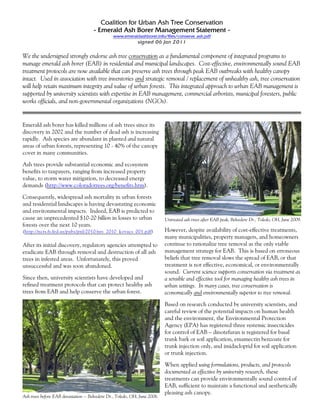
cause an unprecedented $10-20 billion in losses to urban                    Untreated ash trees after EAB peak, Belvedere Dr., Toledo, OH, June 2009.
forests over the next 10 years.
(http://ncrs.fs.fed.us/pubs/jrnl/2010/nrs_2010_kovacs_001.pdf)              However, despite availability of cost-effective treatments,
                                                                            many municipalities, property managers, and homeowners
After its initial discovery, regulatory agencies attempted to               continue to rationalize tree removal as the only viable
eradicate EAB through removal and destruction of all ash                    management strategy for EAB. This is based on erroneous
trees in infested areas. Unfortunately, this proved                         beliefs that tree removal slows the spread of EAB, or that
unsuccessful and was soon abandoned.                                        treatment is not effective, economical, or environmentally
                                                                            sound. Current science supports conservation via treatment as
Since then, university scientists have developed and                        a sensible and effective tool for managing healthy ash trees in
refined treatment protocols that can protect healthy ash                    urban settings. In many cases, tree conservation is
trees from EAB and help conserve the urban forest.                          economically and environmentally superior to tree removal.

                                                                            Based on research conducted by university scientists, and
                                                                            careful review of the potential impacts on human health
                                                                            and the environment, the Environmental Protection
                                                                            Agency (EPA) has registered three systemic insecticides
                                                                            for control of EAB – dinotefuran is registered for basal
                                                                            trunk bark or soil application, emamectin benzoate for
                                                                            trunk injection only, and imidacloprid for soil application
                                                                            or trunk injection.

                                                                            When applied using formulations, products, and protocols
                                                                            documented as effective by university research, these
                                                                            treatments can provide environmentally sound control of
                                                                            EAB, sufficient to maintain a functional and aesthetically
                                                                            pleasing ash canopy.
Ash trees before EAB devastation -- Belvedere Dr., Toledo, OH, June 2006.
Treatment is most appropriate after EAB infestation has                        A program of sustained treatment will be needed to
been detected within 15 miles, and is most effective when                      conserve trees through peak EAB infestation. However, as
applied before trees are infested. However, treatment can                      the local EAB population declines due to death of
also save ash trees with a low level of EAB infestation.                       untreated ash, it is possible that treatment frequency may
Spring is the ideal time for treatment, but soil application                   be reduced. Research on this question and other aspects
in fall can be effective in some situations.                                   of EAB management is ongoing, requiring practitioners to
                                                                               stay current.
Different treatment regimens will be optimal under
different situations -- no one treatment plan or application                   Up-to-date information about EAB insecticides,
method is best under all circumstances.                                        application protocols, and effectiveness can be found at:

                       http://www.emeraldashborer.info/files/multistate_EAB_Insecticide_Fact_Sheet.pdf

                                               É É É
In summary, urban ash conservation can be less costly than removal, especially when the significant
environmental and economic benefits of established trees are considered (www.treebenefits.com,
http://extension.entm.purdue.edu/treecomputer/). Furthermore, ash conservation can circumvent the
substantial environmental impacts caused by wholesale deforestation of the urban landscape, as well as
the documented public safety risks associated with standing dead ash trees and their removal.


                                                       -- Signed - 06 Jan 2011 --

Jim Bell, Parks Superintendent                    Daniel A. Herms, PhD                             Michael Robinson, VP; Mgr. Midwest Div. *
City of Elgin, IL                                 Prof., Dept. of Entomology                       The F. A. Bartlett Tree Expert Company
                                                  The Ohio State University; Wooster, OH
Shawn Bernick, Director of Research *                                                              Clifford S. Sadof, PhD
Rainbow Treecare Scientific Advancements          Ray Iacobucci, Regional Technical Manager        Prof., Entomology
                                                  TruGreen; Lewis Center, OH                       Purdue University; West Lafayette, IN
Joe Boggs, Asst. Prof.
OSU Extension / OSU Dept. of Entomology           Dana Irwin, Sr. Director - East Svc. Delivery    Craig Schaar, Forestry Inspector *
The Ohio State University                         Scotts LawnService                               City of Toledo, OH

J. Bradford Bonham, DVM *                         Deborah G. McCullough, PhD                       David Smitley, PhD
Municipal consultant (OH)                         Prof., Depts. of Entomology and Forestry         Prof., Dept. of Entomology
                                                  Michigan State University; E. Lansing, MI        Michigan State University; E. Lansing, MI
Joe Chamberlin, PhD; Development Mgr, SE
Valent U.S.A. Corporation                         Fredric Miller, PhD ^                            Chad Tinkel, Manager, Forestry Operations *
                                                  Prof., Horticulture                              City of Ft. Wayne, IN
Richard S. Cowles, PhD                            Joliet Junior College; Joliet, IL
Agricultural Scientist                                                                             Chris Williamson, PhD
The Connecticut Agricultural Experiment Station   Michael J. Raupp, PhD                            Assoc. Prof., Dept. of Entomology
                                                  Prof. & Ext. Specialist, Dept. of Entomology     University of Wisconsin; Madison, WI
Mike Galvin, Deputy Director *~                   University of Maryland; College Park, MD
Casey Trees, Washington, DC                                                                        James Zwack, Dir. Technical Services
                                                                                                   The Davey Tree Expert Company
Larry Hanks, Consulting Arborist *~                                                                                        *ISA-certified arborist
Pampered Properties, Georgetown, KY                                                                        ^ISA Board-Certified Master Arborist
                                                                                                           ~ASCA Registered Consulting Arborist


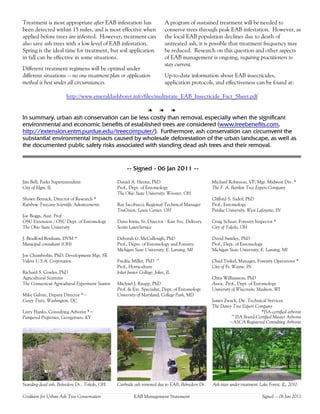
Standing dead ash, Belvedere Dr., Toledo, OH.     Curbside ash removed due to EAB, Belvedere Dr.    Ash trees under treatment, Lake Forest, IL, 2010.

Coalition for Urban Ash Tree Conservation                   EAB Management Statement                                            Signed -- 06 Jan 2011

2011 Ash Conservation Statement 010611

  • 1.
    Coalition for UrbanAsh Tree Conservation - Emerald Ash Borer Management Statement - www.emeraldashborer.info/files/conserve_ash.pdf signed 06 Jan 2011 We the undersigned strongly endorse ash tree conservation as a fundamental component of integrated programs to manage emerald ash borer (EAB) in residential and municipal landscapes. Cost-effective, environmentally sound EAB treatment protocols are now available that can preserve ash trees through peak EAB outbreaks with healthy canopy intact. Used in association with tree inventories and strategic removal / replacement of unhealthy ash, tree conservation will help retain maximum integrity and value of urban forests. This integrated approach to urban EAB management is supported by university scientists with expertise in EAB management, commercial arborists, municipal foresters, public works officials, and non-governmental organizations (NGOs). Emerald ash borer has killed millions of ash trees since its discovery in 2002 and the number of dead ash is increasing rapidly. Ash species are abundant in planted and natural areas of urban forests, representing 10 - 40% of the canopy cover in many communities. Ash trees provide substantial economic and ecosystem benefits to taxpayers, ranging from increased property value, to storm water mitigation, to decreased energy demands (http://www.coloradotrees.org/benefits.htm). Consequently, widespread ash mortality in urban forests and residential landscapes is having devastating economic and environmental impacts. Indeed, EAB is predicted to cause an unprecedented $10-20 billion in losses to urban Untreated ash trees after EAB peak, Belvedere Dr., Toledo, OH, June 2009. forests over the next 10 years. (http://ncrs.fs.fed.us/pubs/jrnl/2010/nrs_2010_kovacs_001.pdf) However, despite availability of cost-effective treatments, many municipalities, property managers, and homeowners After its initial discovery, regulatory agencies attempted to continue to rationalize tree removal as the only viable eradicate EAB through removal and destruction of all ash management strategy for EAB. This is based on erroneous trees in infested areas. Unfortunately, this proved beliefs that tree removal slows the spread of EAB, or that unsuccessful and was soon abandoned. treatment is not effective, economical, or environmentally sound. Current science supports conservation via treatment as Since then, university scientists have developed and a sensible and effective tool for managing healthy ash trees in refined treatment protocols that can protect healthy ash urban settings. In many cases, tree conservation is trees from EAB and help conserve the urban forest. economically and environmentally superior to tree removal. Based on research conducted by university scientists, and careful review of the potential impacts on human health and the environment, the Environmental Protection Agency (EPA) has registered three systemic insecticides for control of EAB – dinotefuran is registered for basal trunk bark or soil application, emamectin benzoate for trunk injection only, and imidacloprid for soil application or trunk injection. When applied using formulations, products, and protocols documented as effective by university research, these treatments can provide environmentally sound control of EAB, sufficient to maintain a functional and aesthetically pleasing ash canopy. Ash trees before EAB devastation -- Belvedere Dr., Toledo, OH, June 2006.
  • 2.
    Treatment is mostappropriate after EAB infestation has A program of sustained treatment will be needed to been detected within 15 miles, and is most effective when conserve trees through peak EAB infestation. However, as applied before trees are infested. However, treatment can the local EAB population declines due to death of also save ash trees with a low level of EAB infestation. untreated ash, it is possible that treatment frequency may Spring is the ideal time for treatment, but soil application be reduced. Research on this question and other aspects in fall can be effective in some situations. of EAB management is ongoing, requiring practitioners to stay current. Different treatment regimens will be optimal under different situations -- no one treatment plan or application Up-to-date information about EAB insecticides, method is best under all circumstances. application protocols, and effectiveness can be found at: http://www.emeraldashborer.info/files/multistate_EAB_Insecticide_Fact_Sheet.pdf É É É In summary, urban ash conservation can be less costly than removal, especially when the significant environmental and economic benefits of established trees are considered (www.treebenefits.com, http://extension.entm.purdue.edu/treecomputer/). Furthermore, ash conservation can circumvent the substantial environmental impacts caused by wholesale deforestation of the urban landscape, as well as the documented public safety risks associated with standing dead ash trees and their removal. -- Signed - 06 Jan 2011 -- Jim Bell, Parks Superintendent Daniel A. Herms, PhD Michael Robinson, VP; Mgr. Midwest Div. * City of Elgin, IL Prof., Dept. of Entomology The F. A. Bartlett Tree Expert Company The Ohio State University; Wooster, OH Shawn Bernick, Director of Research * Clifford S. Sadof, PhD Rainbow Treecare Scientific Advancements Ray Iacobucci, Regional Technical Manager Prof., Entomology TruGreen; Lewis Center, OH Purdue University; West Lafayette, IN Joe Boggs, Asst. Prof. OSU Extension / OSU Dept. of Entomology Dana Irwin, Sr. Director - East Svc. Delivery Craig Schaar, Forestry Inspector * The Ohio State University Scotts LawnService City of Toledo, OH J. Bradford Bonham, DVM * Deborah G. McCullough, PhD David Smitley, PhD Municipal consultant (OH) Prof., Depts. of Entomology and Forestry Prof., Dept. of Entomology Michigan State University; E. Lansing, MI Michigan State University; E. Lansing, MI Joe Chamberlin, PhD; Development Mgr, SE Valent U.S.A. Corporation Fredric Miller, PhD ^ Chad Tinkel, Manager, Forestry Operations * Prof., Horticulture City of Ft. Wayne, IN Richard S. Cowles, PhD Joliet Junior College; Joliet, IL Agricultural Scientist Chris Williamson, PhD The Connecticut Agricultural Experiment Station Michael J. Raupp, PhD Assoc. Prof., Dept. of Entomology Prof. & Ext. Specialist, Dept. of Entomology University of Wisconsin; Madison, WI Mike Galvin, Deputy Director *~ University of Maryland; College Park, MD Casey Trees, Washington, DC James Zwack, Dir. Technical Services The Davey Tree Expert Company Larry Hanks, Consulting Arborist *~ *ISA-certified arborist Pampered Properties, Georgetown, KY ^ISA Board-Certified Master Arborist ~ASCA Registered Consulting Arborist Standing dead ash, Belvedere Dr., Toledo, OH. Curbside ash removed due to EAB, Belvedere Dr. Ash trees under treatment, Lake Forest, IL, 2010. Coalition for Urban Ash Tree Conservation EAB Management Statement Signed -- 06 Jan 2011