Language Learning & Technology                                             October 2010, Volume 14, Number 3
http://llt.msu.edu/vol14num3/yanguas.pdf                                                            pp. 72–93


          ORAL COMPUTER-MEDIATED INTERACTION BETWEEN
                  L2 LEARNERS: IT’S ABOUT TIME!
Íñigo Yanguas
San Diego State University
      This study explores task-based, synchronous oral computer-mediated communication
      (CMC) among intermediate-level learners of Spanish. In particular, this paper examines
      (a) how learners in video and audio CMC groups negotiate for meaning during task-based
      interaction, (b) possible differences between both oral CMC modes and traditional face-to-
      face (FTF) communication, and (c) how this oral computer mediated negotiation compares
      to that found in the text-based CMC literature. Fifteen learner-to-learner dyads were
      randomly assigned to an audio group, a video group, and a FTF control group to complete
      a jigsaw task that was seeded with 16 unknown lexical items. Experimental groups used
      Skype, free online communication software, to carry out the task. The transcripts of the
      conversations reveal that oral CMC groups do indeed negotiate for meaning in this
      multimedia context when non-understanding occurs between speakers. In addition, results
      showed differences in the way audio and video groups carry out these negotiations, which
      were mainly due to the lack of visual contact in the audio group. No differences were
      found between video and FTF groups. Furthermore, oral CMC turn-taking patterns were
      shown to be very similar to FTF patterns but opposite to those found in written
      synchronous CMC. Oral CMC interaction patterns are shown to be more versatile.

INTRODUCTION
Research investigating computer-mediated communication (CMC) in the context of second language
acquisition (SLA) has proliferated since the early 1990s. Several scholars at that time embarked on
investigations that assessed second language (L2) learners’ interactions using local networked computers
and the Daedalus interchange software (e.g., Beauvois, 1992; Chun, 1994; Kelm, 1992; Kern, 1995).
Since then and after the appearance of several Web-based chat programs such as Yahoo and MSN
Messenger, several studies have been published investigating various aspects of CMC such as teacher
strategies (Meskill & Anthony, 2005), socialization (Sengupta, 2001; Shin, 2006), individual differences
(Payne & Ross, 2005), or studies that compared synchronous versus asynchronous CMC (Pérez, 2003;
Sotillo, 2000).
However, the bulk of research has investigated CMC under an interactionist perspective (Blake, 2000;
Darhower, 2002; Fernández-García & Martínez-Arbelaiz, 2002; Negretti, 1999; Pellettieri, 2000; Smith,
2003; Toyoda & Harrison, 2002; Tudini, 2003; Warner, 2004; Xie, 2002). Not only do these studies
deserve a special mention for their numbers but also for their efforts to connect this strand of Computer-
Assisted Language Learning (CALL) with the SLA field by utilizing the Interaction Hypothesis (Long,
1996) as theoretical framework. This hypothesis associates input, attention, and output through
negotiation in meaningful and productive ways and has been widely investigated in the SLA field. Studies
have used different types of tasks and activities that promote interaction and have shown that negotiation
of meaning in these learner-to-learner interactions does indeed occur (Ellis, Tanaka, & Yamazaki, 1994;
Gass, 1998; Gass & Varonis, 1985; Long, 1983; 1985; Loschky, 1994; Mackey, 1999; Pica, 1994; Pica,
Holliday, Lewis, Berducci, & Newman, 1991). Even if evidence that interactive negotiation leads to
language acquisition is not conclusive, it is widely believed by the SLA community that this type of
interaction among L2 learners is beneficial for L2 development (Smith, 2004).
Less fruitful, at least in terms of quantity, has been research investigating a more direct link between
CMC interaction and SLA (De la Fuente, 2003; Sachs & Suh, 2007; Shekary & Tahririan, 2006; Smith,


Copyright © 2010, ISSN 1094-3501                                                                           72
Íñigo Yanguas                                                               Oral Computer-Mediated Interaction


2004, 2005). Far from being conclusive, results from some of these studies seem to suggest that lexical
items trigger more negotiation episodes than any other aspect of conversation (Blake, 2000; Blake &
Zyzik, 2003; Toyoda & Harrison, 2002) and, therefore, are most likely to be learned. For instance, Smith
(2004) found positive effects for CMC negotiated interaction on lexical acquisition. Along the same lines,
De la Fuente found that text-based CMC was as effective as face-to-face (FTF) interaction in promoting
written receptive and productive learning of the target words. Interestingly, results for oral acquisition
were not quite the same and she concluded “text-based CMC negotiated interaction may not be the best
answer for development of productive, oral skills” (p.74). However, there are studies that have shown that
interacting in a chatroom environment can foster oral skills (Payne & Whitney, 2002).
As all these investigations show, much research in the CMC strand of research has focused on written
communication, whether synchronous or asynchronous. In the oral CMC realm, Cziko and Park (2003)
reviewed six free Web-based programs that allowed video and/or voice communication over the Internet.
They claimed that recent advances in programming, computer speed, and Internet bandwidth had
facilitated the possibility of free real-time communication through video-conferencing and its application
in the L2 classroom. Three years later, Levy and Stockwell (2006) stated that the spread of broadband
technologies and lower prices for both software and hardware made audio- and video-conferencing
affordable for most institutions. At the turn of the decade, technological advances have taken on a new
dimension making the present time, when laptops come equipped with cameras and microphones and fast
broadband Internet networks are common on many campuses, even more favorable for investigating and
implementing oral computer-mediated-communication (OCMC) in the L2 classroom. Traditional free
Internet chatting programs now have, in addition to chatting capabilities, appropriate audio and video
quality, and they are widely used. Furthermore, some electronic mail providers such as Gmail have
recently included video-conferencing capabilities that provide high quality pictures easily from your
inbox. Skype, a relatively new program that has been based in Luxembourg since 2003, is a program with
high picture and sound quality. Godwin-Jones (2005) claimed that in comparison to programs such as
Paltalk, Skype generally offers better quality and poses less compatibility issues than other programs. On
Skype’s Website (http://about.skype.com/), it is noted that in the third quarter of 2009, Skype users made
almost 28 billion Skype-to-Skype calls, more than three quarters of which were video calls. As a matter of
fact, we have used Skype at a large public university to foster speaking practice in the L2 since 2007, and
can confirm that, contrary to Hampel and Hauck (2004), the effective implementation of video- and
audio-conferencing in the L2 classroom, given the appropriate technological infrastructure, is not such a
complex endeavor. However, we agree with Blake (2008) who claimed that any technological tool is
inherently neutral, and that successful CMC will depend on careful planning on the part of the instructor
or researcher.
Synchronous written computer-mediated communication (WCMC) has been labeled as a hybrid mode
because it exhibits features of both written and spoken language (Roed, 2003; Smith 2005; Yates, 1996)
and as such has been capitalized on by practitioners in the L2 classroom. Overall, research has shown that
WCMC poses similar benefits to traditional FTF interaction (Blake, 2000) because of the real time
interaction in which learners negotiate meaning, modify input and output, and respond to feedback.
Written CMC has been argued to have advantages over FTF because learners amplify their attention to
form, produce a larger quantity of better output, and feel less threatened (Smith, 2004; Blake, 2008).
Nevertheless, this hybrid mode is different from FTF as WCMC is a non-visual mode of communication
where visual cues, which are key in understanding and interpreting spoken messages in the real world, are
not available to the speakers (besides emoticons). It is therefore necessary to practice and foster
communicative habits that can provide learners with the right tools to effectively communicate orally be it
with other L2 learners or with native speakers in the outside world. In its video version OCMC offers the
possibility of incorporating visual communication clues, but research needs to be conducted to assess the
potential benefits of negotiated interaction for the L2 learner using this mode of communication.


Language Learning & Technology                                                                             73
Íñigo Yanguas                                                                Oral Computer-Mediated Interaction


As Blake (2008) pointed out, research into audio- and video-conferencing has been predominantly in the
area of distance language education (e.g., Develotte, 2009; Lamy, 2004; Rosell-Aguilar, 2005). In fact,
very few studies (some exceptions are, Lee, 2007; Jepson, 2005; Sykes, 2005) have investigated
synchronous OCMC in the classroom as a means to develop L2 proficiency. These researchers
investigating OCMC, however, have taken very different perspectives and have used entirely different
research designs making it very difficult to draw any general conclusions. For example, Jepson (2005)
compared the patterns of repair moves in text chat rooms and in voice chat rooms on the Internet;
specifically, he was interested in the types of repair moves that each group used.. Participants in Jepson’s
study were students of English as a foreign language at an online school where they were enrolled. Jepson
used Long (1983, 1996) to operationalize and count repair moves according to two categories:
Negotiation of Meaning and Negative Feedback. Results showed that a significantly higher number of
repair moves were made in voice chats than in text chats. Additionally, qualitative analyses indicated that
most repair moves in these voice chats were pronunciation related. In turn, Sykes (2005) examined the
effects of three types of synchronous group discussion in the acquisition of a speech act (refusal of an
invitation) in the L2. She found that no group outperformed another in pragmatic acquisition, but she also
found that the synchronous written chat group outperformed the other two in complexity and variety of
strategies used. Finally, Lee (2007) investigated L1-L2 dyads in task-based video-conferencing from a
qualitative perspective. She carried out interviews to examine participants’ experiences and insights into
video-conferencing as a tool to foster speaking skills. She concluded that it was essential to use a well-
designed and motivating task, to carefully select the linguistic context, and to provide students with
training in video-conferencing.
Results from these three studies are revealing; they serve as a starting point on which to build our
knowledge of how OCMC promotes the L2 acquisition process. There are, however, many unanswered
questions related to the implementation of OCMC in the classroom and its effects on L2 development; the
present study seeks to provide insight to some of these questions. In particular, this task-based study
compares two different versions of OCMC (video-conference and voice-conference) and a control FTF
group on the communicative outcomes of a learning task. In addition, it seeks to compare results for both
the OCMC groups with what has been found in the previous interactionist literature for WCMC. In order
to achieve these goals, participants in this study interacted in the L2 in an effort to solve a learning task
for which they were randomly placed in two experimental conditions (VidCMC and AudCMC) and a
control group (FTF). To my knowledge, the current CMC study is the first work to use Skype, a free
widely used Internet application, to investigate L2 negotiated interaction in CALL.
Negotiation of Meaning in Task-Based Learner-to-Learner OCMC
As most of the studies discussed above, the present investigation was carried out under an interactionist
perspective. Long’s (1996) Interaction Hypothesis suggests that learners engaging in conversation will
create an ideal situation for L2 learning when some misunderstanding arises and the speaker and
interlocutor negotiate for meaning. Interlocutors may modify their speech using several mechanisms such
as: modifications, recasts, repetitions, elaborations, etc. When this adjustment is made, attention (Schmidt,
1990) is drawn to the part of the input that has not been understood by the learner thus optimizing the
opportunity for learning to occur. Furthermore, learners will modify their output in the L2 to adapt it to
the negotiated form reaping the benefits attributed to this process by Swain (1985, 1995). These benefits
include the use of the learners’ linguistic resources in the L2 and the opportunity to test hypotheses about
the target language while syntactically processing it.
Though it cannot be claimed that negotiation of meaning directly causes SLA, this interactionist stance
has countless followers in the field because this negotiation “creates a fertile environment for SLA to
occur” (Blake, 2000, p. 121). The benefits of interacting in the L2 have been shown for traditional L1 -
L2 learner (e.g., Long, 1983) and L2 learner/L2 learner FTF interactions (e.g., Gass & Varonis, 1994) and,
as discussed above, in networked text-based interactions (e.g., Smith, 2003). The present study adds a


Language Learning & Technology                                                                              74
Íñigo Yanguas                                                               Oral Computer-Mediated Interaction


new context to the investigation of negotiated interaction by exploring how L2 learner/L2 learner dyads
interact using audio- and video-conferencing.
The way learners interact among them is different from the way learners and L1 speakers interact, and
more research is needed to ascertain what consequences this type of interaction has on the learning
process (Adams, 2007). If any benefits for L2 acquisition were to be attributed to learner-to-learner
interactions, they could be reaped in the L2 classroom. In addition, investigations of non-text-based CMC
are due at a time when technological resources, both hardware and software applications, are becoming
more available and this mode of communication has gone widely underesearched.
Research Questions
The present study seeks answers to the following research questions:
    1. (a) How do learners in video and audio CMC groups negotiate for meaning during task-based
       interaction? (b) Are there any differences between oral CMC and traditional FTF communication?
    2. How do these negotiation routines compare to those found in the text-based CMC negotiation
       literature?

METHOD
Participants
Conversations from 15 dyads of Spanish L2 learners were recorded and qualitatively analyzed to find an
answer to this study’s research questions. One intact class of third semester Spanish, enrolled in a large
public university in Southern California, participated in this investigation. Based on a pretreatment
background questionnaire, learners were determined to have taken an average of almost two Spanish
college classes, ranging from one to four classes (M = 1.9, SD = .90).
Procedure
Participants met in a language lab as part of their regular class syllabus, and they were randomly assigned
to one of the following three interaction groups: video-conferencing (VidCMC), audio-conferencing
(AudCMC), and face-to-face (FTF). They were assigned to a numbered computer station where they
listened to a recording explaining the procedure for this lab session; each computer station was also
labeled with the names of the group they belonged to (VidCMC, AudCMC, FTF). Once they finished
listening to the recording, they read and signed the participant consent form. Immediately after, the
researcher checked that participants understood the procedure and answered any questions learners had at
that point. Given that Skype was widely used in Spanish classes at the host institution, participants only
had questions about the task and how to record their conversation. After all questions were answered and
assessment tasks administered, participants signed into Skype and called their assigned partners. Dyads
for the FTF control group were seated together and computer microphones were used to record their
conversations. The groups of VidCMC and AudCMC dyads were seated far apart from each other in the
computer lab and used headsets to carry out their conversations. The lab was set up so that learners could
not easily see each other’s screens or talk with one another. Specifically, each computer station was
equipped with a privacy guard on either side of the station. This guard was removed for FTF dyads and
their chairs were set to face each other. Once all the CMC dyads had established and tested their Skype
connection, they were instructed to begin the task. Time was limited to 20 minutes; this time was set
based on the previous piloting of the task with an intact class of third semester Spanish where most dyads
finished within this time frame. Participants then completed the post-task assessment tasks.
Task
Each group completed a jigsaw style task (see Appendix A for instructions). Pica, Kanagy, and Falodun
(1993), in one of the most widely cited works on task typology, argued that jigsaw and information-gap
tasks promoted the most negotiation. In particular, jigsaw tasks are those tasks that force learners to


Language Learning & Technology                                                                             75
Íñigo Yanguas                                                                   Oral Computer-Mediated Interaction


equally share their (different) information to achieve a particular goal. Extensively used in the literature
(e.g., Blake, 2000; Smith, 2003, 2004), this type of two-way task adheres to what Pica and her colleagues
cited as the most recurrent characteristics of tasks discussed in the literature: first, they should be oriented
toward goals; second, participants are expect to take on active roles in carrying out the task. Furthermore,
as advocated by Hampel (2006) in her discussion of a framework for the development of tasks in a
synchronous online environment, the task used in the present study is “genuinely interactive and student-
centered” (p. 119). In addition, we utilized a task in this study that had a connection to the real world; The
Amazing Race is a reality television game show in which a team of two people race around the world in
competition with other teams. Based on this popular award-winning game show, the task used in this
study, also called The Amazing Race, required participants to interact in pairs to prepare for a race in
Latin America. Before they embarked on the trip, they had to decide on which items they would take with
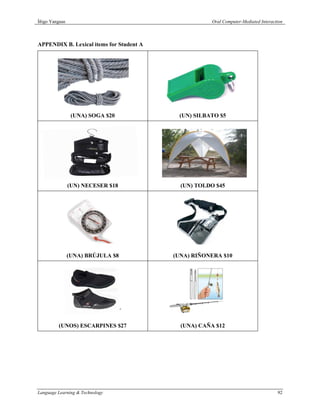
them with a limited $120 budget. Each participant was given a list with eight objects including pictures
and prices (see Appendices A and B) of which they had to choose four items each to be carried in a
shared backpack. Similar to the piloting stage of the task development, the originality of the task used in
this study engaged and motivated participants to carry it out successfully.
Since it appears that lexical items are negotiated most frequently (Sato, 1986; Pica, 1994) if the task is not
structure-focused (Blake & Zyzyk, 2003), this task was seeded with low frequency, unknown lexical
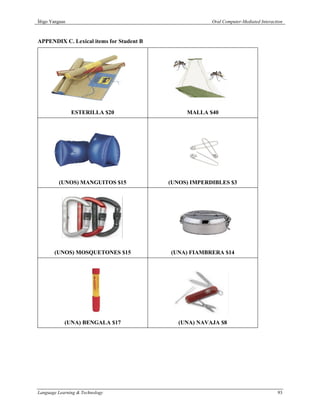
items (objects). Each participant (Student A and Student B) received eight different target lexical items
(see Appendices B and C). As suggested in the literature (see Smith, 2003), these items were selected
based on the results of a pretest that was administered two weeks before to a randomly chosen third
semester class in which 25 items were included. The sixteen less known items were selected for inclusion
in the task, none of these items were known by more than three students in the class.

ANALYSIS
The model put forth by Varonis and Gass (1985) was utilized to identify and analyze the negotiation
routines found in the transcriptions of the conversations carried out by the 15 L2 learner/L2 learner
conversational dyads that participated in this investigation. Widely used both in the traditional
interactionist literature and in the CMC literature (e.g., Blake, 2000; Fernández-García & Martínez-
Arbelaiz, 2002; Gass & Varonis, 1994; and Smith, 2003), this model for negotiation of meaning among
L2 learners proposes four functional primes and two different parts: a trigger (T), and then a resolution
composed of an indicator (I), a response (R), and a reaction to the response (RR). The trigger (T) or
source of non-understanding generates a resolution, which starts with an acknowledgement of the
communication problem or indicator (I). The response (R) then tries to solve the problem; the last
functional prime is an optional element in this model, a reaction to the solution given or reaction to the
response (RR) that might or might not take place. In Varonis and Gass (1985) terms, the horizontal flow
of conversation is interrupted when the indicator (I) occurs following the trigger (T); then, it is pushed
down until the negotiation for meaning ends successfully or otherwise. The conversation at this point
goes back to the main line of discourse.
Since the task utilized in the present study was seeded with unknown lexical items, it was to be expected
that the main sources of non-understanding were lexical items. As mentioned, this fact is common in the
literature because lexical items carry a higher communicative load that makes them often crucial for the
development of the conversation and the task (Blake & Zyzik, 2003). There are, however, several other
factors that can cause a conversation to come to a halt such as the incorrect use of a word, grammatical or
morphosyntactic issues or task-related problems.
Following Smith (2003), a ratio of negotiated turns to total turns was calculated. Turns were counted
every time participants held the floor rather than every time they spoke. Often, perhaps due to their
limited oral proficiency, participants’ interventions signaled the beginning of a turn. In some cases
learners held the floor after a short pause, therefore, extending their intervention. For example, in Excerpt


Language Learning & Technology                                                                                 76
Íñigo Yanguas                                                                 Oral Computer-Mediated Interaction


1 there are a total of eight turns. “Student A” and “Student B” are used in all the excerpts used in this
section for consistency and ease of reference for the reader that can see the items each student had in
Appendices B and C.

    Excerpt 1
    1      A: ¿cómo se dice otra vez?
              [How do you say it again?]

    2      B: navaja
              [Swiss army knife]

    3      A: ¿navaja?
              [Swiss army knife?]

    4      B: y cuesta 8 dólares
              [And it costs $8]

    5      A: ¡sólamente 8, bien!
              [Just 8, great!]
              y tengo un… uh unos zapatos de mar
              [And I have uh a pair of water shoes]

    6      B: ¿es negro?
              [Is it black?]
              ¿es para… uh hacer surf cuando es frío?
              [Is it for uh surf when it’s cold?]

    7      A: sí, uh
              [Yes]
              dice unos “escarpines”
              [It says “escarpines”]

    8      B: ok
              [OK]

Since all dyads spent a different amount of time on task within the twenty assigned (M = 18.2; SD = 0.8)
and previous analyses of the pilot task showed that most negotiations took place during the first twelve
minutes, only the first twelve minutes were analyzed in an effort to make data from all dyads comparable.
Negotiation Routines
As mentioned above, Varonis and Gass’ (1985) model was used to analyze negotiation routines. Four
components or functional primes were distinguished in this model: Trigger (T), Indicator (I), Response
(R), and (the optional) reaction to the response (RR). Following these authors, a negotiation routine, or
non-understanding routine, serves either to negotiate a non-understanding or to continue a conversation.
A negotiation routine is operationally defined as “those exchanges in which there is some overt indication
that understanding between participants has not been complete” (Varonis & Gass, 1985, p. 73).
Additionally, comprehension checks (CC) can occur anywhere in the conversation.


Language Learning & Technology                                                                               77
Íñigo Yanguas                                                                  Oral Computer-Mediated Interaction


Excerpt 2 illustrates these functional primes (optional components of the model are shown in parentheses):

    Excerpt 2
    A:     y tengo un silbato, 5 dólares…                                TRIGGER
           [I have a whistle, $5]

    B:     ¿silbato?                                                     INDICATOR
           [A whistle]

    A:     es…um…para hacer ruido con tu boca cuando necesitas RESPONSE
           ayuda or…
           [It’s to make noise with your mouth when you need help]

    A:     ¿sabes?                                                       (COMPREHENSION CHECK)
           [do you know?]

    B:     oh sí, sí, es bueno                                           (REACTION TO RESONSE)
           [Oh yeah, it’s good]

Different categories within these functional primes have been distinguished in the literature to account for
the occurrences found in the conversations under scrutiny. I believe, however, that it is key not to restrict
any qualitative analysis to preconceived categories and that these categories should be creates during the
process of analysis (McCracken, 1988). In the following section, the different types of functional primes
found in the conversations will be analyzed and discussed. Two raters independently coded the
conversations for turns, negotiation routines, and functional primes. All disagreements in coding were
discussed until 100% agreement was reached.

RESULTS AND DISCUSSION
Qualitative analyses of the conversations of the VidCMC, AudCMC, and FTF dyads were carried out to
investigate how learners in these three groups negotiated for meaning during task-based interaction. Table
1 shows the total number of turns, the negotiated turns, the mean percentages of turns negotiated, and the
total number of negotiation routines for all three groups.

Table 1. Total Turns and Negotiated Turns During Task-based Interaction

                            Negotiated             Turns                Mean                 Negotiation
         Group                Turns                Total              Percentage              Routines
 VidCMC                          230                475                  48%                       39
 AudCMC                          290                505                  57%                       35
 FTF                             242                480                  50%                       42
 Total                           742               1460                  50.8%                    114

It can be seen in Table 1 that the relative amount of negotiation in all groups is quite similar for VidCMC
and FTF. The percentage of negotiated turns is somewhat higher for AudCMC (57%) with a slightly
lower number of actual negotiation routines. It remains a fact, therefore, that learners negotiated for
meaning of the lexical items regardless of the group they were in. It is also a fact that these are high
percentages compared to Smith’s (2003) findings where one third of conversations were spent on


Language Learning & Technology                                                                                78
Íñigo Yanguas                                                                  Oral Computer-Mediated Interaction


negotiation. This is not surprising, nonetheless, because only the first part of the conversation, where most
negotiations occurred, was analyzed.
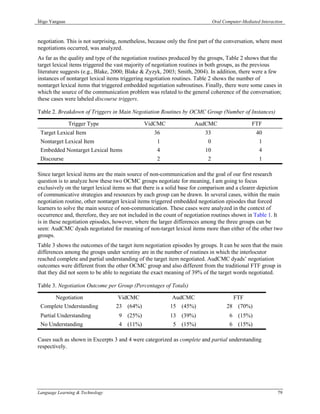
As far as the quality and type of the negotiation routines produced by the groups, Table 2 shows that the
target lexical items triggered the vast majority of negotiation routines in both groups, as the previous
literature suggests (e.g., Blake, 2000; Blake & Zyzyk, 2003; Smith, 2004). In addition, there were a few
instances of nontarget lexical items triggering negotiation routines. Table 2 shows the number of
nontarget lexical items that triggered embedded negotiation subroutines. Finally, there were some cases in
which the source of the communication problem was related to the general coherence of the conversation;
these cases were labeled discourse triggers.

Table 2. Breakdown of Triggers in Main Negotiation Routines by OCMC Group (Number of Instances)

                Trigger Type                   VidCMC                AudCMC                       FTF
 Target Lexical Item                               36                     33                        40
 Nontarget Lexical Item                              1                     0                         1
 Embedded Nontarget Lexical Items                    4                    10                         4
 Discourse                                           2                     2                         1

Since target lexical items are the main source of non-communication and the goal of our first research
question is to analyze how these two OCMC groups negotiate for meaning, I am going to focus
exclusively on the target lexical items so that there is a solid base for comparison and a clearer depiction
of communicative strategies and resources by each group can be drawn. In several cases, within the main
negotiation routine, other nontarget lexical items triggered embedded negotiation episodes that forced
learners to solve the main source of non-communication. These cases were analyzed in the context of
occurrence and, therefore, they are not included in the count of negotiation routines shown in Table 1. It
is in these negotiation episodes, however, where the larger differences among the three groups can be
seen: AudCMC dyads negotiated for meaning of non-target lexical items more than either of the other two
groups.
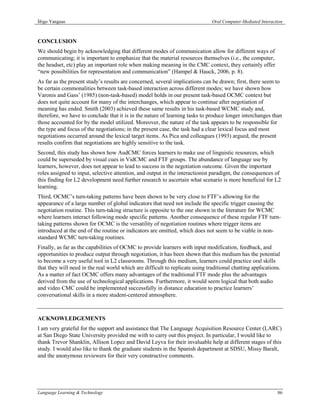
Table 3 shows the outcomes of the target item negotiation episodes by groups. It can be seen that the main
differences among the groups under scrutiny are in the number of routines in which the interlocutor
reached complete and partial understanding of the target item negotiated. AudCMC dyads’ negotiation
outcomes were different from the other OCMC group and also different from the traditional FTF group in
that they did not seem to be able to negotiate the exact meaning of 39% of the target words negotiated.

Table 3. Negotiation Outcome per Group (Percentages of Totals)

        Negotiation                VidCMC                  AudCMC                        FTF
 Complete Understanding           23 (64%)                 15 (45%)                   28 (70%)
 Partial Understanding              9 (25%)                13 (39%)                    6 (15%)
 No Understanding                   4 (11%)                 5 (15%)                    6 (15%)

Cases such as shown in Excerpts 3 and 4 were categorized as complete and partial understanding
respectively.


Language Learning & Technology                                                                                79
Íñigo Yanguas                                                              Oral Computer-Mediated Interaction


    Excerpt 3. Example of Complete Understanding
    B:     creo que um…necesitamos un navaja
           [I think um…we need a Swiss army knife]

    A:     ¿qué es?
           [What is it?]

    B:     es como una…como um…como…
           [It’s like um…like a…um]

    A:     ¿Qué usas para?, ¿usas para qué?
           [What do you use it for?]

    B:     Para cortar cosas o…
           [For cutting stuff]

    A:     ¡Oh! Sí, sí
           [Oh! Yes]

    Excerpt 4. Example of Partial Understanding
    B:     y navaja por 8 dólares
           [And a Swiss army knife for $8]

    A:     ¿navaja?
           [A Swiss army knife?]

    B:     por cocinar
           [For cooking]

    A:     ¡Oh! sí
           [Oh! Yes]

    B:     Para cortar cosas o…
           [For cutting stuff]

    A:     ¡Oh! Sí, sí
           [Oh! Yes]

In Excerpt 3, we can be sure that Student A understood that “navaja” is a cutting utensil, which is the
main use of a Swiss army knife. There are other routines in which learners arrived at a more precise
interpretation of the word “navaja,” but the raters agreed to code cases like the one in Excerpt 3 as
complete understanding reached. On the contrary, Student A in Excerpt 4 interpreted this word as a tool
for cooking in general; we cannot be sure of what this participant had in mind when he or she confirms
understanding.
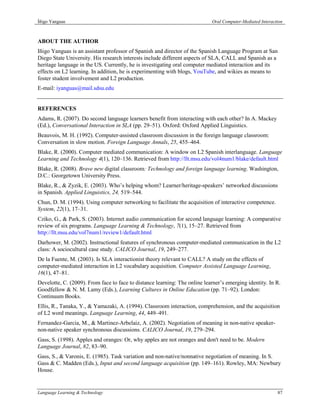
In the following, I explain how dyads achieved these different negotiation outcomes. Table 4 shows the
subcategories of each negotiation phase by group.


Language Learning & Technology                                                                            80
Íñigo Yanguas                                                                 Oral Computer-Mediated Interaction


Table 4. Percentages of Subcategories of Negotiation Phase per Group

      Negotiation Phase                  Subcategory               VidCMC        AudCMC           FTF
 Trigger                         Lexical                            100%          100%           100%
 Indicator <I>                   Omitted                             31%           35%            29%
                                 Global                              41%           39%            44%
                                 Local                               23%           17%            25%
                                 Inferential                          5%            9%             2%
 Response <R>                    Elaboration                         42%           95%            47%
                                 Use of Signs                        55%           N/A            45%
                                 Synonyms                             2%            4%             7%
 Reaction to Response<RR>        Minimal                             48%           52%            50%
                                 Testing Hypotheses                  25%           26%%           21%
                                 Task Appropriate Response           15%           14%            21%
                                 Implicit                            10%            5%             4%

Contrary to WCMC in which turn adjacency conventions are not usually followed (Jepson, 2005), we find
that most negotiation routines by both OCMC groups in this study, as well as the FTF group, adhere to
these conventions and complete the negotiation sequence outlined by Varonis and Gass (1985) as shown
in Excerpt 2. As a consequence, all routines that reached complete or partial understanding in all groups
completed the sequence T – I – R – (RR). There are, nonetheless, a number of cases in which negotiation
routines are completed with one omitted element (<I>). Given the nature of the target items utilized in
this study and the task itself participants assumed their interlocutor did not know the target word and thus
anticipated the response <R>, omitting the indicator <I> as in Excerpt 5.

    Excerpt 5. Example of an Omitted Indicator
    A:     Es muy bien…uh…yo creo que es necesario uh yo creo nos necesitamos los es car pin es,
           unos escarpines <T>, (<I>) es como los zapatos para el agua <R>
           [Very good…uh…I think that It is necessary uh…I think…us… we need a pair of water shoes,
           it’s like shoes for the water]

    B:     ¡Oh! sí sí <RR>
           [Oh yes, yes!]

Since the omission of <I> in the routine did not affect its outcome nor its internal structure, these routines
were categorized as abbreviated routines. These routines reached complete or partial understanding of the
target items in all cases for both OCMC groups. As shown in Table 4, a large percentage of <I> elements
in both OCMC and FTF groups are omitted. The fact that this pattern occurs in all three groups seems to
point to the task and the nature of the target items as possible causes for omitted <I> elements. Varonis
and Gass (1985) included in their classification of indicators what they called non-verbal responses that
could be of use here; they included here silence or mmmm. Some of the cases found in the present study,
such as shown in Excerpt 5, would not seem to fall within this category because the speaker did not wait
for the interlocutor to signal non-understanding and simply continued to define the word. All cases,
however, show that there is a break on the intonation pattern on the trigger that could be taken advantage
of by the interlocutor to gain the floor. Sometimes the interlocutor did not take his or her turn, however,
and the speaker went on with the elaboration presupposing that the interlocutor did not know the word.


Language Learning & Technology                                                                               81
Íñigo Yanguas                                                                  Oral Computer-Mediated Interaction


All other types of <I> found in the transcripts of the conversations carried out by dyads in both OCMC
groups fall within the categories defined by Rost and Ross (1991). These authors distinguished global,
local, and inferential indicators. Global indicators occur when the trigger is not specifically identified, and
local indicators are said to be those that clearly specify the trigger; finally, inferential indicators are used
when interlocutors test their own hypotheses about the meaning of certain lexical items. In the transcripts
of the conversations carried out by all groups in the present study, we found a clear abundance of global
indicators (41% and 39% respectively for OCMC groups and 44% for FTF) that did not specifically
identify the trigger (see Excerpt 6).

    Excerpt 6. Example of a Global Indicator
    B:     Um…también…uh…necesita o necesitamos una brújula <T>
           [um..also…needs or we need a compass]

    A:     ¿Qué es eso? <I>
           [What is that?]

    B:     para cuando nosotros no sabemos el dirección <R>
           [For when we don’t know what direction to take]

    A:     sí <RR>
           [Yes]

Looking at Table 4, it seems clear that the larger difference among groups is the types of response given
by speakers. Very interestingly, these responses are perhaps the most vital element in the negotiation
routines because, on the one hand, they include the feedback provided to the interlocutor to fix the
communication problem and, on the other, they are pushed output on the part of the speaker. These are
the main premises of the interaction hypothesis (Long, 1996) and the output hypothesis (Swain, 1995)
respectively. Thus, under either perspective, these responses are key in making this environment ripe for
language acquisition to occur (Blake, 2000). As Table 4 shows, they take the form of elaborations in the
AudCMC group (95%); whereas in the VidCMC and FTF groups, learners made use of both gestures and
elaborations at roughly 50% respectively. Excerpts 7 and 8 illustrate this.

    Excerpt 7. Response <R> Elaborations (AudCMC)
    A:     Un toldo, toldo, cuarenta y cinco dólares
           [Awning, $45]

    B:     ¿qué es?
           [What is it?]

    A:     um…un poquito como un…uh…cuando ir al campo, es parte su casa cuando ir al campo,
           ¿sí?
           [Um… it’s a little like a…when you go camping, it’s part of your home when you camp, yes?]

    B:     ¡oh! Sí
           [Oh! Yes]


Language Learning & Technology                                                                                82
Íñigo Yanguas                                                                Oral Computer-Mediated Interaction


    Excerpt 8. Response <R> Use of Signs (VidCMC)
    A:     y también tengo un toldo
           [And I also have an awning]

    B:     ¿Qué es esto?
           [What is this?]

    A:     es como… [MAKING SIGNS FOR SHELTER]
           [It’s like…]

    B:     ¡oh! como casa
           [Oh! like a house]

    A:     sí
           [Yes]

It seems that the impossibility of using visual cues in the AudCMC dyad pushed Student A to elaborate
on the lexical item that caused the non-communication. On the contrary, Student A in the VidCMC group
used signs to tackle the communication problem. In both cases, the result is the same but in terms of both
output and linguistic input the scenario in Excerpt 8 does not seem to be ideal for L2 learning. Inevitably,
elaborations made routines longer, which in several cases included other lexical items (see Table 2) that
triggered embedded negotiation routines fertilizing, using Blake’s (2000) metaphor, even more the
grounds for L2 development to occur.
However, these more linguistically elaborated responses had negative consequences, namely, they
translated into a higher percentage of partially understood target lexical items, as shown in Table 3. The
question is then what is more important for L2 acquisition, to linguistically elaborate on the item
augmenting the possibility of non-communication to occur, or to fully and unequivocally understanding
the concept being focused on as a source of non-communication? In an interactionist context such as ours,
it seems that the most logical answer would be the former rather than the latter but more research is
needed to properly address this question.
As aforementioned, very few studies to date (Lee, 2007; Jepson, 2005; Sykes, 2005) have included
synchronous OCMC in their research designs. However, these studies’ results are difficult to bring into
our present discussion because their goals and research designs were entirely different from the present
study’s design. Jepson (2005) found, on the one hand, that the voice chat group outperformed the written
chat group in number of repair moves. On the other hand, he found that most of these moves were
pronunciation related. Our results show that the AudCMC group used more elaborated responses to try to
solve the non-communication episode but none of them were pronunciation related. Undoubtedly, this
could be attributable to the type of non-task-based activity that learners were carrying out in Jepson’s
study. In turn, Lee (2007) used task-based activities but she analyzed L1/L2 learner dyads, and her focus
was on their perceptions toward the medium rather than on the quality and type of conversations they
carried out. Finally, Sykes (2005) found no difference between oral CMC, written CMC, and FTF in
pragmatic acquisition but did find that the WCMC group used a more complex and varied set of strategies.
This study is very relevant due to its focus on pragmatic aspects of SLA, but not pertinent for our present
purposes.
In regards to our second research question, which compares the present results with past results for
WCMC, let us begin by saying that WCMC has been hailed as a hybrid mode of communication because
it has some of the characteristics of oral speech. To support this, it has been argued that in synchronous
WCMC participants converse in real time and, therefore, might have the possibility of benefiting from


Language Learning & Technology                                                                              83
Íñigo Yanguas                                                                 Oral Computer-Mediated Interaction


interacting and negotiating meaning as FTF speakers do. As a matter of fact, Sotillo (2000) found that
interactional modifications in WCMC were similar to those occurring in FTF interaction. As a counter
argument, it has been claimed that FTF and synchronous WCMC conversations clearly differ in the
discourse sequence (Jepson, 2005). Along these lines, Smith (2003) stated that turn adjacency is complex
in the WCMC mode and, as such, some of the negotiations and repair moves that occur in the
conversations are related to these complexities.
On the contrary, the present results show that turn adjacency in synchronous oral CMC resembles the one
occurring in FTF communication and, consequently, it is opposed to what has been found for WCMC.
Both OCMC modes, audio- and video-conferencing, display turn-taking patterns similar to the traditional
FTF version. In fact, the main difference among the three modes investigated in the present study seems
to be the inability of the AudCMC participants to resort to signs, thus being bound to find a resolution to
the non-communication problem by linguistic means, which translated into a higher number of
elaboration responses. In this sense, WCMC and OCMC could be argued to be comparable, given that
written chat tends to produce more complex language than FTF (Payne & Whitney, 2002). Otherwise, it
can be argued that both OCMC modes are much closer to FTF than WCMC has been in the past research;
as a matter of fact, no qualitative differences have been found between VidCMC and FTF in the present
study. WCMC has been said to display more equal patterns of participation (Kelm, 1992), AudCMC
would have to be further investigated on this issue but it would seem logical that students felt at ease and,
therefore, participate more in the tasks in this mode because they still remain anonymous behind the
computer’s screen.
In terms of the components of the negotiation routines, in particular, indicators, it has been shown above
that most were of a global nature (39%–44%) and many (29%–35%) were omitted. We explained the
latter by looking at the low frequency of the target lexical items and the nature of the task, but the former
clearly contrasts with results from WCMC studies such as Smith (2003) and Fernandez-García and
Martínez-Arbelaiz (2002) who found that most indicators were local. This can be interpreted by
considering turn adjacency conventions in both CMC modes; as discussed above, when chatting, these
conventions are not easy to follow and interlocutors may feel the need to specifically refer to the item that
is creating the communication problem. On the contrary, oral CMC follows these conventions as
traditional FTF would, and it seems that participants were aware of what caused the communication
problem. This argument, however, would go against Smith’s (2003) explanation for the use of local
indicators in his study: “…due to the absence of nonlinguistic cues” (Smith, 2003, p. 47), since global
indicators also appear in the AudCMC.
Another significant consequence of OCMC conventional turn adjacency is the low occurrence of
interrupted or split negotiation routines that are very common in WCMC (Smith, 2003). Participants in
this study for the most part finished the negotiation routine they were engaged in before starting a new
one. We did find, however, several cases of reversed routines where the target <T> is introduced at the
end of the routine, as in Excerpt 9.

    Excerpt 9. Reversed Routine
    A:     tengo un um… uh…unos zapatos de mar
           [I have some water shoes]

    B:     ¿es negro? ¿es para hacer surf cuando es frío?
           [Are they black? Are they used for surfing when it’s cold]

    A:     sí
           [Yes]


Language Learning & Technology                                                                               84
Íñigo Yanguas                                                                 Oral Computer-Mediated Interaction


    B:     ok
           [Ok]

    A:     dice unos escarpines
           [They are called escarpines]

We can see how all the functional elements of the negotiation routine are present, but Student A
introduces what really caused the negotiation at the end. This leads us to conclude that the interlocutor
assumed that his or her partner did not know the target item and began by giving a synonym to start the
negotiation. It was only when Student A was sure that Student B had understood the concept that the
target item was introduced. This type of routine is parallel to the omission of the indicator <I> discussed
above, given that both are a consequence of the speaker assuming that the interlocutor did not know the
target word. Both strategies are facilitated by the fact that all groups in this study followed turn adjacency
conventions, as mentioned above.
Regarding the optional component of the conversation routines, reaction to response <RR>, Table 4
shows no large differences among groups. The present results are in accord with other task-based CMC
studies that have found the greater percentage of these turns are minimal responses (Smith, 2003). These
responses are typically short, explicit statements of understanding after a response to the non-
communication problem has been given. Examples of these can be seen in Excerpts 7, 8, and 9. Smith
(2003) also distinguished what he called task appropriate responses (TAR) in task-based synchronous
WCMC; examples of these were also found in the transcriptions of the conversations in the present study
(see Table 4). In many cases, minimal reactions to responses were followed by comments that had to do
with the development of the task by either learner or both. Most of the time, learners remarked how useful
the items were to attain the goal of the task or how much they cost. For example, see the following
interchange between an AudCMC dyad after they have resolved the negotiation routine around navaja
(Swiss army knife)

    Excerpt 10. Example of Task Appropriate Response <TAR>
    A:     ¿y cuánto cuesta? <TAR>
           [And how much is it?]

    B:     cuesta 8 dólares
           [It costs $8]

    A:     solamente 8 ¡bien!
           [Just 8, great!]

This interchange takes place after learners have resolved the non-communication problem. Student A
gives a reaction to response that implicitly signals understanding of the concept being negotiated by
asking about the price. Then, two more turns are added to the reaction to response phase that are related to
the value of the item for the task at hand. The present data reveals that examples like these are very
common in both the OCMC and FTF groups; learners tend to carry out the conversations past the reaction
to response stage showing a deep involvement in the task. This has also been shown in task-based CMC
studies such as Smith (2003), where Varonis and Gass’ (1985) model has been proven to be a valid basic
tool to analyze task-based WCMC conversations but not able to account for several instances in which
participants go past the reaction to response phase. These contrasting results are not surprising because
this earlier study did not include a task in its research design; participants were asked to carry out
informal open conversations. It seems, therefore, that the model should be revised in the light of the
results of these task-based CMC studies.


Language Learning & Technology                                                                               85
Íñigo Yanguas                                                                  Oral Computer-Mediated Interaction


CONCLUSION
We should begin by acknowledging that different modes of communication allow for different ways of
communicating; it is important to emphasize that the material resources themselves (i.e., the computer,
the headset, etc) play an important role when making meaning in the CMC context, they certainly offer
“new possibilities for representation and communication” (Hampel & Hauck, 2006, p. 8).
As far as the present study’s results are concerned, several implications can be drawn; first, there seem to
be certain commonalities between task-based interaction across different modes; we have shown how
Varonis and Gass’ (1985) (non-task-based) model holds in our present task-based OCMC context but
does not quite account for many of the interchanges, which appear to continue after negotiation of
meaning has ended. Smith (2003) achieved these same results in his task-based WCMC study and,
therefore, we have to conclude that it is in the nature of learning tasks to produce longer interchanges than
those accounted for by the model utilized. Moreover, the nature of the task appears to be responsible for
the type and focus of the negotiations; in the present case, the task had a clear lexical focus and most
negotiations occurred around the lexical target items. As Pica and colleagues (1993) argued, the present
results confirm that negotiations are highly sensitive to the task.
Second, this study has shown how AudCMC forces learners to make use of linguistic resources, which
could be superseded by visual cues in VidCMC and FTF groups. The abundance of language use by
learners, however, does not appear to lead to success in the negotiation outcome. Given the important
roles assigned to input, selective attention, and output in the interactionist paradigm, the consequences of
this finding for L2 development need further research to ascertain what scenario is more beneficial for L2
learning.
Third, OCMC’s turn-taking patterns have been shown to be very close to FTF’s allowing for the
appearance of a large number of global indicators that need not include the specific trigger causing the
negotiation routine. This turn-taking structure is opposite to the one shown in the literature for WCMC
where learners interact following mode specific patterns. Another consequence of these regular FTF turn-
taking patterns shown for OCMC is the versatility of negotiation routines where trigger items are
introduced at the end of the routine or indicators are omitted, which does not seem to be viable in non-
standard WCMC turn-taking routines.
Finally, as far as the capabilities of OCMC to provide learners with input modification, feedback, and
opportunities to produce output through negotiation, it has been shown that this medium has the potential
to become a very useful tool in L2 classrooms. Through this medium, learners could practice oral skills
that they will need in the real world which are difficult to replicate using traditional chatting applications.
As a matter of fact OCMC offers many advantages of the traditional FTF mode plus the advantages
derived from the use of technological applications. Furthermore, it would seem logical that both audio
and video CMC could be implemented successfully in distance education to practice learners’
conversational skills in a more student-centered atmosphere.


ACKNOWLEDGEMENTS
I am very grateful for the support and assistance that The Language Acquisition Resource Center (LARC)
at San Diego State University provided me with to carry out this project. In particular, I would like to
thank Trevor Shanklin, Allison Lopez and David Leyva for their invaluable help at different stages of this
study. I would also like to thank the graduate students in the Spanish department at SDSU, Missy Baralt,
and the anonymous reviewers for their very constructive comments.


Language Learning & Technology                                                                                86
Íñigo Yanguas                                                               Oral Computer-Mediated Interaction


ABOUT THE AUTHOR
Iñigo Yanguas is an assistant professor of Spanish and director of the Spanish Language Program at San
Diego State University. His research interests include different aspects of SLA, CALL and Spanish as a
heritage language in the US. Currently, he is investigating oral computer mediated interaction and its
effects on L2 learning. In addition, he is experimenting with blogs, YouTube, and wikies as means to
foster student involvement and L2 production.
E-mail: iyanguas@mail.sdsu.edu


REFERENCES
Adams, R. (2007). Do second language learners benefit from interacting with each other? In A. Mackey
(Ed.), Conversational Interaction in SLA (pp. 29–51). Oxford: Oxford Applied Linguistics.
Beauvois, M. H. (1992). Computer-assisted classroom discussion in the foreign language classroom:
Conversation in slow motion. Foreign Language Annals, 25, 455–464.
Blake, R. (2000). Computer mediated communication: A window on L2 Spanish interlanguage. Language
Learning and Technology 4(1), 120–136. Retrieved from http://llt.msu.edu/vol4num1/blake/default.html
Blake, R. (2008). Brave new digital classroom: Technology and foreign language learning. Washington,
D.C.: Georgetown University Press.
Blake, R., & Zyzik, E. (2003). Who’s helping whom? Learner/heritage-speakers’ networked discussions
in Spanish. Applied Linguistics, 24, 519–544.
Chun, D. M. (1994). Using computer networking to facilitate the acquisition of interactive competence.
System, 22(1), 17–31.
Cziko, G., & Park, S. (2003). Internet audio communication for second language learning: A comparative
review of six programs. Language Learning & Technology, 7(1), 15–27. Retrieved from
http://llt.msu.edu/vol7num1/review1/default.html
Darhower, M. (2002). Instructional features of synchronous computer-mediated communication in the L2
class: A sociocultural case study. CALICO Journal, 19, 249–277.
De la Fuente, M. (2003). Is SLA interactionist theory relevant to CALL? A study on the effects of
computer-mediated interaction in L2 vocabulary acquisition. Computer Assisted Language Learning,
16(1), 47–81.
Develotte, C. (2009). From face to face to distance learning: The online learner’s emerging identity. In R.
Goodfellow & N. M. Lamy (Eds.), Learning Cultures in Online Education (pp. 71–92). London:
Continuum Books.
Ellis, R., Tanaka, Y., & Yamazaki, A. (1994). Classroom interaction, comprehension, and the acquisition
of L2 word meanings. Language Learning, 44, 449–491.
Fernandez-Garcia, M., & Martinez-Arbelaiz, A. (2002). Negotiation of meaning in non-native speaker-
non-native speaker synchronous discussions. CALICO Journal, 19, 279–294.
Gass, S. (1998). Apples and oranges: Or, why apples are not oranges and don't need to be. Modern
Language Journal, 82, 83–90.
Gass, S., & Varonis, E. (1985). Task variation and non-native/nonnative negotiation of meaning. In S.
Gass & C. Madden (Eds.), Input and second language acquisition (pp. 149–161). Rowley, MA: Newbury
House.


Language Learning & Technology                                                                             87
Íñigo Yanguas                                                              Oral Computer-Mediated Interaction


Gass, S., & Varonis, E. (1994). Input, interaction, and second language production. Studies in Second
Language Acquisition, 16, 283–302.
Godwin-Jones, R. (Ed.). (2005). Language Learning & Technology, 9(3), 9–12. Retrieved from
http://llt.msu.edu/vol9num3/emerging/default.html
Hampel, R. (2006). Rethinking task design for the digital age: A framework for language teaching and
learning in a synchronous online environment. ReCALL, 18(1), 105–121.
Hampel, R., & Hauck, M. (2004). Towards an effective use of audio conferencing in distance language
courses. Language, Learning & Technology, 8(1). 66–82. Retrieved from
http://llt.msu.edu/vol8num1/hampel/default.html
Hampel, R., & Hauck, M. (2006). Computer-mediated language learning: Making meaning in multimodal
virtual learning spaces. JALT-CALL Journal, 2(2), 3–18.
Jepson, K. (2005). Conversations–and negotiated interaction–in text and voice chat rooms. Language
Learning & Technology, 9(3), 79–98. Retrieved from http://llt.msu.edu/vol9num3/jepson/default.html
Kelm, O. (1992). The use of synchronous computer networks in second language instruction: A
preliminary report. Foreign Language Annals, 25, 441–454.
Kern, R. (1995). Restructuring classroom interaction with networked computers: Effects on quantity and
characteristics of language production. Modern Language Journal, 79, 457–476.
Lamy, M. N. (2004). Oral conversations online: Redefining oral competence in synchronous environment.
ReCALL, 16(2), 520–538.
Lee, L. (2007). Fostering second language oral communication through constructivist interaction in
desktop videoconferencing. Foreign Language Annals, 40(4), 635–649.
Levy, M. & Stockwell, G. (2006). CALL dimensions: Options and issues in computer-assisted language
learning. Mahwah, NJ: Routledge.
Long, M. (1983). Native speaker/non-native speaker conversations in the second language classroom. In
M. A. Clarke & J. Handscombe (Eds.), On TESOL ’82 (pp. 207–225). Washington, DC: TESOL.
Long, M. (1985). Input and second language acquisition theory. In S. Gass & C. Madden (Eds.), Input
and second language acquisition (pp. 377–393). Rowley, MA: Newbury House.
Long, M. H. (1996). The role of the linguistic environment in second language acquisition. In W. Ritchie
& T. Bhatia (Eds.), Handbook of second language acquisition (pp. 413–468). San Diego, CA: Academic
Press.
Loschky, L. (1994). Comprehensible input and second language acquisition: What is the relationship?
Studies in Second Language Acquisition, 19, 37–66.
Mackey, A. (1999). Input, interaction, and second language development: An empirical study of input,
interaction, and second language development. Studies in Second Language Acquisition, 21, 557–588.
McCracken, G. (1988). The Long Interview (12th Ed.). Newbury Park, CA: Sage Publications.
Meskill, C. and Anthony, N. (2005). Foreign language learning with CMC: Forms of online instructional
discourse in a hybrid Russian Class. System, 33(1), 89–105.
Negretti, R. (1999). Web-based activities and SLA: A conversation analysis research approach. Language
Learning & Technology, 3(1), 75–87. Retrieved from http://llt.msu.edu/vol3num1/negretti


Language Learning & Technology                                                                            88
Íñigo Yanguas                                                               Oral Computer-Mediated Interaction


Payne, J. S., & Ross, B. (2005). Synchronous CMC, working memory, and L2 oral proficiency
development. Language Learning & Technology, 9(3), 34–54. Retrieved from
http://llt.msu.edu/vol9num3/payne/default.html
Payne, J. S., & Whitney, P. J. (2002). Developing L2 oral proficiency through synchronous CMC: Output,
working memory, and interlanguage development. CALICO Journal, 20(1), 7–32.
Pellettieri, J., (2000). Negotiation in cyberspace: The role of chatting in the development of grammatical
competence. In M. Warschauer & R. Kern. (Eds.), Network-based Language Teaching: Concepts and
Practices (pp. 59–86). New York: Cambridge University Press.
Pérez, L. C. (2003). Foreign language productivity in synchronous versus asynchronous computer-
mediated communication. CALICO Journal, 21(1), 89–104.
Pica, T. (1994). Research on negotiation: What does it reveal about second-language learning conditions,
processes, and outcomes? Language Learning, 44, 493–527.
Pica, T., Holliday, L., Lewis, N., Berducci, D., & Newman, J. (1991). Language learning through
interaction: What role does gender play? Studies in Second Language Acquisition, 13, 343–372.
Pica, T., Kanagy, R., & Falodun, J. (1993). Choosing and using communication tasks for second language
research and instruction. In G. Crookes & S. Gass (Eds.), Tasks and second language learning (pp. 9–34).
Clevedon, UK: Multilingual Matters.
Roed, J. (2003). Language Learner Behaviour in a Virtual Environment. Computer Assisted Language
Learning: An International Journal, 16(2-3), 155–72.
Rosell-Aguilar, F. (2005). Task design for audiographic conferencing: Promoting beginner oral
interaction in distance language learning. Computer Assisted Language Learning, 18(5), 417-442.
Rost, M., & Ross, S. (1991). Learner use of strategies in interaction: Typology and teachability.
Language Learning, 41, 231–249.
Sachs, R. & Suh, B. R. (2007). Textually Enhanced Recasts, Learner Awareness, and L2 Outcomes in
Synchronous Computer-Mediated Interaction. In A. Mackey (Ed.), Conversational Interaction and
Second Language Acquisition: A Series of Empirical Studies (pp. 197–227). Oxford: Oxford University
Press.
Sato, C. (1986). Conversation and interlanguage development: Rethinking the connection. In R. Day (Ed.),
Talking to learn: Conversation in second language acquisition (pp. 2–45). Rowley, MA: Newbury House.
Schmidt, R. (1990). The Role of Consciousness in Second Language Learning. Applied Linguistics, 11(2),
129–158.
Sengupta, S. (2001). Exchanging ideas with peers in network-based classrooms: An aid or a pain?
Language Learning & Technology, 5(1), 103–134. Retrieved from
http://llt.msu.edu/vol5num1/sengupta/default.html
Shekary, M. & Tahririan, M. H. (2006). Negotiation of meaning and noticing in text-based online chat.
The Modern Language Journal, 90(4), 557–573.
Shin, D. (2006). ESL students’ computer-mediated communication practices: Context configuration.
Language Learning & Technology, 10(3), 65–84. Retrieved from http://llt.msu.edu/vol10num3/shin/default.html
Smith, B. (2003). Computer-mediated negotiated interaction: An expanded model. The Modern Language
Journal, 87(1), 38–57.
Smith, B. (2004). Computer-mediated negotiated interaction and lexical acquisition. Studies in Second
Language Acquisition, 26, 365–398.


Language Learning & Technology                                                                             89
Íñigo Yanguas                                                              Oral Computer-Mediated Interaction


Smith, B. (2005). English language learning and technology: Lectures on applied linguistics in the age of
information and communication technology. Modern Language Journal, 89(4), 647–648.
Sotillo, S. (2000). Discourse functions and syntactic complexity in synchronous and asynchronous
communication. Language Learning & Technology, 4(1), 82–119. Retrieved from
http://llt.msu.edu/vol4num1/sotillo/default.html
Swain, M. (1985) Communicative competence: Some roles of comprehensible input and comprehensible
output in its development. In S. Gass & C. Madden (Eds.), Input in Second Language Acquisition (pp.
235–256). New York: Newbury House.
Swain, M. (1995) Three functions of output in second language learning. In G. Cook & B. Seidelhofer
(Eds.), Principle and practice in applied linguistics: Studies in honor of H.G. Widdowson (pp. 125–144).
Oxford: Oxford University Press.
Sykes, J. (2005). Synchronous CMC and pragmatic development: Effects of oral and written chat.
CALICO Journal, 22(3), 399–431.
Toyoda, E. & Harrison, R. (2002). Categorization of text chat communication between learners and native
speakers and native speakers of Japanese. Language Learning & Technology, 6(1), 82–99. Retrieved from
http://llt.msu.edu/vol6num1/toyoda/default.html
Tudini, V. (2003). Using native speakers in chat. Language Learning & Technology 7(3), 141–159.
Retrieved from http://llt.msu.edu/vol7num3/tudini/default.html
Varonis, E., & Gass, S. (1985). Non-native / non-native conversations: A model for negotiation of
meaning. Applied Linguistics, 6, 71–90.
Warner, C. N. (2004). It’s just a game, right? Types of play in foreign language CMC. Language
Learning & Technology 8(2), 69–87. Retrieved from http://llt.msu.edu/vol8num2/warner/default.html
Yates, S. J. (1996). Oral and written aspects of computer conferencing. In S. C. Herring (Ed.),
Computermediated communication: Linguistic social and crosscultural perspectives (pp. 29–46).
Philadelphia: John Benjamins.
Xie, T. (2002). Using Internet relay chat in teaching Chinese. CALICO Journal 19(3), 513-524.


Language Learning & Technology                                                                            90
Íñigo Yanguas                                                                Oral Computer-Mediated Interaction


APPENDIX A. Jigsaw Task Instructions
The Amazing Race


Congratulations! You have been selected to represent your school in the college version of “The Amazing
Race.” You and a partner will be traveling through Central and South America competing against 30
other teams. You have a big advantage because you are one of the few teams that speak Spanish, so you
are certain to receive help from the locals. You know that you will be in the rainforest and close to water
for much of the time. You will also be responsible for creating your own shelter. It will be a tremendous
test of your survival skills.


Before you leave on the race you receive a list of 8 very necessary items for the race. Your instructions
are the following:
You have one backpack between the two of you a budget of $120.00 total. In order to qualify for the race
and claim the million-dollar prize, you and your partner must select 4 items each (8 total) from your lists
to fill your backpack. You MUST choose at least 1 item that will allow you to survive in the water and the
items necessary to build a shelter. Remember the 8 items MUST NOT cost more than $120 total.
Using Skype discuss with your partner which items seem most necessary for your adventure and fit
within your budget and guidelines. Your success on this task will depend on how well you chose your
items based on the instructions.


Good Luck!


Language Learning & Technology                                                                              91
Íñigo Yanguas                                        Oral Computer-Mediated Interaction


APPENDIX B. Lexical items for Student A


                 (UNA) SOGA $20            (UN) SILBATO $5


                (UN) NECESER $18            (UN) TOLDO $45


                (UNA) BRÚJULA $8          (UNA) RIÑONERA $10


         (UNOS) ESCARPINES $27              (UNA) CAÑA $12


Language Learning & Technology                                                      92
Íñigo Yanguas                                          Oral Computer-Mediated Interaction


APPENDIX C. Lexical items for Student B


                ESTERILLA $20                  MALLA $40


          (UNOS) MANGUITOS $15            (UNOS) IMPERDIBLES $3


       (UNOS) MOSQUETONES $15             (UNA) FIAMBRERA $14


            (UNA) BENGALA $17                (UNA) NAVAJA $8


Language Learning & Technology                                                        93

Oral computer mediated interaction

  • 1.
    Language Learning &Technology October 2010, Volume 14, Number 3 http://llt.msu.edu/vol14num3/yanguas.pdf pp. 72–93 ORAL COMPUTER-MEDIATED INTERACTION BETWEEN L2 LEARNERS: IT’S ABOUT TIME! Íñigo Yanguas San Diego State University This study explores task-based, synchronous oral computer-mediated communication (CMC) among intermediate-level learners of Spanish. In particular, this paper examines (a) how learners in video and audio CMC groups negotiate for meaning during task-based interaction, (b) possible differences between both oral CMC modes and traditional face-to- face (FTF) communication, and (c) how this oral computer mediated negotiation compares to that found in the text-based CMC literature. Fifteen learner-to-learner dyads were randomly assigned to an audio group, a video group, and a FTF control group to complete a jigsaw task that was seeded with 16 unknown lexical items. Experimental groups used Skype, free online communication software, to carry out the task. The transcripts of the conversations reveal that oral CMC groups do indeed negotiate for meaning in this multimedia context when non-understanding occurs between speakers. In addition, results showed differences in the way audio and video groups carry out these negotiations, which were mainly due to the lack of visual contact in the audio group. No differences were found between video and FTF groups. Furthermore, oral CMC turn-taking patterns were shown to be very similar to FTF patterns but opposite to those found in written synchronous CMC. Oral CMC interaction patterns are shown to be more versatile. INTRODUCTION Research investigating computer-mediated communication (CMC) in the context of second language acquisition (SLA) has proliferated since the early 1990s. Several scholars at that time embarked on investigations that assessed second language (L2) learners’ interactions using local networked computers and the Daedalus interchange software (e.g., Beauvois, 1992; Chun, 1994; Kelm, 1992; Kern, 1995). Since then and after the appearance of several Web-based chat programs such as Yahoo and MSN Messenger, several studies have been published investigating various aspects of CMC such as teacher strategies (Meskill & Anthony, 2005), socialization (Sengupta, 2001; Shin, 2006), individual differences (Payne & Ross, 2005), or studies that compared synchronous versus asynchronous CMC (Pérez, 2003; Sotillo, 2000). However, the bulk of research has investigated CMC under an interactionist perspective (Blake, 2000; Darhower, 2002; Fernández-García & Martínez-Arbelaiz, 2002; Negretti, 1999; Pellettieri, 2000; Smith, 2003; Toyoda & Harrison, 2002; Tudini, 2003; Warner, 2004; Xie, 2002). Not only do these studies deserve a special mention for their numbers but also for their efforts to connect this strand of Computer- Assisted Language Learning (CALL) with the SLA field by utilizing the Interaction Hypothesis (Long, 1996) as theoretical framework. This hypothesis associates input, attention, and output through negotiation in meaningful and productive ways and has been widely investigated in the SLA field. Studies have used different types of tasks and activities that promote interaction and have shown that negotiation of meaning in these learner-to-learner interactions does indeed occur (Ellis, Tanaka, & Yamazaki, 1994; Gass, 1998; Gass & Varonis, 1985; Long, 1983; 1985; Loschky, 1994; Mackey, 1999; Pica, 1994; Pica, Holliday, Lewis, Berducci, & Newman, 1991). Even if evidence that interactive negotiation leads to language acquisition is not conclusive, it is widely believed by the SLA community that this type of interaction among L2 learners is beneficial for L2 development (Smith, 2004). Less fruitful, at least in terms of quantity, has been research investigating a more direct link between CMC interaction and SLA (De la Fuente, 2003; Sachs & Suh, 2007; Shekary & Tahririan, 2006; Smith, Copyright © 2010, ISSN 1094-3501 72
  • 2.
    Íñigo Yanguas Oral Computer-Mediated Interaction 2004, 2005). Far from being conclusive, results from some of these studies seem to suggest that lexical items trigger more negotiation episodes than any other aspect of conversation (Blake, 2000; Blake & Zyzik, 2003; Toyoda & Harrison, 2002) and, therefore, are most likely to be learned. For instance, Smith (2004) found positive effects for CMC negotiated interaction on lexical acquisition. Along the same lines, De la Fuente found that text-based CMC was as effective as face-to-face (FTF) interaction in promoting written receptive and productive learning of the target words. Interestingly, results for oral acquisition were not quite the same and she concluded “text-based CMC negotiated interaction may not be the best answer for development of productive, oral skills” (p.74). However, there are studies that have shown that interacting in a chatroom environment can foster oral skills (Payne & Whitney, 2002). As all these investigations show, much research in the CMC strand of research has focused on written communication, whether synchronous or asynchronous. In the oral CMC realm, Cziko and Park (2003) reviewed six free Web-based programs that allowed video and/or voice communication over the Internet. They claimed that recent advances in programming, computer speed, and Internet bandwidth had facilitated the possibility of free real-time communication through video-conferencing and its application in the L2 classroom. Three years later, Levy and Stockwell (2006) stated that the spread of broadband technologies and lower prices for both software and hardware made audio- and video-conferencing affordable for most institutions. At the turn of the decade, technological advances have taken on a new dimension making the present time, when laptops come equipped with cameras and microphones and fast broadband Internet networks are common on many campuses, even more favorable for investigating and implementing oral computer-mediated-communication (OCMC) in the L2 classroom. Traditional free Internet chatting programs now have, in addition to chatting capabilities, appropriate audio and video quality, and they are widely used. Furthermore, some electronic mail providers such as Gmail have recently included video-conferencing capabilities that provide high quality pictures easily from your inbox. Skype, a relatively new program that has been based in Luxembourg since 2003, is a program with high picture and sound quality. Godwin-Jones (2005) claimed that in comparison to programs such as Paltalk, Skype generally offers better quality and poses less compatibility issues than other programs. On Skype’s Website (http://about.skype.com/), it is noted that in the third quarter of 2009, Skype users made almost 28 billion Skype-to-Skype calls, more than three quarters of which were video calls. As a matter of fact, we have used Skype at a large public university to foster speaking practice in the L2 since 2007, and can confirm that, contrary to Hampel and Hauck (2004), the effective implementation of video- and audio-conferencing in the L2 classroom, given the appropriate technological infrastructure, is not such a complex endeavor. However, we agree with Blake (2008) who claimed that any technological tool is inherently neutral, and that successful CMC will depend on careful planning on the part of the instructor or researcher. Synchronous written computer-mediated communication (WCMC) has been labeled as a hybrid mode because it exhibits features of both written and spoken language (Roed, 2003; Smith 2005; Yates, 1996) and as such has been capitalized on by practitioners in the L2 classroom. Overall, research has shown that WCMC poses similar benefits to traditional FTF interaction (Blake, 2000) because of the real time interaction in which learners negotiate meaning, modify input and output, and respond to feedback. Written CMC has been argued to have advantages over FTF because learners amplify their attention to form, produce a larger quantity of better output, and feel less threatened (Smith, 2004; Blake, 2008). Nevertheless, this hybrid mode is different from FTF as WCMC is a non-visual mode of communication where visual cues, which are key in understanding and interpreting spoken messages in the real world, are not available to the speakers (besides emoticons). It is therefore necessary to practice and foster communicative habits that can provide learners with the right tools to effectively communicate orally be it with other L2 learners or with native speakers in the outside world. In its video version OCMC offers the possibility of incorporating visual communication clues, but research needs to be conducted to assess the potential benefits of negotiated interaction for the L2 learner using this mode of communication. Language Learning & Technology 73
  • 3.
    Íñigo Yanguas Oral Computer-Mediated Interaction As Blake (2008) pointed out, research into audio- and video-conferencing has been predominantly in the area of distance language education (e.g., Develotte, 2009; Lamy, 2004; Rosell-Aguilar, 2005). In fact, very few studies (some exceptions are, Lee, 2007; Jepson, 2005; Sykes, 2005) have investigated synchronous OCMC in the classroom as a means to develop L2 proficiency. These researchers investigating OCMC, however, have taken very different perspectives and have used entirely different research designs making it very difficult to draw any general conclusions. For example, Jepson (2005) compared the patterns of repair moves in text chat rooms and in voice chat rooms on the Internet; specifically, he was interested in the types of repair moves that each group used.. Participants in Jepson’s study were students of English as a foreign language at an online school where they were enrolled. Jepson used Long (1983, 1996) to operationalize and count repair moves according to two categories: Negotiation of Meaning and Negative Feedback. Results showed that a significantly higher number of repair moves were made in voice chats than in text chats. Additionally, qualitative analyses indicated that most repair moves in these voice chats were pronunciation related. In turn, Sykes (2005) examined the effects of three types of synchronous group discussion in the acquisition of a speech act (refusal of an invitation) in the L2. She found that no group outperformed another in pragmatic acquisition, but she also found that the synchronous written chat group outperformed the other two in complexity and variety of strategies used. Finally, Lee (2007) investigated L1-L2 dyads in task-based video-conferencing from a qualitative perspective. She carried out interviews to examine participants’ experiences and insights into video-conferencing as a tool to foster speaking skills. She concluded that it was essential to use a well- designed and motivating task, to carefully select the linguistic context, and to provide students with training in video-conferencing. Results from these three studies are revealing; they serve as a starting point on which to build our knowledge of how OCMC promotes the L2 acquisition process. There are, however, many unanswered questions related to the implementation of OCMC in the classroom and its effects on L2 development; the present study seeks to provide insight to some of these questions. In particular, this task-based study compares two different versions of OCMC (video-conference and voice-conference) and a control FTF group on the communicative outcomes of a learning task. In addition, it seeks to compare results for both the OCMC groups with what has been found in the previous interactionist literature for WCMC. In order to achieve these goals, participants in this study interacted in the L2 in an effort to solve a learning task for which they were randomly placed in two experimental conditions (VidCMC and AudCMC) and a control group (FTF). To my knowledge, the current CMC study is the first work to use Skype, a free widely used Internet application, to investigate L2 negotiated interaction in CALL. Negotiation of Meaning in Task-Based Learner-to-Learner OCMC As most of the studies discussed above, the present investigation was carried out under an interactionist perspective. Long’s (1996) Interaction Hypothesis suggests that learners engaging in conversation will create an ideal situation for L2 learning when some misunderstanding arises and the speaker and interlocutor negotiate for meaning. Interlocutors may modify their speech using several mechanisms such as: modifications, recasts, repetitions, elaborations, etc. When this adjustment is made, attention (Schmidt, 1990) is drawn to the part of the input that has not been understood by the learner thus optimizing the opportunity for learning to occur. Furthermore, learners will modify their output in the L2 to adapt it to the negotiated form reaping the benefits attributed to this process by Swain (1985, 1995). These benefits include the use of the learners’ linguistic resources in the L2 and the opportunity to test hypotheses about the target language while syntactically processing it. Though it cannot be claimed that negotiation of meaning directly causes SLA, this interactionist stance has countless followers in the field because this negotiation “creates a fertile environment for SLA to occur” (Blake, 2000, p. 121). The benefits of interacting in the L2 have been shown for traditional L1 - L2 learner (e.g., Long, 1983) and L2 learner/L2 learner FTF interactions (e.g., Gass & Varonis, 1994) and, as discussed above, in networked text-based interactions (e.g., Smith, 2003). The present study adds a Language Learning & Technology 74
  • 4.
    Íñigo Yanguas Oral Computer-Mediated Interaction new context to the investigation of negotiated interaction by exploring how L2 learner/L2 learner dyads interact using audio- and video-conferencing. The way learners interact among them is different from the way learners and L1 speakers interact, and more research is needed to ascertain what consequences this type of interaction has on the learning process (Adams, 2007). If any benefits for L2 acquisition were to be attributed to learner-to-learner interactions, they could be reaped in the L2 classroom. In addition, investigations of non-text-based CMC are due at a time when technological resources, both hardware and software applications, are becoming more available and this mode of communication has gone widely underesearched. Research Questions The present study seeks answers to the following research questions: 1. (a) How do learners in video and audio CMC groups negotiate for meaning during task-based interaction? (b) Are there any differences between oral CMC and traditional FTF communication? 2. How do these negotiation routines compare to those found in the text-based CMC negotiation literature? METHOD Participants Conversations from 15 dyads of Spanish L2 learners were recorded and qualitatively analyzed to find an answer to this study’s research questions. One intact class of third semester Spanish, enrolled in a large public university in Southern California, participated in this investigation. Based on a pretreatment background questionnaire, learners were determined to have taken an average of almost two Spanish college classes, ranging from one to four classes (M = 1.9, SD = .90). Procedure Participants met in a language lab as part of their regular class syllabus, and they were randomly assigned to one of the following three interaction groups: video-conferencing (VidCMC), audio-conferencing (AudCMC), and face-to-face (FTF). They were assigned to a numbered computer station where they listened to a recording explaining the procedure for this lab session; each computer station was also labeled with the names of the group they belonged to (VidCMC, AudCMC, FTF). Once they finished listening to the recording, they read and signed the participant consent form. Immediately after, the researcher checked that participants understood the procedure and answered any questions learners had at that point. Given that Skype was widely used in Spanish classes at the host institution, participants only had questions about the task and how to record their conversation. After all questions were answered and assessment tasks administered, participants signed into Skype and called their assigned partners. Dyads for the FTF control group were seated together and computer microphones were used to record their conversations. The groups of VidCMC and AudCMC dyads were seated far apart from each other in the computer lab and used headsets to carry out their conversations. The lab was set up so that learners could not easily see each other’s screens or talk with one another. Specifically, each computer station was equipped with a privacy guard on either side of the station. This guard was removed for FTF dyads and their chairs were set to face each other. Once all the CMC dyads had established and tested their Skype connection, they were instructed to begin the task. Time was limited to 20 minutes; this time was set based on the previous piloting of the task with an intact class of third semester Spanish where most dyads finished within this time frame. Participants then completed the post-task assessment tasks. Task Each group completed a jigsaw style task (see Appendix A for instructions). Pica, Kanagy, and Falodun (1993), in one of the most widely cited works on task typology, argued that jigsaw and information-gap tasks promoted the most negotiation. In particular, jigsaw tasks are those tasks that force learners to Language Learning & Technology 75
  • 5.
    Íñigo Yanguas Oral Computer-Mediated Interaction equally share their (different) information to achieve a particular goal. Extensively used in the literature (e.g., Blake, 2000; Smith, 2003, 2004), this type of two-way task adheres to what Pica and her colleagues cited as the most recurrent characteristics of tasks discussed in the literature: first, they should be oriented toward goals; second, participants are expect to take on active roles in carrying out the task. Furthermore, as advocated by Hampel (2006) in her discussion of a framework for the development of tasks in a synchronous online environment, the task used in the present study is “genuinely interactive and student- centered” (p. 119). In addition, we utilized a task in this study that had a connection to the real world; The Amazing Race is a reality television game show in which a team of two people race around the world in competition with other teams. Based on this popular award-winning game show, the task used in this study, also called The Amazing Race, required participants to interact in pairs to prepare for a race in Latin America. Before they embarked on the trip, they had to decide on which items they would take with them with a limited $120 budget. Each participant was given a list with eight objects including pictures and prices (see Appendices A and B) of which they had to choose four items each to be carried in a shared backpack. Similar to the piloting stage of the task development, the originality of the task used in this study engaged and motivated participants to carry it out successfully. Since it appears that lexical items are negotiated most frequently (Sato, 1986; Pica, 1994) if the task is not structure-focused (Blake & Zyzyk, 2003), this task was seeded with low frequency, unknown lexical items (objects). Each participant (Student A and Student B) received eight different target lexical items (see Appendices B and C). As suggested in the literature (see Smith, 2003), these items were selected based on the results of a pretest that was administered two weeks before to a randomly chosen third semester class in which 25 items were included. The sixteen less known items were selected for inclusion in the task, none of these items were known by more than three students in the class. ANALYSIS The model put forth by Varonis and Gass (1985) was utilized to identify and analyze the negotiation routines found in the transcriptions of the conversations carried out by the 15 L2 learner/L2 learner conversational dyads that participated in this investigation. Widely used both in the traditional interactionist literature and in the CMC literature (e.g., Blake, 2000; Fernández-García & Martínez- Arbelaiz, 2002; Gass & Varonis, 1994; and Smith, 2003), this model for negotiation of meaning among L2 learners proposes four functional primes and two different parts: a trigger (T), and then a resolution composed of an indicator (I), a response (R), and a reaction to the response (RR). The trigger (T) or source of non-understanding generates a resolution, which starts with an acknowledgement of the communication problem or indicator (I). The response (R) then tries to solve the problem; the last functional prime is an optional element in this model, a reaction to the solution given or reaction to the response (RR) that might or might not take place. In Varonis and Gass (1985) terms, the horizontal flow of conversation is interrupted when the indicator (I) occurs following the trigger (T); then, it is pushed down until the negotiation for meaning ends successfully or otherwise. The conversation at this point goes back to the main line of discourse. Since the task utilized in the present study was seeded with unknown lexical items, it was to be expected that the main sources of non-understanding were lexical items. As mentioned, this fact is common in the literature because lexical items carry a higher communicative load that makes them often crucial for the development of the conversation and the task (Blake & Zyzik, 2003). There are, however, several other factors that can cause a conversation to come to a halt such as the incorrect use of a word, grammatical or morphosyntactic issues or task-related problems. Following Smith (2003), a ratio of negotiated turns to total turns was calculated. Turns were counted every time participants held the floor rather than every time they spoke. Often, perhaps due to their limited oral proficiency, participants’ interventions signaled the beginning of a turn. In some cases learners held the floor after a short pause, therefore, extending their intervention. For example, in Excerpt Language Learning & Technology 76
  • 6.
    Íñigo Yanguas Oral Computer-Mediated Interaction 1 there are a total of eight turns. “Student A” and “Student B” are used in all the excerpts used in this section for consistency and ease of reference for the reader that can see the items each student had in Appendices B and C. Excerpt 1 1 A: ¿cómo se dice otra vez? [How do you say it again?] 2 B: navaja [Swiss army knife] 3 A: ¿navaja? [Swiss army knife?] 4 B: y cuesta 8 dólares [And it costs $8] 5 A: ¡sólamente 8, bien! [Just 8, great!] y tengo un… uh unos zapatos de mar [And I have uh a pair of water shoes] 6 B: ¿es negro? [Is it black?] ¿es para… uh hacer surf cuando es frío? [Is it for uh surf when it’s cold?] 7 A: sí, uh [Yes] dice unos “escarpines” [It says “escarpines”] 8 B: ok [OK] Since all dyads spent a different amount of time on task within the twenty assigned (M = 18.2; SD = 0.8) and previous analyses of the pilot task showed that most negotiations took place during the first twelve minutes, only the first twelve minutes were analyzed in an effort to make data from all dyads comparable. Negotiation Routines As mentioned above, Varonis and Gass’ (1985) model was used to analyze negotiation routines. Four components or functional primes were distinguished in this model: Trigger (T), Indicator (I), Response (R), and (the optional) reaction to the response (RR). Following these authors, a negotiation routine, or non-understanding routine, serves either to negotiate a non-understanding or to continue a conversation. A negotiation routine is operationally defined as “those exchanges in which there is some overt indication that understanding between participants has not been complete” (Varonis & Gass, 1985, p. 73). Additionally, comprehension checks (CC) can occur anywhere in the conversation. Language Learning & Technology 77
  • 7.
    Íñigo Yanguas Oral Computer-Mediated Interaction Excerpt 2 illustrates these functional primes (optional components of the model are shown in parentheses): Excerpt 2 A: y tengo un silbato, 5 dólares… TRIGGER [I have a whistle, $5] B: ¿silbato? INDICATOR [A whistle] A: es…um…para hacer ruido con tu boca cuando necesitas RESPONSE ayuda or… [It’s to make noise with your mouth when you need help] A: ¿sabes? (COMPREHENSION CHECK) [do you know?] B: oh sí, sí, es bueno (REACTION TO RESONSE) [Oh yeah, it’s good] Different categories within these functional primes have been distinguished in the literature to account for the occurrences found in the conversations under scrutiny. I believe, however, that it is key not to restrict any qualitative analysis to preconceived categories and that these categories should be creates during the process of analysis (McCracken, 1988). In the following section, the different types of functional primes found in the conversations will be analyzed and discussed. Two raters independently coded the conversations for turns, negotiation routines, and functional primes. All disagreements in coding were discussed until 100% agreement was reached. RESULTS AND DISCUSSION Qualitative analyses of the conversations of the VidCMC, AudCMC, and FTF dyads were carried out to investigate how learners in these three groups negotiated for meaning during task-based interaction. Table 1 shows the total number of turns, the negotiated turns, the mean percentages of turns negotiated, and the total number of negotiation routines for all three groups. Table 1. Total Turns and Negotiated Turns During Task-based Interaction Negotiated Turns Mean Negotiation Group Turns Total Percentage Routines VidCMC 230 475 48% 39 AudCMC 290 505 57% 35 FTF 242 480 50% 42 Total 742 1460 50.8% 114 It can be seen in Table 1 that the relative amount of negotiation in all groups is quite similar for VidCMC and FTF. The percentage of negotiated turns is somewhat higher for AudCMC (57%) with a slightly lower number of actual negotiation routines. It remains a fact, therefore, that learners negotiated for meaning of the lexical items regardless of the group they were in. It is also a fact that these are high percentages compared to Smith’s (2003) findings where one third of conversations were spent on Language Learning & Technology 78
  • 8.
    Íñigo Yanguas Oral Computer-Mediated Interaction negotiation. This is not surprising, nonetheless, because only the first part of the conversation, where most negotiations occurred, was analyzed. As far as the quality and type of the negotiation routines produced by the groups, Table 2 shows that the target lexical items triggered the vast majority of negotiation routines in both groups, as the previous literature suggests (e.g., Blake, 2000; Blake & Zyzyk, 2003; Smith, 2004). In addition, there were a few instances of nontarget lexical items triggering negotiation routines. Table 2 shows the number of nontarget lexical items that triggered embedded negotiation subroutines. Finally, there were some cases in which the source of the communication problem was related to the general coherence of the conversation; these cases were labeled discourse triggers. Table 2. Breakdown of Triggers in Main Negotiation Routines by OCMC Group (Number of Instances) Trigger Type VidCMC AudCMC FTF Target Lexical Item 36 33 40 Nontarget Lexical Item 1 0 1 Embedded Nontarget Lexical Items 4 10 4 Discourse 2 2 1 Since target lexical items are the main source of non-communication and the goal of our first research question is to analyze how these two OCMC groups negotiate for meaning, I am going to focus exclusively on the target lexical items so that there is a solid base for comparison and a clearer depiction of communicative strategies and resources by each group can be drawn. In several cases, within the main negotiation routine, other nontarget lexical items triggered embedded negotiation episodes that forced learners to solve the main source of non-communication. These cases were analyzed in the context of occurrence and, therefore, they are not included in the count of negotiation routines shown in Table 1. It is in these negotiation episodes, however, where the larger differences among the three groups can be seen: AudCMC dyads negotiated for meaning of non-target lexical items more than either of the other two groups. Table 3 shows the outcomes of the target item negotiation episodes by groups. It can be seen that the main differences among the groups under scrutiny are in the number of routines in which the interlocutor reached complete and partial understanding of the target item negotiated. AudCMC dyads’ negotiation outcomes were different from the other OCMC group and also different from the traditional FTF group in that they did not seem to be able to negotiate the exact meaning of 39% of the target words negotiated. Table 3. Negotiation Outcome per Group (Percentages of Totals) Negotiation VidCMC AudCMC FTF Complete Understanding 23 (64%) 15 (45%) 28 (70%) Partial Understanding 9 (25%) 13 (39%) 6 (15%) No Understanding 4 (11%) 5 (15%) 6 (15%) Cases such as shown in Excerpts 3 and 4 were categorized as complete and partial understanding respectively. Language Learning & Technology 79
  • 9.
    Íñigo Yanguas Oral Computer-Mediated Interaction Excerpt 3. Example of Complete Understanding B: creo que um…necesitamos un navaja [I think um…we need a Swiss army knife] A: ¿qué es? [What is it?] B: es como una…como um…como… [It’s like um…like a…um] A: ¿Qué usas para?, ¿usas para qué? [What do you use it for?] B: Para cortar cosas o… [For cutting stuff] A: ¡Oh! Sí, sí [Oh! Yes] Excerpt 4. Example of Partial Understanding B: y navaja por 8 dólares [And a Swiss army knife for $8] A: ¿navaja? [A Swiss army knife?] B: por cocinar [For cooking] A: ¡Oh! sí [Oh! Yes] B: Para cortar cosas o… [For cutting stuff] A: ¡Oh! Sí, sí [Oh! Yes] In Excerpt 3, we can be sure that Student A understood that “navaja” is a cutting utensil, which is the main use of a Swiss army knife. There are other routines in which learners arrived at a more precise interpretation of the word “navaja,” but the raters agreed to code cases like the one in Excerpt 3 as complete understanding reached. On the contrary, Student A in Excerpt 4 interpreted this word as a tool for cooking in general; we cannot be sure of what this participant had in mind when he or she confirms understanding. In the following, I explain how dyads achieved these different negotiation outcomes. Table 4 shows the subcategories of each negotiation phase by group. Language Learning & Technology 80
  • 10.
    Íñigo Yanguas Oral Computer-Mediated Interaction Table 4. Percentages of Subcategories of Negotiation Phase per Group Negotiation Phase Subcategory VidCMC AudCMC FTF Trigger Lexical 100% 100% 100% Indicator <I> Omitted 31% 35% 29% Global 41% 39% 44% Local 23% 17% 25% Inferential 5% 9% 2% Response <R> Elaboration 42% 95% 47% Use of Signs 55% N/A 45% Synonyms 2% 4% 7% Reaction to Response<RR> Minimal 48% 52% 50% Testing Hypotheses 25% 26%% 21% Task Appropriate Response 15% 14% 21% Implicit 10% 5% 4% Contrary to WCMC in which turn adjacency conventions are not usually followed (Jepson, 2005), we find that most negotiation routines by both OCMC groups in this study, as well as the FTF group, adhere to these conventions and complete the negotiation sequence outlined by Varonis and Gass (1985) as shown in Excerpt 2. As a consequence, all routines that reached complete or partial understanding in all groups completed the sequence T – I – R – (RR). There are, nonetheless, a number of cases in which negotiation routines are completed with one omitted element (<I>). Given the nature of the target items utilized in this study and the task itself participants assumed their interlocutor did not know the target word and thus anticipated the response <R>, omitting the indicator <I> as in Excerpt 5. Excerpt 5. Example of an Omitted Indicator A: Es muy bien…uh…yo creo que es necesario uh yo creo nos necesitamos los es car pin es, unos escarpines <T>, (<I>) es como los zapatos para el agua <R> [Very good…uh…I think that It is necessary uh…I think…us… we need a pair of water shoes, it’s like shoes for the water] B: ¡Oh! sí sí <RR> [Oh yes, yes!] Since the omission of <I> in the routine did not affect its outcome nor its internal structure, these routines were categorized as abbreviated routines. These routines reached complete or partial understanding of the target items in all cases for both OCMC groups. As shown in Table 4, a large percentage of <I> elements in both OCMC and FTF groups are omitted. The fact that this pattern occurs in all three groups seems to point to the task and the nature of the target items as possible causes for omitted <I> elements. Varonis and Gass (1985) included in their classification of indicators what they called non-verbal responses that could be of use here; they included here silence or mmmm. Some of the cases found in the present study, such as shown in Excerpt 5, would not seem to fall within this category because the speaker did not wait for the interlocutor to signal non-understanding and simply continued to define the word. All cases, however, show that there is a break on the intonation pattern on the trigger that could be taken advantage of by the interlocutor to gain the floor. Sometimes the interlocutor did not take his or her turn, however, and the speaker went on with the elaboration presupposing that the interlocutor did not know the word. Language Learning & Technology 81
  • 11.
    Íñigo Yanguas Oral Computer-Mediated Interaction All other types of <I> found in the transcripts of the conversations carried out by dyads in both OCMC groups fall within the categories defined by Rost and Ross (1991). These authors distinguished global, local, and inferential indicators. Global indicators occur when the trigger is not specifically identified, and local indicators are said to be those that clearly specify the trigger; finally, inferential indicators are used when interlocutors test their own hypotheses about the meaning of certain lexical items. In the transcripts of the conversations carried out by all groups in the present study, we found a clear abundance of global indicators (41% and 39% respectively for OCMC groups and 44% for FTF) that did not specifically identify the trigger (see Excerpt 6). Excerpt 6. Example of a Global Indicator B: Um…también…uh…necesita o necesitamos una brújula <T> [um..also…needs or we need a compass] A: ¿Qué es eso? <I> [What is that?] B: para cuando nosotros no sabemos el dirección <R> [For when we don’t know what direction to take] A: sí <RR> [Yes] Looking at Table 4, it seems clear that the larger difference among groups is the types of response given by speakers. Very interestingly, these responses are perhaps the most vital element in the negotiation routines because, on the one hand, they include the feedback provided to the interlocutor to fix the communication problem and, on the other, they are pushed output on the part of the speaker. These are the main premises of the interaction hypothesis (Long, 1996) and the output hypothesis (Swain, 1995) respectively. Thus, under either perspective, these responses are key in making this environment ripe for language acquisition to occur (Blake, 2000). As Table 4 shows, they take the form of elaborations in the AudCMC group (95%); whereas in the VidCMC and FTF groups, learners made use of both gestures and elaborations at roughly 50% respectively. Excerpts 7 and 8 illustrate this. Excerpt 7. Response <R> Elaborations (AudCMC) A: Un toldo, toldo, cuarenta y cinco dólares [Awning, $45] B: ¿qué es? [What is it?] A: um…un poquito como un…uh…cuando ir al campo, es parte su casa cuando ir al campo, ¿sí? [Um… it’s a little like a…when you go camping, it’s part of your home when you camp, yes?] B: ¡oh! Sí [Oh! Yes] Language Learning & Technology 82
  • 12.
    Íñigo Yanguas Oral Computer-Mediated Interaction Excerpt 8. Response <R> Use of Signs (VidCMC) A: y también tengo un toldo [And I also have an awning] B: ¿Qué es esto? [What is this?] A: es como… [MAKING SIGNS FOR SHELTER] [It’s like…] B: ¡oh! como casa [Oh! like a house] A: sí [Yes] It seems that the impossibility of using visual cues in the AudCMC dyad pushed Student A to elaborate on the lexical item that caused the non-communication. On the contrary, Student A in the VidCMC group used signs to tackle the communication problem. In both cases, the result is the same but in terms of both output and linguistic input the scenario in Excerpt 8 does not seem to be ideal for L2 learning. Inevitably, elaborations made routines longer, which in several cases included other lexical items (see Table 2) that triggered embedded negotiation routines fertilizing, using Blake’s (2000) metaphor, even more the grounds for L2 development to occur. However, these more linguistically elaborated responses had negative consequences, namely, they translated into a higher percentage of partially understood target lexical items, as shown in Table 3. The question is then what is more important for L2 acquisition, to linguistically elaborate on the item augmenting the possibility of non-communication to occur, or to fully and unequivocally understanding the concept being focused on as a source of non-communication? In an interactionist context such as ours, it seems that the most logical answer would be the former rather than the latter but more research is needed to properly address this question. As aforementioned, very few studies to date (Lee, 2007; Jepson, 2005; Sykes, 2005) have included synchronous OCMC in their research designs. However, these studies’ results are difficult to bring into our present discussion because their goals and research designs were entirely different from the present study’s design. Jepson (2005) found, on the one hand, that the voice chat group outperformed the written chat group in number of repair moves. On the other hand, he found that most of these moves were pronunciation related. Our results show that the AudCMC group used more elaborated responses to try to solve the non-communication episode but none of them were pronunciation related. Undoubtedly, this could be attributable to the type of non-task-based activity that learners were carrying out in Jepson’s study. In turn, Lee (2007) used task-based activities but she analyzed L1/L2 learner dyads, and her focus was on their perceptions toward the medium rather than on the quality and type of conversations they carried out. Finally, Sykes (2005) found no difference between oral CMC, written CMC, and FTF in pragmatic acquisition but did find that the WCMC group used a more complex and varied set of strategies. This study is very relevant due to its focus on pragmatic aspects of SLA, but not pertinent for our present purposes. In regards to our second research question, which compares the present results with past results for WCMC, let us begin by saying that WCMC has been hailed as a hybrid mode of communication because it has some of the characteristics of oral speech. To support this, it has been argued that in synchronous WCMC participants converse in real time and, therefore, might have the possibility of benefiting from Language Learning & Technology 83
  • 13.
    Íñigo Yanguas Oral Computer-Mediated Interaction interacting and negotiating meaning as FTF speakers do. As a matter of fact, Sotillo (2000) found that interactional modifications in WCMC were similar to those occurring in FTF interaction. As a counter argument, it has been claimed that FTF and synchronous WCMC conversations clearly differ in the discourse sequence (Jepson, 2005). Along these lines, Smith (2003) stated that turn adjacency is complex in the WCMC mode and, as such, some of the negotiations and repair moves that occur in the conversations are related to these complexities. On the contrary, the present results show that turn adjacency in synchronous oral CMC resembles the one occurring in FTF communication and, consequently, it is opposed to what has been found for WCMC. Both OCMC modes, audio- and video-conferencing, display turn-taking patterns similar to the traditional FTF version. In fact, the main difference among the three modes investigated in the present study seems to be the inability of the AudCMC participants to resort to signs, thus being bound to find a resolution to the non-communication problem by linguistic means, which translated into a higher number of elaboration responses. In this sense, WCMC and OCMC could be argued to be comparable, given that written chat tends to produce more complex language than FTF (Payne & Whitney, 2002). Otherwise, it can be argued that both OCMC modes are much closer to FTF than WCMC has been in the past research; as a matter of fact, no qualitative differences have been found between VidCMC and FTF in the present study. WCMC has been said to display more equal patterns of participation (Kelm, 1992), AudCMC would have to be further investigated on this issue but it would seem logical that students felt at ease and, therefore, participate more in the tasks in this mode because they still remain anonymous behind the computer’s screen. In terms of the components of the negotiation routines, in particular, indicators, it has been shown above that most were of a global nature (39%–44%) and many (29%–35%) were omitted. We explained the latter by looking at the low frequency of the target lexical items and the nature of the task, but the former clearly contrasts with results from WCMC studies such as Smith (2003) and Fernandez-García and Martínez-Arbelaiz (2002) who found that most indicators were local. This can be interpreted by considering turn adjacency conventions in both CMC modes; as discussed above, when chatting, these conventions are not easy to follow and interlocutors may feel the need to specifically refer to the item that is creating the communication problem. On the contrary, oral CMC follows these conventions as traditional FTF would, and it seems that participants were aware of what caused the communication problem. This argument, however, would go against Smith’s (2003) explanation for the use of local indicators in his study: “…due to the absence of nonlinguistic cues” (Smith, 2003, p. 47), since global indicators also appear in the AudCMC. Another significant consequence of OCMC conventional turn adjacency is the low occurrence of interrupted or split negotiation routines that are very common in WCMC (Smith, 2003). Participants in this study for the most part finished the negotiation routine they were engaged in before starting a new one. We did find, however, several cases of reversed routines where the target <T> is introduced at the end of the routine, as in Excerpt 9. Excerpt 9. Reversed Routine A: tengo un um… uh…unos zapatos de mar [I have some water shoes] B: ¿es negro? ¿es para hacer surf cuando es frío? [Are they black? Are they used for surfing when it’s cold] A: sí [Yes] Language Learning & Technology 84
  • 14.
    Íñigo Yanguas Oral Computer-Mediated Interaction B: ok [Ok] A: dice unos escarpines [They are called escarpines] We can see how all the functional elements of the negotiation routine are present, but Student A introduces what really caused the negotiation at the end. This leads us to conclude that the interlocutor assumed that his or her partner did not know the target item and began by giving a synonym to start the negotiation. It was only when Student A was sure that Student B had understood the concept that the target item was introduced. This type of routine is parallel to the omission of the indicator <I> discussed above, given that both are a consequence of the speaker assuming that the interlocutor did not know the target word. Both strategies are facilitated by the fact that all groups in this study followed turn adjacency conventions, as mentioned above. Regarding the optional component of the conversation routines, reaction to response <RR>, Table 4 shows no large differences among groups. The present results are in accord with other task-based CMC studies that have found the greater percentage of these turns are minimal responses (Smith, 2003). These responses are typically short, explicit statements of understanding after a response to the non- communication problem has been given. Examples of these can be seen in Excerpts 7, 8, and 9. Smith (2003) also distinguished what he called task appropriate responses (TAR) in task-based synchronous WCMC; examples of these were also found in the transcriptions of the conversations in the present study (see Table 4). In many cases, minimal reactions to responses were followed by comments that had to do with the development of the task by either learner or both. Most of the time, learners remarked how useful the items were to attain the goal of the task or how much they cost. For example, see the following interchange between an AudCMC dyad after they have resolved the negotiation routine around navaja (Swiss army knife) Excerpt 10. Example of Task Appropriate Response <TAR> A: ¿y cuánto cuesta? <TAR> [And how much is it?] B: cuesta 8 dólares [It costs $8] A: solamente 8 ¡bien! [Just 8, great!] This interchange takes place after learners have resolved the non-communication problem. Student A gives a reaction to response that implicitly signals understanding of the concept being negotiated by asking about the price. Then, two more turns are added to the reaction to response phase that are related to the value of the item for the task at hand. The present data reveals that examples like these are very common in both the OCMC and FTF groups; learners tend to carry out the conversations past the reaction to response stage showing a deep involvement in the task. This has also been shown in task-based CMC studies such as Smith (2003), where Varonis and Gass’ (1985) model has been proven to be a valid basic tool to analyze task-based WCMC conversations but not able to account for several instances in which participants go past the reaction to response phase. These contrasting results are not surprising because this earlier study did not include a task in its research design; participants were asked to carry out informal open conversations. It seems, therefore, that the model should be revised in the light of the results of these task-based CMC studies. Language Learning & Technology 85
  • 15.
    Íñigo Yanguas Oral Computer-Mediated Interaction CONCLUSION We should begin by acknowledging that different modes of communication allow for different ways of communicating; it is important to emphasize that the material resources themselves (i.e., the computer, the headset, etc) play an important role when making meaning in the CMC context, they certainly offer “new possibilities for representation and communication” (Hampel & Hauck, 2006, p. 8). As far as the present study’s results are concerned, several implications can be drawn; first, there seem to be certain commonalities between task-based interaction across different modes; we have shown how Varonis and Gass’ (1985) (non-task-based) model holds in our present task-based OCMC context but does not quite account for many of the interchanges, which appear to continue after negotiation of meaning has ended. Smith (2003) achieved these same results in his task-based WCMC study and, therefore, we have to conclude that it is in the nature of learning tasks to produce longer interchanges than those accounted for by the model utilized. Moreover, the nature of the task appears to be responsible for the type and focus of the negotiations; in the present case, the task had a clear lexical focus and most negotiations occurred around the lexical target items. As Pica and colleagues (1993) argued, the present results confirm that negotiations are highly sensitive to the task. Second, this study has shown how AudCMC forces learners to make use of linguistic resources, which could be superseded by visual cues in VidCMC and FTF groups. The abundance of language use by learners, however, does not appear to lead to success in the negotiation outcome. Given the important roles assigned to input, selective attention, and output in the interactionist paradigm, the consequences of this finding for L2 development need further research to ascertain what scenario is more beneficial for L2 learning. Third, OCMC’s turn-taking patterns have been shown to be very close to FTF’s allowing for the appearance of a large number of global indicators that need not include the specific trigger causing the negotiation routine. This turn-taking structure is opposite to the one shown in the literature for WCMC where learners interact following mode specific patterns. Another consequence of these regular FTF turn- taking patterns shown for OCMC is the versatility of negotiation routines where trigger items are introduced at the end of the routine or indicators are omitted, which does not seem to be viable in non- standard WCMC turn-taking routines. Finally, as far as the capabilities of OCMC to provide learners with input modification, feedback, and opportunities to produce output through negotiation, it has been shown that this medium has the potential to become a very useful tool in L2 classrooms. Through this medium, learners could practice oral skills that they will need in the real world which are difficult to replicate using traditional chatting applications. As a matter of fact OCMC offers many advantages of the traditional FTF mode plus the advantages derived from the use of technological applications. Furthermore, it would seem logical that both audio and video CMC could be implemented successfully in distance education to practice learners’ conversational skills in a more student-centered atmosphere. ACKNOWLEDGEMENTS I am very grateful for the support and assistance that The Language Acquisition Resource Center (LARC) at San Diego State University provided me with to carry out this project. In particular, I would like to thank Trevor Shanklin, Allison Lopez and David Leyva for their invaluable help at different stages of this study. I would also like to thank the graduate students in the Spanish department at SDSU, Missy Baralt, and the anonymous reviewers for their very constructive comments. Language Learning & Technology 86
  • 16.
    Íñigo Yanguas Oral Computer-Mediated Interaction ABOUT THE AUTHOR Iñigo Yanguas is an assistant professor of Spanish and director of the Spanish Language Program at San Diego State University. His research interests include different aspects of SLA, CALL and Spanish as a heritage language in the US. Currently, he is investigating oral computer mediated interaction and its effects on L2 learning. In addition, he is experimenting with blogs, YouTube, and wikies as means to foster student involvement and L2 production. E-mail: iyanguas@mail.sdsu.edu REFERENCES Adams, R. (2007). Do second language learners benefit from interacting with each other? In A. Mackey (Ed.), Conversational Interaction in SLA (pp. 29–51). Oxford: Oxford Applied Linguistics. Beauvois, M. H. (1992). Computer-assisted classroom discussion in the foreign language classroom: Conversation in slow motion. Foreign Language Annals, 25, 455–464. Blake, R. (2000). Computer mediated communication: A window on L2 Spanish interlanguage. Language Learning and Technology 4(1), 120–136. Retrieved from http://llt.msu.edu/vol4num1/blake/default.html Blake, R. (2008). Brave new digital classroom: Technology and foreign language learning. Washington, D.C.: Georgetown University Press. Blake, R., & Zyzik, E. (2003). Who’s helping whom? Learner/heritage-speakers’ networked discussions in Spanish. Applied Linguistics, 24, 519–544. Chun, D. M. (1994). Using computer networking to facilitate the acquisition of interactive competence. System, 22(1), 17–31. Cziko, G., & Park, S. (2003). Internet audio communication for second language learning: A comparative review of six programs. Language Learning & Technology, 7(1), 15–27. Retrieved from http://llt.msu.edu/vol7num1/review1/default.html Darhower, M. (2002). Instructional features of synchronous computer-mediated communication in the L2 class: A sociocultural case study. CALICO Journal, 19, 249–277. De la Fuente, M. (2003). Is SLA interactionist theory relevant to CALL? A study on the effects of computer-mediated interaction in L2 vocabulary acquisition. Computer Assisted Language Learning, 16(1), 47–81. Develotte, C. (2009). From face to face to distance learning: The online learner’s emerging identity. In R. Goodfellow & N. M. Lamy (Eds.), Learning Cultures in Online Education (pp. 71–92). London: Continuum Books. Ellis, R., Tanaka, Y., & Yamazaki, A. (1994). Classroom interaction, comprehension, and the acquisition of L2 word meanings. Language Learning, 44, 449–491. Fernandez-Garcia, M., & Martinez-Arbelaiz, A. (2002). Negotiation of meaning in non-native speaker- non-native speaker synchronous discussions. CALICO Journal, 19, 279–294. Gass, S. (1998). Apples and oranges: Or, why apples are not oranges and don't need to be. Modern Language Journal, 82, 83–90. Gass, S., & Varonis, E. (1985). Task variation and non-native/nonnative negotiation of meaning. In S. Gass & C. Madden (Eds.), Input and second language acquisition (pp. 149–161). Rowley, MA: Newbury House. Language Learning & Technology 87
  • 17.
    Íñigo Yanguas Oral Computer-Mediated Interaction Gass, S., & Varonis, E. (1994). Input, interaction, and second language production. Studies in Second Language Acquisition, 16, 283–302. Godwin-Jones, R. (Ed.). (2005). Language Learning & Technology, 9(3), 9–12. Retrieved from http://llt.msu.edu/vol9num3/emerging/default.html Hampel, R. (2006). Rethinking task design for the digital age: A framework for language teaching and learning in a synchronous online environment. ReCALL, 18(1), 105–121. Hampel, R., & Hauck, M. (2004). Towards an effective use of audio conferencing in distance language courses. Language, Learning & Technology, 8(1). 66–82. Retrieved from http://llt.msu.edu/vol8num1/hampel/default.html Hampel, R., & Hauck, M. (2006). Computer-mediated language learning: Making meaning in multimodal virtual learning spaces. JALT-CALL Journal, 2(2), 3–18. Jepson, K. (2005). Conversations–and negotiated interaction–in text and voice chat rooms. Language Learning & Technology, 9(3), 79–98. Retrieved from http://llt.msu.edu/vol9num3/jepson/default.html Kelm, O. (1992). The use of synchronous computer networks in second language instruction: A preliminary report. Foreign Language Annals, 25, 441–454. Kern, R. (1995). Restructuring classroom interaction with networked computers: Effects on quantity and characteristics of language production. Modern Language Journal, 79, 457–476. Lamy, M. N. (2004). Oral conversations online: Redefining oral competence in synchronous environment. ReCALL, 16(2), 520–538. Lee, L. (2007). Fostering second language oral communication through constructivist interaction in desktop videoconferencing. Foreign Language Annals, 40(4), 635–649. Levy, M. & Stockwell, G. (2006). CALL dimensions: Options and issues in computer-assisted language learning. Mahwah, NJ: Routledge. Long, M. (1983). Native speaker/non-native speaker conversations in the second language classroom. In M. A. Clarke & J. Handscombe (Eds.), On TESOL ’82 (pp. 207–225). Washington, DC: TESOL. Long, M. (1985). Input and second language acquisition theory. In S. Gass & C. Madden (Eds.), Input and second language acquisition (pp. 377–393). Rowley, MA: Newbury House. Long, M. H. (1996). The role of the linguistic environment in second language acquisition. In W. Ritchie & T. Bhatia (Eds.), Handbook of second language acquisition (pp. 413–468). San Diego, CA: Academic Press. Loschky, L. (1994). Comprehensible input and second language acquisition: What is the relationship? Studies in Second Language Acquisition, 19, 37–66. Mackey, A. (1999). Input, interaction, and second language development: An empirical study of input, interaction, and second language development. Studies in Second Language Acquisition, 21, 557–588. McCracken, G. (1988). The Long Interview (12th Ed.). Newbury Park, CA: Sage Publications. Meskill, C. and Anthony, N. (2005). Foreign language learning with CMC: Forms of online instructional discourse in a hybrid Russian Class. System, 33(1), 89–105. Negretti, R. (1999). Web-based activities and SLA: A conversation analysis research approach. Language Learning & Technology, 3(1), 75–87. Retrieved from http://llt.msu.edu/vol3num1/negretti Language Learning & Technology 88
  • 18.
    Íñigo Yanguas Oral Computer-Mediated Interaction Payne, J. S., & Ross, B. (2005). Synchronous CMC, working memory, and L2 oral proficiency development. Language Learning & Technology, 9(3), 34–54. Retrieved from http://llt.msu.edu/vol9num3/payne/default.html Payne, J. S., & Whitney, P. J. (2002). Developing L2 oral proficiency through synchronous CMC: Output, working memory, and interlanguage development. CALICO Journal, 20(1), 7–32. Pellettieri, J., (2000). Negotiation in cyberspace: The role of chatting in the development of grammatical competence. In M. Warschauer & R. Kern. (Eds.), Network-based Language Teaching: Concepts and Practices (pp. 59–86). New York: Cambridge University Press. Pérez, L. C. (2003). Foreign language productivity in synchronous versus asynchronous computer- mediated communication. CALICO Journal, 21(1), 89–104. Pica, T. (1994). Research on negotiation: What does it reveal about second-language learning conditions, processes, and outcomes? Language Learning, 44, 493–527. Pica, T., Holliday, L., Lewis, N., Berducci, D., & Newman, J. (1991). Language learning through interaction: What role does gender play? Studies in Second Language Acquisition, 13, 343–372. Pica, T., Kanagy, R., & Falodun, J. (1993). Choosing and using communication tasks for second language research and instruction. In G. Crookes & S. Gass (Eds.), Tasks and second language learning (pp. 9–34). Clevedon, UK: Multilingual Matters. Roed, J. (2003). Language Learner Behaviour in a Virtual Environment. Computer Assisted Language Learning: An International Journal, 16(2-3), 155–72. Rosell-Aguilar, F. (2005). Task design for audiographic conferencing: Promoting beginner oral interaction in distance language learning. Computer Assisted Language Learning, 18(5), 417-442. Rost, M., & Ross, S. (1991). Learner use of strategies in interaction: Typology and teachability. Language Learning, 41, 231–249. Sachs, R. & Suh, B. R. (2007). Textually Enhanced Recasts, Learner Awareness, and L2 Outcomes in Synchronous Computer-Mediated Interaction. In A. Mackey (Ed.), Conversational Interaction and Second Language Acquisition: A Series of Empirical Studies (pp. 197–227). Oxford: Oxford University Press. Sato, C. (1986). Conversation and interlanguage development: Rethinking the connection. In R. Day (Ed.), Talking to learn: Conversation in second language acquisition (pp. 2–45). Rowley, MA: Newbury House. Schmidt, R. (1990). The Role of Consciousness in Second Language Learning. Applied Linguistics, 11(2), 129–158. Sengupta, S. (2001). Exchanging ideas with peers in network-based classrooms: An aid or a pain? Language Learning & Technology, 5(1), 103–134. Retrieved from http://llt.msu.edu/vol5num1/sengupta/default.html Shekary, M. & Tahririan, M. H. (2006). Negotiation of meaning and noticing in text-based online chat. The Modern Language Journal, 90(4), 557–573. Shin, D. (2006). ESL students’ computer-mediated communication practices: Context configuration. Language Learning & Technology, 10(3), 65–84. Retrieved from http://llt.msu.edu/vol10num3/shin/default.html Smith, B. (2003). Computer-mediated negotiated interaction: An expanded model. The Modern Language Journal, 87(1), 38–57. Smith, B. (2004). Computer-mediated negotiated interaction and lexical acquisition. Studies in Second Language Acquisition, 26, 365–398. Language Learning & Technology 89
  • 19.
    Íñigo Yanguas Oral Computer-Mediated Interaction Smith, B. (2005). English language learning and technology: Lectures on applied linguistics in the age of information and communication technology. Modern Language Journal, 89(4), 647–648. Sotillo, S. (2000). Discourse functions and syntactic complexity in synchronous and asynchronous communication. Language Learning & Technology, 4(1), 82–119. Retrieved from http://llt.msu.edu/vol4num1/sotillo/default.html Swain, M. (1985) Communicative competence: Some roles of comprehensible input and comprehensible output in its development. In S. Gass & C. Madden (Eds.), Input in Second Language Acquisition (pp. 235–256). New York: Newbury House. Swain, M. (1995) Three functions of output in second language learning. In G. Cook & B. Seidelhofer (Eds.), Principle and practice in applied linguistics: Studies in honor of H.G. Widdowson (pp. 125–144). Oxford: Oxford University Press. Sykes, J. (2005). Synchronous CMC and pragmatic development: Effects of oral and written chat. CALICO Journal, 22(3), 399–431. Toyoda, E. & Harrison, R. (2002). Categorization of text chat communication between learners and native speakers and native speakers of Japanese. Language Learning & Technology, 6(1), 82–99. Retrieved from http://llt.msu.edu/vol6num1/toyoda/default.html Tudini, V. (2003). Using native speakers in chat. Language Learning & Technology 7(3), 141–159. Retrieved from http://llt.msu.edu/vol7num3/tudini/default.html Varonis, E., & Gass, S. (1985). Non-native / non-native conversations: A model for negotiation of meaning. Applied Linguistics, 6, 71–90. Warner, C. N. (2004). It’s just a game, right? Types of play in foreign language CMC. Language Learning & Technology 8(2), 69–87. Retrieved from http://llt.msu.edu/vol8num2/warner/default.html Yates, S. J. (1996). Oral and written aspects of computer conferencing. In S. C. Herring (Ed.), Computermediated communication: Linguistic social and crosscultural perspectives (pp. 29–46). Philadelphia: John Benjamins. Xie, T. (2002). Using Internet relay chat in teaching Chinese. CALICO Journal 19(3), 513-524. Language Learning & Technology 90
  • 20.
    Íñigo Yanguas Oral Computer-Mediated Interaction APPENDIX A. Jigsaw Task Instructions The Amazing Race Congratulations! You have been selected to represent your school in the college version of “The Amazing Race.” You and a partner will be traveling through Central and South America competing against 30 other teams. You have a big advantage because you are one of the few teams that speak Spanish, so you are certain to receive help from the locals. You know that you will be in the rainforest and close to water for much of the time. You will also be responsible for creating your own shelter. It will be a tremendous test of your survival skills. Before you leave on the race you receive a list of 8 very necessary items for the race. Your instructions are the following: You have one backpack between the two of you a budget of $120.00 total. In order to qualify for the race and claim the million-dollar prize, you and your partner must select 4 items each (8 total) from your lists to fill your backpack. You MUST choose at least 1 item that will allow you to survive in the water and the items necessary to build a shelter. Remember the 8 items MUST NOT cost more than $120 total. Using Skype discuss with your partner which items seem most necessary for your adventure and fit within your budget and guidelines. Your success on this task will depend on how well you chose your items based on the instructions. Good Luck! Language Learning & Technology 91
  • 21.
    Íñigo Yanguas Oral Computer-Mediated Interaction APPENDIX B. Lexical items for Student A (UNA) SOGA $20 (UN) SILBATO $5 (UN) NECESER $18 (UN) TOLDO $45 (UNA) BRÚJULA $8 (UNA) RIÑONERA $10 (UNOS) ESCARPINES $27 (UNA) CAÑA $12 Language Learning & Technology 92
  • 22.
    Íñigo Yanguas Oral Computer-Mediated Interaction APPENDIX C. Lexical items for Student B ESTERILLA $20 MALLA $40 (UNOS) MANGUITOS $15 (UNOS) IMPERDIBLES $3 (UNOS) MOSQUETONES $15 (UNA) FIAMBRERA $14 (UNA) BENGALA $17 (UNA) NAVAJA $8 Language Learning & Technology 93