MICRO- AND MACROSKILLS OF LISTENING
• Microskills is attending to the smaller bits and chunks
of language, in more of a bottom-up process.
• Macroskills is focussing on the larger elements
involved in a top–down approach to a listening task.
What makes listening difficult:
1. Clustering: attending to appropriate “chunks” of
language-phrases, clauses, constituents.
2. Redudancy: repetitons, rephrasing, elaborations
and insertions
3. Reduced forms: understanding the reduced
forms that may not have been a part of an English
learner’s past learning experience in classes where
only formal “textbook” language has been presented.
4. Performance variables: being able to “weed
out” hesitations, false starts, pauses, and corrections
in natural speech.
5. Colloquial Language: Idioms, slang, reduced
forms, shared cultural language
6. Rate of Delivery: Keeping up with the speed of
delivery, processing automatically as the speaker
continues
7. Stress, rhythm, and intonation: correctly
understanding prosodic elements of spoken language,
which is almost always much more difficult than
understanding the smaller phonological bits and
pieces.
8. Interaction: managing the interactive flow of
language from listening to speaking to listening,
etc.
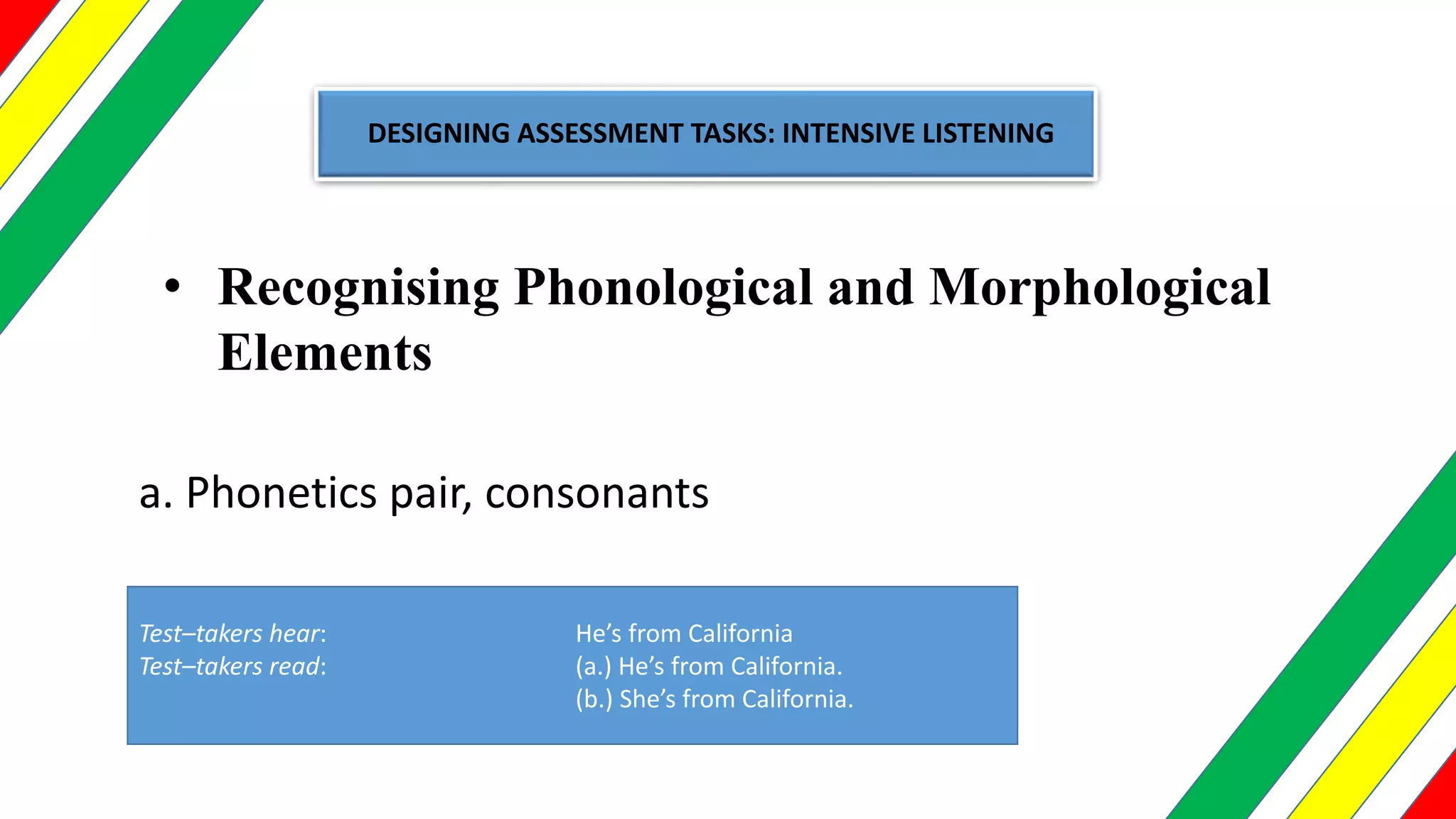
DESIGNING ASSESSMENT TASKS: INTENSIVE LISTENING
• Recognising Phonological and Morphological
Elements
a. Phonetics pair, consonants
Test–takers hear: He’s from California
Test–takers read: (a.) He’s from California.
(b.) She’s from California.
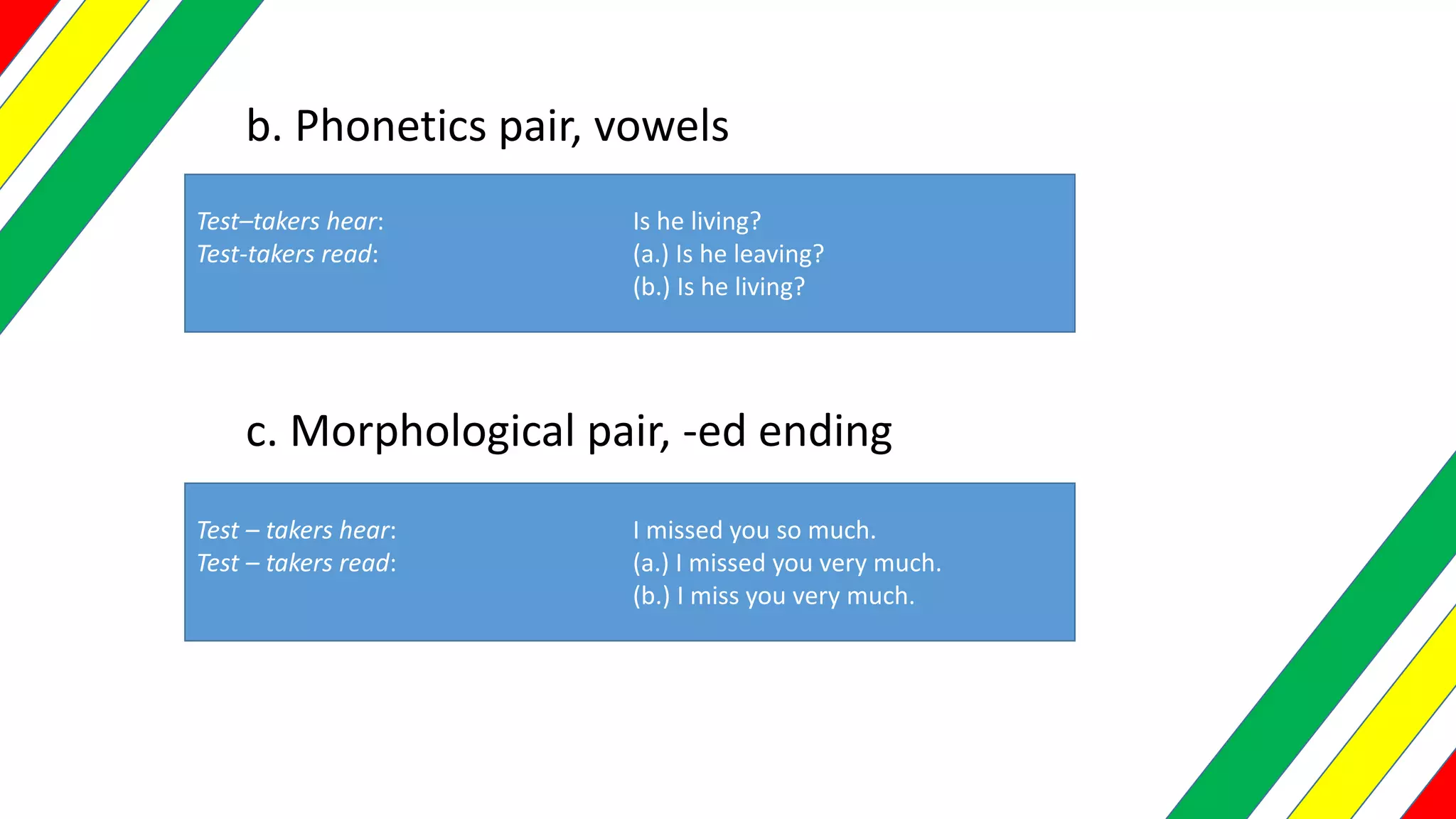
b. Phonetics pair, vowels
Test–takers hear: Is he living?
Test-takers read: (a.) Is he leaving?
(b.) Is he living?
c. Morphological pair, -ed ending
Test – takers hear: I missed you so much.
Test – takers read: (a.) I missed you very much.
(b.) I miss you very much.
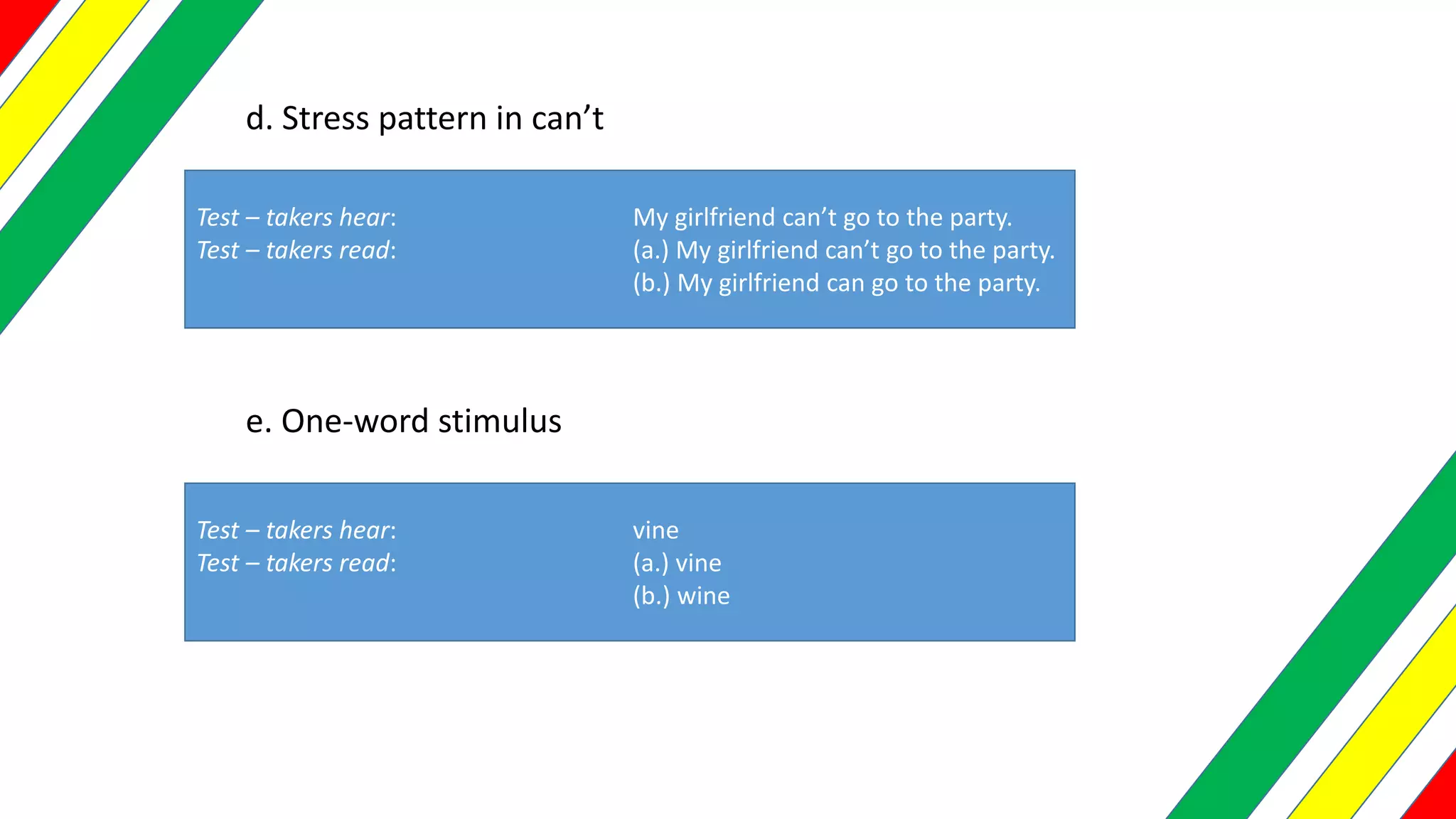
d. Stress pattern in can’t
Test – takers hear: My girlfriend can’t go to the party.
Test – takers read: (a.) My girlfriend can’t go to the party.
(b.) My girlfriend can go to the party.
e. One-word stimulus
Test – takers hear: vine
Test – takers read: (a.) vine
(b.) wine
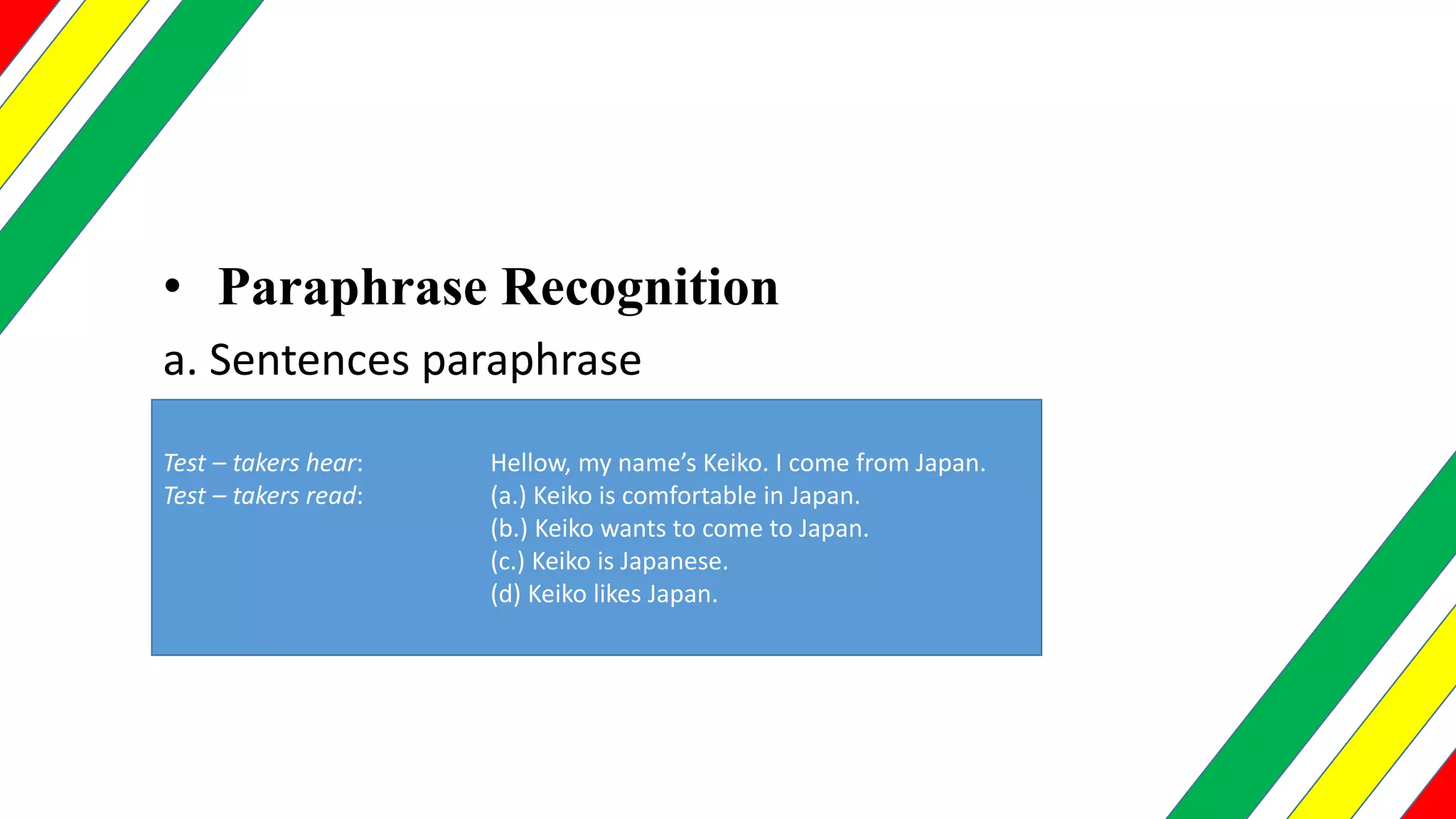
• Paraphrase Recognition
a. Sentences paraphrase
Test – takers hear: Hellow, my name’s Keiko. I come from Japan.
Test – takers read: (a.) Keiko is comfortable in Japan.
(b.) Keiko wants to come to Japan.
(c.) Keiko is Japanese.
(d) Keiko likes Japan.
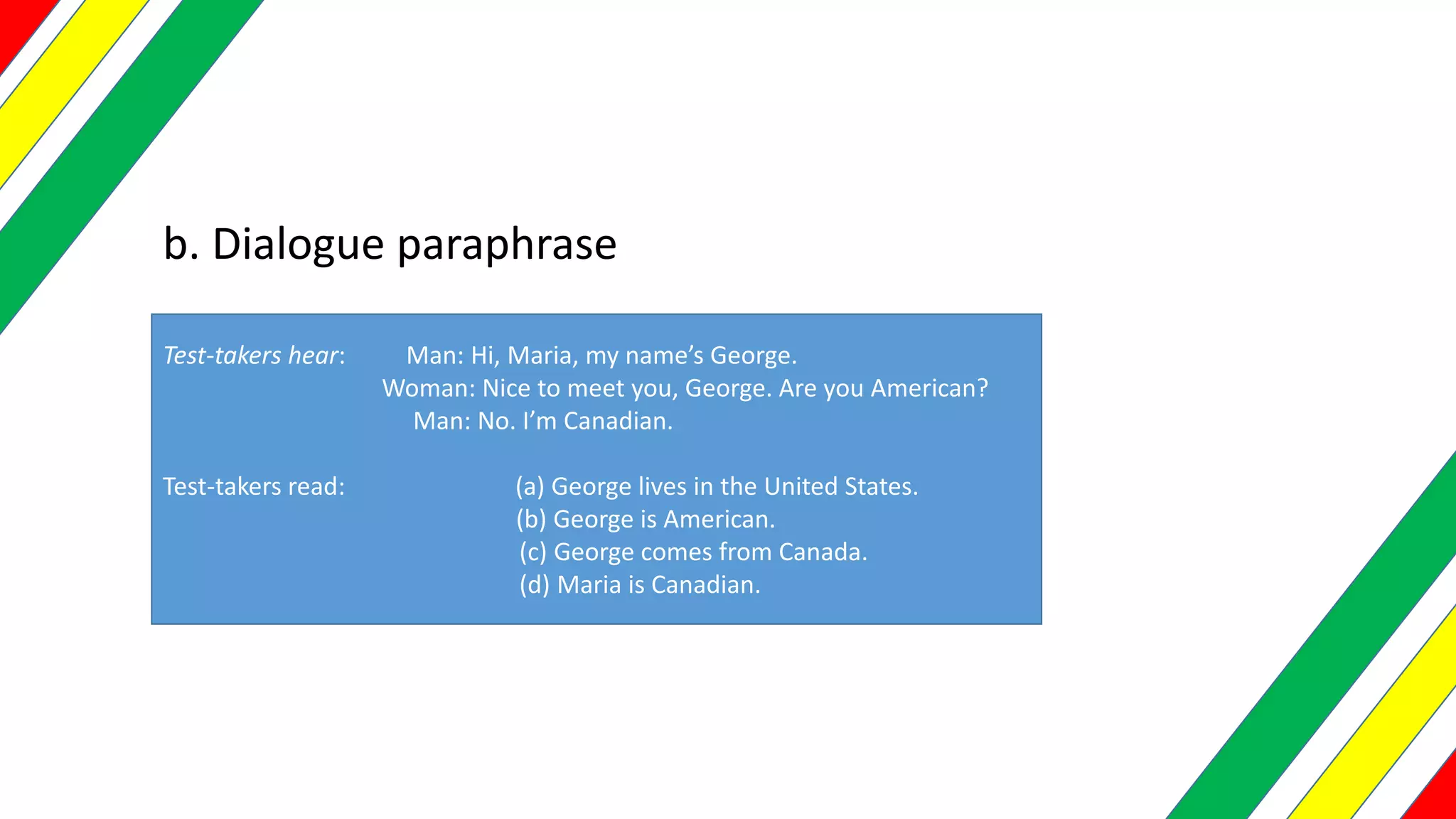
b. Dialogue paraphrase
Test-takers hear: Man: Hi, Maria, my name’s George.
Woman: Nice to meet you, George. Are you American?
Man: No. I’m Canadian.
Test-takers read: (a) George lives in the United States.
(b) George is American.
(c) George comes from Canada.
(d) Maria is Canadian.
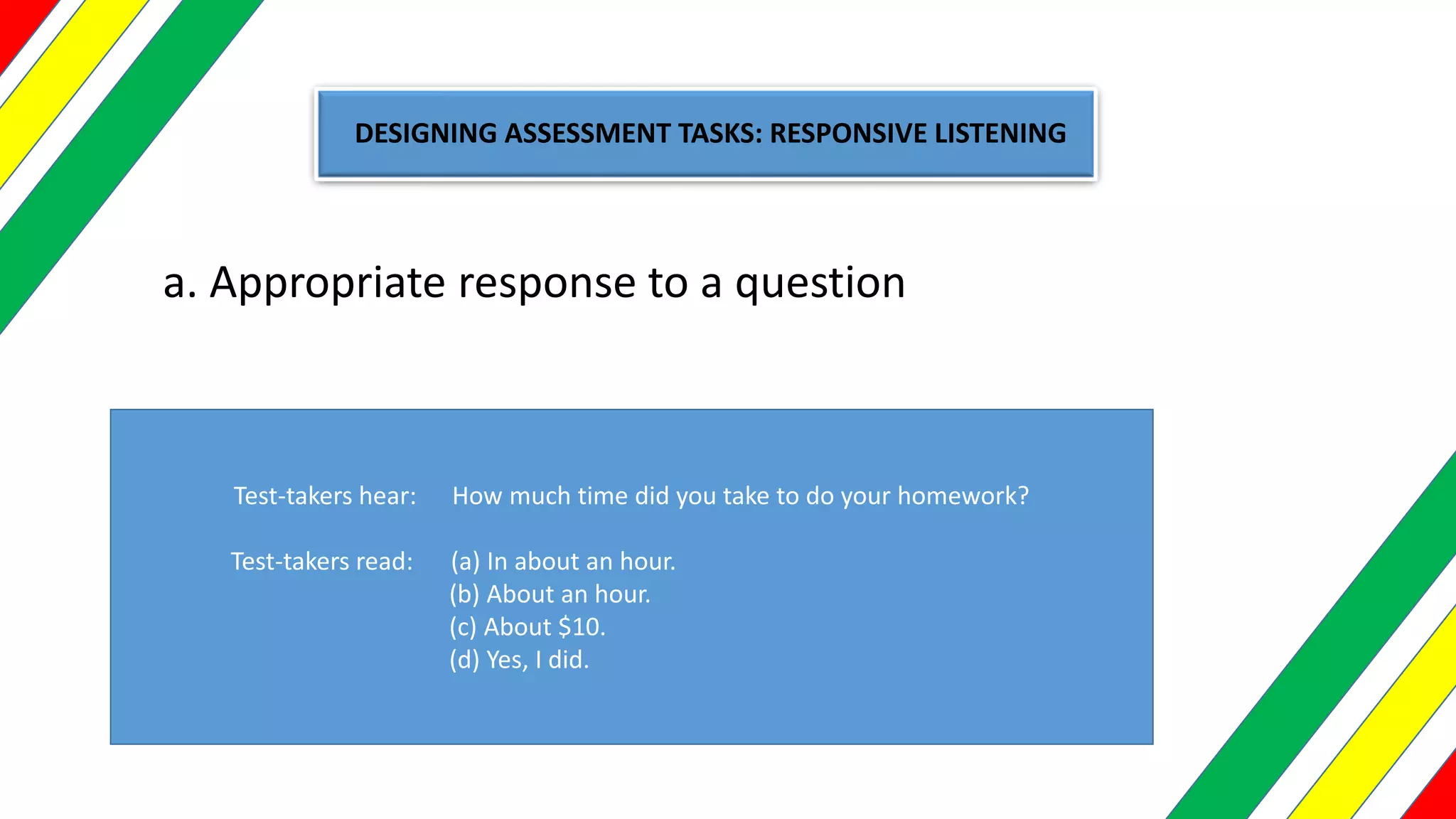
DESIGNING ASSESSMENT TASKS: RESPONSIVE LISTENING
a. Appropriate response to a question
Test-takers hear: How much time did you take to do your homework?
Test-takers read: (a) In about an hour.
(b) About an hour.
(c) About $10.
(d) Yes, I did.
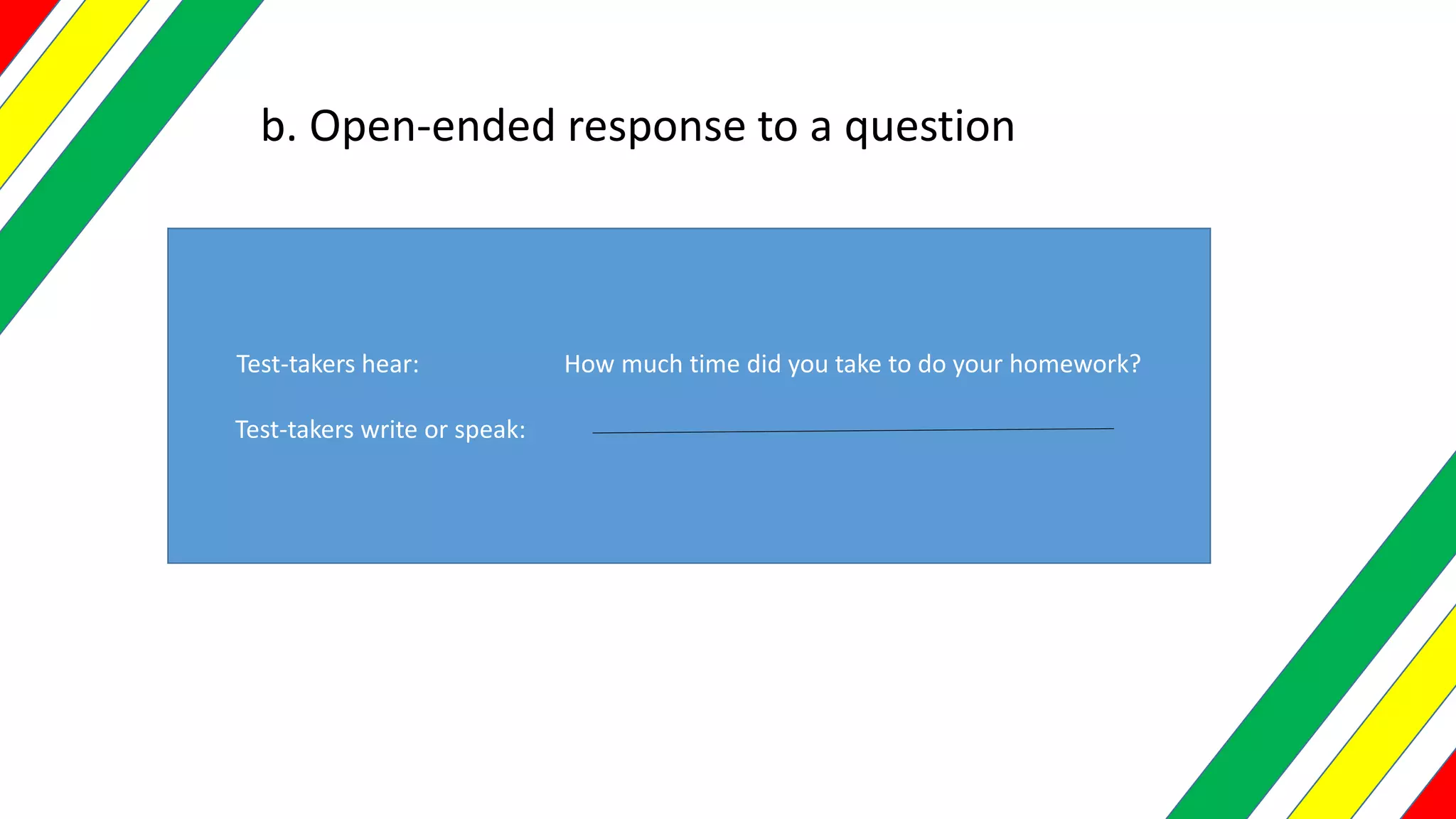
b. Open-ended response to a question
Test-takers hear: How much time did you take to do your homework?
Test-takers write or speak:

Assessing listening micro and macroskills of listening

  • 1.
    MICRO- AND MACROSKILLSOF LISTENING • Microskills is attending to the smaller bits and chunks of language, in more of a bottom-up process. • Macroskills is focussing on the larger elements involved in a top–down approach to a listening task.
  • 2.
    What makes listeningdifficult: 1. Clustering: attending to appropriate “chunks” of language-phrases, clauses, constituents. 2. Redudancy: repetitons, rephrasing, elaborations and insertions
  • 3.
    3. Reduced forms:understanding the reduced forms that may not have been a part of an English learner’s past learning experience in classes where only formal “textbook” language has been presented. 4. Performance variables: being able to “weed out” hesitations, false starts, pauses, and corrections in natural speech.
  • 4.
    5. Colloquial Language:Idioms, slang, reduced forms, shared cultural language 6. Rate of Delivery: Keeping up with the speed of delivery, processing automatically as the speaker continues
  • 5.
    7. Stress, rhythm,and intonation: correctly understanding prosodic elements of spoken language, which is almost always much more difficult than understanding the smaller phonological bits and pieces. 8. Interaction: managing the interactive flow of language from listening to speaking to listening, etc.
  • 6.
    DESIGNING ASSESSMENT TASKS:INTENSIVE LISTENING • Recognising Phonological and Morphological Elements a. Phonetics pair, consonants Test–takers hear: He’s from California Test–takers read: (a.) He’s from California. (b.) She’s from California.
  • 7.
    b. Phonetics pair,vowels Test–takers hear: Is he living? Test-takers read: (a.) Is he leaving? (b.) Is he living? c. Morphological pair, -ed ending Test – takers hear: I missed you so much. Test – takers read: (a.) I missed you very much. (b.) I miss you very much.
  • 8.
    d. Stress patternin can’t Test – takers hear: My girlfriend can’t go to the party. Test – takers read: (a.) My girlfriend can’t go to the party. (b.) My girlfriend can go to the party. e. One-word stimulus Test – takers hear: vine Test – takers read: (a.) vine (b.) wine
  • 9.
    • Paraphrase Recognition a.Sentences paraphrase Test – takers hear: Hellow, my name’s Keiko. I come from Japan. Test – takers read: (a.) Keiko is comfortable in Japan. (b.) Keiko wants to come to Japan. (c.) Keiko is Japanese. (d) Keiko likes Japan.
  • 10.
    b. Dialogue paraphrase Test-takershear: Man: Hi, Maria, my name’s George. Woman: Nice to meet you, George. Are you American? Man: No. I’m Canadian. Test-takers read: (a) George lives in the United States. (b) George is American. (c) George comes from Canada. (d) Maria is Canadian.
  • 11.
    DESIGNING ASSESSMENT TASKS:RESPONSIVE LISTENING a. Appropriate response to a question Test-takers hear: How much time did you take to do your homework? Test-takers read: (a) In about an hour. (b) About an hour. (c) About $10. (d) Yes, I did.
  • 12.
    b. Open-ended responseto a question Test-takers hear: How much time did you take to do your homework? Test-takers write or speak: