COMMUNICATIVE COMPETENCE
Betty
TEACHING SPEAKING
What is Communicative Competence
Glossary of communication (Pertti Hume, 2001)
Communication competence is the ability to take part in
effective communication, which is characterized by
skills and understandings that enable communication
partners to exchange messages successfully diversity,
have advanced language skills, and behave with
patience.
2
What is Communicative Competence
The desired outcome of the language learning
process is the ability to communicate
competently, not the ability to use the language
exactly as a native speaker does.
Developing the communicative competence of the learners
is one of the major goals for English teaching and is
considered as that “the essence of English teaching is
communication” and ‘communicative competence is the
initial and ultimate goal of English teaching”(Wang,1996)
(http://www.nclrc.org/essentials/goalsmethods/goal.htm)
3
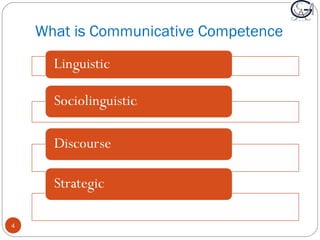
What is Communicative Competence
4
Communicative competence
Linguistic competence is knowing how to use
the grammar, syntax, and vocabulary of a
language. Linguistic competence asks: What
words do I use? How do I put them into
phrases and sentences?
5
Communicative competence
Sociolinguistic competence is knowing how to
use and respond to language appropriately,
given the setting, the topic, and the
relationships among the people
communicating.
6
Communicative competence
Discourse competence is knowing how to
interpret the larger context and how to
construct longer stretches of language so
that the parts make up a coherent whole.
7
Communicative competence
Strategic competence is knowing how to
recognize and repair communication
breakdowns, how to work around gaps in
one’s knowledge of the language, and how
to learn more about the language and in the
context.
8
Teaching Speaking
Speaking is the process of building and
sharing meaning through the use of verbal
and non-verbal symbols (Vanesa,2008)
9
Teaching Speaking
Speaking ability as the measure of knowing
a language. Fluency is defined as the ability
to converse with others, much more than
the ability to read, write, or comprehend
oral language.
10
Speaking involves three areas of
knowledge
11
Teaching Speaking
Mechanics (pronunciation, grammar, and vocabulary): Using
the right words in the right order with the correct
pronunciation
12
Functions (transaction and interaction): Knowing
when clarity of message is essential
(transaction/information exchange) and when
precise understanding is not required
(interaction/relationship building)
Teaching Speaking
13
Teaching Speaking
Social and cultural rules and norms (turn-taking,
rate of speech, length of pauses between
speakers, relative roles of participants):
Understanding how to take into account who is
speaking to whom, in what circumstances, about
what, and for what reason.
14
Teaching speaking: communicative
competence
Instructors help their students develop this body
of knowledge by providing authentic practice that
prepares students for real-life communication
situations.
15
Teaching speaking: communicative
competence
Instructors help their students develop the ability
to produce grammatically correct, logically
connected sentences that are appropriate to
specific contexts, and to do so using acceptable
(that is, comprehensible) pronunciation.
16
Why use Drama in Speaking Teaching
I hear and I forget,
I listen and I remember,
I do and I understand
(Chinese proverb)
Tell me, and I’ll forget.
Show me, and I may not remember.
Involve me, and I’ll understand.
(Native American proverb)
Both sentences are true specializing when studying a language. If
learners want to be perfect at any language they should be “do”
practice using it or “involve” in speaking situations.
17
Why use Drama in Speaking Teaching?
John Somers (1994) defines drama as a method, as
a means of communication and points out that
drama tools help us achieve our goals in all school
areas and subject.
18
Why use Drama in Speaking Teaching?
Drama can be fundamental in establishing better
communication, because it shows many aspects of
life and includes also elements related to
creativity and fantasy.
19
Why use Drama in Speaking Teaching?
Help students to develop oral skills; because it
seems that in schools the emphasis has been on
written production and, together with this, of
course, putting emphasis on reading.
20
Why use Drama in Speaking Teaching
Enhance not only creativity and imagination but also
sensitivity towards others.
Help students to extends to understanding and feeling
sympathy for the experience of others
more confident in themselves when they want to
communicate or speak.
21
Why use Drama in Speaking Teaching?
Drama provides with plenty of imagined
situations in which a shared understanding of
place, time, characters and other contextual
information becomes crucial to the quality of the
experience
22
Why use Drama in Speaking Teaching?
The key to good drama lies in “working with
ideas” may open up different opportunities to
students. They can create spaces in which they
argue, discuss, ask and answer questions, both
rationally and passionately, engaging their
emotions and their reason at the same time.
23
Why use Drama in Speaking Teaching?
Drama (storytelling and scenarios) can provide
students with the possibility of performing
interactively in a transformed space, where
meaningful communication can take place
24
Drama activities for teaching speaking
Role play
Simulations
Drama games
Guided improvisation
Acting play scripts
Prepared improvised drama
25
Drama meets the need of criteria for a
good speaking activity
Interaction among students
Personalized
Information gap
Provoked thinking
Interesting and fun
Variety
Good length
26
Drama meets the need of criteria for a good
speaking activity
Focusing on language patterns
Volume (a lot of speaking)
Validity (practicing speaking)
Suitable for different level of English
Minimal teacher assistance
Focusing on Fluency rather than accuracy
The end product
27
Conclusion
Speaking is an activity used by someone to
communicate with other. It takes place every
where and has become part of our life.
Using Drama in Speaking teaching is considered
as the effective method. According to Tulay
(2007) “Drama is the centre of existence” ,“it is a
valuable form of communication” and it provides
students with an opportunity to work together
cooperatively on a share life.
28
Disscussion
Is it possible to use Drama activities for
developing speaking competence of primary
students?
What are the advantages and disadvantages?
29
“Drama with children” project in
Goettingen
March, 2013
30
“Drama with children” project
31
“Drama with children” project
32
“Drama with children” project
33
“Drama with children” project
34
“Drama with children” project
35
Thank you for listening!
36

Teaching speaking- Communicative competence

  • 1.
  • 2.
    What is CommunicativeCompetence Glossary of communication (Pertti Hume, 2001) Communication competence is the ability to take part in effective communication, which is characterized by skills and understandings that enable communication partners to exchange messages successfully diversity, have advanced language skills, and behave with patience. 2
  • 3.
    What is CommunicativeCompetence The desired outcome of the language learning process is the ability to communicate competently, not the ability to use the language exactly as a native speaker does. Developing the communicative competence of the learners is one of the major goals for English teaching and is considered as that “the essence of English teaching is communication” and ‘communicative competence is the initial and ultimate goal of English teaching”(Wang,1996) (http://www.nclrc.org/essentials/goalsmethods/goal.htm) 3
  • 4.
  • 5.
    Communicative competence Linguistic competence isknowing how to use the grammar, syntax, and vocabulary of a language. Linguistic competence asks: What words do I use? How do I put them into phrases and sentences? 5
  • 6.
    Communicative competence Sociolinguistic competence isknowing how to use and respond to language appropriately, given the setting, the topic, and the relationships among the people communicating. 6
  • 7.
    Communicative competence Discourse competence isknowing how to interpret the larger context and how to construct longer stretches of language so that the parts make up a coherent whole. 7
  • 8.
    Communicative competence Strategic competence isknowing how to recognize and repair communication breakdowns, how to work around gaps in one’s knowledge of the language, and how to learn more about the language and in the context. 8
  • 9.
    Teaching Speaking Speaking isthe process of building and sharing meaning through the use of verbal and non-verbal symbols (Vanesa,2008) 9
  • 10.
    Teaching Speaking Speaking abilityas the measure of knowing a language. Fluency is defined as the ability to converse with others, much more than the ability to read, write, or comprehend oral language. 10
  • 11.
    Speaking involves threeareas of knowledge 11
  • 12.
    Teaching Speaking Mechanics (pronunciation,grammar, and vocabulary): Using the right words in the right order with the correct pronunciation 12
  • 13.
    Functions (transaction andinteraction): Knowing when clarity of message is essential (transaction/information exchange) and when precise understanding is not required (interaction/relationship building) Teaching Speaking 13
  • 14.
    Teaching Speaking Social andcultural rules and norms (turn-taking, rate of speech, length of pauses between speakers, relative roles of participants): Understanding how to take into account who is speaking to whom, in what circumstances, about what, and for what reason. 14
  • 15.
    Teaching speaking: communicative competence Instructorshelp their students develop this body of knowledge by providing authentic practice that prepares students for real-life communication situations. 15
  • 16.
    Teaching speaking: communicative competence Instructorshelp their students develop the ability to produce grammatically correct, logically connected sentences that are appropriate to specific contexts, and to do so using acceptable (that is, comprehensible) pronunciation. 16
  • 17.
    Why use Dramain Speaking Teaching I hear and I forget, I listen and I remember, I do and I understand (Chinese proverb) Tell me, and I’ll forget. Show me, and I may not remember. Involve me, and I’ll understand. (Native American proverb) Both sentences are true specializing when studying a language. If learners want to be perfect at any language they should be “do” practice using it or “involve” in speaking situations. 17
  • 18.
    Why use Dramain Speaking Teaching? John Somers (1994) defines drama as a method, as a means of communication and points out that drama tools help us achieve our goals in all school areas and subject. 18
  • 19.
    Why use Dramain Speaking Teaching? Drama can be fundamental in establishing better communication, because it shows many aspects of life and includes also elements related to creativity and fantasy. 19
  • 20.
    Why use Dramain Speaking Teaching? Help students to develop oral skills; because it seems that in schools the emphasis has been on written production and, together with this, of course, putting emphasis on reading. 20
  • 21.
    Why use Dramain Speaking Teaching Enhance not only creativity and imagination but also sensitivity towards others. Help students to extends to understanding and feeling sympathy for the experience of others more confident in themselves when they want to communicate or speak. 21
  • 22.
    Why use Dramain Speaking Teaching? Drama provides with plenty of imagined situations in which a shared understanding of place, time, characters and other contextual information becomes crucial to the quality of the experience 22
  • 23.
    Why use Dramain Speaking Teaching? The key to good drama lies in “working with ideas” may open up different opportunities to students. They can create spaces in which they argue, discuss, ask and answer questions, both rationally and passionately, engaging their emotions and their reason at the same time. 23
  • 24.
    Why use Dramain Speaking Teaching? Drama (storytelling and scenarios) can provide students with the possibility of performing interactively in a transformed space, where meaningful communication can take place 24
  • 25.
    Drama activities forteaching speaking Role play Simulations Drama games Guided improvisation Acting play scripts Prepared improvised drama 25
  • 26.
    Drama meets theneed of criteria for a good speaking activity Interaction among students Personalized Information gap Provoked thinking Interesting and fun Variety Good length 26
  • 27.
    Drama meets theneed of criteria for a good speaking activity Focusing on language patterns Volume (a lot of speaking) Validity (practicing speaking) Suitable for different level of English Minimal teacher assistance Focusing on Fluency rather than accuracy The end product 27
  • 28.
    Conclusion Speaking is anactivity used by someone to communicate with other. It takes place every where and has become part of our life. Using Drama in Speaking teaching is considered as the effective method. According to Tulay (2007) “Drama is the centre of existence” ,“it is a valuable form of communication” and it provides students with an opportunity to work together cooperatively on a share life. 28
  • 29.
    Disscussion Is it possibleto use Drama activities for developing speaking competence of primary students? What are the advantages and disadvantages? 29
  • 30.
    “Drama with children”project in Goettingen March, 2013 30
  • 31.
  • 32.
  • 33.
  • 34.
  • 35.
  • 36.
    Thank you forlistening! 36