SUGGESTOPEDIA
 Suggestiopedia is now called Desuggestopedia to
reflect the importance placed on desuggesting
limitations on learning.
 We set up psychological barriers to learning and
thus we do not use the full mental powers we have;
in order to use our reserved capacity, the limitations
we think we have need to be “desuggested.”.
 Decoration.
 Furniture.
 Arrangement of the classroom.
 The use of soft music.
 The authoritative behavior of the
teacher.
There are six principal
theoretical components
through which
desuggestopedia and
suggestopedia operate and
that set- up access to
reserves.
 Authority.
 Infantilization.
 Double-
planedness.
 Intonation,
rhythm, and
concert psuedo-
passiveness.
 Design
 syllabus
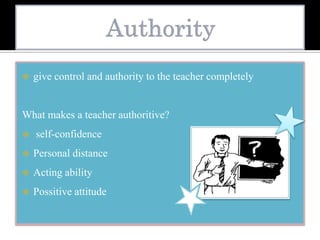
 give control and authority to the teacher completely
What makes a teacher authoritive?
 self-confidence
 Personal distance
 Acting ability
 Possitive attitude
 Authority is also used to suggest a teacher-student
relation like that of parent to child. In the child’s role
the learner takes part in role playing, games, songs,
and gymnastic exercise that help “the older student
regain the self-confidence, spontaneity, receptivity
of the child”.
 The learner learn not only from the effect of
direct instruction takes places.The bright decor
of the classroom, the musical background, the
shape of the chairs, and the personality of the
teacher are considered as important instruction
as the form of the instructional material itself.
 Varying the tone and rhythm of presented material helps both
to avoid boredom through monotony of repetition and
dramatize, emotionalize, and give meaning to linguistic
material.
 Both intonation and rhythm are coordinated with a musical
background. The musical background helps to induce a relaxed
attitude, which Lozanov refers to as concert pseudo-passiveness.
This state is felt to be optimal for learning, in that anxieties and
tension are relieved and power of concentration for new
material is raised.
 Objectives.
 Syllabus.
 Learning Activities.
 Roles of Learners, Teachers, and
Materials.
 course lasts 30 days, 10 units of
study.
 Classes are held 4 hours a day, 6
days a week.
 The central focus of each unit is a
dialogue consisting of 1200 word,
or with an accompanying
vocabulary list and grammatical
commentary.
Question and answer
Role play
Listening exercises
 Pseudo-passive state.
 Learners must not try to to figure out,
 Not to manipulate, or
Not to study material
 Learners sit in a circle
 Encourages face-to-face exchange
 Activity participation
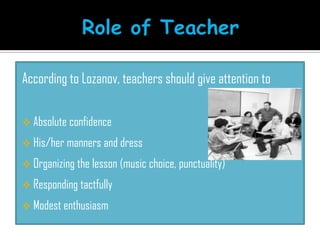
According to Lozanov, teachers should give attention to
 Absolute confidence
 His/her manners and dress
 Organizing the lesson (music choice, punctuality)
 Responding tactfully
 Modest enthusiasm
1. Show absolute confidence in the method.
2. Display fastidious conduct in manners and dress.
3. Organize properly, and strictly observe the initial stages of the teaching
process—this includes choice and play of music, as well as punctuality.
4. Maintain a solemn attitude towards the session.
5. Give tests and respond tactfully to poor papers (if any).
6. Stress global rather than analytical attitudes towards material.
7. Maintain a modest enthusiasm.
-Direct Supported Materials:
 Texts
 Tape
-Indirect Supported Materials:
 Classroom fixtures
 Music
 Text books
 Learning environment
The 4-hours language class has three parts:
 Oral review section
micro studies
macro studies
 The class new material presentation and
discussion
 The concert session
 At the beginning of the session, all conversation
stops for a minute, or two minutes, and the
teacher listens to the music coming from a tape-
recorder.
 The teacher waits and listens to several passages
in order to enter into the mood of the music and
then begins to read or recite the new text, his
voice modulated in harmony with the musical
phrases.
 The students follow the text in their textbooks
where each lesson is translated into the mother
tongue.
 Between the first and second part of the concert, there are
several of solemn silence. In some cases, even longer pauses
can be given to permit the students to stir a little. Before
beginning of the second part of the concert, there are again
several minutes of silence and some phrases of the music are
heard again before the teacher begins to read the text. Now
the students close their textbooks and listen to the teacher’s
reading.
 At the end, the students silently leave the room.
 To accelerate the process of learning a
foreign language for everyday
communication
 To desuggest learners’ psychological
barriers
 To activate learners’ ‘paraconscious’ part of
the mind.
 The teacher’s role:
authority—being confident and trustable
security—affording a cheerful classroom
atmosphere
 The students’ role:
relaxed—following the teacher’s instruction easily
role play—enjoying in the new identity freely
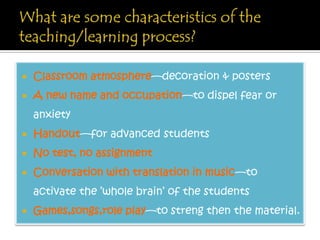
 Classroom atmosphere—decoration & posters
 A new name and occupation—to dispel fear or
anxiety
 Handout—for advanced students
 No test, no assignment
 Conversation with translation in music—to
activate the ’whole brain’ of the students
 Games,songs,role play—to streng then the material.
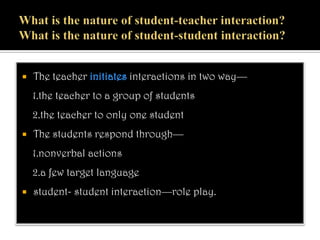
 The teacher initiates interactions in two way—
1.the teacher to a group of students
2.the teacher to only one student
 The students respond through—
1.nonverbal actions
2.a few target language
 student- student interaction—role play.
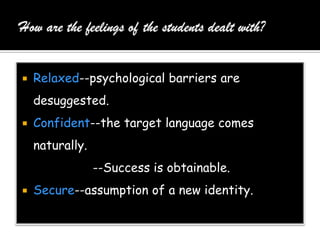
 Relaxed--psychological barriers are
desuggested.
 Confident--the target language comes
naturally.
--Success is obtainable.
 Secure--assumption of a new identity.
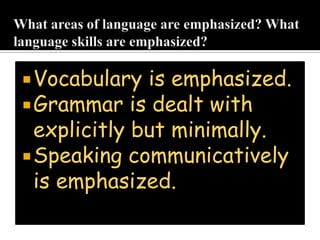
Vocabulary is emphasized.
Grammar is dealt with
explicitly but minimally.
Speaking communicatively
is emphasized.
 Native language is used to make
the meaning of the dialog clear.
 As the course proceeds, the
teacher uses the native language
less and less.
Evaluation usually is
conducted on students’
normal in-class
performance, not through
tests.
Errors are
corrected gently,
with the teacher
using a soft voice.
• Motivation
• self-confidence
• Less stressed
Hardness of finding colorful environment
Negative effects of direct translation
Concentration problems.
Psychological barriers.
 Positive approach.
In the Suggestopedia teaching it’s important
to make student very relaxaed.

Suggestopedia

  • 1.
  • 3.
     Suggestiopedia isnow called Desuggestopedia to reflect the importance placed on desuggesting limitations on learning.  We set up psychological barriers to learning and thus we do not use the full mental powers we have; in order to use our reserved capacity, the limitations we think we have need to be “desuggested.”.
  • 4.
     Decoration.  Furniture. Arrangement of the classroom.  The use of soft music.  The authoritative behavior of the teacher.
  • 5.
    There are sixprincipal theoretical components through which desuggestopedia and suggestopedia operate and that set- up access to reserves.  Authority.  Infantilization.  Double- planedness.  Intonation, rhythm, and concert psuedo- passiveness.  Design  syllabus
  • 6.
     give controland authority to the teacher completely What makes a teacher authoritive?  self-confidence  Personal distance  Acting ability  Possitive attitude
  • 7.
     Authority isalso used to suggest a teacher-student relation like that of parent to child. In the child’s role the learner takes part in role playing, games, songs, and gymnastic exercise that help “the older student regain the self-confidence, spontaneity, receptivity of the child”.
  • 8.
     The learnerlearn not only from the effect of direct instruction takes places.The bright decor of the classroom, the musical background, the shape of the chairs, and the personality of the teacher are considered as important instruction as the form of the instructional material itself.
  • 9.
     Varying thetone and rhythm of presented material helps both to avoid boredom through monotony of repetition and dramatize, emotionalize, and give meaning to linguistic material.  Both intonation and rhythm are coordinated with a musical background. The musical background helps to induce a relaxed attitude, which Lozanov refers to as concert pseudo-passiveness. This state is felt to be optimal for learning, in that anxieties and tension are relieved and power of concentration for new material is raised.
  • 10.
     Objectives.  Syllabus. Learning Activities.  Roles of Learners, Teachers, and Materials.
  • 11.
     course lasts30 days, 10 units of study.  Classes are held 4 hours a day, 6 days a week.  The central focus of each unit is a dialogue consisting of 1200 word, or with an accompanying vocabulary list and grammatical commentary.
  • 12.
    Question and answer Roleplay Listening exercises
  • 13.
     Pseudo-passive state. Learners must not try to to figure out,  Not to manipulate, or Not to study material  Learners sit in a circle  Encourages face-to-face exchange  Activity participation
  • 14.
    According to Lozanov,teachers should give attention to  Absolute confidence  His/her manners and dress  Organizing the lesson (music choice, punctuality)  Responding tactfully  Modest enthusiasm
  • 15.
    1. Show absoluteconfidence in the method. 2. Display fastidious conduct in manners and dress. 3. Organize properly, and strictly observe the initial stages of the teaching process—this includes choice and play of music, as well as punctuality. 4. Maintain a solemn attitude towards the session. 5. Give tests and respond tactfully to poor papers (if any). 6. Stress global rather than analytical attitudes towards material. 7. Maintain a modest enthusiasm.
  • 16.
    -Direct Supported Materials: Texts  Tape -Indirect Supported Materials:  Classroom fixtures  Music  Text books  Learning environment
  • 17.
    The 4-hours languageclass has three parts:  Oral review section micro studies macro studies  The class new material presentation and discussion  The concert session
  • 18.
     At thebeginning of the session, all conversation stops for a minute, or two minutes, and the teacher listens to the music coming from a tape- recorder.  The teacher waits and listens to several passages in order to enter into the mood of the music and then begins to read or recite the new text, his voice modulated in harmony with the musical phrases.  The students follow the text in their textbooks where each lesson is translated into the mother tongue.
  • 19.
     Between thefirst and second part of the concert, there are several of solemn silence. In some cases, even longer pauses can be given to permit the students to stir a little. Before beginning of the second part of the concert, there are again several minutes of silence and some phrases of the music are heard again before the teacher begins to read the text. Now the students close their textbooks and listen to the teacher’s reading.  At the end, the students silently leave the room.
  • 20.
     To acceleratethe process of learning a foreign language for everyday communication  To desuggest learners’ psychological barriers  To activate learners’ ‘paraconscious’ part of the mind.
  • 21.
     The teacher’srole: authority—being confident and trustable security—affording a cheerful classroom atmosphere  The students’ role: relaxed—following the teacher’s instruction easily role play—enjoying in the new identity freely
  • 22.
     Classroom atmosphere—decoration& posters  A new name and occupation—to dispel fear or anxiety  Handout—for advanced students  No test, no assignment  Conversation with translation in music—to activate the ’whole brain’ of the students  Games,songs,role play—to streng then the material.
  • 23.
     The teacherinitiates interactions in two way— 1.the teacher to a group of students 2.the teacher to only one student  The students respond through— 1.nonverbal actions 2.a few target language  student- student interaction—role play.
  • 24.
     Relaxed--psychological barriersare desuggested.  Confident--the target language comes naturally. --Success is obtainable.  Secure--assumption of a new identity.
  • 25.
    Vocabulary is emphasized. Grammaris dealt with explicitly but minimally. Speaking communicatively is emphasized.
  • 26.
     Native languageis used to make the meaning of the dialog clear.  As the course proceeds, the teacher uses the native language less and less.
  • 27.
    Evaluation usually is conductedon students’ normal in-class performance, not through tests.
  • 28.
    Errors are corrected gently, withthe teacher using a soft voice.
  • 29.
  • 30.
    Hardness of findingcolorful environment Negative effects of direct translation Concentration problems.
  • 31.
    Psychological barriers.  Positiveapproach. In the Suggestopedia teaching it’s important to make student very relaxaed.