Elementary Algebra
SHEILA MARIE C. NAVARRO
REAL NUMBERS SYSTEM
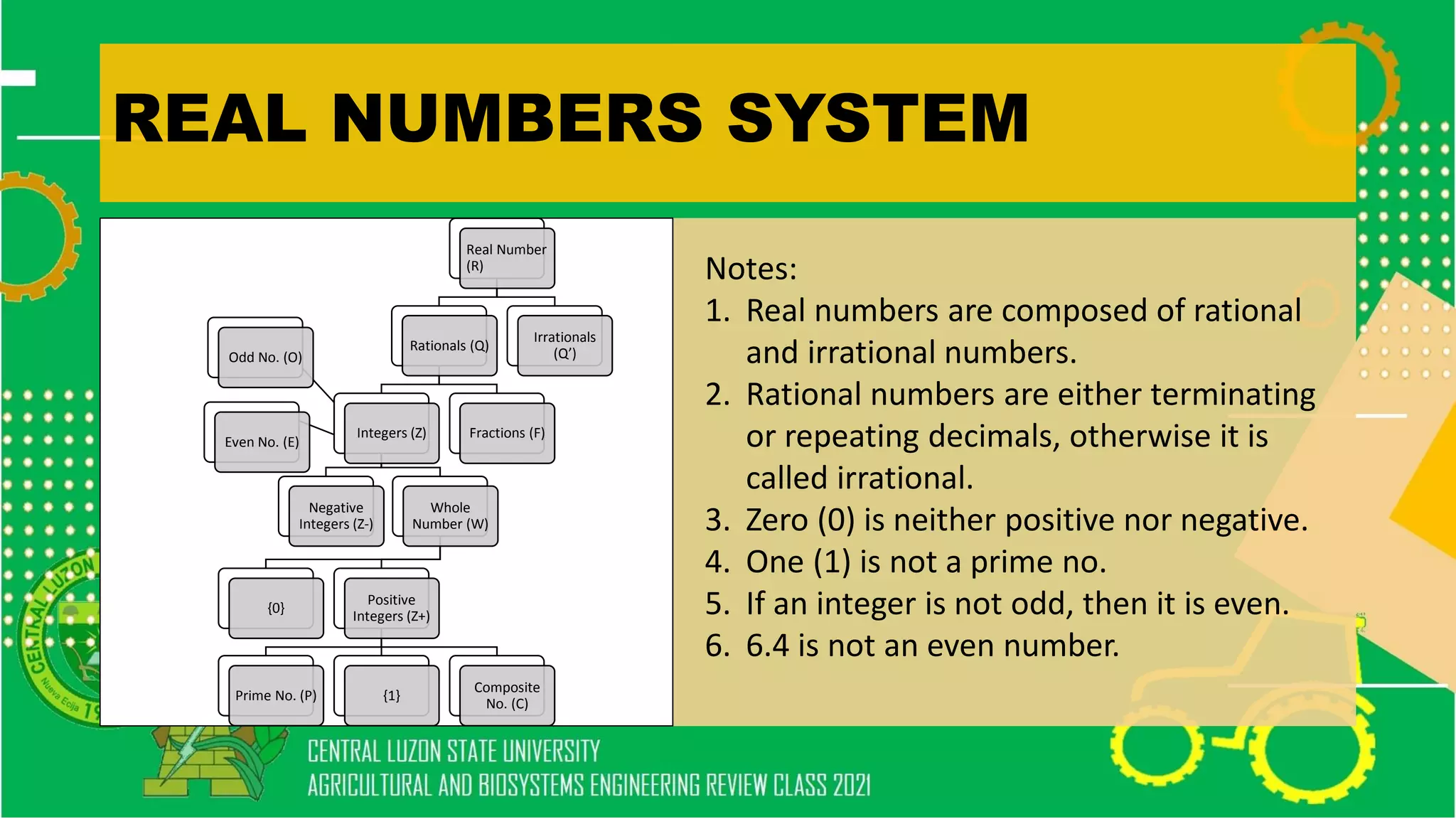
Real Number
(R)
Rationals (Q)
Integers (Z)
Negative
Integers (Z-)
Whole
Number (W)
{0}
Positive
Integers (Z+)
Prime No. (P) {1}
Composite
No. (C)
Even No. (E)
Odd No. (O)
Fractions (F)
Irrationals
(Q’)
Notes:
1. Real numbers are composed of rational
and irrational numbers.
2. Rational numbers are either terminating
or repeating decimals, otherwise it is
called irrational.
3. Zero (0) is neither positive nor negative.
4. One (1) is not a prime no.
5. If an integer is not odd, then it is even.
6. 6.4 is not an even number.
Question:
1. What is the sum of the smallest prime and largest
2-digit prime number?
a. 95
b. 98
c. 99
d. 100
ANS: C
Question:
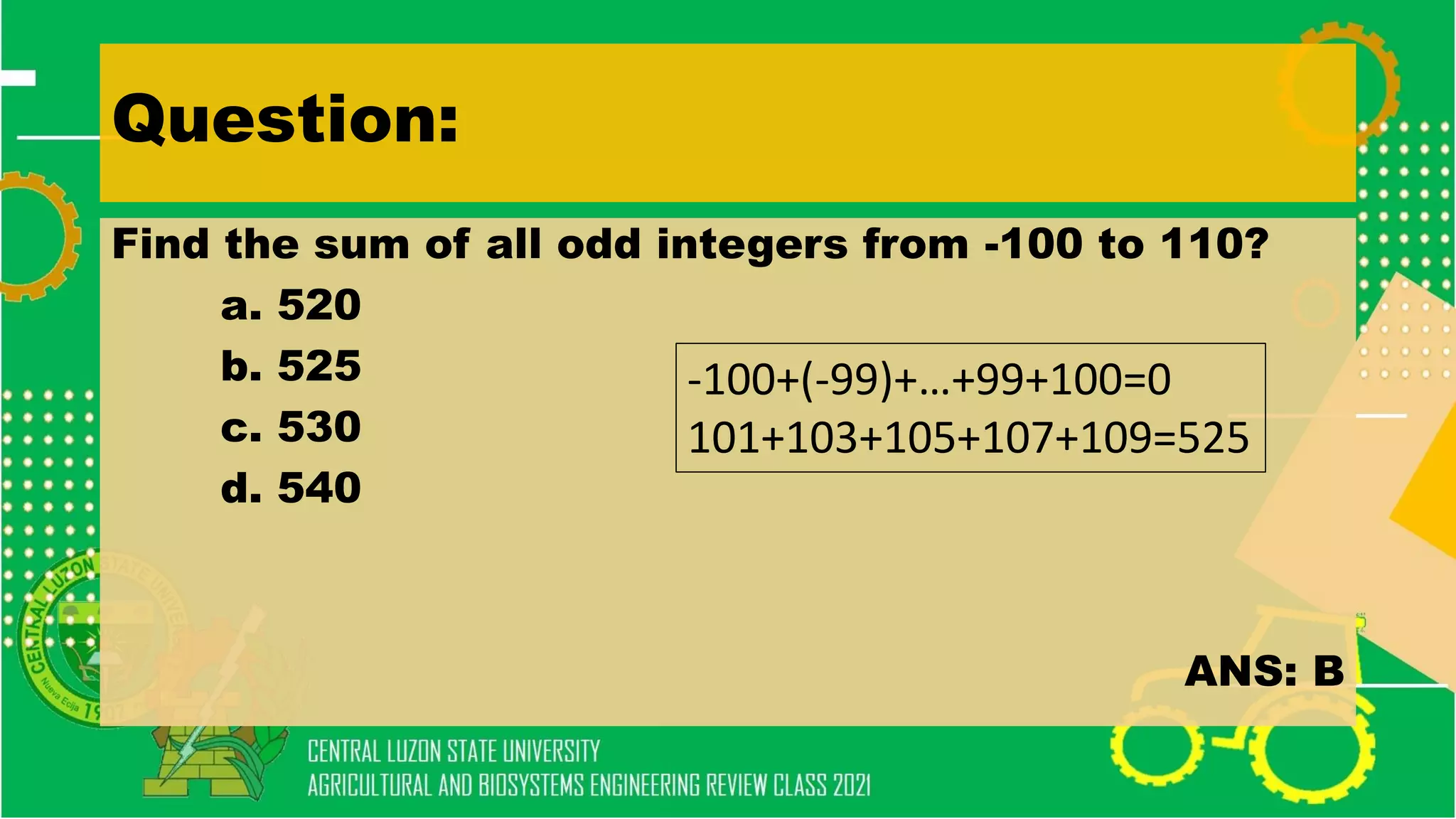
Find the sum of all odd integers from -100 to 110?
a. 520
b. 525
c. 530
d. 540
ANS: B
-100+(-99)+…+99+100=0
101+103+105+107+109=525
SETS
Union (“or” / ∪) All elements of two
sets
𝑨 ∪ 𝑩 = {𝟏, 𝟑, 𝟒, 𝟓, 𝟕, 𝟖}
Intersection (“and” / ∩) All common elements
of two sets
𝐴 ∩ 𝐵 = {1}
Complement ( ‘/ (𝑈 − 𝐴)) Elements in 𝑈 not in 𝐴 𝐴′
= {2, 3, 6, 7, 8, 9, 10}
Difference (− / (𝐴 − 𝐵)) Elements in 𝐴 not in 𝐵 𝐴 − 𝐵 = {4, 5}
Cross Product (𝐴 × 𝐵) Ordered pairs with
domain from 𝐴 and
abscisa from 𝐵
𝐴 × 𝐵
= { 1,1 , 1, 3 , … , 5, 7 , 5,8 )
A = {1, 4, 5}
B = {1, 3, 7, 8}
U = {1, 2, …, 10}
Question:
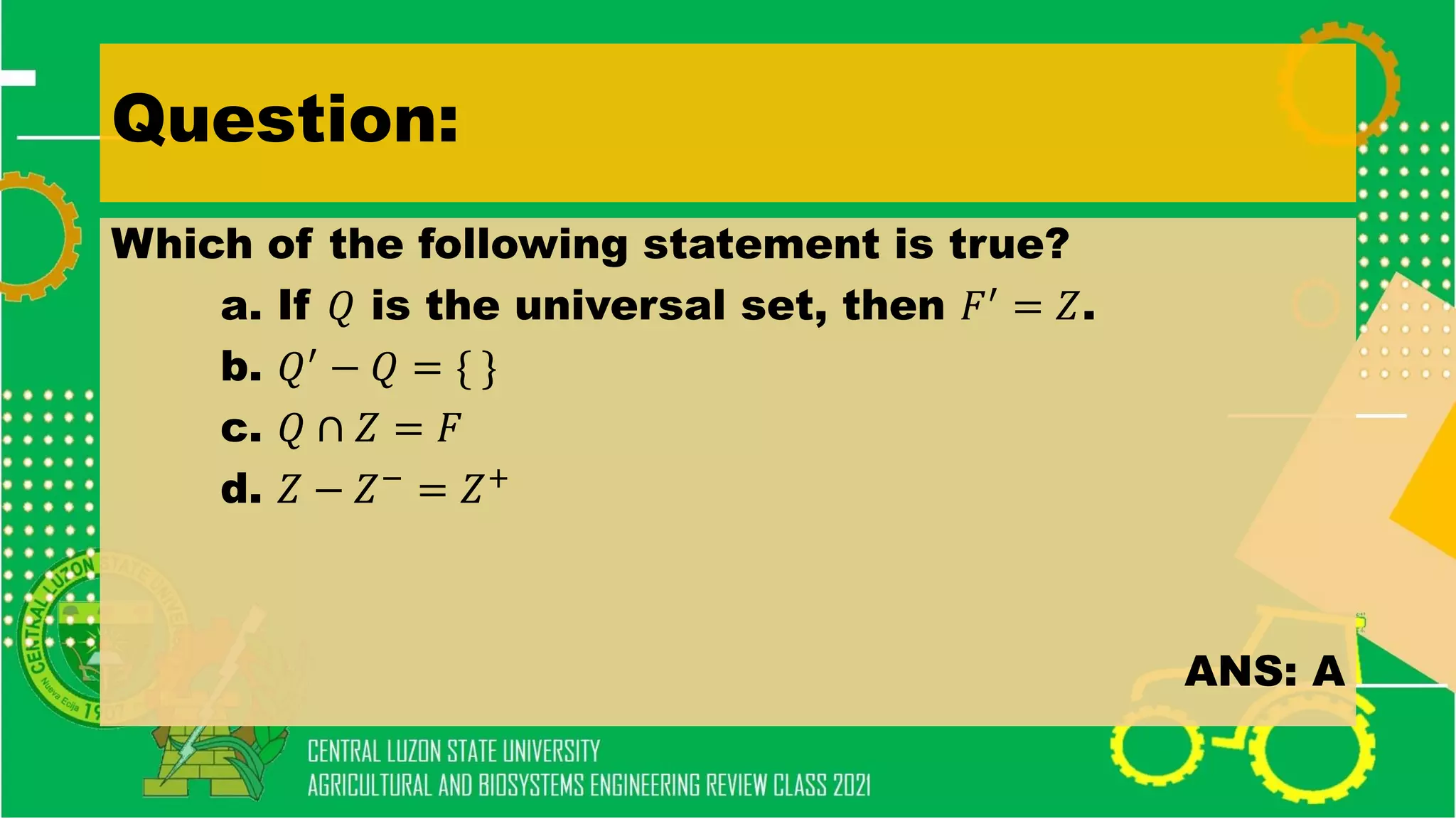
Which of the following statement is true?
a. If 𝑄 is the universal set, then 𝐹′ = 𝑍.
b. 𝑄′ − 𝑄 = { }
c. 𝑄 ∩ 𝑍 = 𝐹
d. 𝑍 − 𝑍−
= 𝑍+
ANS: A
Question:
During a survey, the following data were gathered: 60 students like
algebra, 50 students like calculus, and 45 likes physics. Thirty students like
both algebra and calculus; 25 students like both calculus and physics; and
20 students like algebra and physics. Only 15 students like all the three
subjects. How many students were surveyed?
a. 155
b. 125
c. 115
d. 95
ANS: D
Algebra Calculus
Physics
15
5 10
15
25 10
15
25+5+15+15+10+10+15=95
SOME THEOREMS ON REAL
NUMBERS
• Theorem 1. −
𝑎
𝑏
=
−𝑎
𝑏
=
𝑎
−𝑏
.
• Theorem 2.
𝑎𝑐
𝑏𝑐
=
𝑎
𝑏
.
• Theorem 3.
𝑎
𝑐
+
𝑏
𝑐
=
𝑎+𝑏
𝑐
or
𝑎
𝑐
+
𝑏
𝑑
=
𝑎𝑑+𝑏𝑐
𝑐𝑑
.
• Theorem 4.
𝑎
𝑏
×
𝑐
𝑑
=
𝑎𝑐
𝑏𝑑
.
• Theorem 5.
𝑎
𝑏
÷
𝑐
𝑑
=
𝑎
𝑏
×
𝑑
𝑐
=
𝑎𝑑
𝑏𝑐
.
NOTE: In the following theorems, 𝑎, 𝑏, 𝑐, 𝑑 may stand for any algebraic
expression.
0
𝑎
= 0;
𝑎
0
= 𝑢𝑛𝑑𝑒𝑓𝑖𝑛𝑒𝑑;
𝑎
∞
= 0.
Common Mistake
•
𝑥2−3𝑥+2
𝑥2−2𝑥+1
=
(𝑥−2)(𝑥−1)
(𝑥−1)(𝑥−1)
=
𝑥−2
𝑥−1
•
𝑥−2 𝑥+1
𝑥−2 𝑥−3
=
𝑥−2 𝑥+1
𝑥−2 𝑥−3
Fundamental Operations
• Addition and Subtraction is only applicable to
similar terms.
1. 2𝑥 − 3𝑦 + (5𝑥 + 2𝑦) =
2. 2𝑥 − 3𝑦 − 5𝑥 + 2𝑦 =
• For Multiplication and Division, laws of exponents
are needed.
𝟕𝒙 − 𝒚
2𝑥 − 3𝑦 − 5𝑥 − 2𝑦 = −𝟑𝒙 − 𝟓𝒚
Laws of Exponents
1. 𝑎𝑚 ∙ 𝑎𝑛 = 𝑎𝑚+𝑛
2.
𝑎𝑚
𝑎𝑛 = 𝑎𝑚−𝑛
3. 𝑎𝑚 𝑛 = 𝑎𝑚𝑛
4. 𝑎𝑏 𝑚
= 𝑎𝑚
𝑏𝑚
5.
𝑎
𝑏
𝑚
=
𝑎𝑚
𝑏𝑚
6. 𝑎
𝑚
𝑛 =
𝑛
𝑎𝑚
7. 𝑎0 = 1 provided 𝑎 ≠ 0.
Note: 00 is indeterminate.
6. 𝑎−𝑚 =
1
𝑎𝑚
7. If 𝑎𝑚 = 𝑎𝑛, then 𝑚 = 𝑛.
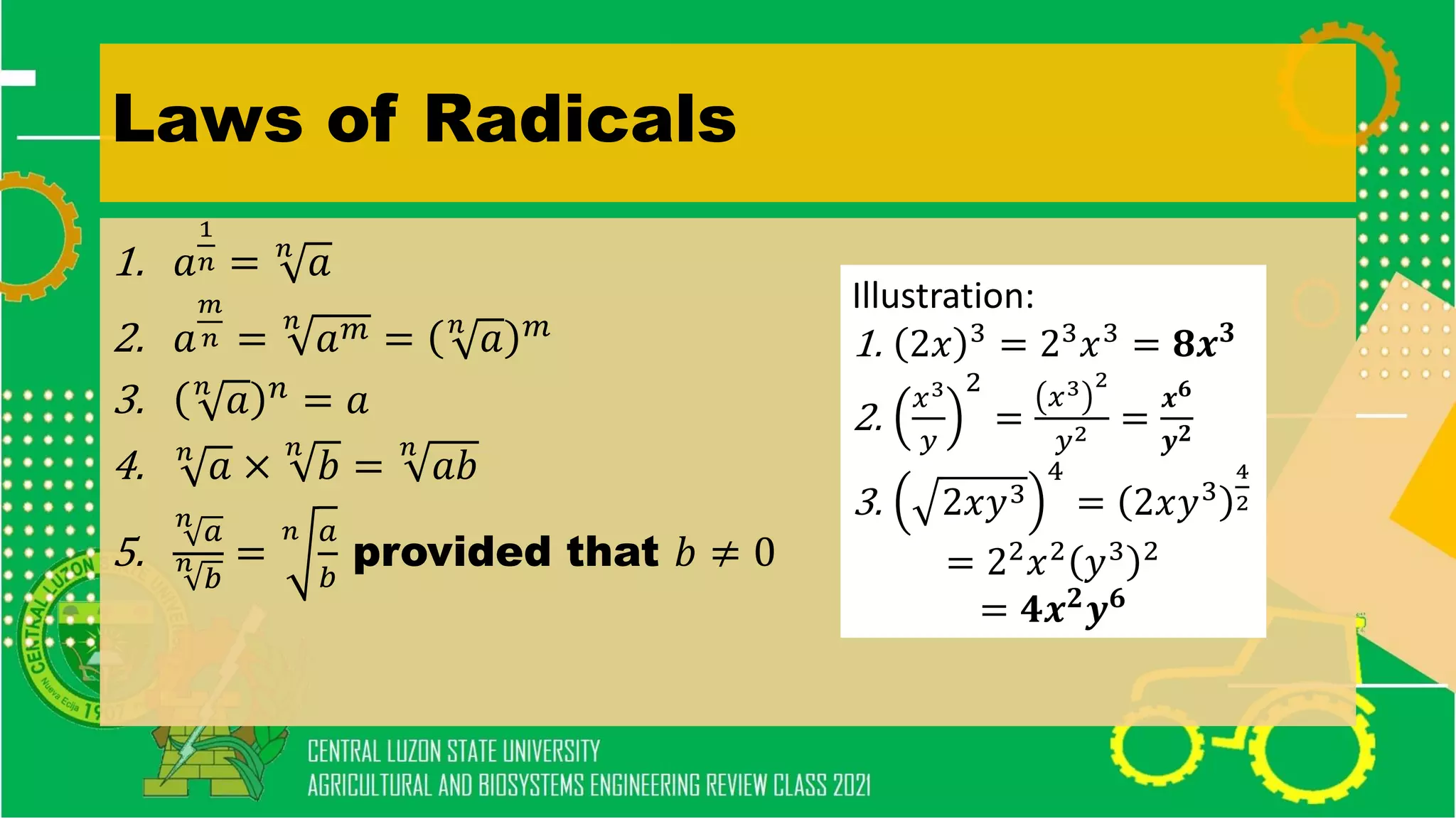
Laws of Radicals
1. 𝑎
1
𝑛 = 𝑛
𝑎
2. 𝑎
𝑚
𝑛 =
𝑛
𝑎𝑚 = 𝑛
𝑎 𝑚
3. 𝑛
𝑎 𝑛 = 𝑎
4. 𝑛
𝑎 ×
𝑛
𝑏 =
𝑛
𝑎𝑏
5.
𝑛
𝑎
𝑛
𝑏
=
𝑛 𝑎
𝑏
provided that 𝑏 ≠ 0
Illustration:
1. 2𝑥 3
= 23
𝑥3
= 𝟖𝒙𝟑
2.
𝑥3
𝑦
2
=
𝑥3 2
𝑦2 =
𝒙𝟔
𝒚𝟐
3. 2𝑥𝑦3
4
= 2𝑥𝑦3
4
2
= 22
𝑥2
𝑦3 2
= 𝟒𝒙𝟐
𝒚𝟔
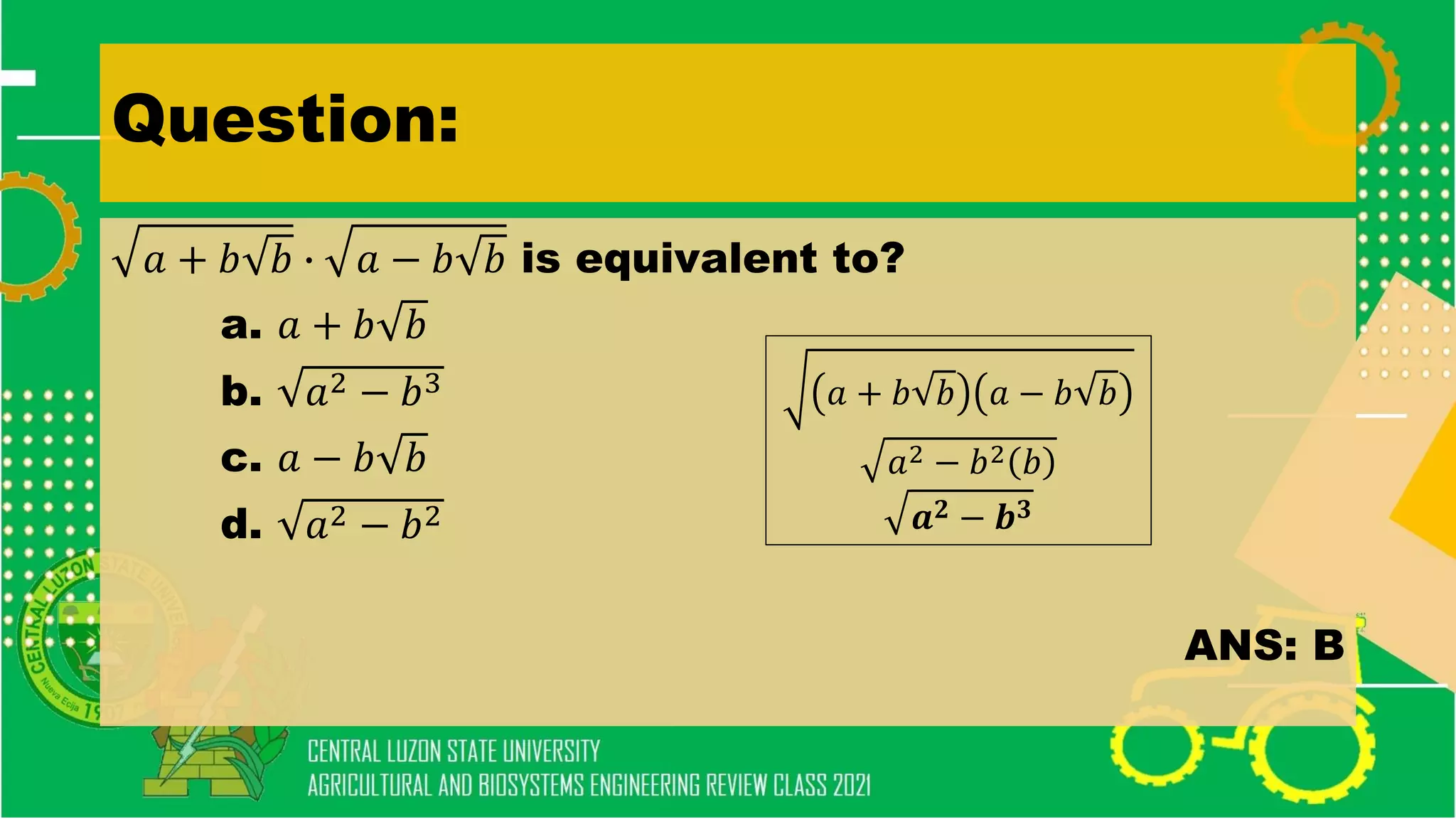
Question:
𝑎 + 𝑏 𝑏 ∙ 𝑎 − 𝑏 𝑏 is equivalent to?
a. 𝑎 + 𝑏 𝑏
b. 𝑎2 − 𝑏3
c. 𝑎 − 𝑏 𝑏
d. 𝑎2 − 𝑏2
ANS: B
𝑎 + 𝑏 𝑏 𝑎 − 𝑏 𝑏
𝑎2 − 𝑏2 𝑏
𝒂𝟐 − 𝒃𝟑
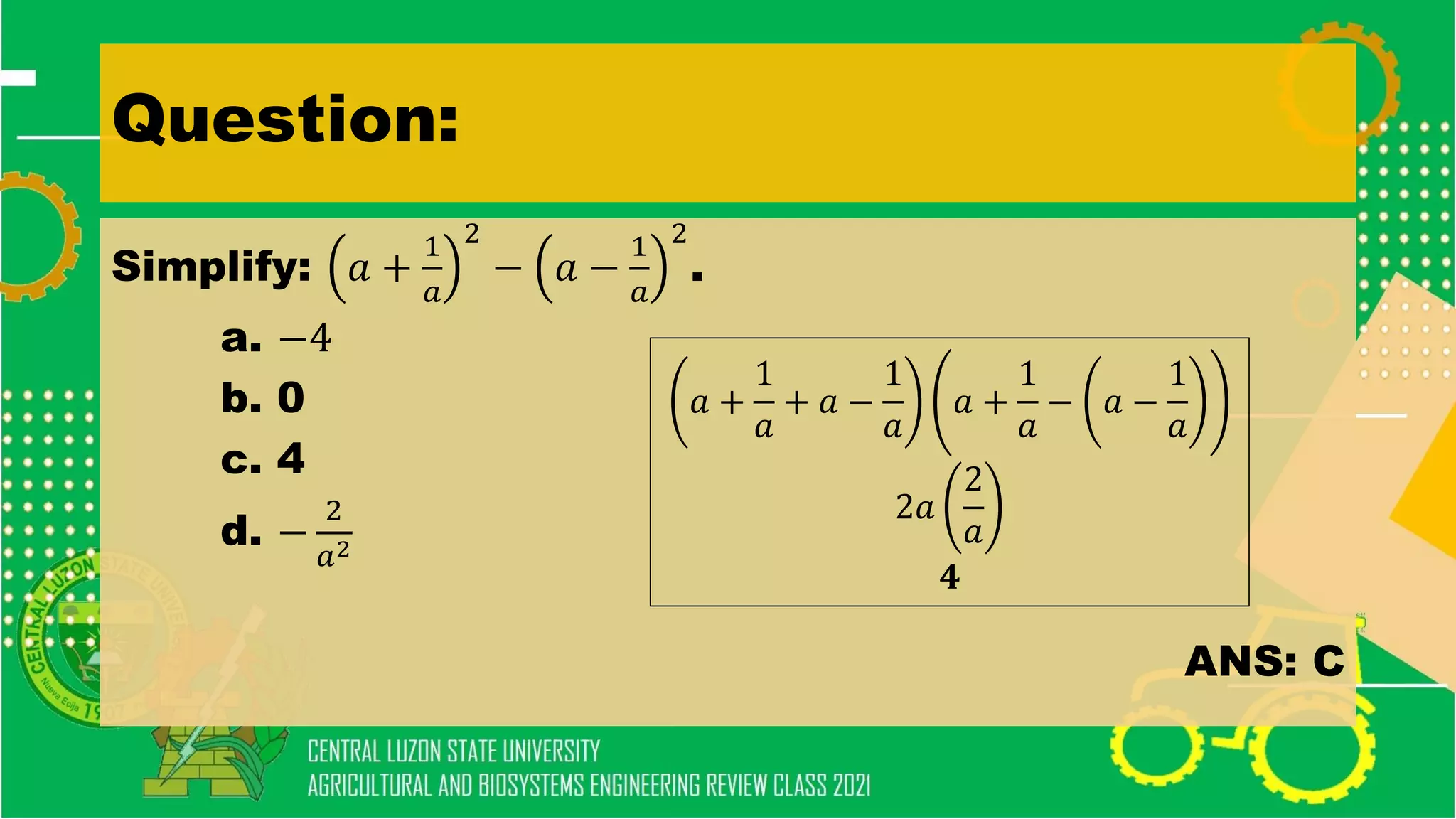
Question:
Simplify: 𝑎 +
1
𝑎
2
− 𝑎 −
1
𝑎
2
.
a. −4
b. 0
c. 4
d. −
2
𝑎2
ANS: C
𝑎 +
1
𝑎
+ 𝑎 −
1
𝑎
𝑎 +
1
𝑎
− 𝑎 −
1
𝑎
2𝑎
2
𝑎
𝟒
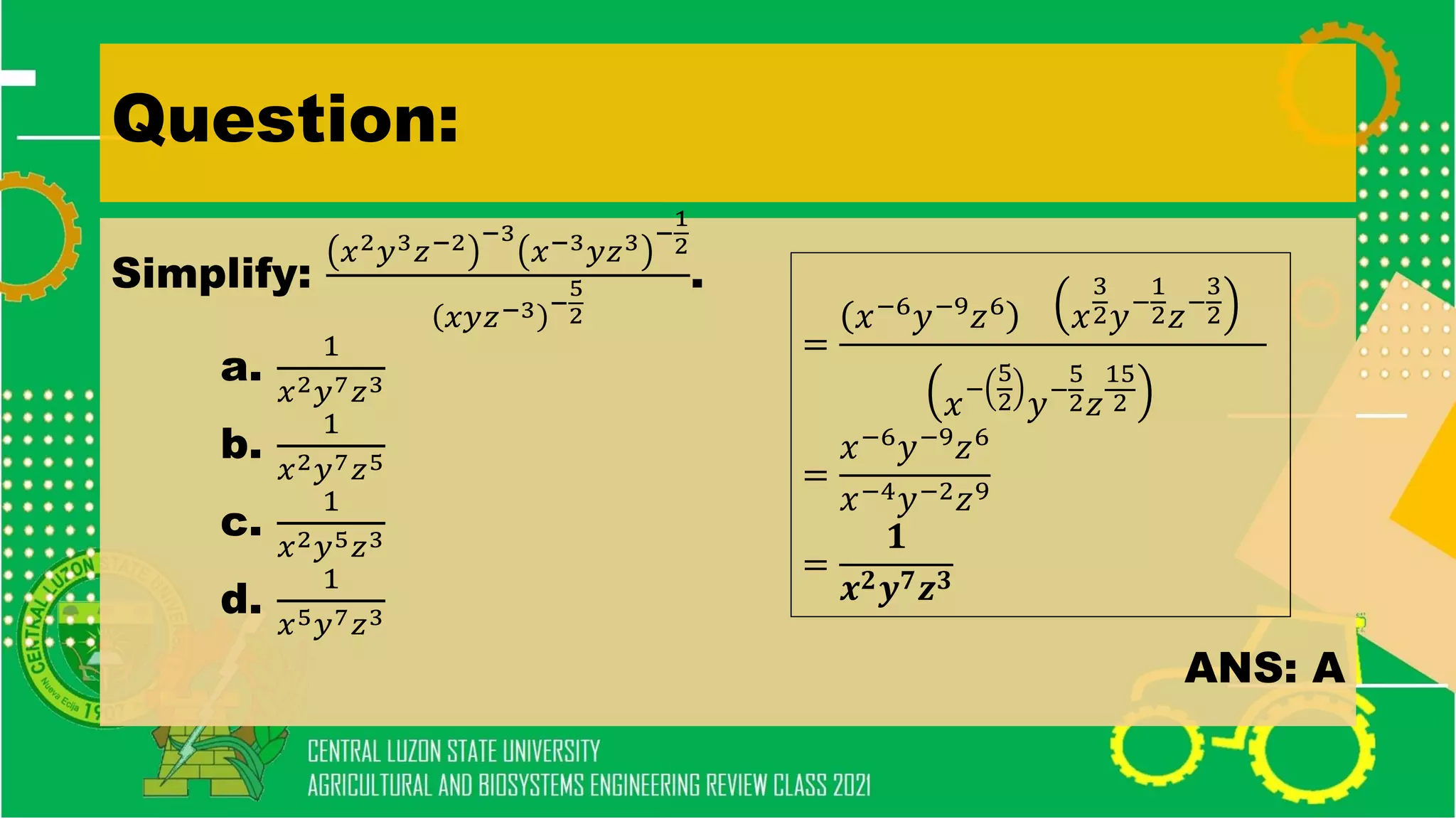
Question:
Simplify:
𝑥2𝑦3𝑧−2 −3
𝑥−3𝑦𝑧3 −
1
2
𝑥𝑦𝑧−3 −
5
2
.
a.
1
𝑥2𝑦7𝑧3
b.
1
𝑥2𝑦7𝑧5
c.
1
𝑥2𝑦5𝑧3
d.
1
𝑥5𝑦7𝑧3
ANS: A
=
𝑥−6
𝑦−9
𝑧6
𝑥
3
2𝑦−
1
2𝑧−
3
2
𝑥
−
5
2 𝑦−
5
2𝑧
15
2
=
𝑥−6𝑦−9𝑧6
𝑥−4𝑦−2𝑧9
=
𝟏
𝒙𝟐𝒚𝟕𝒛𝟑
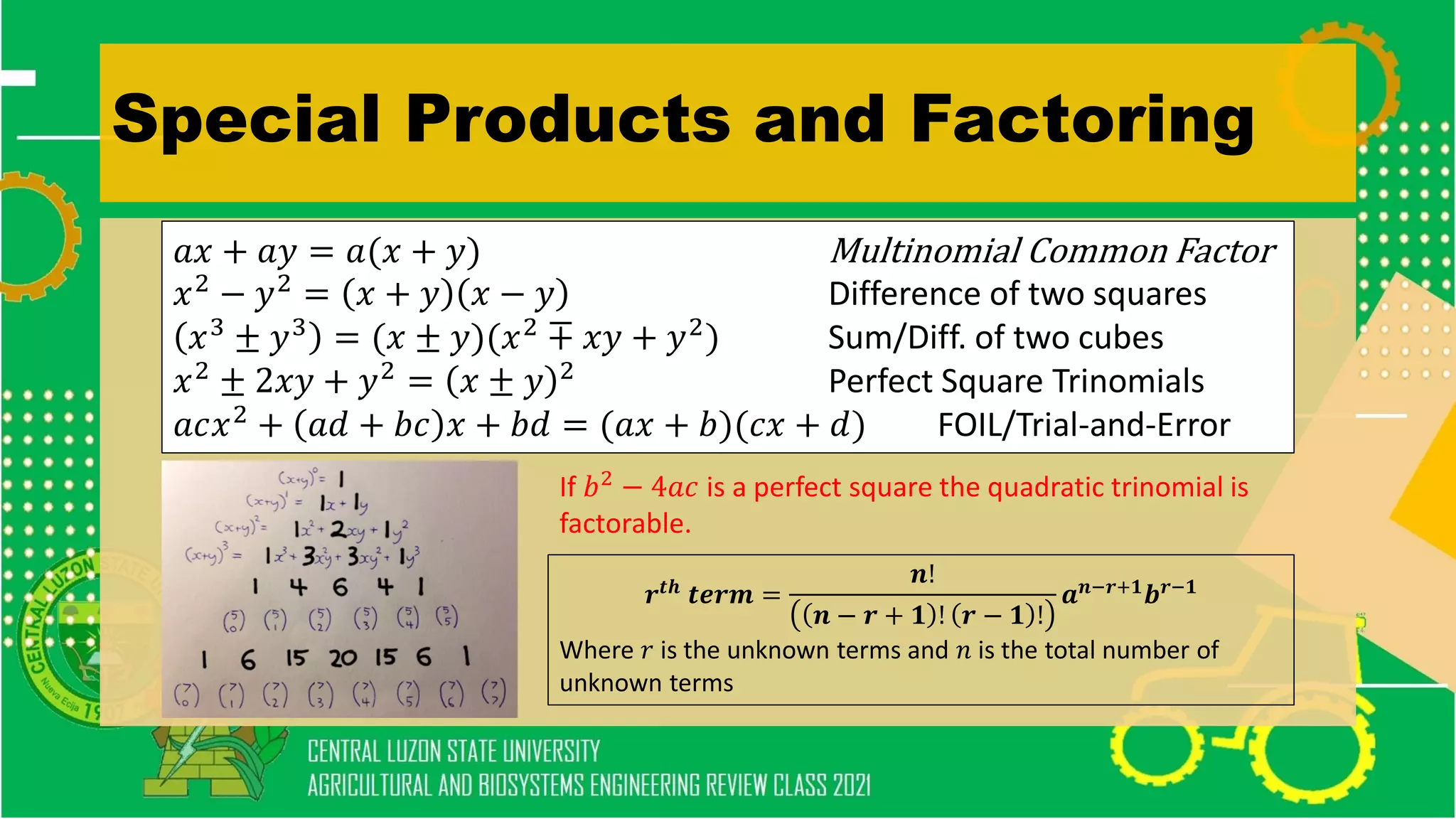
Special Products and Factoring
𝑎𝑥 + 𝑎𝑦 = 𝑎(𝑥 + 𝑦) Multinomial Common Factor
𝑥2 − 𝑦2 = 𝑥 + 𝑦 𝑥 − 𝑦 Difference of two squares
𝑥3 ± 𝑦3 = (𝑥 ± 𝑦)(𝑥2 ∓ 𝑥𝑦 + 𝑦2) Sum/Diff. of two cubes
𝑥2
± 2𝑥𝑦 + 𝑦2
= 𝑥 ± 𝑦 2
Perfect Square Trinomials
𝑎𝑐𝑥2 + 𝑎𝑑 + 𝑏𝑐 𝑥 + 𝑏𝑑 = (𝑎𝑥 + 𝑏)(𝑐𝑥 + 𝑑) FOIL/Trial-and-Error
𝒓𝒕𝒉
𝒕𝒆𝒓𝒎 =
𝒏!
𝒏 − 𝒓 + 𝟏 ! 𝒓 − 𝟏 !
𝒂𝒏−𝒓+𝟏
𝒃𝒓−𝟏
Where 𝑟 is the unknown terms and 𝑛 is the total number of
unknown terms
If 𝑏2
− 4𝑎𝑐 is a perfect square the quadratic trinomial is
factorable.
Horizontal Multiplication
We can always multiply polynomials by polynomials
using the distribution methods.
Multiply (2𝑥2
− 3𝑥𝑦 + 𝑦2
)(−3𝑥2
+ 2𝑥𝑦 − 3𝑦2
).
−3𝑥2 2𝑥2 − 3𝑥𝑦 + 𝑦2 + 2𝑥𝑦 2𝑥2 − 3𝑥𝑦 + 𝑦2 − 3y2(2𝑥2 − 3𝑥𝑦 + 𝑦2)
−6𝑥4
+ 9𝑥3
𝑦 − 3𝑥2
𝑦2
+ 4𝑥3
𝑦 − 6𝑥2
𝑦2
+ 2𝑥𝑦3
− 6𝑥2
𝑦2
+ 9𝑥𝑦3
− 3𝑦4
−𝟔𝒙𝟒
+ 𝟏𝟑𝒙𝟑
𝒚 − 𝟏𝟓𝒙𝟐
𝒚𝟐
+ 𝟏𝟏𝒙𝒚𝟑
− 𝟑𝒚𝟒
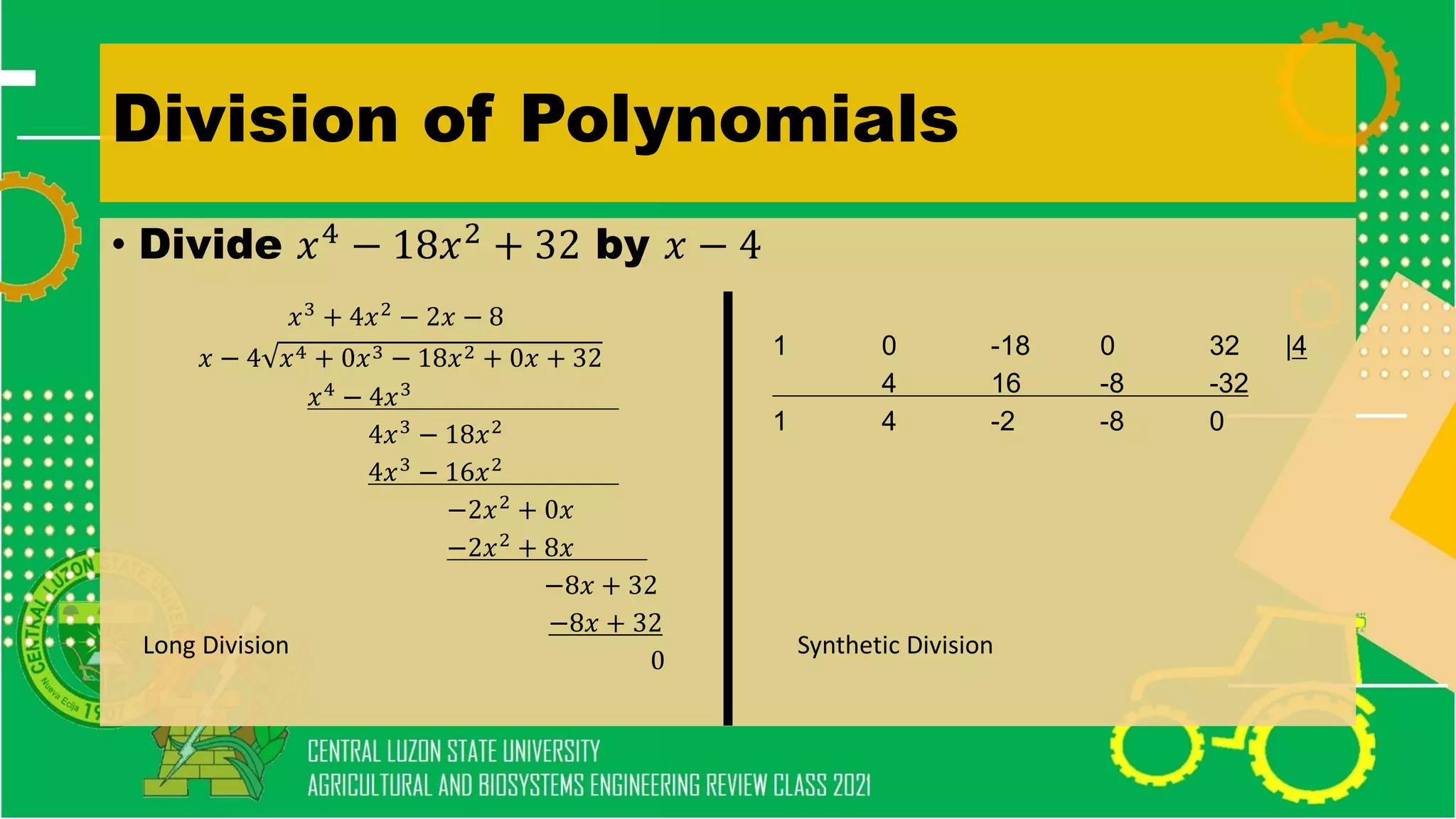
Division of Polynomials
• Divide 𝑥4
− 18𝑥2
+ 32 by 𝑥 − 4
𝑥3
+ 4𝑥2
− 2𝑥 − 8
𝑥 − 4 𝑥4 + 0𝑥3 − 18𝑥2 + 0𝑥 + 32
𝑥4 − 4𝑥3
4𝑥3 − 18𝑥2
4𝑥3
− 16𝑥2
−2𝑥2
+ 0𝑥
−2𝑥2 + 8𝑥
−8𝑥 + 32
−8𝑥 + 32
0
1 0 -18 0 32 |4
4 16 -8 -32
1 4 -2 -8 0
Long Division Synthetic Division
Factor and Remainder theorem
Given a function 𝑓(𝑥) and a binomial 𝑥 − 𝑐 where c is
constant.
FACTOR. If 𝑓 𝑐 = 0, then 𝑥 − 𝑐 is a factor of 𝑓(𝑥).
Example: f x = 2𝑥3 + 5𝑥2 − 𝑥 − 6 and 𝑥 + 2.
𝑓 −2 = 2 −2 3
+ 5 −22
− −2 − 6 = 0
REMAINDER. If 𝑓 𝑐 = 𝑧 where 𝑧 ≠ 0, then 𝑧 is the
exponent whenever 𝑓(𝑥) is divided by 𝑥 − 𝑐.
Example: 𝑓 2 = 2 23
+ 5 22
− 2 − 6 = 28
Sum of Coefficient of Variables
Substitute 1 to each variables in the polynomials
then simplify the expression to get the sum of its
coefficients.
Example: Find the coefficients of the variables in the
expansion 2𝑥 + 3𝑦 − 1 4.
2 1 + 3 1 − 1 4 = 44 = 256
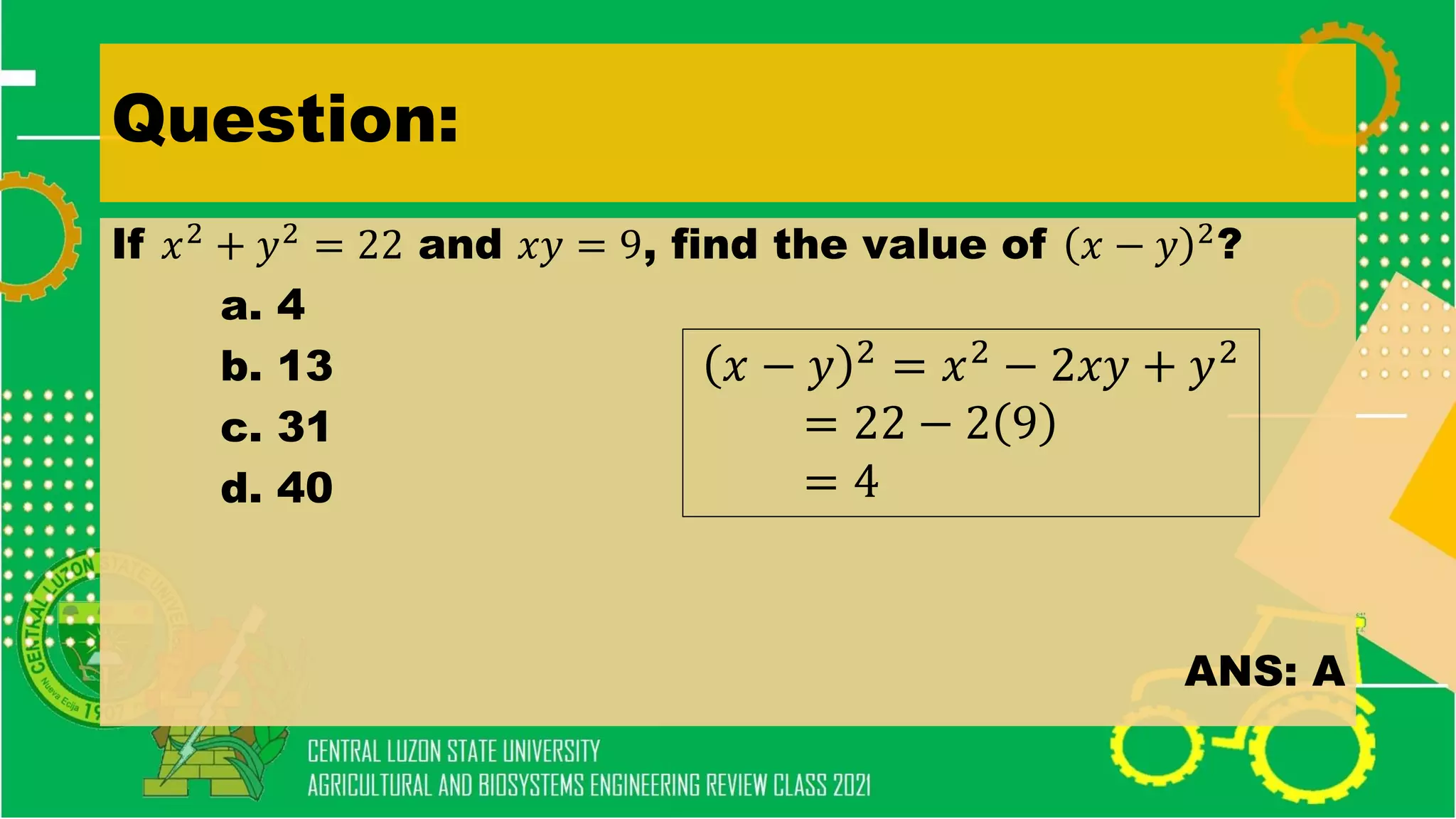
Question:
If 𝑥2
+ 𝑦2
= 22 and 𝑥𝑦 = 9, find the value of 𝑥 − 𝑦 2
?
a. 4
b. 13
c. 31
d. 40
ANS: A
𝑥 − 𝑦 2
= 𝑥2
− 2𝑥𝑦 + 𝑦2
= 22 − 2 9
= 4
Question:
Factor 𝑎4
− 𝑏2
+ 𝑏 − 𝑎2
as completely as possible.
a. 𝑎2
+ 𝑏 𝑎2
+ 𝑏 − 1
b. 𝑎2
+ 𝑏 𝑎2
− 𝑏 − 1
c. 𝑎2 − 𝑏 𝑎2 + 𝑏 − 1
d. 𝑎2
− 𝑏 𝑎2
− 𝑏 − 1
ANS: C
= 𝑎4 − 𝑏2 − 𝑎2 − 𝑏
= 𝑎2
+ 𝑏 𝑎2
− 𝑏 − 𝑎2
− 𝑏
= (𝒂𝟐 − 𝒃)(𝒂𝟐 + 𝒃 − 𝟏)
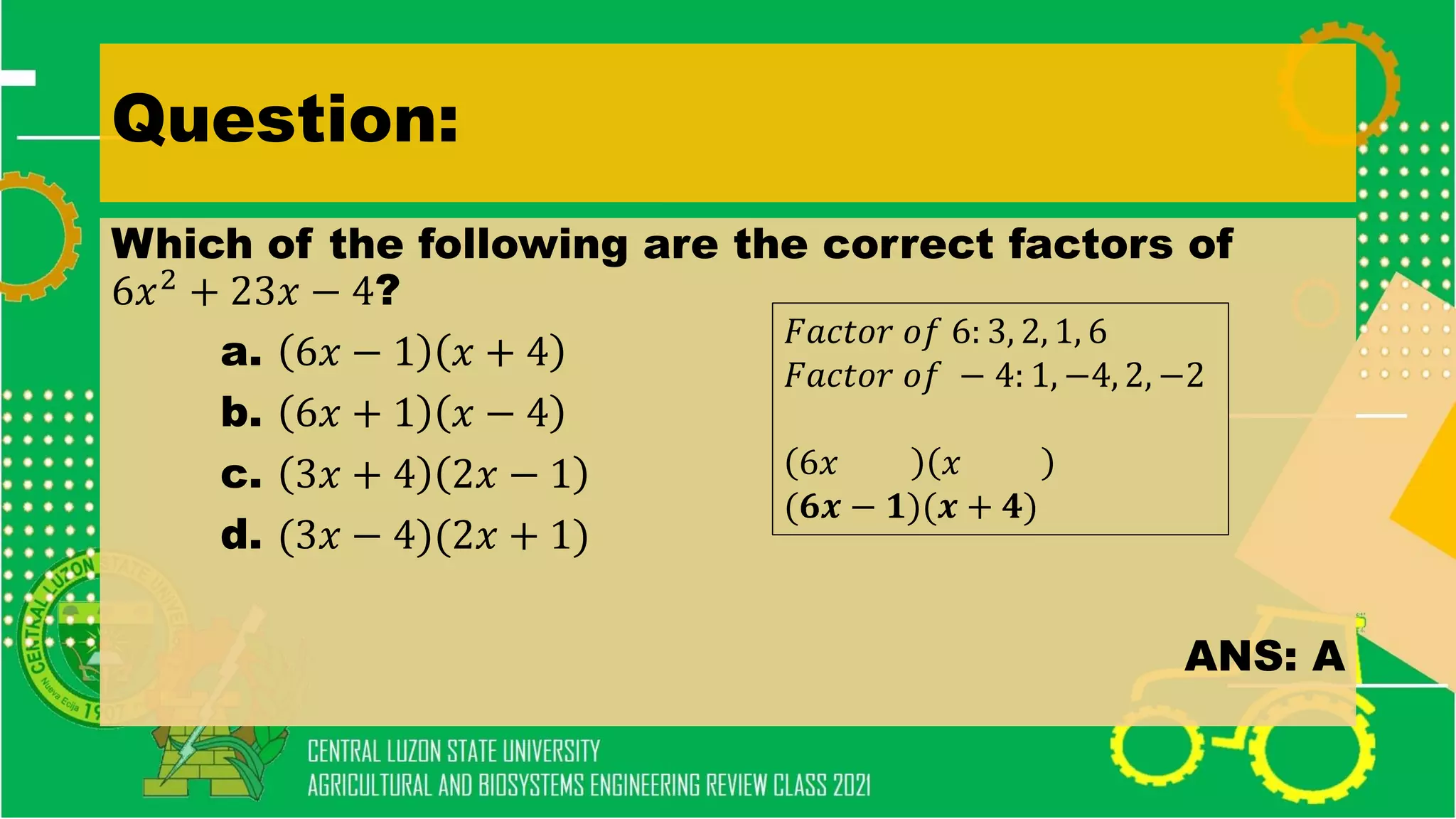
Question:
Which of the following are the correct factors of
6𝑥2
+ 23𝑥 − 4?
a. 6𝑥 − 1 𝑥 + 4
b. 6𝑥 + 1 𝑥 − 4
c. 3𝑥 + 4 2𝑥 − 1
d. (3𝑥 − 4)(2𝑥 + 1)
ANS: A
𝐹𝑎𝑐𝑡𝑜𝑟 𝑜𝑓 6: 3, 2, 1, 6
𝐹𝑎𝑐𝑡𝑜𝑟 𝑜𝑓 − 4: 1, −4, 2, −2
6𝑥 𝑥
(𝟔𝒙 − 𝟏)(𝒙 + 𝟒)
Question:
Factor the expression 𝑥6
− 1 as completely as
possible.
a. 𝑥 + 1 𝑥 − 1 𝑥4
+ 𝑥2
− 1
b. 𝑥 + 1 𝑥 − 1 𝑥4 + 2𝑥2 + 1
c. 𝑥 + 1 𝑥 − 1 𝑥4
− 𝑥2
+ 1
d. (𝑥 + 1)(𝑥 − 1)(𝑥4 + 𝑥2 + 1)
ANS: D
𝑥2
− 1 𝑥4
+ 𝑥2
+ 1
(𝑥 + 1)(𝑥 − 1)(𝑥4 + 𝑥2 + 1)
Question:
Give a 3rd term so that 4𝑥4
+ 9𝑦2
becomes a perfect
square trinomial.
a. 6𝑥2
𝑦
b. 12𝑥2𝑦2
c. 12𝑥2
𝑦
d. 36𝑥2𝑦
ANS: C
4𝑥4
+ 9𝑦2
1st = 2𝑥2
2nd = 3𝑦
3rd = 2*1st *2nd
= 2 2𝑥2
3𝑦
= 𝟏𝟐𝒙𝟐
𝒚
Question:
Simplify:
5𝑥
2𝑥2+7𝑥+3
−
𝑥+3
2𝑥2−3𝑥−2
+
2𝑥+1
𝑥2+𝑥−6
.
a.
2
𝑥−3
b.
𝑥−3
5
c.
𝑥+3
𝑥−1
d.
4
𝑥+3
ANS: D
=
5𝑥
2𝑥 + 1 𝑥 + 3
−
𝑥 + 3
2𝑥 + 1 𝑥 − 2
+
2𝑥 + 1
𝑥 + 3 𝑥 − 2
=
5𝑥 𝑥 − 2 − 𝑥 + 3 𝑥 + 3 + 2𝑥 + 1 2𝑥 + 1
2𝑥 + 1 𝑥 + 3 𝑥 − 2
=
5𝑥2 − 10𝑥 − 𝑥2 − 6𝑥 − 9 + 4𝑥2 + 4𝑥 + 1
2𝑥 + 1 𝑥 + 3 𝑥 − 2
=
8𝑥2 − 12𝑥 − 8
2𝑥 + 1 𝑥 + 3 𝑥 − 2
=
4 2𝑥 + 1 𝑥 − 2
2𝑥 + 1 𝑥 + 3 𝑥 − 2
=
𝟒
𝒙 + 𝟑
Question:
Simplify:
𝑚3−8
2𝑚−1
∙
2𝑚2+3𝑚−2
𝑚2−4
.
a. 𝑚2 + 2𝑚 + 4
b. 𝑚2 + 2𝑚 − 4
c. 𝑚2 − 2𝑚 + 4
d. 𝑚2 − 2𝑚 − 4
ANS: A
=
𝑚 − 2 𝑚2
+ 2𝑚 + 4
2𝑚 − 1
∙
2𝑚 − 1 𝑚 + 2
𝑚 + 2 𝑚 − 2
= 𝒎𝟐
+ 𝟐𝒎 + 𝟒
Question:
What is the remainder if 2𝑥3
− 3𝑥2
+ 5𝑥 − 4 is divided
by 𝑥 − 1?
a. 0
b. -8
c. -4
d. 6
ANS: A
𝑥 − 𝑐 = 𝑥 − 1 𝑠𝑜 𝑐 = 1
= 2 1 3 − 3 1 2 + 5 1 − 4
= 𝟎
Question:
Given: 𝑓 𝑥 = 𝑥 − 3 𝑥 + 4 + 4 when divided by (𝑥 − 𝑘),
the remainder is 𝑘. Find 𝑘.
a. 2
b. 3
c. 4
d. -3
ANS: C
𝑓 𝑥 = 𝑥2
+ 𝑥 − 8
𝑓 𝑘 = 𝑘
𝑘 = 𝑘2
+ 𝑘 − 8
0 = 𝑘2 − 8
𝒌 = ±𝟒
Question:
Find the sum of the coefficients of all terms in
5𝑥2
− 3𝑦2 8
?
a. 186
b. 256
c. 512
d. 542
ANS: B
Substitute 1 to all variables
= 5 1 2
− 3 1 2 8
= 28 or 256
Linear Equations in One Unknown
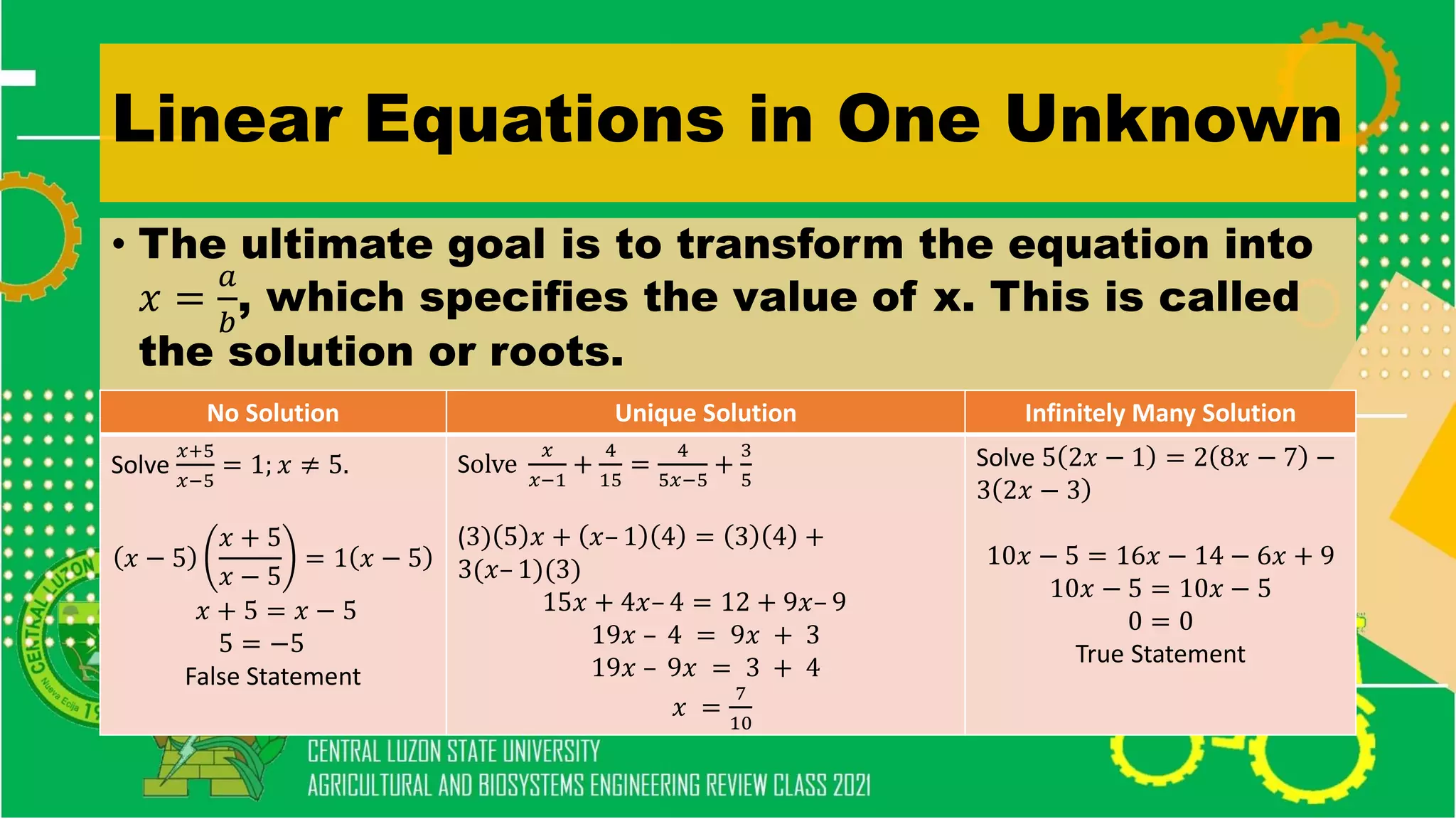
• The ultimate goal is to transform the equation into
𝑥 =
𝑎
𝑏
, which specifies the value of x. This is called
the solution or roots.
No Solution Unique Solution Infinitely Many Solution
Solve
𝑥+5
𝑥−5
= 1; 𝑥 ≠ 5.
𝑥 − 5
𝑥 + 5
𝑥 − 5
= 1 𝑥 − 5
𝑥 + 5 = 𝑥 − 5
5 = −5
False Statement
Solve
𝑥
𝑥−1
+
4
15
=
4
5𝑥−5
+
3
5
(3) 5 𝑥 + 𝑥– 1 4 = 3 4 +
3(𝑥– 1)(3)
15𝑥 + 4𝑥– 4 = 12 + 9𝑥– 9
19𝑥 – 4 = 9𝑥 + 3
19𝑥 – 9𝑥 = 3 + 4
𝑥 =
7
10
Solve 5 2𝑥 − 1 = 2 8𝑥 − 7 −
3 2𝑥 − 3
10𝑥 − 5 = 16𝑥 − 14 − 6𝑥 + 9
10𝑥 − 5 = 10𝑥 − 5
0 = 0
True Statement
Solving Linear Equation w/ Two
Unknown
• Graphical Method
Unique Solution Infinitely Many No Solution
Solving Linear Equation w/ Two
Unknown
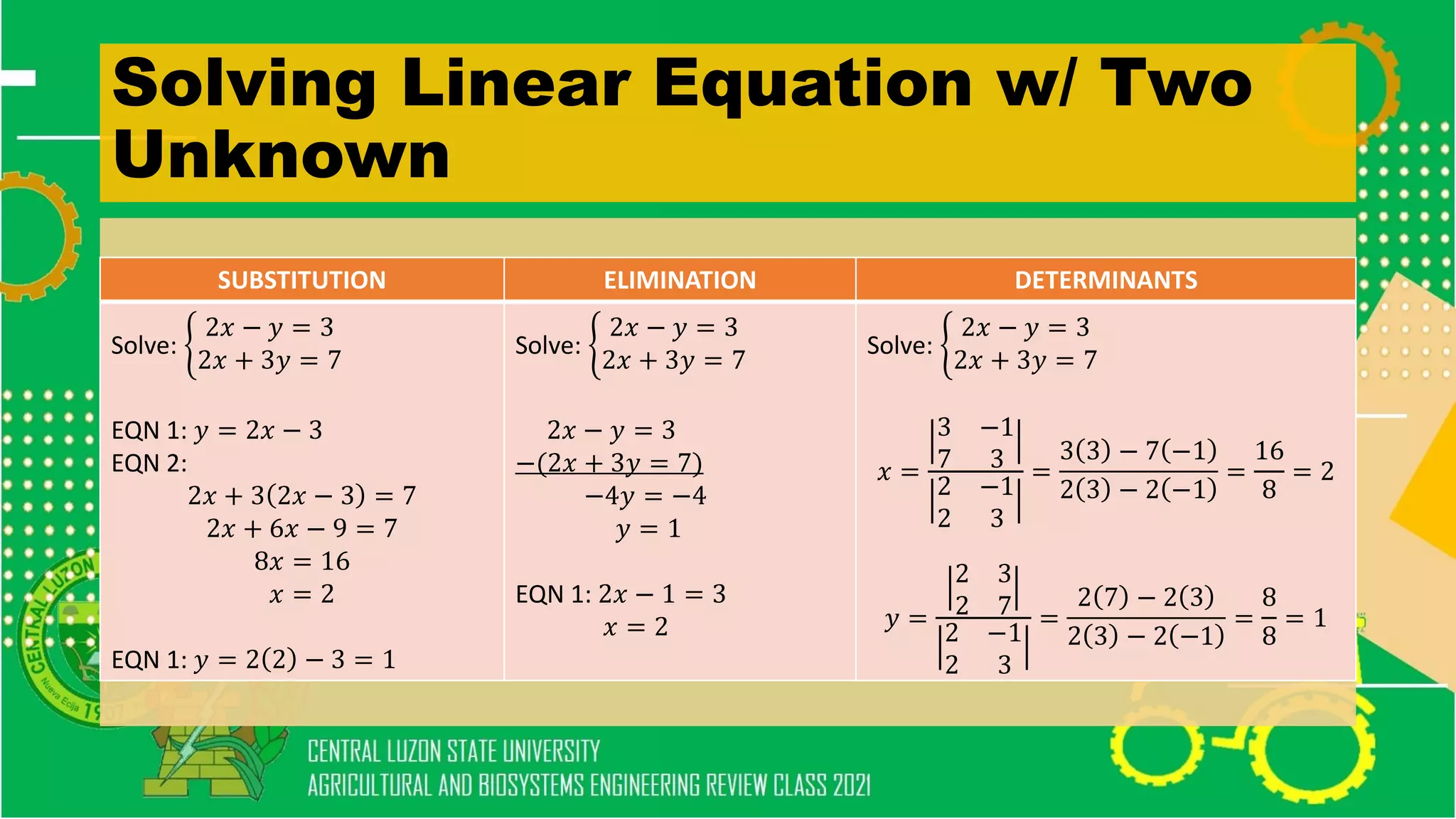
SUBSTITUTION ELIMINATION DETERMINANTS
Solve:
2𝑥 − 𝑦 = 3
2𝑥 + 3𝑦 = 7
EQN 1: 𝑦 = 2𝑥 − 3
EQN 2:
2𝑥 + 3 2𝑥 − 3 = 7
2𝑥 + 6𝑥 − 9 = 7
8𝑥 = 16
𝑥 = 2
EQN 1: 𝑦 = 2 2 − 3 = 1
Solve:
2𝑥 − 𝑦 = 3
2𝑥 + 3𝑦 = 7
2𝑥 − 𝑦 = 3
−(2𝑥 + 3𝑦 = 7)
−4𝑦 = −4
𝑦 = 1
EQN 1: 2𝑥 − 1 = 3
𝑥 = 2
Solve:
2𝑥 − 𝑦 = 3
2𝑥 + 3𝑦 = 7
𝑥 =
3 −1
7 3
2 −1
2 3
=
3 3 − 7 −1
2 3 − 2 −1
=
16
8
= 2
𝑦 =
2 3
2 7
2 −1
2 3
=
2 7 − 2 3
2 3 − 2 −1
=
8
8
= 1
Question:
Find the value of 𝑥 and 𝑦 that satisfies the system of
equations: 3𝑥 − 𝑦 = 6 and 9𝑥 − 𝑦 = 12.
a. 𝑥 = 3; 𝑦 = 1
b. 𝑥 = 1; y = −3
c. 𝑥 = 2; 𝑦 = 2
d. 𝑥 = 4; 𝑦 = 2
ANS: B
3𝑥 − 𝑦 = 6
− 9𝑥 − 𝑦 = 12
−6𝑥 = −6
Implies 𝒙 = 𝟏.
3 1 − 𝑦 = 6
𝒚 = −𝟑
Question:
If 𝑓 𝑥 = 2𝑥2
− 𝑥 + 1, what is the value of 𝑓 𝑥 − 𝑓(𝑥 + 1)?
a. 4x-1
b. -4x-1
c. 4x+1
d. 1-4x
ANS: B
= 2𝑥2 − 𝑥 + 1 − 2 𝑥 + 1 2 − 𝑥 + 1 + 1
= 2𝑥2
− 𝑥 + 1 − 2𝑥2
− 4𝑥 − 2 + 𝑥 + 1 − 1
= −𝟒𝒙 − 𝟏
Solving Quadratic Equation
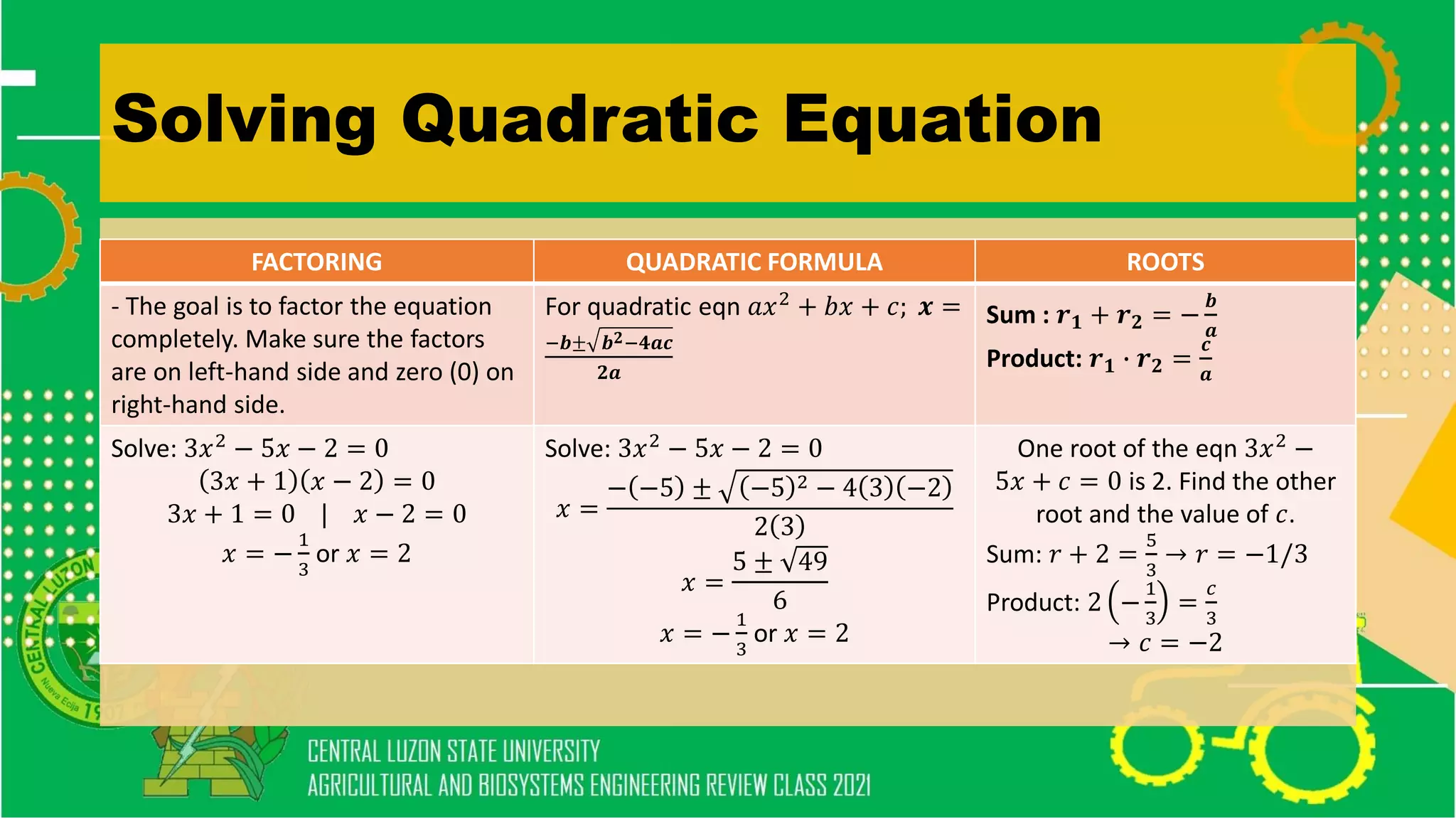
FACTORING QUADRATIC FORMULA ROOTS
- The goal is to factor the equation
completely. Make sure the factors
are on left-hand side and zero (0) on
right-hand side.
For quadratic eqn 𝑎𝑥2 + 𝑏𝑥 + 𝑐; 𝒙 =
−𝒃± 𝒃𝟐−𝟒𝒂𝒄
𝟐𝒂
Sum : 𝒓𝟏 + 𝒓𝟐 = −
𝒃
𝒂
Product: 𝒓𝟏 ∙ 𝒓𝟐 =
𝒄
𝒂
Solve: 3𝑥2 − 5𝑥 − 2 = 0
3𝑥 + 1 𝑥 − 2 = 0
3𝑥 + 1 = 0 | 𝑥 − 2 = 0
𝑥 = −
1
3
or 𝑥 = 2
Solve: 3𝑥2 − 5𝑥 − 2 = 0
𝑥 =
− −5 ± −5 2 − 4 3 −2
2 3
𝑥 =
5 ± 49
6
𝑥 = −
1
3
or 𝑥 = 2
One root of the eqn 3𝑥2 −
5𝑥 + 𝑐 = 0 is 2. Find the other
root and the value of 𝑐.
Sum: 𝑟 + 2 =
5
3
→ 𝑟 = −1/3
Product: 2 −
1
3
=
𝑐
3
→ 𝑐 = −2
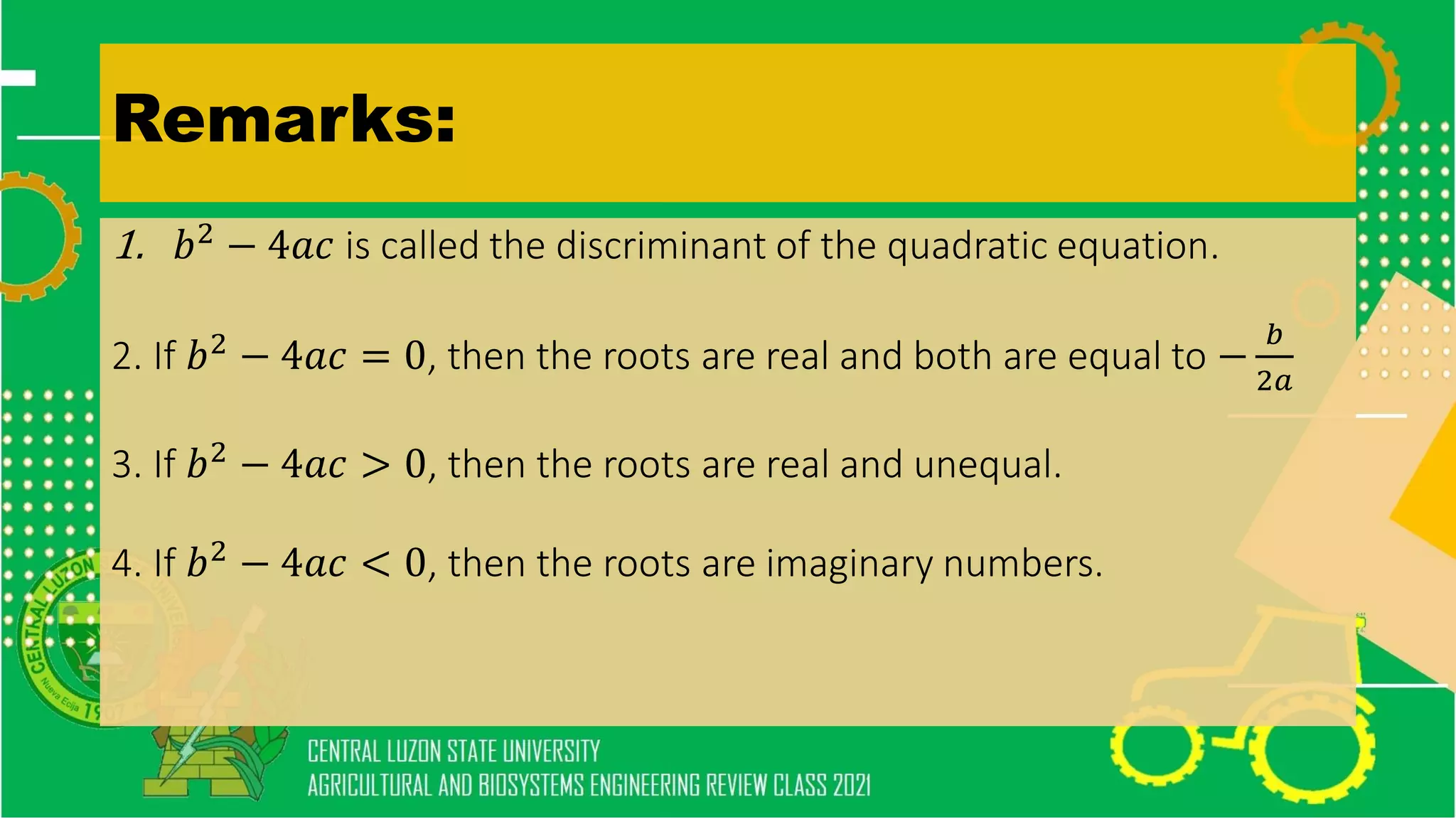
Remarks:
1. 𝑏2
− 4𝑎𝑐 is called the discriminant of the quadratic equation.
2. If 𝑏2
− 4𝑎𝑐 = 0, then the roots are real and both are equal to −
𝑏
2𝑎
3. If 𝑏2 − 4𝑎𝑐 > 0, then the roots are real and unequal.
4. If 𝑏2
− 4𝑎𝑐 < 0, then the roots are imaginary numbers.
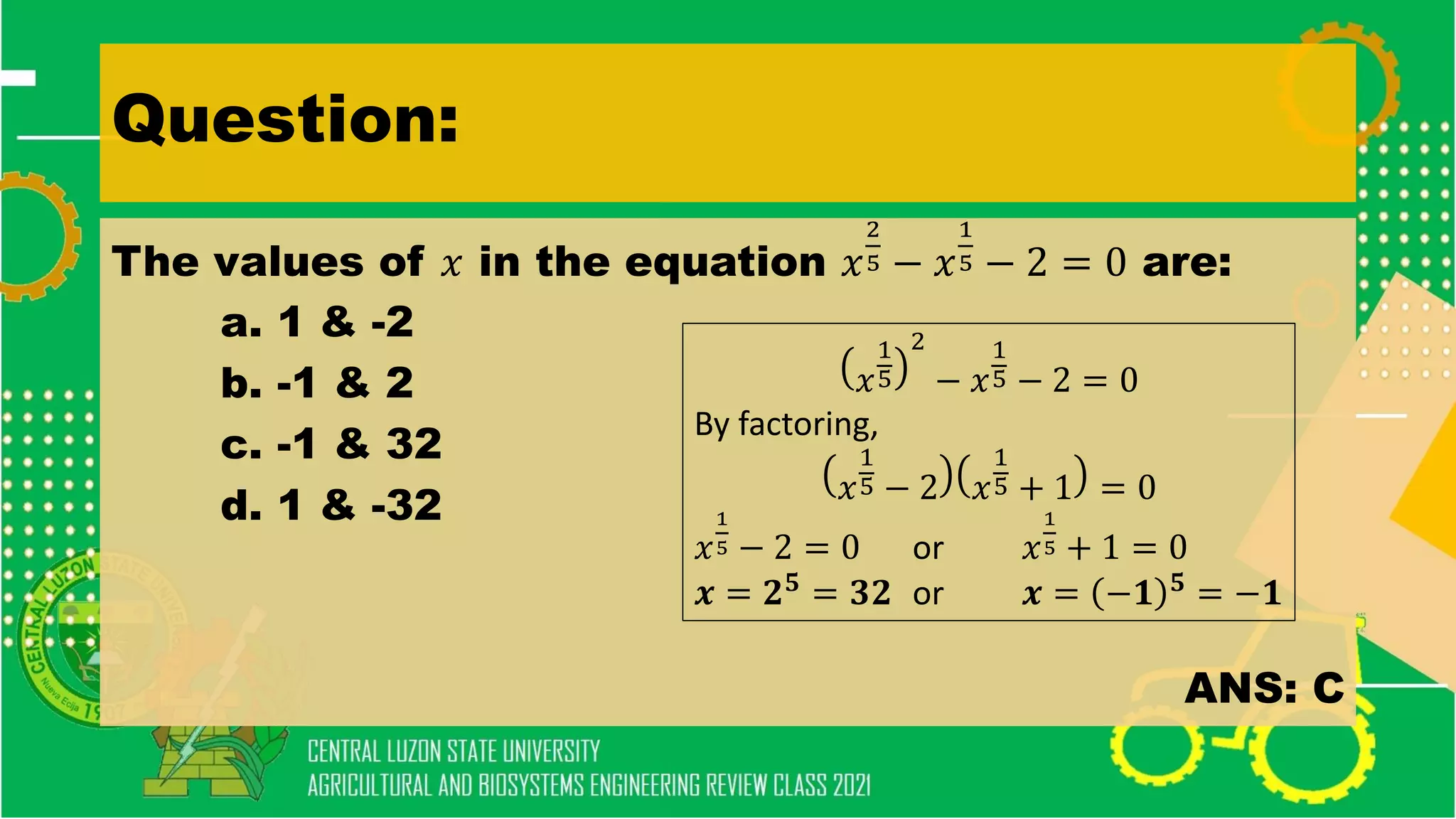
Question:
The values of 𝑥 in the equation 𝑥
2
5 − 𝑥
1
5 − 2 = 0 are:
a. 1 & -2
b. -1 & 2
c. -1 & 32
d. 1 & -32
ANS: C
𝑥
1
5
2
− 𝑥
1
5 − 2 = 0
By factoring,
𝑥
1
5 − 2 𝑥
1
5 + 1 = 0
𝑥
1
5 − 2 = 0 or 𝑥
1
5 + 1 = 0
𝒙 = 𝟐𝟓
= 𝟑𝟐 or 𝒙 = −𝟏 𝟓
= −𝟏
Question:
Give the sum of the roots of 2𝑥2
− 8𝑥 + 1 = 0.
a. 4
b. -5
c. -2
d. 2
ANS: A
𝑟1 + 𝑟2 = −
−8
2
= 𝟒
Question:
Find 𝑘 in the equation 4𝑥2
+ 𝑘𝑥 + 9 = 0 so that it will
only have one real root.
a. 10
b. 11
c. 12
d. 13
ANS: C
Real and unique roots if 𝑏2
− 4𝑎𝑐 = 0
𝑘2
− 4 4 9 = 0
𝑘2 = 144
𝒌 = ±𝟏𝟐
Question:
Find the roots of 𝑥2 − 4 + 4𝑥 = 0.
a. 2
b. 2 and -2
c. 0
d. no root
ANS: D
𝑥2 − 4 = − 4𝑥
𝑥2
− 4 = 4𝑥
𝑥2
− 4𝑥 − 4 = 0
𝑥 − 2 2
= 0
𝑥 = 2
Checking: 0 + 16 ≠ 0.
False statement → No roots
Partial Fractions
Illustrations:
•
3
𝑥−1 𝑥+2
=
𝐴
𝑥−1
+
𝐵
𝑥+2
•
3𝑥2+2𝑥+1
𝑥−1 3 =
𝐴
𝑥−1
+
𝐵
𝑥−1 2 +
𝐶
𝑥−1 3
•
3𝑥−5
𝑥−1 𝑥2+𝑥+1 2 =
𝐴
𝑥−1
+
𝐵𝑥+𝐶
𝑥2+𝑥+1
+
𝐷𝑥+𝐸
𝑥2+𝑥+1 2
•
3𝑥−2
𝑥−1 2 𝑥2+𝑥+1
=
𝐴
𝑥−1
+
𝐵
𝑥−1 2 +
𝐶𝑥+𝐷
𝑥2+𝑥+1
Question:
Find A and B such that
𝑥+10
𝑥2−4
=
𝐴
𝑥−2
+
𝐵
𝑥+2
.
a. A= -3; B= 2
b. A= -3; B= -2
c. A= 3; B= -2
d. A= 3; B= 2
ANS: C
𝑥 + 10 = 𝐴 𝑥 + 2 + 𝐵 𝑥 − 2
𝑥 + 10 = 𝐴 + 𝐵 𝑥 + 2𝐴 − 2𝐵
This implies
𝐴 + 𝐵 = 1 and 2𝐴 − 2𝐵 = 10
Then, 2 1 − 𝐵 − 2𝐵 = 10
−4𝐵 = 8
𝑩 = −𝟐
From 𝐴 + 𝐵 = 1
𝑨 = 𝟑
Question:
Find the value of A:
𝑥2 + 4𝑥 + 10
𝑥3 + 2𝑥2 + 5𝑥
=
𝐴
𝑥
+
𝐵 2𝑥 + 2
𝑥2 + 2𝑥 + 5
+
𝐶
𝑥2 + 2𝑥 + 5
a. 2
b. -2
c. ½
d. -1/2
ANS: A
𝑥2 + 4𝑥 + 10 = 𝐴 𝑥2 + 2𝑥 + 5 + 𝐵𝑥 2𝑥 + 2 + 𝐶𝑥
𝑥2
+ 4𝑥 + 10 = 𝐴 + 2𝐵 𝑥2
+ 2𝐴 + 2𝐵 + 𝐶 𝑥 + 5𝐴
5𝐴 = 10
𝑨 = 𝟐
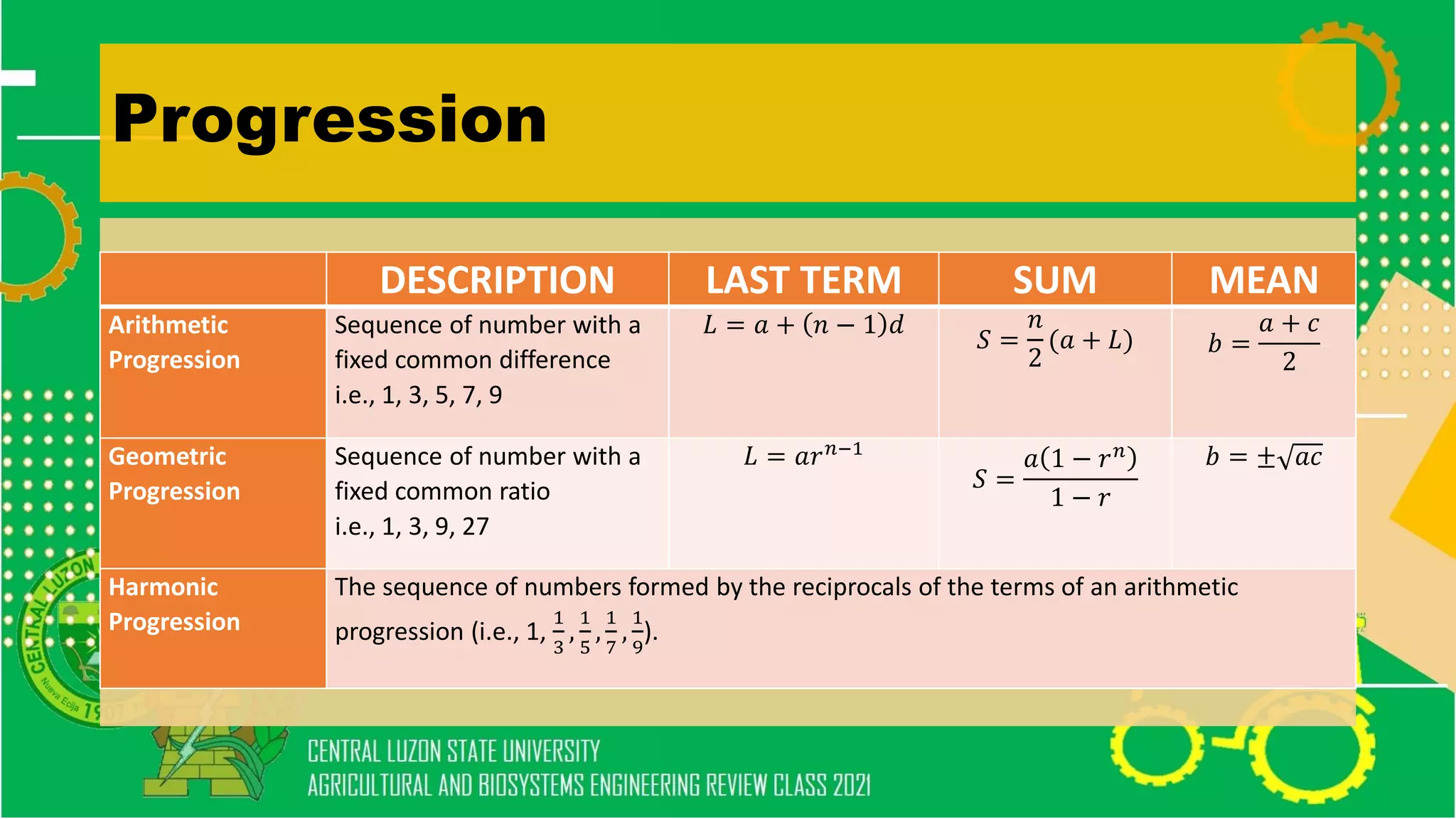
Progression
DESCRIPTION LAST TERM SUM MEAN
Arithmetic
Progression
Sequence of number with a
fixed common difference
i.e., 1, 3, 5, 7, 9
𝐿 = 𝑎 + 𝑛 − 1 𝑑
𝑆 =
𝑛
2
(𝑎 + 𝐿) 𝑏 =
𝑎 + 𝑐
2
Geometric
Progression
Sequence of number with a
fixed common ratio
i.e., 1, 3, 9, 27
𝐿 = 𝑎𝑟𝑛−1
𝑆 =
𝑎 1 − 𝑟𝑛
1 − 𝑟
𝑏 = ± 𝑎𝑐
Harmonic
Progression
The sequence of numbers formed by the reciprocals of the terms of an arithmetic
progression (i.e., 1,
1
3
,
1
5
,
1
7
,
1
9
).
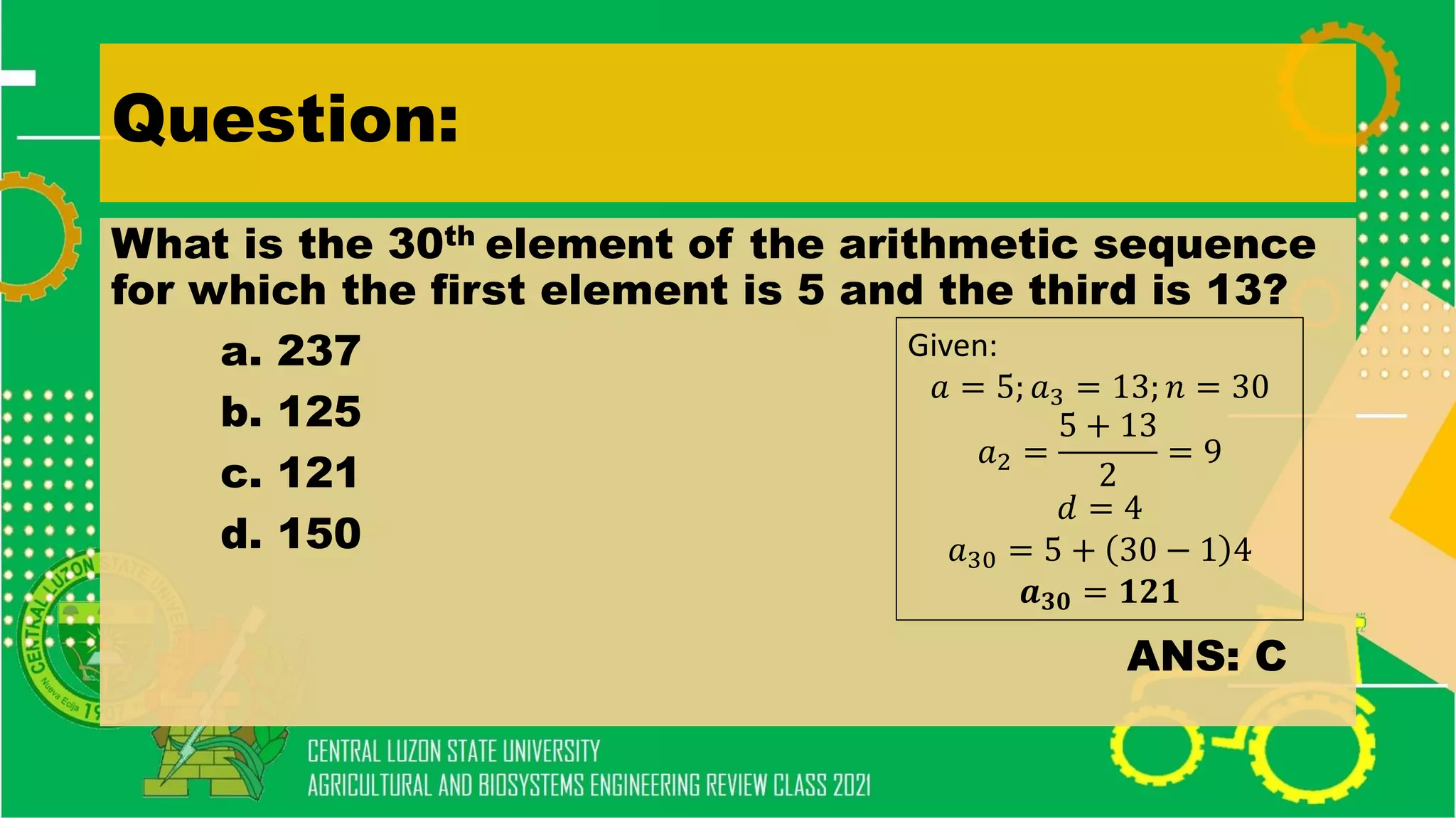
Question:
What is the 30th element of the arithmetic sequence
for which the first element is 5 and the third is 13?
a. 237
b. 125
c. 121
d. 150
ANS: C
Given:
𝑎 = 5; 𝑎3 = 13; 𝑛 = 30
𝑎2 =
5 + 13
2
= 9
𝑑 = 4
𝑎30 = 5 + 30 − 1 4
𝒂𝟑𝟎 = 𝟏𝟐𝟏
Question:
Find the 12th term of the series 6, 3, 2.
a. ½
b. ¼
c. 1/8
d. 1/12
ANS: A
𝑁𝑜𝑡𝑒:
1
6
,
1
3
,
1
2
is an arithmetic seq.
Given:
𝑎1 =
1
6
; 𝑑 =
1
6
; 𝑛 = 12
𝑎12 =
1
6
+ 12 − 1
1
6
𝑎12 =
12
6
𝑜𝑟 2
Thus, the 12th term is
𝟏
𝟐
.
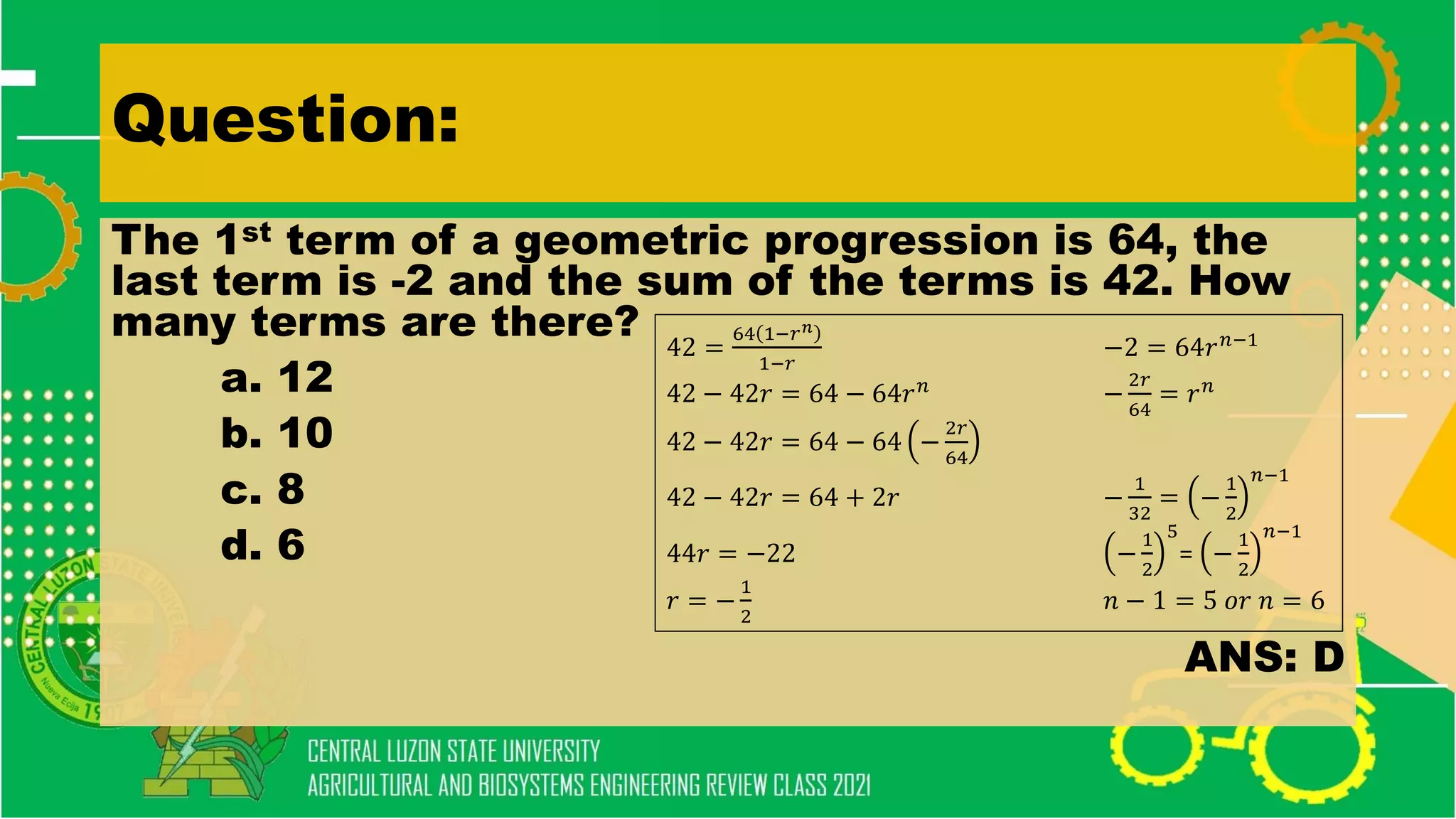
Question:
The 1st term of a geometric progression is 64, the
last term is -2 and the sum of the terms is 42. How
many terms are there?
a. 12
b. 10
c. 8
d. 6
ANS: D
42 =
64 1−𝑟𝑛
1−𝑟
−2 = 64𝑟𝑛−1
42 − 42𝑟 = 64 − 64𝑟𝑛
−
2𝑟
64
= 𝑟𝑛
42 − 42𝑟 = 64 − 64 −
2𝑟
64
42 − 42𝑟 = 64 + 2𝑟 −
1
32
= −
1
2
𝑛−1
44𝑟 = −22 −
1
2
5
= −
1
2
𝑛−1
𝑟 = −
1
2
𝑛 − 1 = 5 𝑜𝑟 𝑛 = 6
Problem Solving
Step 1. Identify the given and unknowns
Step 2. Translate word phrases into algebraic symbols
Step 3. Perform the operations and solve for the
unknowns
Step 4. Verify your answer.
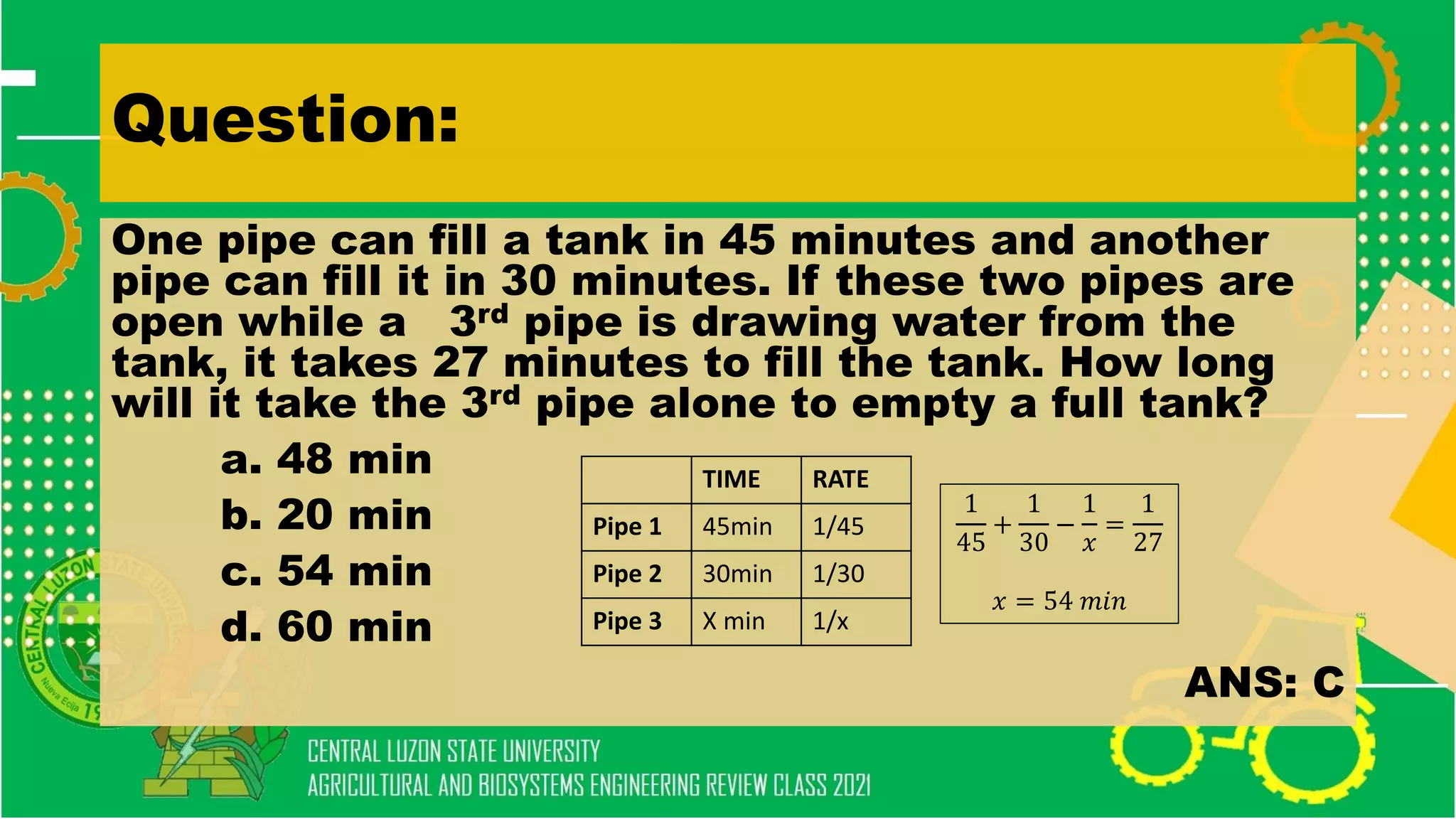
Question:
One pipe can fill a tank in 45 minutes and another
pipe can fill it in 30 minutes. If these two pipes are
open while a 3rd pipe is drawing water from the
tank, it takes 27 minutes to fill the tank. How long
will it take the 3rd pipe alone to empty a full tank?
a. 48 min
b. 20 min
c. 54 min
d. 60 min
ANS: C
TIME RATE
Pipe 1 45min 1/45
Pipe 2 30min 1/30
Pipe 3 X min 1/x
1
45
+
1
30
−
1
𝑥
=
1
27
𝑥 = 54 𝑚𝑖𝑛
Question:
A student in a chemistry laboratory wants to form a
32 ml mixture of 2 solutions to contain 30% acid.
Solution A contains 42% acid and solution B
contains18% acid. How many ml of each solution
must be used?
a. A=16; B=16
b. A=14; B=18
c. A=10; B=22
d. A=15; B=17
ANS: A
mL %
Soln 1 X 42%
Soln 2 y 18%
𝑥 + 𝑦 = 32
0.42𝑥 + 0.18𝑦 = 32 0.3
0.42 32 − 𝑦 + 0.18𝑦 = 9.6
13.44 − 0.24𝑦 = 9.6
𝑦 = 16
𝑥 = 16
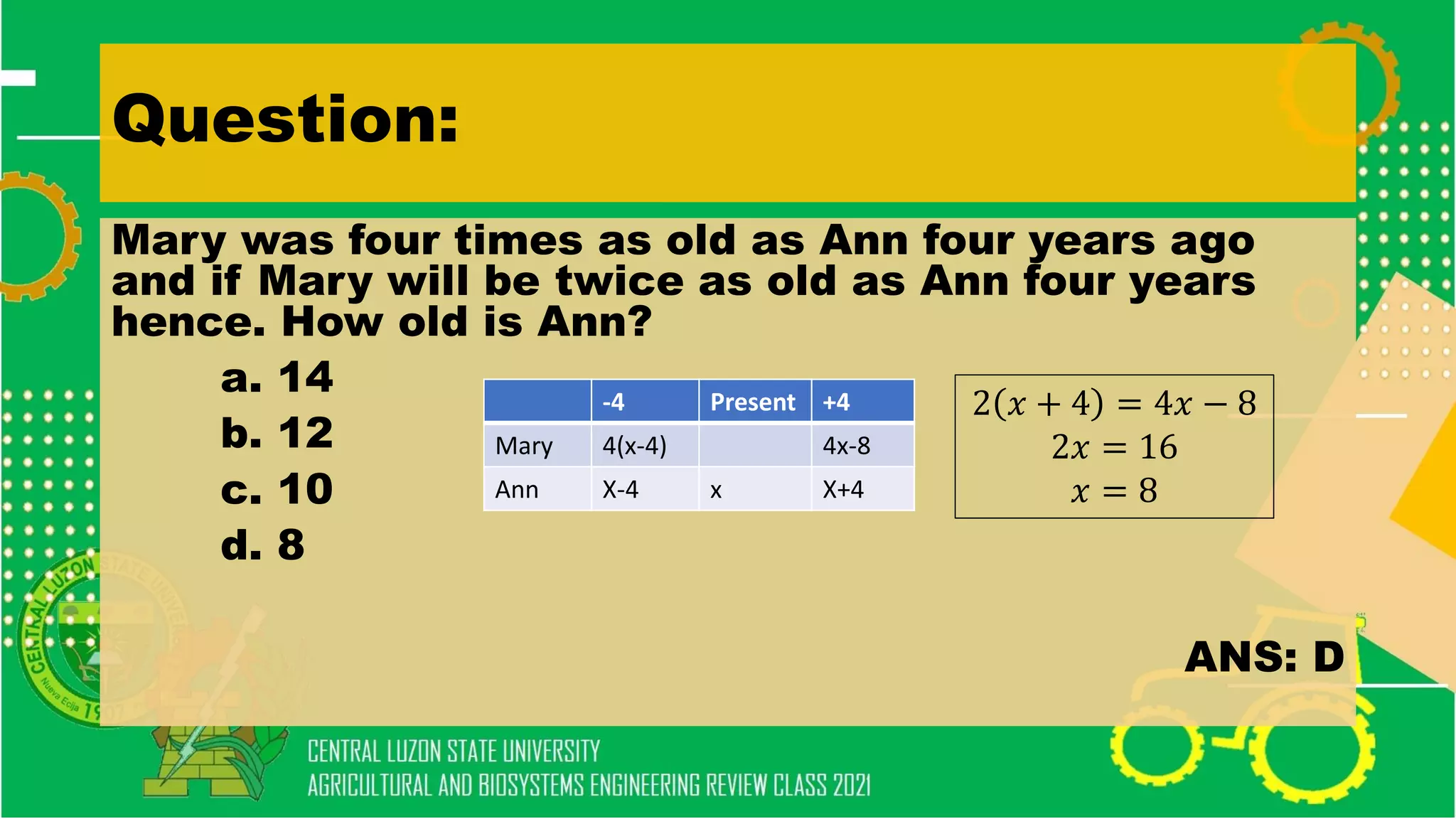
Question:
Mary was four times as old as Ann four years ago
and if Mary will be twice as old as Ann four years
hence. How old is Ann?
a. 14
b. 12
c. 10
d. 8
ANS: D
-4 Present +4
Mary 4(x-4) 4x-8
Ann X-4 x X+4
2 𝑥 + 4 = 4𝑥 − 8
2𝑥 = 16
𝑥 = 8
Question:
The number of centimeters in the perimeter of a
certain square is equal to the number of square
centimeter in its area. Find the length of the sides of
the square.
a. 5 cm
b. 2 cm
c. 4 cm
d. 6 cm
ANS: C
4𝑠 = 𝑠2
𝑠2
− 4𝑠 = 0
𝑠 𝑠 − 4 = 0
𝑠 = 0 𝑜𝑟 𝒔 = 𝟒
Question:
Find two consecutive even integers such that the
square of larger is 44 greater than the square of the
smaller integer.
a. 10 & 12
b. 12 & 14
c. 8 & 10
d. 14 & 16
ANS: A
Let 𝑥 and 𝑥 + 2 be the two even integers
𝑥 + 2 2 = 𝑥2 + 44
𝑥2 + 4𝑥 + 4 = 𝑥2 + 44
4𝑥 = 40
𝒙 = 𝟏𝟎
𝒙 + 𝟐 = 𝟏𝟐
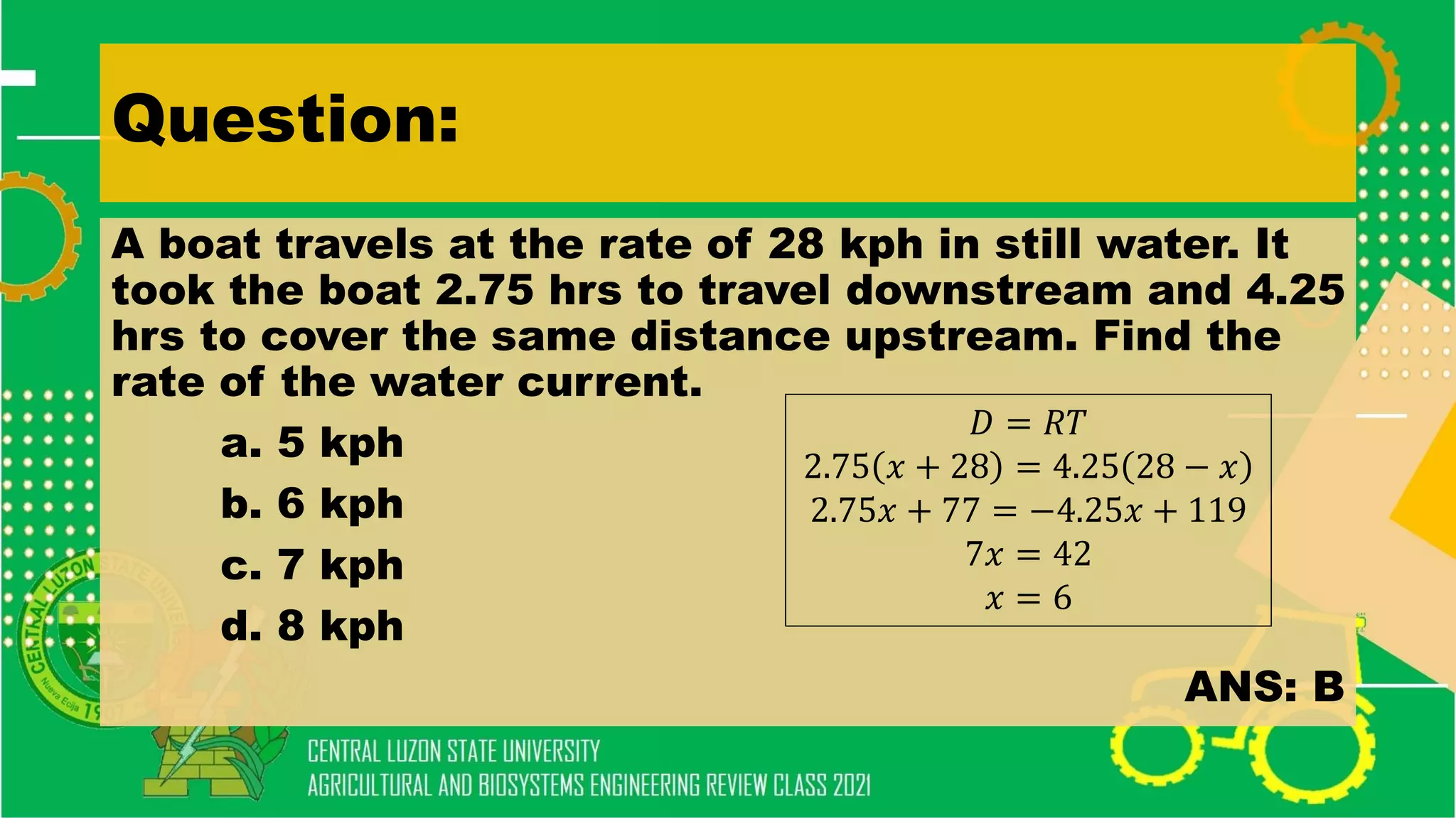
Question:
A boat travels at the rate of 28 kph in still water. It
took the boat 2.75 hrs to travel downstream and 4.25
hrs to cover the same distance upstream. Find the
rate of the water current.
a. 5 kph
b. 6 kph
c. 7 kph
d. 8 kph
ANS: B
𝐷 = 𝑅𝑇
2.75 𝑥 + 28 = 4.25 28 − 𝑥
2.75𝑥 + 77 = −4.25𝑥 + 119
7𝑥 = 42
𝑥 = 6
Question:
The unit digits of a 2-digit no. exceeds the tens digit
by 3. If the digits are reversed and divided by the
original, the quotient is 2 and remainder is 2. Find
the number.
a. 25
b. 36
c. 14
d. 22
ANS: A
𝑑𝑖𝑔𝑖𝑡 = 10𝑥 + 𝑥 + 3
Reverse = 10 𝑥 + 3 + 𝑥
10 𝑥 + 3 + 𝑥
10𝑥 + 𝑥 + 3
= 2 +
2
10𝑥 + 𝑥 + 3
11𝑥 + 30
11𝑥 + 3
=
22𝑥 + 8
11𝑥 + 3
11𝑥 + 30 = 22𝑥 + 8
11𝑥 = 22
𝑥 = 2
Digit = 20 + 2 + 3 = 25
Complex Number:
Complex numbers are written in the form 𝑎 + 𝑏𝑖,
where 𝑎 is the real part and 𝑏𝑖 is the imaginary part.
When dealing with imaginary number always
remember that 𝑖2 = −1.
Example: 𝑖15
= 𝑖14
𝑖 = 𝑖2 7
𝑖 = −1 7
𝑖 = −𝑖
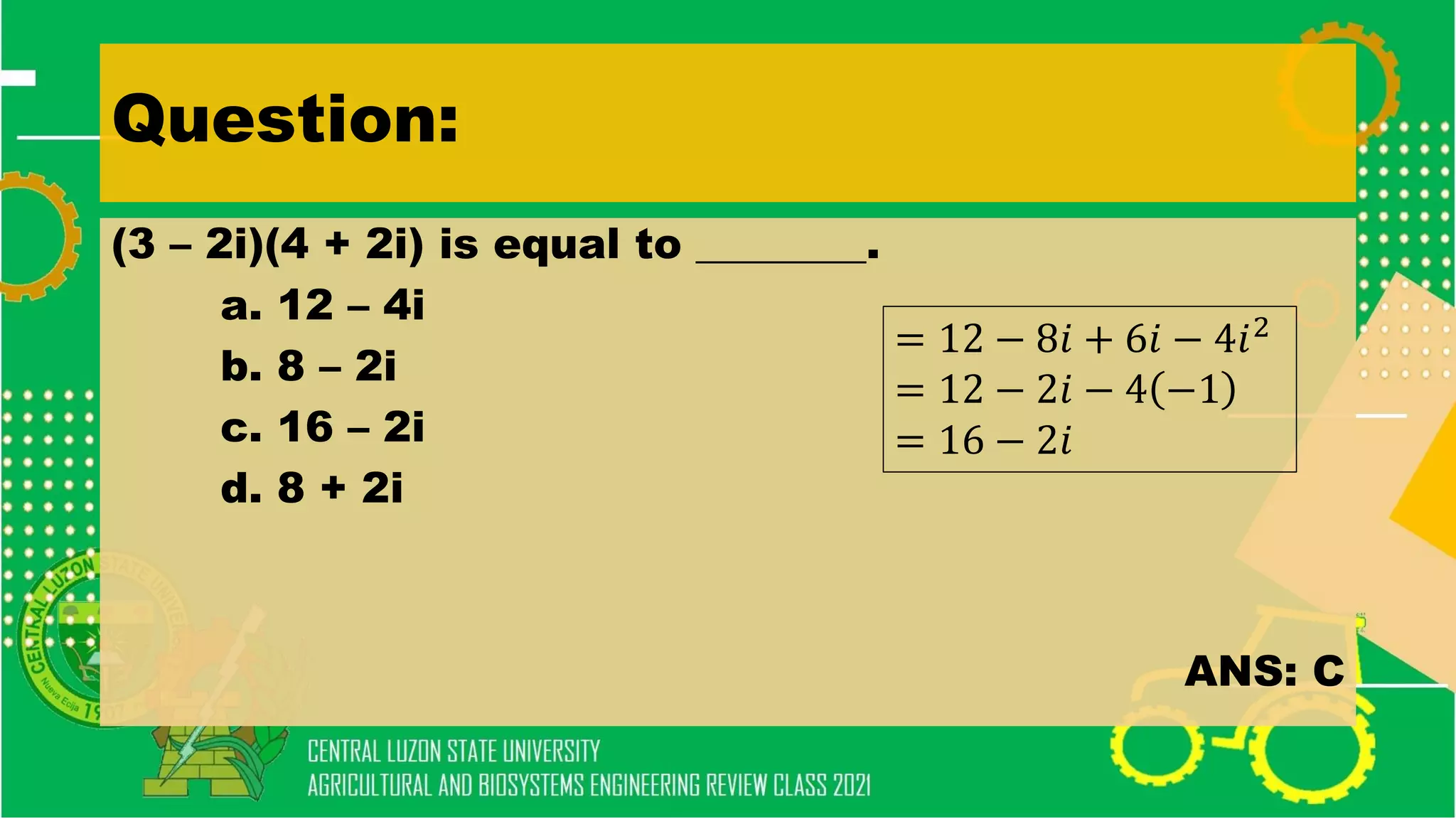
Question:
(3 – 2i)(4 + 2i) is equal to ________.
a. 12 – 4i
b. 8 – 2i
c. 16 – 2i
d. 8 + 2i
ANS: C
= 12 − 8𝑖 + 6𝑖 − 4𝑖2
= 12 − 2𝑖 − 4 −1
= 16 − 2𝑖

elemetary algebra review.pdf

  • 1.
  • 2.
    REAL NUMBERS SYSTEM RealNumber (R) Rationals (Q) Integers (Z) Negative Integers (Z-) Whole Number (W) {0} Positive Integers (Z+) Prime No. (P) {1} Composite No. (C) Even No. (E) Odd No. (O) Fractions (F) Irrationals (Q’) Notes: 1. Real numbers are composed of rational and irrational numbers. 2. Rational numbers are either terminating or repeating decimals, otherwise it is called irrational. 3. Zero (0) is neither positive nor negative. 4. One (1) is not a prime no. 5. If an integer is not odd, then it is even. 6. 6.4 is not an even number.
  • 3.
    Question: 1. What isthe sum of the smallest prime and largest 2-digit prime number? a. 95 b. 98 c. 99 d. 100 ANS: C
  • 4.
    Question: Find the sumof all odd integers from -100 to 110? a. 520 b. 525 c. 530 d. 540 ANS: B -100+(-99)+…+99+100=0 101+103+105+107+109=525
  • 5.
    SETS Union (“or” /∪) All elements of two sets 𝑨 ∪ 𝑩 = {𝟏, 𝟑, 𝟒, 𝟓, 𝟕, 𝟖} Intersection (“and” / ∩) All common elements of two sets 𝐴 ∩ 𝐵 = {1} Complement ( ‘/ (𝑈 − 𝐴)) Elements in 𝑈 not in 𝐴 𝐴′ = {2, 3, 6, 7, 8, 9, 10} Difference (− / (𝐴 − 𝐵)) Elements in 𝐴 not in 𝐵 𝐴 − 𝐵 = {4, 5} Cross Product (𝐴 × 𝐵) Ordered pairs with domain from 𝐴 and abscisa from 𝐵 𝐴 × 𝐵 = { 1,1 , 1, 3 , … , 5, 7 , 5,8 ) A = {1, 4, 5} B = {1, 3, 7, 8} U = {1, 2, …, 10}
  • 6.
    Question: Which of thefollowing statement is true? a. If 𝑄 is the universal set, then 𝐹′ = 𝑍. b. 𝑄′ − 𝑄 = { } c. 𝑄 ∩ 𝑍 = 𝐹 d. 𝑍 − 𝑍− = 𝑍+ ANS: A
  • 7.
    Question: During a survey,the following data were gathered: 60 students like algebra, 50 students like calculus, and 45 likes physics. Thirty students like both algebra and calculus; 25 students like both calculus and physics; and 20 students like algebra and physics. Only 15 students like all the three subjects. How many students were surveyed? a. 155 b. 125 c. 115 d. 95 ANS: D Algebra Calculus Physics 15 5 10 15 25 10 15 25+5+15+15+10+10+15=95
  • 8.
    SOME THEOREMS ONREAL NUMBERS • Theorem 1. − 𝑎 𝑏 = −𝑎 𝑏 = 𝑎 −𝑏 . • Theorem 2. 𝑎𝑐 𝑏𝑐 = 𝑎 𝑏 . • Theorem 3. 𝑎 𝑐 + 𝑏 𝑐 = 𝑎+𝑏 𝑐 or 𝑎 𝑐 + 𝑏 𝑑 = 𝑎𝑑+𝑏𝑐 𝑐𝑑 . • Theorem 4. 𝑎 𝑏 × 𝑐 𝑑 = 𝑎𝑐 𝑏𝑑 . • Theorem 5. 𝑎 𝑏 ÷ 𝑐 𝑑 = 𝑎 𝑏 × 𝑑 𝑐 = 𝑎𝑑 𝑏𝑐 . NOTE: In the following theorems, 𝑎, 𝑏, 𝑐, 𝑑 may stand for any algebraic expression. 0 𝑎 = 0; 𝑎 0 = 𝑢𝑛𝑑𝑒𝑓𝑖𝑛𝑒𝑑; 𝑎 ∞ = 0. Common Mistake • 𝑥2−3𝑥+2 𝑥2−2𝑥+1 = (𝑥−2)(𝑥−1) (𝑥−1)(𝑥−1) = 𝑥−2 𝑥−1 • 𝑥−2 𝑥+1 𝑥−2 𝑥−3 = 𝑥−2 𝑥+1 𝑥−2 𝑥−3
  • 9.
    Fundamental Operations • Additionand Subtraction is only applicable to similar terms. 1. 2𝑥 − 3𝑦 + (5𝑥 + 2𝑦) = 2. 2𝑥 − 3𝑦 − 5𝑥 + 2𝑦 = • For Multiplication and Division, laws of exponents are needed. 𝟕𝒙 − 𝒚 2𝑥 − 3𝑦 − 5𝑥 − 2𝑦 = −𝟑𝒙 − 𝟓𝒚
  • 10.
    Laws of Exponents 1.𝑎𝑚 ∙ 𝑎𝑛 = 𝑎𝑚+𝑛 2. 𝑎𝑚 𝑎𝑛 = 𝑎𝑚−𝑛 3. 𝑎𝑚 𝑛 = 𝑎𝑚𝑛 4. 𝑎𝑏 𝑚 = 𝑎𝑚 𝑏𝑚 5. 𝑎 𝑏 𝑚 = 𝑎𝑚 𝑏𝑚 6. 𝑎 𝑚 𝑛 = 𝑛 𝑎𝑚 7. 𝑎0 = 1 provided 𝑎 ≠ 0. Note: 00 is indeterminate. 6. 𝑎−𝑚 = 1 𝑎𝑚 7. If 𝑎𝑚 = 𝑎𝑛, then 𝑚 = 𝑛.
  • 11.
    Laws of Radicals 1.𝑎 1 𝑛 = 𝑛 𝑎 2. 𝑎 𝑚 𝑛 = 𝑛 𝑎𝑚 = 𝑛 𝑎 𝑚 3. 𝑛 𝑎 𝑛 = 𝑎 4. 𝑛 𝑎 × 𝑛 𝑏 = 𝑛 𝑎𝑏 5. 𝑛 𝑎 𝑛 𝑏 = 𝑛 𝑎 𝑏 provided that 𝑏 ≠ 0 Illustration: 1. 2𝑥 3 = 23 𝑥3 = 𝟖𝒙𝟑 2. 𝑥3 𝑦 2 = 𝑥3 2 𝑦2 = 𝒙𝟔 𝒚𝟐 3. 2𝑥𝑦3 4 = 2𝑥𝑦3 4 2 = 22 𝑥2 𝑦3 2 = 𝟒𝒙𝟐 𝒚𝟔
  • 12.
    Question: 𝑎 + 𝑏𝑏 ∙ 𝑎 − 𝑏 𝑏 is equivalent to? a. 𝑎 + 𝑏 𝑏 b. 𝑎2 − 𝑏3 c. 𝑎 − 𝑏 𝑏 d. 𝑎2 − 𝑏2 ANS: B 𝑎 + 𝑏 𝑏 𝑎 − 𝑏 𝑏 𝑎2 − 𝑏2 𝑏 𝒂𝟐 − 𝒃𝟑
  • 13.
    Question: Simplify: 𝑎 + 1 𝑎 2 −𝑎 − 1 𝑎 2 . a. −4 b. 0 c. 4 d. − 2 𝑎2 ANS: C 𝑎 + 1 𝑎 + 𝑎 − 1 𝑎 𝑎 + 1 𝑎 − 𝑎 − 1 𝑎 2𝑎 2 𝑎 𝟒
  • 14.
    Question: Simplify: 𝑥2𝑦3𝑧−2 −3 𝑥−3𝑦𝑧3 − 1 2 𝑥𝑦𝑧−3− 5 2 . a. 1 𝑥2𝑦7𝑧3 b. 1 𝑥2𝑦7𝑧5 c. 1 𝑥2𝑦5𝑧3 d. 1 𝑥5𝑦7𝑧3 ANS: A = 𝑥−6 𝑦−9 𝑧6 𝑥 3 2𝑦− 1 2𝑧− 3 2 𝑥 − 5 2 𝑦− 5 2𝑧 15 2 = 𝑥−6𝑦−9𝑧6 𝑥−4𝑦−2𝑧9 = 𝟏 𝒙𝟐𝒚𝟕𝒛𝟑
  • 15.
    Special Products andFactoring 𝑎𝑥 + 𝑎𝑦 = 𝑎(𝑥 + 𝑦) Multinomial Common Factor 𝑥2 − 𝑦2 = 𝑥 + 𝑦 𝑥 − 𝑦 Difference of two squares 𝑥3 ± 𝑦3 = (𝑥 ± 𝑦)(𝑥2 ∓ 𝑥𝑦 + 𝑦2) Sum/Diff. of two cubes 𝑥2 ± 2𝑥𝑦 + 𝑦2 = 𝑥 ± 𝑦 2 Perfect Square Trinomials 𝑎𝑐𝑥2 + 𝑎𝑑 + 𝑏𝑐 𝑥 + 𝑏𝑑 = (𝑎𝑥 + 𝑏)(𝑐𝑥 + 𝑑) FOIL/Trial-and-Error 𝒓𝒕𝒉 𝒕𝒆𝒓𝒎 = 𝒏! 𝒏 − 𝒓 + 𝟏 ! 𝒓 − 𝟏 ! 𝒂𝒏−𝒓+𝟏 𝒃𝒓−𝟏 Where 𝑟 is the unknown terms and 𝑛 is the total number of unknown terms If 𝑏2 − 4𝑎𝑐 is a perfect square the quadratic trinomial is factorable.
  • 16.
    Horizontal Multiplication We canalways multiply polynomials by polynomials using the distribution methods. Multiply (2𝑥2 − 3𝑥𝑦 + 𝑦2 )(−3𝑥2 + 2𝑥𝑦 − 3𝑦2 ). −3𝑥2 2𝑥2 − 3𝑥𝑦 + 𝑦2 + 2𝑥𝑦 2𝑥2 − 3𝑥𝑦 + 𝑦2 − 3y2(2𝑥2 − 3𝑥𝑦 + 𝑦2) −6𝑥4 + 9𝑥3 𝑦 − 3𝑥2 𝑦2 + 4𝑥3 𝑦 − 6𝑥2 𝑦2 + 2𝑥𝑦3 − 6𝑥2 𝑦2 + 9𝑥𝑦3 − 3𝑦4 −𝟔𝒙𝟒 + 𝟏𝟑𝒙𝟑 𝒚 − 𝟏𝟓𝒙𝟐 𝒚𝟐 + 𝟏𝟏𝒙𝒚𝟑 − 𝟑𝒚𝟒
  • 17.
    Division of Polynomials •Divide 𝑥4 − 18𝑥2 + 32 by 𝑥 − 4 𝑥3 + 4𝑥2 − 2𝑥 − 8 𝑥 − 4 𝑥4 + 0𝑥3 − 18𝑥2 + 0𝑥 + 32 𝑥4 − 4𝑥3 4𝑥3 − 18𝑥2 4𝑥3 − 16𝑥2 −2𝑥2 + 0𝑥 −2𝑥2 + 8𝑥 −8𝑥 + 32 −8𝑥 + 32 0 1 0 -18 0 32 |4 4 16 -8 -32 1 4 -2 -8 0 Long Division Synthetic Division
  • 18.
    Factor and Remaindertheorem Given a function 𝑓(𝑥) and a binomial 𝑥 − 𝑐 where c is constant. FACTOR. If 𝑓 𝑐 = 0, then 𝑥 − 𝑐 is a factor of 𝑓(𝑥). Example: f x = 2𝑥3 + 5𝑥2 − 𝑥 − 6 and 𝑥 + 2. 𝑓 −2 = 2 −2 3 + 5 −22 − −2 − 6 = 0 REMAINDER. If 𝑓 𝑐 = 𝑧 where 𝑧 ≠ 0, then 𝑧 is the exponent whenever 𝑓(𝑥) is divided by 𝑥 − 𝑐. Example: 𝑓 2 = 2 23 + 5 22 − 2 − 6 = 28
  • 19.
    Sum of Coefficientof Variables Substitute 1 to each variables in the polynomials then simplify the expression to get the sum of its coefficients. Example: Find the coefficients of the variables in the expansion 2𝑥 + 3𝑦 − 1 4. 2 1 + 3 1 − 1 4 = 44 = 256
  • 20.
    Question: If 𝑥2 + 𝑦2 =22 and 𝑥𝑦 = 9, find the value of 𝑥 − 𝑦 2 ? a. 4 b. 13 c. 31 d. 40 ANS: A 𝑥 − 𝑦 2 = 𝑥2 − 2𝑥𝑦 + 𝑦2 = 22 − 2 9 = 4
  • 21.
    Question: Factor 𝑎4 − 𝑏2 +𝑏 − 𝑎2 as completely as possible. a. 𝑎2 + 𝑏 𝑎2 + 𝑏 − 1 b. 𝑎2 + 𝑏 𝑎2 − 𝑏 − 1 c. 𝑎2 − 𝑏 𝑎2 + 𝑏 − 1 d. 𝑎2 − 𝑏 𝑎2 − 𝑏 − 1 ANS: C = 𝑎4 − 𝑏2 − 𝑎2 − 𝑏 = 𝑎2 + 𝑏 𝑎2 − 𝑏 − 𝑎2 − 𝑏 = (𝒂𝟐 − 𝒃)(𝒂𝟐 + 𝒃 − 𝟏)
  • 22.
    Question: Which of thefollowing are the correct factors of 6𝑥2 + 23𝑥 − 4? a. 6𝑥 − 1 𝑥 + 4 b. 6𝑥 + 1 𝑥 − 4 c. 3𝑥 + 4 2𝑥 − 1 d. (3𝑥 − 4)(2𝑥 + 1) ANS: A 𝐹𝑎𝑐𝑡𝑜𝑟 𝑜𝑓 6: 3, 2, 1, 6 𝐹𝑎𝑐𝑡𝑜𝑟 𝑜𝑓 − 4: 1, −4, 2, −2 6𝑥 𝑥 (𝟔𝒙 − 𝟏)(𝒙 + 𝟒)
  • 23.
    Question: Factor the expression𝑥6 − 1 as completely as possible. a. 𝑥 + 1 𝑥 − 1 𝑥4 + 𝑥2 − 1 b. 𝑥 + 1 𝑥 − 1 𝑥4 + 2𝑥2 + 1 c. 𝑥 + 1 𝑥 − 1 𝑥4 − 𝑥2 + 1 d. (𝑥 + 1)(𝑥 − 1)(𝑥4 + 𝑥2 + 1) ANS: D 𝑥2 − 1 𝑥4 + 𝑥2 + 1 (𝑥 + 1)(𝑥 − 1)(𝑥4 + 𝑥2 + 1)
  • 24.
    Question: Give a 3rdterm so that 4𝑥4 + 9𝑦2 becomes a perfect square trinomial. a. 6𝑥2 𝑦 b. 12𝑥2𝑦2 c. 12𝑥2 𝑦 d. 36𝑥2𝑦 ANS: C 4𝑥4 + 9𝑦2 1st = 2𝑥2 2nd = 3𝑦 3rd = 2*1st *2nd = 2 2𝑥2 3𝑦 = 𝟏𝟐𝒙𝟐 𝒚
  • 25.
    Question: Simplify: 5𝑥 2𝑥2+7𝑥+3 − 𝑥+3 2𝑥2−3𝑥−2 + 2𝑥+1 𝑥2+𝑥−6 . a. 2 𝑥−3 b. 𝑥−3 5 c. 𝑥+3 𝑥−1 d. 4 𝑥+3 ANS: D = 5𝑥 2𝑥 +1 𝑥 + 3 − 𝑥 + 3 2𝑥 + 1 𝑥 − 2 + 2𝑥 + 1 𝑥 + 3 𝑥 − 2 = 5𝑥 𝑥 − 2 − 𝑥 + 3 𝑥 + 3 + 2𝑥 + 1 2𝑥 + 1 2𝑥 + 1 𝑥 + 3 𝑥 − 2 = 5𝑥2 − 10𝑥 − 𝑥2 − 6𝑥 − 9 + 4𝑥2 + 4𝑥 + 1 2𝑥 + 1 𝑥 + 3 𝑥 − 2 = 8𝑥2 − 12𝑥 − 8 2𝑥 + 1 𝑥 + 3 𝑥 − 2 = 4 2𝑥 + 1 𝑥 − 2 2𝑥 + 1 𝑥 + 3 𝑥 − 2 = 𝟒 𝒙 + 𝟑
  • 26.
    Question: Simplify: 𝑚3−8 2𝑚−1 ∙ 2𝑚2+3𝑚−2 𝑚2−4 . a. 𝑚2 +2𝑚 + 4 b. 𝑚2 + 2𝑚 − 4 c. 𝑚2 − 2𝑚 + 4 d. 𝑚2 − 2𝑚 − 4 ANS: A = 𝑚 − 2 𝑚2 + 2𝑚 + 4 2𝑚 − 1 ∙ 2𝑚 − 1 𝑚 + 2 𝑚 + 2 𝑚 − 2 = 𝒎𝟐 + 𝟐𝒎 + 𝟒
  • 27.
    Question: What is theremainder if 2𝑥3 − 3𝑥2 + 5𝑥 − 4 is divided by 𝑥 − 1? a. 0 b. -8 c. -4 d. 6 ANS: A 𝑥 − 𝑐 = 𝑥 − 1 𝑠𝑜 𝑐 = 1 = 2 1 3 − 3 1 2 + 5 1 − 4 = 𝟎
  • 28.
    Question: Given: 𝑓 𝑥= 𝑥 − 3 𝑥 + 4 + 4 when divided by (𝑥 − 𝑘), the remainder is 𝑘. Find 𝑘. a. 2 b. 3 c. 4 d. -3 ANS: C 𝑓 𝑥 = 𝑥2 + 𝑥 − 8 𝑓 𝑘 = 𝑘 𝑘 = 𝑘2 + 𝑘 − 8 0 = 𝑘2 − 8 𝒌 = ±𝟒
  • 29.
    Question: Find the sumof the coefficients of all terms in 5𝑥2 − 3𝑦2 8 ? a. 186 b. 256 c. 512 d. 542 ANS: B Substitute 1 to all variables = 5 1 2 − 3 1 2 8 = 28 or 256
  • 30.
    Linear Equations inOne Unknown • The ultimate goal is to transform the equation into 𝑥 = 𝑎 𝑏 , which specifies the value of x. This is called the solution or roots. No Solution Unique Solution Infinitely Many Solution Solve 𝑥+5 𝑥−5 = 1; 𝑥 ≠ 5. 𝑥 − 5 𝑥 + 5 𝑥 − 5 = 1 𝑥 − 5 𝑥 + 5 = 𝑥 − 5 5 = −5 False Statement Solve 𝑥 𝑥−1 + 4 15 = 4 5𝑥−5 + 3 5 (3) 5 𝑥 + 𝑥– 1 4 = 3 4 + 3(𝑥– 1)(3) 15𝑥 + 4𝑥– 4 = 12 + 9𝑥– 9 19𝑥 – 4 = 9𝑥 + 3 19𝑥 – 9𝑥 = 3 + 4 𝑥 = 7 10 Solve 5 2𝑥 − 1 = 2 8𝑥 − 7 − 3 2𝑥 − 3 10𝑥 − 5 = 16𝑥 − 14 − 6𝑥 + 9 10𝑥 − 5 = 10𝑥 − 5 0 = 0 True Statement
  • 31.
    Solving Linear Equationw/ Two Unknown • Graphical Method Unique Solution Infinitely Many No Solution
  • 32.
    Solving Linear Equationw/ Two Unknown SUBSTITUTION ELIMINATION DETERMINANTS Solve: 2𝑥 − 𝑦 = 3 2𝑥 + 3𝑦 = 7 EQN 1: 𝑦 = 2𝑥 − 3 EQN 2: 2𝑥 + 3 2𝑥 − 3 = 7 2𝑥 + 6𝑥 − 9 = 7 8𝑥 = 16 𝑥 = 2 EQN 1: 𝑦 = 2 2 − 3 = 1 Solve: 2𝑥 − 𝑦 = 3 2𝑥 + 3𝑦 = 7 2𝑥 − 𝑦 = 3 −(2𝑥 + 3𝑦 = 7) −4𝑦 = −4 𝑦 = 1 EQN 1: 2𝑥 − 1 = 3 𝑥 = 2 Solve: 2𝑥 − 𝑦 = 3 2𝑥 + 3𝑦 = 7 𝑥 = 3 −1 7 3 2 −1 2 3 = 3 3 − 7 −1 2 3 − 2 −1 = 16 8 = 2 𝑦 = 2 3 2 7 2 −1 2 3 = 2 7 − 2 3 2 3 − 2 −1 = 8 8 = 1
  • 33.
    Question: Find the valueof 𝑥 and 𝑦 that satisfies the system of equations: 3𝑥 − 𝑦 = 6 and 9𝑥 − 𝑦 = 12. a. 𝑥 = 3; 𝑦 = 1 b. 𝑥 = 1; y = −3 c. 𝑥 = 2; 𝑦 = 2 d. 𝑥 = 4; 𝑦 = 2 ANS: B 3𝑥 − 𝑦 = 6 − 9𝑥 − 𝑦 = 12 −6𝑥 = −6 Implies 𝒙 = 𝟏. 3 1 − 𝑦 = 6 𝒚 = −𝟑
  • 34.
    Question: If 𝑓 𝑥= 2𝑥2 − 𝑥 + 1, what is the value of 𝑓 𝑥 − 𝑓(𝑥 + 1)? a. 4x-1 b. -4x-1 c. 4x+1 d. 1-4x ANS: B = 2𝑥2 − 𝑥 + 1 − 2 𝑥 + 1 2 − 𝑥 + 1 + 1 = 2𝑥2 − 𝑥 + 1 − 2𝑥2 − 4𝑥 − 2 + 𝑥 + 1 − 1 = −𝟒𝒙 − 𝟏
  • 35.
    Solving Quadratic Equation FACTORINGQUADRATIC FORMULA ROOTS - The goal is to factor the equation completely. Make sure the factors are on left-hand side and zero (0) on right-hand side. For quadratic eqn 𝑎𝑥2 + 𝑏𝑥 + 𝑐; 𝒙 = −𝒃± 𝒃𝟐−𝟒𝒂𝒄 𝟐𝒂 Sum : 𝒓𝟏 + 𝒓𝟐 = − 𝒃 𝒂 Product: 𝒓𝟏 ∙ 𝒓𝟐 = 𝒄 𝒂 Solve: 3𝑥2 − 5𝑥 − 2 = 0 3𝑥 + 1 𝑥 − 2 = 0 3𝑥 + 1 = 0 | 𝑥 − 2 = 0 𝑥 = − 1 3 or 𝑥 = 2 Solve: 3𝑥2 − 5𝑥 − 2 = 0 𝑥 = − −5 ± −5 2 − 4 3 −2 2 3 𝑥 = 5 ± 49 6 𝑥 = − 1 3 or 𝑥 = 2 One root of the eqn 3𝑥2 − 5𝑥 + 𝑐 = 0 is 2. Find the other root and the value of 𝑐. Sum: 𝑟 + 2 = 5 3 → 𝑟 = −1/3 Product: 2 − 1 3 = 𝑐 3 → 𝑐 = −2
  • 36.
    Remarks: 1. 𝑏2 − 4𝑎𝑐is called the discriminant of the quadratic equation. 2. If 𝑏2 − 4𝑎𝑐 = 0, then the roots are real and both are equal to − 𝑏 2𝑎 3. If 𝑏2 − 4𝑎𝑐 > 0, then the roots are real and unequal. 4. If 𝑏2 − 4𝑎𝑐 < 0, then the roots are imaginary numbers.
  • 37.
    Question: The values of𝑥 in the equation 𝑥 2 5 − 𝑥 1 5 − 2 = 0 are: a. 1 & -2 b. -1 & 2 c. -1 & 32 d. 1 & -32 ANS: C 𝑥 1 5 2 − 𝑥 1 5 − 2 = 0 By factoring, 𝑥 1 5 − 2 𝑥 1 5 + 1 = 0 𝑥 1 5 − 2 = 0 or 𝑥 1 5 + 1 = 0 𝒙 = 𝟐𝟓 = 𝟑𝟐 or 𝒙 = −𝟏 𝟓 = −𝟏
  • 38.
    Question: Give the sumof the roots of 2𝑥2 − 8𝑥 + 1 = 0. a. 4 b. -5 c. -2 d. 2 ANS: A 𝑟1 + 𝑟2 = − −8 2 = 𝟒
  • 39.
    Question: Find 𝑘 inthe equation 4𝑥2 + 𝑘𝑥 + 9 = 0 so that it will only have one real root. a. 10 b. 11 c. 12 d. 13 ANS: C Real and unique roots if 𝑏2 − 4𝑎𝑐 = 0 𝑘2 − 4 4 9 = 0 𝑘2 = 144 𝒌 = ±𝟏𝟐
  • 40.
    Question: Find the rootsof 𝑥2 − 4 + 4𝑥 = 0. a. 2 b. 2 and -2 c. 0 d. no root ANS: D 𝑥2 − 4 = − 4𝑥 𝑥2 − 4 = 4𝑥 𝑥2 − 4𝑥 − 4 = 0 𝑥 − 2 2 = 0 𝑥 = 2 Checking: 0 + 16 ≠ 0. False statement → No roots
  • 41.
    Partial Fractions Illustrations: • 3 𝑥−1 𝑥+2 = 𝐴 𝑥−1 + 𝐵 𝑥+2 • 3𝑥2+2𝑥+1 𝑥−13 = 𝐴 𝑥−1 + 𝐵 𝑥−1 2 + 𝐶 𝑥−1 3 • 3𝑥−5 𝑥−1 𝑥2+𝑥+1 2 = 𝐴 𝑥−1 + 𝐵𝑥+𝐶 𝑥2+𝑥+1 + 𝐷𝑥+𝐸 𝑥2+𝑥+1 2 • 3𝑥−2 𝑥−1 2 𝑥2+𝑥+1 = 𝐴 𝑥−1 + 𝐵 𝑥−1 2 + 𝐶𝑥+𝐷 𝑥2+𝑥+1
  • 42.
    Question: Find A andB such that 𝑥+10 𝑥2−4 = 𝐴 𝑥−2 + 𝐵 𝑥+2 . a. A= -3; B= 2 b. A= -3; B= -2 c. A= 3; B= -2 d. A= 3; B= 2 ANS: C 𝑥 + 10 = 𝐴 𝑥 + 2 + 𝐵 𝑥 − 2 𝑥 + 10 = 𝐴 + 𝐵 𝑥 + 2𝐴 − 2𝐵 This implies 𝐴 + 𝐵 = 1 and 2𝐴 − 2𝐵 = 10 Then, 2 1 − 𝐵 − 2𝐵 = 10 −4𝐵 = 8 𝑩 = −𝟐 From 𝐴 + 𝐵 = 1 𝑨 = 𝟑
  • 43.
    Question: Find the valueof A: 𝑥2 + 4𝑥 + 10 𝑥3 + 2𝑥2 + 5𝑥 = 𝐴 𝑥 + 𝐵 2𝑥 + 2 𝑥2 + 2𝑥 + 5 + 𝐶 𝑥2 + 2𝑥 + 5 a. 2 b. -2 c. ½ d. -1/2 ANS: A 𝑥2 + 4𝑥 + 10 = 𝐴 𝑥2 + 2𝑥 + 5 + 𝐵𝑥 2𝑥 + 2 + 𝐶𝑥 𝑥2 + 4𝑥 + 10 = 𝐴 + 2𝐵 𝑥2 + 2𝐴 + 2𝐵 + 𝐶 𝑥 + 5𝐴 5𝐴 = 10 𝑨 = 𝟐
  • 44.
    Progression DESCRIPTION LAST TERMSUM MEAN Arithmetic Progression Sequence of number with a fixed common difference i.e., 1, 3, 5, 7, 9 𝐿 = 𝑎 + 𝑛 − 1 𝑑 𝑆 = 𝑛 2 (𝑎 + 𝐿) 𝑏 = 𝑎 + 𝑐 2 Geometric Progression Sequence of number with a fixed common ratio i.e., 1, 3, 9, 27 𝐿 = 𝑎𝑟𝑛−1 𝑆 = 𝑎 1 − 𝑟𝑛 1 − 𝑟 𝑏 = ± 𝑎𝑐 Harmonic Progression The sequence of numbers formed by the reciprocals of the terms of an arithmetic progression (i.e., 1, 1 3 , 1 5 , 1 7 , 1 9 ).
  • 45.
    Question: What is the30th element of the arithmetic sequence for which the first element is 5 and the third is 13? a. 237 b. 125 c. 121 d. 150 ANS: C Given: 𝑎 = 5; 𝑎3 = 13; 𝑛 = 30 𝑎2 = 5 + 13 2 = 9 𝑑 = 4 𝑎30 = 5 + 30 − 1 4 𝒂𝟑𝟎 = 𝟏𝟐𝟏
  • 46.
    Question: Find the 12thterm of the series 6, 3, 2. a. ½ b. ¼ c. 1/8 d. 1/12 ANS: A 𝑁𝑜𝑡𝑒: 1 6 , 1 3 , 1 2 is an arithmetic seq. Given: 𝑎1 = 1 6 ; 𝑑 = 1 6 ; 𝑛 = 12 𝑎12 = 1 6 + 12 − 1 1 6 𝑎12 = 12 6 𝑜𝑟 2 Thus, the 12th term is 𝟏 𝟐 .
  • 47.
    Question: The 1st termof a geometric progression is 64, the last term is -2 and the sum of the terms is 42. How many terms are there? a. 12 b. 10 c. 8 d. 6 ANS: D 42 = 64 1−𝑟𝑛 1−𝑟 −2 = 64𝑟𝑛−1 42 − 42𝑟 = 64 − 64𝑟𝑛 − 2𝑟 64 = 𝑟𝑛 42 − 42𝑟 = 64 − 64 − 2𝑟 64 42 − 42𝑟 = 64 + 2𝑟 − 1 32 = − 1 2 𝑛−1 44𝑟 = −22 − 1 2 5 = − 1 2 𝑛−1 𝑟 = − 1 2 𝑛 − 1 = 5 𝑜𝑟 𝑛 = 6
  • 48.
    Problem Solving Step 1.Identify the given and unknowns Step 2. Translate word phrases into algebraic symbols Step 3. Perform the operations and solve for the unknowns Step 4. Verify your answer.
  • 49.
    Question: One pipe canfill a tank in 45 minutes and another pipe can fill it in 30 minutes. If these two pipes are open while a 3rd pipe is drawing water from the tank, it takes 27 minutes to fill the tank. How long will it take the 3rd pipe alone to empty a full tank? a. 48 min b. 20 min c. 54 min d. 60 min ANS: C TIME RATE Pipe 1 45min 1/45 Pipe 2 30min 1/30 Pipe 3 X min 1/x 1 45 + 1 30 − 1 𝑥 = 1 27 𝑥 = 54 𝑚𝑖𝑛
  • 50.
    Question: A student ina chemistry laboratory wants to form a 32 ml mixture of 2 solutions to contain 30% acid. Solution A contains 42% acid and solution B contains18% acid. How many ml of each solution must be used? a. A=16; B=16 b. A=14; B=18 c. A=10; B=22 d. A=15; B=17 ANS: A mL % Soln 1 X 42% Soln 2 y 18% 𝑥 + 𝑦 = 32 0.42𝑥 + 0.18𝑦 = 32 0.3 0.42 32 − 𝑦 + 0.18𝑦 = 9.6 13.44 − 0.24𝑦 = 9.6 𝑦 = 16 𝑥 = 16
  • 51.
    Question: Mary was fourtimes as old as Ann four years ago and if Mary will be twice as old as Ann four years hence. How old is Ann? a. 14 b. 12 c. 10 d. 8 ANS: D -4 Present +4 Mary 4(x-4) 4x-8 Ann X-4 x X+4 2 𝑥 + 4 = 4𝑥 − 8 2𝑥 = 16 𝑥 = 8
  • 52.
    Question: The number ofcentimeters in the perimeter of a certain square is equal to the number of square centimeter in its area. Find the length of the sides of the square. a. 5 cm b. 2 cm c. 4 cm d. 6 cm ANS: C 4𝑠 = 𝑠2 𝑠2 − 4𝑠 = 0 𝑠 𝑠 − 4 = 0 𝑠 = 0 𝑜𝑟 𝒔 = 𝟒
  • 53.
    Question: Find two consecutiveeven integers such that the square of larger is 44 greater than the square of the smaller integer. a. 10 & 12 b. 12 & 14 c. 8 & 10 d. 14 & 16 ANS: A Let 𝑥 and 𝑥 + 2 be the two even integers 𝑥 + 2 2 = 𝑥2 + 44 𝑥2 + 4𝑥 + 4 = 𝑥2 + 44 4𝑥 = 40 𝒙 = 𝟏𝟎 𝒙 + 𝟐 = 𝟏𝟐
  • 54.
    Question: A boat travelsat the rate of 28 kph in still water. It took the boat 2.75 hrs to travel downstream and 4.25 hrs to cover the same distance upstream. Find the rate of the water current. a. 5 kph b. 6 kph c. 7 kph d. 8 kph ANS: B 𝐷 = 𝑅𝑇 2.75 𝑥 + 28 = 4.25 28 − 𝑥 2.75𝑥 + 77 = −4.25𝑥 + 119 7𝑥 = 42 𝑥 = 6
  • 55.
    Question: The unit digitsof a 2-digit no. exceeds the tens digit by 3. If the digits are reversed and divided by the original, the quotient is 2 and remainder is 2. Find the number. a. 25 b. 36 c. 14 d. 22 ANS: A 𝑑𝑖𝑔𝑖𝑡 = 10𝑥 + 𝑥 + 3 Reverse = 10 𝑥 + 3 + 𝑥 10 𝑥 + 3 + 𝑥 10𝑥 + 𝑥 + 3 = 2 + 2 10𝑥 + 𝑥 + 3 11𝑥 + 30 11𝑥 + 3 = 22𝑥 + 8 11𝑥 + 3 11𝑥 + 30 = 22𝑥 + 8 11𝑥 = 22 𝑥 = 2 Digit = 20 + 2 + 3 = 25
  • 56.
    Complex Number: Complex numbersare written in the form 𝑎 + 𝑏𝑖, where 𝑎 is the real part and 𝑏𝑖 is the imaginary part. When dealing with imaginary number always remember that 𝑖2 = −1. Example: 𝑖15 = 𝑖14 𝑖 = 𝑖2 7 𝑖 = −1 7 𝑖 = −𝑖
  • 57.
    Question: (3 – 2i)(4+ 2i) is equal to ________. a. 12 – 4i b. 8 – 2i c. 16 – 2i d. 8 + 2i ANS: C = 12 − 8𝑖 + 6𝑖 − 4𝑖2 = 12 − 2𝑖 − 4 −1 = 16 − 2𝑖