Equations
Objectives:
(a) Solve equations, including with unknowns
on both sides and with brackets.
KEY TERMS
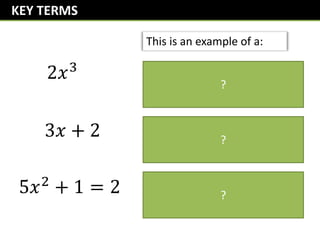
2𝑥3
This is an example of a:
Term
A term is a product of numbers and variables
(no additions/subtractions)
3𝑥 + 2 Expression
An expression is composed of one or more
terms, whether added or otherwise.
5𝑥2 + 1 = 2 Equation
An equation says that the expressions on the
left and right hand side of the = have the same
value.
?
?
?
3𝑛 + 1
9 − 𝑛
The perimeter of this
work of art is 32.
By trial and error (or any
other method), find 𝑛.
𝑛 = 3 ?
If we added all four sides of the painting to
get the perimeter, we’d have:
3𝑛 + 1 + 3𝑛 + 1 + 9 − 𝑛 + 9 − 𝑛
= 4𝑛 + 20
And we’re told the perimeter is 32, so
𝟒𝒏 + 𝟐𝟎 = 𝟑𝟐. We’ll see today how to
‘solve’ equations like this so we can find 𝑛.
STARTER
a 4
2 2
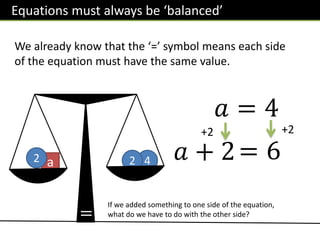
We already know that the ‘=’ symbol means each side
of the equation must have the same value.
If we added something to one side of the equation,
what do we have to do with the other side?
𝑎 = 4
= 6
+2
𝑎 + 2
+2
Equations must always be ‘balanced’
=
a 4
a 4
a 4
If we tripled the load on one side of the scales,
what do we have to do with the other side?
𝑎 = 4
= 12
×3
3𝑎
×3
Equations must always be ‘balanced’
=
!To solve an equation means that we find the value of
the variable(s).
4𝑛 + 20 = 32
3𝑛 + 1
9 − 𝑛
Strategy: To get 𝑛 on its own on
one side of the equation, we
gradually need to ‘claw away’
the things surrounding it.
Solving
4𝑛 + 20 = 32
-20
-20
4𝑛 = 12
𝑛 = 3
4
4
? ?
?
?
?
?
Strategy: Do the opposite
operation to ‘get rid of’ items
surrounding our variable.
𝑥 + 4 𝑥
3𝑦 𝑦
-4
3
𝑧
6
×6
𝑧
?
?
?
Solving
Bro Tip: Many students find writing these
operations between each equation helpful to
remind them what they’re doing to each side, but
you’ll eventually want to wean yourself off these.
Bro Note: You can probably see the answer to this in your
head because the equation is relatively simple, but this full
method is crucial when things become more complicated
3𝑛 − 5 = 13
+5
+5
3𝑛 = 18
𝑛 = 6
3
3
? ?
?
?
?
?
Test Your Understanding
4 + 6𝑧 = 18
-4
-4
6𝑧 = 14
𝑧 =
14
16
=
7
3
6
6
? ?
?
?
?
?
Bro Note: In algebra,
we tend to give our
answers as fractions
rather than decimals
(unless asked).
And NEVER EVER EVER
recurring decimals.
When the solution is not a whole number
Your Go…
3 = 20 + 4𝑥
−17 = 4𝑥
𝒙 = −
𝟏𝟕
𝟒
?
3 +
𝑥
5
= 28
-3
-3
𝑥
5
= 25
𝑥 = 125
×5
×5
? ?
?
?
?
?
Dealing with Fractions
What step next?
Use your planners to vote for the step that
would be easiest to do next in solving the
equation.
×  + -
×  + -
2𝑥 + 7 = 5
2𝑥 = −2
-7
-7
×  + -
3𝑥 = 9
𝑥 = 3
3
3
×  + -
−1 + 7𝑥 = 13
7𝑥 = 14
+1
+1
×  + -
𝑦
3
= 9
𝑦 = 27
×3
×3
×  + -
−𝑥 = 2
𝑥 = −2
(-1)
(-1)
Multiplying by -1 or dividing by -1
would have the same effect.
Exercise 1
Solve the following equations,
showing full working.
𝑛 − 4 = 10 𝒏 = 𝟏𝟒
2𝑥 + 3 = 9 𝒙 = 𝟑
5𝑥 − 4 = 36 𝒙 = 𝟖
9𝑥 − 2 = 61 𝒙 = 𝟕
9 = 1 + 4𝑦 𝒚 = 𝟐
8𝑎 + 3 = 75 𝒂 = 𝟗
3𝑥 = 7 𝒙 =
𝟕
𝟑
5𝑥 + 2 = 11 𝒙 =
𝟗
𝟓
8𝑥 − 2 = 3 𝒙 =
𝟓
𝟖
3 + 10𝑞 = 7 𝒒 =
𝟐
𝟓
5 + 3𝑎 = 4 𝒂 = −
𝟏
𝟑
7𝑏 + 23 = 11 𝒃 = −
𝟏𝟐
𝟕
14 + 9𝑏 = 3 𝒃 = −
𝟏𝟏
𝟗
𝑥
7
= 5 𝒙 = 𝟑𝟓
𝑎
4
+ 3 = 8 𝒂 = 𝟐𝟎
𝑏
2
− 1 = 5 𝒃 = 𝟏𝟐
1 +
𝑏
3
= 7 𝒃 = 𝟏𝟖
𝑥
5
+ 3 = 4 𝒙 = 𝟓
𝑦
4
+ 8 = 5 𝒚 = −𝟏𝟐
5 =
𝑎
6
+ 9 𝒂 = −𝟐𝟒
3 +
2𝑥
5
= 7 𝒙 = 𝟏𝟎
5𝑞
6
− 3 = 10 𝒒 =
𝟕𝟖
𝟓
5 +
3𝑥
4
= 3 𝒙 = −
𝟖
𝟑
11 =
6𝑥
7
+ 9 𝒙 = −
𝟕
𝟑
3 =
6
5
𝑥 + 3
8
+ 9 𝒙 = −
𝟖𝟓
𝟐
1
2
3
4
5
6
7
8
9
10
11
12
13
14
15
16
17
18
19
20
21
22
23
24
N
?
?
?
?
?
?
?
?
?
?
?
?
?
?
?
?
?
?
?
?
?
?
?
?
?
5𝑎 + 3 = 2𝑎 + 9
What might our strategy be?
Collect the variable terms (i.e. The terms involving a) on one side of the
equation, and the ‘constants’ (i.e. The individual numbers) on the other
side.
?
What happens if variable appears on both sides?
𝑎 = 2
5𝑎 + 3 = 2𝑎 + 9
-3
-3
5𝑎 = 2𝑎 + 6
3𝑎 = 6
-2a
-2a ?
?
?
?
3
3 ?
?
?
Let’s move the ‘𝑎’
terms to the left
(as 5 > 2) and the
constants to the
right.
This is to get rid
of the constant
term on the left. We could
have done
these two
steps in
either order.
What happens if variable appears on both sides?
Strategy? Collect the variable terms on the side of the equation where
there’s more of them (and move constant terms to other side).
?
𝑥 = −1
11𝑥 − 4 = 2𝑥 − 13
?
More Examples
𝑦 =
9
5
3𝑦 + 4 = 8𝑦 − 5
?
5 = 3 − 3𝑥
2 = −3𝑥
𝑥 =
2
−3
= −
2
3
5 + 3𝑥 = 3
3𝑥 = −2
𝑥 = −
2
3
Both methods are valid,
but I prefer the second
– it’s best to avoid
dividing by negative
numbers, and is less
likely to lead to error.
Or where we put 𝑥 term on
side where it’s positive:
Way we’d have
previously done it…
? ?
Test Your Understanding
3𝑥 − 3 = 𝑥 + 5
𝟐𝒙 = 𝟖
𝒙 = 𝟒
3 − 5𝑥 = 5 + 2𝑥
−𝟐 = 𝟕𝒙
𝒙 = −
𝟐
𝟕
?
?
Dealing with Brackets
If there’s any brackets, simply expand them first!
2 2𝑥 + 3 = 9
𝟒𝒙 + 𝟔 = 𝟗
𝟒𝒙 = 𝟑
𝒙 =
𝟑
𝟒
3 − 4 2𝑥 − 3 = 7𝑥
𝟑 − 𝟖𝒙 + 𝟏𝟐 = 𝟕𝒙
𝟏𝟓 − 𝟖𝒙 = 𝟕𝒙
𝟏𝟓 = 𝟏𝟓𝒙
𝒙 = 𝟏
? ?
Test Your Understanding
7 3𝑥 − 1 = 21 + 14𝑥
𝟐𝟏𝒙 − 𝟕 = 𝟐𝟏 + 𝟏𝟒𝒙
𝟕𝒙 = 𝟐𝟖
𝒙 = 𝟒
5 − 2 𝑥 + 2 = 4 − 3 2 − 𝑥
𝟓 − 𝟐𝒙 − 𝟒 = 𝟒 − 𝟔 + 𝟑𝒙
𝟏 − 𝟐𝒙 = −𝟐 + 𝟑𝒙
𝟑 = 𝟓𝒙
𝒙 =
𝟑
𝟓
?
?
Exercise 2
3𝑥 = 𝑥 + 4 𝒙 = 𝟐
6𝑦 = 4𝑦 − 4 𝒚 = −𝟐
5𝑥 + 3 = 3𝑥 + 7 𝒙 = 𝟐
8𝑦 − 3 = 6𝑦 + 7 𝒚 = 𝟓
10𝑥 + 3 = 7𝑥 − 3 𝒙 = −𝟐
𝑥 = 2 − 𝑥 𝒙 = 𝟏
2𝑧 = 9 − 𝑧 𝒛 = 𝟑
9𝑡 = 99 − 2𝑡 𝒕 = 𝟗
𝑥 + 6 = 2𝑥 − 6 𝒙 = 𝟏𝟐
7𝑦 + 1 = 9𝑦 + 5 𝒚 = −𝟐
5 𝑥 − 2 = 30 𝒙 = 𝟖
2 𝑥 + 1 = 9 + 𝑥 𝒙 = 𝟕
4 𝑥 − 1 = 3𝑥 − 1 𝒙 = 𝟑
3 𝑥 − 2 = 3 + 𝑥 𝒙 =
𝟗
𝟐
5 2𝑥 + 3 = 20 𝒙 =
𝟏
𝟐
10 − 5 𝑥 − 2 = 3 + 4𝑥 𝒙 =
𝟏𝟕
𝟗
9 − 4𝑥 = 4 − 9𝑥 𝒙 = −𝟏
2 3𝑥 + 1 = 3 + 2 2𝑥 − 1 𝒙 = −
𝟏
𝟐
3 + 2 3𝑥 + 1 = 7 + 𝑥 𝒙 =
𝟐
𝟓
2 − 𝑥 − 2 = 𝑥 − 2 − 𝑥 𝒙 = 𝟐
6 + 3 𝑦 − 2 = 5 𝑦 + 4 𝒚 = −𝟏𝟎
𝑥 − 2 2 − 𝑥 = 3 𝑥 − 2 − 𝑥 𝒙 = −𝟐
1
2
𝑥 +
3
4
𝑥 − 2 =
1
3
2𝑥 − 3 𝒙 =
𝟔
𝟕
Solve the following.
1
2
3
4
5
6
7
8
9
10
11
12
13
14
15
16
17
18
19
20
21
22
N
?
?
?
?
?
?
?
?
?
?
?
?
?
?
?
?
?
?
?
?
?
?
?
Year 7 Forming and Solving
Equations
Dr J Frost (jfrost@tiffin.kingston.sch.uk)
RECAP :: Forming/Solving Process
[JMC 2008 Q18] Granny swears that she is getting younger. She has
calculated that she is four times as old as I am now, but remember that 5
years ago she was five times as old as I was at that time. What is the sum of
our ages now?
Worded problem
Stage 1: Represent
problem algebraically
Let 𝑎 be my age and 𝑔
be Granny’s age.
𝑔 = 4𝑎
𝑔 − 5 = 5(𝑎 − 5)
Stage 2: ‘Solve’ equation(s)
to find value of variables.
𝑔 − 5 = 5𝑎 − 25
𝑔 = 5𝑎 − 20
5𝑎 − 20 = 4𝑎
𝑎 = 20
∴ 𝑔 = 80
We previously learnt how to form expressions given a worded context.
We’ll learn how to actually solve these equations formed now! We’ll first
focus on problems where the expressions have already been specified.
Example
𝒙 + 𝟏𝟎
𝟐𝒙 𝒙 − 𝟓𝟎
𝑥 + 10 + 2𝑥 + 𝑥 − 50 = 180
4𝑥 − 40 = 180
4𝑥 = 220
𝑥 = 55
Step 1: Think of a sentence which would have the
word “is” in it. Write each part of sentence as an
algebraic expression, with “is” giving =.
The angles of a triangle are as
pictured. Determine 𝑥.
Step 2: Solve!
Expr 1? Expr 2?
Solve!
“Sum of angles is 180°”
Sentence with “is” in it?
Another Example
𝑥 + 4
3
10
𝑥
The rectangle and triangle have the same
area. Determine the width of the rectangle.
3 𝑥 + 4 = 5𝑥
3𝑥 + 12 = 5𝑥
12 = 2𝑥
𝑥 = 6
Therefore width of
rectangle is 6 + 4 = 10
Expr 1? Expr 2?
Solve!
“Area of triangle is area of rect”
“is” sentence?
Check Your Understanding
3𝑥
2𝑥 + 20
2𝑥 + 10
120
The following diagram shows the angles
of a quadrilateral. Determine 𝑥.
“Total angle is 360”
𝟑𝒙 + 𝟐𝒙 + 𝟐𝟎 + 𝟐𝒙 + 𝟏𝟎 + 𝟏𝟐𝟎 = 𝟑𝟔𝟎
𝟕𝒙 + 𝟏𝟓𝟎 = 𝟑𝟔𝟎
𝟕𝒙 = 𝟐𝟏𝟎
𝒙 = 𝟑𝟎°
𝑥 + 4
5
𝑥
12
The area of the triangle is 1 more than the
area of the parallelogram. Determine 𝑥.
Area of 𝚫 is 1 more than area of par
𝟔𝒙 = 𝟏 + 𝟓 𝒙 + 𝟒
𝟓𝒙 + 𝟐𝟎 + 𝟏 = 𝟔𝒙
𝒙 = 𝟐𝟏
Expr 1? Expr 2?
Solve!
Expr 1? Expr 2?
Solve!
[JMO 1999 A9] Skimmed milk contains 0.1% fat and pasteurised whole milk contains
4% fat. When 6 litres of skimmed milk are mixed with 𝑛 litres of pasteurised whole
milk, the fat content of the resulting mixture is 1.66%. What is the value of 𝑛?
N
Fat content of skimmed + Fat content of pasteurised = fat content of mixture
6 × 0.001 + 0.04𝑛 = 0.0166 𝑛 + 6 → 𝑛 = 4
?
1
2
The ages of three cats are 𝑎, 𝑎 + 4 and 2𝑎 − 3.
Their total age is 21. Determine 𝑎.
𝟒𝒂 + 𝟏 = 𝟐𝟏
𝒂 = 𝟓
Three angles in a triangle are 𝑥, 2𝑥 + 20° and
7𝑥 − 10°. What is 𝑥? 𝒙 = 𝟏𝟕°
Two angles on a straight line are 𝑥 + 30° and
2𝑥 − 60°. What is 𝑥? 𝒙 = 𝟕𝟎°
The perimeter of this rectangle is 44. What is 𝑥?
Solution: 7
The area of this rectangle
is 48. Determine 𝑥.
𝒙 = 𝟕
An equilateral triangle has lengths
3𝑥 + 6, 5𝑥, 5𝑥. What is 𝑥?
𝒙 = 𝟑
Exercise 3
𝑥 + 5
4
[JMC 1998 Q18] The three angles of a
triangle are 𝑥 + 10 °, 2𝑥 − 40 °,
3𝑥 − 90 °. Which statement about the
triangles is correct? It is:
A right-angled isosceles
B right-angled, but not isosceles
C equilateral
D obtuse-angled and isosceles
E none of A-D Solution: C
The following triangle is isosceles.
Determine its perimeter (by first
determining 𝑥).
2𝑥 + 3
𝑥 − 2
1
2
3
4
5
6
7
8
?
3𝑥 + 10
5𝑥 − 50
𝑥 + 5
𝟑𝒙 + 𝟏𝟎 = 𝟓𝒙 − 𝟓𝟎 → 𝒙 = 𝟑𝟎°
Perimeter = 𝟑𝟓 + 𝟏𝟎𝟎 + 𝟏𝟎𝟎 = 𝟐𝟑𝟓
?
?
?
?
?
?
?
(See printed sheet)
Exercise 3
7𝑥
9𝑥
𝐴
𝐵
𝐶
𝐷
𝟗𝒙 + 𝟗𝒙 + 𝟐𝒙 = 𝟏𝟖𝟎
𝒙 = 𝟗
9 [JMO 2013 A7] Calculate the value of 𝑥
in the diagram shown?
Solution: 36
In the following diagram,
𝐴𝐷 = 𝐵𝐷, 𝐴𝐵 = 𝐴𝐶, ∠𝐶𝐴𝐷 = 7𝑥 and
∠𝐴𝐵𝐷 = 9𝑥. Determine 𝑥.
10
11 A very large jug of 𝑥 litres of orange
squash is 10% concentrate (the rest
water). When 5 litres of concentrate
is added the jug is now 12%
concentrate.
a. Form an equation in terms of
𝑥 (by considering the
amount of concentrate we
have).
𝟎. 𝟏𝒙 + 𝟓 = 𝟎. 𝟏𝟐(𝒙 + 𝟓)
b. Hence determine 𝑥.
𝟎. 𝟏𝒙 + 𝟓 = 𝟎. 𝟏𝟐𝒙 + 𝟎. 𝟔
𝟎. 𝟎𝟐𝒙 = 𝟒. 𝟒
𝒙 = 𝟐𝟐𝟎 𝒍𝒊𝒕𝒓𝒆𝒔
?
?
?
?
(See printed sheet)
Forming the expressions yourself
Enoch is 5m shorter than Alex. Hajun is double the height
of Alex. Their combined height is 35m. Find Alex’s height.
Use the word “Let …” to
define your variable(s)!
Let Alex’s height be 𝒙.
Then Enoch’ height is 𝒙 − 𝟓.
Hajun’s height is 𝟐𝒙.
Then: 𝒙 + 𝒙 − 𝟓 + 𝟐𝒙 = 𝟑𝟓
𝟒𝒙 − 𝟓 = 𝟑𝟓
𝒙 = 𝟏𝟎
∴ Alex’s height is 10m.
You want a clear narrative
while being as concise as
possible.
?
?
?
[JMC 2013 Q7] After tennis training, Andy collects twice as
many balls as Roger and five more than Maria. They collect
35 balls in total. How many balls does Andy collect?
More Examples
Let 𝒙 be the number of balls Roger collects.
Then Andy collects 𝟐𝒙 balls and Maria collects 𝟐𝒙 − 𝟓.
Total balls collected:
𝒙 + 𝟐𝒙 + 𝟐𝒙 − 𝟓 = 𝟑𝟓
𝟓𝒙 − 𝟓 = 𝟑𝟓
𝒙 = 𝟖
So Andy collected 𝟐 × 𝟖 = 𝟏𝟔 balls.
[TMC Regional 2014 Q9] In a list of seven consecutive numbers a
quarter of the smallest number is five less than a third of the largest
number. What is the value of the smallest number in the list?
Let smallest number be 𝒙. Then numbers are 𝒙, 𝒙 + 𝟏, 𝒙 + 𝟐, 𝒙 + 𝟑, 𝒙 + 𝟒, 𝒙 + 𝟓, 𝒙 + 𝟔
Therefore
𝟏
𝟒
𝒙 =
𝟏
𝟑
𝒙 + 𝟔 − 𝟓
𝟏
𝟒
𝒙 =
𝟏
𝟑
𝒙 + 𝟐 − 𝟓
𝟏
𝟏𝟐
𝒙 = 𝟑 → 𝒙 = 𝟑𝟔
So smallest number is 36.
?
?
Test Your Understanding
The length of the rectangle is three
times the width. The total perimeter is
56m. Determine its width.
Let 𝒙 be the width of the rectangle.
Then the length is 𝟑𝒙.
Then the perimeter is:
𝒙 + 𝟑𝒙 + 𝒙 + 𝟑𝒙 = 𝟓𝟔
𝟖𝒙 = 𝟓𝟔
𝒙 = 𝟕
∴ The width is 7m.
Bro Reminder: You
should usually start
with “Let …”
In 4 years time I will be 3 times as old as I was 10 years ago.
How old am I?
Let 𝒂 be my age.
Then 𝒂 + 𝟒 = 𝟑 𝒂 − 𝟏𝟎
𝒂 + 𝟒 = 𝟑𝒂 − 𝟑𝟎
𝟐𝒂 = 𝟑𝟒
𝒂 = 𝟏𝟕
?
?
1
2
Exercise 4
The sum of 5 consecutive numbers
is 200. What is the smallest
number?
Solution: 38 (a quick non-algebraic
method is to realise the middle
number is the average of the five
numbers, i.e. 40)
In 5 years time I will be 5 times as
old as I was 11 years ago. Form a
suitable equation, and hence
determine my age.
𝒂 + 𝟓 = 𝟓 𝒂 − 𝟏𝟏
𝒂 = 𝟏𝟓
In 6 years time I will be twice as old
as I was 8 years ago. Determine my
age.
𝒂 + 𝟔 = 𝟐 𝒂 − 𝟖
𝒂 = 𝟐𝟐
I have three times as many cats as Alice
but Bob has 7 less cats than me. In total
we have 56 cats. How many cats do I
have?
Solution: 27
Bob is twice as old as Alice at the
moment. In 4 years time their total age
will be 71. What is Alice’s age now?
4 years time: Alice 𝒂 + 𝟒 Bob 𝟐𝒂 + 𝟒
𝟑𝒂 + 𝟖 = 𝟕𝟏 → 𝒂 = 𝟐𝟏
[TMC Final 2012 Q1] A Triple Jump
consists of a hop, step and jump. The
length of Keith’s step was three-quarters
of the length of his hop and the length of
his jump was half the length of his step.
If the total length of Keith’s triple jump
was 17m, what was the length of his
hop, in metres?
Solution: 8 metres
1
2
3
4
5
?
?
?
?
?
6
?
(See printed sheet)
[JMO 2003 A6] Given a “starting” number, you double it
and add 1, then divide the answer by 1 less than the
starting number to get the “final” number. If you start
with 2, your final number is 5. If you start with 4, your
final number is 3. What starting number gives the final
number 4?
𝟐𝒙 + 𝟏
𝒙 − 𝟏
= 𝟒
𝟐𝒙 + 𝟏 = 𝟒 𝒙 − 𝟏
𝒙 =
𝟓
𝟐
Exercise 4
7
?
(See printed sheet)
Exercise 4
[JMO 2012 A3] In triangle 𝐴𝐵𝐶, ∠𝐶𝐴𝐵 = 84°; 𝐷
is a point on 𝐴𝐵 such that ∠𝐶𝐷𝐵 = 3 × ∠𝐴𝐶𝐷
and 𝐷𝐶 = 𝐷𝐵. What is the size of ∠𝐵𝐶𝐷?
Solution: Let ∠𝑨𝑪𝑫 = 𝒙, then ∠𝑪𝑫𝑩 = 𝟑𝒙
and ∠𝑨𝑫𝑪 = 𝟏𝟖𝟎 − 𝟑𝒙. Angles in 𝚫𝑨𝑪𝑫:
𝟖𝟒 + 𝟏𝟖𝟎 − 𝟑𝒙 + 𝒙 = 𝟏𝟖𝟎
𝒙 = 𝟒𝟐°
Then ∠𝑫𝑪𝑩 =
𝟏𝟖𝟎−𝟏𝟐𝟔
𝟐
= 𝟐𝟕°
[JMO 2005 A8] A large container holds 14 litres
of a solution which is 25% antifreeze, the
remainder being water. How many litres of
antifreeze must be added to the container to
make a solution which is 30% antifreeze?
Let 𝒙 be the amount of antifreeze added in
litres. 25% of 14 is 3.5. Thus:
𝟑. 𝟓 + 𝒙 = 𝟎. 𝟑 𝟏𝟒 + 𝒙
𝒙 = 𝟏
[JMC 2012 Q24] After playing 500
games, my success rate in Spider
Solitaire is 49%. Assuming I win every
game from now on, how many extra
games do I need to play in order that my
success rate increases to 50%?
A 1 B 2 C 5 D 10 E 50
Let 𝒙 be the number of extra games
played. Then, giving 245 games were
won before:
𝟐𝟒𝟓 + 𝒙 = 𝟎. 𝟓 𝟓𝟎𝟎 + 𝒙
𝒙 = 𝟏𝟎
(Note: it’s easier to just exploit the fact it’s multiple
choice and try the options!)
[JMO 2008 A9] In the diagram, 𝐶𝐷 is the
bisector of angle 𝐴𝐶𝐵.
Also 𝐵𝐶 = 𝐶𝐷 and 𝐴𝐵 = 𝐴𝐶. What is
the size of angle 𝐶𝐷𝐴?
Let ∠𝑫𝑪𝑩 = 𝒙. Filling in the angles
using the information we find
angles in 𝚫𝑫𝑨𝑪 are 𝒙, 𝟏𝟖𝟎 − 𝟐𝒙
and 𝟏𝟖𝟎 − 𝟒𝒙. This gives 𝒙 = 𝟑𝟔° .
∴ ∠𝑪𝑫𝑨 = 𝟏𝟖𝟎 − 𝟐 × 𝟑𝟔
= 𝟏𝟎𝟖° (Note: this is not intended to
be a full proof!)
8
9
10
N1
?
?
?
?
(See printed sheet)
Exercise 4
[JMO 2010 A10] Inn the diagram, 𝐽𝐾
and 𝑀𝐿 are parallel. 𝐽𝐾 = 𝐾𝑂 = 𝑂𝐽 =
𝑂𝑀 and 𝐿𝑀 = 𝐿𝑂 = 𝐿𝐾. Find the size
of angle 𝐽𝑀𝑂.
𝑥
𝑥
𝑥
𝑥
60°
300
− 2𝑥
𝑥 − 60°
𝑥 − 60°
60°
Since 𝑱𝑲 and 𝑴𝑳 are parallel, ∠𝑲𝑱𝑴 and
∠𝑱𝑴𝑳 are cointerior so add to 𝟏𝟖𝟎°.
If we let ∠𝑲𝑶𝑳 = 𝒙, we can eventually
find the angles as pictured.
𝒙 − 𝟔𝟎 + 𝟔𝟎 + 𝒙 − 𝟔𝟎 + 𝒙 = 𝟏𝟖𝟎
𝒙 = 𝟖𝟎° ∴ ∠𝑱𝑴𝑶 = 𝟖𝟎 − 𝟔𝟎 = 𝟐𝟎°
[JMO 2013 B2] Pippa thinks of a number. She adds
1 to it to get a second number. She then adds 2 to
the second number to get a third number, adds 3
to the third to get a fourth, and finally adds 4 to
the fourth to get a fifth number.
Pippa’s brother Ben also thinks of a number but he
subtracts 1 to get a second. He then subtracts 2
from the second to get a third, and so on until he
has five numbers.
They discover that the sum of Pippa’s five
numbers is the same as the sum of Ben’s five
numbers. What is the difference between the two
numbers of which they first thought?
Let 𝒙 be Pippa’s first number. Then her numbers
are 𝒙, 𝒙 + 𝟏, 𝒙 + 𝟑, 𝒙 + 𝟔, 𝒙 + 𝟏𝟎. Sum is 𝟓𝒙 +
𝟐𝟎.
Let 𝒚 be Ben’s first number. Then his numbers are
𝒚, 𝒚 − 𝟏, 𝒚 − 𝟑, 𝒚 − 𝟔, 𝒚 − 𝟏𝟎. Sum is 𝟓𝒚 − 𝟐𝟎
We’re told 𝟓𝒙 + 𝟐𝟎 = 𝟓𝒚 − 𝟐𝟎 and the
difference between their two starting numbers is
𝒚 − 𝒙. Rearranging:
𝟓𝒙 + 𝟐𝟎 = 𝟓𝒚 − 𝟐𝟎
𝟓𝒚 − 𝟓𝒙 = 𝟒𝟎
∴ 𝒚 − 𝒙 = 𝟖
N2 N3
?
?
(See printed sheet)
[JMO 2005 B4] In this figure 𝐴𝐷𝐶 is a straight
line and 𝐴𝐵 = 𝐵𝐶 = 𝐶𝐷. Also, 𝐷𝐴 = 𝐷𝐵.
Find the size of ∠𝐵𝐴𝐶.
(Full proof needed)
Exercise 4
Full proof:
Let ∠𝑫𝑨𝑩 = 𝒙
Then ∠𝑫𝑩𝑨 = 𝒙 (base angles of isosceles 𝚫𝑫𝑨𝑩 are equal)
∠𝑨𝑪𝑩 = 𝒙 (base angles of isosceles 𝚫𝑨𝑩𝑪 are equal)
∠𝑪𝑫𝑩 = 𝟐𝒙 (exterior angle of triangle 𝚫𝑫𝑨𝑩 is sum of two interior angles)
∠𝑫𝑩𝑪 = 𝟐𝒙 (base angles of isosceles 𝚫𝑩𝑪𝑫 are equal)
The angles in a triangle sum to 𝟏𝟖𝟎°. Using the angles in 𝚫𝑨𝑩𝑪:
𝒙 + 𝒙 + 𝟐𝒙 + 𝒙 = 𝟏𝟖𝟎°
𝟓𝒙 = 𝟏𝟖𝟎°
𝒙 = 𝟑𝟔°
(We could have also used the angles in 𝚫𝑩𝑪𝑫)
N4
?
(See printed sheet)

Equations.pptx

  • 1.
    Equations Objectives: (a) Solve equations,including with unknowns on both sides and with brackets.
  • 2.
    KEY TERMS 2𝑥3 This isan example of a: Term A term is a product of numbers and variables (no additions/subtractions) 3𝑥 + 2 Expression An expression is composed of one or more terms, whether added or otherwise. 5𝑥2 + 1 = 2 Equation An equation says that the expressions on the left and right hand side of the = have the same value. ? ? ?
  • 3.
    3𝑛 + 1 9− 𝑛 The perimeter of this work of art is 32. By trial and error (or any other method), find 𝑛. 𝑛 = 3 ? If we added all four sides of the painting to get the perimeter, we’d have: 3𝑛 + 1 + 3𝑛 + 1 + 9 − 𝑛 + 9 − 𝑛 = 4𝑛 + 20 And we’re told the perimeter is 32, so 𝟒𝒏 + 𝟐𝟎 = 𝟑𝟐. We’ll see today how to ‘solve’ equations like this so we can find 𝑛. STARTER
  • 4.
    a 4 2 2 Wealready know that the ‘=’ symbol means each side of the equation must have the same value. If we added something to one side of the equation, what do we have to do with the other side? 𝑎 = 4 = 6 +2 𝑎 + 2 +2 Equations must always be ‘balanced’ =
  • 5.
    a 4 a 4 a4 If we tripled the load on one side of the scales, what do we have to do with the other side? 𝑎 = 4 = 12 ×3 3𝑎 ×3 Equations must always be ‘balanced’ =
  • 6.
    !To solve anequation means that we find the value of the variable(s). 4𝑛 + 20 = 32 3𝑛 + 1 9 − 𝑛 Strategy: To get 𝑛 on its own on one side of the equation, we gradually need to ‘claw away’ the things surrounding it. Solving
  • 7.
    4𝑛 + 20= 32 -20 -20 4𝑛 = 12 𝑛 = 3 4 4 ? ? ? ? ? ? Strategy: Do the opposite operation to ‘get rid of’ items surrounding our variable. 𝑥 + 4 𝑥 3𝑦 𝑦 -4 3 𝑧 6 ×6 𝑧 ? ? ? Solving Bro Tip: Many students find writing these operations between each equation helpful to remind them what they’re doing to each side, but you’ll eventually want to wean yourself off these. Bro Note: You can probably see the answer to this in your head because the equation is relatively simple, but this full method is crucial when things become more complicated
  • 8.
    3𝑛 − 5= 13 +5 +5 3𝑛 = 18 𝑛 = 6 3 3 ? ? ? ? ? ? Test Your Understanding
  • 9.
    4 + 6𝑧= 18 -4 -4 6𝑧 = 14 𝑧 = 14 16 = 7 3 6 6 ? ? ? ? ? ? Bro Note: In algebra, we tend to give our answers as fractions rather than decimals (unless asked). And NEVER EVER EVER recurring decimals. When the solution is not a whole number Your Go… 3 = 20 + 4𝑥 −17 = 4𝑥 𝒙 = − 𝟏𝟕 𝟒 ?
  • 10.
    3 + 𝑥 5 = 28 -3 -3 𝑥 5 =25 𝑥 = 125 ×5 ×5 ? ? ? ? ? ? Dealing with Fractions
  • 11.
    What step next? Useyour planners to vote for the step that would be easiest to do next in solving the equation. ×  + -
  • 12.
    ×  +- 2𝑥 + 7 = 5 2𝑥 = −2 -7 -7
  • 13.
    ×  +- 3𝑥 = 9 𝑥 = 3 3 3
  • 14.
    ×  +- −1 + 7𝑥 = 13 7𝑥 = 14 +1 +1
  • 15.
    ×  +- 𝑦 3 = 9 𝑦 = 27 ×3 ×3
  • 16.
    ×  +- −𝑥 = 2 𝑥 = −2 (-1) (-1) Multiplying by -1 or dividing by -1 would have the same effect.
  • 17.
    Exercise 1 Solve thefollowing equations, showing full working. 𝑛 − 4 = 10 𝒏 = 𝟏𝟒 2𝑥 + 3 = 9 𝒙 = 𝟑 5𝑥 − 4 = 36 𝒙 = 𝟖 9𝑥 − 2 = 61 𝒙 = 𝟕 9 = 1 + 4𝑦 𝒚 = 𝟐 8𝑎 + 3 = 75 𝒂 = 𝟗 3𝑥 = 7 𝒙 = 𝟕 𝟑 5𝑥 + 2 = 11 𝒙 = 𝟗 𝟓 8𝑥 − 2 = 3 𝒙 = 𝟓 𝟖 3 + 10𝑞 = 7 𝒒 = 𝟐 𝟓 5 + 3𝑎 = 4 𝒂 = − 𝟏 𝟑 7𝑏 + 23 = 11 𝒃 = − 𝟏𝟐 𝟕 14 + 9𝑏 = 3 𝒃 = − 𝟏𝟏 𝟗 𝑥 7 = 5 𝒙 = 𝟑𝟓 𝑎 4 + 3 = 8 𝒂 = 𝟐𝟎 𝑏 2 − 1 = 5 𝒃 = 𝟏𝟐 1 + 𝑏 3 = 7 𝒃 = 𝟏𝟖 𝑥 5 + 3 = 4 𝒙 = 𝟓 𝑦 4 + 8 = 5 𝒚 = −𝟏𝟐 5 = 𝑎 6 + 9 𝒂 = −𝟐𝟒 3 + 2𝑥 5 = 7 𝒙 = 𝟏𝟎 5𝑞 6 − 3 = 10 𝒒 = 𝟕𝟖 𝟓 5 + 3𝑥 4 = 3 𝒙 = − 𝟖 𝟑 11 = 6𝑥 7 + 9 𝒙 = − 𝟕 𝟑 3 = 6 5 𝑥 + 3 8 + 9 𝒙 = − 𝟖𝟓 𝟐 1 2 3 4 5 6 7 8 9 10 11 12 13 14 15 16 17 18 19 20 21 22 23 24 N ? ? ? ? ? ? ? ? ? ? ? ? ? ? ? ? ? ? ? ? ? ? ? ? ?
  • 18.
    5𝑎 + 3= 2𝑎 + 9 What might our strategy be? Collect the variable terms (i.e. The terms involving a) on one side of the equation, and the ‘constants’ (i.e. The individual numbers) on the other side. ? What happens if variable appears on both sides?
  • 19.
    𝑎 = 2 5𝑎+ 3 = 2𝑎 + 9 -3 -3 5𝑎 = 2𝑎 + 6 3𝑎 = 6 -2a -2a ? ? ? ? 3 3 ? ? ? Let’s move the ‘𝑎’ terms to the left (as 5 > 2) and the constants to the right. This is to get rid of the constant term on the left. We could have done these two steps in either order. What happens if variable appears on both sides? Strategy? Collect the variable terms on the side of the equation where there’s more of them (and move constant terms to other side). ?
  • 20.
    𝑥 = −1 11𝑥− 4 = 2𝑥 − 13 ? More Examples 𝑦 = 9 5 3𝑦 + 4 = 8𝑦 − 5 ? 5 = 3 − 3𝑥 2 = −3𝑥 𝑥 = 2 −3 = − 2 3 5 + 3𝑥 = 3 3𝑥 = −2 𝑥 = − 2 3 Both methods are valid, but I prefer the second – it’s best to avoid dividing by negative numbers, and is less likely to lead to error. Or where we put 𝑥 term on side where it’s positive: Way we’d have previously done it… ? ?
  • 21.
    Test Your Understanding 3𝑥− 3 = 𝑥 + 5 𝟐𝒙 = 𝟖 𝒙 = 𝟒 3 − 5𝑥 = 5 + 2𝑥 −𝟐 = 𝟕𝒙 𝒙 = − 𝟐 𝟕 ? ?
  • 22.
    Dealing with Brackets Ifthere’s any brackets, simply expand them first! 2 2𝑥 + 3 = 9 𝟒𝒙 + 𝟔 = 𝟗 𝟒𝒙 = 𝟑 𝒙 = 𝟑 𝟒 3 − 4 2𝑥 − 3 = 7𝑥 𝟑 − 𝟖𝒙 + 𝟏𝟐 = 𝟕𝒙 𝟏𝟓 − 𝟖𝒙 = 𝟕𝒙 𝟏𝟓 = 𝟏𝟓𝒙 𝒙 = 𝟏 ? ?
  • 23.
    Test Your Understanding 73𝑥 − 1 = 21 + 14𝑥 𝟐𝟏𝒙 − 𝟕 = 𝟐𝟏 + 𝟏𝟒𝒙 𝟕𝒙 = 𝟐𝟖 𝒙 = 𝟒 5 − 2 𝑥 + 2 = 4 − 3 2 − 𝑥 𝟓 − 𝟐𝒙 − 𝟒 = 𝟒 − 𝟔 + 𝟑𝒙 𝟏 − 𝟐𝒙 = −𝟐 + 𝟑𝒙 𝟑 = 𝟓𝒙 𝒙 = 𝟑 𝟓 ? ?
  • 24.
    Exercise 2 3𝑥 =𝑥 + 4 𝒙 = 𝟐 6𝑦 = 4𝑦 − 4 𝒚 = −𝟐 5𝑥 + 3 = 3𝑥 + 7 𝒙 = 𝟐 8𝑦 − 3 = 6𝑦 + 7 𝒚 = 𝟓 10𝑥 + 3 = 7𝑥 − 3 𝒙 = −𝟐 𝑥 = 2 − 𝑥 𝒙 = 𝟏 2𝑧 = 9 − 𝑧 𝒛 = 𝟑 9𝑡 = 99 − 2𝑡 𝒕 = 𝟗 𝑥 + 6 = 2𝑥 − 6 𝒙 = 𝟏𝟐 7𝑦 + 1 = 9𝑦 + 5 𝒚 = −𝟐 5 𝑥 − 2 = 30 𝒙 = 𝟖 2 𝑥 + 1 = 9 + 𝑥 𝒙 = 𝟕 4 𝑥 − 1 = 3𝑥 − 1 𝒙 = 𝟑 3 𝑥 − 2 = 3 + 𝑥 𝒙 = 𝟗 𝟐 5 2𝑥 + 3 = 20 𝒙 = 𝟏 𝟐 10 − 5 𝑥 − 2 = 3 + 4𝑥 𝒙 = 𝟏𝟕 𝟗 9 − 4𝑥 = 4 − 9𝑥 𝒙 = −𝟏 2 3𝑥 + 1 = 3 + 2 2𝑥 − 1 𝒙 = − 𝟏 𝟐 3 + 2 3𝑥 + 1 = 7 + 𝑥 𝒙 = 𝟐 𝟓 2 − 𝑥 − 2 = 𝑥 − 2 − 𝑥 𝒙 = 𝟐 6 + 3 𝑦 − 2 = 5 𝑦 + 4 𝒚 = −𝟏𝟎 𝑥 − 2 2 − 𝑥 = 3 𝑥 − 2 − 𝑥 𝒙 = −𝟐 1 2 𝑥 + 3 4 𝑥 − 2 = 1 3 2𝑥 − 3 𝒙 = 𝟔 𝟕 Solve the following. 1 2 3 4 5 6 7 8 9 10 11 12 13 14 15 16 17 18 19 20 21 22 N ? ? ? ? ? ? ? ? ? ? ? ? ? ? ? ? ? ? ? ? ? ? ?
  • 25.
    Year 7 Formingand Solving Equations Dr J Frost (jfrost@tiffin.kingston.sch.uk)
  • 26.
    RECAP :: Forming/SolvingProcess [JMC 2008 Q18] Granny swears that she is getting younger. She has calculated that she is four times as old as I am now, but remember that 5 years ago she was five times as old as I was at that time. What is the sum of our ages now? Worded problem Stage 1: Represent problem algebraically Let 𝑎 be my age and 𝑔 be Granny’s age. 𝑔 = 4𝑎 𝑔 − 5 = 5(𝑎 − 5) Stage 2: ‘Solve’ equation(s) to find value of variables. 𝑔 − 5 = 5𝑎 − 25 𝑔 = 5𝑎 − 20 5𝑎 − 20 = 4𝑎 𝑎 = 20 ∴ 𝑔 = 80 We previously learnt how to form expressions given a worded context. We’ll learn how to actually solve these equations formed now! We’ll first focus on problems where the expressions have already been specified.
  • 27.
    Example 𝒙 + 𝟏𝟎 𝟐𝒙𝒙 − 𝟓𝟎 𝑥 + 10 + 2𝑥 + 𝑥 − 50 = 180 4𝑥 − 40 = 180 4𝑥 = 220 𝑥 = 55 Step 1: Think of a sentence which would have the word “is” in it. Write each part of sentence as an algebraic expression, with “is” giving =. The angles of a triangle are as pictured. Determine 𝑥. Step 2: Solve! Expr 1? Expr 2? Solve! “Sum of angles is 180°” Sentence with “is” in it?
  • 28.
    Another Example 𝑥 +4 3 10 𝑥 The rectangle and triangle have the same area. Determine the width of the rectangle. 3 𝑥 + 4 = 5𝑥 3𝑥 + 12 = 5𝑥 12 = 2𝑥 𝑥 = 6 Therefore width of rectangle is 6 + 4 = 10 Expr 1? Expr 2? Solve! “Area of triangle is area of rect” “is” sentence?
  • 29.
    Check Your Understanding 3𝑥 2𝑥+ 20 2𝑥 + 10 120 The following diagram shows the angles of a quadrilateral. Determine 𝑥. “Total angle is 360” 𝟑𝒙 + 𝟐𝒙 + 𝟐𝟎 + 𝟐𝒙 + 𝟏𝟎 + 𝟏𝟐𝟎 = 𝟑𝟔𝟎 𝟕𝒙 + 𝟏𝟓𝟎 = 𝟑𝟔𝟎 𝟕𝒙 = 𝟐𝟏𝟎 𝒙 = 𝟑𝟎° 𝑥 + 4 5 𝑥 12 The area of the triangle is 1 more than the area of the parallelogram. Determine 𝑥. Area of 𝚫 is 1 more than area of par 𝟔𝒙 = 𝟏 + 𝟓 𝒙 + 𝟒 𝟓𝒙 + 𝟐𝟎 + 𝟏 = 𝟔𝒙 𝒙 = 𝟐𝟏 Expr 1? Expr 2? Solve! Expr 1? Expr 2? Solve! [JMO 1999 A9] Skimmed milk contains 0.1% fat and pasteurised whole milk contains 4% fat. When 6 litres of skimmed milk are mixed with 𝑛 litres of pasteurised whole milk, the fat content of the resulting mixture is 1.66%. What is the value of 𝑛? N Fat content of skimmed + Fat content of pasteurised = fat content of mixture 6 × 0.001 + 0.04𝑛 = 0.0166 𝑛 + 6 → 𝑛 = 4 ? 1 2
  • 30.
    The ages ofthree cats are 𝑎, 𝑎 + 4 and 2𝑎 − 3. Their total age is 21. Determine 𝑎. 𝟒𝒂 + 𝟏 = 𝟐𝟏 𝒂 = 𝟓 Three angles in a triangle are 𝑥, 2𝑥 + 20° and 7𝑥 − 10°. What is 𝑥? 𝒙 = 𝟏𝟕° Two angles on a straight line are 𝑥 + 30° and 2𝑥 − 60°. What is 𝑥? 𝒙 = 𝟕𝟎° The perimeter of this rectangle is 44. What is 𝑥? Solution: 7 The area of this rectangle is 48. Determine 𝑥. 𝒙 = 𝟕 An equilateral triangle has lengths 3𝑥 + 6, 5𝑥, 5𝑥. What is 𝑥? 𝒙 = 𝟑 Exercise 3 𝑥 + 5 4 [JMC 1998 Q18] The three angles of a triangle are 𝑥 + 10 °, 2𝑥 − 40 °, 3𝑥 − 90 °. Which statement about the triangles is correct? It is: A right-angled isosceles B right-angled, but not isosceles C equilateral D obtuse-angled and isosceles E none of A-D Solution: C The following triangle is isosceles. Determine its perimeter (by first determining 𝑥). 2𝑥 + 3 𝑥 − 2 1 2 3 4 5 6 7 8 ? 3𝑥 + 10 5𝑥 − 50 𝑥 + 5 𝟑𝒙 + 𝟏𝟎 = 𝟓𝒙 − 𝟓𝟎 → 𝒙 = 𝟑𝟎° Perimeter = 𝟑𝟓 + 𝟏𝟎𝟎 + 𝟏𝟎𝟎 = 𝟐𝟑𝟓 ? ? ? ? ? ? ? (See printed sheet)
  • 31.
    Exercise 3 7𝑥 9𝑥 𝐴 𝐵 𝐶 𝐷 𝟗𝒙 +𝟗𝒙 + 𝟐𝒙 = 𝟏𝟖𝟎 𝒙 = 𝟗 9 [JMO 2013 A7] Calculate the value of 𝑥 in the diagram shown? Solution: 36 In the following diagram, 𝐴𝐷 = 𝐵𝐷, 𝐴𝐵 = 𝐴𝐶, ∠𝐶𝐴𝐷 = 7𝑥 and ∠𝐴𝐵𝐷 = 9𝑥. Determine 𝑥. 10 11 A very large jug of 𝑥 litres of orange squash is 10% concentrate (the rest water). When 5 litres of concentrate is added the jug is now 12% concentrate. a. Form an equation in terms of 𝑥 (by considering the amount of concentrate we have). 𝟎. 𝟏𝒙 + 𝟓 = 𝟎. 𝟏𝟐(𝒙 + 𝟓) b. Hence determine 𝑥. 𝟎. 𝟏𝒙 + 𝟓 = 𝟎. 𝟏𝟐𝒙 + 𝟎. 𝟔 𝟎. 𝟎𝟐𝒙 = 𝟒. 𝟒 𝒙 = 𝟐𝟐𝟎 𝒍𝒊𝒕𝒓𝒆𝒔 ? ? ? ? (See printed sheet)
  • 32.
    Forming the expressionsyourself Enoch is 5m shorter than Alex. Hajun is double the height of Alex. Their combined height is 35m. Find Alex’s height. Use the word “Let …” to define your variable(s)! Let Alex’s height be 𝒙. Then Enoch’ height is 𝒙 − 𝟓. Hajun’s height is 𝟐𝒙. Then: 𝒙 + 𝒙 − 𝟓 + 𝟐𝒙 = 𝟑𝟓 𝟒𝒙 − 𝟓 = 𝟑𝟓 𝒙 = 𝟏𝟎 ∴ Alex’s height is 10m. You want a clear narrative while being as concise as possible. ? ? ?
  • 33.
    [JMC 2013 Q7]After tennis training, Andy collects twice as many balls as Roger and five more than Maria. They collect 35 balls in total. How many balls does Andy collect? More Examples Let 𝒙 be the number of balls Roger collects. Then Andy collects 𝟐𝒙 balls and Maria collects 𝟐𝒙 − 𝟓. Total balls collected: 𝒙 + 𝟐𝒙 + 𝟐𝒙 − 𝟓 = 𝟑𝟓 𝟓𝒙 − 𝟓 = 𝟑𝟓 𝒙 = 𝟖 So Andy collected 𝟐 × 𝟖 = 𝟏𝟔 balls. [TMC Regional 2014 Q9] In a list of seven consecutive numbers a quarter of the smallest number is five less than a third of the largest number. What is the value of the smallest number in the list? Let smallest number be 𝒙. Then numbers are 𝒙, 𝒙 + 𝟏, 𝒙 + 𝟐, 𝒙 + 𝟑, 𝒙 + 𝟒, 𝒙 + 𝟓, 𝒙 + 𝟔 Therefore 𝟏 𝟒 𝒙 = 𝟏 𝟑 𝒙 + 𝟔 − 𝟓 𝟏 𝟒 𝒙 = 𝟏 𝟑 𝒙 + 𝟐 − 𝟓 𝟏 𝟏𝟐 𝒙 = 𝟑 → 𝒙 = 𝟑𝟔 So smallest number is 36. ? ?
  • 34.
    Test Your Understanding Thelength of the rectangle is three times the width. The total perimeter is 56m. Determine its width. Let 𝒙 be the width of the rectangle. Then the length is 𝟑𝒙. Then the perimeter is: 𝒙 + 𝟑𝒙 + 𝒙 + 𝟑𝒙 = 𝟓𝟔 𝟖𝒙 = 𝟓𝟔 𝒙 = 𝟕 ∴ The width is 7m. Bro Reminder: You should usually start with “Let …” In 4 years time I will be 3 times as old as I was 10 years ago. How old am I? Let 𝒂 be my age. Then 𝒂 + 𝟒 = 𝟑 𝒂 − 𝟏𝟎 𝒂 + 𝟒 = 𝟑𝒂 − 𝟑𝟎 𝟐𝒂 = 𝟑𝟒 𝒂 = 𝟏𝟕 ? ? 1 2
  • 35.
    Exercise 4 The sumof 5 consecutive numbers is 200. What is the smallest number? Solution: 38 (a quick non-algebraic method is to realise the middle number is the average of the five numbers, i.e. 40) In 5 years time I will be 5 times as old as I was 11 years ago. Form a suitable equation, and hence determine my age. 𝒂 + 𝟓 = 𝟓 𝒂 − 𝟏𝟏 𝒂 = 𝟏𝟓 In 6 years time I will be twice as old as I was 8 years ago. Determine my age. 𝒂 + 𝟔 = 𝟐 𝒂 − 𝟖 𝒂 = 𝟐𝟐 I have three times as many cats as Alice but Bob has 7 less cats than me. In total we have 56 cats. How many cats do I have? Solution: 27 Bob is twice as old as Alice at the moment. In 4 years time their total age will be 71. What is Alice’s age now? 4 years time: Alice 𝒂 + 𝟒 Bob 𝟐𝒂 + 𝟒 𝟑𝒂 + 𝟖 = 𝟕𝟏 → 𝒂 = 𝟐𝟏 [TMC Final 2012 Q1] A Triple Jump consists of a hop, step and jump. The length of Keith’s step was three-quarters of the length of his hop and the length of his jump was half the length of his step. If the total length of Keith’s triple jump was 17m, what was the length of his hop, in metres? Solution: 8 metres 1 2 3 4 5 ? ? ? ? ? 6 ? (See printed sheet)
  • 36.
    [JMO 2003 A6]Given a “starting” number, you double it and add 1, then divide the answer by 1 less than the starting number to get the “final” number. If you start with 2, your final number is 5. If you start with 4, your final number is 3. What starting number gives the final number 4? 𝟐𝒙 + 𝟏 𝒙 − 𝟏 = 𝟒 𝟐𝒙 + 𝟏 = 𝟒 𝒙 − 𝟏 𝒙 = 𝟓 𝟐 Exercise 4 7 ? (See printed sheet)
  • 37.
    Exercise 4 [JMO 2012A3] In triangle 𝐴𝐵𝐶, ∠𝐶𝐴𝐵 = 84°; 𝐷 is a point on 𝐴𝐵 such that ∠𝐶𝐷𝐵 = 3 × ∠𝐴𝐶𝐷 and 𝐷𝐶 = 𝐷𝐵. What is the size of ∠𝐵𝐶𝐷? Solution: Let ∠𝑨𝑪𝑫 = 𝒙, then ∠𝑪𝑫𝑩 = 𝟑𝒙 and ∠𝑨𝑫𝑪 = 𝟏𝟖𝟎 − 𝟑𝒙. Angles in 𝚫𝑨𝑪𝑫: 𝟖𝟒 + 𝟏𝟖𝟎 − 𝟑𝒙 + 𝒙 = 𝟏𝟖𝟎 𝒙 = 𝟒𝟐° Then ∠𝑫𝑪𝑩 = 𝟏𝟖𝟎−𝟏𝟐𝟔 𝟐 = 𝟐𝟕° [JMO 2005 A8] A large container holds 14 litres of a solution which is 25% antifreeze, the remainder being water. How many litres of antifreeze must be added to the container to make a solution which is 30% antifreeze? Let 𝒙 be the amount of antifreeze added in litres. 25% of 14 is 3.5. Thus: 𝟑. 𝟓 + 𝒙 = 𝟎. 𝟑 𝟏𝟒 + 𝒙 𝒙 = 𝟏 [JMC 2012 Q24] After playing 500 games, my success rate in Spider Solitaire is 49%. Assuming I win every game from now on, how many extra games do I need to play in order that my success rate increases to 50%? A 1 B 2 C 5 D 10 E 50 Let 𝒙 be the number of extra games played. Then, giving 245 games were won before: 𝟐𝟒𝟓 + 𝒙 = 𝟎. 𝟓 𝟓𝟎𝟎 + 𝒙 𝒙 = 𝟏𝟎 (Note: it’s easier to just exploit the fact it’s multiple choice and try the options!) [JMO 2008 A9] In the diagram, 𝐶𝐷 is the bisector of angle 𝐴𝐶𝐵. Also 𝐵𝐶 = 𝐶𝐷 and 𝐴𝐵 = 𝐴𝐶. What is the size of angle 𝐶𝐷𝐴? Let ∠𝑫𝑪𝑩 = 𝒙. Filling in the angles using the information we find angles in 𝚫𝑫𝑨𝑪 are 𝒙, 𝟏𝟖𝟎 − 𝟐𝒙 and 𝟏𝟖𝟎 − 𝟒𝒙. This gives 𝒙 = 𝟑𝟔° . ∴ ∠𝑪𝑫𝑨 = 𝟏𝟖𝟎 − 𝟐 × 𝟑𝟔 = 𝟏𝟎𝟖° (Note: this is not intended to be a full proof!) 8 9 10 N1 ? ? ? ? (See printed sheet)
  • 38.
    Exercise 4 [JMO 2010A10] Inn the diagram, 𝐽𝐾 and 𝑀𝐿 are parallel. 𝐽𝐾 = 𝐾𝑂 = 𝑂𝐽 = 𝑂𝑀 and 𝐿𝑀 = 𝐿𝑂 = 𝐿𝐾. Find the size of angle 𝐽𝑀𝑂. 𝑥 𝑥 𝑥 𝑥 60° 300 − 2𝑥 𝑥 − 60° 𝑥 − 60° 60° Since 𝑱𝑲 and 𝑴𝑳 are parallel, ∠𝑲𝑱𝑴 and ∠𝑱𝑴𝑳 are cointerior so add to 𝟏𝟖𝟎°. If we let ∠𝑲𝑶𝑳 = 𝒙, we can eventually find the angles as pictured. 𝒙 − 𝟔𝟎 + 𝟔𝟎 + 𝒙 − 𝟔𝟎 + 𝒙 = 𝟏𝟖𝟎 𝒙 = 𝟖𝟎° ∴ ∠𝑱𝑴𝑶 = 𝟖𝟎 − 𝟔𝟎 = 𝟐𝟎° [JMO 2013 B2] Pippa thinks of a number. She adds 1 to it to get a second number. She then adds 2 to the second number to get a third number, adds 3 to the third to get a fourth, and finally adds 4 to the fourth to get a fifth number. Pippa’s brother Ben also thinks of a number but he subtracts 1 to get a second. He then subtracts 2 from the second to get a third, and so on until he has five numbers. They discover that the sum of Pippa’s five numbers is the same as the sum of Ben’s five numbers. What is the difference between the two numbers of which they first thought? Let 𝒙 be Pippa’s first number. Then her numbers are 𝒙, 𝒙 + 𝟏, 𝒙 + 𝟑, 𝒙 + 𝟔, 𝒙 + 𝟏𝟎. Sum is 𝟓𝒙 + 𝟐𝟎. Let 𝒚 be Ben’s first number. Then his numbers are 𝒚, 𝒚 − 𝟏, 𝒚 − 𝟑, 𝒚 − 𝟔, 𝒚 − 𝟏𝟎. Sum is 𝟓𝒚 − 𝟐𝟎 We’re told 𝟓𝒙 + 𝟐𝟎 = 𝟓𝒚 − 𝟐𝟎 and the difference between their two starting numbers is 𝒚 − 𝒙. Rearranging: 𝟓𝒙 + 𝟐𝟎 = 𝟓𝒚 − 𝟐𝟎 𝟓𝒚 − 𝟓𝒙 = 𝟒𝟎 ∴ 𝒚 − 𝒙 = 𝟖 N2 N3 ? ? (See printed sheet)
  • 39.
    [JMO 2005 B4]In this figure 𝐴𝐷𝐶 is a straight line and 𝐴𝐵 = 𝐵𝐶 = 𝐶𝐷. Also, 𝐷𝐴 = 𝐷𝐵. Find the size of ∠𝐵𝐴𝐶. (Full proof needed) Exercise 4 Full proof: Let ∠𝑫𝑨𝑩 = 𝒙 Then ∠𝑫𝑩𝑨 = 𝒙 (base angles of isosceles 𝚫𝑫𝑨𝑩 are equal) ∠𝑨𝑪𝑩 = 𝒙 (base angles of isosceles 𝚫𝑨𝑩𝑪 are equal) ∠𝑪𝑫𝑩 = 𝟐𝒙 (exterior angle of triangle 𝚫𝑫𝑨𝑩 is sum of two interior angles) ∠𝑫𝑩𝑪 = 𝟐𝒙 (base angles of isosceles 𝚫𝑩𝑪𝑫 are equal) The angles in a triangle sum to 𝟏𝟖𝟎°. Using the angles in 𝚫𝑨𝑩𝑪: 𝒙 + 𝒙 + 𝟐𝒙 + 𝒙 = 𝟏𝟖𝟎° 𝟓𝒙 = 𝟏𝟖𝟎° 𝒙 = 𝟑𝟔° (We could have also used the angles in 𝚫𝑩𝑪𝑫) N4 ? (See printed sheet)