Presentation on
ABSORPTION COSTING
AND
MARGINAL COSTING
AYJAZ AHMAD MALIK
1ST M.COM
ROLL NO: 10
1
INTRODUCTION
• We allocate all manufacturing costs to
products regardless of whether they are fixed
or variable. This approach is known as
absorption costing/full costing.
• However, only variable costs are relevant to
decision-making. This is known as marginal
costing/variable costing.
2
Definition
1. Absorption costing
2. Marginal costing
3
Absorption Costing
• It is costing system which treats all
manufacturing costs including both the fixed
and variable costs as product costs.
• Under this technique, cost per unit remains
same only when the level of output remains
same. But when the level of output changes the
cost per unit also changes because of the
presence of fixed cost which remains constant.
4
Marginal costing
• It is a costing system which treats only the
variable manufacturing costs as product costs.
The fixed manufacturing overheads are
regarded as period cost.
• According to ICMA, London "Marginal cost is
the amount at any given volume of output, by
which aggregate costs are charged, if the
volume of output is increased or decreased by
one unit."
5
6
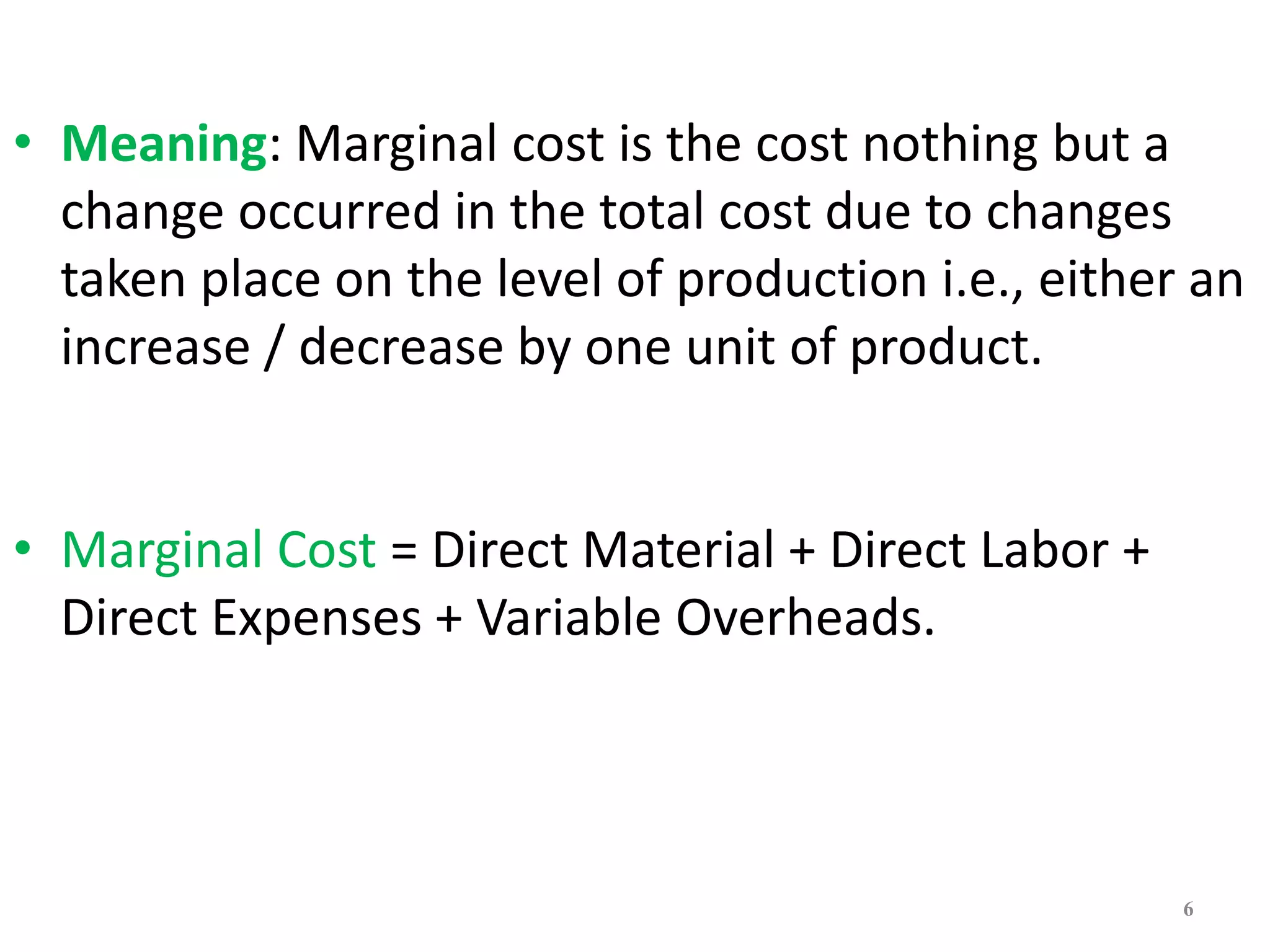
• Meaning: Marginal cost is the cost nothing but a
change occurred in the total cost due to changes
taken place on the level of production i.e., either an
increase / decrease by one unit of product.
• Marginal Cost = Direct Material + Direct Labor +
Direct Expenses + Variable Overheads.
Difference Between Absorption And
Marginal Costing
7
8
Absorption costing Marginal costing
Treatment for
fixed
manufacturing
overheads
Fixed
manufacturing
overheads are
treated as product
cost. It is believed
that products cannot
be produced without
the resources
provided by fixed
manufacturing
overheads
Fixed manufacturing
overhead are treated
as period costs. It is
believed that only the
variable costs are
relevant to decision-
making.
Fixed manufacturing
overheads will be
incurred regardless
there is production or
not
9
Absorption costing Marginal costing
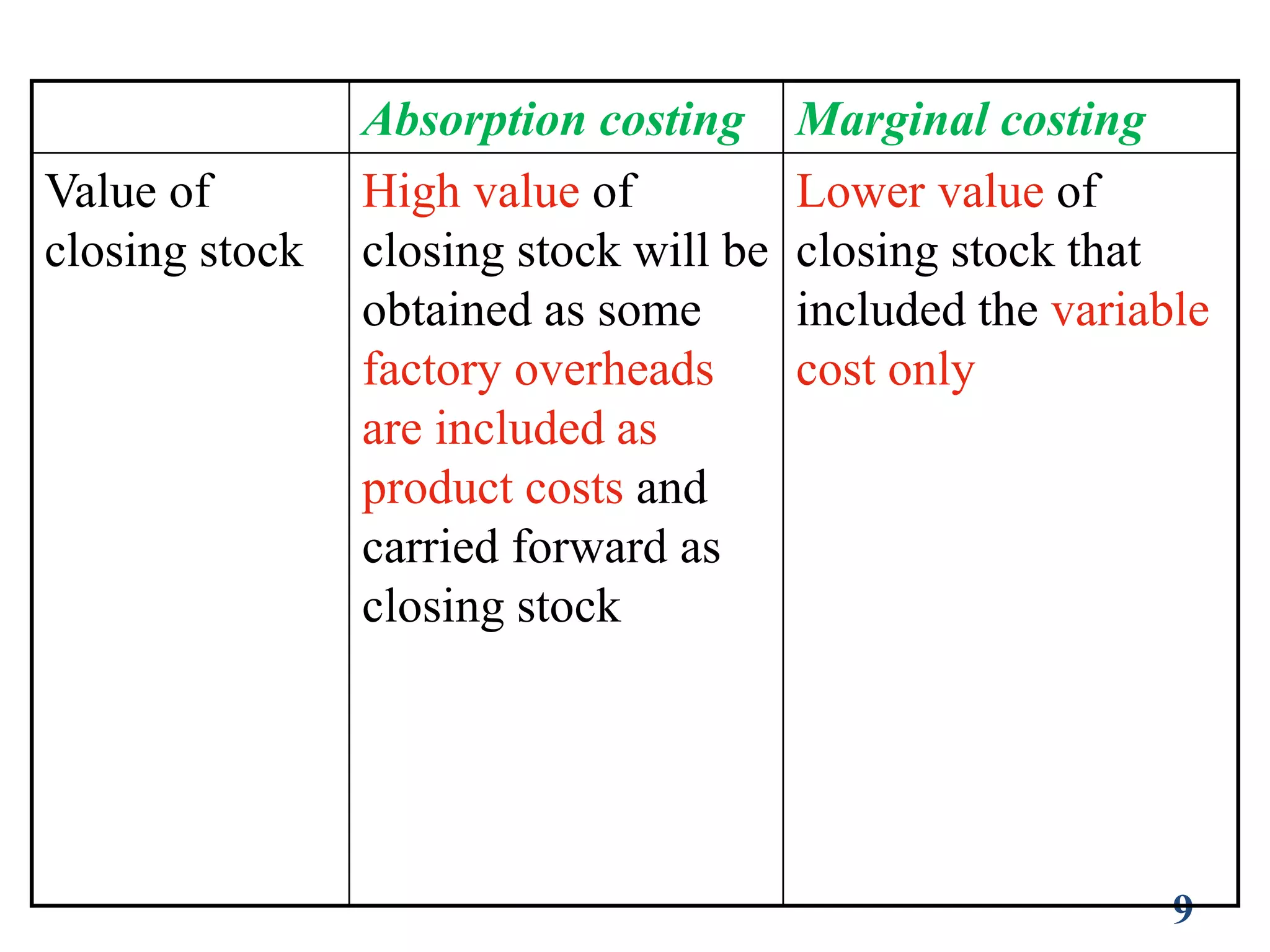
Value of
closing stock
High value of
closing stock will be
obtained as some
factory overheads
are included as
product costs and
carried forward as
closing stock
Lower value of
closing stock that
included the variable
cost only
Advantages of Marginal Costing
1. Marginal costing is simple to understand.
2. By not charging fixed overhead to cost of
production, the effect of varying charges per unit
is avoided.
3. It prevents the illogical carry forward in stock
valuation of some proportion of current year’s
fixed overhead.
4. It eliminates large balances left in overhead control
accounts which indicate the difficulty of
ascertaining an accurate overhead recovery rate.
10
Disadvantages of marginal costing
1. The separation of costs into fixed and
variable is difficult and sometimes gives
misleading results.
2. Fixed production costs are not spread out
between units of production.
3. The closing is not valued according to
accounting standards.
11
Characteristics of Marginal costing
12
1.Classification into Fixed and Variable Cost: Costs
are bifurcated, on the basis of variability into fixed
cost and variable costs. In the same way, semi
variable cost is separated.
2. Valuation of Stock: While valuing the finished
goods and work in progress, only variable cost are
taken into account. However, the variable selling and
distribution overheads are not included in the
valuation of inventory.
3. Determination of Price: The prices are determined
on the basis of marginal cost and marginal
contribution.
4. Profitability: The ascertainment of departmental
and product’s profitability is based on the.
13
Conclusion
• Marginal costing is very useful tool in hands of
management and is extensively used for cost
control ,decision making and profit planning .
At last ,we can say that absorption costing is
total cost technique and marginal costing is
variable cost technique.
14
References
1 . RAVI M KISHORE - Cost and management
Accounting – 6th edition – TAXMANN’S
Publications.
2. RAVI M Kishore – Advanced Management
Accounting – 1997 TAXMAN’S Publications .
3. M Y KHAN, P K JAIN – cost accounting – MC Grew
Hill Publications .
15
THANK YOU
16

Absorption Costing and Marginal Costing ppt

  • 1.
    Presentation on ABSORPTION COSTING AND MARGINALCOSTING AYJAZ AHMAD MALIK 1ST M.COM ROLL NO: 10 1
  • 2.
    INTRODUCTION • We allocateall manufacturing costs to products regardless of whether they are fixed or variable. This approach is known as absorption costing/full costing. • However, only variable costs are relevant to decision-making. This is known as marginal costing/variable costing. 2
  • 3.
  • 4.
    Absorption Costing • Itis costing system which treats all manufacturing costs including both the fixed and variable costs as product costs. • Under this technique, cost per unit remains same only when the level of output remains same. But when the level of output changes the cost per unit also changes because of the presence of fixed cost which remains constant. 4
  • 5.
    Marginal costing • Itis a costing system which treats only the variable manufacturing costs as product costs. The fixed manufacturing overheads are regarded as period cost. • According to ICMA, London "Marginal cost is the amount at any given volume of output, by which aggregate costs are charged, if the volume of output is increased or decreased by one unit." 5
  • 6.
    6 • Meaning: Marginalcost is the cost nothing but a change occurred in the total cost due to changes taken place on the level of production i.e., either an increase / decrease by one unit of product. • Marginal Cost = Direct Material + Direct Labor + Direct Expenses + Variable Overheads.
  • 7.
    Difference Between AbsorptionAnd Marginal Costing 7
  • 8.
    8 Absorption costing Marginalcosting Treatment for fixed manufacturing overheads Fixed manufacturing overheads are treated as product cost. It is believed that products cannot be produced without the resources provided by fixed manufacturing overheads Fixed manufacturing overhead are treated as period costs. It is believed that only the variable costs are relevant to decision- making. Fixed manufacturing overheads will be incurred regardless there is production or not
  • 9.
    9 Absorption costing Marginalcosting Value of closing stock High value of closing stock will be obtained as some factory overheads are included as product costs and carried forward as closing stock Lower value of closing stock that included the variable cost only
  • 10.
    Advantages of MarginalCosting 1. Marginal costing is simple to understand. 2. By not charging fixed overhead to cost of production, the effect of varying charges per unit is avoided. 3. It prevents the illogical carry forward in stock valuation of some proportion of current year’s fixed overhead. 4. It eliminates large balances left in overhead control accounts which indicate the difficulty of ascertaining an accurate overhead recovery rate. 10
  • 11.
    Disadvantages of marginalcosting 1. The separation of costs into fixed and variable is difficult and sometimes gives misleading results. 2. Fixed production costs are not spread out between units of production. 3. The closing is not valued according to accounting standards. 11
  • 12.
  • 13.
    1.Classification into Fixedand Variable Cost: Costs are bifurcated, on the basis of variability into fixed cost and variable costs. In the same way, semi variable cost is separated. 2. Valuation of Stock: While valuing the finished goods and work in progress, only variable cost are taken into account. However, the variable selling and distribution overheads are not included in the valuation of inventory. 3. Determination of Price: The prices are determined on the basis of marginal cost and marginal contribution. 4. Profitability: The ascertainment of departmental and product’s profitability is based on the. 13
  • 14.
    Conclusion • Marginal costingis very useful tool in hands of management and is extensively used for cost control ,decision making and profit planning . At last ,we can say that absorption costing is total cost technique and marginal costing is variable cost technique. 14
  • 15.
    References 1 . RAVIM KISHORE - Cost and management Accounting – 6th edition – TAXMANN’S Publications. 2. RAVI M Kishore – Advanced Management Accounting – 1997 TAXMAN’S Publications . 3. M Y KHAN, P K JAIN – cost accounting – MC Grew Hill Publications . 15
  • 16.