
COST ACCOUNTING


Cost accounting is the application of costing & cost accounting principle,
methods & technique of the science, art and practice of the cost control
ascertainment of profitability.



It also includes the presentation of information derived for the purpose of
managerial decision making.



It is thus the science art & practice of a cost accountant



BY B.K. VASHISHTHA
COST ACCOUNTING - MEANING



Cost accounting is concerned with recording, classifying and summarizing
costs for determination of costs of products or services, planning, controlling
and reducing such costs and furnishing of information to management for
decision making
COST ACCOUNTING - INTRODUCTION
Accounting for determination and control of costs.


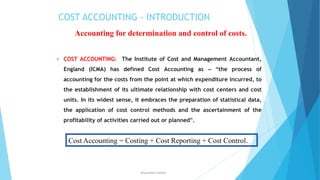
COST ACCOUNTING: The Institute of Cost and Management Accountant,
England (ICMA) has defined Cost Accounting as – “the process of
accounting for the costs from the point at which expenditure incurred, to
the establishment of its ultimate relationship with cost centers and cost
units. In its widest sense, it embraces the preparation of statistical data,
the application of cost control methods and the ascertainment of the
profitability of activities carried out or planned”.

Cost Accounting = Costing + Cost Reporting + Cost Control.

ahsanullah.mohsen
COST - MEANING
Cost means the amount of expenditure
(actual or notional) incurred on, or
attributable to, a given thing.
ahsanullah.mohsen
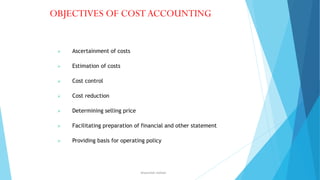
OBJECTIVES OF COST ACCOUNTING



Ascertainment of costs



Estimation of costs



Cost control



Cost reduction



Determining selling price



Facilitating preparation of financial and other statement



Providing basis for operating policy

ahsanullah.mohsen
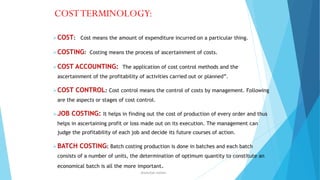
COST TERMINOLOGY:
 COST: Cost means the amount of expenditure incurred on a particular thing.
 COSTING: Costing means the process of ascertainment of costs.
 COST ACCOUNTING: The application of cost control methods and the
ascertainment of the profitability of activities carried out or planned”.
 COST

CONTROL: Cost control means the control of costs by management. Following

are the aspects or stages of cost control.
 JOB

COSTING:

It helps in finding out the cost of production of every order and thus

helps in ascertaining profit or loss made out on its execution. The management can
judge the profitability of each job and decide its future courses of action.
 BATCH

COSTING: Batch costing production is done in batches and each batch

consists of a number of units, the determination of optimum quantity to constitute an
economical batch is all the more important.
ahsanullah.mohsen
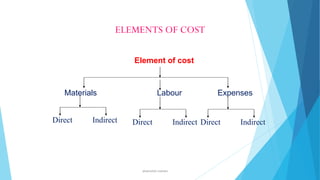
ELEMENTS OF COST
Element of cost

Materials

Direct

Indirect

Labour

Direct

ahsanullah.mohsen

Expenses

Indirect Direct

Indirect
MATERIAL: The substance from which the

finished product is made is known as
material.
(a) DIRECT MATERIAL: is one which can be
directly or easily identified in the
product Eg: Timber in furniture, Cloth in
dress, etc.
(b) INDIRECT MATERIAL: one which cannot

be easily identified in the product.
ahsanullah.mohsen
EXAMPLES OF INDIRECT MATERIAL

At factory level – lubricants, oil,
consumables, etc.
At office level – Printing & stationery,
Brooms, Dusters, etc.
At selling & dist. level – Packing
materials, printing & stationery, etc.

ahsanullah.mohsen
The human effort required to convert the
materials into finished product is called labour.
LABOUR:

(a) DIRECT LABOUR: is one which can be conveniently
identified or attributed wholly to a particular job,
product or process.
Eg:wages paid to carpenter, fees paid to tailor,etc.
(b) INDIRECT LABOUR: is one which cannot be

conveniently identified or attributed wholly to a
particular job, product or process.

ahsanullah.mohsen
EXAMPLES OF INDIRECT LABOUR

At factory level – foremen’s salary,
works manager’s salary, gate keeper’s
salary,etc
At office level – Accountant’s salary,
GM’s salary, Manager’s salary, etc.
At selling and dist.level – salesmen
salaries, Logistics manager salary, etc.

ahsanullah.mohsen
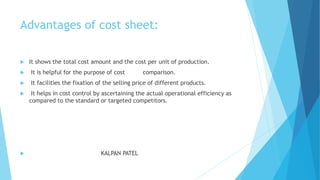
Advantages of cost sheet:


It shows the total cost amount and the cost per unit of production.



It is helpful for the purpose of cost



It facilities the fixation of the selling price of different products.





comparison.

It helps in cost control by ascertaining the actual operational efficiency as
compared to the standard or targeted competitors.

KALPAN PATEL
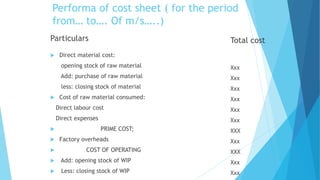
Performa of cost sheet ( for the period
from… to…. Of m/s…..)
Particulars


Total cost

Direct material cost:
opening stock of raw material
Add: purchase of raw material

Xxx

less: closing stock of material


Xxx
Xxx

Cost of raw material consumed:

Xxx

Direct labour cost
Direct expenses





Xxx
Xxx

PRIME COST;

Factory overheads
COST OF OPERATING

XXX
Xxx
XXX



Add: opening stock of WIP

Xxx



Less: closing stock of WIP

Xxx
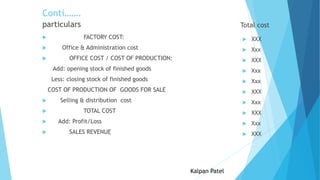
Conti…….
particulars




Total cost
FACTORY COST:









SALES REVENUE

Kalpan Patel

Xxx



Add: Profit/Loss

XXX



TOTAL COST

Xxx



Selling & distribution cost

XXX



COST OF PRODUCTION OF GOODS FOR SALE

Xxx



Less: closing stock of finished goods

Xxx



Add: opening stock of finished goods

XXX



OFFICE COST / COST OF PRODUCTION:

Xxx



Office & Administration cost

XXX

XXX
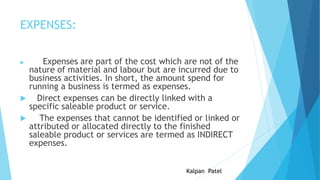
EXPENSES:





Expenses are part of the cost which are not of the
nature of material and labour but are incurred due to
business activities. In short, the amount spend for
running a business is termed as expenses.
Direct expenses can be directly linked with a
specific saleable product or service.
The expenses that cannot be identified or linked or
attributed or allocated directly to the finished
saleable product or services are termed as INDIRECT
expenses.
Kalpan Patel
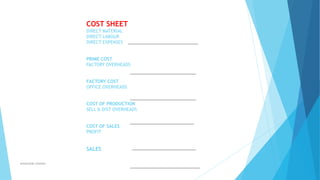
COST SHEET
DIRECT MATERIAL
DIRECT LABOUR
DIRECT EXPENSES
PRIME COST
FACTORY OVERHEADS
FACTORY COST
OFFICE OVERHEADS
COST OF PRODUCTION
SELL & DIST OVERHEADS
COST OF SALES
PROFIT

SALES
ahsanullah.mohsen
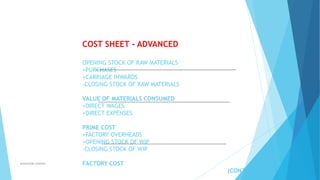
COST SHEET - ADVANCED
OPENING STOCK OF RAW MATERIALS
+PURCHASES
+CARRIAGE INWARDS
-CLOSING STOCK OF RAW MATERIALS

VALUE OF MATERIALS CONSUMED
+DIRECT WAGES
+DIRECT EXPENSES
PRIME COST
+FACTORY OVERHEADS
+OPENING STOCK OF WIP
-CLOSING STOCK OF WIP
ahsanullah.mohsen

FACTORY COST
(CONT.)
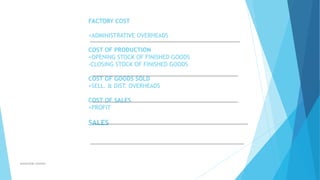
FACTORY COST
+ADMINISTRATIVE OVERHEADS
COST OF PRODUCTION
+OPENING STOCK OF FINISHED GOODS
-CLOSING STOCK OF FINISHED GOODS
COST OF GOODS SOLD
+SELL. & DIST. OVERHEADS
COST OF SALES
+PROFIT

SALES

ahsanullah.mohsen
The concept of cost


Out lay cost



Opportunity cost



Cost and expenses



Expenses



Operating cost



Product cost



Period cost
ahsanullah.mohsen
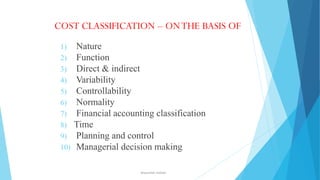
COST CLASSIFICATION – ON THE BASIS OF
1)
2)
3)
4)
5)
6)
7)
8)
9)
10)

Nature
Function
Direct & indirect
Variability
Controllability
Normality
Financial accounting classification
Time
Planning and control
Managerial decision making
ahsanullah.mohsen
ON THE BASIS OF NATURE


Materials



Labour



Expenses

ahsanullah.mohsen
ON THE BASIS OF VARIABILITY


Fixed costs



Variable costs



Semi variable costs

ahsanullah.mohsen
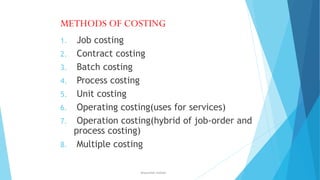
METHODS OF COSTING
1.

2.
3.
4.

5.
6.
7.
8.

Job costing
Contract costing
Batch costing
Process costing
Unit costing
Operating costing(uses for services)
Operation costing(hybrid of job-order and
process costing)
Multiple costing
ahsanullah.mohsen
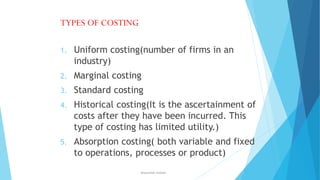
TYPES OF COSTING
1.

Uniform costing(number of firms in an
industry)

2.

Marginal costing

3.

Standard costing

4.

Historical costing(It is the ascertainment of
costs after they have been incurred. This
type of costing has limited utility.)

5.

Absorption costing( both variable and fixed
to operations, processes or product)
ahsanullah.mohsen
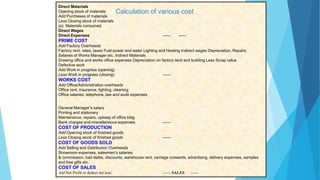
Direct Materials
Opening stock of materials
Add Purchases of materials
Less Closing stock of materials
(a) Materials consumed
Direct Wages
Direct Expenses

Calculation of various cost

------

------

PRIME COST
Add Factory Overheads
Factory rent, rates, taxes Fuel-power and water Lighting and Heating Indirect wages Depreciation, Repairs
Salaries of Works Manager etc. Indirect Materials
Drawing office and works office expenses Depreciation on factory land and building Less Scrap value
Defective work
Add Work in progress (opening)
Less Work in progress (closing)
------

WORKS COST
Add Office/Administration overheads
Office rent, insurance, lighting, cleaning
Office salaries, telephone, law and audit expenses

General Manager’s salary
Printing and stationery
Maintenance, repairs, upkeep of office bldg
Bank charges and miscellaneous expenses

------

COST OF PRODUCTION
Add Opening stock of finished goods
Less Closing stock of finished goods

------

COST OF GOODS SOLD
Add Selling and Distribution Overheads
Showroom expenses, salesmen’s salaries
& commission, bad debts, discounts, warehouse rent, carriage outwards, advertising, delivery expenses, samples
and free gifts etc.

COST OF SALES
Add Net Profit or deduct net loss:

------ SALES

------
Audit Of Manufacturing Company


Adaptation



Scope Definition



Accounting Work



Letter of Engagement



Internal Control



Management Responsibilities



Evaluation of Evidence



Reporting
Special Items Considered in Auditing
of Manufacturing Company
Goods in Bonds
 Loose-tools at Construction Site


 Physical

Verification Sheet
 Financial Statement
 Work

in Progress

 Cost

Sheets
 Previous year financial Statements
 General
 Provisions of companies act
REFERENCES


Mohnes,A.Cost accounting



Professor,Joshi,D.(2012). Cost and management accountancy.



Patel,D, and Patel,K.(2012). Cost and management and accountancy.



Vashishtha,B.K.(2010). Cost of accounting.



Purushotham,V. Prabakaran. Audit of Manufacturing Company.

Assignment

  • 2.
    COST ACCOUNTING  Cost accountingis the application of costing & cost accounting principle, methods & technique of the science, art and practice of the cost control ascertainment of profitability.  It also includes the presentation of information derived for the purpose of managerial decision making.  It is thus the science art & practice of a cost accountant  BY B.K. VASHISHTHA
  • 3.
    COST ACCOUNTING -MEANING  Cost accounting is concerned with recording, classifying and summarizing costs for determination of costs of products or services, planning, controlling and reducing such costs and furnishing of information to management for decision making
  • 4.
    COST ACCOUNTING -INTRODUCTION Accounting for determination and control of costs.  COST ACCOUNTING: The Institute of Cost and Management Accountant, England (ICMA) has defined Cost Accounting as – “the process of accounting for the costs from the point at which expenditure incurred, to the establishment of its ultimate relationship with cost centers and cost units. In its widest sense, it embraces the preparation of statistical data, the application of cost control methods and the ascertainment of the profitability of activities carried out or planned”. Cost Accounting = Costing + Cost Reporting + Cost Control. ahsanullah.mohsen
  • 5.
    COST - MEANING Costmeans the amount of expenditure (actual or notional) incurred on, or attributable to, a given thing. ahsanullah.mohsen
  • 6.
    OBJECTIVES OF COSTACCOUNTING  Ascertainment of costs  Estimation of costs  Cost control  Cost reduction  Determining selling price  Facilitating preparation of financial and other statement  Providing basis for operating policy ahsanullah.mohsen
  • 7.
    COST TERMINOLOGY:  COST:Cost means the amount of expenditure incurred on a particular thing.  COSTING: Costing means the process of ascertainment of costs.  COST ACCOUNTING: The application of cost control methods and the ascertainment of the profitability of activities carried out or planned”.  COST CONTROL: Cost control means the control of costs by management. Following are the aspects or stages of cost control.  JOB COSTING: It helps in finding out the cost of production of every order and thus helps in ascertaining profit or loss made out on its execution. The management can judge the profitability of each job and decide its future courses of action.  BATCH COSTING: Batch costing production is done in batches and each batch consists of a number of units, the determination of optimum quantity to constitute an economical batch is all the more important. ahsanullah.mohsen
  • 8.
    ELEMENTS OF COST Elementof cost Materials Direct Indirect Labour Direct ahsanullah.mohsen Expenses Indirect Direct Indirect
  • 9.
    MATERIAL: The substancefrom which the finished product is made is known as material. (a) DIRECT MATERIAL: is one which can be directly or easily identified in the product Eg: Timber in furniture, Cloth in dress, etc. (b) INDIRECT MATERIAL: one which cannot be easily identified in the product. ahsanullah.mohsen
  • 10.
    EXAMPLES OF INDIRECTMATERIAL At factory level – lubricants, oil, consumables, etc. At office level – Printing & stationery, Brooms, Dusters, etc. At selling & dist. level – Packing materials, printing & stationery, etc. ahsanullah.mohsen
  • 11.
    The human effortrequired to convert the materials into finished product is called labour. LABOUR: (a) DIRECT LABOUR: is one which can be conveniently identified or attributed wholly to a particular job, product or process. Eg:wages paid to carpenter, fees paid to tailor,etc. (b) INDIRECT LABOUR: is one which cannot be conveniently identified or attributed wholly to a particular job, product or process. ahsanullah.mohsen
  • 12.
    EXAMPLES OF INDIRECTLABOUR At factory level – foremen’s salary, works manager’s salary, gate keeper’s salary,etc At office level – Accountant’s salary, GM’s salary, Manager’s salary, etc. At selling and dist.level – salesmen salaries, Logistics manager salary, etc. ahsanullah.mohsen
  • 13.
    Advantages of costsheet:  It shows the total cost amount and the cost per unit of production.  It is helpful for the purpose of cost  It facilities the fixation of the selling price of different products.   comparison. It helps in cost control by ascertaining the actual operational efficiency as compared to the standard or targeted competitors. KALPAN PATEL
  • 14.
    Performa of costsheet ( for the period from… to…. Of m/s…..) Particulars  Total cost Direct material cost: opening stock of raw material Add: purchase of raw material Xxx less: closing stock of material  Xxx Xxx Cost of raw material consumed: Xxx Direct labour cost Direct expenses    Xxx Xxx PRIME COST; Factory overheads COST OF OPERATING XXX Xxx XXX  Add: opening stock of WIP Xxx  Less: closing stock of WIP Xxx
  • 15.
    Conti……. particulars    Total cost FACTORY COST:       SALESREVENUE Kalpan Patel Xxx  Add: Profit/Loss XXX  TOTAL COST Xxx  Selling & distribution cost XXX  COST OF PRODUCTION OF GOODS FOR SALE Xxx  Less: closing stock of finished goods Xxx  Add: opening stock of finished goods XXX  OFFICE COST / COST OF PRODUCTION: Xxx  Office & Administration cost XXX XXX
  • 16.
    EXPENSES:    Expenses are partof the cost which are not of the nature of material and labour but are incurred due to business activities. In short, the amount spend for running a business is termed as expenses. Direct expenses can be directly linked with a specific saleable product or service. The expenses that cannot be identified or linked or attributed or allocated directly to the finished saleable product or services are termed as INDIRECT expenses. Kalpan Patel
  • 17.
    COST SHEET DIRECT MATERIAL DIRECTLABOUR DIRECT EXPENSES PRIME COST FACTORY OVERHEADS FACTORY COST OFFICE OVERHEADS COST OF PRODUCTION SELL & DIST OVERHEADS COST OF SALES PROFIT SALES ahsanullah.mohsen
  • 18.
    COST SHEET -ADVANCED OPENING STOCK OF RAW MATERIALS +PURCHASES +CARRIAGE INWARDS -CLOSING STOCK OF RAW MATERIALS VALUE OF MATERIALS CONSUMED +DIRECT WAGES +DIRECT EXPENSES PRIME COST +FACTORY OVERHEADS +OPENING STOCK OF WIP -CLOSING STOCK OF WIP ahsanullah.mohsen FACTORY COST (CONT.)
  • 19.
    FACTORY COST +ADMINISTRATIVE OVERHEADS COSTOF PRODUCTION +OPENING STOCK OF FINISHED GOODS -CLOSING STOCK OF FINISHED GOODS COST OF GOODS SOLD +SELL. & DIST. OVERHEADS COST OF SALES +PROFIT SALES ahsanullah.mohsen
  • 20.
    The concept ofcost  Out lay cost  Opportunity cost  Cost and expenses  Expenses  Operating cost  Product cost  Period cost ahsanullah.mohsen
  • 21.
    COST CLASSIFICATION –ON THE BASIS OF 1) 2) 3) 4) 5) 6) 7) 8) 9) 10) Nature Function Direct & indirect Variability Controllability Normality Financial accounting classification Time Planning and control Managerial decision making ahsanullah.mohsen
  • 22.
    ON THE BASISOF NATURE  Materials  Labour  Expenses ahsanullah.mohsen
  • 23.
    ON THE BASISOF VARIABILITY  Fixed costs  Variable costs  Semi variable costs ahsanullah.mohsen
  • 24.
    METHODS OF COSTING 1. 2. 3. 4. 5. 6. 7. 8. Jobcosting Contract costing Batch costing Process costing Unit costing Operating costing(uses for services) Operation costing(hybrid of job-order and process costing) Multiple costing ahsanullah.mohsen
  • 25.
    TYPES OF COSTING 1. Uniformcosting(number of firms in an industry) 2. Marginal costing 3. Standard costing 4. Historical costing(It is the ascertainment of costs after they have been incurred. This type of costing has limited utility.) 5. Absorption costing( both variable and fixed to operations, processes or product) ahsanullah.mohsen
  • 26.
    Direct Materials Opening stockof materials Add Purchases of materials Less Closing stock of materials (a) Materials consumed Direct Wages Direct Expenses Calculation of various cost ------ ------ PRIME COST Add Factory Overheads Factory rent, rates, taxes Fuel-power and water Lighting and Heating Indirect wages Depreciation, Repairs Salaries of Works Manager etc. Indirect Materials Drawing office and works office expenses Depreciation on factory land and building Less Scrap value Defective work Add Work in progress (opening) Less Work in progress (closing) ------ WORKS COST Add Office/Administration overheads Office rent, insurance, lighting, cleaning Office salaries, telephone, law and audit expenses General Manager’s salary Printing and stationery Maintenance, repairs, upkeep of office bldg Bank charges and miscellaneous expenses ------ COST OF PRODUCTION Add Opening stock of finished goods Less Closing stock of finished goods ------ COST OF GOODS SOLD Add Selling and Distribution Overheads Showroom expenses, salesmen’s salaries & commission, bad debts, discounts, warehouse rent, carriage outwards, advertising, delivery expenses, samples and free gifts etc. COST OF SALES Add Net Profit or deduct net loss: ------ SALES ------
  • 27.
    Audit Of ManufacturingCompany  Adaptation  Scope Definition  Accounting Work  Letter of Engagement  Internal Control  Management Responsibilities  Evaluation of Evidence  Reporting
  • 28.
    Special Items Consideredin Auditing of Manufacturing Company Goods in Bonds  Loose-tools at Construction Site   Physical Verification Sheet  Financial Statement
  • 29.
     Work in Progress Cost Sheets  Previous year financial Statements  General  Provisions of companies act
  • 31.
    REFERENCES  Mohnes,A.Cost accounting  Professor,Joshi,D.(2012). Costand management accountancy.  Patel,D, and Patel,K.(2012). Cost and management and accountancy.  Vashishtha,B.K.(2010). Cost of accounting.  Purushotham,V. Prabakaran. Audit of Manufacturing Company.