Cost accounting
• Cost accounting is concerned with recording,
classifying and summarizing costs for determination
of costs of products or services.
1. Historical Costing -
“The ascertainment of costs after they have been incurred.” Under
this method all the expenses incurred on the production are first
incurred and then the costs are
ascertained.
2. Standard costing-
“The preparation and use of standard costs, their comparison with
actual costs and the analysis of variances to their causes and points of
incidence.”
3. Marginal Costing -
“The ascertainment of marginal costs and of the effect on profit of
changes in volume or type of output by differentiating between fixed
costs and variable costs.”
4. Direct Costing -
“The practice of charging all direct costs to operations, processes or
products, leaving all the indirect costs to be written off against profits
in the period in which they arise.”
5. Absorption Costing -
“The practice of charging all costs, both variable and fixed, to
operations, processes or products.”
6. Uniform Costing -
“The use by several undertakings of the same costing principles
and/or practices.”
Methods of Costing
1. Job costing
2. Batch Costing
3. Operation Costing.
4. Process Costing
5. Contract Costing.
6. Composite or Multipl costing
7. joint costing
1. Only Previous Performances are Documented
2. Proper Upkeep is Necessary
3. Expertise is Needed While Recording
4. System Complexity
5. Costly to Maintain
• 1. Analysis of the profitability of product, service, job or activities.
• 2. Analysis of profitability of various departments of segments of the
organization.
• 3. Analysis of the type and nature of cost.
• 4. Explanation of the causes of variances between actual cost and
standard cost.
• 5. Helpful in determination of selling price.
• 6. Analysis of the change in profit as per the change in level of
production.
• 7. Analysis of the profit or loss of the organization.
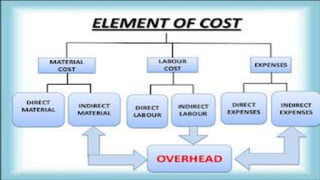
Elements of Cost accounting
Following are the elements of cost:
(1) Material Cost
(2) Labour cost &
(3) Expenses.
(4) Overheads
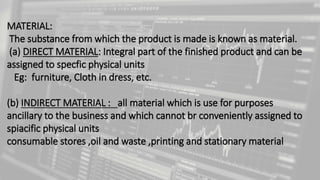
MATERIAL:
The substance from which the product is made is known as material.
(a) DIRECT MATERIAL: Integral part of the finished product and can be
assigned to specfic physical units
Eg: furniture, Cloth in dress, etc.
(b) INDIRECT MATERIAL : all material which is use for purposes
ancillary to the business and which cannot br conveniently assigned to
spiacific physical units
consumable stores ,oil and waste ,printing and stationary material
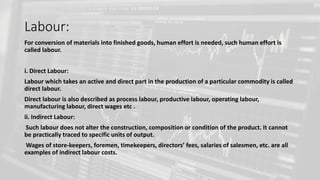
Labour:
For conversion of materials into finished goods, human effort is needed, such human effort is
called labour.
i. Direct Labour:
Labour which takes an active and direct part in the production of a particular commodity is called
direct labour.
Direct labour is also described as process labour, productive labour, operating labour,
manufacturing labour, direct wages etc .
ii. Indirect Labour:
Such labour does not alter the construction, composition or condition of the product. It cannot
be practically traced to specific units of output.
Wages of store-keepers, foremen, timekeepers, directors’ fees, salaries of salesmen, etc. are all
examples of indirect labour costs.
Expenses
• Direct Expenses – These are expenses which can be directly,
conveniently and wholly allocated to specific cost centres or cost
units. Examples of such expenses are – hire of some special
machinery required for a particular contract, cost of defective work
incurred in connection with a particular job or contract etc. Direct
expenses are sometimes also described as “chargeable expenses.”
• Indirect Expenses – These are expenses which cannot be directly,
conveniently and wholly allocated to cost centres or cost units.
• examples -office expenses, rent, supervisor salaries, telephone
expense, and utilities.
Overheads
Overheads includes indiract material, indractlabour, indiract expanses
All indirect cost are overhads
Cost sheet
A cost sheet is a statement that shows the various components of total
cost for a product and shows previous data for comparison. You can
deduce the ideal selling price of a product based on the cost sheet.
components of total cost
 prime/basic/frist/flat cost- consist direct material ,labour and
expenes
 factory/work/production/manufacturing cost- comprises prime
cost and in addition , works or factory overhads
 office/administration/total cost of production- office and
administration overheads are add factory cost
 total cost/cost of sales- salling and distribution overheads are add in
office cost
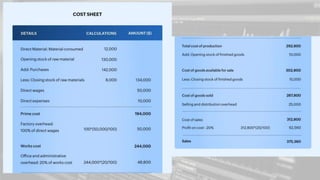
Cost sheet Example
The various components of cost explained in the previous section can be represented in the form of a
statement. A cost sheet statement consists of prime cost, factory cost, cost involved in the production of goods
sold, and total cost. Let us look at an example, in which you have to prepare a cost sheet for a furniture
company for the financial year ending March 31, 2019. Now take a look at the following information which is
available to you to prepare a cost sheet statement.
• Direct material consumed – $12,000
• Opening stock of raw materials – $130,000
• Closing stock of raw materials – $8,000
• Direct wages – $50,000
• Direct expenses – $10,000
• Factory overhead is 100% of direct wages
• Office and administration overhead is 20% of works
• Selling and distribution overhead – $25,000
• Cost of opening stock for finished goods – $10,000
• Cost of closing stock for finished goods – $15,000
• Profit on cost is 20%
cost accounting  , Element  & cost sheet.pptx

cost accounting , Element & cost sheet.pptx

  • 1.
    Cost accounting • Costaccounting is concerned with recording, classifying and summarizing costs for determination of costs of products or services.
  • 2.
    1. Historical Costing- “The ascertainment of costs after they have been incurred.” Under this method all the expenses incurred on the production are first incurred and then the costs are ascertained. 2. Standard costing- “The preparation and use of standard costs, their comparison with actual costs and the analysis of variances to their causes and points of incidence.” 3. Marginal Costing - “The ascertainment of marginal costs and of the effect on profit of changes in volume or type of output by differentiating between fixed costs and variable costs.”
  • 3.
    4. Direct Costing- “The practice of charging all direct costs to operations, processes or products, leaving all the indirect costs to be written off against profits in the period in which they arise.” 5. Absorption Costing - “The practice of charging all costs, both variable and fixed, to operations, processes or products.” 6. Uniform Costing - “The use by several undertakings of the same costing principles and/or practices.”
  • 4.
    Methods of Costing 1.Job costing 2. Batch Costing 3. Operation Costing. 4. Process Costing 5. Contract Costing. 6. Composite or Multipl costing 7. joint costing
  • 6.
    1. Only PreviousPerformances are Documented 2. Proper Upkeep is Necessary 3. Expertise is Needed While Recording 4. System Complexity 5. Costly to Maintain
  • 7.
    • 1. Analysisof the profitability of product, service, job or activities. • 2. Analysis of profitability of various departments of segments of the organization. • 3. Analysis of the type and nature of cost. • 4. Explanation of the causes of variances between actual cost and standard cost. • 5. Helpful in determination of selling price. • 6. Analysis of the change in profit as per the change in level of production. • 7. Analysis of the profit or loss of the organization.
  • 8.
    Elements of Costaccounting Following are the elements of cost: (1) Material Cost (2) Labour cost & (3) Expenses. (4) Overheads
  • 10.
    MATERIAL: The substance fromwhich the product is made is known as material. (a) DIRECT MATERIAL: Integral part of the finished product and can be assigned to specfic physical units Eg: furniture, Cloth in dress, etc. (b) INDIRECT MATERIAL : all material which is use for purposes ancillary to the business and which cannot br conveniently assigned to spiacific physical units consumable stores ,oil and waste ,printing and stationary material
  • 11.
    Labour: For conversion ofmaterials into finished goods, human effort is needed, such human effort is called labour. i. Direct Labour: Labour which takes an active and direct part in the production of a particular commodity is called direct labour. Direct labour is also described as process labour, productive labour, operating labour, manufacturing labour, direct wages etc . ii. Indirect Labour: Such labour does not alter the construction, composition or condition of the product. It cannot be practically traced to specific units of output. Wages of store-keepers, foremen, timekeepers, directors’ fees, salaries of salesmen, etc. are all examples of indirect labour costs.
  • 12.
    Expenses • Direct Expenses– These are expenses which can be directly, conveniently and wholly allocated to specific cost centres or cost units. Examples of such expenses are – hire of some special machinery required for a particular contract, cost of defective work incurred in connection with a particular job or contract etc. Direct expenses are sometimes also described as “chargeable expenses.” • Indirect Expenses – These are expenses which cannot be directly, conveniently and wholly allocated to cost centres or cost units. • examples -office expenses, rent, supervisor salaries, telephone expense, and utilities.
  • 13.
    Overheads Overheads includes indiractmaterial, indractlabour, indiract expanses All indirect cost are overhads
  • 14.
    Cost sheet A costsheet is a statement that shows the various components of total cost for a product and shows previous data for comparison. You can deduce the ideal selling price of a product based on the cost sheet. components of total cost  prime/basic/frist/flat cost- consist direct material ,labour and expenes  factory/work/production/manufacturing cost- comprises prime cost and in addition , works or factory overhads  office/administration/total cost of production- office and administration overheads are add factory cost  total cost/cost of sales- salling and distribution overheads are add in office cost
  • 15.
    Cost sheet Example Thevarious components of cost explained in the previous section can be represented in the form of a statement. A cost sheet statement consists of prime cost, factory cost, cost involved in the production of goods sold, and total cost. Let us look at an example, in which you have to prepare a cost sheet for a furniture company for the financial year ending March 31, 2019. Now take a look at the following information which is available to you to prepare a cost sheet statement. • Direct material consumed – $12,000 • Opening stock of raw materials – $130,000 • Closing stock of raw materials – $8,000 • Direct wages – $50,000 • Direct expenses – $10,000 • Factory overhead is 100% of direct wages • Office and administration overhead is 20% of works • Selling and distribution overhead – $25,000 • Cost of opening stock for finished goods – $10,000 • Cost of closing stock for finished goods – $15,000 • Profit on cost is 20%