REPUBLIC ACT NO. 5734
BE IT ENACTED BY THE SENATE AND HOUSE OF REPRESENTATIVES
OF THE PHILIPPINES IN CONGRESS
The Electronics and Communications Engineering Act
of the Philippines
 Section 1. Title of Act
 the “Electronics and Communications Engineering Law
of the Philippines”
 Section 2:
 (a) No person shall use the title “Electronics and/or
Communications Engineer” or any word, letter, figure, or
sign tending to convey the impression that he is an electronics
and/or communications engineer, or advertise or indicate in
any manner that he is qualified to perform the work of an
electronics and communications engineer without holding a
valid certificate of registration as electronics and
communications engineer issued by the Board in
accordance with this Act, except as provided under Section
eleven hereof.
 (b) It shall be unlawful for any firm, company, or
corporation, to offer itself to the public as electronics and
communications engineer without the certification,
supervision and/or guidance of a duly registered
electronics and communications engineer.
 Section 3. Registration
 Certificate of Registration
 Section 4. Board Examination
 All applicants of ECE shall undergo the required technical
examination
 Section 5. Pre qualification for Examination
- at least twenty-one years of age
- citizen of the Philippines
- good moral character
- holder of the degree of BS ECE
 Section 6. Schedule of Examination
- twice a year
 Section 7. Scope of Examination
 Consist of written tests prescribed by the Board
 Section 8. Ratings in the Examination
 Average of 70%
 Section 9. Report of Results of Examination
 within 90 days after the examination
 Section 10. Fees for Examination and Registration
 Examination fee of 45php
 Registration fee of 10php
 Section 11. Roster of Electronics and
Communications Engineers
 Section 12. Creation and Composition of the Board
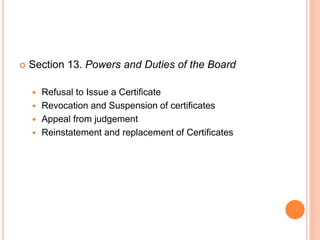
 Section 13. Powers and Duties of the Board
 Refusal to Issue a Certificate
 Revocation and Suspension of certificates
 Appeal from judgement
 Reinstatement and replacement of Certificates
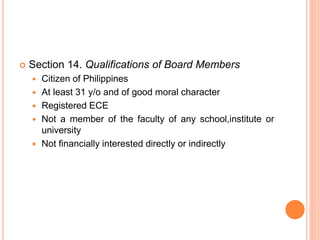
 Section 14. Qualifications of Board Members
 Citizen of Philippines
 At least 31 y/o and of good moral character
 Registered ECE
 Not a member of the faculty of any school,institute or
university
 Not financially interested directly or indirectly
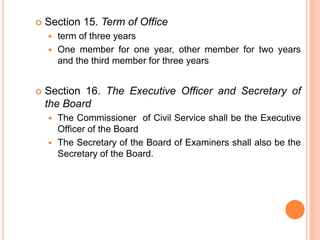
 Section 15. Term of Office
 term of three years
 One member for one year, other member for two years
and the third member for three years
 Section 16. The Executive Officer and Secretary of
the Board
 The Commissioner of Civil Service shall be the Executive
Officer of the Board
 The Secretary of the Board of Examiners shall also be the
Secretary of the Board.
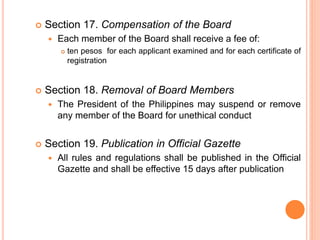
 Section 17. Compensation of the Board
 Each member of the Board shall receive a fee of:
 ten pesos for each applicant examined and for each certificate of
registration
 Section 18. Removal of Board Members
 The President of the Philippines may suspend or remove
any member of the Board for unethical conduct
 Section 19. Publication in Official Gazette
 All rules and regulations shall be published in the Official
Gazette and shall be effective 15 days after publication
 Section 20. Annual Report
 The Board shall submit an annual report to the
President of the Philippines
 Section 21. Definitions
a. Board
b. Communications
c. Electronics
d. Electronics and Communications Engineer
 Section 22. Enforcement of the Act by Officers of
the Law
 It shall be the duty of the constituted officers of the law
of the National Government to enforce the provisions of
this act and to prosecute any person violating the same.
 Section 23. Foreign Reciprocity
 No foreigner shall be admitted to an examination or
registration
 Section 24. Penal Provisions
 Giving false or fraudulent statement to the Board to obtain
COR
 Usage of another person’s COR
 Usage of revoked or suspended COR
 Advertise the title even if he/she is not a registered ECE
 A registrant who stamped or sealed a document w/ his or
her expired, revoked or suspended COR.
 Any registered ECE who affix other’s name, signature or
seal on his/her plans, technical description or documents
and vice versa.
 Engaging to the ff
 Wire-tapping
 Disregard of the privilege of private communications
 Maintain an unlicensed and/or unregistered communications
system or device
 Violate any provision of this or any rules and regulations
promulgated under this Act.
 Punishment
 Fine of not less than P2,000 but not more than P5,000
 Imprisonment for 6 months to 6years
 Section 25. Appropriation of Funds
 Sum of ten thousand pesos disbursed by the Board
 Section 26. Repealing Clause
 All laws, executive orders, rules, regulations, or parts in
conflict with the provisions of this Act are repealed or amended
accordingly
 Section 27. Separability of Provisions
 Any provision is declared unconstitutional shall not be affected
thereby.
 Section 28. Effectivity
 Take effect upon its approval
 Approved
 June 21, 1969
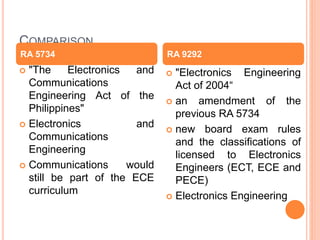
COMPARISON
 "The Electronics and
Communications
Engineering Act of the
Philippines"
 Electronics and
Communications
Engineering
 Communications would
still be part of the ECE
curriculum
 "Electronics Engineering
Act of 2004“
 an amendment of the
previous RA 5734
 new board exam rules
and the classifications of
licensed to Electronics
Engineers (ECT, ECE and
PECE)
 Electronics Engineering
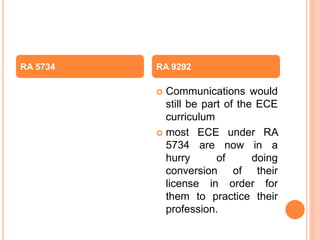
RA 5734 RA 9292
 Communications would
still be part of the ECE
curriculum
 most ECE under RA
5734 are now in a
hurry of doing
conversion of their
license in order for
them to practice their
profession.
RA 5734 RA 9292
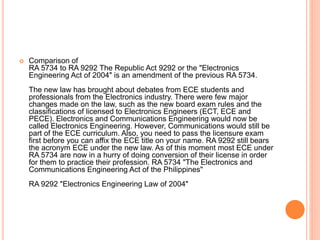
 Comparison of
RA 5734 to RA 9292 The Republic Act 9292 or the "Electronics
Engineering Act of 2004" is an amendment of the previous RA 5734.
The new law has brought about debates from ECE students and
professionals from the Electronics industry. There were few major
changes made on the law, such as the new board exam rules and the
classifications of licensed to Electronics Engineers (ECT, ECE and
PECE). Electronics and Communications Engineering would now be
called Electronics Engineering. However, Communications would still be
part of the ECE curriculum. Also, you need to pass the licensure exam
first before you can affix the ECE title on your name. RA 9292 still bears
the acronym ECE under the new law. As of this moment most ECE under
RA 5734 are now in a hurry of doing conversion of their license in order
for them to practice their profession. RA 5734 "The Electronics and
Communications Engineering Act of the Philippines"
RA 9292 "Electronics Engineering Law of 2004"

RA 5734

  • 1.
    REPUBLIC ACT NO.5734 BE IT ENACTED BY THE SENATE AND HOUSE OF REPRESENTATIVES OF THE PHILIPPINES IN CONGRESS The Electronics and Communications Engineering Act of the Philippines
  • 2.
     Section 1.Title of Act  the “Electronics and Communications Engineering Law of the Philippines”
  • 3.
     Section 2: (a) No person shall use the title “Electronics and/or Communications Engineer” or any word, letter, figure, or sign tending to convey the impression that he is an electronics and/or communications engineer, or advertise or indicate in any manner that he is qualified to perform the work of an electronics and communications engineer without holding a valid certificate of registration as electronics and communications engineer issued by the Board in accordance with this Act, except as provided under Section eleven hereof.  (b) It shall be unlawful for any firm, company, or corporation, to offer itself to the public as electronics and communications engineer without the certification, supervision and/or guidance of a duly registered electronics and communications engineer.
  • 4.
     Section 3.Registration  Certificate of Registration  Section 4. Board Examination  All applicants of ECE shall undergo the required technical examination
  • 5.
     Section 5.Pre qualification for Examination - at least twenty-one years of age - citizen of the Philippines - good moral character - holder of the degree of BS ECE  Section 6. Schedule of Examination - twice a year
  • 6.
     Section 7.Scope of Examination  Consist of written tests prescribed by the Board  Section 8. Ratings in the Examination  Average of 70%
  • 7.
     Section 9.Report of Results of Examination  within 90 days after the examination  Section 10. Fees for Examination and Registration  Examination fee of 45php  Registration fee of 10php
  • 8.
     Section 11.Roster of Electronics and Communications Engineers  Section 12. Creation and Composition of the Board
  • 9.
     Section 13.Powers and Duties of the Board  Refusal to Issue a Certificate  Revocation and Suspension of certificates  Appeal from judgement  Reinstatement and replacement of Certificates
  • 10.
     Section 14.Qualifications of Board Members  Citizen of Philippines  At least 31 y/o and of good moral character  Registered ECE  Not a member of the faculty of any school,institute or university  Not financially interested directly or indirectly
  • 11.
     Section 15.Term of Office  term of three years  One member for one year, other member for two years and the third member for three years  Section 16. The Executive Officer and Secretary of the Board  The Commissioner of Civil Service shall be the Executive Officer of the Board  The Secretary of the Board of Examiners shall also be the Secretary of the Board.
  • 12.
     Section 17.Compensation of the Board  Each member of the Board shall receive a fee of:  ten pesos for each applicant examined and for each certificate of registration  Section 18. Removal of Board Members  The President of the Philippines may suspend or remove any member of the Board for unethical conduct  Section 19. Publication in Official Gazette  All rules and regulations shall be published in the Official Gazette and shall be effective 15 days after publication
  • 13.
     Section 20.Annual Report  The Board shall submit an annual report to the President of the Philippines  Section 21. Definitions a. Board b. Communications c. Electronics d. Electronics and Communications Engineer
  • 14.
     Section 22.Enforcement of the Act by Officers of the Law  It shall be the duty of the constituted officers of the law of the National Government to enforce the provisions of this act and to prosecute any person violating the same.
  • 15.
     Section 23.Foreign Reciprocity  No foreigner shall be admitted to an examination or registration  Section 24. Penal Provisions  Giving false or fraudulent statement to the Board to obtain COR  Usage of another person’s COR  Usage of revoked or suspended COR  Advertise the title even if he/she is not a registered ECE  A registrant who stamped or sealed a document w/ his or her expired, revoked or suspended COR.
  • 16.
     Any registeredECE who affix other’s name, signature or seal on his/her plans, technical description or documents and vice versa.  Engaging to the ff  Wire-tapping  Disregard of the privilege of private communications  Maintain an unlicensed and/or unregistered communications system or device  Violate any provision of this or any rules and regulations promulgated under this Act.
  • 17.
     Punishment  Fineof not less than P2,000 but not more than P5,000  Imprisonment for 6 months to 6years  Section 25. Appropriation of Funds  Sum of ten thousand pesos disbursed by the Board
  • 18.
     Section 26.Repealing Clause  All laws, executive orders, rules, regulations, or parts in conflict with the provisions of this Act are repealed or amended accordingly  Section 27. Separability of Provisions  Any provision is declared unconstitutional shall not be affected thereby.  Section 28. Effectivity  Take effect upon its approval
  • 19.
  • 20.
    COMPARISON  "The Electronicsand Communications Engineering Act of the Philippines"  Electronics and Communications Engineering  Communications would still be part of the ECE curriculum  "Electronics Engineering Act of 2004“  an amendment of the previous RA 5734  new board exam rules and the classifications of licensed to Electronics Engineers (ECT, ECE and PECE)  Electronics Engineering RA 5734 RA 9292
  • 21.
     Communications would stillbe part of the ECE curriculum  most ECE under RA 5734 are now in a hurry of doing conversion of their license in order for them to practice their profession. RA 5734 RA 9292
  • 22.
     Comparison of RA5734 to RA 9292 The Republic Act 9292 or the "Electronics Engineering Act of 2004" is an amendment of the previous RA 5734. The new law has brought about debates from ECE students and professionals from the Electronics industry. There were few major changes made on the law, such as the new board exam rules and the classifications of licensed to Electronics Engineers (ECT, ECE and PECE). Electronics and Communications Engineering would now be called Electronics Engineering. However, Communications would still be part of the ECE curriculum. Also, you need to pass the licensure exam first before you can affix the ECE title on your name. RA 9292 still bears the acronym ECE under the new law. As of this moment most ECE under RA 5734 are now in a hurry of doing conversion of their license in order for them to practice their profession. RA 5734 "The Electronics and Communications Engineering Act of the Philippines" RA 9292 "Electronics Engineering Law of 2004"

Editor's Notes

  • #2 Be it enacted by the Senate and House of Representatives of the Philippines in Congress
  • #3 Section 2: (a) No person shall use the title “Electronics and/or Communications Engineer” or any word, letter, figure, or sign tending to convey the impression that he is an electronics and/or communications engineer, or advertise or indicate in any manner that he is qualified to perform the work of an electronics and communications engineer without holding a valid certificate of registration as electronics and communications engineer issued by the Board in accordance with this Act, except as provided under Section eleven hereof. (b) It shall be unlawful for any firm, company, or corporation, to offer itself to the public as electronics and communications engineer without the certification, supervision and/or guidance of a duly registered electronics and communications engineer.
  • #5 Section 3. Certification of Registration – A certificate of registration for electronics and communications engineer shall be issued to any applicant who passes the examination hereinafter provided upon payment of the required fees: Provided, That, the first Board may issue within a period not exceeding two years from the composition of the said Board, a certificate of registration as electronics and communications engineer, without the necessity of undergoing the examination herein prescribed to its members and to any applicant who, with his application for registration as electronics and communications engineer, shall present evidence or other proof satisfactory to the Board showing (a) that he has a specific record of at least ten years of active practice in electronics and/or communications engineering, (b) that he is of a responsible character indicating that he may be entrusted to perform or render professional electronics and/or communications engineering service as defined in this Act, and (c) who is a bona fide member of any officially registered association of electronics and communications engineers in the Philippines. Every certificate of registration shall show the full name of the registrant with a serial number, and shall be signed by the members of the Board, attested to by the Secretary of the Board of Examiners and duly authenticated by the official seal of the Board. The certificate of registration issued by the Board to the registrant shall be evidence that the person named therein is entitled to the rights and privileges of a registered electronics and communications engineer while said certificate remains in force or unrevoked.
  • #21 Comparison of RA 5734 to RA 9292 The Republic Act 9292 or the "Electronics Engineering Act of 2004" is an amendment of the previous RA 5734. The new law has brought about debates from ECE students and professionals from the Electronics industry. There were few major changes made on the law, such as the new board exam rules and the classifications of licensed to Electronics Engineers (ECT, ECE and PECE). Electronics and Communications Engineering would now be called Electronics Engineering. However, Communications would still be part of the ECE curriculum. Also, you need to pass the licensure exam first before you can affix the ECE title on your name. RA 9292 still bears the acronym ECE under the new law. As of this moment most ECE under RA 5734 are now in a hurry of doing conversion of their license in order for them to practice their profession. RA 5734 "The Electronics and Communications Engineering Act of the Philippines" RA 9292 "Electronics Engineering Law of 2004"