CHEMICAL PATTERNS Module 3
By the end of this lesson I should be able to…….. Predict the electron arrangement in atoms using the periodic table. Appreciate that atoms like to have full orbits of electrons if they are to be stable. Understand the link between electron arrangement and reactivity. Know which elements are the halogens. Know the properties of the halogens
Using Power Point If it is written in white – it should be in my exercise book! If it is written in red – it need not be in my exercise book.
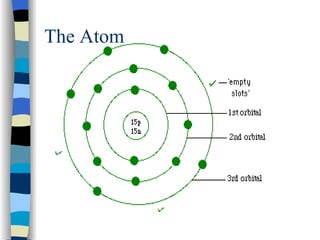
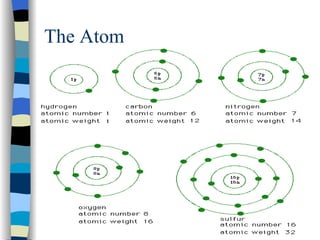
The Atom
The Atom
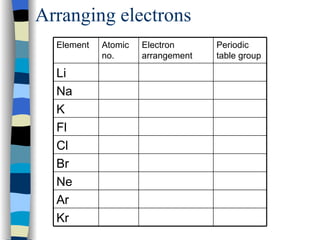
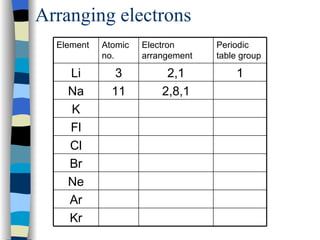
Arranging electrons Kr Ar Ne Br Cl Fl K Na Li Periodic table group Electron arrangement Atomic no. Element
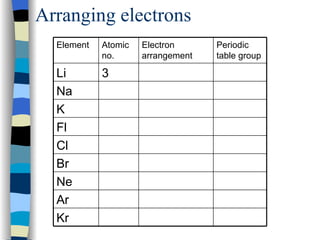
Arranging electrons Kr Ar Ne Br Cl Fl K Na 3 Li Periodic table group Electron arrangement Atomic no. Element
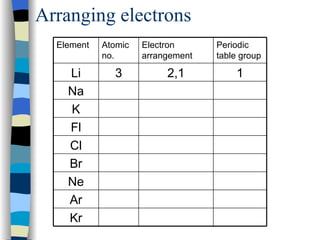
Arranging electrons Kr Ar Ne Br Cl Fl K Na 1 2,1 3 Li Periodic table group Electron arrangement Atomic no. Element
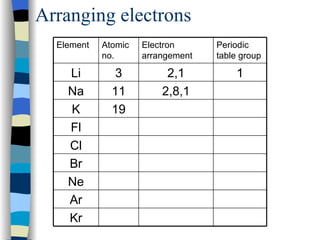
Arranging electrons Kr Ar Ne Br Cl Fl K 2,8,1 11 Na 1 2,1 3 Li Periodic table group Electron arrangement Atomic no. Element
Arranging electrons Kr Ar Ne Br Cl Fl 19 K 2,8,1 11 Na 1 2,1 3 Li Periodic table group Electron arrangement Atomic no. Element
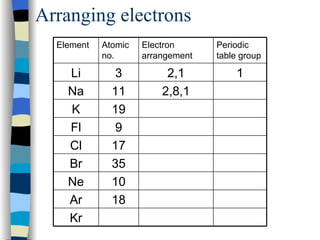
Arranging electrons Kr 18 Ar 10 Ne 35 Br 17 Cl 9 Fl 19 K 2,8,1 11 Na 1 2,1 3 Li Periodic table group Electron arrangement Atomic no. Element
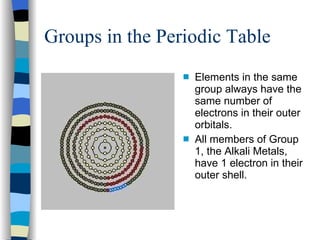
Groups in the Periodic Table Elements in the same group always have the same number of electrons in their outer orbitals. All members of Group 1, the Alkali Metals, have 1 electron in their outer shell.
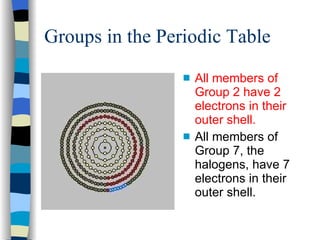
Groups in the Periodic Table All members of Group 2 have 2 electrons in their outer shell. All members of Group 7, the halogens, have 7 electrons in their outer shell.
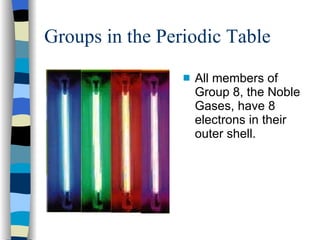
Groups in the Periodic Table All members of Group 8, the Noble Gases, have 8 electrons in their outer shell.
Stable (happy) atoms! Atoms will always try and get full outer shells of electrons. If the outer shell is full the atom is stable! Atoms will always try and react in order to end up with a full outer shell!
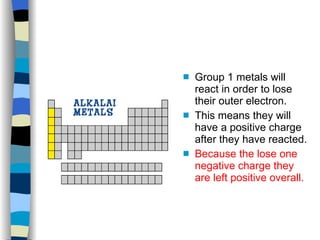
Group 1 metals will react in order to lose their outer electron. This means they will have a positive charge after they have reacted. Because the lose one negative charge they are left positive overall.
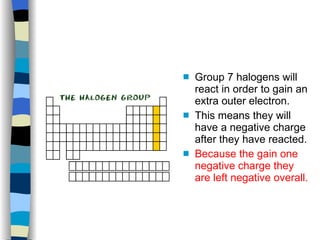
Group 7 halogens will react in order to gain an extra outer electron. This means they will have a negative charge after they have reacted. Because the gain one negative charge they are left negative overall.
Move into room 143! Looking at the HALOGENS!
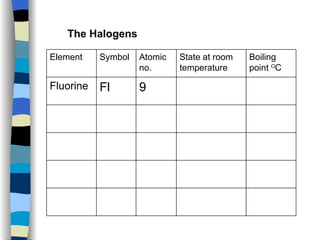
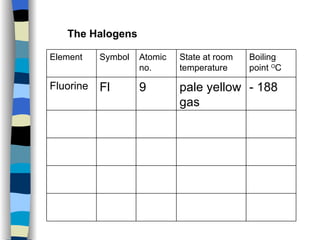
The Halogens 9 Fl Fluorine Boiling point  O C State at room temperature Atomic no. Symbol Element
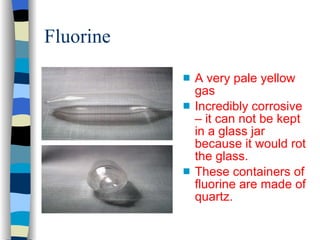
Fluorine A very pale yellow gas Incredibly corrosive – it can not be kept in a glass jar because it would rot the glass. These containers of fluorine are made of quartz.
The Halogens - 188 pale yellow gas 9 Fl Fluorine Boiling point  O C State at room temperature Atomic no. Symbol Element
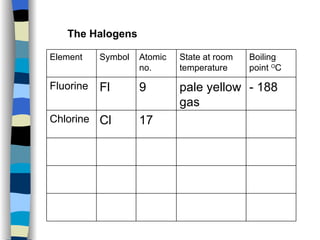
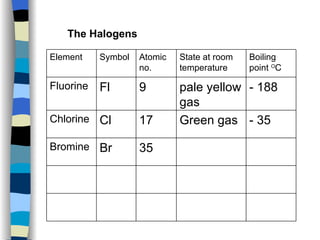
The Halogens 17 Cl Chlorine - 188 pale yellow gas 9 Fl Fluorine Boiling point  O C State at room temperature Atomic no. Symbol Element
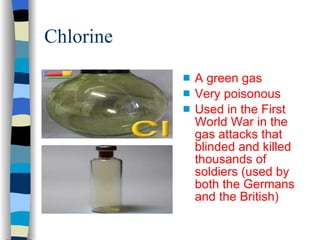
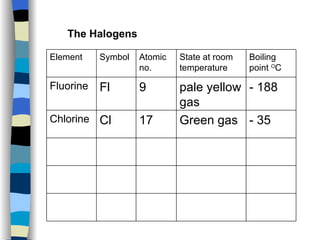
Chlorine A green gas Very poisonous Used in the First World War in the gas attacks that blinded and killed thousands of soldiers (used by both the Germans and the British)
The Halogens - 35 Green gas 17 Cl Chlorine - 188 pale yellow gas 9 Fl Fluorine Boiling point  O C State at room temperature Atomic no. Symbol Element
The Halogens 35 Br Bromine - 35 Green gas 17 Cl Chlorine - 188 pale yellow gas 9 Fl Fluorine Boiling point  O C State at room temperature Atomic no. Symbol Element
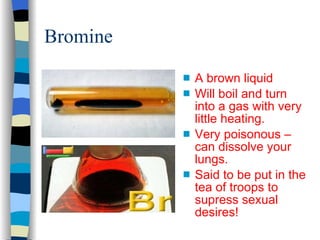
Bromine A brown liquid Will boil and turn into a gas with very little heating. Very poisonous – can dissolve your lungs. Said to be put in the tea of troops to supress sexual desires!
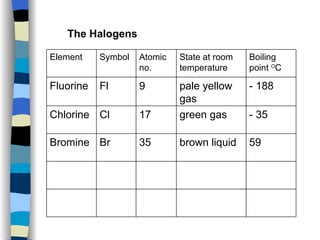
The Halogens 59 brown liquid 35 Br Bromine - 35 green gas 17 Cl Chlorine - 188 pale yellow gas 9 Fl Fluorine Boiling point  O C State at room temperature Atomic no. Symbol Element
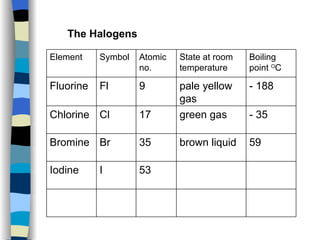
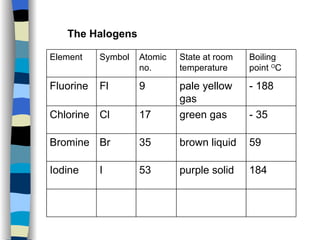
The Halogens 53 I Iodine 59 brown liquid 35 Br Bromine - 35 green gas 17 Cl Chlorine - 188 pale yellow gas 9 Fl Fluorine Boiling point  O C State at room temperature Atomic no. Symbol Element
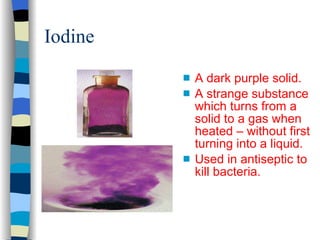
Iodine A dark purple solid. A strange substance which turns from a solid to a gas when heated – without first turning into a liquid. Used in antiseptic to kill bacteria.
The Halogens 184 purple solid 53 I Iodine 59 brown liquid 35 Br Bromine - 35 green gas 17 Cl Chlorine - 188 pale yellow gas 9 Fl Fluorine Boiling point  O C State at room temperature Atomic no. Symbol Element
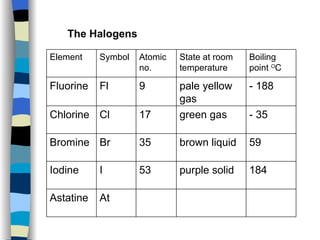
The Halogens At Astatine 184 purple solid 53 I Iodine 59 brown liquid 35 Br Bromine - 35 green gas 17 Cl Chlorine - 188 pale yellow gas 9 Fl Fluorine Boiling point  O C State at room temperature Atomic no. Symbol Element
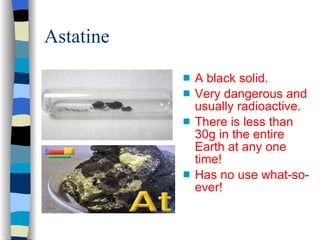
Astatine A black solid. Very dangerous and usually radioactive. There is less than 30g in the entire Earth at any one time! Has no use what-so-ever!
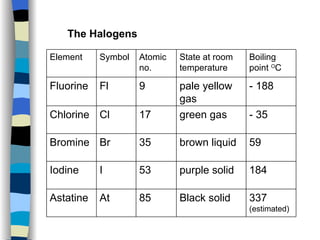
The Halogens 337  (estimated) Black solid 85 At Astatine 184 purple solid 53 I Iodine 59 brown liquid 35 Br Bromine - 35 green gas 17 Cl Chlorine - 188 pale yellow gas 9 Fl Fluorine Boiling point  O C State at room temperature Atomic no. Symbol Element
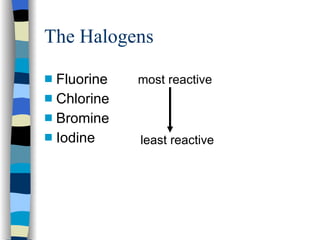
The Halogens Fluorine Chlorine Bromine Iodine most reactive least reactive
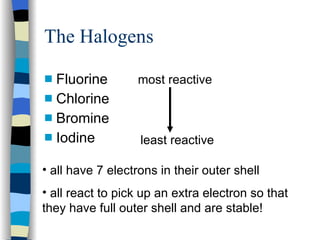
The Halogens Fluorine Chlorine Bromine Iodine most reactive least reactive all have 7 electrons in their outer shell all react to pick up an extra electron so that they have full outer shell and are stable!
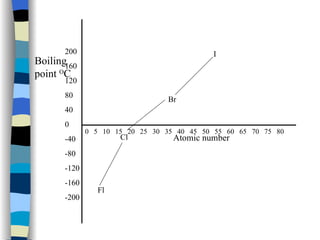
Boiling point  O C 200 160 120 80 40 0 -40 -80 -120 -160 -200 Atomic number 0  5  10  15  20  25  30  35  40  45  50  55  60  65  70  75  80 Fl Cl Br I
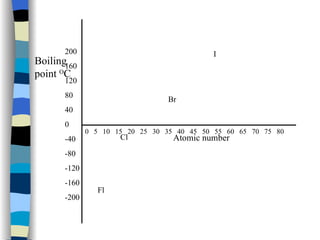
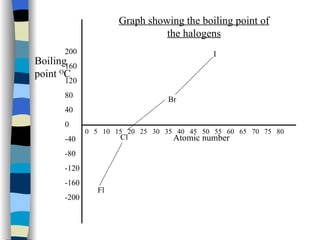
Boiling point  O C 200 160 120 80 40 0 -40 -80 -120 -160 -200 Atomic number 0  5  10  15  20  25  30  35  40  45  50  55  60  65  70  75  80 Fl Cl Br I Graph showing the boiling point of the halogens

Electrons In Atoms

  • 1.
  • 2.
    By the endof this lesson I should be able to…….. Predict the electron arrangement in atoms using the periodic table. Appreciate that atoms like to have full orbits of electrons if they are to be stable. Understand the link between electron arrangement and reactivity. Know which elements are the halogens. Know the properties of the halogens
  • 3.
    Using Power PointIf it is written in white – it should be in my exercise book! If it is written in red – it need not be in my exercise book.
  • 4.
  • 5.
  • 6.
    Arranging electrons KrAr Ne Br Cl Fl K Na Li Periodic table group Electron arrangement Atomic no. Element
  • 7.
    Arranging electrons KrAr Ne Br Cl Fl K Na 3 Li Periodic table group Electron arrangement Atomic no. Element
  • 8.
    Arranging electrons KrAr Ne Br Cl Fl K Na 1 2,1 3 Li Periodic table group Electron arrangement Atomic no. Element
  • 9.
    Arranging electrons KrAr Ne Br Cl Fl K 2,8,1 11 Na 1 2,1 3 Li Periodic table group Electron arrangement Atomic no. Element
  • 10.
    Arranging electrons KrAr Ne Br Cl Fl 19 K 2,8,1 11 Na 1 2,1 3 Li Periodic table group Electron arrangement Atomic no. Element
  • 11.
    Arranging electrons Kr18 Ar 10 Ne 35 Br 17 Cl 9 Fl 19 K 2,8,1 11 Na 1 2,1 3 Li Periodic table group Electron arrangement Atomic no. Element
  • 12.
    Groups in thePeriodic Table Elements in the same group always have the same number of electrons in their outer orbitals. All members of Group 1, the Alkali Metals, have 1 electron in their outer shell.
  • 13.
    Groups in thePeriodic Table All members of Group 2 have 2 electrons in their outer shell. All members of Group 7, the halogens, have 7 electrons in their outer shell.
  • 14.
    Groups in thePeriodic Table All members of Group 8, the Noble Gases, have 8 electrons in their outer shell.
  • 15.
    Stable (happy) atoms!Atoms will always try and get full outer shells of electrons. If the outer shell is full the atom is stable! Atoms will always try and react in order to end up with a full outer shell!
  • 16.
    Group 1 metalswill react in order to lose their outer electron. This means they will have a positive charge after they have reacted. Because the lose one negative charge they are left positive overall.
  • 17.
    Group 7 halogenswill react in order to gain an extra outer electron. This means they will have a negative charge after they have reacted. Because the gain one negative charge they are left negative overall.
  • 18.
    Move into room143! Looking at the HALOGENS!
  • 19.
    The Halogens 9Fl Fluorine Boiling point O C State at room temperature Atomic no. Symbol Element
  • 20.
    Fluorine A verypale yellow gas Incredibly corrosive – it can not be kept in a glass jar because it would rot the glass. These containers of fluorine are made of quartz.
  • 21.
    The Halogens -188 pale yellow gas 9 Fl Fluorine Boiling point O C State at room temperature Atomic no. Symbol Element
  • 22.
    The Halogens 17Cl Chlorine - 188 pale yellow gas 9 Fl Fluorine Boiling point O C State at room temperature Atomic no. Symbol Element
  • 23.
    Chlorine A greengas Very poisonous Used in the First World War in the gas attacks that blinded and killed thousands of soldiers (used by both the Germans and the British)
  • 24.
    The Halogens -35 Green gas 17 Cl Chlorine - 188 pale yellow gas 9 Fl Fluorine Boiling point O C State at room temperature Atomic no. Symbol Element
  • 25.
    The Halogens 35Br Bromine - 35 Green gas 17 Cl Chlorine - 188 pale yellow gas 9 Fl Fluorine Boiling point O C State at room temperature Atomic no. Symbol Element
  • 26.
    Bromine A brownliquid Will boil and turn into a gas with very little heating. Very poisonous – can dissolve your lungs. Said to be put in the tea of troops to supress sexual desires!
  • 27.
    The Halogens 59brown liquid 35 Br Bromine - 35 green gas 17 Cl Chlorine - 188 pale yellow gas 9 Fl Fluorine Boiling point O C State at room temperature Atomic no. Symbol Element
  • 28.
    The Halogens 53I Iodine 59 brown liquid 35 Br Bromine - 35 green gas 17 Cl Chlorine - 188 pale yellow gas 9 Fl Fluorine Boiling point O C State at room temperature Atomic no. Symbol Element
  • 29.
    Iodine A darkpurple solid. A strange substance which turns from a solid to a gas when heated – without first turning into a liquid. Used in antiseptic to kill bacteria.
  • 30.
    The Halogens 184purple solid 53 I Iodine 59 brown liquid 35 Br Bromine - 35 green gas 17 Cl Chlorine - 188 pale yellow gas 9 Fl Fluorine Boiling point O C State at room temperature Atomic no. Symbol Element
  • 31.
    The Halogens AtAstatine 184 purple solid 53 I Iodine 59 brown liquid 35 Br Bromine - 35 green gas 17 Cl Chlorine - 188 pale yellow gas 9 Fl Fluorine Boiling point O C State at room temperature Atomic no. Symbol Element
  • 32.
    Astatine A blacksolid. Very dangerous and usually radioactive. There is less than 30g in the entire Earth at any one time! Has no use what-so-ever!
  • 33.
    The Halogens 337 (estimated) Black solid 85 At Astatine 184 purple solid 53 I Iodine 59 brown liquid 35 Br Bromine - 35 green gas 17 Cl Chlorine - 188 pale yellow gas 9 Fl Fluorine Boiling point O C State at room temperature Atomic no. Symbol Element
  • 34.
    The Halogens FluorineChlorine Bromine Iodine most reactive least reactive
  • 35.
    The Halogens FluorineChlorine Bromine Iodine most reactive least reactive all have 7 electrons in their outer shell all react to pick up an extra electron so that they have full outer shell and are stable!
  • 36.
    Boiling point O C 200 160 120 80 40 0 -40 -80 -120 -160 -200 Atomic number 0 5 10 15 20 25 30 35 40 45 50 55 60 65 70 75 80 Fl Cl Br I
  • 37.
    Boiling point O C 200 160 120 80 40 0 -40 -80 -120 -160 -200 Atomic number 0 5 10 15 20 25 30 35 40 45 50 55 60 65 70 75 80 Fl Cl Br I
  • 38.
    Boiling point O C 200 160 120 80 40 0 -40 -80 -120 -160 -200 Atomic number 0 5 10 15 20 25 30 35 40 45 50 55 60 65 70 75 80 Fl Cl Br I Graph showing the boiling point of the halogens