BUSINESS ENGLISH
SPRING 2016
 Week 5: Markets
 Week 6: Share markets
 Week 7: Finance and Trading
 Week 9: Business Ethics
 Week 11: Leadership
 Week 13: Meetings
 Week 14: Oral presentation
CURRICULUM OUTLINE FEBRUARY - MARCH
ASSESSMENT
Assessment of:
 Written English
 Listening
 Speaking
ESSENTIAL VOCABULARY P48 MARKETS AND COMPETITORS
Word Definition
Market growth The sales of digital music, particularly Apple have seen a massive
increase in the number of people buying songs form iTunes. There has
been huge ??????? in sales.
Market segment Regional airlines are important customers for the Embraer ERJ-145.
They are a big ?????? for Embracer.
Market segmentation Microsoft divides the software market into large companies, small
companies, home offices users, and leisure users. This is how it does its
????????
Market share The US, Japanese carmakers are selling a bigger percentage of cars
whilst US manufacturers are selling a smaller percentage. The Japanese
carmakers have been gaining ?????????
Market leader Tesco is the biggest supermarket chain in the UK and it is therefore the
?????????????
ESSENTIAL VOCABULARY P48 MARKETS AND COMPETITORS
Word - Verb Definition place the verb in a sentences starting: A company….
enters N: entre, gå inn
penetrates N: trenge gjennom
abandons N: forlate, oppgi
dominates N: dominere, dominere over, herske over, styre, være
fremherskende
corners N: spekulasjonskjøp av aksjer/varer i et omfang som gjør det
mulig å beherske markedet
monopolizes E: the exclusive possession or control of the supply of or trade
in a commodity or service
drives out E: Economics for example: ‘Bad money drives out good’
Marketing
 Retail
 Administration
 Process Management
 Case Studies
BUSINESS VOCABULARY
MARKETING STRATEGIES
 The Marketing Plan
 The 4 P’s
 Pricing Strategy
 Positioning Strategy
MARKETING AND MARKET ORIENTATION VOCABULARY QUIZ
https://play.kahoot.it/#/k/37c9d3d8-3027-454d-9770-3928113af74f
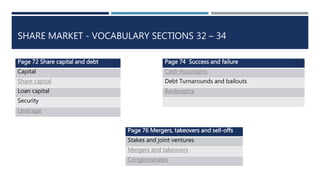
SHARE MARKET - VOCABULARY SECTIONS 32 – 34
Page 72 Share capital and debt
Capital
Share capital
Loan capital
Security
Leverage
Page 74 Success and failure
Cash mountains
Debt Turnarounds and bailouts
Bankruptcy
Page 76 Mergers, takeovers and sell-offs
Stakes and joint ventures
Mergers and takeovers
Conglomerates
ORAL TASK
With your partner, discuss the following
questions:
 What are 5 different ways of becoming rich?
 Which one/s do you think are the best? Why?
 Is it better to be born rich or become rich?
VIEWING TASK - WALL STREET: TELDAR PAPER (1:11:42 – 1:15:44)
Answer the following questions;
 According to Gekko, why was corporate
America successful in the past?
 What are his criticisms of the board of the
Teldar Paper Company?
 What does he say about greed?
 How far do you agree with Gekko? Why?
https://youtu.be/6Da1tDKFfno?list=PLzYwCbwmhKb2IVjIS2BJkpeeQXY3uT6_8
CAPITAL
SECURITY AND LEVERAGE
SUCCESS AND FAILURE
MERGERS, TAKEOVERS AND SELL-OFFS
CONGLOMERATES
PERSONAL FINANCE
 Traditional Banking
 Internet banking
 Personal investing
Oral task: What is one
advantage and one
disadvantage of online
banking?
ONLINE BANKING
Advantages of online banking
Lower costs to the customer
Available 24/7
Can use the telephone, PC and mobile to bank
Are able to see your entire banking status
Saves time. You don’t have to physically turn up
to the bank and wait in a queue
In developing countries people can still bank
Disadvantages of online banking
The bank becomes impersonal
404 
Security Password!!!!!!!
Safety – hackers
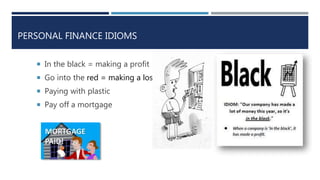
PERSONAL FINANCE IDIOMS
 In the black = making a profit
 Go into the red = making a loss
 Paying with plastic
 Pay off a mortgage
FINANCIAL CENTRES AND INDEXES
 The London FTSE (“Footsie”)
 New York: Wall St and Nasdaq
 Paris: CPC 40
 Frankfurt: DAX
 Tokyo: NIKKEI
 Hong Kong: Hang Seng
 Shanghai: SSE
Oral task: What is Norway’s
main financial center and where
are commodities traded?
TRADING – TRANSLATION EXERCISE
Nervousness on the Shanghai Stock Exchange
After the United States stock exchanges had a downturn last night, the stock exchanges in Europe plunged
(fell) steeply from the start of trading Wednesday.
In the US the stock indexes fell up to 1.4 percent yesterday, while the Tokyo Stock Exchange in Asia rose on
Wednesday. China has experienced large trade fluctuations after the Central Bank cut interest rates and
lowered banks' reserves recently.
In the oil market North Sea Oil traded for 43.5 dollars per barrel, a small change from yesterday afternoon, but
still down 20 percent from last month.
TRADING – TRANSLATION EXERCISE
Nervøst på Shanghai-børsen
Etter at USA-børsene snudde ned i går kveld falt børsene i Europa kraftig fra start onsdag.
I USA falt aksjeindeksene opp mot 1,4 prosent i går, mens Tokyo-børsen steg i Asia onsdag. I Kina preges
handelen av store svingninger etter at sentralbanken i går kuttet rentene og senket bankenes kapitalkrav.
I oljemarkedet handles nordsjøoljen for 43,5 dollar per fat, lite endret fra i går ettermiddag, men fremdeles
ned 20 prosent den siste måneden.
WRONGDOING AND CORRUPTION
CORRUPTION - WHY DOES THIS MATTER?
The World Cup is the most-watched sporting event in the world, larger even
than the Olympics. It generates billions of dollars in revenue from corporate
sponsors, broadcasting rights and merchandising. These arrests and
investigations cast doubt over the transparency and honesty for the process of
allocating World Cup tournaments, electing its president, and the
administration of funds, including those earmarked for improving football
facilities in some of FIFA's poorer members.
FIFA is the body responsible for running world football. It has recently been
accused of corruption, particularly after awarding the 2022 World Cup to the
tiny but rich and influential Gulf state of Qatar. In December 2014, FIFA chose
not to release its own investigation into corruption, instead releasing an
executive summary which it said exonerated the bidding process. The report's
independent author, American lawyer Michael Garcia, resigned in protest.
CORRUPTION - WHY DOES THIS MATTER?
 Track and field's governing body
(IAAF) was corrupted from the inside
by a "powerful rogue group" led by
its president, and they conspired to
extort athletes and allow doping
Russians to continue competing, the
World Anti-Doping Agency (WADA)
probe reported earlier this year.
CORRUPTION - WHY DOES THIS MATTER?
The World Anti-Doping Agency (WADA) was concerned to
learn of the absence of a quality anti-doping testing
program at the X Games, in Oslo on Wednesday, 24
February.
“Whilst the X Games is an independent, privately-run event,
it is still surprising and regrettable to learn that there will be
no anti-doping testing program in place for athletes during
the Games,” said WADA Director General, David Howman.
“This sends the wrong message to athletes at a fragile time
for clean sport worldwide.”
“Norway is a signatory to the UNESCO International
Convention against Doping in Sport and, as an event that
receives public authority funding, we would expect the X
Games to adopt a quality anti-doping program so that the
athletes, and indeed the public, can have confidence in the
competition.”
WADA Statement on X Games in Norway
CORRUPTION - WHY DOES THIS MATTER?
Anti-Doping Norway has launched a new
and better anti-doping program.
An increasing number of fitness centers
want to work towards a doping-free
training environment. With its
performance enhancing effect and easy
availability, doping is becoming a major
threat to a healthy and positive training
environment. It is also a threat to the
mental and physical health of the
individuals using it.
New anti-doping program for fitness centers
VOCABULARY
Word (Noun) Verb Slang (BrE) / Example
Bribe (N=bestikkelse, smøring) A
bribery is a sum of money or
other inducement offered or
given to bribe someone.
dishonestly persuade
(someone) to act in one's
favour by a gift of money or
other inducement:
Kickback/ sweetener/ backhander
Bribes resulted in the 2022 World
Cup being awarded to the tiny but
rich and influential Gulf state of
Qatar.
Fraud (N= bedrageri, svindel)
wrongful or criminal deception
intended to result in financial or
personal gain
IAAF was accused of fraud when
they allowed doping Russians to
continue competing in international
sporting events.
Embezzlement (N=underslag)
theft or misappropriation of
funds placed in one's trust or
belonging to one's employer
steal or misappropriate
money
An example of a crime of
embezzlement is when members of
FIFA received kickbacks to vote for
a specific candidate in an election
or bidding process.
WHAT IS BUSINESS ETHICS?
 Code of ethics
 Code of conduct
 Rules or professional guidelines that
control the way an organisation or
employee/employer behaves.
 Behaviour is described as being ethical or
unethical
 Breaches lead to being guilty of
unprofessional conduct
29
EXAMPLES OF UNETHICAL ACTIVITIES WHICH BREACH RULES
 Accounting: misrepresenting the
truth
 Human Resources: hiring
relatives
 Marketing: selling unhealthy
products to youth
 IT: using illegal copies of
software
30
INTERNATIONAL VIEWS & ETHICS
 Ethics is practiced differently around the world
 Bribes
 Minimum working age
 Safe workplaces
 Copyright protection
 Nepotism
 Religion can also play a role in shaping ethics
31
NEGATIVE IMPACT OF UNETHICAL BEHAVIOR
 Unethical actions hurt many to
benefit a few (in the developing
world).
 Examples:
 Ethnical minorities treated unfairly
 Gender issues: women segregated
or treated unequally in the work
place
 Human rights: child labour
 Environmental issues: mining
accidents destroy homes and
environment
32
BENEFITS OF CORPORATE SOCIAL RESPONSIBILITY
 Human Resources – attractive to potential
hires
 Risk Management – keeps customers
happy
 Unique Brand – stand out from the crowd
 New Customers – reach new people with
your products by helping them
33
EXAMPLE: ENVIRONMENT OR GREEN ISSUES
VOCABULARY REVISION
VOCABULARY
Word (Noun) Verb Slang (BrE) / Example
Bribe (N=bestikkelse, smøring) A
bribery is a sum of money or
other inducement offered or
given to bribe someone.
dishonestly persuade
(someone) to act in one's
favour by a gift of money or
other inducement:
Kickback/ sweetener/ backhander
Bribes resulted in the 2022 World
Cup being awarded to the tiny but
rich and influential Gulf state of
Qatar.
Fraud (N= bedrageri, svindel)
wrongful or criminal deception
intended to result in financial or
personal gain
IAAF was accused of fraud when
they allowed doping Russians to
continue competing in international
sporting events.
Embezzlement (N=underslag)
theft or misappropriation of
funds placed in one's trust or
belonging to one's employer
steal or misappropriate
money
An example of a crime of
embezzlement is when members of
FIFA received kickbacks to vote for
a specific candidate in an election
or bidding process.
BUSINESS ACROSS CULTURES – AIMS AND OBJECTIVES
Students need to be able to explain
the following words and give
examples:
 Culture,
 Ethnocentrism,
 Intercultural language,
 Verbal and non-verbal
communication,
 High- vrs low-context language,
 Deal-focused vrs relationship-
focused business cultures
 Student are able to discuss how cultural
differences affect communication in a
business.
 Students are able to give examples of
these terms in at least four of the
following countries’ business cultures :
Japan, China, India, Australia, The
United Kingdom, The USA and
Germany.
Sources:
World Business Culture,
Guidelines for Business Etiquette
 Read: Business Vocabulary in Use U42-
46, 51-52, 62, 64
U45: BUSINESS ACROSS CULTURES 1
 Culture is the characteristics
and knowledge of a particular
group of people, defined by
everything from language,
religion, cuisine, social habits,
music and arts.
U46: BUSINESS ACROSS CULTURES 2
 Individualism vrs collectivism
 Attitudes to time:
 Working hours
 Holidays
 Meals and entertaining
 Punctuality
 Boundaries
Cross-cultural communication
 Distance
 Eye contact
 Gesture
 Greetings/goodbyes
 Humour
 Physical contact
 Presents
 Rules of conversations and role of silence
U44: LEADERSHIP AND MANAGEMENT STYLES - "FAWLTY TOWERS"
MOMENTS
What makes a great leader?
 Leadership skills
 Charisma
 Vision
 Dynamism
 Get ready for a stay in the Fawlty Towers hotel,
where the staff is courteous but the manager is
something else! I Want My Sausages!
How have management styles changed?
 Before
 distant and remote, top-down approach
 Today
 accessible and approachable
 consultation – consensus
U44: LEADERSHIP AND MANAGEMENT STYLES - EMPOWERMENT
What exactly is empowerment?
 Employees use their own initiative
 Decentralized decision making
 Delegate responsibility
Fredrikssons fabrikk: Stå på krava!
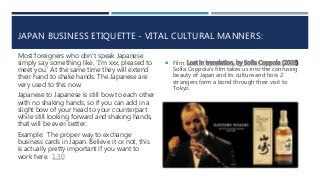
JAPAN BUSINESS ETIQUETTE - VITAL CULTURAL MANNERS:
Most foreigners who don’t speak Japanese
simply say something like, ‘I’m xxx, pleased to
meet you.’ At the same time they will extend
their hand to shake hands. The Japanese are
very used to this now.
Japanese to Japanese is still bow to each other
with no shaking hands, so if you can add in a
slight bow of your head to your counterpart
while still looking forward and shaking hands,
that will be even better.
Example: The proper way to exchange
business cards in Japan. Believe it or not, this
is actually pretty important if you want to
work here. 1:30
 Film: Lost in translation, by Sofia Coppola (2003)
Sofia Coppola's film takes us into the confusing
beauty of Japan and its culture and how 2
strangers form a bond through their visit to
Tokyo.
CHINESE BUSINESS ETIQUETTE - VITAL CULTURAL MANNERS
 The Chinese will sometimes nod as an
initial greeting. Bowing is seldom used
except in ceremonies. Handshakes are
also popular; wait, however, for your
Chinese counterpart to initiate the
gesture.
 Avoid making expansive gestures and
using unusual facial expressions
 Do not put your hands in your mouth,
as it is considered vulgar.
Example: Chinese business customs- How to greet someone
here
AUSTRALIAN BUSINESS ETIQUETTE - VITAL CULTURAL MANNERS
 Men should refrain from being too physically demonstrative with women,
and winking or whistling is unacceptable. People don’t usually touch each
other. They shake hands at the beginning and end of a meeting. Good
friends often kiss once on the right cheek.
 “G’day, mate” is a popular casual greeting, particularly between individuals
who already know each other. “How are you?” is a more common, often
just another way of saying “Hi”.
 Maintaining personal space is important. Australians are not comfortable
with silence and will feel they have to say something. Direct, moderate
speech is the general rule.
 Don’t break eye contact with an Australian when s/he is talking to you.
 Remain friendly, relaxed, modest, and unpretentious.
 Australians are very difficult to impress; even if you do manage to impress
them, they may not openly admit it.
 Example:
Information about
workplace or
organizational culture
in Australia, including
details about the
Australian way of life
and how people
interact with each
other in the
workplace.
INDIAN BUSINESS ETIQUETTE - VITAL CULTURAL MANNERS
 Feet are considered unclean in India
 Indians do not maintain continuous eye-contact while
talking with others. Direct eye-contact may be seen as
intrusive.
 The comfortable distance to be maintained during an
interaction is much closer in India than in most Western
countries.
 The public spaces [e.g., markets, roads, public transportation,
etc.] in India are far more crowded than in the West. Traffic
when crossing roads, and pick-pockets who can steal your
wallet.
 Being a poor country, there are often beggars in most public
places.
 Most Indians are very courteous to foreigners. However,
many also see foreigners as a target for being swindled.
 Example: Film
Outsourced
INDIAN BUSINESS ETIQUETTE - VITAL CULTURAL MANNERS
 As the world market becomes smaller and more interdependent, it is
imperative that you bear in mind that some of you may have to work (have
already worked) for a foreign or International Joint Venture (IJV) firm. This
means not only do you need to improve your oral (and written) foreign
business language skills, but also come to terms with cultural differences and
business styles which will be very useful in your future working lives.
 Example: Film 2007
Outsourced
Josh Hamilton tries to explain to his new workers why they shouldn't call
erasers rubbers when they are selling them to American consumers because
the word rubber isn't used the same as in India. The translation is lost even
more when they think he is talking about condominiums when he's actually
talking about ?
BUSINESS MEETINGS
 Vocabulary
 Expressions
 Diplomacy
 Accuracy and Refining
TYPES OF MEETINGS
AGM: ANNUAL GENERAL MEETING (BRE) ANNUAL MEETING (AME)
A meeting held every year to inform
an organization's members of previous
and future activities. (Gives assess to
the business)
This meeting is often required by law
or the constitution or charter of an
organization. (Called Statutory
Meetings)
 Directors and shareholders discuss
the company’s annual report
 Usually 21 days notice
BOARD MEETINGS
An official, formal meeting of the
company’s directors
Attended by all board members and
chaired by chairman of board
DEPARTMENT(AL) MEETINGS
A meeting of the staff in a department
for planning, discussion and reporting.
 Chaired by chairman of the
department
 Finance dept
 Quality dept
 Export dept etc…
HOW WAS THE MEETING? PLANNING BEFORE-DURING-AFTER
Determine the focus of the meeting
(three W’s);
 Who should attend?
 Who takes the minutes?
 What is on the agenda for the
meeting?
 When is the best time and place to
hold it?
Schedule a meeting for a time when
all or most of the key people can be
present.
If a meeting must be held without
some key participants, ask those
people for their contributions prior to
the meeting or invite them to
participate by Skype or other remote
methods.
HOW WAS THE MEETING? PLANNING BEFORE-DURING-AFTER
If the agenda (the list of things to be
discussed) is distributed in advance of the
meeting, it should be accompanied by a cover
letter or message informing people of the
following:
 The purpose of the meeting
 The date and place of the meeting
 The meeting start and stop times
 The names of the people invited
 Instructions on how to prepare
MEETINGS: THE CHAIR
 A good Chair needs to demonstrate
a broad spectrum of skills, including:
diplomacy, good timekeeping,
delegation for example, appoint a
minute-taker, gives room for
discussion, is tactful, avoids
digressions and enables resolutions
to be decided.
FOLLOW UP - MINUTES OF THE MEETING
Minutes of the meeting:
 need to be prepared during or after the
meeting.
 are important because all the points
discussed are put on record for the
attendees and non-attendees.
 should be disseminated to the concerned
group of people.
 should be communicated using print
medium or email.
Click here for: Word Meeting Minutes Templates
FOLLOW UP - MINUTES OF THE MEETING - EPOST
Meeting Minutes Template for Email
ORAL PROJECT - PRESENTATION SKILLS
 ABC of Public Speaking
 Structures
 Expressions
 Vocabulary
 Cultural Awareness
 Audience Awareness
 Persuasion Techniques
ORAL PROJECT - TASK
 A power point presentation on a company of your choice. The company
presentation should at least cover:
 The company's history
 History of products and service(s)
 Financial information (current fiscal sales figures, losses, gains, market share)
 Goals and future marketing strategies, management changes, etc.
 Student's assessment of the company (pros and cons and suggestions on how
the company should improve as though he/she was an outside consultant)
COMMUNICATION SKILLS
 Telephone Calls
 Answering the telephone
 Introducing yourself
 Asking to speak to someone
 Connecting someone
 Making requests
 Taking a message
 Ending a conversation
 Email Correspondence
ON THE PHONE AT WORK
 These guidelines are
important to remember in
a professional situation
 Be polite and friendly
 Speak clearly
 Don’t speak too fast, too slowly or too
loudly
 Avoid eating an drinking whilst on the
phone
 Concentrate on the conversation
 Confirm that you have understood
 Ask if you don’t understand
 Use formal language
 Listen carefully
 Note down important information
COMMUNICATION SKILLS
 Telephone Calls
 Pp 102-109 Business Vocabulary in
Use
 Contacting Customers
 Pp 27 – 36 Company to Company
STATISTICS AND TRENDS
 Vocabulary
 Bar or column graph
 Line graph
 Pie Chart
 Here are four useful phrases for describing causes:
Due to:
The drop in sales is due to an interest rate rise.
A consequence of:
The drop in sales is a consequence of an interest rate rise.
Because of:
The drop in sales is because of an interest rate rise.
A result of:
The drop in sales is a result of an interest rate rise.
0
5
10
Series 1 Series 2 Series 3
Episode 8 Business English
LANGUAGE USED TO DESCRIBE WHAT A GRAPH SHOWS
In describing trends, we use either a noun or verb.
For example we may talk about an increase, or a
decrease in numbers. Other words for an increase
are rise, climb, improvement, upturn.
Most of these words can also be used as a verb: to
increase; to rise; to climb; to improve.
Other words for a decrease are fall, decline,
worsening, downturn.
These also have verbs from them: to decrease; to
fall; to decline; to worsen.
So we say - there was an improvement in the
figures for April, or the figures for April have
improved.
Sometimes we add more descriptive words -adjectives
and adverbs. Remember adjectives go before nouns, and
adverbs go after verbs. These describe the change in
figures - was it big or small, fast or slow? Other words for
a big change are significant, marked, massive,
pronounced, substantial.
Most adjectives can also be made into adverbs, just by
adding 'ly' or 'lee'. There is no adverb for 'big', but
informally we say 'a lot'.
Other words for small are slight, insignificant, and their
adverbs slightly, insignifanctly.
Other words for a fast or quick change are sharp,
dramatic, sudden, and again we add 'ly' for the adverbs.
And for a slow or medium change, we can use steady or
moderate, and the adverbs steadily and moderately
PRODUCING REPORTS
 Practice
 Summarizing
NEGOTIATION SKILLS
 Theory of Negotiations
 Diplomacy and Formality
MARKETING
 Jobs and Responsibilities
 Corporate Identities
 Branding and logos
CREATING ADVERTS
 The AIDA Model
 Working with an Agency
 Advertising Channels
 Rate Sheets
TARGET AUDIENCE
 Market Research
 Customer Profiling
 Data Collection
 Telephone Surveys
MARKETING TOOLS
 Distribution Channels
 Type of Discount
 Types of Retailers
 Direct Marketing
 Telemarketing
 Public Relations
 Websites
 Sponsorship
 Effective Press Releases
PRESENTING YOUR PUBLIC FACE
 Attending a Trade Fair
 Organizing Events
 Giveaways
TRADE FAIRS
EXAMS - 7TH JUNE
 Tillate hjelpemidler: Utdelt enspråklig engelsk
ordbok ubeskrevet / umarkert
 Ved uklarheter / problemer kontakt: Telefon: (+47)
75 65 66 80 , Mobil: 922 45 522
epost: fiona.j.ellingsen@uit.no ITS Learning: fel005
 Prøven har 8 sider og 3 deler
 Framgangsmåte og krav til besvarelsen: Prøven i
engelsk har tre hoveddeler. For å bestå eksamen
må det besvares oppgaver fra samtlige tre deler. I
del 1 skal du svare alle spørsmål (1A og 1B). I del 2
velge du to av tre oppgaver. I del 3 skal du svare
alle spørsmål. Du må skrive nummer og bokstav på
oppgaven du har svart.
EXAMINATION RESOURCES ON ITSLEARNING

Forretningsengelsk

  • 1.
  • 2.
     Week 5:Markets  Week 6: Share markets  Week 7: Finance and Trading  Week 9: Business Ethics  Week 11: Leadership  Week 13: Meetings  Week 14: Oral presentation CURRICULUM OUTLINE FEBRUARY - MARCH
  • 3.
    ASSESSMENT Assessment of:  WrittenEnglish  Listening  Speaking
  • 4.
    ESSENTIAL VOCABULARY P48MARKETS AND COMPETITORS Word Definition Market growth The sales of digital music, particularly Apple have seen a massive increase in the number of people buying songs form iTunes. There has been huge ??????? in sales. Market segment Regional airlines are important customers for the Embraer ERJ-145. They are a big ?????? for Embracer. Market segmentation Microsoft divides the software market into large companies, small companies, home offices users, and leisure users. This is how it does its ???????? Market share The US, Japanese carmakers are selling a bigger percentage of cars whilst US manufacturers are selling a smaller percentage. The Japanese carmakers have been gaining ????????? Market leader Tesco is the biggest supermarket chain in the UK and it is therefore the ?????????????
  • 5.
    ESSENTIAL VOCABULARY P48MARKETS AND COMPETITORS Word - Verb Definition place the verb in a sentences starting: A company…. enters N: entre, gå inn penetrates N: trenge gjennom abandons N: forlate, oppgi dominates N: dominere, dominere over, herske over, styre, være fremherskende corners N: spekulasjonskjøp av aksjer/varer i et omfang som gjør det mulig å beherske markedet monopolizes E: the exclusive possession or control of the supply of or trade in a commodity or service drives out E: Economics for example: ‘Bad money drives out good’
  • 6.
    Marketing  Retail  Administration Process Management  Case Studies BUSINESS VOCABULARY
  • 7.
    MARKETING STRATEGIES  TheMarketing Plan  The 4 P’s  Pricing Strategy  Positioning Strategy
  • 8.
    MARKETING AND MARKETORIENTATION VOCABULARY QUIZ https://play.kahoot.it/#/k/37c9d3d8-3027-454d-9770-3928113af74f
  • 9.
    SHARE MARKET -VOCABULARY SECTIONS 32 – 34 Page 72 Share capital and debt Capital Share capital Loan capital Security Leverage Page 74 Success and failure Cash mountains Debt Turnarounds and bailouts Bankruptcy Page 76 Mergers, takeovers and sell-offs Stakes and joint ventures Mergers and takeovers Conglomerates
  • 10.
    ORAL TASK With yourpartner, discuss the following questions:  What are 5 different ways of becoming rich?  Which one/s do you think are the best? Why?  Is it better to be born rich or become rich?
  • 11.
    VIEWING TASK -WALL STREET: TELDAR PAPER (1:11:42 – 1:15:44) Answer the following questions;  According to Gekko, why was corporate America successful in the past?  What are his criticisms of the board of the Teldar Paper Company?  What does he say about greed?  How far do you agree with Gekko? Why? https://youtu.be/6Da1tDKFfno?list=PLzYwCbwmhKb2IVjIS2BJkpeeQXY3uT6_8
  • 12.
  • 13.
  • 14.
  • 15.
  • 16.
  • 17.
    PERSONAL FINANCE  TraditionalBanking  Internet banking  Personal investing Oral task: What is one advantage and one disadvantage of online banking?
  • 18.
    ONLINE BANKING Advantages ofonline banking Lower costs to the customer Available 24/7 Can use the telephone, PC and mobile to bank Are able to see your entire banking status Saves time. You don’t have to physically turn up to the bank and wait in a queue In developing countries people can still bank Disadvantages of online banking The bank becomes impersonal 404  Security Password!!!!!!! Safety – hackers
  • 19.
    PERSONAL FINANCE IDIOMS In the black = making a profit  Go into the red = making a loss  Paying with plastic  Pay off a mortgage
  • 20.
    FINANCIAL CENTRES ANDINDEXES  The London FTSE (“Footsie”)  New York: Wall St and Nasdaq  Paris: CPC 40  Frankfurt: DAX  Tokyo: NIKKEI  Hong Kong: Hang Seng  Shanghai: SSE Oral task: What is Norway’s main financial center and where are commodities traded?
  • 21.
    TRADING – TRANSLATIONEXERCISE Nervousness on the Shanghai Stock Exchange After the United States stock exchanges had a downturn last night, the stock exchanges in Europe plunged (fell) steeply from the start of trading Wednesday. In the US the stock indexes fell up to 1.4 percent yesterday, while the Tokyo Stock Exchange in Asia rose on Wednesday. China has experienced large trade fluctuations after the Central Bank cut interest rates and lowered banks' reserves recently. In the oil market North Sea Oil traded for 43.5 dollars per barrel, a small change from yesterday afternoon, but still down 20 percent from last month.
  • 22.
    TRADING – TRANSLATIONEXERCISE Nervøst på Shanghai-børsen Etter at USA-børsene snudde ned i går kveld falt børsene i Europa kraftig fra start onsdag. I USA falt aksjeindeksene opp mot 1,4 prosent i går, mens Tokyo-børsen steg i Asia onsdag. I Kina preges handelen av store svingninger etter at sentralbanken i går kuttet rentene og senket bankenes kapitalkrav. I oljemarkedet handles nordsjøoljen for 43,5 dollar per fat, lite endret fra i går ettermiddag, men fremdeles ned 20 prosent den siste måneden.
  • 23.
  • 24.
    CORRUPTION - WHYDOES THIS MATTER? The World Cup is the most-watched sporting event in the world, larger even than the Olympics. It generates billions of dollars in revenue from corporate sponsors, broadcasting rights and merchandising. These arrests and investigations cast doubt over the transparency and honesty for the process of allocating World Cup tournaments, electing its president, and the administration of funds, including those earmarked for improving football facilities in some of FIFA's poorer members. FIFA is the body responsible for running world football. It has recently been accused of corruption, particularly after awarding the 2022 World Cup to the tiny but rich and influential Gulf state of Qatar. In December 2014, FIFA chose not to release its own investigation into corruption, instead releasing an executive summary which it said exonerated the bidding process. The report's independent author, American lawyer Michael Garcia, resigned in protest.
  • 25.
    CORRUPTION - WHYDOES THIS MATTER?  Track and field's governing body (IAAF) was corrupted from the inside by a "powerful rogue group" led by its president, and they conspired to extort athletes and allow doping Russians to continue competing, the World Anti-Doping Agency (WADA) probe reported earlier this year.
  • 26.
    CORRUPTION - WHYDOES THIS MATTER? The World Anti-Doping Agency (WADA) was concerned to learn of the absence of a quality anti-doping testing program at the X Games, in Oslo on Wednesday, 24 February. “Whilst the X Games is an independent, privately-run event, it is still surprising and regrettable to learn that there will be no anti-doping testing program in place for athletes during the Games,” said WADA Director General, David Howman. “This sends the wrong message to athletes at a fragile time for clean sport worldwide.” “Norway is a signatory to the UNESCO International Convention against Doping in Sport and, as an event that receives public authority funding, we would expect the X Games to adopt a quality anti-doping program so that the athletes, and indeed the public, can have confidence in the competition.” WADA Statement on X Games in Norway
  • 27.
    CORRUPTION - WHYDOES THIS MATTER? Anti-Doping Norway has launched a new and better anti-doping program. An increasing number of fitness centers want to work towards a doping-free training environment. With its performance enhancing effect and easy availability, doping is becoming a major threat to a healthy and positive training environment. It is also a threat to the mental and physical health of the individuals using it. New anti-doping program for fitness centers
  • 28.
    VOCABULARY Word (Noun) VerbSlang (BrE) / Example Bribe (N=bestikkelse, smøring) A bribery is a sum of money or other inducement offered or given to bribe someone. dishonestly persuade (someone) to act in one's favour by a gift of money or other inducement: Kickback/ sweetener/ backhander Bribes resulted in the 2022 World Cup being awarded to the tiny but rich and influential Gulf state of Qatar. Fraud (N= bedrageri, svindel) wrongful or criminal deception intended to result in financial or personal gain IAAF was accused of fraud when they allowed doping Russians to continue competing in international sporting events. Embezzlement (N=underslag) theft or misappropriation of funds placed in one's trust or belonging to one's employer steal or misappropriate money An example of a crime of embezzlement is when members of FIFA received kickbacks to vote for a specific candidate in an election or bidding process.
  • 29.
    WHAT IS BUSINESSETHICS?  Code of ethics  Code of conduct  Rules or professional guidelines that control the way an organisation or employee/employer behaves.  Behaviour is described as being ethical or unethical  Breaches lead to being guilty of unprofessional conduct 29
  • 30.
    EXAMPLES OF UNETHICALACTIVITIES WHICH BREACH RULES  Accounting: misrepresenting the truth  Human Resources: hiring relatives  Marketing: selling unhealthy products to youth  IT: using illegal copies of software 30
  • 31.
    INTERNATIONAL VIEWS &ETHICS  Ethics is practiced differently around the world  Bribes  Minimum working age  Safe workplaces  Copyright protection  Nepotism  Religion can also play a role in shaping ethics 31
  • 32.
    NEGATIVE IMPACT OFUNETHICAL BEHAVIOR  Unethical actions hurt many to benefit a few (in the developing world).  Examples:  Ethnical minorities treated unfairly  Gender issues: women segregated or treated unequally in the work place  Human rights: child labour  Environmental issues: mining accidents destroy homes and environment 32
  • 33.
    BENEFITS OF CORPORATESOCIAL RESPONSIBILITY  Human Resources – attractive to potential hires  Risk Management – keeps customers happy  Unique Brand – stand out from the crowd  New Customers – reach new people with your products by helping them 33
  • 34.
  • 35.
  • 36.
    VOCABULARY Word (Noun) VerbSlang (BrE) / Example Bribe (N=bestikkelse, smøring) A bribery is a sum of money or other inducement offered or given to bribe someone. dishonestly persuade (someone) to act in one's favour by a gift of money or other inducement: Kickback/ sweetener/ backhander Bribes resulted in the 2022 World Cup being awarded to the tiny but rich and influential Gulf state of Qatar. Fraud (N= bedrageri, svindel) wrongful or criminal deception intended to result in financial or personal gain IAAF was accused of fraud when they allowed doping Russians to continue competing in international sporting events. Embezzlement (N=underslag) theft or misappropriation of funds placed in one's trust or belonging to one's employer steal or misappropriate money An example of a crime of embezzlement is when members of FIFA received kickbacks to vote for a specific candidate in an election or bidding process.
  • 37.
    BUSINESS ACROSS CULTURES– AIMS AND OBJECTIVES Students need to be able to explain the following words and give examples:  Culture,  Ethnocentrism,  Intercultural language,  Verbal and non-verbal communication,  High- vrs low-context language,  Deal-focused vrs relationship- focused business cultures  Student are able to discuss how cultural differences affect communication in a business.  Students are able to give examples of these terms in at least four of the following countries’ business cultures : Japan, China, India, Australia, The United Kingdom, The USA and Germany. Sources: World Business Culture, Guidelines for Business Etiquette  Read: Business Vocabulary in Use U42- 46, 51-52, 62, 64
  • 38.
    U45: BUSINESS ACROSSCULTURES 1  Culture is the characteristics and knowledge of a particular group of people, defined by everything from language, religion, cuisine, social habits, music and arts.
  • 39.
    U46: BUSINESS ACROSSCULTURES 2  Individualism vrs collectivism  Attitudes to time:  Working hours  Holidays  Meals and entertaining  Punctuality  Boundaries Cross-cultural communication  Distance  Eye contact  Gesture  Greetings/goodbyes  Humour  Physical contact  Presents  Rules of conversations and role of silence
  • 40.
    U44: LEADERSHIP ANDMANAGEMENT STYLES - "FAWLTY TOWERS" MOMENTS What makes a great leader?  Leadership skills  Charisma  Vision  Dynamism  Get ready for a stay in the Fawlty Towers hotel, where the staff is courteous but the manager is something else! I Want My Sausages! How have management styles changed?  Before  distant and remote, top-down approach  Today  accessible and approachable  consultation – consensus
  • 41.
    U44: LEADERSHIP ANDMANAGEMENT STYLES - EMPOWERMENT What exactly is empowerment?  Employees use their own initiative  Decentralized decision making  Delegate responsibility Fredrikssons fabrikk: Stå på krava!
  • 42.
    JAPAN BUSINESS ETIQUETTE- VITAL CULTURAL MANNERS: Most foreigners who don’t speak Japanese simply say something like, ‘I’m xxx, pleased to meet you.’ At the same time they will extend their hand to shake hands. The Japanese are very used to this now. Japanese to Japanese is still bow to each other with no shaking hands, so if you can add in a slight bow of your head to your counterpart while still looking forward and shaking hands, that will be even better. Example: The proper way to exchange business cards in Japan. Believe it or not, this is actually pretty important if you want to work here. 1:30  Film: Lost in translation, by Sofia Coppola (2003) Sofia Coppola's film takes us into the confusing beauty of Japan and its culture and how 2 strangers form a bond through their visit to Tokyo.
  • 43.
    CHINESE BUSINESS ETIQUETTE- VITAL CULTURAL MANNERS  The Chinese will sometimes nod as an initial greeting. Bowing is seldom used except in ceremonies. Handshakes are also popular; wait, however, for your Chinese counterpart to initiate the gesture.  Avoid making expansive gestures and using unusual facial expressions  Do not put your hands in your mouth, as it is considered vulgar. Example: Chinese business customs- How to greet someone here
  • 44.
    AUSTRALIAN BUSINESS ETIQUETTE- VITAL CULTURAL MANNERS  Men should refrain from being too physically demonstrative with women, and winking or whistling is unacceptable. People don’t usually touch each other. They shake hands at the beginning and end of a meeting. Good friends often kiss once on the right cheek.  “G’day, mate” is a popular casual greeting, particularly between individuals who already know each other. “How are you?” is a more common, often just another way of saying “Hi”.  Maintaining personal space is important. Australians are not comfortable with silence and will feel they have to say something. Direct, moderate speech is the general rule.  Don’t break eye contact with an Australian when s/he is talking to you.  Remain friendly, relaxed, modest, and unpretentious.  Australians are very difficult to impress; even if you do manage to impress them, they may not openly admit it.  Example: Information about workplace or organizational culture in Australia, including details about the Australian way of life and how people interact with each other in the workplace.
  • 45.
    INDIAN BUSINESS ETIQUETTE- VITAL CULTURAL MANNERS  Feet are considered unclean in India  Indians do not maintain continuous eye-contact while talking with others. Direct eye-contact may be seen as intrusive.  The comfortable distance to be maintained during an interaction is much closer in India than in most Western countries.  The public spaces [e.g., markets, roads, public transportation, etc.] in India are far more crowded than in the West. Traffic when crossing roads, and pick-pockets who can steal your wallet.  Being a poor country, there are often beggars in most public places.  Most Indians are very courteous to foreigners. However, many also see foreigners as a target for being swindled.  Example: Film Outsourced
  • 46.
    INDIAN BUSINESS ETIQUETTE- VITAL CULTURAL MANNERS  As the world market becomes smaller and more interdependent, it is imperative that you bear in mind that some of you may have to work (have already worked) for a foreign or International Joint Venture (IJV) firm. This means not only do you need to improve your oral (and written) foreign business language skills, but also come to terms with cultural differences and business styles which will be very useful in your future working lives.  Example: Film 2007 Outsourced Josh Hamilton tries to explain to his new workers why they shouldn't call erasers rubbers when they are selling them to American consumers because the word rubber isn't used the same as in India. The translation is lost even more when they think he is talking about condominiums when he's actually talking about ?
  • 47.
    BUSINESS MEETINGS  Vocabulary Expressions  Diplomacy  Accuracy and Refining
  • 48.
  • 49.
    AGM: ANNUAL GENERALMEETING (BRE) ANNUAL MEETING (AME) A meeting held every year to inform an organization's members of previous and future activities. (Gives assess to the business) This meeting is often required by law or the constitution or charter of an organization. (Called Statutory Meetings)  Directors and shareholders discuss the company’s annual report  Usually 21 days notice
  • 50.
    BOARD MEETINGS An official,formal meeting of the company’s directors Attended by all board members and chaired by chairman of board
  • 51.
    DEPARTMENT(AL) MEETINGS A meetingof the staff in a department for planning, discussion and reporting.  Chaired by chairman of the department  Finance dept  Quality dept  Export dept etc…
  • 52.
    HOW WAS THEMEETING? PLANNING BEFORE-DURING-AFTER Determine the focus of the meeting (three W’s);  Who should attend?  Who takes the minutes?  What is on the agenda for the meeting?  When is the best time and place to hold it? Schedule a meeting for a time when all or most of the key people can be present. If a meeting must be held without some key participants, ask those people for their contributions prior to the meeting or invite them to participate by Skype or other remote methods.
  • 53.
    HOW WAS THEMEETING? PLANNING BEFORE-DURING-AFTER If the agenda (the list of things to be discussed) is distributed in advance of the meeting, it should be accompanied by a cover letter or message informing people of the following:  The purpose of the meeting  The date and place of the meeting  The meeting start and stop times  The names of the people invited  Instructions on how to prepare
  • 54.
    MEETINGS: THE CHAIR A good Chair needs to demonstrate a broad spectrum of skills, including: diplomacy, good timekeeping, delegation for example, appoint a minute-taker, gives room for discussion, is tactful, avoids digressions and enables resolutions to be decided.
  • 55.
    FOLLOW UP -MINUTES OF THE MEETING Minutes of the meeting:  need to be prepared during or after the meeting.  are important because all the points discussed are put on record for the attendees and non-attendees.  should be disseminated to the concerned group of people.  should be communicated using print medium or email. Click here for: Word Meeting Minutes Templates
  • 56.
    FOLLOW UP -MINUTES OF THE MEETING - EPOST Meeting Minutes Template for Email
  • 57.
    ORAL PROJECT -PRESENTATION SKILLS  ABC of Public Speaking  Structures  Expressions  Vocabulary  Cultural Awareness  Audience Awareness  Persuasion Techniques
  • 58.
    ORAL PROJECT -TASK  A power point presentation on a company of your choice. The company presentation should at least cover:  The company's history  History of products and service(s)  Financial information (current fiscal sales figures, losses, gains, market share)  Goals and future marketing strategies, management changes, etc.  Student's assessment of the company (pros and cons and suggestions on how the company should improve as though he/she was an outside consultant)
  • 59.
    COMMUNICATION SKILLS  TelephoneCalls  Answering the telephone  Introducing yourself  Asking to speak to someone  Connecting someone  Making requests  Taking a message  Ending a conversation  Email Correspondence
  • 60.
    ON THE PHONEAT WORK  These guidelines are important to remember in a professional situation  Be polite and friendly  Speak clearly  Don’t speak too fast, too slowly or too loudly  Avoid eating an drinking whilst on the phone  Concentrate on the conversation  Confirm that you have understood  Ask if you don’t understand  Use formal language  Listen carefully  Note down important information
  • 61.
    COMMUNICATION SKILLS  TelephoneCalls  Pp 102-109 Business Vocabulary in Use  Contacting Customers  Pp 27 – 36 Company to Company
  • 62.
    STATISTICS AND TRENDS Vocabulary  Bar or column graph  Line graph  Pie Chart  Here are four useful phrases for describing causes: Due to: The drop in sales is due to an interest rate rise. A consequence of: The drop in sales is a consequence of an interest rate rise. Because of: The drop in sales is because of an interest rate rise. A result of: The drop in sales is a result of an interest rate rise. 0 5 10 Series 1 Series 2 Series 3 Episode 8 Business English
  • 63.
    LANGUAGE USED TODESCRIBE WHAT A GRAPH SHOWS In describing trends, we use either a noun or verb. For example we may talk about an increase, or a decrease in numbers. Other words for an increase are rise, climb, improvement, upturn. Most of these words can also be used as a verb: to increase; to rise; to climb; to improve. Other words for a decrease are fall, decline, worsening, downturn. These also have verbs from them: to decrease; to fall; to decline; to worsen. So we say - there was an improvement in the figures for April, or the figures for April have improved.
  • 64.
    Sometimes we addmore descriptive words -adjectives and adverbs. Remember adjectives go before nouns, and adverbs go after verbs. These describe the change in figures - was it big or small, fast or slow? Other words for a big change are significant, marked, massive, pronounced, substantial. Most adjectives can also be made into adverbs, just by adding 'ly' or 'lee'. There is no adverb for 'big', but informally we say 'a lot'. Other words for small are slight, insignificant, and their adverbs slightly, insignifanctly. Other words for a fast or quick change are sharp, dramatic, sudden, and again we add 'ly' for the adverbs. And for a slow or medium change, we can use steady or moderate, and the adverbs steadily and moderately
  • 65.
  • 66.
    NEGOTIATION SKILLS  Theoryof Negotiations  Diplomacy and Formality
  • 67.
    MARKETING  Jobs andResponsibilities  Corporate Identities  Branding and logos
  • 68.
    CREATING ADVERTS  TheAIDA Model  Working with an Agency  Advertising Channels  Rate Sheets
  • 69.
    TARGET AUDIENCE  MarketResearch  Customer Profiling  Data Collection  Telephone Surveys
  • 70.
    MARKETING TOOLS  DistributionChannels  Type of Discount  Types of Retailers  Direct Marketing  Telemarketing
  • 71.
     Public Relations Websites  Sponsorship  Effective Press Releases PRESENTING YOUR PUBLIC FACE
  • 72.
     Attending aTrade Fair  Organizing Events  Giveaways TRADE FAIRS
  • 73.
    EXAMS - 7THJUNE  Tillate hjelpemidler: Utdelt enspråklig engelsk ordbok ubeskrevet / umarkert  Ved uklarheter / problemer kontakt: Telefon: (+47) 75 65 66 80 , Mobil: 922 45 522 epost: fiona.j.ellingsen@uit.no ITS Learning: fel005  Prøven har 8 sider og 3 deler  Framgangsmåte og krav til besvarelsen: Prøven i engelsk har tre hoveddeler. For å bestå eksamen må det besvares oppgaver fra samtlige tre deler. I del 1 skal du svare alle spørsmål (1A og 1B). I del 2 velge du to av tre oppgaver. I del 3 skal du svare alle spørsmål. Du må skrive nummer og bokstav på oppgaven du har svart.
  • 74.