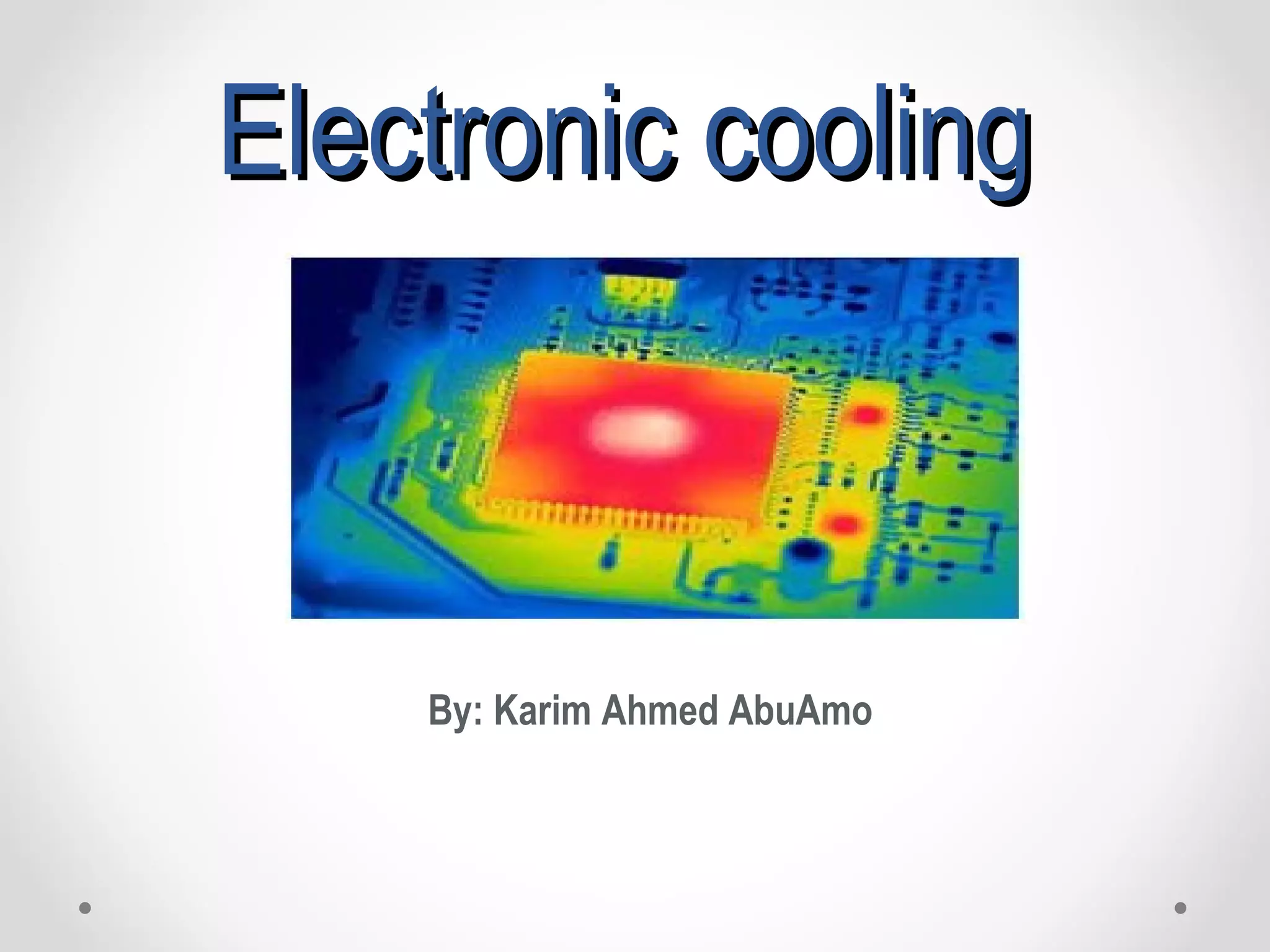
Electronic coolingElectronic cooling
By: Karim Ahmed AbuAmo
Contents:Contents:
• INTRODUCTION
• COOLING LOAD OF ELECTRONIC EQUIPMENT
• MANUFACTURING OF ELECTRONIC EQUIPMENT
• CONDUCTION COOLING
• AIR COOLING: NATURAL CONVECTION AND RADIATION
• AIR COOLING: FORCED CONVECTION
• LIQUID COOLING
• IMMERSION COOLING
• Electronic components depend on the passage of electric current to
perform their duties, and they become potential sites for excessive
heating, since the current flow through a resistance is accompanied
by heat generation.
• Continued miniaturization of electronic systems has resulted in a
dramatic increase in the amount of heat generated per unit volume
Introduction
• The failure rate of electronic equipment increases exponentially with
temperature
COOLING LOAD OF ELECTRONIC
EQUIPMENT
• The duty cycle is another important consideration in the design and
selection of a cooling technique.
1.The Chip Carrier
•The chip is housed in a chip carrier to protect its circuitry from the
effects of the environment.
•provides a rugged housing for the safe handling of the chip during the
manufacturing process, as well as the connectors between the chip and
the circuit board.
MANUFACTURING OF ELECTRONIC
EQUIPMENT
Conduction in Chip Carriers
• The design of the chip carrier is the first level in the thermal control of
electronic devices
• The heat generated at the junction spreads throughout the chip and
is conducted across the thickness of the chip
• Heat is then transported outside the electronic device through the
leads.
2. Printed Circuit Boards and heat frames
•the electronic components are placed on boards attached to a
conductive metal, called the heat frame, that serves as a conduction
path to the edge of the circuit board and thus to the cold plate for the
heat generated in the components.
•The power dissipated by a PCB usually ranges from 5 W to about 30
W.
Conduction in Printed Circuit Boards
• heat transfer along the epoxy laminate can be ignored relative to that
along the copper layer, since the thermal conductivity of copper is
about 1500 times that of epoxy.
Heat Frames
• In critical applications, the electronic components are placed on
boards attached to a conductive metal, called the heat frame, that
serves as a conduction path to the edge of the circuit board and thus
to the cold plate for the heat
• generated in the components.This is especially the case for
multilayer PCBs that are packed with high-power output chips.
• heat conduction in the epoxy layer of the PCB is
through its thickness instead of along its length. The
epoxy layer in this case offers a much smaller
resistance to heat flow because of the short
distance involved.
• This resistance can be made even smaller by drilling
holes in the epoxy and filling them with copper
The Thermal Conduction Module (TCM)
• The total internal thermal resistance R(int) of the TCM is about
8°C/W, which is rather impressive.
• The compact design of the TCM significantly reduces the distance
between the chips, and thus the signal transmission time between the
chips. This, in turn, increases the operating speed of the electronic
device.
• The chip is cooled by direct contact to the cooling system to minimize
the junction-to-case thermal resistance.
• The heat flow path from the chip to the metal casing is provided by a
piston, which is pressed against the back surface of the chip by a
spring.
• Heat conduction between the chip and the piston occurs primarily
through the gas space between the chip and the piston because of
the limited contact area between them. To maximize heat conduction
through the gas, the air in the TCM cavity is evacuated and is
replaced by helium gas, whose thermal conductivity is about six times
that of air. Heat is then conducted through the piston, across the
surrounding helium gas layer, through the module housing, and
finally to the cooling water circulating through the cold plate attached
to the top surface of the TCM.
• Electronic components or PCBs placed in enclosures such as a TV or
DVD player are cooled by natural convection by providing a sufficient
number of vents on the case to enable the cool air to enter and the
heated air to leave the case freely
AIR COOLING: NATURAL CONVECTION
AND RADIATION
• When hot surfaces are surrounded by cooler surfaces such as the
walls and ceilings of a room or just the sky, the surfaces are also
cooled by radiation
AIR COOLING: FORCED CONVECTION
• When natural convection cooling is not adequate, we simply add a
fan and blow air through the enclosure that houses the electronic
components.
• By doing so, we can increase the heat transfer coefficient by a factor
of up to about 10.
Fan Selection
• Variable-speed fans that automatically increase speed when the air
density decreases.
• The generally preferred location to place the fan is in the inlet.
LIQUID COOLING
• Liquids normally have much higher thermal conductivities than gases,
and thus much higher heat transfer coefficients associated with them.
Therefore, liquid cooling is far more effective than gas cooling.
• liquid cooling is reserved for applications involving power densities
that are too high for safe dissipation by air cooling.
• The liquids used in the cooling of electronic equipment must meet
several requirements, depending on the specific application.
Indirect cooling
• In indirect cooling systems, however, there is no direct contact with
the components. The heat generated in this case is first transferred to
a medium such as a cold plate before it is carried away by the liquid.
• The components in this case are mounted on a metal plate made of a
highly conducting material such as copper or aluminium. The metal
plate is cooled by circulating a cooling fluid through tubes attached to
it.
• The heated liquid is then cooled in a heat exchanger,usually by air (or
sea water in marine applications), and is recirculated by a pump
through the tubes.
IMMERSION COOLING
• High-power electronic components can be cooled effectively by
immersing them in a dielectric liquid and taking advantage of the very
high heat transfer coefficients associated with boiling.
A simple open-loop immersion cooling system.
• The open-loop-type immersion cooling system described here is
simple, but there are several impracticalities associated with it. First
of all, it is heavy and bulky because of the presence of an external
liquid reservoir, and the fluid lost through evaporation needs to be
replenished continually, which adds to the cost. Further, the release
of the vapor into the atmosphere greatly limits the fluids that can be
used in such a system. Therefore, the use of open-loop immersion
systems is limited to applications that involve occasional use and
thus have a light duty cycle.
• More sophisticated immersion cooling systems operate in a closed
loop in that the vapor is condensed and returned to the electronic
enclosure instead of being purged to the atmosphere.
• The performance of closed-loop immersion cooling systems is most
susceptible to the presence of noncondensable gases such as air in
the vapor space.
• The problems associated with the condensation process and
noncondensable gases can be avoided by submerging the condenser
(actually, heat exchanger tubes in this case) in the liquid instead of
the vapor in the electronic enclosure.
• A step further in the all-liquid immersion cooling systems is to remove
the heat from the dielectric liquid directly from the outer surface of the
electronics enclosure
• Typical ranges of heat transfer coefficients for various dielectric fluids
suitable for use in the cooling of electronic equipment
• Fluorocarbon fluids have boiling points ranging from 30°C to 174°C
and freezing points below 50°C. They are nonflammable, chemically
inert, and highly compatible with materials used in electronic
equipment.
• Experimental results for the power dissipation of a chip having a heat
transfer area of 0.457 cm2 and its substrate during immersion cooling
in an FC86 bath
• The FC86 liquid is maintained at a bulk temperature of 5°C during
the experiments by the use of a heat exchanger.
• Heat transfer from the chip is by natural convection in regime A–B,
and bubble formation and thus boiling begins in regime B–C. Note
that the chip surface temperature suddenly drops with the onset of
boiling because of the high heat transfer coefficients associated with
boiling. Heat transfer is by nucleate boiling in regime C–D, and very
high heat transfer rates can be achieved in this regime with relatively
small temperature differences.
ThanksThanks

Electronic cooling

  • 1.
  • 2.
    Contents:Contents: • INTRODUCTION • COOLINGLOAD OF ELECTRONIC EQUIPMENT • MANUFACTURING OF ELECTRONIC EQUIPMENT • CONDUCTION COOLING • AIR COOLING: NATURAL CONVECTION AND RADIATION • AIR COOLING: FORCED CONVECTION • LIQUID COOLING • IMMERSION COOLING
  • 3.
    • Electronic componentsdepend on the passage of electric current to perform their duties, and they become potential sites for excessive heating, since the current flow through a resistance is accompanied by heat generation. • Continued miniaturization of electronic systems has resulted in a dramatic increase in the amount of heat generated per unit volume Introduction
  • 5.
    • The failurerate of electronic equipment increases exponentially with temperature
  • 6.
    COOLING LOAD OFELECTRONIC EQUIPMENT
  • 7.
    • The dutycycle is another important consideration in the design and selection of a cooling technique.
  • 8.
    1.The Chip Carrier •Thechip is housed in a chip carrier to protect its circuitry from the effects of the environment. •provides a rugged housing for the safe handling of the chip during the manufacturing process, as well as the connectors between the chip and the circuit board. MANUFACTURING OF ELECTRONIC EQUIPMENT
  • 9.
    Conduction in ChipCarriers • The design of the chip carrier is the first level in the thermal control of electronic devices • The heat generated at the junction spreads throughout the chip and is conducted across the thickness of the chip • Heat is then transported outside the electronic device through the leads.
  • 10.
    2. Printed CircuitBoards and heat frames •the electronic components are placed on boards attached to a conductive metal, called the heat frame, that serves as a conduction path to the edge of the circuit board and thus to the cold plate for the heat generated in the components. •The power dissipated by a PCB usually ranges from 5 W to about 30 W.
  • 11.
    Conduction in PrintedCircuit Boards • heat transfer along the epoxy laminate can be ignored relative to that along the copper layer, since the thermal conductivity of copper is about 1500 times that of epoxy.
  • 12.
    Heat Frames • Incritical applications, the electronic components are placed on boards attached to a conductive metal, called the heat frame, that serves as a conduction path to the edge of the circuit board and thus to the cold plate for the heat • generated in the components.This is especially the case for multilayer PCBs that are packed with high-power output chips.
  • 13.
    • heat conductionin the epoxy layer of the PCB is through its thickness instead of along its length. The epoxy layer in this case offers a much smaller resistance to heat flow because of the short distance involved. • This resistance can be made even smaller by drilling holes in the epoxy and filling them with copper
  • 14.
    The Thermal ConductionModule (TCM) • The total internal thermal resistance R(int) of the TCM is about 8°C/W, which is rather impressive. • The compact design of the TCM significantly reduces the distance between the chips, and thus the signal transmission time between the chips. This, in turn, increases the operating speed of the electronic device.
  • 15.
    • The chipis cooled by direct contact to the cooling system to minimize the junction-to-case thermal resistance. • The heat flow path from the chip to the metal casing is provided by a piston, which is pressed against the back surface of the chip by a spring. • Heat conduction between the chip and the piston occurs primarily through the gas space between the chip and the piston because of the limited contact area between them. To maximize heat conduction through the gas, the air in the TCM cavity is evacuated and is replaced by helium gas, whose thermal conductivity is about six times that of air. Heat is then conducted through the piston, across the surrounding helium gas layer, through the module housing, and finally to the cooling water circulating through the cold plate attached to the top surface of the TCM.
  • 16.
    • Electronic componentsor PCBs placed in enclosures such as a TV or DVD player are cooled by natural convection by providing a sufficient number of vents on the case to enable the cool air to enter and the heated air to leave the case freely AIR COOLING: NATURAL CONVECTION AND RADIATION
  • 17.
    • When hotsurfaces are surrounded by cooler surfaces such as the walls and ceilings of a room or just the sky, the surfaces are also cooled by radiation
  • 18.
    AIR COOLING: FORCEDCONVECTION • When natural convection cooling is not adequate, we simply add a fan and blow air through the enclosure that houses the electronic components. • By doing so, we can increase the heat transfer coefficient by a factor of up to about 10.
  • 19.
    Fan Selection • Variable-speedfans that automatically increase speed when the air density decreases. • The generally preferred location to place the fan is in the inlet.
  • 20.
    LIQUID COOLING • Liquidsnormally have much higher thermal conductivities than gases, and thus much higher heat transfer coefficients associated with them. Therefore, liquid cooling is far more effective than gas cooling. • liquid cooling is reserved for applications involving power densities that are too high for safe dissipation by air cooling. • The liquids used in the cooling of electronic equipment must meet several requirements, depending on the specific application. Indirect cooling • In indirect cooling systems, however, there is no direct contact with the components. The heat generated in this case is first transferred to a medium such as a cold plate before it is carried away by the liquid.
  • 21.
    • The componentsin this case are mounted on a metal plate made of a highly conducting material such as copper or aluminium. The metal plate is cooled by circulating a cooling fluid through tubes attached to it. • The heated liquid is then cooled in a heat exchanger,usually by air (or sea water in marine applications), and is recirculated by a pump through the tubes.
  • 22.
    IMMERSION COOLING • High-powerelectronic components can be cooled effectively by immersing them in a dielectric liquid and taking advantage of the very high heat transfer coefficients associated with boiling. A simple open-loop immersion cooling system.
  • 23.
    • The open-loop-typeimmersion cooling system described here is simple, but there are several impracticalities associated with it. First of all, it is heavy and bulky because of the presence of an external liquid reservoir, and the fluid lost through evaporation needs to be replenished continually, which adds to the cost. Further, the release of the vapor into the atmosphere greatly limits the fluids that can be used in such a system. Therefore, the use of open-loop immersion systems is limited to applications that involve occasional use and thus have a light duty cycle.
  • 24.
    • More sophisticatedimmersion cooling systems operate in a closed loop in that the vapor is condensed and returned to the electronic enclosure instead of being purged to the atmosphere. • The performance of closed-loop immersion cooling systems is most susceptible to the presence of noncondensable gases such as air in the vapor space.
  • 25.
    • The problemsassociated with the condensation process and noncondensable gases can be avoided by submerging the condenser (actually, heat exchanger tubes in this case) in the liquid instead of the vapor in the electronic enclosure. • A step further in the all-liquid immersion cooling systems is to remove the heat from the dielectric liquid directly from the outer surface of the electronics enclosure
  • 26.
    • Typical rangesof heat transfer coefficients for various dielectric fluids suitable for use in the cooling of electronic equipment • Fluorocarbon fluids have boiling points ranging from 30°C to 174°C and freezing points below 50°C. They are nonflammable, chemically inert, and highly compatible with materials used in electronic equipment.
  • 27.
    • Experimental resultsfor the power dissipation of a chip having a heat transfer area of 0.457 cm2 and its substrate during immersion cooling in an FC86 bath
  • 28.
    • The FC86liquid is maintained at a bulk temperature of 5°C during the experiments by the use of a heat exchanger. • Heat transfer from the chip is by natural convection in regime A–B, and bubble formation and thus boiling begins in regime B–C. Note that the chip surface temperature suddenly drops with the onset of boiling because of the high heat transfer coefficients associated with boiling. Heat transfer is by nucleate boiling in regime C–D, and very high heat transfer rates can be achieved in this regime with relatively small temperature differences.
  • 29.