BAHIR DAR UNIVERSITY
ETHIOPIAN INSTITUTE OF TEXTILE AND
FASHION TECHNOLOGY
EiTEX
Advanced Knitted Fabric Manufacturing
seminar on
Electronic Controls in warp and weft knitting.
Prepared By: Biruk Fentahun
Submitted To: Dr. Kaathirrvelu (Prof )
Juan/2015
1
contents
1. Introduction
2. Advantages of electronic control and programming
3. Application areas of electronics in knitting
4. Microprocessors and computers
5. computerized knitting machine
2
Introduction
• Initially Knitting machines have developed
with mechanically controlled and operated
movements.
• requirements of modern knitting technology,
however, emphasize on limitations of
mechanical movements which are expensive
to manufacture, slow and cumbersome in
operation, difficult to adjust or alter, and
subject to friction and wear.
3
Cont…
Mechanical pattern and
programming data for
controlling knitting machines is
stored in the form of
punched cards, chains, rack-
wheels, peg drums, and element
butt arrangements.
expensive in material, bulky in space on machine or
in storage, time-consuming to handle and alter, slow
in operation, and provide restricted facilities.
4
Advantages of electronic control and programming
convenient power-supply, compatibility with existing mechanical
components
do not require to be of a size proportionate to their task or to operate on a
one-to-one relationship with it.
Electronic selection or machine control is compatible with higher running
speeds and eliminates complex mechanical arrangements, thus reducing
supervisory requirements.
provides greater versatility as regards design parameters,
Simplifies modification of repeat sequences and size, style and pattern-
changing operations
Less response time
Very high capacity
Highly sensitive
Automatic monitoring
High adjusting facility
Easy to transport
Less power consumption
5
compatibility of electronic signals and knitting data
• Electronic devices process information as binary digital logic
signals that exist in two states, ON or OFF. directly translated
as 1 or 0, YES or NO, TRUE or FALSE, or magnetic ATTRACTION
or REPULSION.
• This information can just as conveniently be translated into
knitting states such as KNIT or TUCK, TUCK or MISS.
• The binary digits can be arranged in the form of a programme
where they can be encoded and converted into symbols to
compose, for example, a knitting design or a machine
programme.
6
Fields of applications Electronics in knitting
● Stop motions
● Yarn feed system
● Course and stitch length
● Yarn tension
● Pattern selection
● Stripping
● Shaping of product
● Monitoring of various motions and settings
● Cylinder temperature and oil pressure
● Online quality measurement and control
● Operational data acquisition
● Preparation of design and knitting pattern (CAD)
● Production of knitted structures (CAM)
7
Microprocessors and computers
The most important use of electronics is in microprocessor
and computer systems.
A computer can receive, store, retrieve, and communicate
enormous quantities of information at phenomenal speeds.
It can also manipulate, rearrange, select, and transform this
information. It performs arithmetical or logical processes
accurately at high speed after receiving the instructions
(programm) and values (data) without the need for further
intervention by the operator.
Flexibility in processing of data b/c system can be
programmed to produce YES or NO decisions, based on the
result of comparing and testing monitored data, that then
determine the choice of two alternative courses of action in
the program of the system. These alternative courses
within the main program sequence may include counted
loop sequences, branching or jumping out of the main
sequence, and selection of stored sub-routines.
8
Cont…
It is these facilities that give electronically-
controlled knitting pattern preparation and
needle selection their extensive capabilities as
compared with previously available methods.
Although it is possible to directly program a
system using switches, a matrix board, a
keyboard or another input device, the processor
(and probably the knitting machine) will be held
waiting during this time-consuming operation.
It is therefore preferable to record the program
and data in an auxiliary memory store such as a
tape or disc.
9
computerized knitting machine
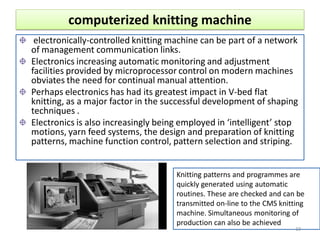
electronically-controlled knitting machine can be part of a network
of management communication links.
Electronics increasing automatic monitoring and adjustment
facilities provided by microprocessor control on modern machines
obviates the need for continual manual attention.
Perhaps electronics has had its greatest impact in V-bed flat
knitting, as a major factor in the successful development of shaping
techniques .
Electronics is also increasingly being employed in ‘intelligent’ stop
motions, yarn feed systems, the design and preparation of knitting
patterns, machine function control, pattern selection and striping.
Knitting patterns and programmes are
quickly generated using automatic
routines. These are checked and can be
transmitted on-line to the CMS knitting
machine. Simultaneous monitoring of
production can also be achieved
10
C.M.C machine
first knitting machine with an integrated computer
controlled carriage driving system. With this system it is
neither compulsory to move the carriage from one side of
the needle bed to the other, nor is it necessary to drive it in
a constant reciprocating movement.
According to knitting programme, carriage can be moved to
any location along the needle bed and reciprocate over a
varying number of needles for as many courses as are
required by the design.
When the knitting process for a certain area is completed,
the carriage can be driven in any direction to a new
location.
two main advantages of this system are:
• 1. Patterning scope is enlarged.
• 2. Productivity is improved to a high extent.
11
Stop motions
I To stop the machine when any yarn breaks
 number of stop motions in a machine is equal to number of feeders, i.e.
presence of every feed yarn is individually detected and action is taken to stop
the machine when the same is either broken or subjected to very high tension
variation.
II. To stop the machine when loops of a needle are not cleared for a few
consecutive knitting cycles due to some other faults in the machine
 fitted over needles maintaining a slight gap with cloth fell at a regular interval
on circular knitting machines.
 knife just placed over cloth forming zone acts as a sensor.
 The knife also opens and closes an electrical circuit according to its position.
During normal running of the machine, the knife keeps the relevant electrical
circuit open.
 When due to some fault in the machine, a particular needle does not clear
loops for a few consecutive cycles, that zone of the fabric is raised and pushes
the knife above it. This up position of the knife closes the relevant electrical
circuit and stops the machine.
12
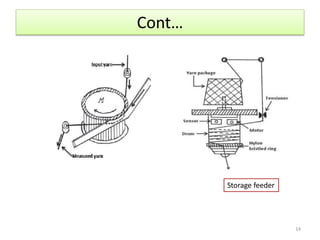
Yarn feeding
• Positive Feeding – In case of positive feeding,
yarn is first measured according to requirement
and then supplied to the needle or knitting
zone.
• This technique makes it possible to supply
equal length of yarn in all the feeds and
maintain uniform tension of the input yarn. As
a result uniform loop length and better quality
of fabric are obtained.
13
Cont…
14
Storage feeder
Electronic needle selection
Used both warp and weft knitting.
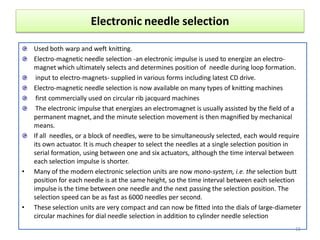
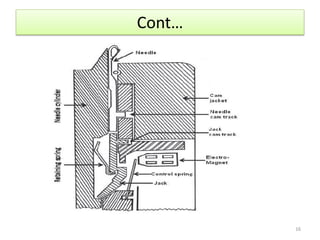
Electro-magnetic needle selection -an electronic impulse is used to energize an electro-
magnet which ultimately selects and determines position of needle during loop formation.
input to electro-magnets- supplied in various forms including latest CD drive.
Electro-magnetic needle selection is now available on many types of knitting machines
first commercially used on circular rib jacquard machines
The electronic impulse that energizes an electromagnet is usually assisted by the field of a
permanent magnet, and the minute selection movement is then magnified by mechanical
means.
If all needles, or a block of needles, were to be simultaneously selected, each would require
its own actuator. It is much cheaper to select the needles at a single selection position in
serial formation, using between one and six actuators, although the time interval between
each selection impulse is shorter.
• Many of the modern electronic selection units are now mono-system, i.e. the selection butt
position for each needle is at the same height, so the time interval between each selection
impulse is the time between one needle and the next passing the selection position. The
selection speed can be as fast as 6000 needles per second.
• These selection units are very compact and can now be fitted into the dials of large-diameter
circular machines for dial needle selection in addition to cylinder needle selection
15
Cont…
16
Needle selection shaping
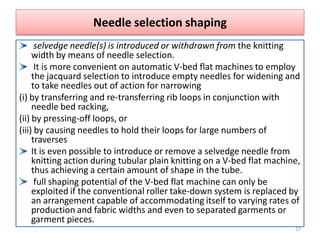
selvedge needle(s) is introduced or withdrawn from the knitting
width by means of needle selection.
It is more convenient on automatic V-bed flat machines to employ
the jacquard selection to introduce empty needles for widening and
to take needles out of action for narrowing
(i) by transferring and re-transferring rib loops in conjunction with
needle bed racking,
(ii) by pressing-off loops, or
(iii) by causing needles to hold their loops for large numbers of
traverses
It is even possible to introduce or remove a selvedge needle from
knitting action during tubular plain knitting on a V-bed flat machine,
thus achieving a certain amount of shape in the tube.
full shaping potential of the V-bed flat machine can only be
exploited if the conventional roller take-down system is replaced by
an arrangement capable of accommodating itself to varying rates of
production and fabric widths and even to separated garments or
garment pieces.
17
The shaping control programme-on flat knitting
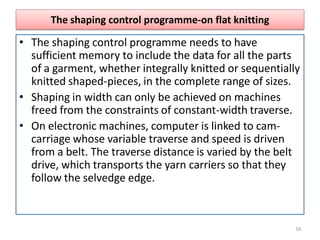
• The shaping control programme needs to have
sufficient memory to include the data for all the parts
of a garment, whether integrally knitted or sequentially
knitted shaped-pieces, in the complete range of sizes.
• Shaping in width can only be achieved on machines
freed from the constraints of constant-width traverse.
• On electronic machines, computer is linked to cam-
carriage whose variable traverse and speed is driven
from a belt. The traverse distance is varied by the belt
drive, which transports the yarn carriers so that they
follow the selvedge edge.
18
Control of the fabric during knitting
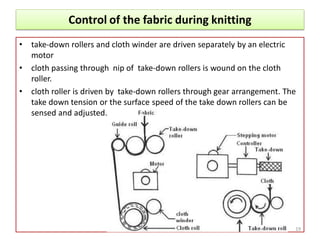
• take-down rollers and cloth winder are driven separately by an electric
motor
• cloth passing through nip of take-down rollers is wound on the cloth
roller.
• cloth roller is driven by take-down rollers through gear arrangement. The
take down tension or the surface speed of the take down rollers can be
sensed and adjusted. with the help of facility available in the control p
19
Cont…
On flat knitting
• Shima have a new computer-controlled pull-down
system for their FIRST Whole-Garment machines.
• front and back of garment each has a separate
takedown panel of tiny pins, each section of
which can be individually controlled for specific
tension.
• This results in a more dimensionally-accurate
garment; for example by allowing shoulder lines
for set-in sleeves to be positioned over the
shoulders and towards the back.
20

Electronic controls in knitting

  • 1.
    BAHIR DAR UNIVERSITY ETHIOPIANINSTITUTE OF TEXTILE AND FASHION TECHNOLOGY EiTEX Advanced Knitted Fabric Manufacturing seminar on Electronic Controls in warp and weft knitting. Prepared By: Biruk Fentahun Submitted To: Dr. Kaathirrvelu (Prof ) Juan/2015 1
  • 2.
    contents 1. Introduction 2. Advantagesof electronic control and programming 3. Application areas of electronics in knitting 4. Microprocessors and computers 5. computerized knitting machine 2
  • 3.
    Introduction • Initially Knittingmachines have developed with mechanically controlled and operated movements. • requirements of modern knitting technology, however, emphasize on limitations of mechanical movements which are expensive to manufacture, slow and cumbersome in operation, difficult to adjust or alter, and subject to friction and wear. 3
  • 4.
    Cont… Mechanical pattern and programmingdata for controlling knitting machines is stored in the form of punched cards, chains, rack- wheels, peg drums, and element butt arrangements. expensive in material, bulky in space on machine or in storage, time-consuming to handle and alter, slow in operation, and provide restricted facilities. 4
  • 5.
    Advantages of electroniccontrol and programming convenient power-supply, compatibility with existing mechanical components do not require to be of a size proportionate to their task or to operate on a one-to-one relationship with it. Electronic selection or machine control is compatible with higher running speeds and eliminates complex mechanical arrangements, thus reducing supervisory requirements. provides greater versatility as regards design parameters, Simplifies modification of repeat sequences and size, style and pattern- changing operations Less response time Very high capacity Highly sensitive Automatic monitoring High adjusting facility Easy to transport Less power consumption 5
  • 6.
    compatibility of electronicsignals and knitting data • Electronic devices process information as binary digital logic signals that exist in two states, ON or OFF. directly translated as 1 or 0, YES or NO, TRUE or FALSE, or magnetic ATTRACTION or REPULSION. • This information can just as conveniently be translated into knitting states such as KNIT or TUCK, TUCK or MISS. • The binary digits can be arranged in the form of a programme where they can be encoded and converted into symbols to compose, for example, a knitting design or a machine programme. 6
  • 7.
    Fields of applicationsElectronics in knitting ● Stop motions ● Yarn feed system ● Course and stitch length ● Yarn tension ● Pattern selection ● Stripping ● Shaping of product ● Monitoring of various motions and settings ● Cylinder temperature and oil pressure ● Online quality measurement and control ● Operational data acquisition ● Preparation of design and knitting pattern (CAD) ● Production of knitted structures (CAM) 7
  • 8.
    Microprocessors and computers Themost important use of electronics is in microprocessor and computer systems. A computer can receive, store, retrieve, and communicate enormous quantities of information at phenomenal speeds. It can also manipulate, rearrange, select, and transform this information. It performs arithmetical or logical processes accurately at high speed after receiving the instructions (programm) and values (data) without the need for further intervention by the operator. Flexibility in processing of data b/c system can be programmed to produce YES or NO decisions, based on the result of comparing and testing monitored data, that then determine the choice of two alternative courses of action in the program of the system. These alternative courses within the main program sequence may include counted loop sequences, branching or jumping out of the main sequence, and selection of stored sub-routines. 8
  • 9.
    Cont… It is thesefacilities that give electronically- controlled knitting pattern preparation and needle selection their extensive capabilities as compared with previously available methods. Although it is possible to directly program a system using switches, a matrix board, a keyboard or another input device, the processor (and probably the knitting machine) will be held waiting during this time-consuming operation. It is therefore preferable to record the program and data in an auxiliary memory store such as a tape or disc. 9
  • 10.
    computerized knitting machine electronically-controlledknitting machine can be part of a network of management communication links. Electronics increasing automatic monitoring and adjustment facilities provided by microprocessor control on modern machines obviates the need for continual manual attention. Perhaps electronics has had its greatest impact in V-bed flat knitting, as a major factor in the successful development of shaping techniques . Electronics is also increasingly being employed in ‘intelligent’ stop motions, yarn feed systems, the design and preparation of knitting patterns, machine function control, pattern selection and striping. Knitting patterns and programmes are quickly generated using automatic routines. These are checked and can be transmitted on-line to the CMS knitting machine. Simultaneous monitoring of production can also be achieved 10
  • 11.
    C.M.C machine first knittingmachine with an integrated computer controlled carriage driving system. With this system it is neither compulsory to move the carriage from one side of the needle bed to the other, nor is it necessary to drive it in a constant reciprocating movement. According to knitting programme, carriage can be moved to any location along the needle bed and reciprocate over a varying number of needles for as many courses as are required by the design. When the knitting process for a certain area is completed, the carriage can be driven in any direction to a new location. two main advantages of this system are: • 1. Patterning scope is enlarged. • 2. Productivity is improved to a high extent. 11
  • 12.
    Stop motions I Tostop the machine when any yarn breaks  number of stop motions in a machine is equal to number of feeders, i.e. presence of every feed yarn is individually detected and action is taken to stop the machine when the same is either broken or subjected to very high tension variation. II. To stop the machine when loops of a needle are not cleared for a few consecutive knitting cycles due to some other faults in the machine  fitted over needles maintaining a slight gap with cloth fell at a regular interval on circular knitting machines.  knife just placed over cloth forming zone acts as a sensor.  The knife also opens and closes an electrical circuit according to its position. During normal running of the machine, the knife keeps the relevant electrical circuit open.  When due to some fault in the machine, a particular needle does not clear loops for a few consecutive cycles, that zone of the fabric is raised and pushes the knife above it. This up position of the knife closes the relevant electrical circuit and stops the machine. 12
  • 13.
    Yarn feeding • PositiveFeeding – In case of positive feeding, yarn is first measured according to requirement and then supplied to the needle or knitting zone. • This technique makes it possible to supply equal length of yarn in all the feeds and maintain uniform tension of the input yarn. As a result uniform loop length and better quality of fabric are obtained. 13
  • 14.
  • 15.
    Electronic needle selection Usedboth warp and weft knitting. Electro-magnetic needle selection -an electronic impulse is used to energize an electro- magnet which ultimately selects and determines position of needle during loop formation. input to electro-magnets- supplied in various forms including latest CD drive. Electro-magnetic needle selection is now available on many types of knitting machines first commercially used on circular rib jacquard machines The electronic impulse that energizes an electromagnet is usually assisted by the field of a permanent magnet, and the minute selection movement is then magnified by mechanical means. If all needles, or a block of needles, were to be simultaneously selected, each would require its own actuator. It is much cheaper to select the needles at a single selection position in serial formation, using between one and six actuators, although the time interval between each selection impulse is shorter. • Many of the modern electronic selection units are now mono-system, i.e. the selection butt position for each needle is at the same height, so the time interval between each selection impulse is the time between one needle and the next passing the selection position. The selection speed can be as fast as 6000 needles per second. • These selection units are very compact and can now be fitted into the dials of large-diameter circular machines for dial needle selection in addition to cylinder needle selection 15
  • 16.
  • 17.
    Needle selection shaping selvedgeneedle(s) is introduced or withdrawn from the knitting width by means of needle selection. It is more convenient on automatic V-bed flat machines to employ the jacquard selection to introduce empty needles for widening and to take needles out of action for narrowing (i) by transferring and re-transferring rib loops in conjunction with needle bed racking, (ii) by pressing-off loops, or (iii) by causing needles to hold their loops for large numbers of traverses It is even possible to introduce or remove a selvedge needle from knitting action during tubular plain knitting on a V-bed flat machine, thus achieving a certain amount of shape in the tube. full shaping potential of the V-bed flat machine can only be exploited if the conventional roller take-down system is replaced by an arrangement capable of accommodating itself to varying rates of production and fabric widths and even to separated garments or garment pieces. 17
  • 18.
    The shaping controlprogramme-on flat knitting • The shaping control programme needs to have sufficient memory to include the data for all the parts of a garment, whether integrally knitted or sequentially knitted shaped-pieces, in the complete range of sizes. • Shaping in width can only be achieved on machines freed from the constraints of constant-width traverse. • On electronic machines, computer is linked to cam- carriage whose variable traverse and speed is driven from a belt. The traverse distance is varied by the belt drive, which transports the yarn carriers so that they follow the selvedge edge. 18
  • 19.
    Control of thefabric during knitting • take-down rollers and cloth winder are driven separately by an electric motor • cloth passing through nip of take-down rollers is wound on the cloth roller. • cloth roller is driven by take-down rollers through gear arrangement. The take down tension or the surface speed of the take down rollers can be sensed and adjusted. with the help of facility available in the control p 19
  • 20.
    Cont… On flat knitting •Shima have a new computer-controlled pull-down system for their FIRST Whole-Garment machines. • front and back of garment each has a separate takedown panel of tiny pins, each section of which can be individually controlled for specific tension. • This results in a more dimensionally-accurate garment; for example by allowing shoulder lines for set-in sleeves to be positioned over the shoulders and towards the back. 20