Electronic Components
A brief tour.
Conductors
-A low resistance path
 for current to flow.
-Insulated by plastic.
-Diameter expressed by a
 “gauge”.
  - Larger gauge = smaller wire

-Solid or Stranded
Switches
- Interrupt the flow of current,
  mechanically
- Characterized by the number of “poles”
  and
“throws”

                   Single Pole, Single Throw


                    Single Pole, Double Throw


-“momentary” vs. “toggle”
Other examples: Tilt Switches
Resistors
-Conductive material that impedes current
flow.
-Converts electrical energy into heat
energy
-Typical Power rating: 1/4 to 2 Watts
-Color Bands on the resister tell you the
value


   Symbol
Resister Color Band Chart
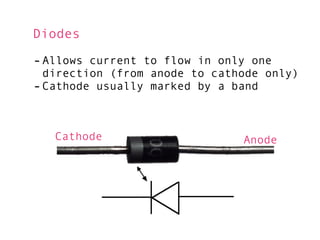
Diodes

- Allows current to flow in only one
  direction (from anode to cathode only)
- Cathode usually marked by a band


   Cathode                     Anode
Light Emitting Diodes (LED)
-Converts electrical energy into light
-Directional (anode and cathode)
-Requires a nominal 0.6V to work (barely).
-Prefers 1.6–2V for optimal awesomeness.


“Short things are closer to the ground”
Usefulness of LEDs
-Power Indicator
-Fun Displays, lighting, way-finding.
-Trouble-shooting / pin status
How do we connect these parts??
Using a solderless breadboard.
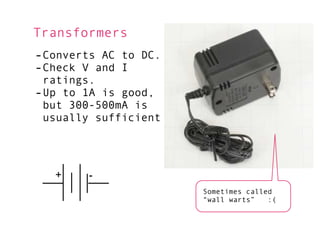
Transformers
-Converts AC to DC.
-Check V and I
 ratings.
-Up to 1A is good,
 but 300-500mA is
 usually sufficient


   +    -
                      Sometimes called
                      “wall warts”   :(
Reading Diagrams:
These are identical


                      +9V

               R1     R1 = 470Ω

+9V
Lighting em up!


                      R1 = 470 ohms
         +9V


         GND


               BUILD IT!
Add a switch


               R1 = 470 ohms
        +9V

        GND
YEAH!
Transistors
-A type of “semiconductor” --
 The heart of modern computing.
 Diodes, LEDs and
 microprocessors are all types
 of semiconductors.
-Can be used as a SWITCH or an
 AMPLIFIER.
-Processor chips are lots and
 lots of transistors in one
 package.
-Transistors have three leads -
 the BASE, COLLECTOR and
 EMITTER.
Bild 61. «Wasser-Transister» leitender Zu-stand
NPN vs PNP
-NPN. If the base is at a higher voltage
than the emitter, current flows from
collector to emitter.
-NPN. Voltage at base controls amount of
current flow through transistor
(collector to emitter).
= 380

                             9V


Bridge the gap
with your fingers!

Warning: Don’t
connect with a
wire...
Capacitors
   -Caps can store and release voltage
   -When connected to DC voltage, the
    capacitor “pulls” and stores voltage.
   -They hold charge when disconnected from
    power supply.
   -When given the opportunity, they release
    the stored voltage.

                               Electrolytic
Ceramic Caps
                               Caps
-Amount of charge a capacitor can hold
 is measured in Farads.
-1 Farad is equal to 1 amp of current
 at 1 volt for 1 second.
-1 Farad is a lot of charge. Capacitors
 we work with are typically measured in
 Micro Farads (µF ) and Pico Farads
 (pF).
Capacitor Lab


  +9V
Circuits in SERIES
-Components connect end-to-end
-Single path for electrons to flow
-All components share the same current
-Total Resistance of the circuit is equal
 to sum of individual resisters.
-Total Voltage of the circuit equal to all
 the individual “voltage drops”
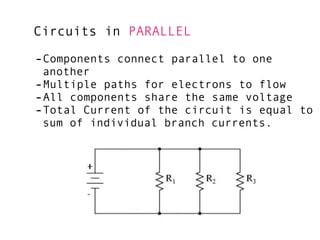
Circuits in PARALLEL

-Components connect parallel to one
 another
-Multiple paths for electrons to flow
-All components share the same voltage
-Total Current of the circuit is equal to
 sum of individual branch currents.
Batteries in SERIES     +       -       +   -

Double the Voltage
Same Current


Batteries in PARALLEL
                            +       +
Double the Current
Same Voltage                -       -

Electronic Components

  • 1.
  • 2.
    Conductors -A low resistancepath for current to flow. -Insulated by plastic. -Diameter expressed by a “gauge”. - Larger gauge = smaller wire -Solid or Stranded
  • 3.
    Switches - Interrupt theflow of current, mechanically - Characterized by the number of “poles” and “throws” Single Pole, Single Throw Single Pole, Double Throw -“momentary” vs. “toggle”
  • 5.
  • 6.
    Resistors -Conductive material thatimpedes current flow. -Converts electrical energy into heat energy -Typical Power rating: 1/4 to 2 Watts -Color Bands on the resister tell you the value Symbol
  • 7.
  • 8.
    Diodes - Allows currentto flow in only one direction (from anode to cathode only) - Cathode usually marked by a band Cathode Anode
  • 9.
    Light Emitting Diodes(LED) -Converts electrical energy into light -Directional (anode and cathode) -Requires a nominal 0.6V to work (barely). -Prefers 1.6–2V for optimal awesomeness. “Short things are closer to the ground”
  • 10.
    Usefulness of LEDs -PowerIndicator -Fun Displays, lighting, way-finding. -Trouble-shooting / pin status
  • 11.
    How do weconnect these parts?? Using a solderless breadboard.
  • 14.
    Transformers -Converts AC toDC. -Check V and I ratings. -Up to 1A is good, but 300-500mA is usually sufficient + - Sometimes called “wall warts” :(
  • 15.
    Reading Diagrams: These areidentical +9V R1 R1 = 470Ω +9V
  • 16.
    Lighting em up! R1 = 470 ohms +9V GND BUILD IT!
  • 17.
    Add a switch R1 = 470 ohms +9V GND
  • 18.
  • 19.
    Transistors -A type of“semiconductor” -- The heart of modern computing. Diodes, LEDs and microprocessors are all types of semiconductors. -Can be used as a SWITCH or an AMPLIFIER. -Processor chips are lots and lots of transistors in one package. -Transistors have three leads - the BASE, COLLECTOR and EMITTER.
  • 21.
  • 22.
    NPN vs PNP -NPN.If the base is at a higher voltage than the emitter, current flows from collector to emitter. -NPN. Voltage at base controls amount of current flow through transistor (collector to emitter).
  • 23.
    = 380 9V Bridge the gap with your fingers! Warning: Don’t connect with a wire...
  • 24.
    Capacitors -Caps can store and release voltage -When connected to DC voltage, the capacitor “pulls” and stores voltage. -They hold charge when disconnected from power supply. -When given the opportunity, they release the stored voltage. Electrolytic Ceramic Caps Caps
  • 26.
    -Amount of chargea capacitor can hold is measured in Farads. -1 Farad is equal to 1 amp of current at 1 volt for 1 second. -1 Farad is a lot of charge. Capacitors we work with are typically measured in Micro Farads (µF ) and Pico Farads (pF).
  • 27.
  • 28.
    Circuits in SERIES -Componentsconnect end-to-end -Single path for electrons to flow -All components share the same current -Total Resistance of the circuit is equal to sum of individual resisters. -Total Voltage of the circuit equal to all the individual “voltage drops”
  • 29.
    Circuits in PARALLEL -Componentsconnect parallel to one another -Multiple paths for electrons to flow -All components share the same voltage -Total Current of the circuit is equal to sum of individual branch currents.
  • 30.
    Batteries in SERIES + - + - Double the Voltage Same Current Batteries in PARALLEL + + Double the Current Same Voltage - -

Editor's Notes