1
Electronic Components
2
Resistor
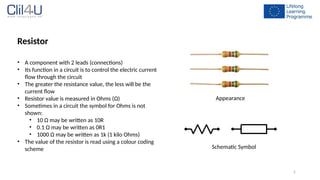
• A component with 2 leads (connections)
• Its function in a circuit is to control the electric current
flow through the circuit
• The greater the resistance value, the less will be the
current flow
• Resistor value is measured in Ohms (Ω)
• Sometimes in a circuit the symbol for Ohms is not
shown:
• 10 Ω may be written as 10R
• 0.1 Ω may be written as 0R1
• 1000 Ω may be written as 1k (1 kilo Ohms)
• The value of the resistor is read using a colour coding
scheme
Appearance
Schematic Symbol
3
4
Resistor Colour Coding:
5
Light Dependent Resistor (L.D.R.)
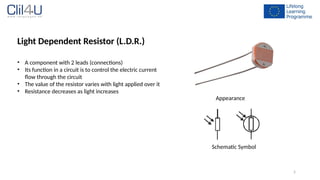
• A component with 2 leads (connections)
• Its function in a circuit is to control the electric current
flow through the circuit
• The value of the resistor varies with light applied over it
• Resistance decreases as light increases
Appearance
Schematic Symbol
6
Capacitor
• A component with 2 leads (connections)
• Its function in a circuit is to charge up to a voltage, hence
storing electrical charge (energy)
• Capacitor value is measured in Farads (F)
• Capacitors usually have a very low capacitance value:
• 0.000001 F is given as 1 µF (µ = micro = 1 x 10⁶
)
• 0.000000001 F is given as 1 nF (n = nano = 1 x 10⁹
)
• 0.000000000001 F is given as 1 pF (p = pico = 1 x 10¹²
)
• The value of the capacitor is read using a number coding
scheme
Appearance
Schematic Symbol
7
Reading Capacitor Value:
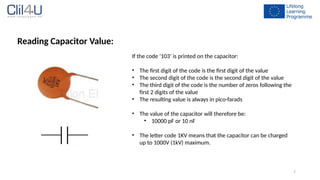
If the code ‘103’ is printed on the capacitor:
• The first digit of the code is the first digit of the value
• The second digit of the code is the second digit of the value
• The third digit of the code is the number of zeros following the
first 2 digits of the value
• The resulting value is always in pico-farads
• The value of the capacitor will therefore be:
• 10000 pF or 10 nF
• The letter code 1KV means that the capacitor can be charged
up to 1000V (1kV) maximum.
8
Polarized Capacitor
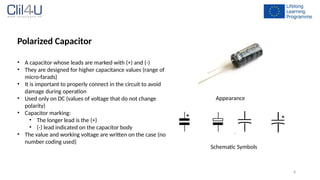
• A capacitor whose leads are marked with (+) and (-)
• They are designed for higher capacitance values (range of
micro-farads)
• It is important to properly connect in the circuit to avoid
damage during operation
• Used only on DC (values of voltage that do not change
polarity)
• Capacitor marking:
• The longer lead is the (+)
• (-) lead indicated on the capacitor body
• The value and working voltage are written on the case (no
number coding used)
Appearance
Schematic Symbols
9
Diode
• A component with 2 leads (connections)
• The connections are named ANODE and CATHODE
• Its function in a circuit is to control the direction of
electric current flow through the circuit
• When a DC voltage is applied across a diode:
• current will be allowed to pass if the (+) is
connected to the anode, and the (-) is connected to
the Cathode (DIODE IS FORWARD BIASED)
• current will not be allowed to pass if the (+) is
connected to the Cathode, and the (-) is connected
to the Anode (DIODE IS REVERSED BIASED)
• A ring printed on one side of the diode body indicates
the Cathode Lead
Appearance
Schematic Symbol
10
Light Emitting Diode (L.E.D.):
• A component with 2 leads (connections)
• Its function in a circuit is to indicate the presence of
voltage, or to produce light.
• When the LED is connected in FORWARD BIAS MODE, it
will light up
• IMPORTANT :
• Never connect a LED in Reverse Bias
• it will not light up 
• It will be damaged with just 5V 
• The maximum voltage to be applied in Forward Bias
Mode is 5V, or the LED will be easily damaged. Appearance
Schematic Symbol
11
How to identify the Leads of a LED:
12
Transistor
• A component with 3 leads (connections)
• Its function in a circuit is as an electronic switch, or as an
amplifier
• Two types of transistors are available:
• NPN
• PNP
• The connections are named:
• COLLECTOR (C)
• BASE (B)
• EMITTER (E) Appearance
Schematic Symbols
13
Transistor pin-outs
14
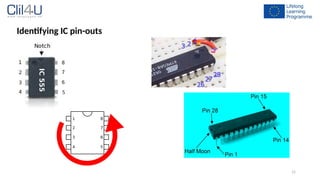
Integrated Circuits (IC)
• A component with a number of pins ranging from 8 to 40
(and more)
• A full electronic circuit is built inside the IC package, and
connected to pins located around the IC
• Each IC has its own functional circuit
• Always read the data sheet of the IC in order to find
out its function
Appearance
Schematic Symbol (example NE 555 timer IC)
15
Identifying IC pin-outs
16
Battery (DC Power Supply)
• A source of DC Power used to supply electronic
components and circuits
• Can be in the form of a battery
• Can be in the form of a piece of electronic equipment
which is plugged into the 230V AC mains supply
• Called DC power supply
• Converts AC 230V into DC
• Steps down the DC into a low voltage suitable for
electronics
Appearance
Schematic Symbols
9V DC Battery Variable output DC
power supply
17
Wire (Conductor)
• Used to interconnect components to form a circuit
• Must be insulated
• Can be single stranded or multi-stranded
• Single stranded used during experiments to insert into the
prototyping (Breadboard) Board
• Multi-stranded type used in practice for improved flexibility
• In the circuit schematics, a wire is drawn as a LINE
Appearance
Schematic Symbols
Single stranded
wire
Multi-stranded
wire
18
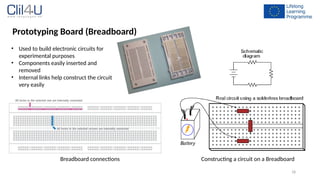
Prototyping Board (Breadboard)
• Used to build electronic circuits for
experimental purposes
• Components easily inserted and
removed
• Internal links help construct the circuit
very easily
Constructing a circuit on a Breadboard
Breadboard connections
19

Basic Electronics components_Lect_01.ppt

  • 1.
  • 2.
    2 Resistor • A componentwith 2 leads (connections) • Its function in a circuit is to control the electric current flow through the circuit • The greater the resistance value, the less will be the current flow • Resistor value is measured in Ohms (Ω) • Sometimes in a circuit the symbol for Ohms is not shown: • 10 Ω may be written as 10R • 0.1 Ω may be written as 0R1 • 1000 Ω may be written as 1k (1 kilo Ohms) • The value of the resistor is read using a colour coding scheme Appearance Schematic Symbol
  • 3.
  • 4.
  • 5.
    5 Light Dependent Resistor(L.D.R.) • A component with 2 leads (connections) • Its function in a circuit is to control the electric current flow through the circuit • The value of the resistor varies with light applied over it • Resistance decreases as light increases Appearance Schematic Symbol
  • 6.
    6 Capacitor • A componentwith 2 leads (connections) • Its function in a circuit is to charge up to a voltage, hence storing electrical charge (energy) • Capacitor value is measured in Farads (F) • Capacitors usually have a very low capacitance value: • 0.000001 F is given as 1 µF (µ = micro = 1 x 10⁶ ) • 0.000000001 F is given as 1 nF (n = nano = 1 x 10⁹ ) • 0.000000000001 F is given as 1 pF (p = pico = 1 x 10¹² ) • The value of the capacitor is read using a number coding scheme Appearance Schematic Symbol
  • 7.
    7 Reading Capacitor Value: Ifthe code ‘103’ is printed on the capacitor: • The first digit of the code is the first digit of the value • The second digit of the code is the second digit of the value • The third digit of the code is the number of zeros following the first 2 digits of the value • The resulting value is always in pico-farads • The value of the capacitor will therefore be: • 10000 pF or 10 nF • The letter code 1KV means that the capacitor can be charged up to 1000V (1kV) maximum.
  • 8.
    8 Polarized Capacitor • Acapacitor whose leads are marked with (+) and (-) • They are designed for higher capacitance values (range of micro-farads) • It is important to properly connect in the circuit to avoid damage during operation • Used only on DC (values of voltage that do not change polarity) • Capacitor marking: • The longer lead is the (+) • (-) lead indicated on the capacitor body • The value and working voltage are written on the case (no number coding used) Appearance Schematic Symbols
  • 9.
    9 Diode • A componentwith 2 leads (connections) • The connections are named ANODE and CATHODE • Its function in a circuit is to control the direction of electric current flow through the circuit • When a DC voltage is applied across a diode: • current will be allowed to pass if the (+) is connected to the anode, and the (-) is connected to the Cathode (DIODE IS FORWARD BIASED) • current will not be allowed to pass if the (+) is connected to the Cathode, and the (-) is connected to the Anode (DIODE IS REVERSED BIASED) • A ring printed on one side of the diode body indicates the Cathode Lead Appearance Schematic Symbol
  • 10.
    10 Light Emitting Diode(L.E.D.): • A component with 2 leads (connections) • Its function in a circuit is to indicate the presence of voltage, or to produce light. • When the LED is connected in FORWARD BIAS MODE, it will light up • IMPORTANT : • Never connect a LED in Reverse Bias • it will not light up  • It will be damaged with just 5V  • The maximum voltage to be applied in Forward Bias Mode is 5V, or the LED will be easily damaged. Appearance Schematic Symbol
  • 11.
    11 How to identifythe Leads of a LED:
  • 12.
    12 Transistor • A componentwith 3 leads (connections) • Its function in a circuit is as an electronic switch, or as an amplifier • Two types of transistors are available: • NPN • PNP • The connections are named: • COLLECTOR (C) • BASE (B) • EMITTER (E) Appearance Schematic Symbols
  • 13.
  • 14.
    14 Integrated Circuits (IC) •A component with a number of pins ranging from 8 to 40 (and more) • A full electronic circuit is built inside the IC package, and connected to pins located around the IC • Each IC has its own functional circuit • Always read the data sheet of the IC in order to find out its function Appearance Schematic Symbol (example NE 555 timer IC)
  • 15.
  • 16.
    16 Battery (DC PowerSupply) • A source of DC Power used to supply electronic components and circuits • Can be in the form of a battery • Can be in the form of a piece of electronic equipment which is plugged into the 230V AC mains supply • Called DC power supply • Converts AC 230V into DC • Steps down the DC into a low voltage suitable for electronics Appearance Schematic Symbols 9V DC Battery Variable output DC power supply
  • 17.
    17 Wire (Conductor) • Usedto interconnect components to form a circuit • Must be insulated • Can be single stranded or multi-stranded • Single stranded used during experiments to insert into the prototyping (Breadboard) Board • Multi-stranded type used in practice for improved flexibility • In the circuit schematics, a wire is drawn as a LINE Appearance Schematic Symbols Single stranded wire Multi-stranded wire
  • 18.
    18 Prototyping Board (Breadboard) •Used to build electronic circuits for experimental purposes • Components easily inserted and removed • Internal links help construct the circuit very easily Constructing a circuit on a Breadboard Breadboard connections
  • 19.