Chapter 5
ElectroChemistry
SIR.MUHAMMAD ABDUL MAGEID
CHAPTER 5: ELECTRICITY & CHEMISTRY
01. REDOX REACTIONS
02. ELECTROLYSIS
03. ELECRTROPLATING
04. INDUSTRIAL APPLICATIONS
ELECTROLYSIS
02.
CHEMISTRY AS-LEVEL
 When an electric current is passed through a molten ionic compound the
compound decomposes or breaks down
 The process also occurs for aqueous solutions of ionic compounds
 Covalent compounds cannot conduct electricity hence they do not undergo
electrolysis
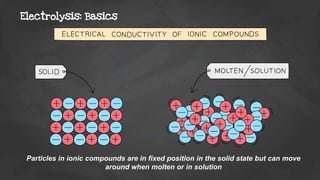
 Ionic compounds in the solid state cannot conduct electricity either since they
have no free ions that can move and carry the charge
 Particles in ionic compounds are in fixed position in the solid state but
can move around when molten or in solution
Electrolysis: Basics
Particles in ionic compounds are in fixed position in the solid state but can move
around when molten or in solution
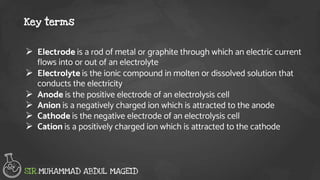
 Electrode is a rod of metal or graphite through which an electric current
flows into or out of an electrolyte
 Electrolyte is the ionic compound in molten or dissolved solution that
conducts the electricity
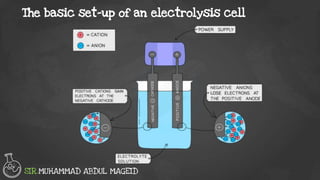
 Anode is the positive electrode of an electrolysis cell
 Anion is a negatively charged ion which is attracted to the anode
 Cathode is the negative electrode of an electrolysis cell
 Cation is a positively charged ion which is attracted to the cathode
Key terms
SIR.MUHAMMAD ABDUL MAGEID
The basic set-up of an electrolysis cell
SIR.MUHAMMAD ABDUL MAGEID
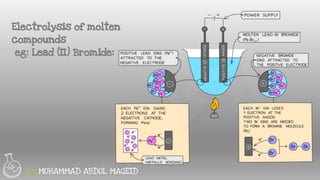
Electrolysis of molten compounds eg: Lead (II) Bromide:
Method:
 Add lead (II) bromide into a beaker and heat so it will turn molten, allowing ions to be
free to move and conduct an electric charge
 Add two graphite rods as the electrodes and connect this to a power pack or battery
 Turn on power pack or battery and allow electrolysis to take place
 Negative bromide ions move to the positive electrode (anode) and lose two electrons
to form bromine molecules. There is bubbling at the anode as brown bromine gas is
given off
 Positive lead ions move to the negative electrode (cathode) and gain electrons to form
a grey lead metal which deposits on the surface of the electrode
Solution Product at positive
electrode (ANODE)
Product at negative
electrode (CATHODE)
Lead (II) bromide
𝑷𝒃𝑩𝒓 𝟐
Bromine 𝑩𝒓 𝟐
𝟐𝑩𝒓−
− 𝟐𝒆−
→ 𝑩𝒓 𝟐
Lead 𝑷𝒃
𝑷𝒃 𝟐+
+ 𝟐𝒆−
→ 𝑷𝒃
Exam Tip
 Positive is Anode Negative is Cathode
 Cations are attracted to the cathode and anions are attracted to
the anode.
 Electron flow in electrochemistry occurs in alphabetical order as electrons
flow from the Anode to the Cathode.
SIR.MUHAMMAD ABDUL MAGEID
Electrolysis: General Principles
SIR.MUHAMMAD ABDUL MAGEID
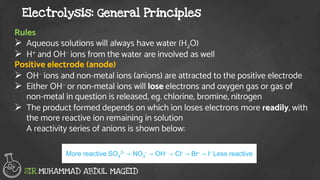
Rules
 Aqueous solutions will always have water (H2O)
 H+ and OH– ions from the water are involved as well
Positive electrode (anode)
 OH– ions and non-metal ions (anions) are attracted to the positive electrode
 Either OH– or non-metal ions will lose electrons and oxygen gas or gas of
non-metal in question is released, eg. chlorine, bromine, nitrogen
 The product formed depends on which ion loses electrons more readily, with
the more reactive ion remaining in solution
A reactivity series of anions is shown below:
More reactive SO4
2- → NO3
- → OH- → Cl- → Br- → I- Less reactive
Electrolysis: General Principles
SIR.MUHAMMAD ABDUL MAGEID
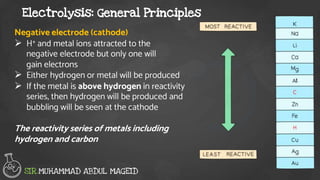
Negative electrode (cathode)
 H+ and metal ions attracted to the
negative electrode but only one will
gain electrons
 Either hydrogen or metal will be produced
 If the metal is above hydrogen in reactivity
series, then hydrogen will be produced and
bubbling will be seen at the cathode
The reactivity series of metals including
hydrogen and carbon
Electrolysis: General Principles
SIR.MUHAMMAD ABDUL MAGEID
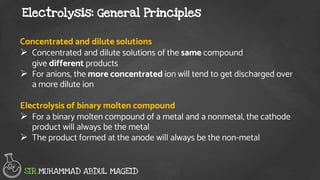
Concentrated and dilute solutions
 Concentrated and dilute solutions of the same compound
give different products
 For anions, the more concentrated ion will tend to get discharged over
a more dilute ion
Electrolysis of binary molten compound
 For a binary molten compound of a metal and a nonmetal, the cathode
product will always be the metal
 The product formed at the anode will always be the non-metal
Electrolysis of Aqueous Solutions
SIR.MUHAMMAD ABDUL MAGEID
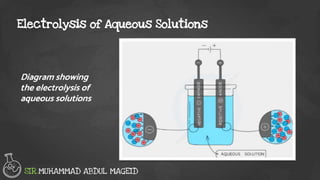
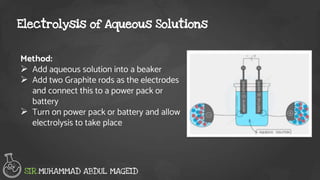
Diagram showing
the electrolysis of
aqueous solutions
Electrolysis of Aqueous Solutions
SIR.MUHAMMAD ABDUL MAGEID
Method:
 Add aqueous solution into a beaker
 Add two Graphite rods as the electrodes
and connect this to a power pack or
battery
 Turn on power pack or battery and allow
electrolysis to take place
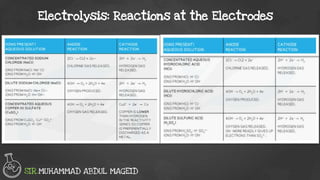
Electrolysis: Reactions at the Electrodes
SIR.MUHAMMAD ABDUL MAGEID
Electrolysis: Reactions at the Electrodes
SIR.MUHAMMAD ABDUL MAGEID
Determining what gas is produced
 If the gas produced at the cathode burns with a ‘pop’ when a sample is lit
with a lighted splint then the gas is hydrogen
 If the gas produced at the anode relights a glowing splint dipped into a
sample of the gas then the gas is oxygen
 The halogen gases all produce their own colours (bromine is red-brown,
chlorine is yellow-green and fluorine is pale yellow)

5.2- electrochemistry ((ELECTROLYSIS))

  • 1.
  • 2.
    CHAPTER 5: ELECTRICITY& CHEMISTRY 01. REDOX REACTIONS 02. ELECTROLYSIS 03. ELECRTROPLATING 04. INDUSTRIAL APPLICATIONS
  • 3.
  • 4.
     When anelectric current is passed through a molten ionic compound the compound decomposes or breaks down  The process also occurs for aqueous solutions of ionic compounds  Covalent compounds cannot conduct electricity hence they do not undergo electrolysis  Ionic compounds in the solid state cannot conduct electricity either since they have no free ions that can move and carry the charge  Particles in ionic compounds are in fixed position in the solid state but can move around when molten or in solution Electrolysis: Basics
  • 5.
    Electrolysis: Basics Particles inionic compounds are in fixed position in the solid state but can move around when molten or in solution
  • 6.
     Electrode isa rod of metal or graphite through which an electric current flows into or out of an electrolyte  Electrolyte is the ionic compound in molten or dissolved solution that conducts the electricity  Anode is the positive electrode of an electrolysis cell  Anion is a negatively charged ion which is attracted to the anode  Cathode is the negative electrode of an electrolysis cell  Cation is a positively charged ion which is attracted to the cathode Key terms SIR.MUHAMMAD ABDUL MAGEID
  • 7.
    The basic set-upof an electrolysis cell SIR.MUHAMMAD ABDUL MAGEID
  • 8.
  • 9.
    Electrolysis of moltencompounds eg: Lead (II) Bromide: Method:  Add lead (II) bromide into a beaker and heat so it will turn molten, allowing ions to be free to move and conduct an electric charge  Add two graphite rods as the electrodes and connect this to a power pack or battery  Turn on power pack or battery and allow electrolysis to take place  Negative bromide ions move to the positive electrode (anode) and lose two electrons to form bromine molecules. There is bubbling at the anode as brown bromine gas is given off  Positive lead ions move to the negative electrode (cathode) and gain electrons to form a grey lead metal which deposits on the surface of the electrode Solution Product at positive electrode (ANODE) Product at negative electrode (CATHODE) Lead (II) bromide 𝑷𝒃𝑩𝒓 𝟐 Bromine 𝑩𝒓 𝟐 𝟐𝑩𝒓− − 𝟐𝒆− → 𝑩𝒓 𝟐 Lead 𝑷𝒃 𝑷𝒃 𝟐+ + 𝟐𝒆− → 𝑷𝒃
  • 10.
    Exam Tip  Positiveis Anode Negative is Cathode  Cations are attracted to the cathode and anions are attracted to the anode.  Electron flow in electrochemistry occurs in alphabetical order as electrons flow from the Anode to the Cathode. SIR.MUHAMMAD ABDUL MAGEID
  • 11.
    Electrolysis: General Principles SIR.MUHAMMADABDUL MAGEID Rules  Aqueous solutions will always have water (H2O)  H+ and OH– ions from the water are involved as well Positive electrode (anode)  OH– ions and non-metal ions (anions) are attracted to the positive electrode  Either OH– or non-metal ions will lose electrons and oxygen gas or gas of non-metal in question is released, eg. chlorine, bromine, nitrogen  The product formed depends on which ion loses electrons more readily, with the more reactive ion remaining in solution A reactivity series of anions is shown below: More reactive SO4 2- → NO3 - → OH- → Cl- → Br- → I- Less reactive
  • 12.
    Electrolysis: General Principles SIR.MUHAMMADABDUL MAGEID Negative electrode (cathode)  H+ and metal ions attracted to the negative electrode but only one will gain electrons  Either hydrogen or metal will be produced  If the metal is above hydrogen in reactivity series, then hydrogen will be produced and bubbling will be seen at the cathode The reactivity series of metals including hydrogen and carbon
  • 13.
    Electrolysis: General Principles SIR.MUHAMMADABDUL MAGEID Concentrated and dilute solutions  Concentrated and dilute solutions of the same compound give different products  For anions, the more concentrated ion will tend to get discharged over a more dilute ion Electrolysis of binary molten compound  For a binary molten compound of a metal and a nonmetal, the cathode product will always be the metal  The product formed at the anode will always be the non-metal
  • 14.
    Electrolysis of AqueousSolutions SIR.MUHAMMAD ABDUL MAGEID Diagram showing the electrolysis of aqueous solutions
  • 15.
    Electrolysis of AqueousSolutions SIR.MUHAMMAD ABDUL MAGEID Method:  Add aqueous solution into a beaker  Add two Graphite rods as the electrodes and connect this to a power pack or battery  Turn on power pack or battery and allow electrolysis to take place
  • 16.
    Electrolysis: Reactions atthe Electrodes SIR.MUHAMMAD ABDUL MAGEID
  • 17.
    Electrolysis: Reactions atthe Electrodes SIR.MUHAMMAD ABDUL MAGEID Determining what gas is produced  If the gas produced at the cathode burns with a ‘pop’ when a sample is lit with a lighted splint then the gas is hydrogen  If the gas produced at the anode relights a glowing splint dipped into a sample of the gas then the gas is oxygen  The halogen gases all produce their own colours (bromine is red-brown, chlorine is yellow-green and fluorine is pale yellow)