
Electricity
           &
 Chemistry
QBA Miguel A. Castro Ramírez
Simple Electrical Devices and
Circuit Symbols
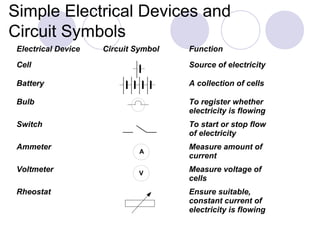
 Electrical Device   Circuit Symbol   Function
 Cell                                 Source of electricity

 Battery                              A collection of cells

 Bulb                                 To register whether
                                      electricity is flowing
 Switch                               To start or stop flow
                                      of electricity
 Ammeter                              Measure amount of
                              A
                                      current
 Voltmeter                    V
                                      Measure voltage of
                                      cells
 Rheostat                             Ensure suitable,
                                      constant current of
                                      electricity is flowing
Electrolysis

 Electricity is passed from a battery
  through a liquid which may be a
  solution/molten solid.
 The plates which carry the electricity
  into the liquid are called electrodes
 Molten ionic compounds or aqueous
  solution of ionic compounds that
  allows electricity to pass through are
  called electrolytes
Electrodes
 Metal
      plates or graphite rods that
 conduct electricity into the electrolyte
   Eg.   Platinum, copper
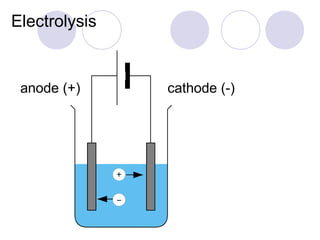
 Cathode:
   Electrodethat is connected to the
   negative terminal of the battery. Postively
   charged ions, cations, moved towards the
   cathode
 Anode:
   Electrodethat is connected to the positive
   terminal of the battery. Negatively
   charged ions, anions, moved towards the
Electrolysis


 anode (+)     cathode (-)
Conduction of electricity
 Conductor   is a substance which conducts
 electricity but is not chemically changed
 during the conduction
   Presence  of freely moving valence electrons
   Eg. All metals and graphite

 Non-conductor    does not allow the passage
 of electricity, a.k.a insulator
   Valence   electrons are held in fixed positions
   Eg. Sulphur, phosphorus, diamond, solid state
    crystalline salts, wood and glass
Electrolytes and non-Electrolytes
 Electrolytes:
   Molten  ionic compounds or aqueous
    solution of ionic compounds that allows
    electricity to pass through and are
    decomposed in the process
   Eg. Acids, Alkali, Salts dissolved in water,
    molten salts
 Non-electrolytes:
   Does  not allow passage of electricity
   Eg. Distilled water, alcohol, turpentine, oil,
    paraffin, organic solvents
Strong and weak Electrolytes
 Strong  Electrolytes    Weak   Electrolytes
 Fully ionised           Partially ionised
 Strong acids            Weak acids
 Strong alkalis               Ethanoic acid
 Salt solution                Sulphurous acid
                               Carbonic acid
                          Weak     alkalis
                               Limewater
                               Ammonia
Electrolysis
 When   electricity is passed through an
  electrolyte, chemical decomposition
  occurs
 This involves the ‘splitting up’ of the
  electrolyte
 Since all electrolytes are ionic, composed
  of positively and negatively charged ions
Electrolysis
 The  process: When an electric current
  pass through the electrolyte, ions in the
  solution migrate towards the oppositely
  charged electrode
 This discharge of ions at the electrodes
  results in the chemical decomposition of
  the electrolyte to form its elements.
Electrolysis
 At the anode, negatively charged ions lose
  their electron(s) to the anode (connected
  to positive terminal of battery) to form
  neutral atoms.
 The negatively charged ions are said to be
  oxidised and discharged at the anode.
 Oxidation occured at the anode.
Electrolysis
 At the cathode, positively charged ions
  gain electron(s) from the cathode
  (connected to negative terminal of battery)
  to form neutral atoms.
 The positively charged ions are said to be
  reduced and discharged at the cathode.
 Reduction occured at the cathode.
Electrolysis of Molten Compounds

     Many ionic compounds are binary
      compounds.
     A binary compound is a
      compound containing only 2
      elements. It contains a metal
      cation and a non-metal anion.
     The electrolysis of a molten binary
      compound will yield a metal and a
      non-metal as products.
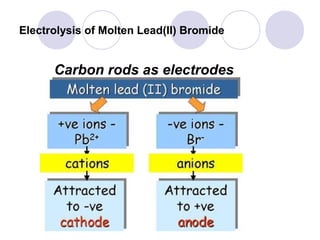
Electrolysis of Molten Lead(II) Bromide


      Carbon rods as electrodes
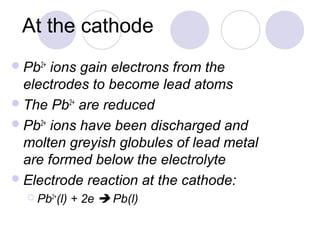
At the cathode
 Pb2+ ions gain electrons from the
  electrodes to become lead atoms
 The Pb2+ are reduced
 Pb2+ ions have been discharged and
  molten greyish globules of lead metal
  are formed below the electrolyte
 Electrode reaction at the cathode:
   Pb2+(l)   + 2e  Pb(l)
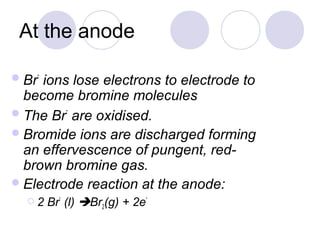
At the anode

 Br-ions lose electrons to electrode to
  become bromine molecules
 The Br- are oxidised.
 Bromide ions are discharged forming
  an effervescence of pungent, red-
  brown bromine gas.
 Electrode reaction at the anode:
          -                   -
  2    Br (l) Br2(g) + 2e
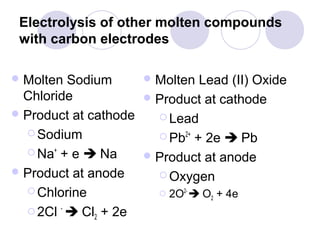
Electrolysis of other molten compounds
 with carbon electrodes

 Molten  Sodium      Molten Lead (II) Oxide
  Chloride            Product at cathode
 Product at cathode    Lead
   Sodium              Pb2+ + 2e  Pb
   Na+ + e  Na      Product at anode
 Product at anode      Oxygen
   Chlorine            2O2-  O + 4e
                                 2

   2Cl -  Cl + 2e
              2
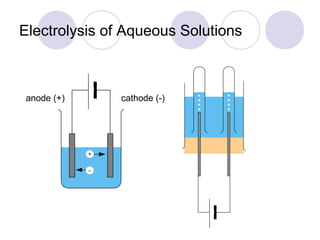
Evidence of Ions

Electrolysis provides
evidence for the
existence of ions which
are held in a lattice when
solid but which are free to
move when molten or in
solution.
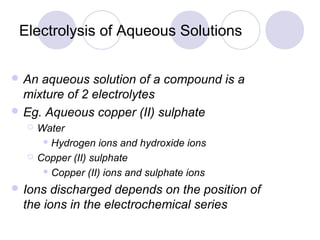
Electrolysis of Aqueous Solutions


anode (+)      cathode (-)
Electrolysis of Aqueous Solutions


 An aqueous solution of a compound is a
  mixture of 2 electrolytes
 Eg. Aqueous copper (II) sulphate
     Water
        Hydrogen ions and hydroxide ions

     Copper (II) sulphate
        Copper (II) ions and sulphate ions

 Ions  discharged depends on the position of
  the ions in the electrochemical series
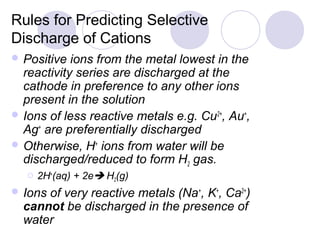
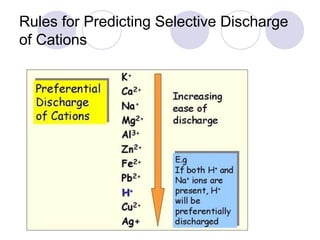
Rules for Predicting Selective
Discharge of Cations
 Positive  ions from the metal lowest in the
  reactivity series are discharged at the
  cathode in preference to any other ions
  present in the solution
 Ions of less reactive metals e.g. Cu 2+, Au+,
  Ag+ are preferentially discharged
 Otherwise, H+ ions from water will be
  discharged/reduced to form H2 gas.
      2H+(aq) + 2e H2(g)
 Ionsof very reactive metals (Na+, K+, Ca2+)
  cannot be discharged in the presence of
  water
Rules for Predicting Selective Discharge
of Cations
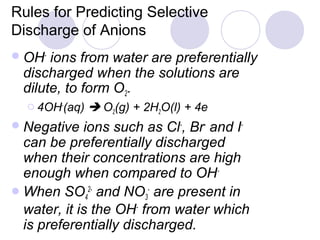
Rules for Predicting Selective
Discharge of Anions
 OH-  ions from water are preferentially
  discharged when the solutions are
  dilute, to form O2.
   4OH-(aq)    O2(g) + 2H2O(l) + 4e
 Negative   ions such as Cl-, Br- and I-
  can be preferentially discharged
  when their concentrations are high
  enough when compared to OH-
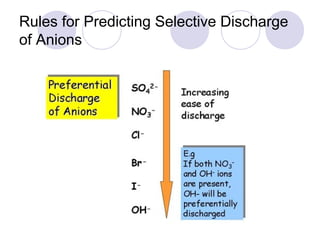
 When SO42- and NO3- are present in
  water, it is the OH- from water which
  is preferentially discharged.
Rules for Predicting Selective Discharge
of Anions
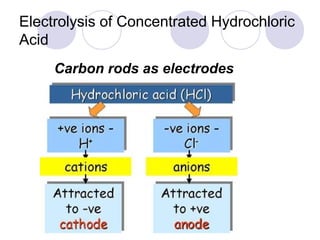
Electrolysis of Concentrated Hydrochloric
Acid
     Carbon rods as electrodes
At the cathode
 H+ ions gain electrons from the electrodes
  to become hydrogen gas molecules
 Gas produced extinguishes a lighted splint
  with a 'pop' sound
 Electrode Reaction at the Cathode:
   2H+(aq)   + 2e  H2(g)
At the anode
 Cl-ions lose electrons to the electrode to
  become chlorine gas molecules
 Gas turns moist blue litmus paper red and
  then bleached it
 Electrode Reaction at the Anode:
   2Cl-(aq)    Cl2(g) + 2e
 Overall   equation:
   2HCl(aq)      Cl2 (g) + H2(g)
Electrolysis of other concentrated
aqueous solutions with carbon electrodes
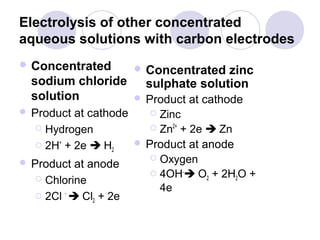
 Concentrated       Concentrated   zinc
  sodium chloride      sulphate solution
  solution           Product   at cathode
 Product  at cathode     Zinc
    Hydrogen             Zn2+ + 2e  Zn

    2H+ + 2e  H      Product at anode
                  2
                          Oxygen
 Product at anode
                          4OH- O + 2H O +
    Chlorine                        2    2

         -
                           4e
    2Cl  Cl + 2e
               2
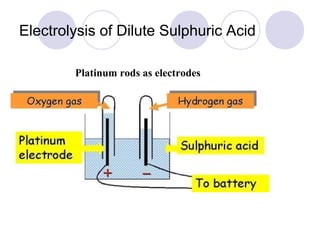
Electrolysis of Dilute Sulphuric Acid

        Platinum rods as electrodes
At the cathode
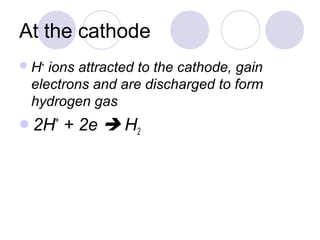
 H+ions attracted to the cathode, gain
 electrons and are discharged to form
 hydrogen gas
2H+   + 2e  H2
At the anode
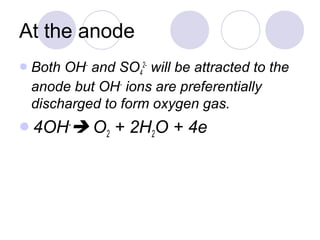
 BothOH- and SO42- will be attracted to the
 anode but OH- ions are preferentially
 discharged to form oxygen gas.
4OH-     O2 + 2H2O + 4e
Overall Reaction
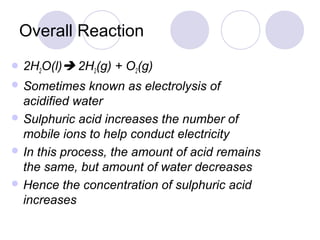
 2H2O(l)   2H2(g) + O2(g)
 Sometimes    known as electrolysis of
  acidified water
 Sulphuric acid increases the number of
  mobile ions to help conduct electricity
 In this process, the amount of acid remains
  the same, but amount of water decreases
 Hence the concentration of sulphuric acid
  increases
Electrolysis of other diluted aqueous
solutions with carbon electrodes
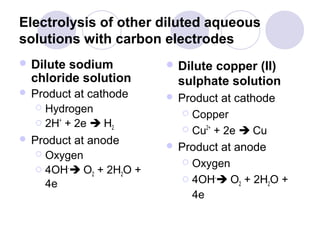
 Dilute sodium          Dilutecopper (II)
  chloride solution       sulphate solution
 Product  at cathode    Product  at cathode
    Hydrogen
                            Copper
    2H+ + 2e  H
                  2         Cu2+ + 2e  Cu
 Product at anode
                         Product at anode
    Oxygen
                            Oxygen
    4OH- O + 2H O +
               2    2
                            4OH- O + 2H O +
     4e                                2    2
                             4e
Inert & Reactive Electrodes
 Inert   Electrodes
   Carbon

   Platinum

 Reactive  Electrodes
– take part in the reactions
   Copper

   Silver
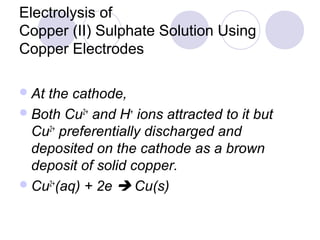
Electrolysis of
Copper (II) Sulphate Solution Using
Copper Electrodes

 Atthe cathode,
 Both Cu2+ and H+ ions attracted to it but
  Cu2+ preferentially discharged and
  deposited on the cathode as a brown
  deposit of solid copper.
 Cu2+(aq) + 2e  Cu(s)
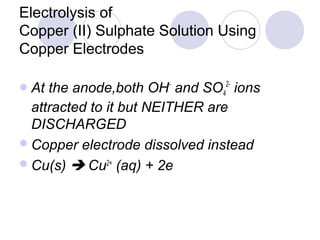
Electrolysis of
Copper (II) Sulphate Solution Using
Copper Electrodes

 At the anode,both OH- and SO42- ions
  attracted to it but NEITHER are
  DISCHARGED
 Copper electrode dissolved instead
 Cu(s)  Cu2+ (aq) + 2e
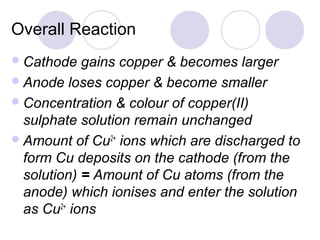
Overall Reaction
 Cathode   gains copper & becomes larger
 Anode loses copper & become smaller
 Concentration & colour of copper(II)
  sulphate solution remain unchanged
 Amount of Cu2+ ions which are discharged to
  form Cu deposits on the cathode (from the
  solution) = Amount of Cu atoms (from the
  anode) which ionises and enter the solution
  as Cu2+ ions
Factors affecting discharge of Ions

 Relative  positions of the ions in the
  reactivity series
 Concentration of the ions in the electrolyte
 Nature of the electrode
Generally
 Metalsor hydrogen are formed at the
  cathode
 Non-metals (other than hydrogen) are
  formed at the anode
Uses of Electrolysis
 Purificationof metals
 Electroplating
 Extraction of metals

ELECTRICITY AND CHEMISTRY

  • 1.
    Electricity & Chemistry QBA Miguel A. Castro Ramírez
  • 2.
    Simple Electrical Devicesand Circuit Symbols Electrical Device Circuit Symbol Function Cell Source of electricity Battery A collection of cells Bulb To register whether electricity is flowing Switch To start or stop flow of electricity Ammeter Measure amount of A current Voltmeter V Measure voltage of cells Rheostat Ensure suitable, constant current of electricity is flowing
  • 3.
    Electrolysis  Electricity ispassed from a battery through a liquid which may be a solution/molten solid.  The plates which carry the electricity into the liquid are called electrodes  Molten ionic compounds or aqueous solution of ionic compounds that allows electricity to pass through are called electrolytes
  • 4.
    Electrodes  Metal plates or graphite rods that conduct electricity into the electrolyte  Eg. Platinum, copper  Cathode:  Electrodethat is connected to the negative terminal of the battery. Postively charged ions, cations, moved towards the cathode  Anode:  Electrodethat is connected to the positive terminal of the battery. Negatively charged ions, anions, moved towards the
  • 5.
  • 6.
    Conduction of electricity Conductor is a substance which conducts electricity but is not chemically changed during the conduction  Presence of freely moving valence electrons  Eg. All metals and graphite  Non-conductor does not allow the passage of electricity, a.k.a insulator  Valence electrons are held in fixed positions  Eg. Sulphur, phosphorus, diamond, solid state crystalline salts, wood and glass
  • 7.
    Electrolytes and non-Electrolytes Electrolytes:  Molten ionic compounds or aqueous solution of ionic compounds that allows electricity to pass through and are decomposed in the process  Eg. Acids, Alkali, Salts dissolved in water, molten salts  Non-electrolytes:  Does not allow passage of electricity  Eg. Distilled water, alcohol, turpentine, oil, paraffin, organic solvents
  • 8.
    Strong and weakElectrolytes  Strong Electrolytes  Weak Electrolytes  Fully ionised  Partially ionised  Strong acids  Weak acids  Strong alkalis  Ethanoic acid  Salt solution  Sulphurous acid  Carbonic acid  Weak alkalis  Limewater  Ammonia
  • 9.
    Electrolysis  When electricity is passed through an electrolyte, chemical decomposition occurs  This involves the ‘splitting up’ of the electrolyte  Since all electrolytes are ionic, composed of positively and negatively charged ions
  • 10.
    Electrolysis  The process: When an electric current pass through the electrolyte, ions in the solution migrate towards the oppositely charged electrode  This discharge of ions at the electrodes results in the chemical decomposition of the electrolyte to form its elements.
  • 11.
    Electrolysis  At theanode, negatively charged ions lose their electron(s) to the anode (connected to positive terminal of battery) to form neutral atoms.  The negatively charged ions are said to be oxidised and discharged at the anode.  Oxidation occured at the anode.
  • 12.
    Electrolysis  At thecathode, positively charged ions gain electron(s) from the cathode (connected to negative terminal of battery) to form neutral atoms.  The positively charged ions are said to be reduced and discharged at the cathode.  Reduction occured at the cathode.
  • 13.
    Electrolysis of MoltenCompounds  Many ionic compounds are binary compounds.  A binary compound is a compound containing only 2 elements. It contains a metal cation and a non-metal anion.  The electrolysis of a molten binary compound will yield a metal and a non-metal as products.
  • 14.
    Electrolysis of MoltenLead(II) Bromide Carbon rods as electrodes
  • 15.
    At the cathode Pb2+ ions gain electrons from the electrodes to become lead atoms  The Pb2+ are reduced  Pb2+ ions have been discharged and molten greyish globules of lead metal are formed below the electrolyte  Electrode reaction at the cathode:  Pb2+(l) + 2e  Pb(l)
  • 16.
    At the anode Br-ions lose electrons to electrode to become bromine molecules  The Br- are oxidised.  Bromide ions are discharged forming an effervescence of pungent, red- brown bromine gas.  Electrode reaction at the anode: - - 2 Br (l) Br2(g) + 2e
  • 17.
    Electrolysis of othermolten compounds with carbon electrodes  Molten Sodium  Molten Lead (II) Oxide Chloride  Product at cathode  Product at cathode  Lead  Sodium  Pb2+ + 2e  Pb  Na+ + e  Na  Product at anode  Product at anode  Oxygen  Chlorine  2O2-  O + 4e 2  2Cl -  Cl + 2e 2
  • 18.
    Evidence of Ions Electrolysisprovides evidence for the existence of ions which are held in a lattice when solid but which are free to move when molten or in solution.
  • 19.
    Electrolysis of AqueousSolutions anode (+) cathode (-)
  • 20.
    Electrolysis of AqueousSolutions  An aqueous solution of a compound is a mixture of 2 electrolytes  Eg. Aqueous copper (II) sulphate  Water  Hydrogen ions and hydroxide ions  Copper (II) sulphate  Copper (II) ions and sulphate ions  Ions discharged depends on the position of the ions in the electrochemical series
  • 21.
    Rules for PredictingSelective Discharge of Cations  Positive ions from the metal lowest in the reactivity series are discharged at the cathode in preference to any other ions present in the solution  Ions of less reactive metals e.g. Cu 2+, Au+, Ag+ are preferentially discharged  Otherwise, H+ ions from water will be discharged/reduced to form H2 gas.  2H+(aq) + 2e H2(g)  Ionsof very reactive metals (Na+, K+, Ca2+) cannot be discharged in the presence of water
  • 22.
    Rules for PredictingSelective Discharge of Cations
  • 23.
    Rules for PredictingSelective Discharge of Anions  OH- ions from water are preferentially discharged when the solutions are dilute, to form O2.  4OH-(aq)  O2(g) + 2H2O(l) + 4e  Negative ions such as Cl-, Br- and I- can be preferentially discharged when their concentrations are high enough when compared to OH-  When SO42- and NO3- are present in water, it is the OH- from water which is preferentially discharged.
  • 24.
    Rules for PredictingSelective Discharge of Anions
  • 25.
    Electrolysis of ConcentratedHydrochloric Acid Carbon rods as electrodes
  • 26.
    At the cathode H+ ions gain electrons from the electrodes to become hydrogen gas molecules  Gas produced extinguishes a lighted splint with a 'pop' sound  Electrode Reaction at the Cathode:  2H+(aq) + 2e  H2(g)
  • 27.
    At the anode Cl-ions lose electrons to the electrode to become chlorine gas molecules  Gas turns moist blue litmus paper red and then bleached it  Electrode Reaction at the Anode:  2Cl-(aq)  Cl2(g) + 2e  Overall equation:  2HCl(aq) Cl2 (g) + H2(g)
  • 28.
    Electrolysis of otherconcentrated aqueous solutions with carbon electrodes  Concentrated  Concentrated zinc sodium chloride sulphate solution solution  Product at cathode  Product at cathode  Zinc  Hydrogen  Zn2+ + 2e  Zn  2H+ + 2e  H  Product at anode 2  Oxygen  Product at anode  4OH- O + 2H O +  Chlorine 2 2 - 4e  2Cl  Cl + 2e 2
  • 29.
    Electrolysis of DiluteSulphuric Acid Platinum rods as electrodes
  • 30.
    At the cathode H+ions attracted to the cathode, gain electrons and are discharged to form hydrogen gas 2H+ + 2e  H2
  • 31.
    At the anode BothOH- and SO42- will be attracted to the anode but OH- ions are preferentially discharged to form oxygen gas. 4OH- O2 + 2H2O + 4e
  • 32.
    Overall Reaction  2H2O(l) 2H2(g) + O2(g)  Sometimes known as electrolysis of acidified water  Sulphuric acid increases the number of mobile ions to help conduct electricity  In this process, the amount of acid remains the same, but amount of water decreases  Hence the concentration of sulphuric acid increases
  • 33.
    Electrolysis of otherdiluted aqueous solutions with carbon electrodes  Dilute sodium  Dilutecopper (II) chloride solution sulphate solution  Product at cathode  Product at cathode  Hydrogen  Copper  2H+ + 2e  H 2  Cu2+ + 2e  Cu  Product at anode  Product at anode  Oxygen  Oxygen  4OH- O + 2H O + 2 2  4OH- O + 2H O + 4e 2 2 4e
  • 34.
    Inert & ReactiveElectrodes  Inert Electrodes  Carbon  Platinum  Reactive Electrodes – take part in the reactions  Copper  Silver
  • 35.
    Electrolysis of Copper (II)Sulphate Solution Using Copper Electrodes  Atthe cathode,  Both Cu2+ and H+ ions attracted to it but Cu2+ preferentially discharged and deposited on the cathode as a brown deposit of solid copper.  Cu2+(aq) + 2e  Cu(s)
  • 36.
    Electrolysis of Copper (II)Sulphate Solution Using Copper Electrodes  At the anode,both OH- and SO42- ions attracted to it but NEITHER are DISCHARGED  Copper electrode dissolved instead  Cu(s)  Cu2+ (aq) + 2e
  • 37.
    Overall Reaction  Cathode gains copper & becomes larger  Anode loses copper & become smaller  Concentration & colour of copper(II) sulphate solution remain unchanged  Amount of Cu2+ ions which are discharged to form Cu deposits on the cathode (from the solution) = Amount of Cu atoms (from the anode) which ionises and enter the solution as Cu2+ ions
  • 38.
    Factors affecting dischargeof Ions  Relative positions of the ions in the reactivity series  Concentration of the ions in the electrolyte  Nature of the electrode
  • 39.
    Generally  Metalsor hydrogenare formed at the cathode  Non-metals (other than hydrogen) are formed at the anode
  • 40.
    Uses of Electrolysis Purificationof metals  Electroplating  Extraction of metals