PSF
Why is it a Hazard ?
It is a Hazard because it by
itself or by interacting with
other variables can result in
Death, Injury, Property
damage and any other loss.
Safety Control Department
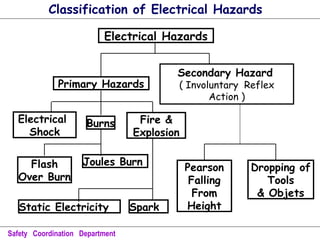
Classification of Electrical Hazards
Electrical Hazards
Secondary Hazard
( Involuntary Reflex
Action )
Electrical
Shock
Burns Fire &
Explosion
Static Electricity Spark
Dropping of
Tools
& Objets
Pearson
Falling
From
Height
Safety Coordination Department
Flash
Over Burn
Joules Burn
Primary Hazards
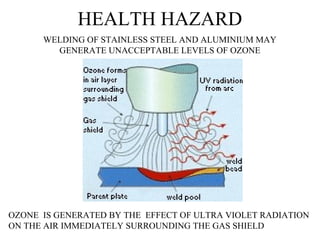
HEALTH HAZARD
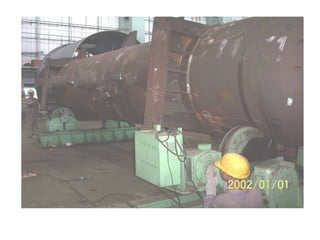
WELDING OF STAINLESS STEEL AND ALUMINIUM MAY
GENERATE UNACCEPTABLE LEVELS OF OZONE
OZONE IS GENERATED BY THE EFFECT OF ULTRA VIOLET RADIATION
ON THE AIR IMMEDIATELY SURROUNDING THE GAS SHIELD
What is Electric Shock ?
Electric Shock is a sudden and
accidental stimulation of body’s
nervous system by electric
current.
Current will flow due to voltage
difference through a low
resistance i.e. the human body in
this case.
Safety Control Department
Severity of shock is not determined
by Voltage alone but….
depends on:
1. Quantity of current flowing through the body
2. The path of the current flowing through the
body.
3. The length of time, current flowing through the
body.
Safety Control Department
Effect of Current flowing through the body.
• 1 to 8 mA - Tingling sensations, Not painful
• 8 to 15 mA - Painful shock, Individual Can let go at
will as muscular control is not lost
• 15 to 20 mA - Painful shock, Muscular control of
adjacent muscles lost, cannot let go
• 20 to 50 mA - Severe muscular contraction, breathing
difficulty
• 50 to 200 mA - ( Possible) Ventricular fibrillation, a
heart condition that results in instant
death
• 200 - 500 mA - Severe burns, muscular contraction so
severe that chest muscles clamp down the
heart and stop it.
Note: Reaction will vary with frequency and time of exposure
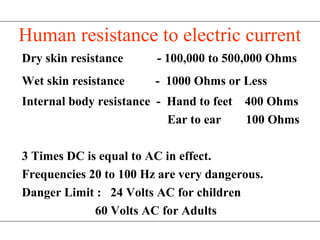
Human resistance to electric current
Dry skin resistance - 100,000 to 500,000 Ohms
Wet skin resistance - 1000 Ohms or Less
Internal body resistance - Hand to feet 400 Ohms
Ear to ear 100 Ohms
3 Times DC is equal to AC in effect.
Frequencies 20 to 100 Hz are very dangerous.
Danger Limit : 24 Volts AC for children
60 Volts AC for Adults
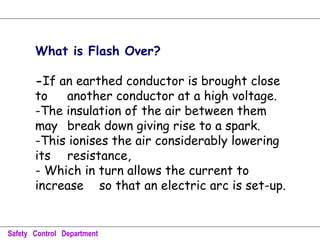
What is Flash Over?
-If an earthed conductor is brought close
to another conductor at a high voltage.
-The insulation of the air between them
may break down giving rise to a spark.
-This ionises the air considerably lowering
its resistance,
- Which in turn allows the current to
increase so that an electric arc is set-up.
Safety Control Department
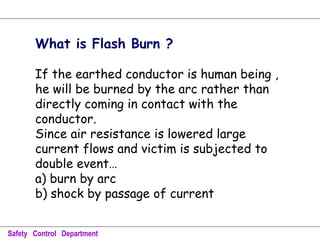
What is Flash Burn ?
If the earthed conductor is human being ,
he will be burned by the arc rather than
directly coming in contact with the
conductor.
Since air resistance is lowered large
current flows and victim is subjected to
double event…
a) burn by arc
b) shock by passage of current
Safety Control Department
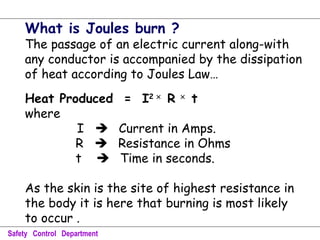
What is Joules burn ?
The passage of an electric current along-with
any conductor is accompanied by the dissipation
of heat according to Joules Law…
Heat Produced = I2 ×
R ×
t
where
I  Current in Amps.
R  Resistance in Ohms
t  Time in seconds.
As the skin is the site of highest resistance in
the body it is here that burning is most likely
to occur .
Safety Control Department
Do you think electric shock
discriminates on Gender basis ?
Yes, it does so.
Provided all the physical conditions
are same, women get shock more
severe
than men
Safety Control Department
Other factors affecting the degree of
shock
- Frequency of the current
- Phase of the heart cycle at the time of
current.
- Physical and psychological
condition of the person
Safety Control Department
# Isolation
# Marking danger signs
# Routine insulation of common parts
e.g.( knobs, dials, handles, etc.)
# Rubber mats at places from where
electrical panels are to be operated.
# Use of (PPE) rubber gloves and
non- conductive shoes.
Safety Control Department
What are the shock Protection Methods ?
About a quarter of all
reportable electrical
accidents involve
portable electric
apparatus
Safety Control Department
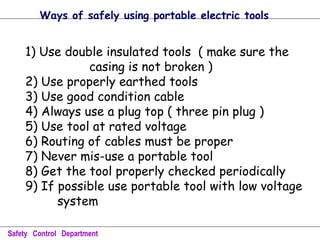
1) Use double insulated tools ( make sure the
casing is not broken )
2) Use properly earthed tools
3) Use good condition cable
4) Always use a plug top ( three pin plug )
5) Use tool at rated voltage
6) Routing of cables must be proper
7) Never mis-use a portable tool
8) Get the tool properly checked periodically
9) If possible use portable tool with low voltage
system
Safety Control Department
Ways of safely using portable electric tools
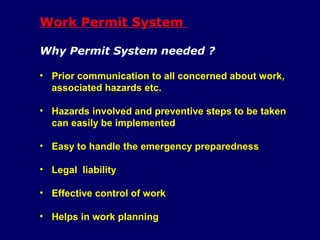
Work Permit System
Why Permit System needed ?
• Prior communication to all concerned about work,
associated hazards etc.
• Hazards involved and preventive steps to be taken
can easily be implemented
• Easy to handle the emergency preparedness
• Legal liability
• Effective control of work
• Helps in work planning
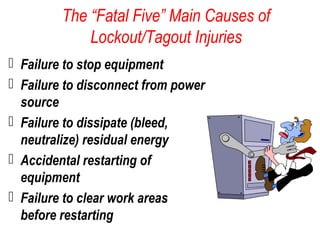
The “Fatal Five” Main Causes of
Lockout/Tagout Injuries
 Failure to stop equipment
 Failure to disconnect from power
source
 Failure to dissipate (bleed,
neutralize) residual energy
 Accidental restarting of
equipment
 Failure to clear work areas
before restarting
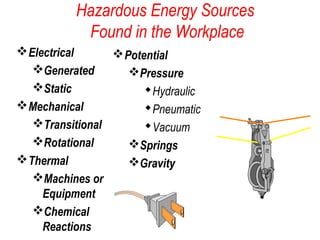
Hazardous Energy Sources
Found in the Workplace
Electrical
Generated
Static
Mechanical
Transitional
Rotational
Thermal
Machines or
Equipment
Chemical
Reactions
Potential
Pressure
Hydraulic
Pneumatic
Vacuum
Springs
Gravity
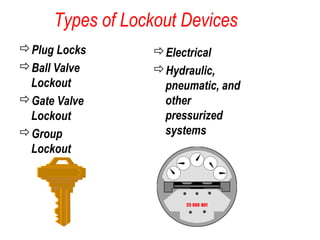
Types of Lockout Devices
Plug Locks
Ball Valve
Lockout
Gate Valve
Lockout
Group
Lockout
Electrical
Hydraulic,
pneumatic, and
other
pressurized
systems
Lockout Procedure
 Alert the operator (s) that power is being disconnected.
 Preparation for Shutdown
 Equipment Shutdown
 Equipment Isolation
 Application of Lockout Devices
 Control of Stored Energy
 Equipment Isolation-Verification
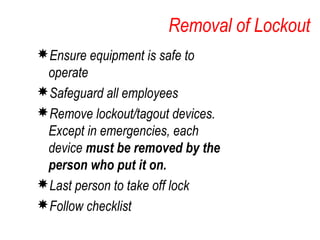
Removal of Lockout
Ensure equipment is safe to
operate
Safeguard all employees
Remove lockout/tagout devices.

Except in emergencies, each
device must be removed by the
person who put it on.
Last person to take off lock
Follow checklist
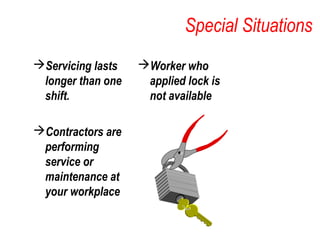
Special Situations
Servicing lasts
longer than one
shift.
Contractors are
performing
service or
maintenance at
your workplace
Worker who
applied lock is
not available
Remember
 Never attempt lockout/tagout procedures
unless you have been trained and certified
by your employer
 Never loan or share your lock,
combination, or key with anybody else.
 Always be sure all lockout/tagout devices
are compatible with the environment in
which they will be used i.e. corrosive,
humid, etc.
Can earthing fail ?
Yes, earthing can fail due to
following reasons :
* Loose contacts in earthing
electrode.
* Earthing pit not maintained
properly.
* Continuity broken in earthing plate.
Safety Control Department
What should be done to maintain
proper earthing ?
The following points should be taken care
of:
- All contacts in earthing wiring should
be tight
- Resistance of earthing pit should be
checked regularly
- Continuity should be checked regularly
Safety Control Department
Static electricity is:
- The electrical charging of materials
- Through physical contact and separation
- The effects that result from the positive and
negative electrical charges formed by various
process.
- Transfer of electrons between bodies
When an electrical charge is present on the surface of
a non conducting body, where it is trapped or
prevented from escaping, it is called static electricity
Static
Electricity
Safety Control Department
(a) Pulverized materials passing through
chutes or pneumatic conveyors
(b) Steam, air, or gas flowing from any
opening in a pipe or hose, when the
steam is wet or the air or gas stream
contains particulate matter
(c) Nonconductive power or conveyor belts
in motion
(d) Moving vehicles
Common sources of Static
Electricity
Cont...
Safety Control Department
(e) Nonconductive liquids flowing through pipes
or splashing, pouring, or falling
(f) Movement of clothing layers against each
other or contact of footwear with floors
and floor coverings while walking
(g) Thunderstorms that produce violent air
currents and temperature differences that
move water, dust, and ice crystals creating
lightning
(h) Motions of all sorts that involve changes in
relative position of contacting surfaces,
usually of dissimilar liquids or solids
Common sources of Static Electricity
Safety Control Department
- The discharge of static electricity can cause
shock or a fire or explosion.
- Electrical charges may not in itself be a
potential fire or explosion hazard.
- For there to be an ignition there must be a
discharge or sudden recombination of the
separated positive and negative charges in
the form of an electric arc in an ignitable
atmosphere.
Static electricity Hazards
TREAT
ELECTICITY
WITH
RESPECT
Any Questions?
Electrical Safety PDK

Electrical Safety PDK

  • 1.
  • 2.
    Why is ita Hazard ? It is a Hazard because it by itself or by interacting with other variables can result in Death, Injury, Property damage and any other loss. Safety Control Department
  • 3.
    Classification of ElectricalHazards Electrical Hazards Secondary Hazard ( Involuntary Reflex Action ) Electrical Shock Burns Fire & Explosion Static Electricity Spark Dropping of Tools & Objets Pearson Falling From Height Safety Coordination Department Flash Over Burn Joules Burn Primary Hazards
  • 4.
    HEALTH HAZARD WELDING OFSTAINLESS STEEL AND ALUMINIUM MAY GENERATE UNACCEPTABLE LEVELS OF OZONE OZONE IS GENERATED BY THE EFFECT OF ULTRA VIOLET RADIATION ON THE AIR IMMEDIATELY SURROUNDING THE GAS SHIELD
  • 9.
    What is ElectricShock ? Electric Shock is a sudden and accidental stimulation of body’s nervous system by electric current. Current will flow due to voltage difference through a low resistance i.e. the human body in this case. Safety Control Department
  • 10.
    Severity of shockis not determined by Voltage alone but…. depends on: 1. Quantity of current flowing through the body 2. The path of the current flowing through the body. 3. The length of time, current flowing through the body. Safety Control Department
  • 11.
    Effect of Currentflowing through the body. • 1 to 8 mA - Tingling sensations, Not painful • 8 to 15 mA - Painful shock, Individual Can let go at will as muscular control is not lost • 15 to 20 mA - Painful shock, Muscular control of adjacent muscles lost, cannot let go • 20 to 50 mA - Severe muscular contraction, breathing difficulty • 50 to 200 mA - ( Possible) Ventricular fibrillation, a heart condition that results in instant death • 200 - 500 mA - Severe burns, muscular contraction so severe that chest muscles clamp down the heart and stop it. Note: Reaction will vary with frequency and time of exposure
  • 13.
    Human resistance toelectric current Dry skin resistance - 100,000 to 500,000 Ohms Wet skin resistance - 1000 Ohms or Less Internal body resistance - Hand to feet 400 Ohms Ear to ear 100 Ohms 3 Times DC is equal to AC in effect. Frequencies 20 to 100 Hz are very dangerous. Danger Limit : 24 Volts AC for children 60 Volts AC for Adults
  • 14.
    What is FlashOver? -If an earthed conductor is brought close to another conductor at a high voltage. -The insulation of the air between them may break down giving rise to a spark. -This ionises the air considerably lowering its resistance, - Which in turn allows the current to increase so that an electric arc is set-up. Safety Control Department
  • 15.
    What is FlashBurn ? If the earthed conductor is human being , he will be burned by the arc rather than directly coming in contact with the conductor. Since air resistance is lowered large current flows and victim is subjected to double event… a) burn by arc b) shock by passage of current Safety Control Department
  • 16.
    What is Joulesburn ? The passage of an electric current along-with any conductor is accompanied by the dissipation of heat according to Joules Law… Heat Produced = I2 × R × t where I  Current in Amps. R  Resistance in Ohms t  Time in seconds. As the skin is the site of highest resistance in the body it is here that burning is most likely to occur . Safety Control Department
  • 17.
    Do you thinkelectric shock discriminates on Gender basis ? Yes, it does so. Provided all the physical conditions are same, women get shock more severe than men Safety Control Department
  • 18.
    Other factors affectingthe degree of shock - Frequency of the current - Phase of the heart cycle at the time of current. - Physical and psychological condition of the person Safety Control Department
  • 19.
    # Isolation # Markingdanger signs # Routine insulation of common parts e.g.( knobs, dials, handles, etc.) # Rubber mats at places from where electrical panels are to be operated. # Use of (PPE) rubber gloves and non- conductive shoes. Safety Control Department What are the shock Protection Methods ?
  • 20.
    About a quarterof all reportable electrical accidents involve portable electric apparatus Safety Control Department
  • 21.
    1) Use doubleinsulated tools ( make sure the casing is not broken ) 2) Use properly earthed tools 3) Use good condition cable 4) Always use a plug top ( three pin plug ) 5) Use tool at rated voltage 6) Routing of cables must be proper 7) Never mis-use a portable tool 8) Get the tool properly checked periodically 9) If possible use portable tool with low voltage system Safety Control Department Ways of safely using portable electric tools
  • 24.
    Work Permit System WhyPermit System needed ? • Prior communication to all concerned about work, associated hazards etc. • Hazards involved and preventive steps to be taken can easily be implemented • Easy to handle the emergency preparedness • Legal liability • Effective control of work • Helps in work planning
  • 25.
    The “Fatal Five”Main Causes of Lockout/Tagout Injuries  Failure to stop equipment  Failure to disconnect from power source  Failure to dissipate (bleed, neutralize) residual energy  Accidental restarting of equipment  Failure to clear work areas before restarting
  • 26.
    Hazardous Energy Sources Foundin the Workplace Electrical Generated Static Mechanical Transitional Rotational Thermal Machines or Equipment Chemical Reactions Potential Pressure Hydraulic Pneumatic Vacuum Springs Gravity
  • 27.
    Types of LockoutDevices Plug Locks Ball Valve Lockout Gate Valve Lockout Group Lockout Electrical Hydraulic, pneumatic, and other pressurized systems
  • 28.
    Lockout Procedure  Alertthe operator (s) that power is being disconnected.  Preparation for Shutdown  Equipment Shutdown  Equipment Isolation  Application of Lockout Devices  Control of Stored Energy  Equipment Isolation-Verification
  • 29.
    Removal of Lockout Ensureequipment is safe to operate Safeguard all employees Remove lockout/tagout devices. Except in emergencies, each device must be removed by the person who put it on. Last person to take off lock Follow checklist
  • 30.
    Special Situations Servicing lasts longerthan one shift. Contractors are performing service or maintenance at your workplace Worker who applied lock is not available
  • 31.
    Remember  Never attemptlockout/tagout procedures unless you have been trained and certified by your employer  Never loan or share your lock, combination, or key with anybody else.  Always be sure all lockout/tagout devices are compatible with the environment in which they will be used i.e. corrosive, humid, etc.
  • 36.
    Can earthing fail? Yes, earthing can fail due to following reasons : * Loose contacts in earthing electrode. * Earthing pit not maintained properly. * Continuity broken in earthing plate. Safety Control Department
  • 37.
    What should bedone to maintain proper earthing ? The following points should be taken care of: - All contacts in earthing wiring should be tight - Resistance of earthing pit should be checked regularly - Continuity should be checked regularly Safety Control Department
  • 38.
    Safety Control Department Staticelectricity is: - The electrical charging of materials - Through physical contact and separation - The effects that result from the positive and negative electrical charges formed by various process. - Transfer of electrons between bodies When an electrical charge is present on the surface of a non conducting body, where it is trapped or prevented from escaping, it is called static electricity Static Electricity
  • 39.
    Safety Control Department (a)Pulverized materials passing through chutes or pneumatic conveyors (b) Steam, air, or gas flowing from any opening in a pipe or hose, when the steam is wet or the air or gas stream contains particulate matter (c) Nonconductive power or conveyor belts in motion (d) Moving vehicles Common sources of Static Electricity Cont...
  • 40.
    Safety Control Department (e)Nonconductive liquids flowing through pipes or splashing, pouring, or falling (f) Movement of clothing layers against each other or contact of footwear with floors and floor coverings while walking (g) Thunderstorms that produce violent air currents and temperature differences that move water, dust, and ice crystals creating lightning (h) Motions of all sorts that involve changes in relative position of contacting surfaces, usually of dissimilar liquids or solids Common sources of Static Electricity
  • 41.
    Safety Control Department -The discharge of static electricity can cause shock or a fire or explosion. - Electrical charges may not in itself be a potential fire or explosion hazard. - For there to be an ignition there must be a discharge or sudden recombination of the separated positive and negative charges in the form of an electric arc in an ignitable atmosphere. Static electricity Hazards
  • 43.
  • 44.