Powered Industrial Trucks -
Operator Training
1910.178 (l)1910.178 (l)
1915.120 (a)1915.120 (a)
1917.1 (a)(2)(xiv)1917.1 (a)(2)(xiv)
1918.1 (b)(10)1918.1 (b)(10)
1926.602 (d)1926.602 (d)
2
Disclaimer
This presentation is intended as a resource for
providing training on OSHA’s revised powered
industrial truck operator standards. It is not a
substitute for any of the provisions of the
Occupational Safety and Health Act of 1970, or
for any standards issued by the U.S. Department
of Labor’s Occupational Safety and Health
Administration (OSHA). It is also not a
substitute for a powered industrial truck
operator training program.
3
Acknowledgment
OSHA’s Office of Training and Education wishes to
acknowledge the following for contributing some of
the graphics used in this presentation:
Caterpillar Lift Trucks
Mason Contractors Association of America
Industrial Truck Association
State of Utah Labor Commission - Occupational Safety
& Health Division
Steamship Trade Association of Baltimore
Taylor Machine Works, Inc.
UAW - Ford National Joint Committee on Health and
Safety
Appearance of products does not imply
endorsement by the U.S. Department of Labor.
4
Powered Industrial
Truck - Definition
A mobile, power-propelled truck used to carry, push,
pull, lift, stack or tier materials. [American Society of
Mechanical Engineers (ASME) definition]
Excluded are vehicles used for earth moving and over-
the-road hauling.
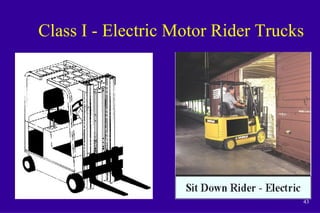
Commonly known as forklifts, pallet trucks, rider
trucks, forktrucks, or lifttrucks.
Can be powered through electric or combustion
engines.
5
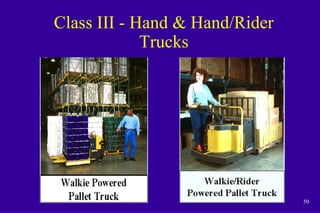
Scope of Standard
The scope provisions of 1910.178(a), which are based
on ANSI B56.1 - 1969, remain in effect and cover:
... fork trucks, tractors, platform lift trucks,
motorized hand trucks, and other specialized
industrial trucks powered by electric motors or
internal combustion engines.
It does not apply to compressed air or nonflammable
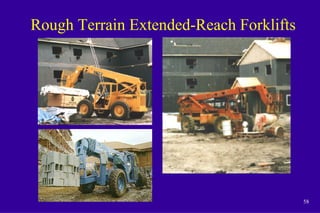
compressed gas-operated industrial trucks, farm
vehicles, nor vehicles intended primarily for earth
moving or over-the-road hauling.
This scope covers general industry, construction and
shipyards.
6
Scope of Standard (continued)
For marine terminal and longshoring industries,
all powered industrial trucks are covered, no
matter what specialized name they are given.
This includes, but is not limited to, straddle
carriers, hustlers, toploaders, container reach
stackers, and other vehicles that carry, push,
pull, lift, or tier loads.
7
Reasons for New Standard
Powered industrial truck accidents cause
approximately 100 fatalities and 36,340 serious
injuries in general industry and construction
annually.
It is estimated that 20 - 25% of the accidents are,
at least in part, caused by inadequate training.
8
Additional Reasons for New
Standard
Updated consensus standards have been published.
OSHA has been petitioned to improve the
requirements for industrial truck training.
Advisory Committee on Construction Safety and
Health has recommended improving the standard.
Resolutions have been introduced in the Senate and
House urging OSHA to revise its outdated standard.
9
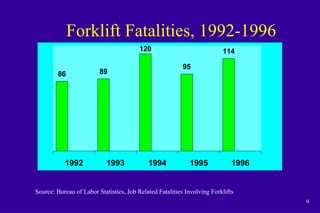
Forklift Fatalities, 1992-1996
Source: Bureau of Labor Statistics, Job Related Fatalities Involving Forklifts
86 89
120
95
114
1992 1993 1994 1995 1996
10
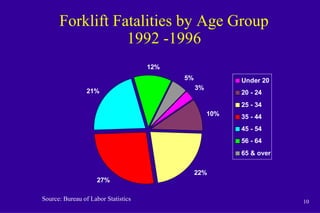
Forklift Fatalities by Age Group
1992 -1996
3%
10%
22%
21%
12%
5%
27%
Under 20
20 - 24
25 - 34
35 - 44
45 - 54
56 - 64
65 & over
Source: Bureau of Labor Statistics
11
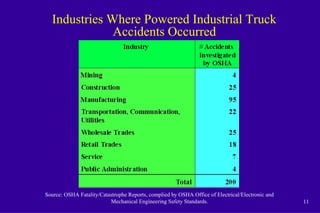
Industries Where Powered Industrial Truck
Accidents Occurred
Source: OSHA Fatality/Catastrophe Reports, complied by OSHA Office of Electrical/Electronic and
Mechanical Engineering Safety Standards.
12
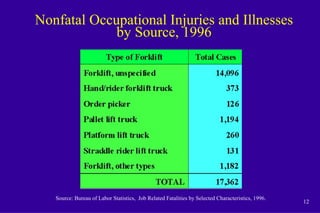
Source: Bureau of Labor Statistics, Job Related Fatalities by Selected Characteristics, 1996.
Nonfatal Occupational Injuries and Illnesses
by Source, 1996
13
Background
The previous OSHA standards, while requiring
operator training, did not define the type of
training or authorization required.
March 15, 1988 - Industrial Truck Association
(ITA) petitioned OSHA for specific training
requirements.
14
Background (continued)
American National Standards Institute (ANSI),
in cooperation with ASME, has revised its
standard 4 times, including current lifttruck
technology and specific training topics.
15
Background (continued)
OSHA published a proposed ruling on March 14,
1995 for General Industry, Shipyard, Marine
Terminals, and Longshoring regulations, adding
specific training requirements.
On January 30, 1996, OSHA proposed a revision of
the construction standards, mandating the
development of an operator training program based
on the prior knowledge and skills of the trainee and
requiring a periodic evaluation.
16
Final Rule
OSHA published the final rule for Powered
Industrial Truck Operator Training on
December 1, 1998.
The effective date is March 1, 1999. Start-up
dates are included in paragraph (l)(7).
It applies to all industries except agricultural
operations.
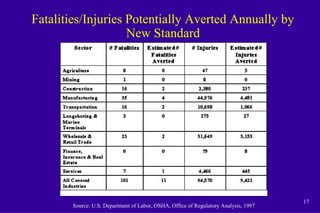
OSHA estimates that the new rule will prevent
11 deaths and 9,422 injuries per year.
17
Fatalities/Injuries Potentially Averted Annually by
New Standard
Source: U.S. Department of Labor, OSHA, Office of Regulatory Analysis, 1997
18
Performance-Oriented Requirements
The powered industrial truck operator training
requirements are performance-oriented to permit
employers to tailor a training program to the
characteristics of their workplaces and the
particular types of powered industrial trucks
operated.
19
Revised Operator Training
Requirements
General Industry: 1910.178 is amended by revising
paragraph (l) and adding Appendix A.
Shipyard Employment: New section 1915.120 and
Appendix A are added.
Marine Terminals: Section 1917.1 is amended by adding
new paragraph (a)(2)(xiv) and Appendix A.
Longshoring: Section 1918.1 is amended by adding new
paragraph (b)(10) and Appendix A.
Construction: 1926.602 is amended by adding new
paragraph (d) and Appendix A.
20
Operator Training
Safe operations
The employer shall ensure that each powered
industrial truck operator is competent to operate a
powered industrial truck safely, as demonstrated by
successful completion of the training and evaluation
specified in the OSHA standard.
Prior to permitting an employee to operate a powered
industrial truck (except for training purposes), the
employer shall ensure that each operator has
successfully completed the required training (or
previously received appropriate training).
21
Training Program Implementation
Trainees may operate a powered industrial truck
only:
Under direct supervision of a person who has the
knowledge, training, and experience to train
operators and evaluate their competence; and,
Where such operation does not endanger the
trainee or other employees.
22
Training Program Implementation
(continued)
Training shall consist of a combination of:Training shall consist of a combination of:
Formal instruction (e.g., lecture, discussion,Formal instruction (e.g., lecture, discussion,
interactive computer learning, written material),interactive computer learning, written material),
Practical training (demonstrations and exercisesPractical training (demonstrations and exercises
performed by the trainee), andperformed by the trainee), and
Evaluation of the operator’s performance in theEvaluation of the operator’s performance in the
workplaceworkplace
23
Training Program Implementation
(continued)
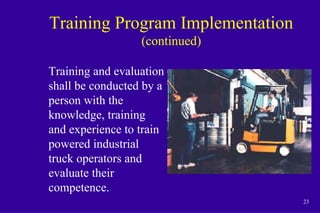
Training and evaluation
shall be conducted by a
person with the
knowledge, training
and experience to train
powered industrial
truck operators and
evaluate their
competence.
24
Training Program Content
Operators shall receive initial training in the
following topics, except in topics which the
employer can demonstrate are not applicable to
safe operation in the employer’s workplace.
Truck-related topics
Workplace-related topics
The requirements of the standard
25
Training Program Content (continued)
Operating instructions,
warnings and precautions
Differences from
automobile
Controls and
instrumentation
Engine or motor
operation
Steering and
maneuvering
Visibility
Truck-related topics
Fork and attachment
adaptation, operation, use
Vehicle capacity and
stability
Vehicle inspection and
maintenance that the
operator will be required to
perform
Refueling/Charging/
Recharging batteries
Operating limitations
Other instructions, etc.
26
Training Program Content (continued)
Surface conditions
Composition and stability
of loads
Load manipulation,
stacking, unstacking
Pedestrian traffic
Narrow aisles and
restricted areas
Operating in hazardous
(classified) locations
Operating on ramps and
sloped surfaces
Potentially hazardous
environmental conditions
Operating in closed
environments or other areas
where poor ventilation or
maintenance could cause
carbon monoxide or diesel
exhaust buildup
Workplace-related topics
27
Training Program Content (continued)
The requirements of the OSHA standard on
powered industrial trucks must also be included
in the initial operator training program.
28
Refresher Training and Evaluation
Refresher training, including an evaluation of the
effectiveness of that training, shall be conducted to
ensure that the operator has the knowledge and
skills needed to operate the powered industrial truck
safely.
Refresher training required when:
Unsafe operation
Accident or near-miss
Evaluation indicates need
Different type of equipment introduced
Workplace condition changes
29
Refresher Training and Evaluation
(continued)
An evaluation of each powered industrial truck
operator’s performance must be conducted:
After initial training,
After refresher training, and
At least once every three years
30
Avoidance of Duplicative Training
If an operator has previously received training in
a topic specified in this section, and the training
is appropriate to the truck and working
conditions encountered, additional training in
that topic is not required if the operator has been
evaluated and found competent to operate the
truck safely.
31
Certification
The employer shall certify that each operator
has been trained and evaluated as required by
the standard.
Certification shall include:
Name of operator
Date of training
Date of evaluation
Identity of person(s) performing the training or
evaluation
32
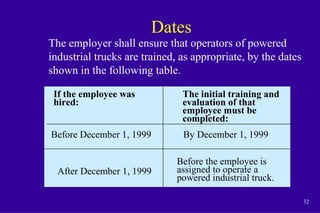
Dates
The employer shall ensure that operators of powered
industrial trucks are trained, as appropriate, by the dates
shown in the following table.
If the employee was
hired:
The initial training and
evaluation of that
employee must be
completed:
Before December 1, 1999 By December 1, 1999
After December 1, 1999
Before the employee is
assigned to operate a
powered industrial truck.
33
Appendix A - Stability of Powered
Industrial Trucks
Appendix A provides non-mandatory guidance
to assist employers in implementing the
standard.
This appendix does not add to, alter, or reduce
the requirements of this section.
34
Appendix A - Stability of Powered
Industrial Trucks
Definitions
General
Basic Principles
Stability Triangle
Longitudinal Stability
Lateral Stability
Dynamic Stability
35
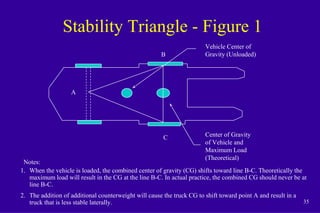
A
B
C
Vehicle Center of
Gravity (Unloaded)
Center of Gravity
of Vehicle and
Maximum Load
(Theoretical)
Stability Triangle - Figure 1
Notes:
1. When the vehicle is loaded, the combined center of gravity (CG) shifts toward line B-C. Theoretically the
maximum load will result in the CG at the line B-C. In actual practice, the combined CG should never be at
line B-C.
2. The addition of additional counterweight will cause the truck CG to shift toward point A and result in a
truck that is less stable laterally.
36
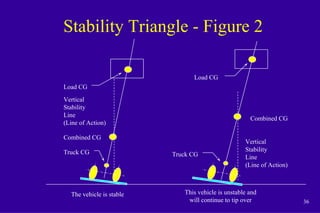
Load CG
Vertical
Stability
Line
(Line of Action)
Combined CG
Truck CG
Load CG
Combined CG
Vertical
Stability
Line
(Line of Action)
Truck CG
The vehicle is stable This vehicle is unstable and
will continue to tip over
Stability Triangle - Figure 2
37
Effective Powered Industrial Truck
Operator Training Program
Four major areas of concern must be addressed:
The general hazards that apply to the operation of all
or most powered industrial trucks;
The hazards associated with the operation of
particular types of trucks;
The hazards of workplaces generally; and,
The hazards of the particular workplace where the
vehicle operates.
38
Types of Powered Industrial Trucks
There are many different types of powered
industrial trucks covered by the OSHA standard.
Commonly used types include:
High lift trucks, counterbalanced trucks, cantilever trucks,
rider trucks, forklift trucks, high lift trucks, high lift platform
trucks, low lift trucks, motorized hand trucks, pallet trucks,
straddle trucks, reach rider trucks, high lift order picker
trucks, motorized hand/rider trucks, and counterbalanced
front/side loader lift trucks.
A single type of truck can only be described by
calling it by all of its characteristics, (e.g., a high
lift, counterbalanced, sit down rider truck).
39
Unique Characteristics of Powered
Industrial Trucks
Each type of powered industrial truck has its
own unique characteristics and some inherent
hazards.
To be effective, training must address the unique
characteristics of the type of vehicle the
employee is being trained to operate.
40
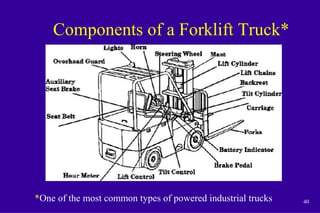
Components of a Forklift Truck*
*One of the most common types of powered industrial trucks
41
Classes of Commonly-Used Powered
Industrial Trucks*
The Industrial Truck Association has placed powered
industrial trucks into 7 classes.
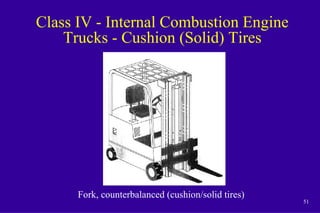
Class I - Electric motor rider trucks
Class II - Electric motor narrow aisle trucks
Class III - Electric motor hand trucks or hand/rider trucks
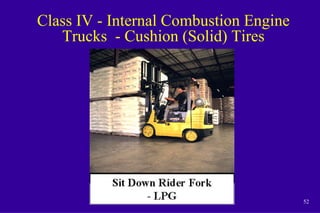
Class IV - Internal combustion engine trucks (solid/cushion
tires)
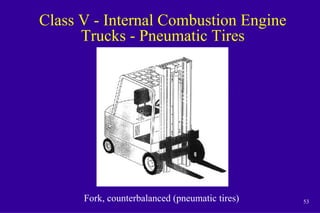
Class V - Internal combustion engine trucks (pneumatic tires)
Class VI - Electric and internal combustion engine tractors
Class VII - Rough terrain forklift trucks
* Note that this classification refers to commonly-used vehicles and does not
include all powered industrial trucks covered by the OSHA standard.
42
Class I - Electric Motor Rider Trucks
Counterbalanced rider type, stand up
Three wheel electric trucks, sit-down
Counterbalanced rider type, cushion tires, sit-
down (high and low platform)
Counterbalanced rider, pneumatic tire, sit-down
(high and low platform)
43
Class I - Electric Motor Rider Trucks
44
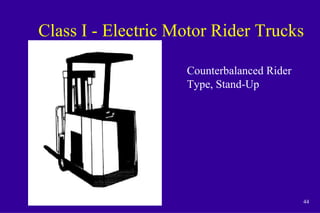
Class I - Electric Motor Rider Trucks
Counterbalanced Rider
Type, Stand-Up
45
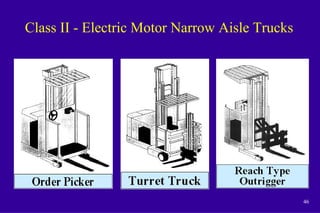
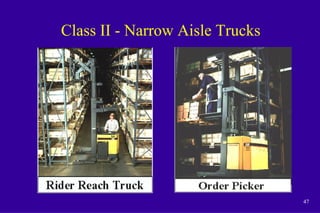
Class II - Electric Motor Narrow Aisle
Trucks
High lift straddle
Order picker
Reach type outrigger
Side loaders, turret trucks, swing mast and
convertible turret/stock pickers
Low lift pallet and platform (rider)
46
Class II - Electric Motor Narrow Aisle Trucks
47
Class II - Narrow Aisle Trucks
48
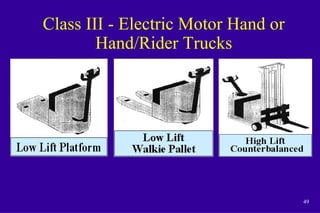
Class III - Electric Motor Hand or
Hand/Rider Trucks
Low lift platform
Low lift walkie pallet
Reach type outrigger
High lift straddle
High lift counterbalanced
Low lift walkie/rider pallet
49
Class III - Electric Motor Hand or
Hand/Rider Trucks
50
Class III - Hand & Hand/Rider
Trucks
51
Class IV - Internal Combustion Engine
Trucks - Cushion (Solid) Tires
Fork, counterbalanced (cushion/solid tires)
52
Class IV - Internal Combustion Engine
Trucks - Cushion (Solid) Tires
53
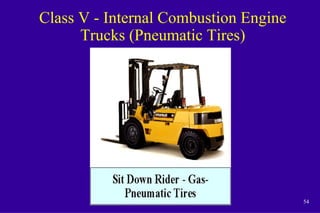
Class V - Internal Combustion Engine
Trucks - Pneumatic Tires
Fork, counterbalanced (pneumatic tires)
54
Class V - Internal Combustion Engine
Trucks (Pneumatic Tires)
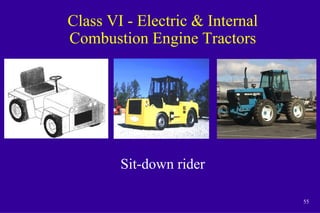
55
Class VI - Electric & Internal
Combustion Engine Tractors
Sit-down rider
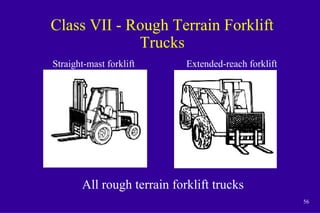
56
Class VII - Rough Terrain Forklift
Trucks
Straight-mast forklift Extended-reach forklift
All rough terrain forklift trucks
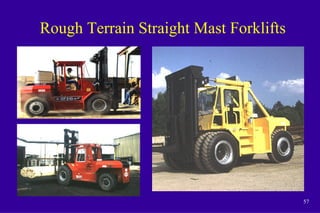
57
Rough Terrain Straight Mast Forklifts
58
Rough Terrain Extended-Reach Forklifts
59
Some Types of Powered Industrial Trucks
Used in Maritime
Container top handlers
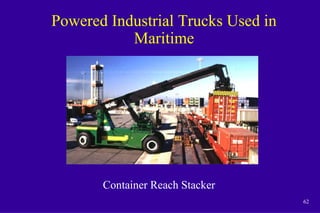
Container reach stackers
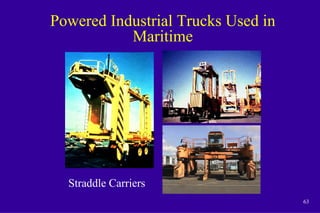
Straddle carriers
Semi-tractors/ Utility
vehicles
Sidehandlers
Combination vacuum lifts
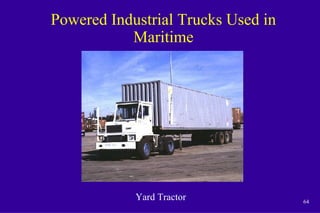
Yard tractors
The following types of vehicles are
covered by the OSHA standard if the
vehicles carry, push, pull, lift, or tier loads.
60
Powered Industrial Trucks Used in
Maritime
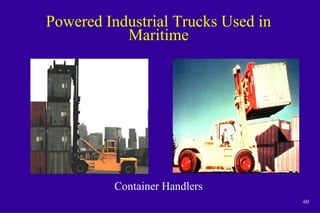
Container Handlers
61
Powered Industrial Trucks Used in
Maritime
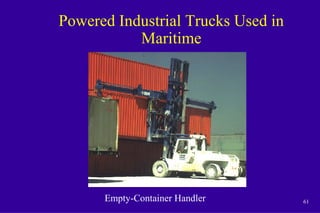
Empty-Container Handler
62
Powered Industrial Trucks Used in
Maritime
Container Reach Stacker
63
Powered Industrial Trucks Used in
Maritime
Straddle Carriers
64
Powered Industrial Trucks Used in
Maritime
Yard Tractor

Powered industrial trucks osha std

  • 1.
    Powered Industrial Trucks- Operator Training 1910.178 (l)1910.178 (l) 1915.120 (a)1915.120 (a) 1917.1 (a)(2)(xiv)1917.1 (a)(2)(xiv) 1918.1 (b)(10)1918.1 (b)(10) 1926.602 (d)1926.602 (d)
  • 2.
    2 Disclaimer This presentation isintended as a resource for providing training on OSHA’s revised powered industrial truck operator standards. It is not a substitute for any of the provisions of the Occupational Safety and Health Act of 1970, or for any standards issued by the U.S. Department of Labor’s Occupational Safety and Health Administration (OSHA). It is also not a substitute for a powered industrial truck operator training program.
  • 3.
    3 Acknowledgment OSHA’s Office ofTraining and Education wishes to acknowledge the following for contributing some of the graphics used in this presentation: Caterpillar Lift Trucks Mason Contractors Association of America Industrial Truck Association State of Utah Labor Commission - Occupational Safety & Health Division Steamship Trade Association of Baltimore Taylor Machine Works, Inc. UAW - Ford National Joint Committee on Health and Safety Appearance of products does not imply endorsement by the U.S. Department of Labor.
  • 4.
    4 Powered Industrial Truck -Definition A mobile, power-propelled truck used to carry, push, pull, lift, stack or tier materials. [American Society of Mechanical Engineers (ASME) definition] Excluded are vehicles used for earth moving and over- the-road hauling. Commonly known as forklifts, pallet trucks, rider trucks, forktrucks, or lifttrucks. Can be powered through electric or combustion engines.
  • 5.
    5 Scope of Standard Thescope provisions of 1910.178(a), which are based on ANSI B56.1 - 1969, remain in effect and cover: ... fork trucks, tractors, platform lift trucks, motorized hand trucks, and other specialized industrial trucks powered by electric motors or internal combustion engines. It does not apply to compressed air or nonflammable compressed gas-operated industrial trucks, farm vehicles, nor vehicles intended primarily for earth moving or over-the-road hauling. This scope covers general industry, construction and shipyards.
  • 6.
    6 Scope of Standard(continued) For marine terminal and longshoring industries, all powered industrial trucks are covered, no matter what specialized name they are given. This includes, but is not limited to, straddle carriers, hustlers, toploaders, container reach stackers, and other vehicles that carry, push, pull, lift, or tier loads.
  • 7.
    7 Reasons for NewStandard Powered industrial truck accidents cause approximately 100 fatalities and 36,340 serious injuries in general industry and construction annually. It is estimated that 20 - 25% of the accidents are, at least in part, caused by inadequate training.
  • 8.
    8 Additional Reasons forNew Standard Updated consensus standards have been published. OSHA has been petitioned to improve the requirements for industrial truck training. Advisory Committee on Construction Safety and Health has recommended improving the standard. Resolutions have been introduced in the Senate and House urging OSHA to revise its outdated standard.
  • 9.
    9 Forklift Fatalities, 1992-1996 Source:Bureau of Labor Statistics, Job Related Fatalities Involving Forklifts 86 89 120 95 114 1992 1993 1994 1995 1996
  • 10.
    10 Forklift Fatalities byAge Group 1992 -1996 3% 10% 22% 21% 12% 5% 27% Under 20 20 - 24 25 - 34 35 - 44 45 - 54 56 - 64 65 & over Source: Bureau of Labor Statistics
  • 11.
    11 Industries Where PoweredIndustrial Truck Accidents Occurred Source: OSHA Fatality/Catastrophe Reports, complied by OSHA Office of Electrical/Electronic and Mechanical Engineering Safety Standards.
  • 12.
    12 Source: Bureau ofLabor Statistics, Job Related Fatalities by Selected Characteristics, 1996. Nonfatal Occupational Injuries and Illnesses by Source, 1996
  • 13.
    13 Background The previous OSHAstandards, while requiring operator training, did not define the type of training or authorization required. March 15, 1988 - Industrial Truck Association (ITA) petitioned OSHA for specific training requirements.
  • 14.
    14 Background (continued) American NationalStandards Institute (ANSI), in cooperation with ASME, has revised its standard 4 times, including current lifttruck technology and specific training topics.
  • 15.
    15 Background (continued) OSHA publisheda proposed ruling on March 14, 1995 for General Industry, Shipyard, Marine Terminals, and Longshoring regulations, adding specific training requirements. On January 30, 1996, OSHA proposed a revision of the construction standards, mandating the development of an operator training program based on the prior knowledge and skills of the trainee and requiring a periodic evaluation.
  • 16.
    16 Final Rule OSHA publishedthe final rule for Powered Industrial Truck Operator Training on December 1, 1998. The effective date is March 1, 1999. Start-up dates are included in paragraph (l)(7). It applies to all industries except agricultural operations. OSHA estimates that the new rule will prevent 11 deaths and 9,422 injuries per year.
  • 17.
    17 Fatalities/Injuries Potentially AvertedAnnually by New Standard Source: U.S. Department of Labor, OSHA, Office of Regulatory Analysis, 1997
  • 18.
    18 Performance-Oriented Requirements The poweredindustrial truck operator training requirements are performance-oriented to permit employers to tailor a training program to the characteristics of their workplaces and the particular types of powered industrial trucks operated.
  • 19.
    19 Revised Operator Training Requirements GeneralIndustry: 1910.178 is amended by revising paragraph (l) and adding Appendix A. Shipyard Employment: New section 1915.120 and Appendix A are added. Marine Terminals: Section 1917.1 is amended by adding new paragraph (a)(2)(xiv) and Appendix A. Longshoring: Section 1918.1 is amended by adding new paragraph (b)(10) and Appendix A. Construction: 1926.602 is amended by adding new paragraph (d) and Appendix A.
  • 20.
    20 Operator Training Safe operations Theemployer shall ensure that each powered industrial truck operator is competent to operate a powered industrial truck safely, as demonstrated by successful completion of the training and evaluation specified in the OSHA standard. Prior to permitting an employee to operate a powered industrial truck (except for training purposes), the employer shall ensure that each operator has successfully completed the required training (or previously received appropriate training).
  • 21.
    21 Training Program Implementation Traineesmay operate a powered industrial truck only: Under direct supervision of a person who has the knowledge, training, and experience to train operators and evaluate their competence; and, Where such operation does not endanger the trainee or other employees.
  • 22.
    22 Training Program Implementation (continued) Trainingshall consist of a combination of:Training shall consist of a combination of: Formal instruction (e.g., lecture, discussion,Formal instruction (e.g., lecture, discussion, interactive computer learning, written material),interactive computer learning, written material), Practical training (demonstrations and exercisesPractical training (demonstrations and exercises performed by the trainee), andperformed by the trainee), and Evaluation of the operator’s performance in theEvaluation of the operator’s performance in the workplaceworkplace
  • 23.
    23 Training Program Implementation (continued) Trainingand evaluation shall be conducted by a person with the knowledge, training and experience to train powered industrial truck operators and evaluate their competence.
  • 24.
    24 Training Program Content Operatorsshall receive initial training in the following topics, except in topics which the employer can demonstrate are not applicable to safe operation in the employer’s workplace. Truck-related topics Workplace-related topics The requirements of the standard
  • 25.
    25 Training Program Content(continued) Operating instructions, warnings and precautions Differences from automobile Controls and instrumentation Engine or motor operation Steering and maneuvering Visibility Truck-related topics Fork and attachment adaptation, operation, use Vehicle capacity and stability Vehicle inspection and maintenance that the operator will be required to perform Refueling/Charging/ Recharging batteries Operating limitations Other instructions, etc.
  • 26.
    26 Training Program Content(continued) Surface conditions Composition and stability of loads Load manipulation, stacking, unstacking Pedestrian traffic Narrow aisles and restricted areas Operating in hazardous (classified) locations Operating on ramps and sloped surfaces Potentially hazardous environmental conditions Operating in closed environments or other areas where poor ventilation or maintenance could cause carbon monoxide or diesel exhaust buildup Workplace-related topics
  • 27.
    27 Training Program Content(continued) The requirements of the OSHA standard on powered industrial trucks must also be included in the initial operator training program.
  • 28.
    28 Refresher Training andEvaluation Refresher training, including an evaluation of the effectiveness of that training, shall be conducted to ensure that the operator has the knowledge and skills needed to operate the powered industrial truck safely. Refresher training required when: Unsafe operation Accident or near-miss Evaluation indicates need Different type of equipment introduced Workplace condition changes
  • 29.
    29 Refresher Training andEvaluation (continued) An evaluation of each powered industrial truck operator’s performance must be conducted: After initial training, After refresher training, and At least once every three years
  • 30.
    30 Avoidance of DuplicativeTraining If an operator has previously received training in a topic specified in this section, and the training is appropriate to the truck and working conditions encountered, additional training in that topic is not required if the operator has been evaluated and found competent to operate the truck safely.
  • 31.
    31 Certification The employer shallcertify that each operator has been trained and evaluated as required by the standard. Certification shall include: Name of operator Date of training Date of evaluation Identity of person(s) performing the training or evaluation
  • 32.
    32 Dates The employer shallensure that operators of powered industrial trucks are trained, as appropriate, by the dates shown in the following table. If the employee was hired: The initial training and evaluation of that employee must be completed: Before December 1, 1999 By December 1, 1999 After December 1, 1999 Before the employee is assigned to operate a powered industrial truck.
  • 33.
    33 Appendix A -Stability of Powered Industrial Trucks Appendix A provides non-mandatory guidance to assist employers in implementing the standard. This appendix does not add to, alter, or reduce the requirements of this section.
  • 34.
    34 Appendix A -Stability of Powered Industrial Trucks Definitions General Basic Principles Stability Triangle Longitudinal Stability Lateral Stability Dynamic Stability
  • 35.
    35 A B C Vehicle Center of Gravity(Unloaded) Center of Gravity of Vehicle and Maximum Load (Theoretical) Stability Triangle - Figure 1 Notes: 1. When the vehicle is loaded, the combined center of gravity (CG) shifts toward line B-C. Theoretically the maximum load will result in the CG at the line B-C. In actual practice, the combined CG should never be at line B-C. 2. The addition of additional counterweight will cause the truck CG to shift toward point A and result in a truck that is less stable laterally.
  • 36.
    36 Load CG Vertical Stability Line (Line ofAction) Combined CG Truck CG Load CG Combined CG Vertical Stability Line (Line of Action) Truck CG The vehicle is stable This vehicle is unstable and will continue to tip over Stability Triangle - Figure 2
  • 37.
    37 Effective Powered IndustrialTruck Operator Training Program Four major areas of concern must be addressed: The general hazards that apply to the operation of all or most powered industrial trucks; The hazards associated with the operation of particular types of trucks; The hazards of workplaces generally; and, The hazards of the particular workplace where the vehicle operates.
  • 38.
    38 Types of PoweredIndustrial Trucks There are many different types of powered industrial trucks covered by the OSHA standard. Commonly used types include: High lift trucks, counterbalanced trucks, cantilever trucks, rider trucks, forklift trucks, high lift trucks, high lift platform trucks, low lift trucks, motorized hand trucks, pallet trucks, straddle trucks, reach rider trucks, high lift order picker trucks, motorized hand/rider trucks, and counterbalanced front/side loader lift trucks. A single type of truck can only be described by calling it by all of its characteristics, (e.g., a high lift, counterbalanced, sit down rider truck).
  • 39.
    39 Unique Characteristics ofPowered Industrial Trucks Each type of powered industrial truck has its own unique characteristics and some inherent hazards. To be effective, training must address the unique characteristics of the type of vehicle the employee is being trained to operate.
  • 40.
    40 Components of aForklift Truck* *One of the most common types of powered industrial trucks
  • 41.
    41 Classes of Commonly-UsedPowered Industrial Trucks* The Industrial Truck Association has placed powered industrial trucks into 7 classes. Class I - Electric motor rider trucks Class II - Electric motor narrow aisle trucks Class III - Electric motor hand trucks or hand/rider trucks Class IV - Internal combustion engine trucks (solid/cushion tires) Class V - Internal combustion engine trucks (pneumatic tires) Class VI - Electric and internal combustion engine tractors Class VII - Rough terrain forklift trucks * Note that this classification refers to commonly-used vehicles and does not include all powered industrial trucks covered by the OSHA standard.
  • 42.
    42 Class I -Electric Motor Rider Trucks Counterbalanced rider type, stand up Three wheel electric trucks, sit-down Counterbalanced rider type, cushion tires, sit- down (high and low platform) Counterbalanced rider, pneumatic tire, sit-down (high and low platform)
  • 43.
    43 Class I -Electric Motor Rider Trucks
  • 44.
    44 Class I -Electric Motor Rider Trucks Counterbalanced Rider Type, Stand-Up
  • 45.
    45 Class II -Electric Motor Narrow Aisle Trucks High lift straddle Order picker Reach type outrigger Side loaders, turret trucks, swing mast and convertible turret/stock pickers Low lift pallet and platform (rider)
  • 46.
    46 Class II -Electric Motor Narrow Aisle Trucks
  • 47.
    47 Class II -Narrow Aisle Trucks
  • 48.
    48 Class III -Electric Motor Hand or Hand/Rider Trucks Low lift platform Low lift walkie pallet Reach type outrigger High lift straddle High lift counterbalanced Low lift walkie/rider pallet
  • 49.
    49 Class III -Electric Motor Hand or Hand/Rider Trucks
  • 50.
    50 Class III -Hand & Hand/Rider Trucks
  • 51.
    51 Class IV -Internal Combustion Engine Trucks - Cushion (Solid) Tires Fork, counterbalanced (cushion/solid tires)
  • 52.
    52 Class IV -Internal Combustion Engine Trucks - Cushion (Solid) Tires
  • 53.
    53 Class V -Internal Combustion Engine Trucks - Pneumatic Tires Fork, counterbalanced (pneumatic tires)
  • 54.
    54 Class V -Internal Combustion Engine Trucks (Pneumatic Tires)
  • 55.
    55 Class VI -Electric & Internal Combustion Engine Tractors Sit-down rider
  • 56.
    56 Class VII -Rough Terrain Forklift Trucks Straight-mast forklift Extended-reach forklift All rough terrain forklift trucks
  • 57.
  • 58.
  • 59.
    59 Some Types ofPowered Industrial Trucks Used in Maritime Container top handlers Container reach stackers Straddle carriers Semi-tractors/ Utility vehicles Sidehandlers Combination vacuum lifts Yard tractors The following types of vehicles are covered by the OSHA standard if the vehicles carry, push, pull, lift, or tier loads.
  • 60.
    60 Powered Industrial TrucksUsed in Maritime Container Handlers
  • 61.
    61 Powered Industrial TrucksUsed in Maritime Empty-Container Handler
  • 62.
    62 Powered Industrial TrucksUsed in Maritime Container Reach Stacker
  • 63.
    63 Powered Industrial TrucksUsed in Maritime Straddle Carriers
  • 64.
    64 Powered Industrial TrucksUsed in Maritime Yard Tractor