Quantitative Risk Assessment
Methodology
Introduction
Purpose of QRA:
1. Identify and quantify hazards and risks
2. Determine individual risks (IR)
3. Recommend measures to minimize/eliminate
hazards/risks
4. Facilitate development of emergency response plans
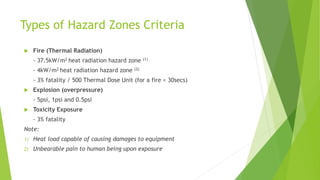
Types of Hazard Zones Criteria
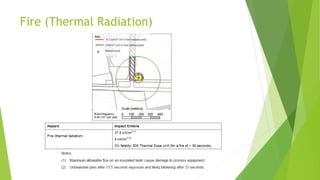
 Fire (Thermal Radiation)
- 37.5kW/m2 heat radiation hazard zone (1)
- 4kW/m2 heat radiation hazard zone (2)
- 3% fatality / 500 Thermal Dose Unit (for a fire < 30secs)
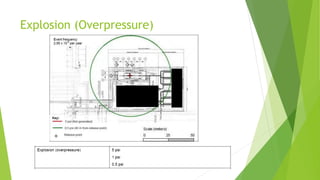
 Explosion (overpressure)
- 5psi, 1psi and 0.5psi
 Toxicity Exposure
- 3% fatality
Note:
1) Heat load capable of causing damages to equipment
2) Unbearable pain to human being upon exposure
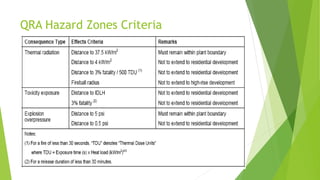
QRA Hazard Zones Criteria
Individual Risk Criteria
Requirements of QRA Report
1. Hazard Identification
2. Base Frequency
3. Modified Frequency
4. Consequence Analysis
5. Risk Summation and Evaluation
6. Recommended Risk Mitigation
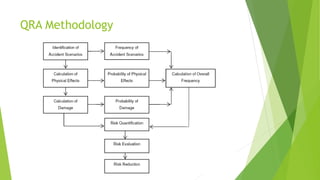
QRA Methodology
1. Hazard Identification
 Hazards of natural gas
 Occupational hazards
 Other hazards:
 Earthquake
 Lightning
 Aircraft crash
 Heavy vehicle impact
 External fire
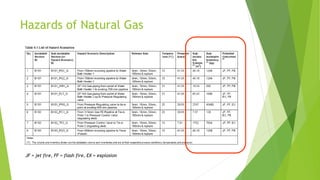
Hazards of Natural Gas
JF = jet fire, FF = flash fire, EX = explosion
2. Base Frequency
From UKOPA Pipeline Fault Database
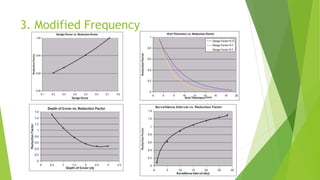
3. Modified Frequency
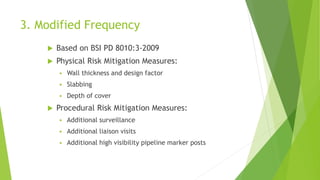
 Based on BSI PD 8010:3-2009
 Physical Risk Mitigation Measures:
 Wall thickness and design factor
 Slabbing
 Depth of cover
 Procedural Risk Mitigation Measures:
 Additional surveillance
 Additional liaison visits
 Additional high visibility pipeline marker posts
3. Modified Frequency
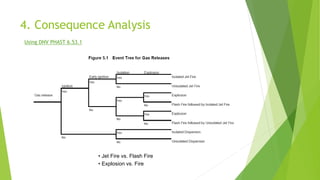
4. Consequence Analysis
• Jet Fire vs. Flash Fire
• Explosion vs. Fire
Using DNV PHAST 6.53.1
Fire (Thermal Radiation)
Explosion (Overpressure)
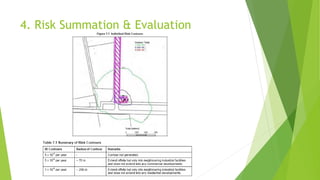
4. Risk Summation & Evaluation
5. Recommended Risk Mitigation
 Provide adequate ventilation
 Install suitable gas monitoring system
 Update relevant operating procedures e.g. maintenance
and inspection
 Update Emergency Response Plan (ERP)
 Communicate updated procedures and ERP to
maintenance personnel

QRA

  • 1.
  • 2.
    Introduction Purpose of QRA: 1.Identify and quantify hazards and risks 2. Determine individual risks (IR) 3. Recommend measures to minimize/eliminate hazards/risks 4. Facilitate development of emergency response plans
  • 3.
    Types of HazardZones Criteria  Fire (Thermal Radiation) - 37.5kW/m2 heat radiation hazard zone (1) - 4kW/m2 heat radiation hazard zone (2) - 3% fatality / 500 Thermal Dose Unit (for a fire < 30secs)  Explosion (overpressure) - 5psi, 1psi and 0.5psi  Toxicity Exposure - 3% fatality Note: 1) Heat load capable of causing damages to equipment 2) Unbearable pain to human being upon exposure
  • 4.
  • 5.
  • 6.
    Requirements of QRAReport 1. Hazard Identification 2. Base Frequency 3. Modified Frequency 4. Consequence Analysis 5. Risk Summation and Evaluation 6. Recommended Risk Mitigation
  • 7.
  • 8.
    1. Hazard Identification Hazards of natural gas  Occupational hazards  Other hazards:  Earthquake  Lightning  Aircraft crash  Heavy vehicle impact  External fire
  • 9.
    Hazards of NaturalGas JF = jet fire, FF = flash fire, EX = explosion
  • 10.
    2. Base Frequency FromUKOPA Pipeline Fault Database
  • 11.
    3. Modified Frequency Based on BSI PD 8010:3-2009  Physical Risk Mitigation Measures:  Wall thickness and design factor  Slabbing  Depth of cover  Procedural Risk Mitigation Measures:  Additional surveillance  Additional liaison visits  Additional high visibility pipeline marker posts
  • 12.
  • 13.
  • 14.
    4. Consequence Analysis •Jet Fire vs. Flash Fire • Explosion vs. Fire Using DNV PHAST 6.53.1
  • 15.
  • 16.
  • 17.
    4. Risk Summation& Evaluation
  • 18.
    5. Recommended RiskMitigation  Provide adequate ventilation  Install suitable gas monitoring system  Update relevant operating procedures e.g. maintenance and inspection  Update Emergency Response Plan (ERP)  Communicate updated procedures and ERP to maintenance personnel