Field Operations Electrical
Safety Training
Centrilift
Objectives
 Be familiar with fundamental concepts of electricity
 Be able to recognise electrical hazards
 Understand the Level 3 Field Operations Electrical
Safety Procedure
 Understand your limitations
 Know how to do your job safely so as to minimise the
risks
Curriculum
 Introduction/Objectives
 Responsibilities
 Basics of Electricity
 Primary hazards of electricity
 Centrilift Definitions
 Pre-Job Electrical Safety Checklist
The Shocking Truth
ELECTRICITY
CAN
KILL
BACKGROUND
 It is the policy of BHI to conduct business
activities in a manner that does not harm people.
Every person has a responsibility to perform their
job in a safe manner.
 Electrocutions rank 5th in work related fatalities
(5%, based on 1996 data) about half involve low
voltage, below 600 volts.
 Centrilift has not had a fatality but we have had 4
to 6 serious electrical accidents/year.
YOUR Responsibilities
 You are responsible for the health & safety of
_______ and those around you.
 You must become familiar with the requirements
of the Field Ops. Electrical Safety Procedure.
 You must ______ your supervisor if you
encounter a task that is beyond your
competence.
 You must inspect, use & take appropriate care of
your assigned electrical & safety equipment.
 You are empowered to __________ activities
when uncontrolled hazards are encountered.
yourself
discontinue
notify
RESPONSIBILITIES
 Operation/Area Manager
 Implementation of the Level 3 Procedure
 Ensure F.S. Personnel are trained and competent
 Provide all required equipment (tools & test equipment)
 Supervisor
 Implementation of the Level 3 Procedure
 Provide training and assess competency of personnel
 Assign the work as outlined in the Electrical Competency Matrix (ECM)
 Issue PPE
 Field Service Personnel
 Adhere to the Level 3 Procedure
 Understand your limitations
 Utilize approved PPE & Tools
Water Analogy
One way to describe how electricity works is to compare it with
water, since they both share common traits.
Water under pressure moves at a rate of flow that depends on the
resistance caused by the water pipes.
Basic Principles of Electricity
Electricity acts in much the same way.
Pressure = Voltage (volts)
Flow = Current (amps)
Restriction of pipe = resistance (ohms)
Voltage, which is electrical pressure, moves
electrical current, or amperage, at a rate of flow
that depends on the "impedance" or electrical
resistance caused by the wires or other electrical
pathways.
Basic Principles of Electricity
As with water, the exact relationship between pressure, flow and
resistance can be calculated mathematically using a formula
known as "Ohm's Law.“
It looks like this:
V = I x R
V = VOLTAGE (electrical pressure in Volts).
I = CURRENT (Amperes or Amps)
R = RESISTANCE (Ohms)
Basic Principles of Electricity
Conductors and Insulators
Electricity flows easily through some materials and is blocked by
others.
 Insulators have a very high resistance to the flow of
electricity and are used to cover wiring and other electrical
components.
 Conductors have low resistance to electricity and are used for
wires, switches and electrical connections.
pics of insulator & conductor
Insulators such as glass, mica, rubber, or plastic used to
coat metals and other conductors help stop or reduce the
flow of electrical current.
Basic Principles of Electricity
Electrical Potential
 The magnitude of current flowing from an energy source is the source's
electrical potential. Only when two unequal potentials are connected
by a conductor is a circuit created.
 Circuit direction is affected by the universal law which says that
electricity always flows from a higher to a lower voltage potential.
 Electricity may take multiple paths and it will flow through all possible
circuits, but the greatest amount of current will flow through the path of
least resistance. This is a key point in electrical safety since the human
body is made up of water, chemicals and materials that make it an
excellent conductor.
Diagram/drawing
Basic Principles of Electricity
 Bridging the gap between two different voltage levels with any
part of your body results in an electrical shock.
 Electrical shock is the magnitude of current flow that passes
through you when you are situated in an electrical circuit.
Basic Principles of Electricity
Grounding
One of the most important and least understood points in
electrical safety is the use of grounds and other circuit
protection devices.
Grounding is the act of providing a previously determined safe
path for stray electrical currents.
A properly installed ground offers a low resistance channel of
electricity to the ground. The most familiar type of ground is a
lighting rod. It attracts dangerous electrical energy and
conducts it harmlessly to the ground.
Basic Principles of Electricity
picture
Since 95% of all ground faults are caused by
malfunctions of equipment and electrical systems, tool
casings, machine enclosures and other conductive
materials that surround electrical lines must be safely
grounded. Double casings and properly installed
grounding connections help keep stray current and
electrical leakage from passing through any part of your
body.
Pic/diagram
Basic Principles of Electricity
System grounding protects electrical components
within the circuit from damage by excess voltage or
line surges.
 Bypassing grounds or careless handling of
connections can result in electrical fires and other
accidents that may be fatal.
Basic Principles of Electricity
Influential Variables. The effects of electric current
on the human body can vary depending on the
following:
Source characteristics (current, frequency, and
voltage of all electric energy sources).
Body impedance and the current's pathway through
the body.
How environmental conditions affect the body's
contact resistance.
Duration of the contact.
5 Primary Hazards of Electricity
1. Shock
 Direct Hazard
 Indirect Hazard
2. Burns
3. Arc-Blast
 Thermal Radiation
 Pressure Wave
 Projectiles
4. Explosions
5. Fires
The effects of electric current on the human body can vary depending on the following:
Source characteristics (current, frequency, and voltage of all electric energy sources).
Body impedance and the current's pathway through the body.
How environmental conditions affect the body's contact resistance.
Duration of the contact.
5 Primary Hazards of Electricity (Cont.)
Electric Shock
Electric shock occurs when the body becomes part of a
path through which electricity can flow (i. e., the circuit).
The resulting effect on the body can be either direct or
indirect:
 Direct. Injury or death can occur whenever electric current
flows through the human body. Currents of less than 30
milliamps (mA) can result in death.
 Indirect. Although the electric current through the human
body may be well below the values required to cause
noticeable injury, human reaction can result in falls from
ladders or scaffolds, or movement into operating machinery.
Such reaction can result in serious injury or death.
 graphic
5 Primary Hazards of Electricity
Electricity flowing
through the human
body can shock,
cause involuntary
muscle reaction,
paralyze muscles,
burn tissues and
organs, or kill. The
typical effects of
various electric
currents flowing
through the body on
the average 150-lb
male and 115-lb
female body are
given in the table.
5 Primary Hazards of Electricity
Electric Shock (Continued)
Delayed Effects. Damage to internal tissues may not be
apparent immediately after contact with the current. Internal
tissue swelling and edema are also possible.
Critical Path. The critical path of electricity through the body
is through the chest cavity. At levels noted in Table B-1, current
flowing from one hand to the other, from a hand to the opposite
foot, or from the head to either foot will pass through the chest
cavity paralyzing the respiratory or heart muscles, initiating
ventricular fibrillation and/or burning vital organs.
Biological Effects of Electrical Hazards
.
5 Primary Hazards of Electricity
Electric Shock (Continued)
Life-Threatening Effects. Charles F. Dalziel, "The Effects of Electric Shock on Man," , Ralph H.
Lee "Human Electrical Sheet" , and others have established the following criteria for the lethal
effects of electric shock:
 Currents in excess of a human's "let-go" current (>16 mA at 60 Hz) passing through the chest can
produce collapse, unconsciousness, asphyxia, and even death.
Currents (>30 mA at 60 Hz) flowing through the nerve centers that control breathing can produce
respiratory inhibition, which could last long after interruption of the current.
 Cardiac arrest can be caused by a current greater than or equal to 1 A at 60 Hz flowing in the
region of the heart.
 Relatively high currents (0.25-1 A) can produce fatal damage to the central nervous system.
 Currents greater than 5 A can produce deep body and organ burns, substantially raise body
temperature, and cause immediate death.
 Delayed reactions and even death can be caused by serious burns or other complications.
 The most dangerous current flow via the chest cavity is through the heart when the shock occurs
in the time relative to the normal heart rhythm. This current may cause ventricular fibrillation,
which is defined as repeated, rapid, uncoordinated contractions of the heart ventricles.
Ventricular fibrillation that alters the heart's normal rhythmic pumping action can be initiated by a
current flow of 75 mA or greater for 5 seconds (5-s) or more through the chest cavity.
5 Primary Hazards of Electricity
Burns
Although a current may not pass
through vital organs or nerve centers,
internal electrical burns can still occur.
These burns, which are a result of
heat generated by current flowing in
tissues, can be either at the skin
surface or in deeper layers (muscles,
bones, etc.), or both. Typically, tissues
damaged from this type of electrical
burn heal slowly.
Burns caused by electricity may be of
three types: electrical burns, arc
burns, and thermal contact burns.
5 Primary Hazards of Electricity
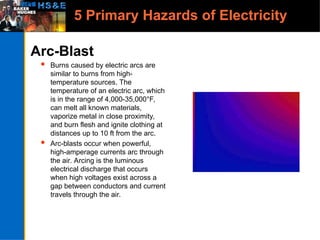
Arc-Blast
 Burns caused by electric arcs are
similar to burns from high-
temperature sources. The
temperature of an electric arc, which
is in the range of 4,000-35,000°F,
can melt all known materials,
vaporize metal in close proximity,
and burn flesh and ignite clothing at
distances up to 10 ft from the arc.
 Arc-blasts occur when powerful,
high-amperage currents arc through
the air. Arcing is the luminous
electrical discharge that occurs
when high voltages exist across a
gap between conductors and current
travels through the air.
5 Primary Hazards of Electricity
Arc-Blast
There are three primary hazards associated with an arc-blast.
 Thermal Radiation. In most cases, the radiated thermal energy is only part of the total
energy available from the arc. Numerous factors, including skin color, area of skin
exposed, type of clothing have an effect on degree of injury. Proper clothing, work
distances, and overcurrent protection can improve the chances of curable burns.
 Pressure Wave. A high- energy arcing fault can produce a considerable pressure wave.
Research has shown that a person 2 feet away from a 25,000 amp arc would experience
a force of approximately 480 pounds on the front of their body. In addition, such a
pressure wave can cause serious ear damage and memory loss due to mild
concussions. In some instances, the pressure wave may propel the victim away from the
arc- blast, reducing the exposure to the thermal energy. However, such rapid movement
could also cause serious physical injury.
 Projectiles. The pressure wave can propel relatively large objects over a considerable
distance. In some cases, the pressure wave has sufficient force to snap the heads of 3/
8- inch steel bolts and knock over ordinary construction walls.
The high- energy arc also causes many of the copper and aluminum components in the
electrical equipment to become molten. These "droplets" of molten metal can be
propelled great distances by the pressure wave. Although these droplets cool rapidly,
they can still be above temperatures capable of causing serious burns or igniting
ordinary clothing at distances of 10 feet or more. In many cases, the burning effect is
much worse than the injury from shrapnel effects of the droplets.
5 Primary Hazards of Electricity
Explosions
Explosions occur when electricity provides a source of ignition
for an explosive mixture in the atmosphere. Explosive
atmospheres can result from the accumulation of flammable
vapors or gases generated by nearby sources and processes.
Ignition can be due to overheated conductors or equipment, or
normal arcing (sparking) at switch contacts
animated pic
5 Primary Hazards of Electricity
Fires
Electricity is one of the most common causes of fire both in the
home and workplace. Defective or misused electrical equipment
is a major cause, with high resistance connections being one of
the primary sources of ignition. High resistance connections
occur where wires are improperly spliced or connected to other
components such as receptacle outlets and switches.
Shauna - pic
DEFINITIONS
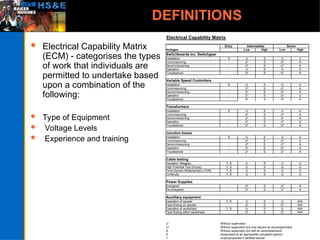
 Electrical Capability Matrix
(ECM) - categorises the types
of work that individuals are
permitted to undertake based
upon a combination of the
following:
 Type of Equipment
 Voltage Levels
 Experience and training
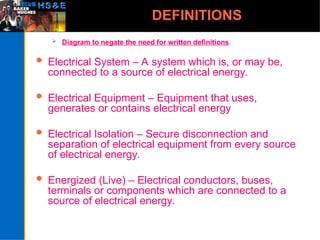
Electrical Capability Matrix
Entry
Voltages Low High Low High
Switchboards inc. Switchgear
Installation S U S U U
Commissioning - U* S U* A
Decommissioning - U* S U* A
Operation - U S U U
Troubleshoot - U* S U* A
Variable Speed Controllers
Installation S U S U U
Commissioning - U* S U* A
Decommissioning - U* S U* A
Operation - U* S U* U
Troubleshoot - U* S U* A
Transformers
Installation S U S U U
Commissioning - U* S U* A
Decommissioning - U* S U* A
Operation - U* S U* U
Troubleshoot - U* S U* A
Junction boxes
Installation S U S U U
Commissioning - U* S U* A
Decommissioning - U* S U* A
Operation - U* S U* U
Troubleshoot - U* S U* A
Cable testing
Insulation (Megger) T, S U S U U
High Potential Test (Hi-pot) T, S U S U U
Time Domain Reflectometry (TDR) T, S U S U U
Continuity T, S U S U U
Power Supplies
Energised - U* S U* A
De-energised - U* S U* A
Auxilliary equipment
Operation of spooler T, S U S U N/A
Fault finding on spooler - U* S U* N/A
Operation of workshack T, S U S U N/A
Fault finding within workshack - U* S U* N/A
U Without supervison
U* Without supervison but may require an accompaniment
A Without supervison but with an accompaniment
S Supervised by an appropriate competent person
T Unaccompanied if certified trained
Senior
Intermediate
DEFINITIONS
ENTRY LEVEL –
 No live work and not permitted to repair, maintain or fault
find on electrical equipment
 Personnel assigned to this level would not normally have
previous training or experience with electrical equipment
 Given specific training you will be authorized in the use of
high voltage / low power test equipment (i.e., megger/Hi-
pot)
DEFINITIONS
INTERMEDIATE LEVEL –
 Personnel who have had experience and training on low
voltage electrical power systems
 Personnel assigned to this level are authorized to work on
live low voltage systems (below 600V)
DEFINITIONS
SENIOR LEVEL –
 Will have as a minimum the training & experience
required for that of the Intermediate Level, and in
addition:
 Relevant training/experience of working on high voltage power
systems
 This person may also assess competency for Entry &
Intermediate Levels
• Working on power systems exceeding 6kV may only
occur under exceptional circumstances and requires
written authorization from the relevant manager
DEFINITIONS
 Diagram to negate the need for written definitions
 Electrical System – A system which is, or may be,
connected to a source of electrical energy.
 Electrical Equipment – Equipment that uses,
generates or contains electrical energy
 Electrical Isolation – Secure disconnection and
separation of electrical equipment from every source
of electrical energy.
 Energized (Live) – Electrical conductors, buses,
terminals or components which are connected to a
source of electrical energy.
DEFINITIONS
 De-Energized (Dead) – Free from any electrical connection
to a source of electrical charge.
 Earthed (Grounded) – Connected to the general mass of earth
DEFINITIONS
 Lock Out and Tag Out (LOTO) – The placement of a safety lock and
employee danger tag on an energy isolating device in the safe position
indicating the energy isolating device shall not be operated or moved until
the lock and tag have been cleared
 Competency - Personnel shall have sufficient technical knowledge and
experience to carry out work in a safe and efficient manner
DEFINITIONS
 Accompaniment – A additional person who is present at the work location
to provide any emergency response that may be required when the pre-job
electrical safety checklist indicates a requirement for accompaniment.
 Instructed how to isolate power
 How to notify/summon emergency response personnel
 Administer First Aid/CPR if properly trained
PRE-JOB ELECTRICAL
SAFETY CHECKLIST
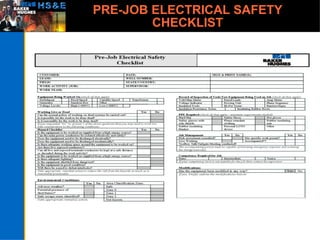
The Pre-Job Electrical Safety Check List is
completed prior to the commencement of
the job. It identifies the hazards and the
control measures to be adopted to reduce or
eliminate the hazards.
The check list may be completed by the
supervisor or by the person carrying out the
work. In either case, the person completing
the check list must have current knowledge
of the work site and experience in assessing
the hazards.
PRE-JOB ELECTRICAL SAFETY
CHECKLIST
PRE-JOB ELECTRICAL SAFETY
CHECKLIST
Safe Working Practices
 Are you qualified and trained to carry out the work?
 Plan every Job
 Use the correct tools for the job
 Ensure tools have been maintained and power leads have been
installed in a safe manner
 Report faulty tools /equipment to your supervisor
 Be aware of the “switch off” points for tools and equipment under
use
 Use appropriate personnel protective equipment
 Use tools rated at 110 volts and below. In damp areas use extra
low voltage equipment/tools (50 volts and below)
 Understand tools/equipment rating plates. Do not overload
equipment
 Is work being carried out in a classified area?
Precautions Against Electrical Hazards
 Use only tools and equipment rated for the job
 It is recommended to use a Residual Current Device (RCD) /
Ground Fault Circuit Interrupter (GFCI) when supplying portable
electrical tools/extension cords
 Do not overload equipment
 Understand the rating plates on tools and equipment – need pic of
plate and use as example to describe how to read it
 If you suspect that a person has come into contact with electricity,
isolate the power supply before touching the victim. Alternatively
remove victim from source of supply using insulated material
 Return suspect or faulty equipment for full inspection and repair
 Carry out a visual inspection on cable/plugs /sockets etc. Look for
signs of wear and/or deterioration in cable systems
Deciding to Work on Live Systems
 Our normal procedure is to work on isolated &/or
de-energized systems
 In general, working on or near live systems is not
normally permitted unless:
 The voltage is less than 50 Volts (ELV)
 It is unreasonable to work dead, and suitable
precautions are taken to prevent injury
 Live working may only proceed if all hazards have
been identified and control measures implemented
to manage the risk
Special Instructions for Intermediate &
Senior Levels
Precautions for Working Dead
 Isolate all sources of electrical energy including sources
of stored energy (capacitors etc)
 Confirm the removal of the energy with a voltage
indicator
 On High Voltage Systems use the grounding/earth stick
to ensure system is and remains discharged
 Implement Lock Out/Tag Out procedure
….only after confirmation of the above may work
commence
Precautions for Working Live
 Identify escape routes
 Remove all metal jewellery/rings/metal watches
 Wear natural fabrics under flame retardant outer
clothing
 Use temporary barriers to prevent live contact, also use
barriers to keep the working area clear of non
authorised personnel
 Ensure adequate lighting and work area is free from trip
hazards
 Use insulated and maintained tools
 Test equipment to be rated for the highest system
voltage
 Use the prescribed PPE (Personnel Protective
Equipment)
Safe Working Distances
Nominal Voltage Minimum Clear Distance (ft)
To Ground Condition 1 Condition 2 Condition 3
601 – 2500 V 3 4 5
2501 – 9000 V 4 5 6
9001 – 25,000 V 5 6 9
Condition 1 – Exposed live parts on one side and no live or grounded parts on the
other side of the working space, or exposed live parts on both sides effectively
guarded by suitable wood or insulating materials. Insulated wire or insulated bus
bars operating at not over 300 volts shall not be considered live parts.
Condition 2 – Exposed live parts on one side and grounded parts on the other
side. Concrete, brick or tile walls will be considered as grounded surfaces.
Condition 3 – Exposed live parts on both sides of the workspace (not guarded as
provided in condition 1) with the operator between.
Nominal Voltage Between Phases Elevation
601v – 7500V 8 ft 6 in.
7501 – 35,000V 9ft
Elevation of Unguarded Live
Parts Above Working Space
Accompaniment
 Where the Pre-Job Electrical Safety Checklist
identifies that conditions and hazards pose
significant risk, a second person should be used
 The accompaniment does not necessarily have to
be a Centrilift employee
 This person should be able to
 isolate energy source
 initiate emergency response
Working in Hazardous Areas
 All areas where explosive
atmospheres can occur or
are considered hazardous
areas, are divided into
zones according to the
probability of the presence
of an explosive atmosphere.
 The correct selection of
suitable tools and test
equipment must consider
the zone requirements and
the use of approved
equipment within the
particular zone. It is also
important that testing
carried out within
hazardous areas does not
give rise to an ignition
source e.g. cable insulation
testing with spark
generating tools such as a
megger.
Insert pic of guy working
With megger in gas cloud
area
Flammable gas
alwa
ys
prese
nt
>1000 hrs/year
Flammable gas
nor
mall
y
prese
nt
10-
1000
hrs/y
ear
Flammable gas not
normally
present
< 10 hrs/year
CENELEC/
IEC
Zone 0
(Zone 20 dust)
Zone 1
(Zone 21 dust)
Zone 2
(Zone 22 dust)
US - NEC 505 Zone 0 Zone 1 Zone 2
US - NEC 500 Division 1 Division 1 Division 2
Personal Protective Equipment
Minimum standard:
 Flame retardant long sleeve clothing
 Non Conductive hard hat
 Safety glasses
 Protective footwear (steel toe caps must be covered)
Additional PPE as required:
 Face Visor
 Insulating covers/mats to provide protection against
direct contact
 Hot Gloves
 Wear natural fabrics under flame retardant outer
clothing (best practice)
Tools & Test Equipment
 Multi-meters should not be used for proving circuits
dead on power systems.
 Multi-meters must have fused leads
 Voltage Indicators with fused leads are used on low and
high voltage power systems to confirm the presence of
electricity
 A Proving Unit or known low power voltage source
shall be used to verify the correct operation of the
indicator before and after use.
 Grounding/earthing stick to be used on High Voltage
Systems to ensure systems are satisfactorily
discharged
Equipment Type Purpose Calibration Other Related Information
Voltage/Current Meters Meters used to measure voltage and current levels in electrical
circuitry.
Digital / analogue multi-meters should not be used for proving
power circuits dead.
Annual Shall be correctly rated for the
system voltage to be measured.
Voltage meters shall have insulated
probes and fused leads.
Voltage Indicator A device with fuse leads used to detect the absence of voltage on
HV and LV power systems after isolation
Annual A proving unit or known voltage
source will be used to verify
the correct operation of the
indicator before and after use.
Proving Unit A known low power voltage device used for checking correct
operation of the voltage indicator.
As Required The proving unit will be used before
and after the use of the voltage
indicator.
Earthing/Grounding Stick A device used to ensure that isolated electrical systems do not
contain an electrical charge, and that such systems can be
worked upon in a safe manner.
As Required
Phase Sequence Indicator Used for identifying phase sequence of a 3 phase supply. . As Required These must only be applied to dead
circuits and then energized
Insulation Resistance /Hi-Pot
Testers
A device used for the measurement and testing of insulation
resistance.
Annual The following control measures must
be implemented. Extreme
caution should used when
using these devices due to high
voltage potentials. Meters
must have a self-discharging
function.
 Barrier area with hazard tape
to prevent unauthorized entry
into area
 Post danger notices in vicinity
 Warn all parties on site that
testing is about to commence
 Apply insulating devices to
exposed conductors
Test Equipment Standards
Meters and test equipment should be manufactured to a
specific safety standard. EN/IEC 61010-1 and
UL61010-B1 are the accepted standards. It is not
intended that equipment that does not meet these
standards is discarded. However, when ordering new
equipment, such standards should be obtained. For
tools, manufacturing to EN 60900 should be quoted
• EN/IEC 61010-1:
• UL61010-B1:
• EN 60900:
Portable Electric Tools & Cords
 Portable equipment must be handled in a manner which
will not cause damage
 Flexible electric cords connected to equipment must not
be used for raising or lowering the equipment
 Flexible cords must not be fastened with staples or
otherwise hung in such a fashion as could damage the
outer jacket or insulation
Portable Electric Tools & Cords
Visual Inspections
Portable cord and plug connected equipment and
flexible cord sets (extension cords) shall be visually
inspected before use on any shift for external defects:
 Loose parts
 Deformed or missing pins
 Damage to outer jacket or insulation
 Evidence of possible internal damage
Portable Electric Tools & Cords
If there is a defect or evidence of damage to any electrical
tools or equipment…
 Remove the item from service
 Tag it for repair
 Tell your co-workers
Other Control Measures
When carrying out testing with equipment that produces
high voltage/low power outputs the following must be
observed:
 Barrier to be erected around test area
 Danger Notices to be posted
 Inform site personnel of the test
 Ensure when test is complete, equipment and circuitry
is discharged using the instruments in-built discharge
circuitry
 Confirm the area zone classification and take
appropriate measures
Modifications
 Authorised & unauthorised modifications must be
identified and recorded
 Modifications should be considered to determine
whether or not it is safe to proceed with the task
 The Supervisor should be consulted where necessary
 Details of modifications & remedial action should be
recorded on the checklist
 Instructions are to be provided to serviceman making
modifications in the field
 Supervisor is to be responsible for the actions of the
serviceman’s modifications in the field
 Reference may be made to the BHI “Management of
Change” procedure
Portable Electric Tools & Cords
 Portable equipment must be handled in a manner which
will not cause damage.
 Flexible electric cords connected to equipment may not
be used for raising or lowering the equipment.
 Flexible cords may not be fastened with staples or
otherwise hung in such a fashion as could damage the
outer jacket or insulation.
Work Area Safety
You must be able to see what you are doing
when working on energized equipment
Do not work on energized electrical parts
 without adequate illumination
 if there is an obstruction that prevents
seeing your work area
 if you must reach blindly into areas which
may contain energized parts
Signs & Barricades
 Use safety signs, safety symbols, or accident prevention
tags to warn others about electrical hazards
 Use barricades to prevent or limit access to work areas
with un-insulated energized conductors or circuit parts
Insert pics of safety signs etc
Hazardous Work Locations
 Electric equipment & flexible cords used in
highly conductive work locations where
employees are likely to contact water or
conductive liquids, must be rated for the wet
environment (RCD/GFCI)
 Electric equipment used in areas where
flammable or explosive atmospheres are
present must be rated for these locations (i.e.
intrinsically safe, etc.)
How To Respond to an Accident
Response to Electrical Shock
 Don’t touch the person and don’t use a conductive tool to free
the person – he or she might be energized
 Shut off the power, fuse or circuit-breaker or pull the plug. This
might be difficult because there might be secondary sources. If
you are not sure, get help
 Remove the person from the contact point using a non-
conductive object such as a dry piece of wood or Safety
Evacuation Hook thingy
How To Respond to an Accident
Response to Electrical Shock
 Secure the area and keep others from
being harmed
 Do not move the injured person unless it
is absolutely necessary to do so (e.g. case
of fire)
 Give necessary first aid and CPR, if
trained to do so
 Report accidents to your supervisor (even
minor shocks and close calls must be
reported).
 Where possible, preserve the evidence to
assist in the incident investigation
Summary
 Bill grace

Field Operations Electrical Safety Training.ppt

  • 1.
  • 2.
    Objectives  Be familiarwith fundamental concepts of electricity  Be able to recognise electrical hazards  Understand the Level 3 Field Operations Electrical Safety Procedure  Understand your limitations  Know how to do your job safely so as to minimise the risks
  • 3.
    Curriculum  Introduction/Objectives  Responsibilities Basics of Electricity  Primary hazards of electricity  Centrilift Definitions  Pre-Job Electrical Safety Checklist
  • 4.
  • 5.
    BACKGROUND  It isthe policy of BHI to conduct business activities in a manner that does not harm people. Every person has a responsibility to perform their job in a safe manner.  Electrocutions rank 5th in work related fatalities (5%, based on 1996 data) about half involve low voltage, below 600 volts.  Centrilift has not had a fatality but we have had 4 to 6 serious electrical accidents/year.
  • 6.
    YOUR Responsibilities  Youare responsible for the health & safety of _______ and those around you.  You must become familiar with the requirements of the Field Ops. Electrical Safety Procedure.  You must ______ your supervisor if you encounter a task that is beyond your competence.  You must inspect, use & take appropriate care of your assigned electrical & safety equipment.  You are empowered to __________ activities when uncontrolled hazards are encountered. yourself discontinue notify
  • 7.
    RESPONSIBILITIES  Operation/Area Manager Implementation of the Level 3 Procedure  Ensure F.S. Personnel are trained and competent  Provide all required equipment (tools & test equipment)  Supervisor  Implementation of the Level 3 Procedure  Provide training and assess competency of personnel  Assign the work as outlined in the Electrical Competency Matrix (ECM)  Issue PPE  Field Service Personnel  Adhere to the Level 3 Procedure  Understand your limitations  Utilize approved PPE & Tools
  • 8.
    Water Analogy One wayto describe how electricity works is to compare it with water, since they both share common traits. Water under pressure moves at a rate of flow that depends on the resistance caused by the water pipes. Basic Principles of Electricity
  • 9.
    Electricity acts inmuch the same way. Pressure = Voltage (volts) Flow = Current (amps) Restriction of pipe = resistance (ohms) Voltage, which is electrical pressure, moves electrical current, or amperage, at a rate of flow that depends on the "impedance" or electrical resistance caused by the wires or other electrical pathways. Basic Principles of Electricity
  • 10.
    As with water,the exact relationship between pressure, flow and resistance can be calculated mathematically using a formula known as "Ohm's Law.“ It looks like this: V = I x R V = VOLTAGE (electrical pressure in Volts). I = CURRENT (Amperes or Amps) R = RESISTANCE (Ohms) Basic Principles of Electricity
  • 11.
    Conductors and Insulators Electricityflows easily through some materials and is blocked by others.  Insulators have a very high resistance to the flow of electricity and are used to cover wiring and other electrical components.  Conductors have low resistance to electricity and are used for wires, switches and electrical connections. pics of insulator & conductor Insulators such as glass, mica, rubber, or plastic used to coat metals and other conductors help stop or reduce the flow of electrical current. Basic Principles of Electricity
  • 12.
    Electrical Potential  Themagnitude of current flowing from an energy source is the source's electrical potential. Only when two unequal potentials are connected by a conductor is a circuit created.  Circuit direction is affected by the universal law which says that electricity always flows from a higher to a lower voltage potential.  Electricity may take multiple paths and it will flow through all possible circuits, but the greatest amount of current will flow through the path of least resistance. This is a key point in electrical safety since the human body is made up of water, chemicals and materials that make it an excellent conductor. Diagram/drawing Basic Principles of Electricity
  • 13.
     Bridging thegap between two different voltage levels with any part of your body results in an electrical shock.  Electrical shock is the magnitude of current flow that passes through you when you are situated in an electrical circuit. Basic Principles of Electricity
  • 14.
    Grounding One of themost important and least understood points in electrical safety is the use of grounds and other circuit protection devices. Grounding is the act of providing a previously determined safe path for stray electrical currents. A properly installed ground offers a low resistance channel of electricity to the ground. The most familiar type of ground is a lighting rod. It attracts dangerous electrical energy and conducts it harmlessly to the ground. Basic Principles of Electricity picture
  • 15.
    Since 95% ofall ground faults are caused by malfunctions of equipment and electrical systems, tool casings, machine enclosures and other conductive materials that surround electrical lines must be safely grounded. Double casings and properly installed grounding connections help keep stray current and electrical leakage from passing through any part of your body. Pic/diagram Basic Principles of Electricity
  • 16.
    System grounding protectselectrical components within the circuit from damage by excess voltage or line surges.  Bypassing grounds or careless handling of connections can result in electrical fires and other accidents that may be fatal. Basic Principles of Electricity
  • 17.
    Influential Variables. Theeffects of electric current on the human body can vary depending on the following: Source characteristics (current, frequency, and voltage of all electric energy sources). Body impedance and the current's pathway through the body. How environmental conditions affect the body's contact resistance. Duration of the contact.
  • 18.
    5 Primary Hazardsof Electricity 1. Shock  Direct Hazard  Indirect Hazard 2. Burns 3. Arc-Blast  Thermal Radiation  Pressure Wave  Projectiles 4. Explosions 5. Fires The effects of electric current on the human body can vary depending on the following: Source characteristics (current, frequency, and voltage of all electric energy sources). Body impedance and the current's pathway through the body. How environmental conditions affect the body's contact resistance. Duration of the contact.
  • 19.
    5 Primary Hazardsof Electricity (Cont.) Electric Shock Electric shock occurs when the body becomes part of a path through which electricity can flow (i. e., the circuit). The resulting effect on the body can be either direct or indirect:  Direct. Injury or death can occur whenever electric current flows through the human body. Currents of less than 30 milliamps (mA) can result in death.  Indirect. Although the electric current through the human body may be well below the values required to cause noticeable injury, human reaction can result in falls from ladders or scaffolds, or movement into operating machinery. Such reaction can result in serious injury or death.  graphic
  • 20.
    5 Primary Hazardsof Electricity Electricity flowing through the human body can shock, cause involuntary muscle reaction, paralyze muscles, burn tissues and organs, or kill. The typical effects of various electric currents flowing through the body on the average 150-lb male and 115-lb female body are given in the table.
  • 21.
    5 Primary Hazardsof Electricity Electric Shock (Continued) Delayed Effects. Damage to internal tissues may not be apparent immediately after contact with the current. Internal tissue swelling and edema are also possible. Critical Path. The critical path of electricity through the body is through the chest cavity. At levels noted in Table B-1, current flowing from one hand to the other, from a hand to the opposite foot, or from the head to either foot will pass through the chest cavity paralyzing the respiratory or heart muscles, initiating ventricular fibrillation and/or burning vital organs. Biological Effects of Electrical Hazards .
  • 22.
    5 Primary Hazardsof Electricity Electric Shock (Continued) Life-Threatening Effects. Charles F. Dalziel, "The Effects of Electric Shock on Man," , Ralph H. Lee "Human Electrical Sheet" , and others have established the following criteria for the lethal effects of electric shock:  Currents in excess of a human's "let-go" current (>16 mA at 60 Hz) passing through the chest can produce collapse, unconsciousness, asphyxia, and even death. Currents (>30 mA at 60 Hz) flowing through the nerve centers that control breathing can produce respiratory inhibition, which could last long after interruption of the current.  Cardiac arrest can be caused by a current greater than or equal to 1 A at 60 Hz flowing in the region of the heart.  Relatively high currents (0.25-1 A) can produce fatal damage to the central nervous system.  Currents greater than 5 A can produce deep body and organ burns, substantially raise body temperature, and cause immediate death.  Delayed reactions and even death can be caused by serious burns or other complications.  The most dangerous current flow via the chest cavity is through the heart when the shock occurs in the time relative to the normal heart rhythm. This current may cause ventricular fibrillation, which is defined as repeated, rapid, uncoordinated contractions of the heart ventricles. Ventricular fibrillation that alters the heart's normal rhythmic pumping action can be initiated by a current flow of 75 mA or greater for 5 seconds (5-s) or more through the chest cavity.
  • 23.
    5 Primary Hazardsof Electricity Burns Although a current may not pass through vital organs or nerve centers, internal electrical burns can still occur. These burns, which are a result of heat generated by current flowing in tissues, can be either at the skin surface or in deeper layers (muscles, bones, etc.), or both. Typically, tissues damaged from this type of electrical burn heal slowly. Burns caused by electricity may be of three types: electrical burns, arc burns, and thermal contact burns.
  • 24.
    5 Primary Hazardsof Electricity Arc-Blast  Burns caused by electric arcs are similar to burns from high- temperature sources. The temperature of an electric arc, which is in the range of 4,000-35,000°F, can melt all known materials, vaporize metal in close proximity, and burn flesh and ignite clothing at distances up to 10 ft from the arc.  Arc-blasts occur when powerful, high-amperage currents arc through the air. Arcing is the luminous electrical discharge that occurs when high voltages exist across a gap between conductors and current travels through the air.
  • 25.
    5 Primary Hazardsof Electricity Arc-Blast There are three primary hazards associated with an arc-blast.  Thermal Radiation. In most cases, the radiated thermal energy is only part of the total energy available from the arc. Numerous factors, including skin color, area of skin exposed, type of clothing have an effect on degree of injury. Proper clothing, work distances, and overcurrent protection can improve the chances of curable burns.  Pressure Wave. A high- energy arcing fault can produce a considerable pressure wave. Research has shown that a person 2 feet away from a 25,000 amp arc would experience a force of approximately 480 pounds on the front of their body. In addition, such a pressure wave can cause serious ear damage and memory loss due to mild concussions. In some instances, the pressure wave may propel the victim away from the arc- blast, reducing the exposure to the thermal energy. However, such rapid movement could also cause serious physical injury.  Projectiles. The pressure wave can propel relatively large objects over a considerable distance. In some cases, the pressure wave has sufficient force to snap the heads of 3/ 8- inch steel bolts and knock over ordinary construction walls. The high- energy arc also causes many of the copper and aluminum components in the electrical equipment to become molten. These "droplets" of molten metal can be propelled great distances by the pressure wave. Although these droplets cool rapidly, they can still be above temperatures capable of causing serious burns or igniting ordinary clothing at distances of 10 feet or more. In many cases, the burning effect is much worse than the injury from shrapnel effects of the droplets.
  • 26.
    5 Primary Hazardsof Electricity Explosions Explosions occur when electricity provides a source of ignition for an explosive mixture in the atmosphere. Explosive atmospheres can result from the accumulation of flammable vapors or gases generated by nearby sources and processes. Ignition can be due to overheated conductors or equipment, or normal arcing (sparking) at switch contacts animated pic
  • 27.
    5 Primary Hazardsof Electricity Fires Electricity is one of the most common causes of fire both in the home and workplace. Defective or misused electrical equipment is a major cause, with high resistance connections being one of the primary sources of ignition. High resistance connections occur where wires are improperly spliced or connected to other components such as receptacle outlets and switches. Shauna - pic
  • 28.
    DEFINITIONS  Electrical CapabilityMatrix (ECM) - categorises the types of work that individuals are permitted to undertake based upon a combination of the following:  Type of Equipment  Voltage Levels  Experience and training Electrical Capability Matrix Entry Voltages Low High Low High Switchboards inc. Switchgear Installation S U S U U Commissioning - U* S U* A Decommissioning - U* S U* A Operation - U S U U Troubleshoot - U* S U* A Variable Speed Controllers Installation S U S U U Commissioning - U* S U* A Decommissioning - U* S U* A Operation - U* S U* U Troubleshoot - U* S U* A Transformers Installation S U S U U Commissioning - U* S U* A Decommissioning - U* S U* A Operation - U* S U* U Troubleshoot - U* S U* A Junction boxes Installation S U S U U Commissioning - U* S U* A Decommissioning - U* S U* A Operation - U* S U* U Troubleshoot - U* S U* A Cable testing Insulation (Megger) T, S U S U U High Potential Test (Hi-pot) T, S U S U U Time Domain Reflectometry (TDR) T, S U S U U Continuity T, S U S U U Power Supplies Energised - U* S U* A De-energised - U* S U* A Auxilliary equipment Operation of spooler T, S U S U N/A Fault finding on spooler - U* S U* N/A Operation of workshack T, S U S U N/A Fault finding within workshack - U* S U* N/A U Without supervison U* Without supervison but may require an accompaniment A Without supervison but with an accompaniment S Supervised by an appropriate competent person T Unaccompanied if certified trained Senior Intermediate
  • 29.
    DEFINITIONS ENTRY LEVEL – No live work and not permitted to repair, maintain or fault find on electrical equipment  Personnel assigned to this level would not normally have previous training or experience with electrical equipment  Given specific training you will be authorized in the use of high voltage / low power test equipment (i.e., megger/Hi- pot)
  • 30.
    DEFINITIONS INTERMEDIATE LEVEL – Personnel who have had experience and training on low voltage electrical power systems  Personnel assigned to this level are authorized to work on live low voltage systems (below 600V)
  • 31.
    DEFINITIONS SENIOR LEVEL – Will have as a minimum the training & experience required for that of the Intermediate Level, and in addition:  Relevant training/experience of working on high voltage power systems  This person may also assess competency for Entry & Intermediate Levels • Working on power systems exceeding 6kV may only occur under exceptional circumstances and requires written authorization from the relevant manager
  • 32.
    DEFINITIONS  Diagram tonegate the need for written definitions  Electrical System – A system which is, or may be, connected to a source of electrical energy.  Electrical Equipment – Equipment that uses, generates or contains electrical energy  Electrical Isolation – Secure disconnection and separation of electrical equipment from every source of electrical energy.  Energized (Live) – Electrical conductors, buses, terminals or components which are connected to a source of electrical energy.
  • 33.
    DEFINITIONS  De-Energized (Dead)– Free from any electrical connection to a source of electrical charge.  Earthed (Grounded) – Connected to the general mass of earth
  • 34.
    DEFINITIONS  Lock Outand Tag Out (LOTO) – The placement of a safety lock and employee danger tag on an energy isolating device in the safe position indicating the energy isolating device shall not be operated or moved until the lock and tag have been cleared  Competency - Personnel shall have sufficient technical knowledge and experience to carry out work in a safe and efficient manner
  • 35.
    DEFINITIONS  Accompaniment –A additional person who is present at the work location to provide any emergency response that may be required when the pre-job electrical safety checklist indicates a requirement for accompaniment.  Instructed how to isolate power  How to notify/summon emergency response personnel  Administer First Aid/CPR if properly trained
  • 36.
    PRE-JOB ELECTRICAL SAFETY CHECKLIST ThePre-Job Electrical Safety Check List is completed prior to the commencement of the job. It identifies the hazards and the control measures to be adopted to reduce or eliminate the hazards. The check list may be completed by the supervisor or by the person carrying out the work. In either case, the person completing the check list must have current knowledge of the work site and experience in assessing the hazards.
  • 37.
  • 38.
  • 39.
    Safe Working Practices Are you qualified and trained to carry out the work?  Plan every Job  Use the correct tools for the job  Ensure tools have been maintained and power leads have been installed in a safe manner  Report faulty tools /equipment to your supervisor  Be aware of the “switch off” points for tools and equipment under use  Use appropriate personnel protective equipment  Use tools rated at 110 volts and below. In damp areas use extra low voltage equipment/tools (50 volts and below)  Understand tools/equipment rating plates. Do not overload equipment  Is work being carried out in a classified area?
  • 40.
    Precautions Against ElectricalHazards  Use only tools and equipment rated for the job  It is recommended to use a Residual Current Device (RCD) / Ground Fault Circuit Interrupter (GFCI) when supplying portable electrical tools/extension cords  Do not overload equipment  Understand the rating plates on tools and equipment – need pic of plate and use as example to describe how to read it  If you suspect that a person has come into contact with electricity, isolate the power supply before touching the victim. Alternatively remove victim from source of supply using insulated material  Return suspect or faulty equipment for full inspection and repair  Carry out a visual inspection on cable/plugs /sockets etc. Look for signs of wear and/or deterioration in cable systems
  • 41.
    Deciding to Workon Live Systems  Our normal procedure is to work on isolated &/or de-energized systems  In general, working on or near live systems is not normally permitted unless:  The voltage is less than 50 Volts (ELV)  It is unreasonable to work dead, and suitable precautions are taken to prevent injury  Live working may only proceed if all hazards have been identified and control measures implemented to manage the risk
  • 42.
    Special Instructions forIntermediate & Senior Levels
  • 43.
    Precautions for WorkingDead  Isolate all sources of electrical energy including sources of stored energy (capacitors etc)  Confirm the removal of the energy with a voltage indicator  On High Voltage Systems use the grounding/earth stick to ensure system is and remains discharged  Implement Lock Out/Tag Out procedure ….only after confirmation of the above may work commence
  • 44.
    Precautions for WorkingLive  Identify escape routes  Remove all metal jewellery/rings/metal watches  Wear natural fabrics under flame retardant outer clothing  Use temporary barriers to prevent live contact, also use barriers to keep the working area clear of non authorised personnel  Ensure adequate lighting and work area is free from trip hazards  Use insulated and maintained tools  Test equipment to be rated for the highest system voltage  Use the prescribed PPE (Personnel Protective Equipment)
  • 45.
    Safe Working Distances NominalVoltage Minimum Clear Distance (ft) To Ground Condition 1 Condition 2 Condition 3 601 – 2500 V 3 4 5 2501 – 9000 V 4 5 6 9001 – 25,000 V 5 6 9 Condition 1 – Exposed live parts on one side and no live or grounded parts on the other side of the working space, or exposed live parts on both sides effectively guarded by suitable wood or insulating materials. Insulated wire or insulated bus bars operating at not over 300 volts shall not be considered live parts. Condition 2 – Exposed live parts on one side and grounded parts on the other side. Concrete, brick or tile walls will be considered as grounded surfaces. Condition 3 – Exposed live parts on both sides of the workspace (not guarded as provided in condition 1) with the operator between. Nominal Voltage Between Phases Elevation 601v – 7500V 8 ft 6 in. 7501 – 35,000V 9ft Elevation of Unguarded Live Parts Above Working Space
  • 46.
    Accompaniment  Where thePre-Job Electrical Safety Checklist identifies that conditions and hazards pose significant risk, a second person should be used  The accompaniment does not necessarily have to be a Centrilift employee  This person should be able to  isolate energy source  initiate emergency response
  • 47.
    Working in HazardousAreas  All areas where explosive atmospheres can occur or are considered hazardous areas, are divided into zones according to the probability of the presence of an explosive atmosphere.  The correct selection of suitable tools and test equipment must consider the zone requirements and the use of approved equipment within the particular zone. It is also important that testing carried out within hazardous areas does not give rise to an ignition source e.g. cable insulation testing with spark generating tools such as a megger. Insert pic of guy working With megger in gas cloud area Flammable gas alwa ys prese nt >1000 hrs/year Flammable gas nor mall y prese nt 10- 1000 hrs/y ear Flammable gas not normally present < 10 hrs/year CENELEC/ IEC Zone 0 (Zone 20 dust) Zone 1 (Zone 21 dust) Zone 2 (Zone 22 dust) US - NEC 505 Zone 0 Zone 1 Zone 2 US - NEC 500 Division 1 Division 1 Division 2
  • 48.
    Personal Protective Equipment Minimumstandard:  Flame retardant long sleeve clothing  Non Conductive hard hat  Safety glasses  Protective footwear (steel toe caps must be covered) Additional PPE as required:  Face Visor  Insulating covers/mats to provide protection against direct contact  Hot Gloves  Wear natural fabrics under flame retardant outer clothing (best practice)
  • 49.
    Tools & TestEquipment  Multi-meters should not be used for proving circuits dead on power systems.  Multi-meters must have fused leads  Voltage Indicators with fused leads are used on low and high voltage power systems to confirm the presence of electricity  A Proving Unit or known low power voltage source shall be used to verify the correct operation of the indicator before and after use.  Grounding/earthing stick to be used on High Voltage Systems to ensure systems are satisfactorily discharged
  • 50.
    Equipment Type PurposeCalibration Other Related Information Voltage/Current Meters Meters used to measure voltage and current levels in electrical circuitry. Digital / analogue multi-meters should not be used for proving power circuits dead. Annual Shall be correctly rated for the system voltage to be measured. Voltage meters shall have insulated probes and fused leads. Voltage Indicator A device with fuse leads used to detect the absence of voltage on HV and LV power systems after isolation Annual A proving unit or known voltage source will be used to verify the correct operation of the indicator before and after use. Proving Unit A known low power voltage device used for checking correct operation of the voltage indicator. As Required The proving unit will be used before and after the use of the voltage indicator. Earthing/Grounding Stick A device used to ensure that isolated electrical systems do not contain an electrical charge, and that such systems can be worked upon in a safe manner. As Required Phase Sequence Indicator Used for identifying phase sequence of a 3 phase supply. . As Required These must only be applied to dead circuits and then energized Insulation Resistance /Hi-Pot Testers A device used for the measurement and testing of insulation resistance. Annual The following control measures must be implemented. Extreme caution should used when using these devices due to high voltage potentials. Meters must have a self-discharging function.  Barrier area with hazard tape to prevent unauthorized entry into area  Post danger notices in vicinity  Warn all parties on site that testing is about to commence  Apply insulating devices to exposed conductors
  • 51.
    Test Equipment Standards Metersand test equipment should be manufactured to a specific safety standard. EN/IEC 61010-1 and UL61010-B1 are the accepted standards. It is not intended that equipment that does not meet these standards is discarded. However, when ordering new equipment, such standards should be obtained. For tools, manufacturing to EN 60900 should be quoted • EN/IEC 61010-1: • UL61010-B1: • EN 60900:
  • 52.
    Portable Electric Tools& Cords  Portable equipment must be handled in a manner which will not cause damage  Flexible electric cords connected to equipment must not be used for raising or lowering the equipment  Flexible cords must not be fastened with staples or otherwise hung in such a fashion as could damage the outer jacket or insulation
  • 53.
    Portable Electric Tools& Cords Visual Inspections Portable cord and plug connected equipment and flexible cord sets (extension cords) shall be visually inspected before use on any shift for external defects:  Loose parts  Deformed or missing pins  Damage to outer jacket or insulation  Evidence of possible internal damage
  • 54.
    Portable Electric Tools& Cords If there is a defect or evidence of damage to any electrical tools or equipment…  Remove the item from service  Tag it for repair  Tell your co-workers
  • 55.
    Other Control Measures Whencarrying out testing with equipment that produces high voltage/low power outputs the following must be observed:  Barrier to be erected around test area  Danger Notices to be posted  Inform site personnel of the test  Ensure when test is complete, equipment and circuitry is discharged using the instruments in-built discharge circuitry  Confirm the area zone classification and take appropriate measures
  • 56.
    Modifications  Authorised &unauthorised modifications must be identified and recorded  Modifications should be considered to determine whether or not it is safe to proceed with the task  The Supervisor should be consulted where necessary  Details of modifications & remedial action should be recorded on the checklist  Instructions are to be provided to serviceman making modifications in the field  Supervisor is to be responsible for the actions of the serviceman’s modifications in the field  Reference may be made to the BHI “Management of Change” procedure
  • 57.
    Portable Electric Tools& Cords  Portable equipment must be handled in a manner which will not cause damage.  Flexible electric cords connected to equipment may not be used for raising or lowering the equipment.  Flexible cords may not be fastened with staples or otherwise hung in such a fashion as could damage the outer jacket or insulation.
  • 58.
    Work Area Safety Youmust be able to see what you are doing when working on energized equipment Do not work on energized electrical parts  without adequate illumination  if there is an obstruction that prevents seeing your work area  if you must reach blindly into areas which may contain energized parts
  • 59.
    Signs & Barricades Use safety signs, safety symbols, or accident prevention tags to warn others about electrical hazards  Use barricades to prevent or limit access to work areas with un-insulated energized conductors or circuit parts Insert pics of safety signs etc
  • 60.
    Hazardous Work Locations Electric equipment & flexible cords used in highly conductive work locations where employees are likely to contact water or conductive liquids, must be rated for the wet environment (RCD/GFCI)  Electric equipment used in areas where flammable or explosive atmospheres are present must be rated for these locations (i.e. intrinsically safe, etc.)
  • 61.
    How To Respondto an Accident Response to Electrical Shock  Don’t touch the person and don’t use a conductive tool to free the person – he or she might be energized  Shut off the power, fuse or circuit-breaker or pull the plug. This might be difficult because there might be secondary sources. If you are not sure, get help  Remove the person from the contact point using a non- conductive object such as a dry piece of wood or Safety Evacuation Hook thingy
  • 62.
    How To Respondto an Accident Response to Electrical Shock  Secure the area and keep others from being harmed  Do not move the injured person unless it is absolutely necessary to do so (e.g. case of fire)  Give necessary first aid and CPR, if trained to do so  Report accidents to your supervisor (even minor shocks and close calls must be reported).  Where possible, preserve the evidence to assist in the incident investigation
  • 63.